Pearson Edexcel · GCSE · Design and Technology
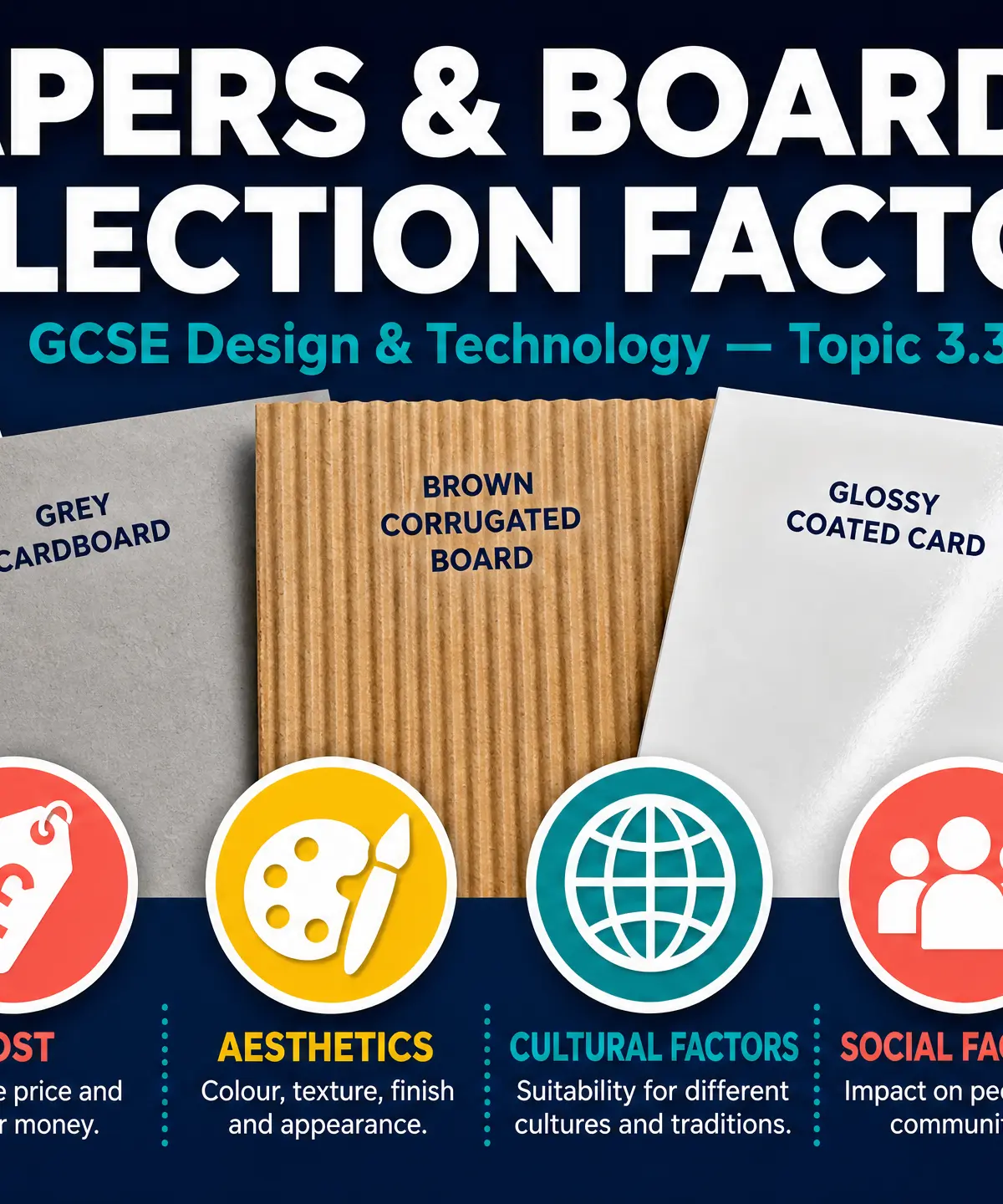
Papers and Boards: The way in which the selection of papers and boards is influenced
This topic covers the critical decision-making process designers use when selecting papers and boards. Understanding the six key influencing factors—Aesthetic, Environmental, Availability, Cost, Social, and Cultural/Ethical—is essential for both the written exam and practical coursework decisions.
- 7 min read
- 3 worked examples
- 3 practice questions
- 6 key terms
Study Notes
Overview
In GCSE Design and Technology, understanding materials is only half the battle. Examiners want to see that you understand why a designer chooses a specific material for a specific product. When it comes to papers and boards (Topic 3.3), this decision is rarely based on just one thing. Designers must balance competing demands—such as the desire for a premium look versus the need for environmental sustainability.
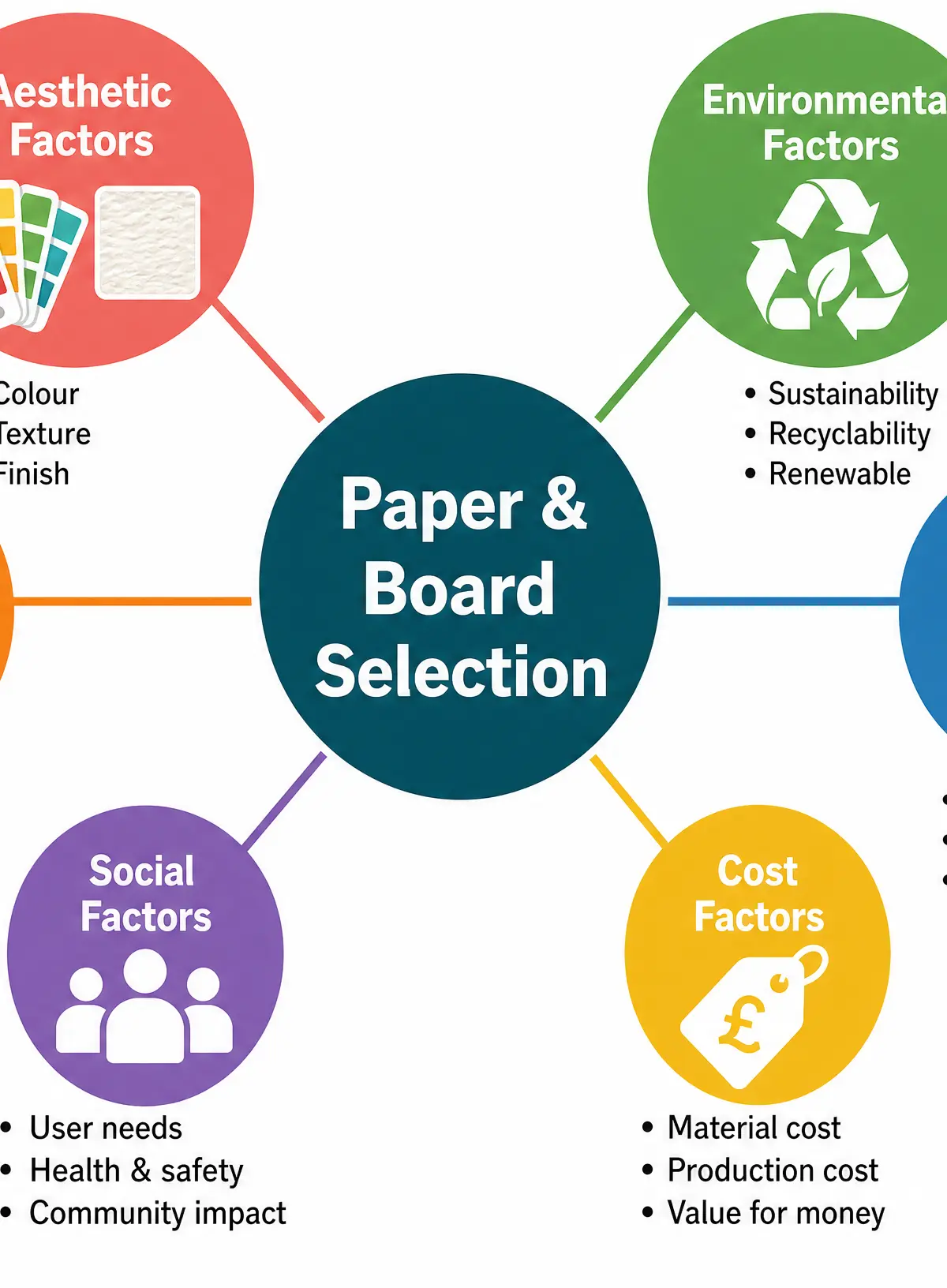
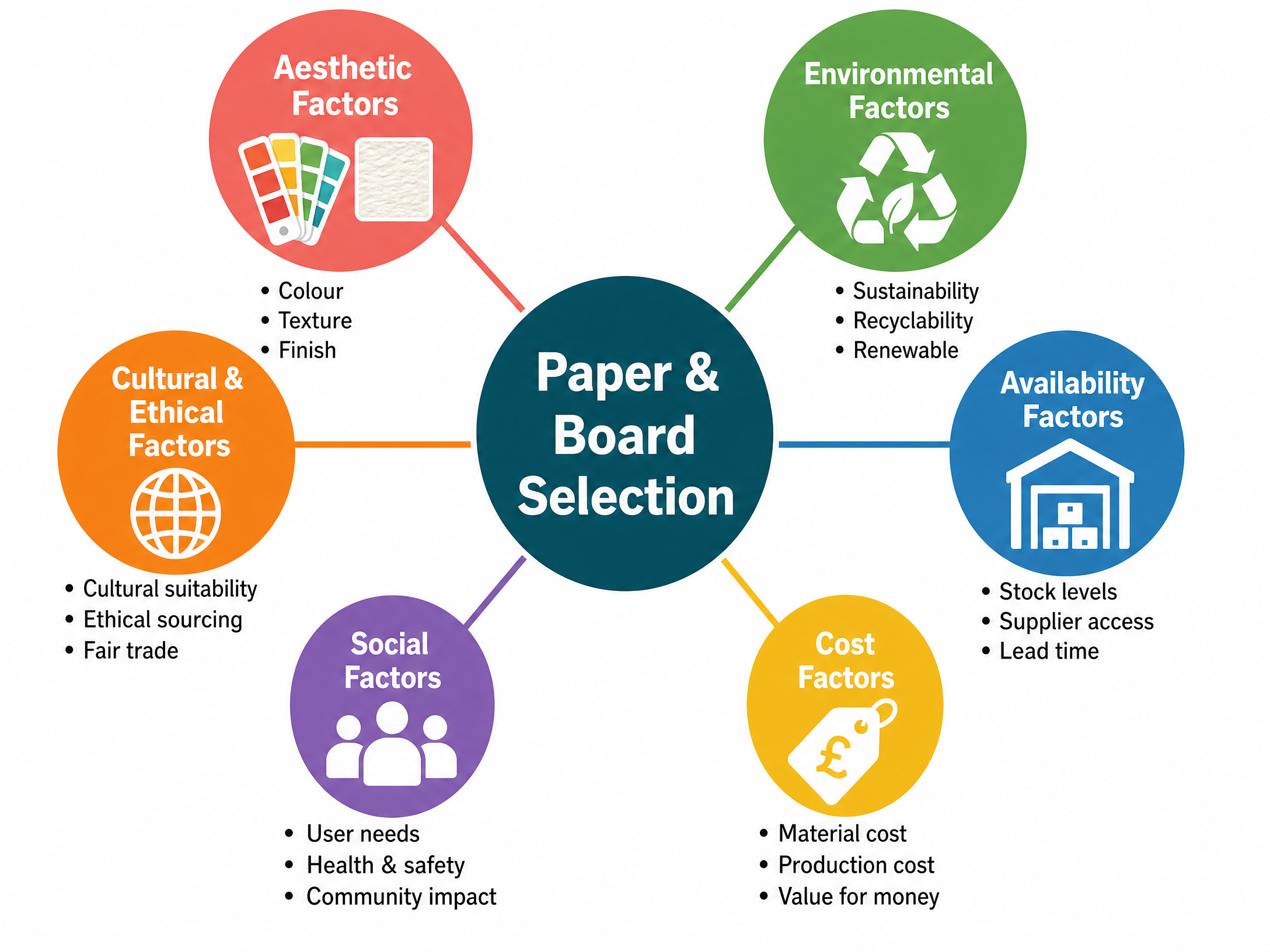
There are six key categories of factors that influence the selection of papers and boards. You must be able to explain these factors, apply them to given product contexts in the exam, and use them to justify your own material choices in your Non-Exam Assessment (NEA) coursework.
Key Knowledge & Theory
The Six Selection Factors
1. Aesthetic Factors
Aesthetics refers to the visual and tactile qualities of a material—how it looks and feels. When selecting papers and boards, designers consider:
- Form and Finish: Does the product require a glossy, matte, or soft-touch finish? Solid white board is often chosen for high-end cosmetics because its smooth surface allows for vibrant, high-quality printing.
- Colour: The base colour of the board affects the printed graphics. Unbleached kraft board has a brown colour that mutes printed inks but communicates a natural, rustic aesthetic.
- Texture: The physical feel of the material. A textured watercolour paper feels artisanal, while a highly calendered layout paper feels smooth and precise.
2. Environmental Factors
Examiners frequently test this area due to the growing importance of sustainable design.
- Sustainability: Is the paper sourced from managed forests? Look for FSC (Forest Stewardship Council) certification. Is the material renewable?
- Pollution and Processing: The bleaching processes used to create bright white papers can release harmful chemicals into water systems. Some designers opt for unbleached alternatives to reduce this impact.
- End of Life: Can the board be easily recycled? Boards laminated with plastic film (like some sandwich cartons) are notoriously difficult to recycle because the layers must be separated.
- Genetic Engineering: An emerging area in the specification. Research into genetically modifying trees to grow faster or produce stronger fibres could change the environmental impact of paper production.
3. Availability Factors
Practical constraints often dictate material choice.
- Stock Materials: Standard sizes, weights, and types of paper (e.g., A4 cartridge paper, standard corrugated board) are readily available from multiple suppliers. They have short lead times and are reliable for mass production.
- Specialist Materials: Custom colours, unique textures, or specific functional coatings (like foil-lined boards) may need to be specially manufactured or imported. This increases lead times and can disrupt production schedules if supply chain issues occur.
4. Cost Factors
Cost is rarely just the purchase price of the raw material.
- Material Quality: Higher GSM (grams per square metre) and specialist coatings increase the cost per sheet.
- Manufacturing Processes: Some boards require specialist, expensive machinery to cut, crease, or print on effectively.
- Decorative Techniques: Adding foil blocking, embossing, or UV spot varnishing significantly increases the unit cost.
- Commodity Prices: The global price of wood pulp fluctuates, affecting the cost of virgin paper.
- Recycling Economics: Sometimes, producing recycled board is actually more expensive than producing virgin board due to the complex sorting, de-inking, and repulping processes required.
5. Social Factors
Designers must consider the target market and societal trends.
- Target Demographic: A product aimed at children might use brightly coloured, robust duplex board, while a product for professionals might use a heavy, minimalist greyboard.
- Trends and Fashion: There is currently a strong social trend towards "eco-minimalism." Brands are responding by using unbleached, recycled-looking boards with minimal ink to appeal to environmentally conscious consumers.
6. Cultural and Ethical Factors
These factors deal with the broader impact of the product on society and global communities.
- Cultural Suitability: Colours and symbols have different meanings in different cultures. For example, white is associated with mourning in some East Asian cultures, so a designer must be careful when selecting white packaging for global export.
- The Consumer Society and Mass Production: The rapid consumption and disposal of packaged goods puts immense strain on natural resources. Designers have an ethical responsibility to minimise material use.
- Built-in Obsolescence: Designing products (or packaging) with an intentionally short lifespan to encourage repeat purchases. In the context of papers and boards, this often manifests as single-use, non-recyclable packaging that forces the consumer to throw it away immediately.
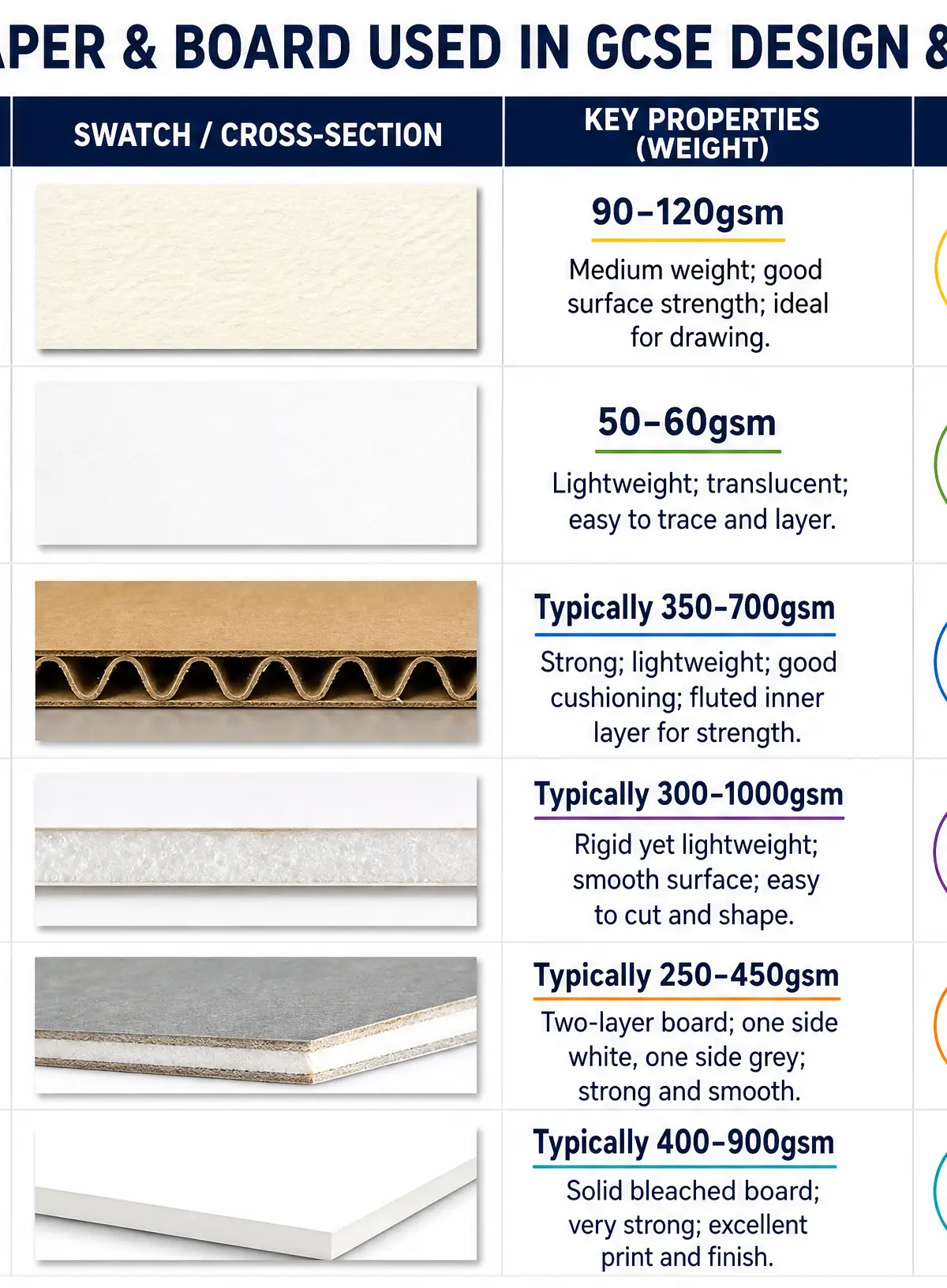
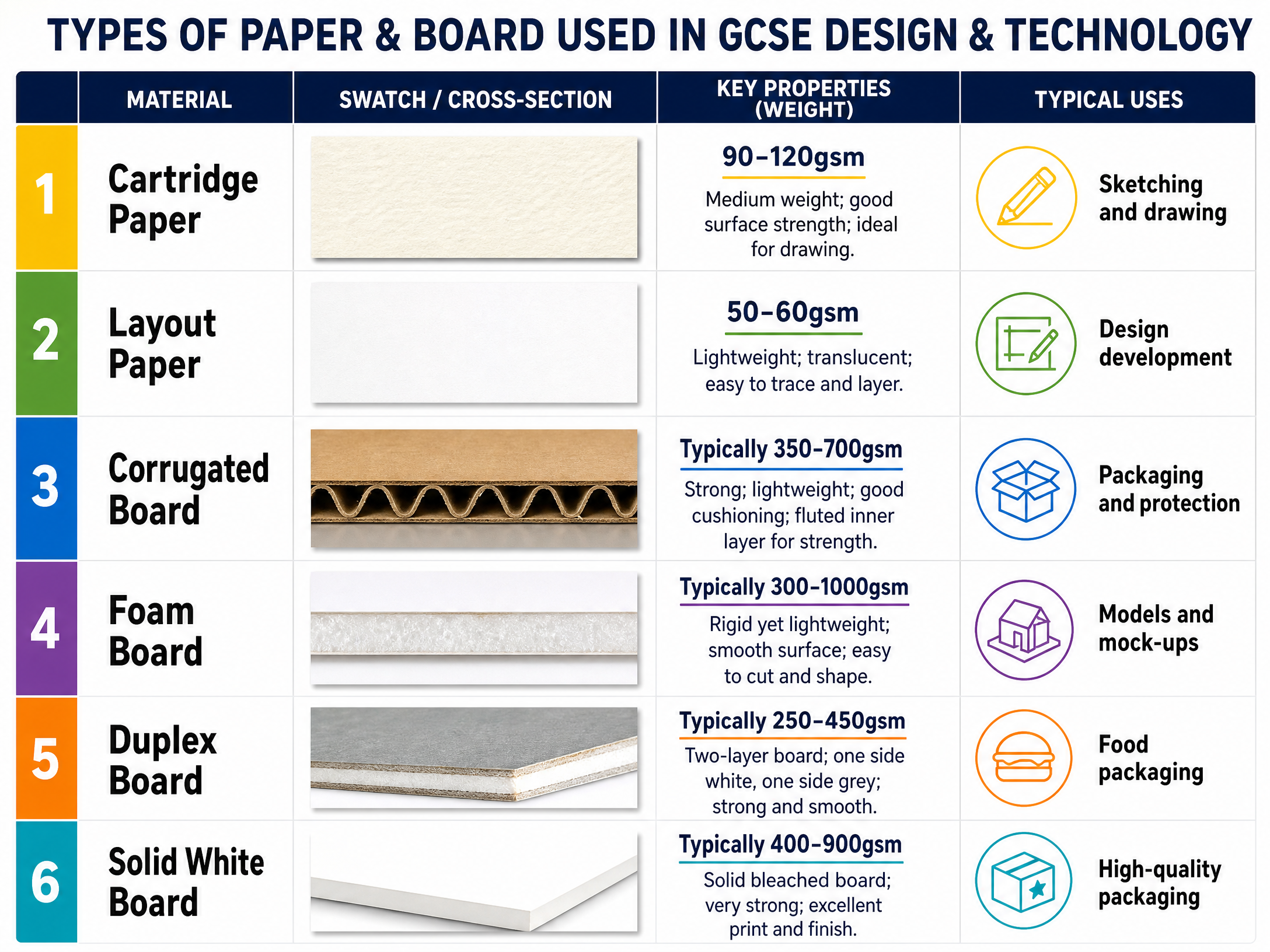
Material Types Comparison
Practical Skills & Portfolio Guidance
Applying Selection Factors in Your NEA
In your Non-Exam Assessment (coursework), you will be awarded marks for how well you justify your material choices.
- Don't just list materials: Saying "I used corrugated board because it is strong" is too basic.
- Use the six factors to justify: "I selected a 400gsm corrugated board for my prototype packaging. Aesthetically, the brown fluting fits the rustic brand identity of my client. Environmentally, it is made from 100% recycled pulp and is fully recyclable. From a cost perspective, it is a standard stock material, making it highly cost-effective for mass production."
Revision Podcast
Listen to this 10-minute audio guide for a deep dive into the selection factors, complete with exam tips and a quick-fire recall quiz.

Exam Component
Written Exam Knowledge
In the written paper, questions on this topic typically fall into two categories:
- Short answer (1-3 marks): Identifying a factor or giving a brief definition (e.g., "State two environmental factors a designer should consider...").
- Extended response (6-8 marks): Evaluating the suitability of a specific material for a given product context. These questions require you to balance competing factors (e.g., cost vs. aesthetics).
Command Word Strategies
- Identify/State: Just give the name of the factor. No explanation needed.
- Explain: Give the factor AND a reason why it matters. (e.g., "Cost [1 mark] because the product is a low-budget item aimed at teenagers [1 mark].")
- Evaluate/Discuss: You must look at multiple sides. Give advantages and disadvantages. Compare different factors (e.g., "While the aesthetic of the foil-lined board is excellent, the environmental impact is poor because it cannot be easily recycled.")
Visual Resources
2 diagrams and illustrations
Interactive Diagrams
1 interactive diagram to visualise key concepts
Conceptual Flow Outline
Decision-making flowchart for board selection
Worked Examples
3 worked examples — open one to explore the question and available guidance.
Practice Questions
Test your understanding — click to reveal model answers
Identify two availability factors a designer must consider when selecting a material. (2 marks)
Hint: Think about where the material comes from and how quickly you can get it.
Explain how social factors might influence the choice of board for a new brand of children's toys. (3 marks)
Hint: Who is the target market, and what trends appeal to them or their parents?
A fast-food chain is redesigning its takeaway burger boxes. Evaluate the use of corrugated board versus solid white board for this product, considering cost, aesthetics, and environmental factors. (8 marks)
Hint: You need to compare the two materials directly across all three specified factors. Give a final judgement.