Pearson Edexcel · GCSE · Design and Technology
Polymers: Alternative processes that can be used to manufacture polymer products to different scales of production
This topic explores the core manufacturing processes used to shape polymers, from bespoke one-off production to continuous automated systems. Understanding how material properties dictate process selection and how scale impacts unit cost is essential for both your NEA portfolio and written exam success.
- 9 min read
- 3 worked examples
- 3 practice questions
- 6 key terms
Study Notes
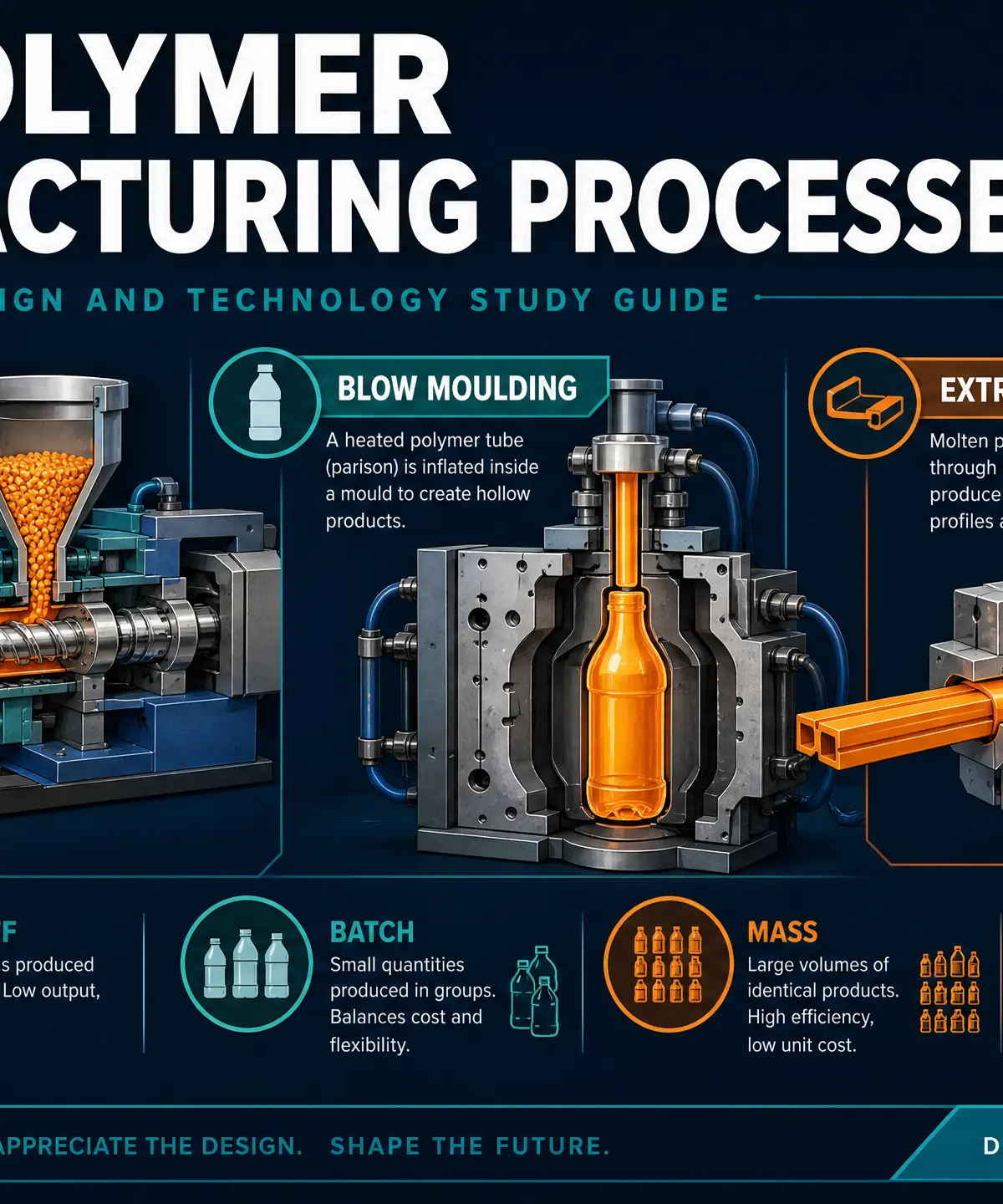
Overview
Manufacturing processes transform raw polymers into finished products. In Design and Technology, understanding how a product is made is just as important as knowing what it is made of. The choice of manufacturing process is dictated by three critical factors: the properties of the polymer (thermoplastic vs. thermosetting), the required scale of production (how many items you need), and the complexity of the product's shape.
Examiners consistently test your ability to link a specific process to a suitable scale of production and justify why that choice is economically and technically viable.
Key Knowledge & Theory
Core Concepts: The Six Key Processes
You must be able to describe and justify the use of six distinct polymer manufacturing processes.
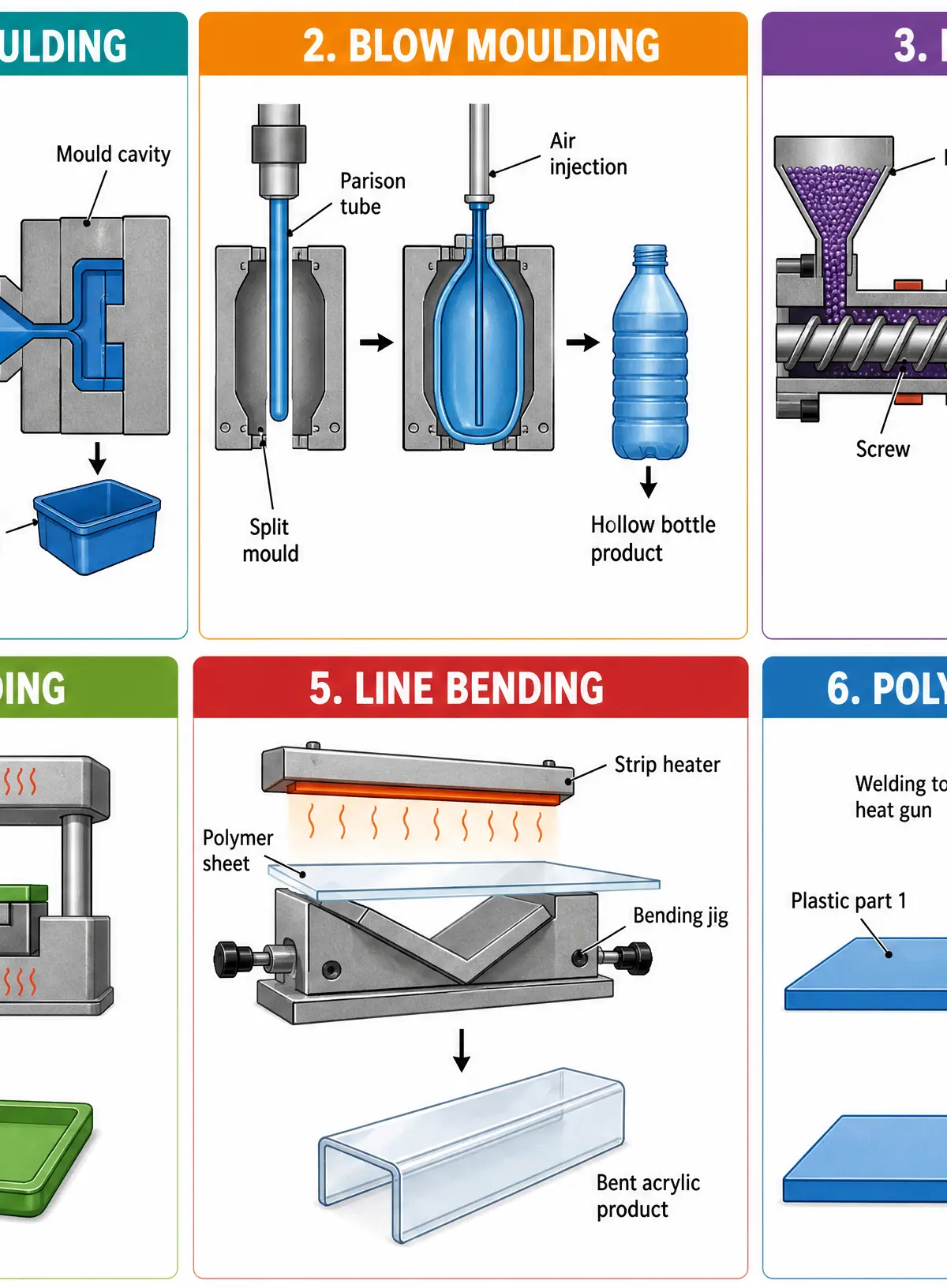
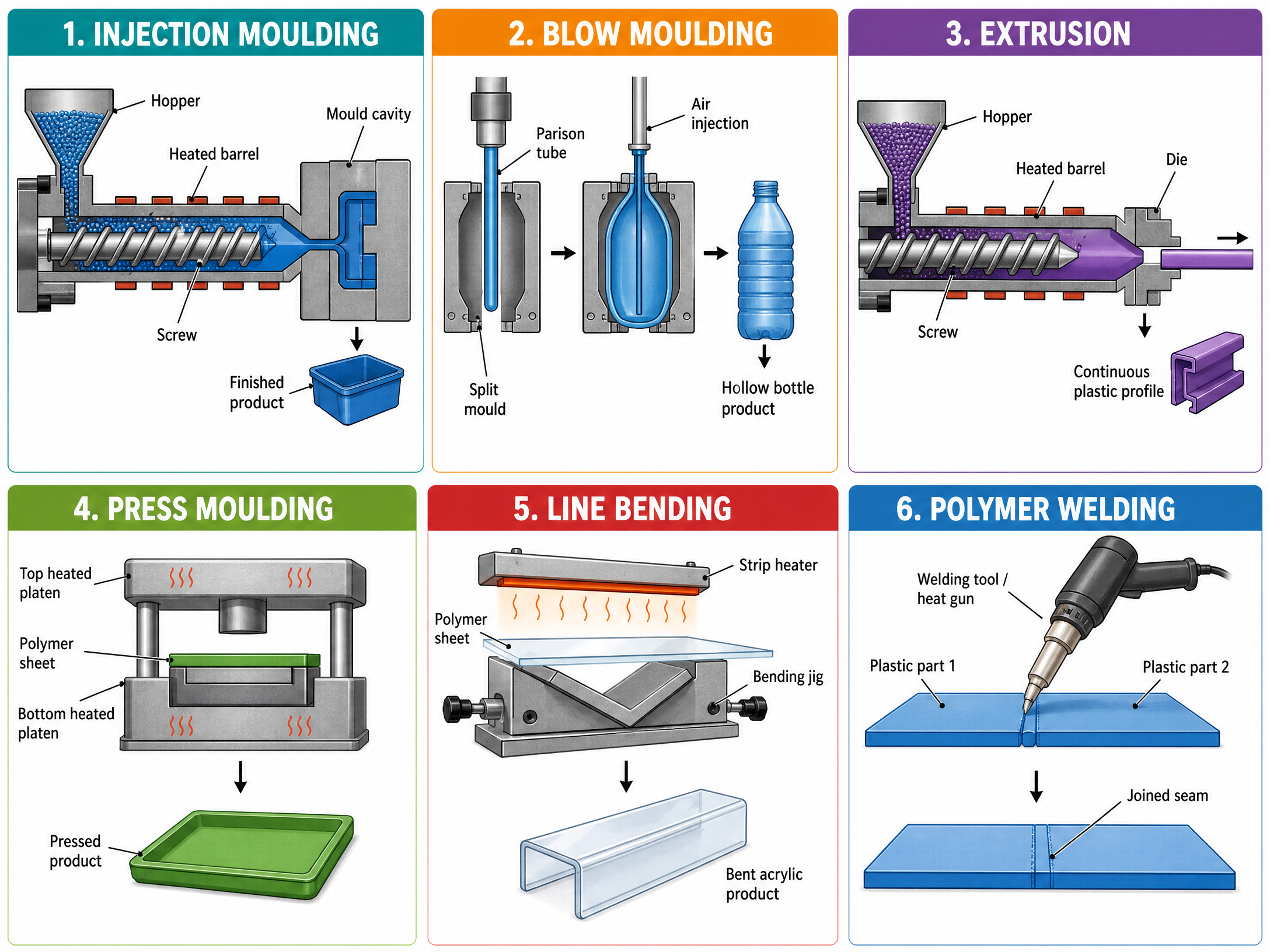
1. Injection Moulding
- How it works: Polymer granules are fed from a hopper into a heated barrel. A rotating Archimedean screw melts and forces the molten polymer forward. A hydraulic ram then injects the molten plastic under extremely high pressure into a precisely machined, split steel mould cavity. The plastic cools rapidly against the cold metal, the mould opens, and ejector pins push the solid part out.
- Material: Thermoplastics (e.g., ABS, Polypropylene, Polystyrene).
- Applications: Complex, highly detailed 3D forms like casing for electronics, Lego bricks, bottle caps, and plastic chairs.
- Scale: Mass production. The initial tooling (mould making) is exceptionally expensive, but the unit cost becomes incredibly low when producing millions of identical parts.
2. Blow Moulding
- How it works: A hollow tube of softened thermoplastic, called a parison, is extruded vertically downwards. A split mould closes around the parison, pinching the bottom shut. Compressed air is then injected into the top of the parison, inflating it like a balloon until it presses against the cold inner walls of the mould. It cools, sets, and is ejected.
- Material: Thermoplastics (e.g., PET, HDPE).
- Applications: Hollow products with narrow necks, such as water bottles, shampoo containers, and traffic cones.
- Scale: Mass production. High setup costs, very low unit cost.
3. Extrusion
- How it works: Similar to injection moulding, granules are melted in a heated barrel by a rotating screw. However, instead of being injected into a closed mould, the molten polymer is continuously forced out through a shaped hole called a die. This produces a continuous profile matching the shape of the die. The extruded plastic is then pulled through a cooling water bath and cut to length.
- Material: Thermoplastics (e.g., PVC, Polyethylene).
- Applications: Products with a continuous cross-section: plastic pipes, window frames, curtain tracks, and 3D printer filament.
- Scale: Continuous production. The machines run 24/7 to maximise efficiency.
4. Press Moulding (Compression Moulding)
- How it works: A pre-weighed amount of polymer (often a powder or pre-formed 'slug') is placed into the heated lower half of a mould. The heated upper half (the force) is pressed down under massive hydraulic pressure. The heat and pressure cause the polymer to flow and fill the cavity, while simultaneously triggering a chemical reaction that permanently cures (sets) the plastic.
- Material: Thermosetting polymers (e.g., Urea Formaldehyde, Melamine Formaldehyde).
- Applications: Products requiring high heat resistance and electrical insulation: plug sockets, light switches, saucepan handles.
- Scale: Batch or Mass production. Crucially, the waste cannot be recycled because thermosets cannot be remelted.
5. Line Bending
- How it works: A strip heater containing a heating element is used to apply intense, localised heat along a narrow line on a sheet of thermoplastic. Once the plastic softens along this line, it is bent to the required angle (often using a wooden or metal jig for accuracy) and held in place until it cools and regains its rigidity.
- Material: Thermoplastic sheet (e.g., Acrylic/PMMA, HIPS).
- Applications: Point-of-sale displays, menu holders, simple protective guards.
- Scale: One-off or Batch production. It is a slow, manual process requiring very cheap equipment.
6. Polymer Welding
- How it works: Joining two pieces of thermoplastic by applying heat to melt the joining surfaces, often adding a filler rod of the same material, and allowing them to fuse together as they cool. Methods include hot gas welding, ultrasonic welding, and friction welding.
- Material: Thermoplastics (e.g., PVC, Polypropylene).
- Applications: Joining chemical tanks, plastic pipework systems, and car bumpers.
- Scale: Batch or Mass production (when automated).
Technical Vocabulary
- Parison: The extruded hollow tube of hot plastic used in blow moulding.
- Die: The shaped metal block that molten plastic is forced through in extrusion.
- Hopper: The funnel that feeds polymer granules into a machine.
- Thermosetting: A polymer that undergoes a chemical change when heated and pressed, setting permanently. It cannot be remelted.
- Thermoplastic: A polymer that softens when heated and hardens when cooled. It can be reheated and reshaped multiple times, making it recyclable.
- Draft Angle: A slight taper on the sides of a mould to allow the plastic part to be easily ejected.
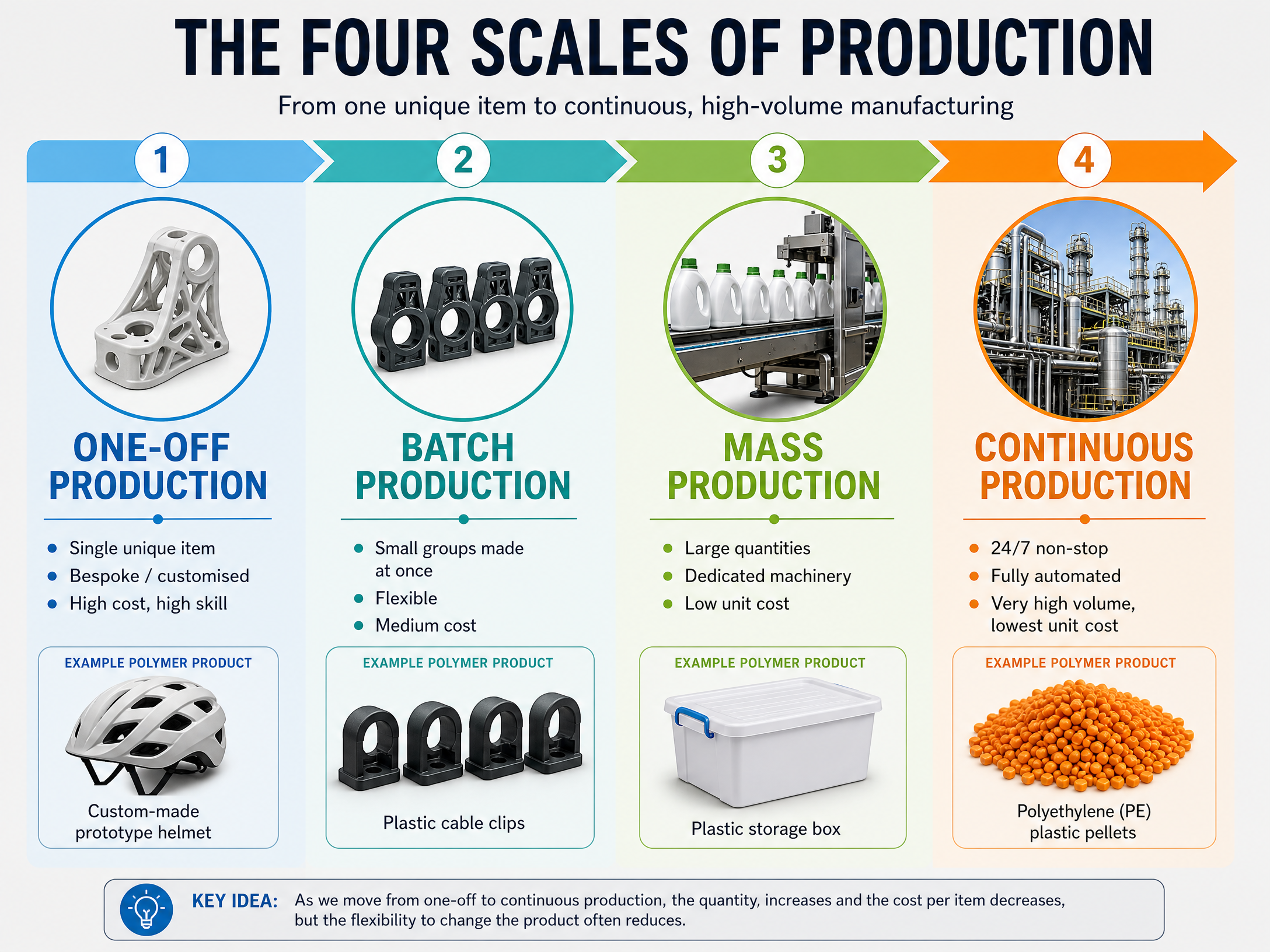
Scales of Production
Examiners expect you to link the manufacturing process to the correct scale of production and understand the economic implications.
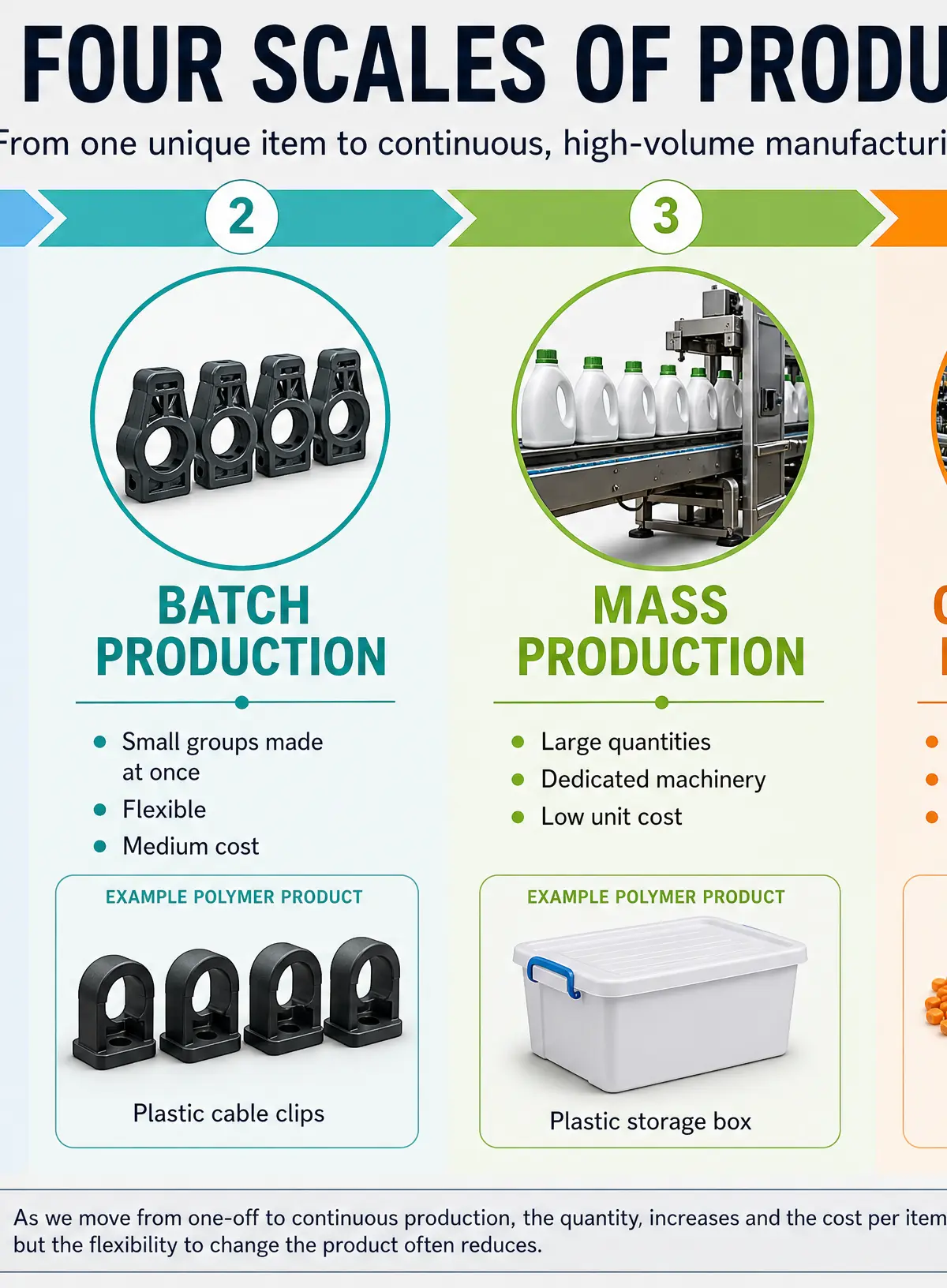
1. One-Off Production
- Definition: Manufacturing a single, unique product to a specific client brief.
- Characteristics: High cost per unit, highly skilled workforce required, flexible manufacturing methods.
- Polymer Example: A custom architectural model made using line bending and laser cutting.
2. Batch Production
- Definition: Manufacturing a set quantity (a batch) of identical products before changing the machinery to make something else.
- Characteristics: Medium unit cost, requires downtime to re-tool machines between batches. Heavily relies on jigs, templates, and moulds to ensure consistency.
- Polymer Example: 500 identical acrylic display stands for a retail chain.
3. Mass Production
- Definition: Manufacturing large quantities of identical products on a dedicated assembly line.
- Characteristics: Very low unit cost, massive initial setup cost for tooling (moulds), low-skilled workforce operating automated machinery.
- Polymer Example: Millions of identical Lego bricks made via injection moulding.
4. Continuous Production
- Definition: Manufacturing a single product continuously, 24 hours a day, 7 days a week, without stopping.
- Characteristics: The lowest possible unit cost, enormous initial capital investment, completely automated.
- Polymer Example: Standard PVC plumbing pipes made via extrusion.
Techniques for Quantity Production
When moving from one-off to batch or mass production, manufacturers must use techniques to guarantee accuracy, speed, and consistency. You must reference these in your exam answers and use them in your NEA.
- Jigs: A custom-made device that holds a workpiece securely in position and guides a cutting tool or bending process. E.g., a bending jig used after line bending to ensure every piece cools at exactly 90 degrees.
- Templates: A rigid, flat pattern (often cut from MDF or acrylic) used to mark out complex shapes onto material repeatedly. It ensures every marked-out part is identical.
- Moulds/Patterns: Used to form the 3D shape of the polymer. The mould dictates the final shape and surface finish.
- Computer Aided Manufacture (CAM): Using computer-controlled machinery (like laser cutters or CNC routers) to cut polymer sheet. CAM guarantees identical parts, operates within tiny tolerances (e.g., +/- 0.1mm), and drastically reduces human error.
- Quality Control (QC): Checking products during and after manufacture against the specification. In batch production, this might involve checking every 10th item using a 'Go/No-Go' gauge.
- Efficient Cutting (Nesting): Arranging the shapes to be cut on a standard sheet of polymer as closely together as possible to minimise waste. This is crucial for commercial viability and sustainability.
Listen to the Revision Podcast
Consolidate your learning by listening to this 13-minute audio guide covering the core concepts, common exam mistakes, and a quick-fire recall quiz.

Exam Component
Written Exam Knowledge
The written exam will test your ability to justify choices. You will rarely be asked simply to name a process; you will be asked to explain why a specific process is the most appropriate for a given product, referencing the material, the scale, and the cost.
Practical Exam Preparation (NEA)
In your Non-Exam Assessment (coursework portfolio), you must demonstrate an understanding of industrial practices. Even if you are only making a one-off prototype using line bending or a laser cutter, you must include a section in your portfolio explaining how your product would be manufactured commercially if it were scaled up to mass production (e.g., "While my prototype is laser-cut acrylic, a commercial batch of 10,000 units would be injection moulded from ABS to reduce unit cost and assembly time").
Visual Resources
2 diagrams and illustrations
Interactive Diagrams
1 interactive diagram to visualise key concepts
Conceptual Flow Outline
Decision tree for selecting a polymer manufacturing process.
Worked Examples
3 worked examples — open one to explore the question and available guidance.
Practice Questions
Test your understanding — click to reveal model answers
Name the manufacturing process used to make standard PVC plumbing pipes.
Hint: Pipes have a continuous cross-section and are made in very long lengths.
Explain why injection moulding is not suitable for one-off production.
Hint: Think about the cost of making the metal mould before you can produce a single plastic part.
A company is designing a new casing for an electrical plug socket. It must be an excellent electrical insulator and withstand heat without melting. Evaluate the use of Press Moulding for this product.
Hint: Discuss the material required (thermoset), how press moulding works with that material, and the scale of production.