Pearson Edexcel · GCSE · Design and Technology
Polymers: Appropriate surface treatments and finishes that can be applied to thermoforming and thermosetting polymers for functional and aesthetic purposes
This topic covers the essential surface treatments and finishes applied to thermoforming and thermosetting polymers. Understanding these processes is crucial for both the written exam, where you must justify functional and aesthetic choices, and your practical coursework, where high-quality finishing demonstrates technical competence.
- 6 min read
- 3 worked examples
- 3 practice questions
- 6 key terms
Study Notes
Overview
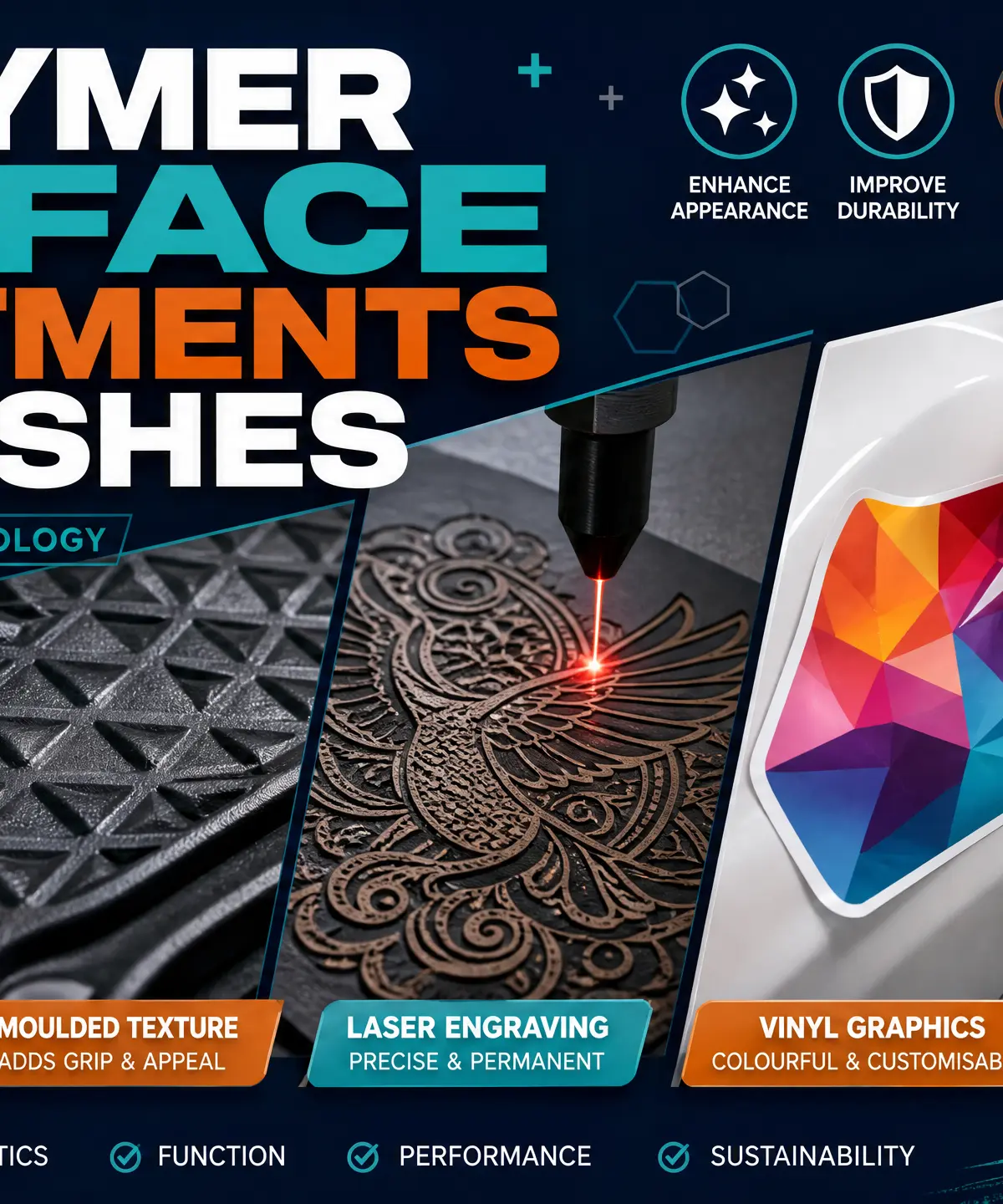
Surface treatments and finishes are applied to polymer products to enhance their functional performance (such as adding grip or durability) and their aesthetic appeal (such as adding colour or pattern). In the GCSE Design and Technology specification, you are required to understand specific finishing techniques, when they are applied, and whether they are suitable for thermoforming or thermosetting polymers.
Listen to the companion podcast for an in-depth review of these concepts:

Key Knowledge & Theory
Core Concepts: Functional vs. Aesthetic Purposes
Examiners frequently ask candidates to distinguish between functional and aesthetic purposes. You must be able to clearly articulate both.
- Functional Purposes: These improve the physical performance or usability of the product. Examples include providing protection against UV degradation, improving grip (ergonomics), adding insulation, or making a surface easier to clean.
- Aesthetic Purposes: These improve the visual appeal of the product. Examples include changing the colour, adding a glossy or matte texture, or applying branding and decorative patterns.
The Five Key Surface Treatments
| Treatment/Finish | Applicable Polymers | When Applied | Primary Purposes |
|---|---|---|---|
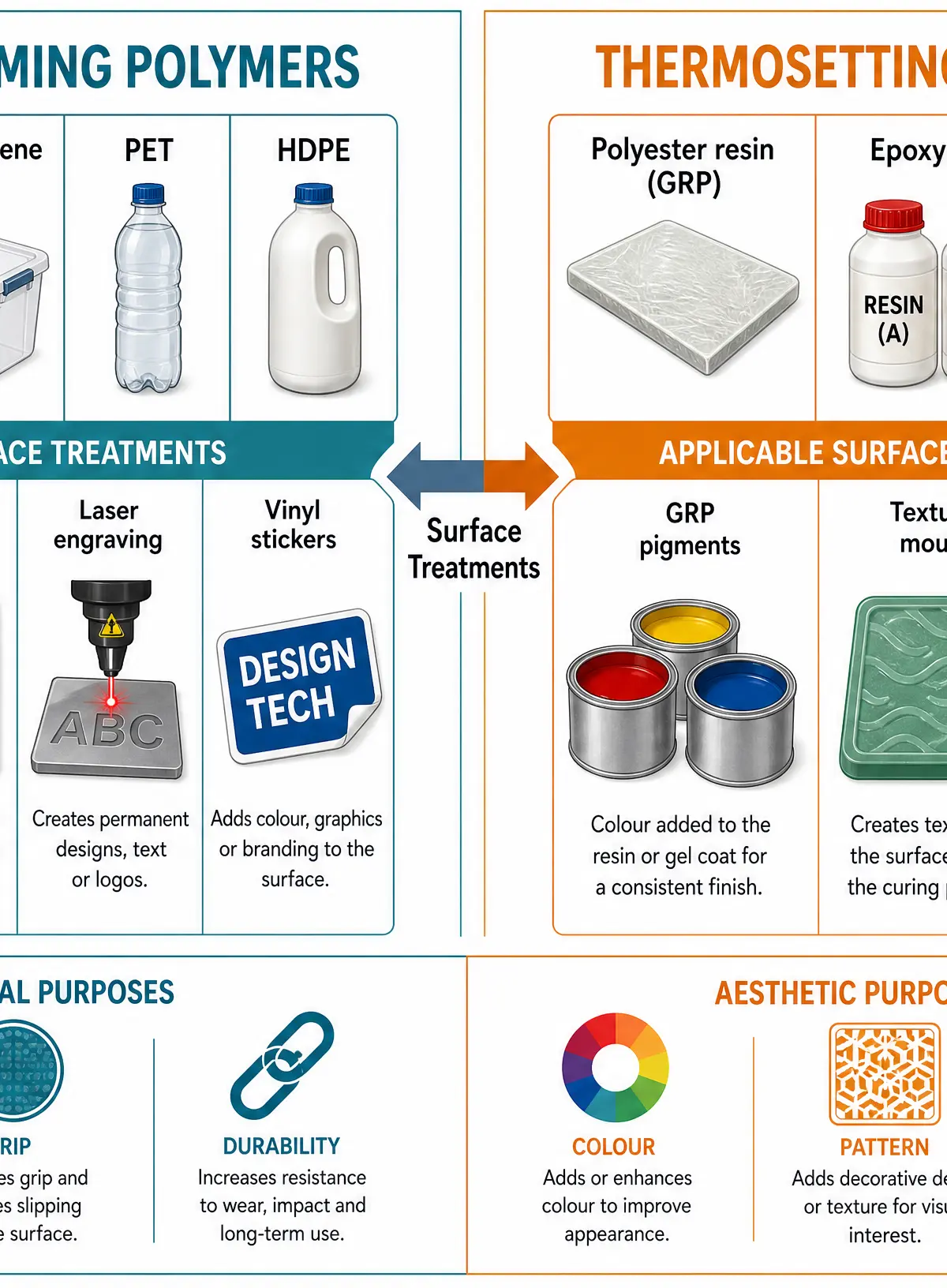
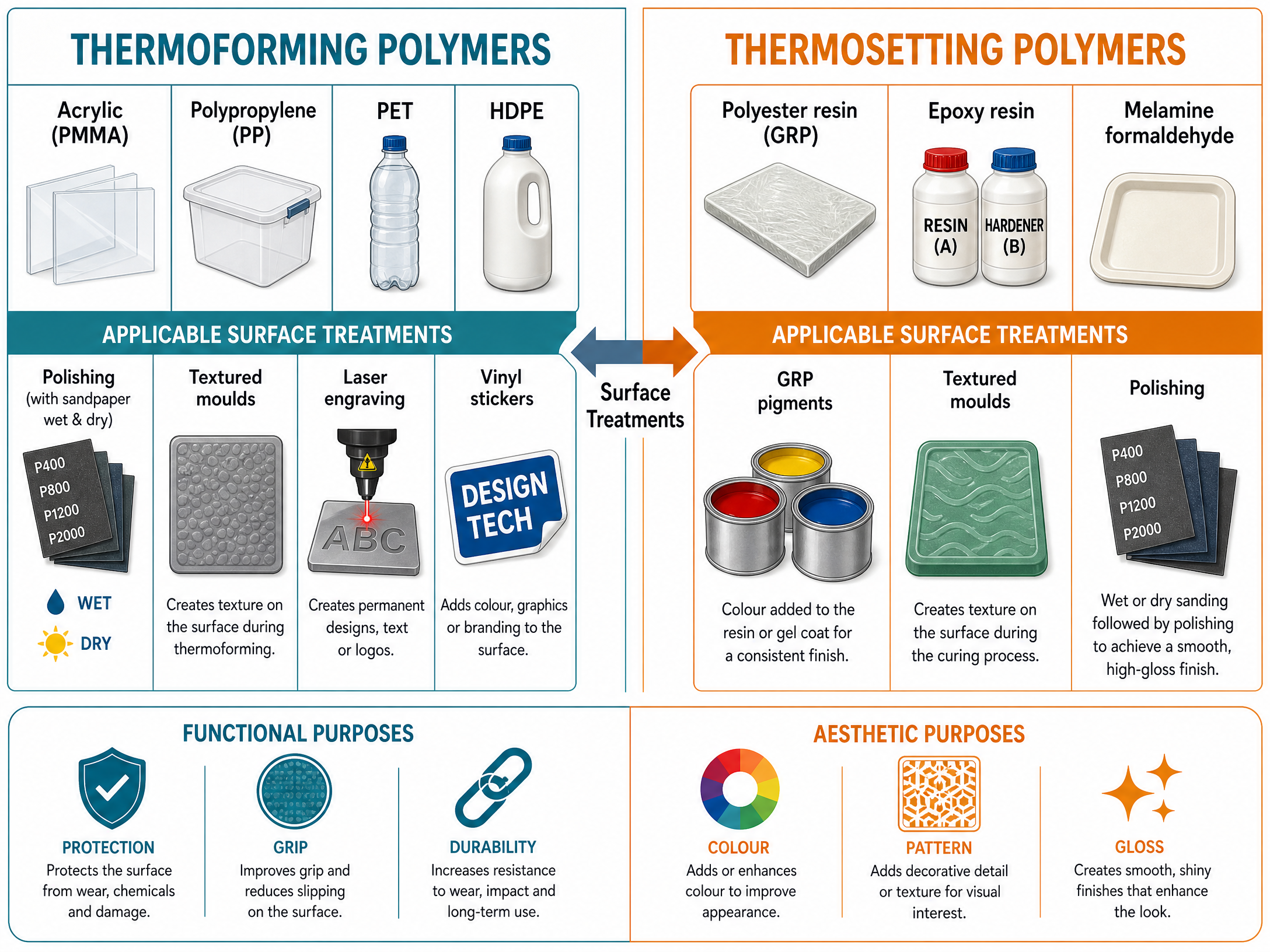
| Polishing | Thermoforming (e.g., Acrylic) & Thermosetting | Post-manufacture | Aesthetic: High gloss, clear finish.<br>Functional: Removes scratches, easy to clean. |
| Textured Moulds | Thermoforming & Thermosetting | During manufacture | Aesthetic: Mimics other materials (e.g., leather).<br>Functional: Adds grip, hides minor scratches. |
| Laser Engraving | Thermoforming (primarily) | Post-manufacture | Aesthetic: Intricate decorative patterns.<br>Functional: Permanent serial numbers/safety info. |
| Vinyl Stickers | Thermoforming & Thermosetting | Post-manufacture | Aesthetic: Custom branding, bright colours.<br>Functional: Minor surface protection. |
| GRP Pigments | Thermosetting (Polyester resin) | During manufacture | Aesthetic: Solid, uniform colour.<br>Functional: Colour runs through material; scratches are less visible. |
Technical Vocabulary
To access higher mark bands, you must use precise technical terminology:
- Thermoforming (Thermoplastic): Polymers that can be repeatedly heated and reshaped.
- Thermosetting: Polymers that undergo a chemical change during curing and cannot be remelted.
- Gel Coat: The outermost layer of a GRP product, which contains the pigment and provides a smooth, weather-resistant finish.
- Abrasive Grade: The coarseness of sandpaper, denoted by a 'P' number (e.g., P400 is coarse, P2000 is fine).
Practical Skills
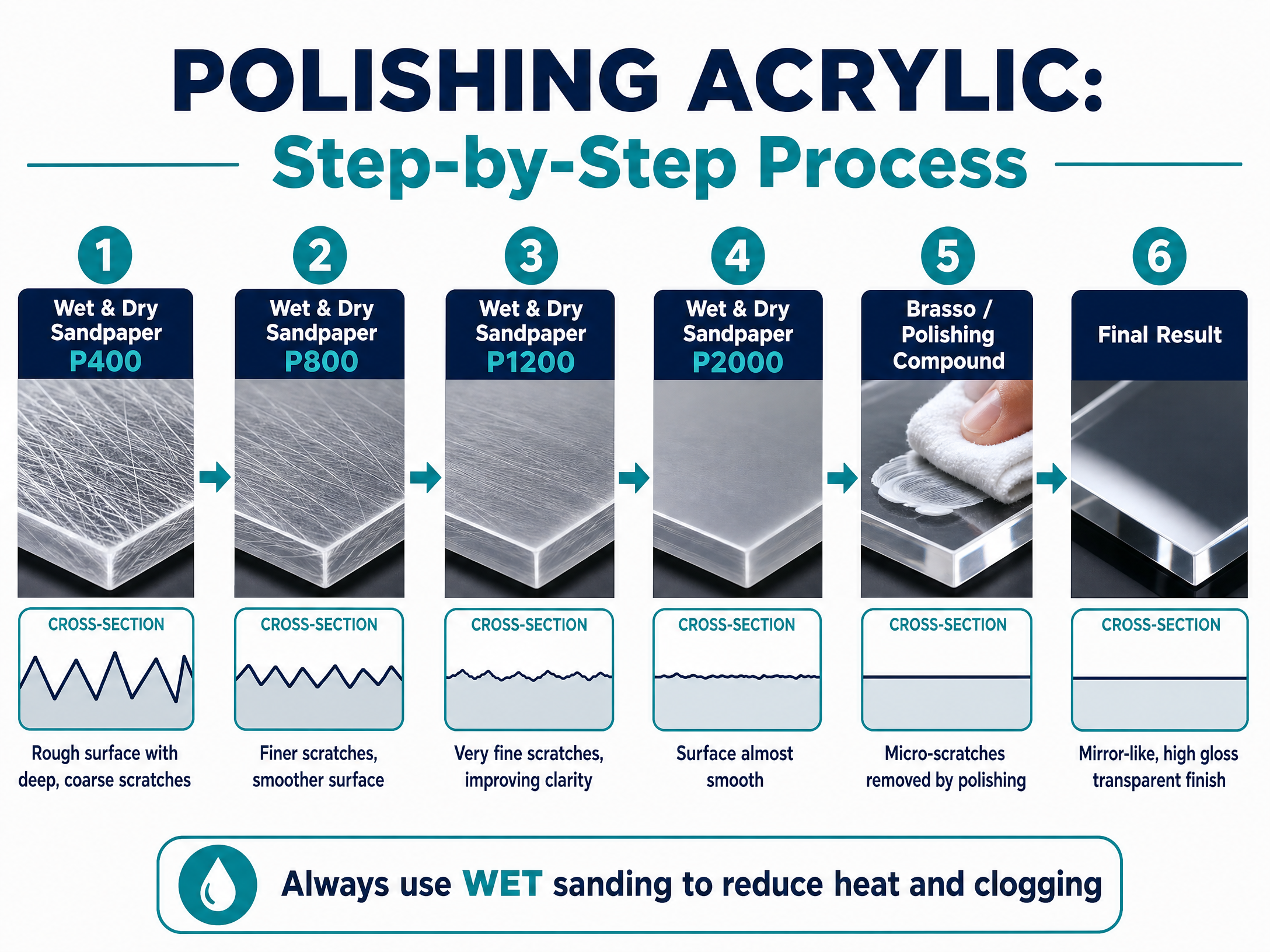
Techniques & Processes: Polishing Acrylic
Polishing acrylic is a fundamental practical skill that you may need to demonstrate in your NEA (Non-Exam Assessment) portfolio.
Step-by-Step Process:
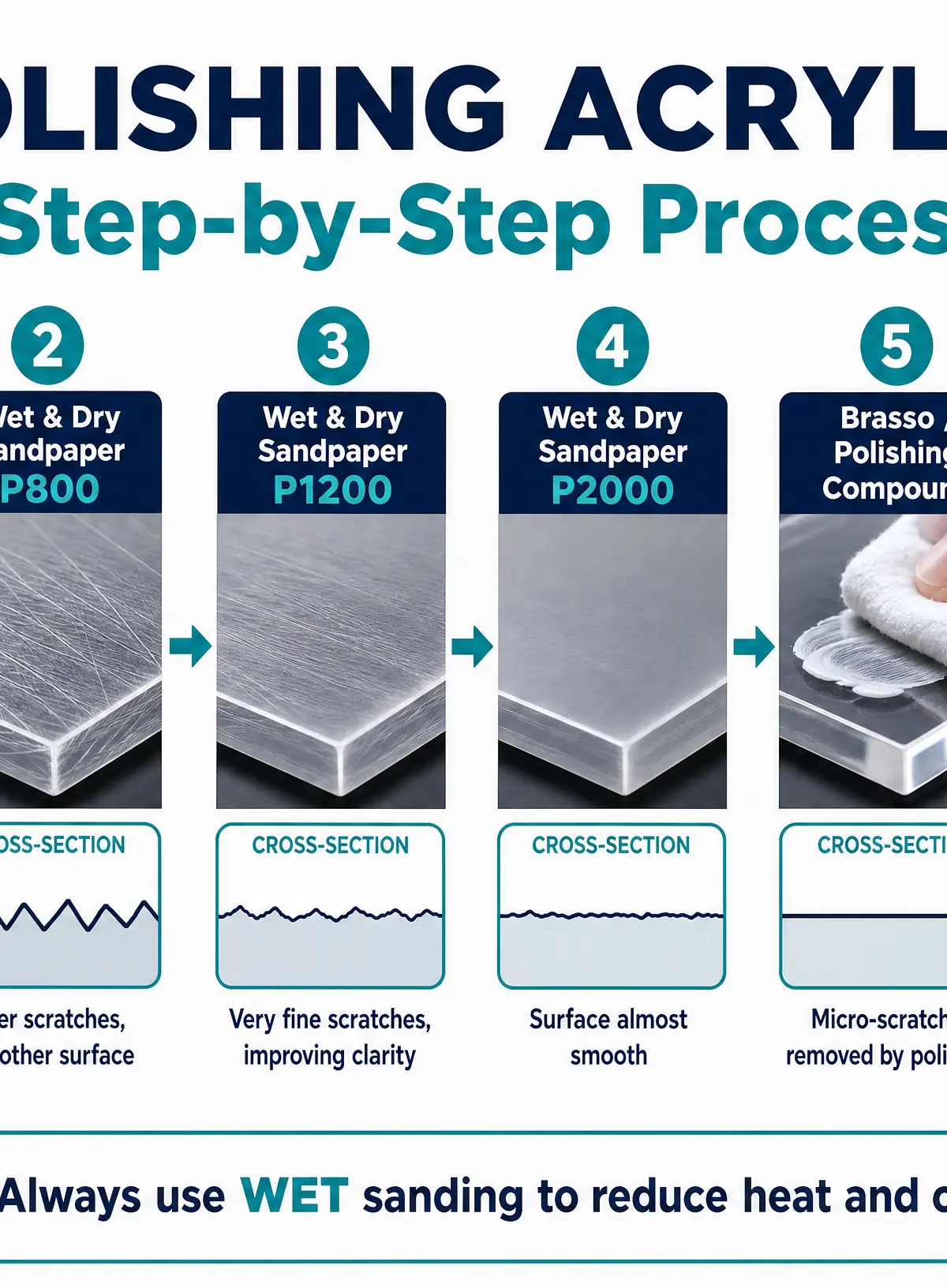
- Preparation: File the cut edge of the acrylic flat to remove deep saw marks (draw filing).
- Wet Sanding (Coarse): Use P400 wet and dry paper. Crucial technique: Use water as a lubricant to prevent the abrasive from clogging and to reduce friction heat, which can melt or cloud the acrylic.
- Wet Sanding (Medium): Progress to P800, then P1200 paper, always washing the edge between stages to remove coarse grit.
- Wet Sanding (Fine): Finish sanding with P2000 paper until the edge is completely smooth but matte.
- Buffing: Apply a polishing compound (e.g., Brasso, T-Cut, or a dedicated acrylic polish) using a soft cloth or a mechanical buffing wheel to achieve a mirror-like, transparent finish.
Materials & Equipment
- Wet and Dry Paper: Silicon carbide abrasive paper designed to be used with water.
- Buffing Wheel: A machine with a soft cotton wheel, used with an abrasive wax block for rapid polishing. Safety: Always wear goggles and hold the work below the centre of the wheel to prevent it being snatched.
Portfolio/Coursework Guidance
Assessment Criteria
Examiners look for evidence of high-quality making skills (AO2). A poorly finished edge on a polymer product will severely limit your marks in the 'Making' section. You must demonstrate that you have selected the appropriate finish and executed it to a commercial standard.
Building a Strong Portfolio
- Photographic Evidence: Document the polishing process. Show a close-up of the rough edge, the intermediate sanded edge, and the final polished edge reflecting light.
- Justification: In your portfolio annotations, do not just state "I polished the acrylic." State why: "I used wet sanding up to P2000 grade followed by a buffing wheel to achieve a transparent, high-gloss finish, ensuring the product looks commercially viable and is easy for the user to clean."
Exam Component
Written Exam Knowledge
In the written paper, questions on this topic often appear as 4-mark or 6-mark extended response questions. You may be shown a product (e.g., a child's plastic toy or a boat hull) and asked to evaluate the suitability of a specific finish.
Practical Exam Preparation
When preparing for theory questions, always link the material property to the finish. For example, because acrylic scratches easily, polishing is a vital restorative treatment. Because GRP is used outdoors, pigmented gel coats are essential for UV resistance without the need for repainting.
Visual Resources
2 diagrams and illustrations
Interactive Diagrams
1 interactive diagram to visualise key concepts
Conceptual Flow Outline
Decision tree for selecting polymer surface finishes
Worked Examples
3 worked examples — open one to explore the question and available guidance.
Practice Questions
Test your understanding — click to reveal model answers
Identify two surface treatments that can be applied to thermoforming polymers. (2 marks)
Hint: Think about treatments applied after the product is made, such as making it shiny or adding a logo.
Explain one functional advantage of adding pigment to polyester resin when manufacturing a GRP boat hull. (2 marks)
Hint: Think about what happens if a painted boat hits a rock versus a boat where the colour is mixed into the plastic.
A designer is creating a plastic casing for a handheld games console. Evaluate the use of a textured mould versus post-manufacture vinyl stickers for adding grip and branding to the product. (6 marks)
Hint: Compare the two methods across different factors: durability, manufacturing efficiency, functional grip, and aesthetic branding.