Pearson Edexcel · GCSE · Design and Technology
Polymers: Design contexts
This topic covers the essential properties, categories, and manufacturing processes of polymers. Understanding the distinction between thermoplastics and thermosetting polymers is crucial for selecting appropriate materials in design contexts and evaluating the sustainability of products.
- 6 min read
- 3 worked examples
- 4 practice questions
- 6 key terms
Study Notes
Overview
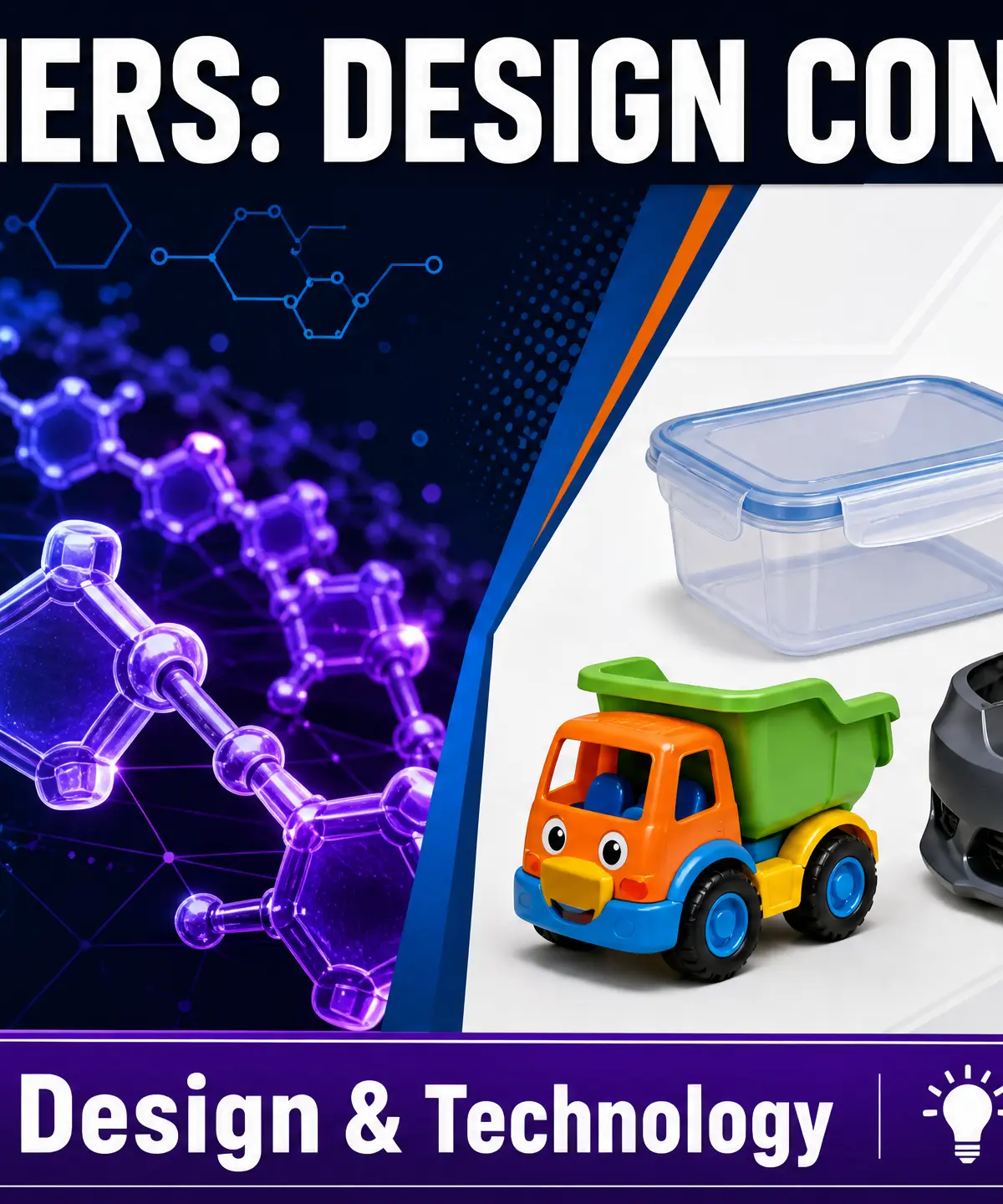
Polymers are ubiquitous in modern design. From the robust bumper of a car to the delicate blister packaging of a paracetamol tablet, polymers offer an extraordinary range of properties. In your GCSE Design and Technology exam, you are expected to not only identify different polymers but to justify their use in specific design contexts based on their working properties, molecular structure, and manufacturing processes.
🎧 Listen to the Revision Podcast:

Key Knowledge & Theory
Core Concepts: Polymer Categories
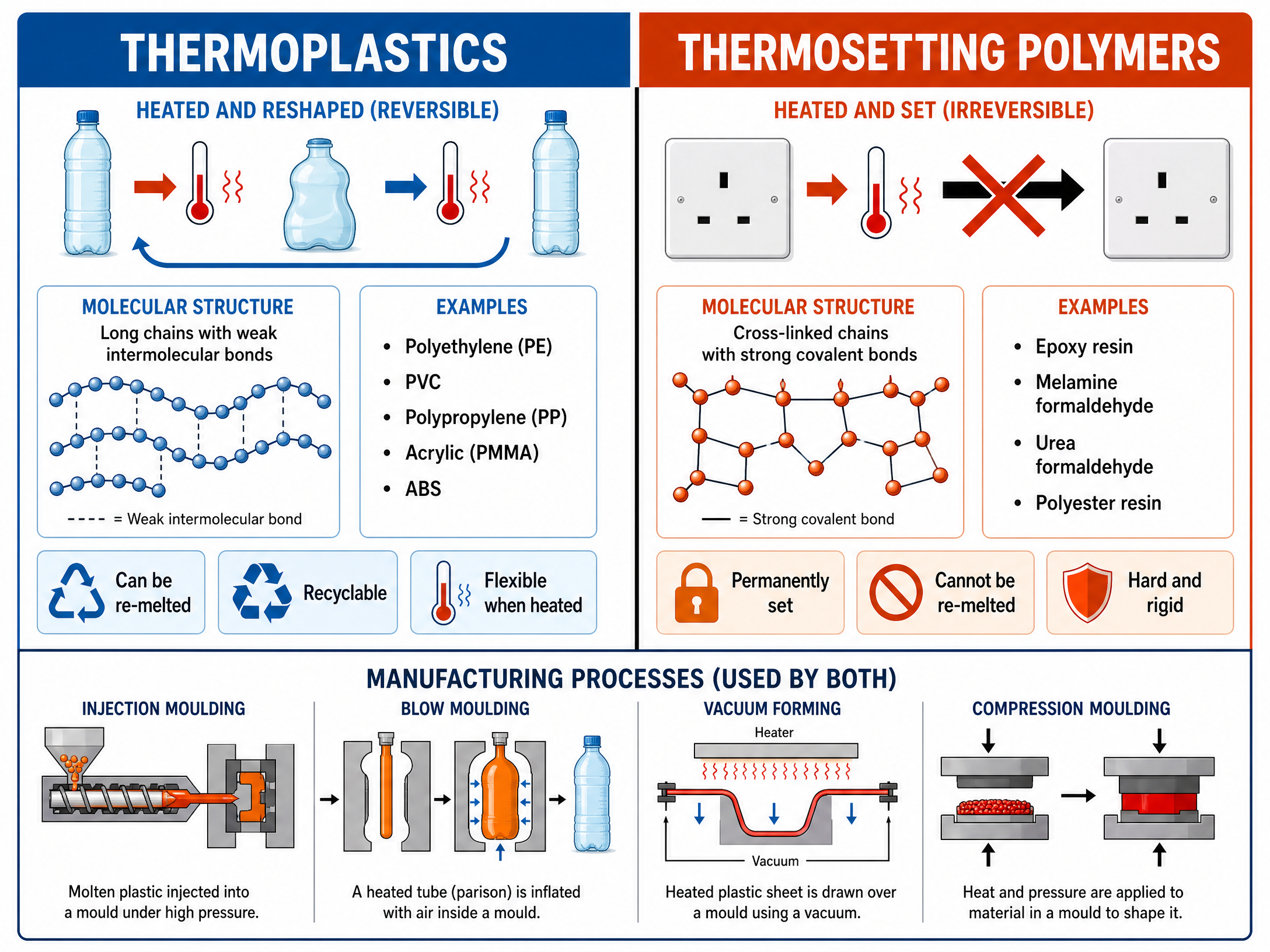
Polymers are materials made of long, repeating chains of molecules (monomers). In design, they are split into two fundamental categories based on their thermal properties. Understanding this distinction is the single most important concept in this topic.
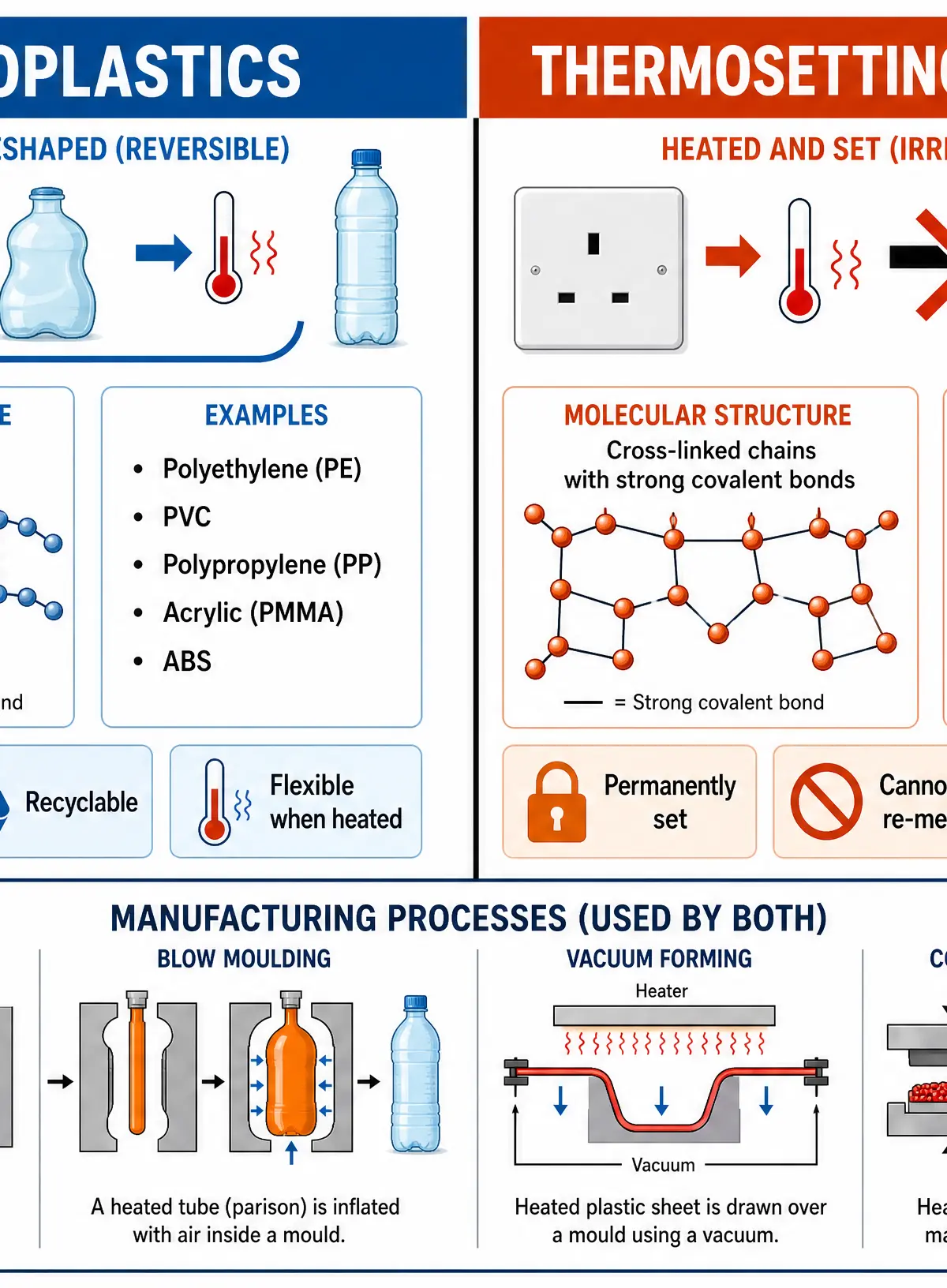
1. ThermoplasticsThermoplastics are polymers that become pliable or mouldable above a specific temperature and solidify upon cooling. This process is reversible.
- Molecular Structure: The polymer chains are long but are held together by weak intermolecular forces. When heat is applied, these weak bonds break, allowing the chains to slide over one another.
- Properties: They can be repeatedly heated, reshaped, and cooled. This makes them highly recyclable.
2. Thermosetting PolymersThermosetting polymers (or thermosets) are materials that strengthen during being heated, but cannot be successfully remoulded or reheated after their initial forming.
- Molecular Structure: During the curing process (often involving heat and pressure, or a chemical catalyst), strong covalent bonds called cross-links form between the polymer chains.
- Properties: They are permanently rigid, hard, and highly heat-resistant. If heated after curing, they will char and burn rather than melt. They are extremely difficult to recycle.
Technical Vocabulary
- Polymerisation: The chemical process of joining monomers together to form a polymer chain.
- Cross-linking: The formation of strong chemical bonds between polymer chains, characteristic of thermosetting polymers.
- Curing: The chemical process that produces the toughening or hardening of a polymer material by cross-linking of polymer chains.
- Plasticity: The ability of a material to be permanently deformed under load without breaking.
Practical Skills & Application
Manufacturing Processes
Examiners award high marks to candidates who can correctly link a polymer type to its appropriate manufacturing process and a specific product outcome.
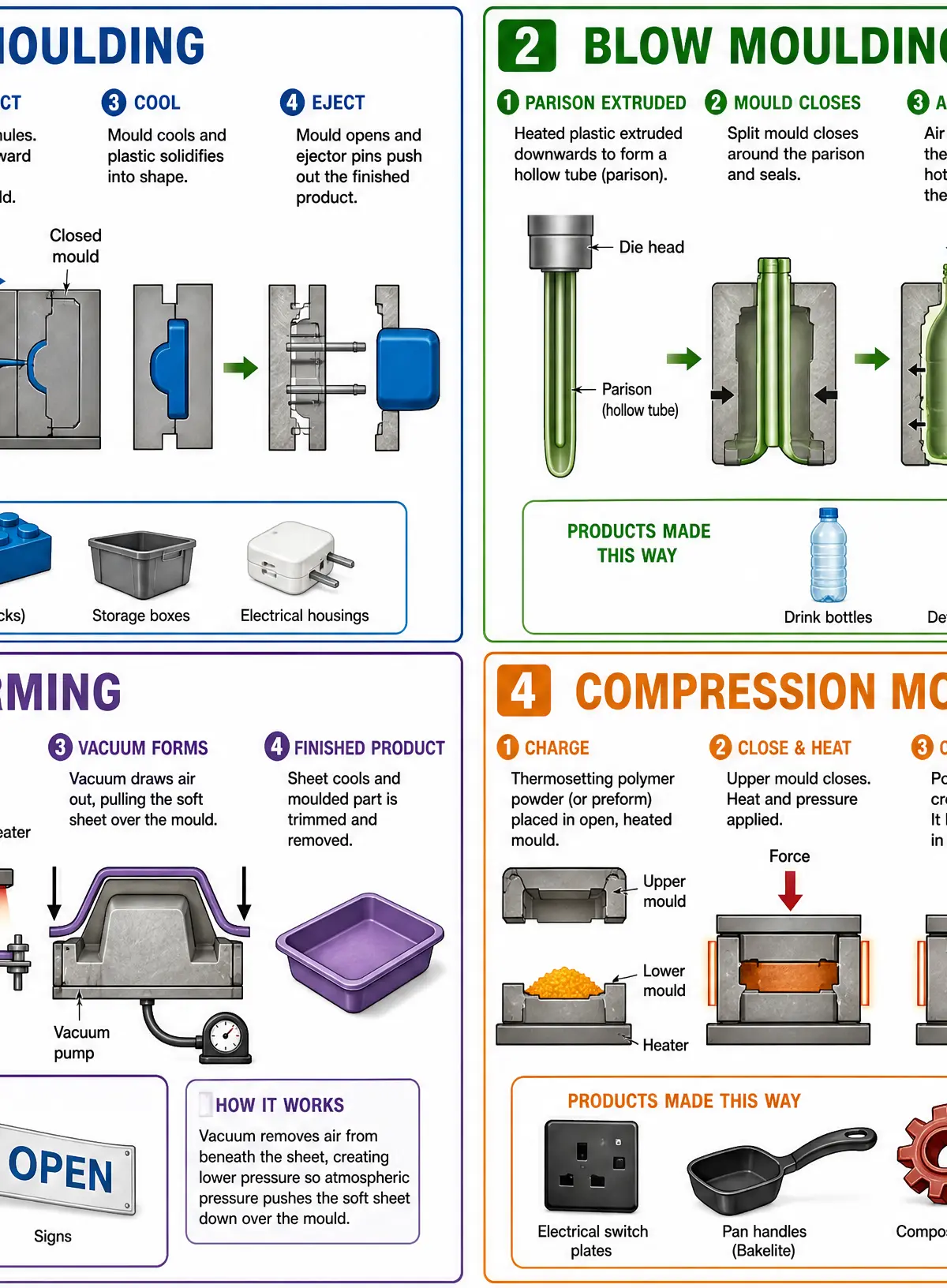
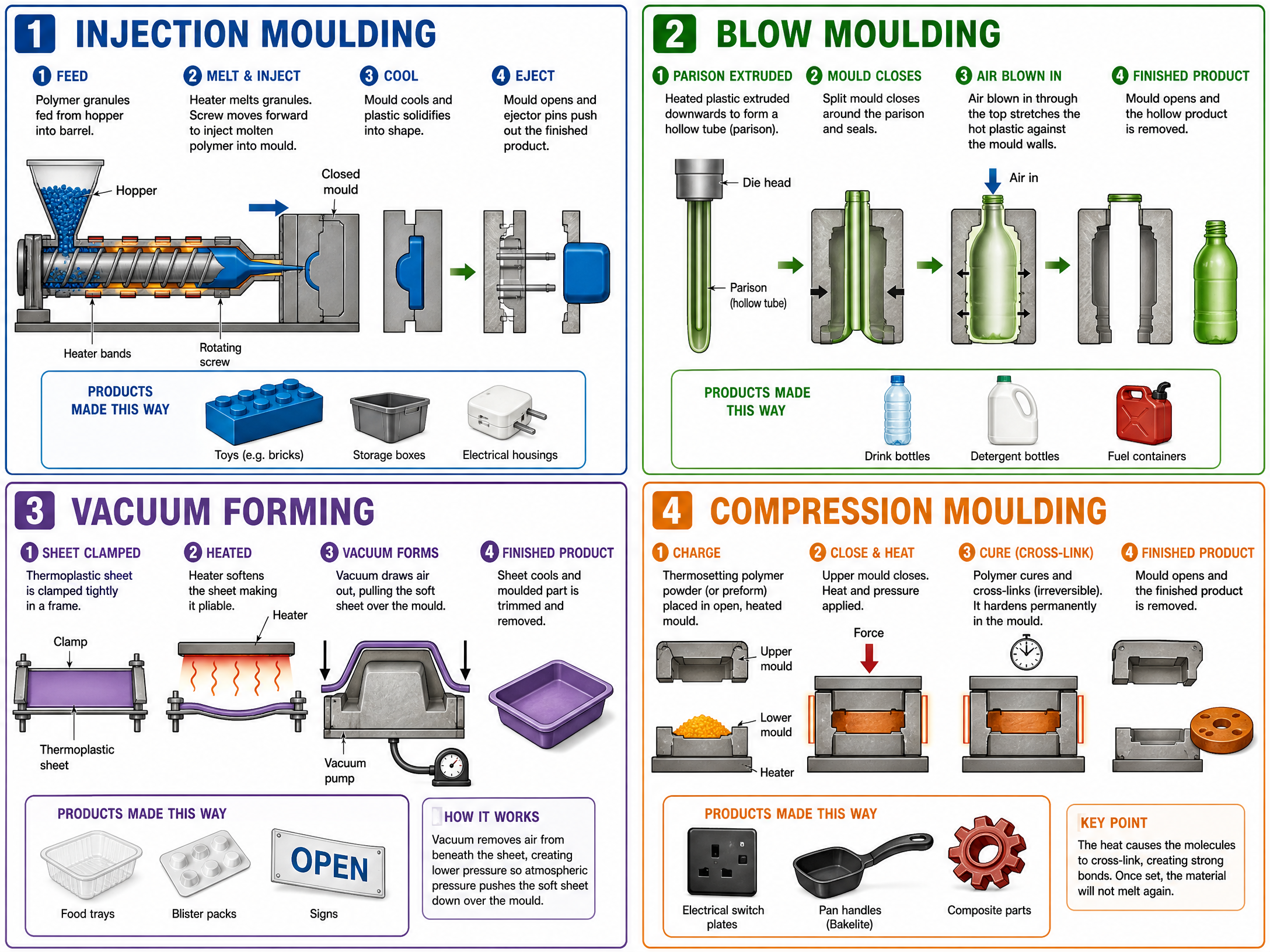
**Injection Moulding (Thermoplastics)**Molten polymer is forced under high pressure into a closed, cooled metal mould.
- Context: Used for complex, 3D solid shapes in high volumes.
- Examples: LEGO bricks, electrical housings, bottle caps.
**Blow Moulding (Thermoplastics)**A heated hollow tube of plastic (a parison) is inflated with compressed air inside a closed mould, forcing the plastic against the mould walls.
- Context: Used exclusively for hollow objects with narrow necks.
- Examples: Drinks bottles, detergent containers.
**Vacuum Forming (Thermoplastics)**A flat sheet of thermoplastic is heated until pliable, then drawn down over a mould by a vacuum pump removing the air beneath it.
- Context: Used for shallow, shell-like shapes.
- Examples: Yoghurt pot trays, blister packaging, bath panels.
**Compression Moulding (Thermosetting Polymers)**A pre-weighed amount of polymer powder (the 'charge') is placed in a heated mould. The upper mould closes with immense pressure, causing the polymer to flow, fill the cavity, and chemically cross-link (cure).
- Context: Used for thick, rigid, heat-resistant components.
- Examples: Electrical plug sockets, saucepan handles.
Portfolio/Coursework Guidance
Assessment Criteria
When applying polymer knowledge in your Non-Examined Assessment (NEA), examiners look for:
- Justification: Why did you choose Acrylic over Polypropylene? You must reference specific properties (e.g., optical clarity vs. impact resistance).
- Process Selection: If you propose a batch production method, you must identify the correct industrial process (e.g., vacuum forming) and explain why your design is suitable for it (e.g., incorporating draft angles).
- Sustainability: A critical assessment of the environmental impact of your chosen polymer, including its source (petrochemical vs. biopolymer) and its end-of-life recyclability.
Building a Strong Portfolio
Do not simply state "I will make this out of plastic." Specify the exact polymer (e.g., High-Density Polyethylene) and justify it. If you are using vacuum forming in the workshop, document the process with photographs, noting the temperature and time required, and evaluate the quality of the mould (e.g., "The lack of a draft angle caused the HIPS to tear upon removal").
Exam Component
Written Exam Knowledge
In the written paper, you will face scenarios requiring you to evaluate material choices. You must be able to compare a thermoplastic with a thermoset for a given product (e.g., an electrical fitting) and explain the safety and manufacturing implications of that choice.
Visual Resources
3 diagrams and illustrations
Interactive Diagrams
1 interactive diagram to visualise key concepts
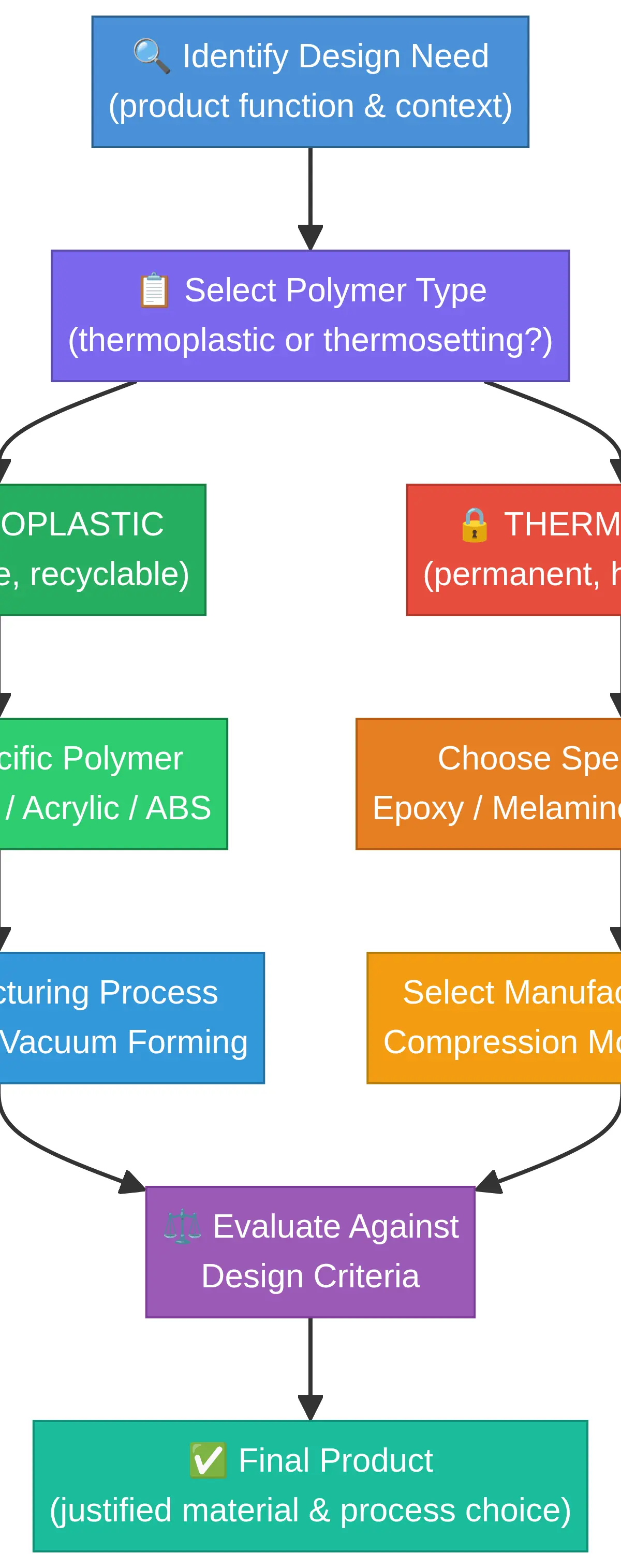
Conceptual Flow Outline
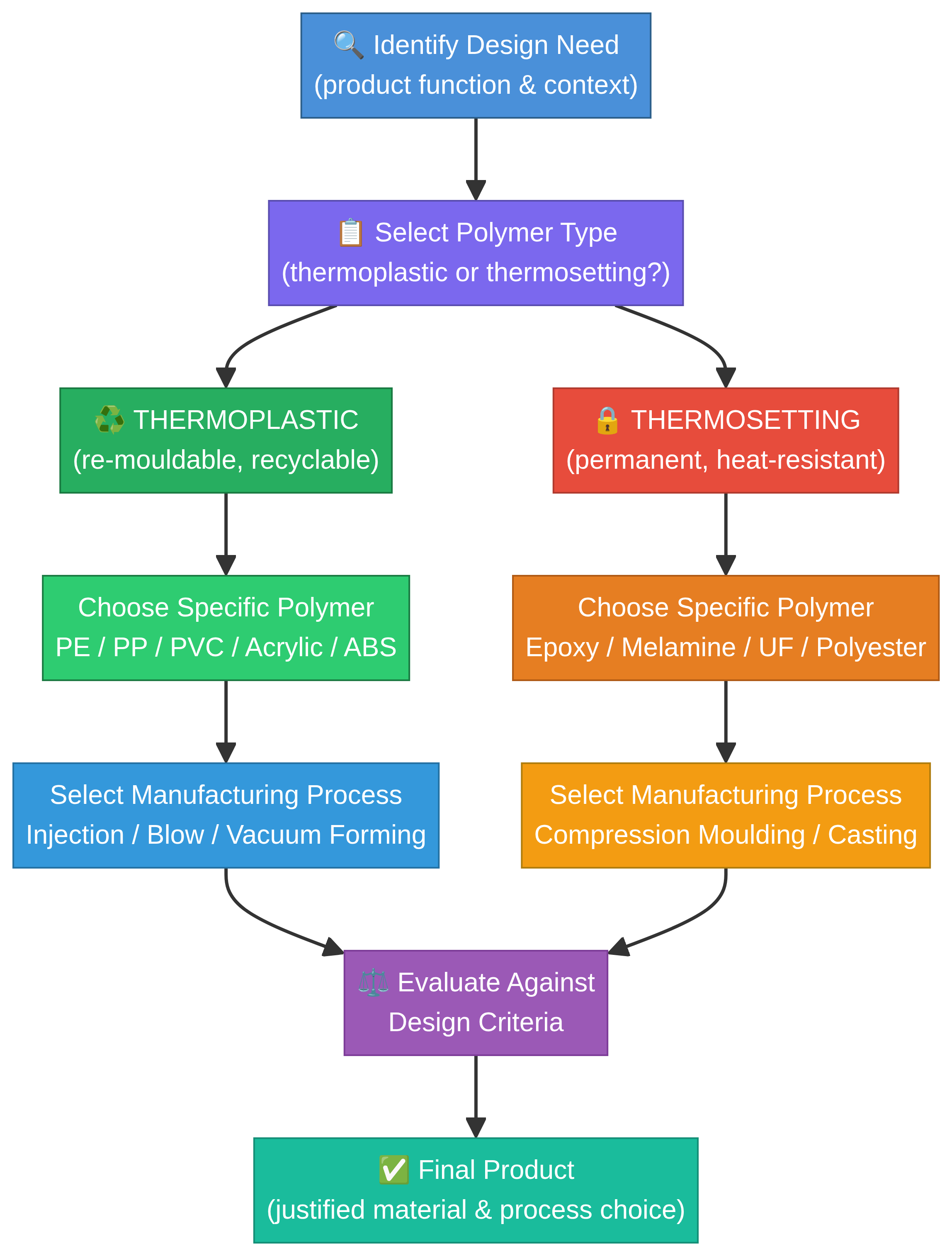
Polymer material and process selection flowchart
Worked Examples
3 worked examples — open one to explore the question and available guidance.
Practice Questions
Test your understanding — click to reveal model answers
Identify one thermoplastic and state one typical application for it. (2 marks)
Hint: Think of everyday items like plastic bags, bottles, or LEGO bricks.
Explain two reasons why Acrylic (PMMA) is a suitable material for an outdoor illuminated shop sign. (4 marks)
Hint: Consider the visual requirements of a sign and the environmental conditions outdoors.
A company is producing thousands of identical plastic casings for a new computer mouse. Name the most appropriate manufacturing process and explain why it is suitable. (4 marks)
Hint: The product is a complex 3D shape required in high volumes.
Evaluate the use of High-Density Polyethylene (HDPE) compared to Melamine Formaldehyde for manufacturing children's picnic plates. (6 marks)
Hint: Compare a thermoplastic with a thermoset. Think about safety, durability, washing, and end-of-life.