Pearson Edexcel · GCSE · Design and Technology
Polymers: The impact of forces and stresses on thermoforming and thermosetting polymers and how they can be reinforced and stiffened
This topic covers the fundamental properties of thermoforming and thermosetting polymers, focusing on how they respond to tension, compression, shear, and bending forces. It is essential for understanding material selection and how designers use reinforcement and stiffening techniques to improve product performance.
- 6 min read
- 3 worked examples
- 4 practice questions
- 6 key terms
Study Notes
Overview
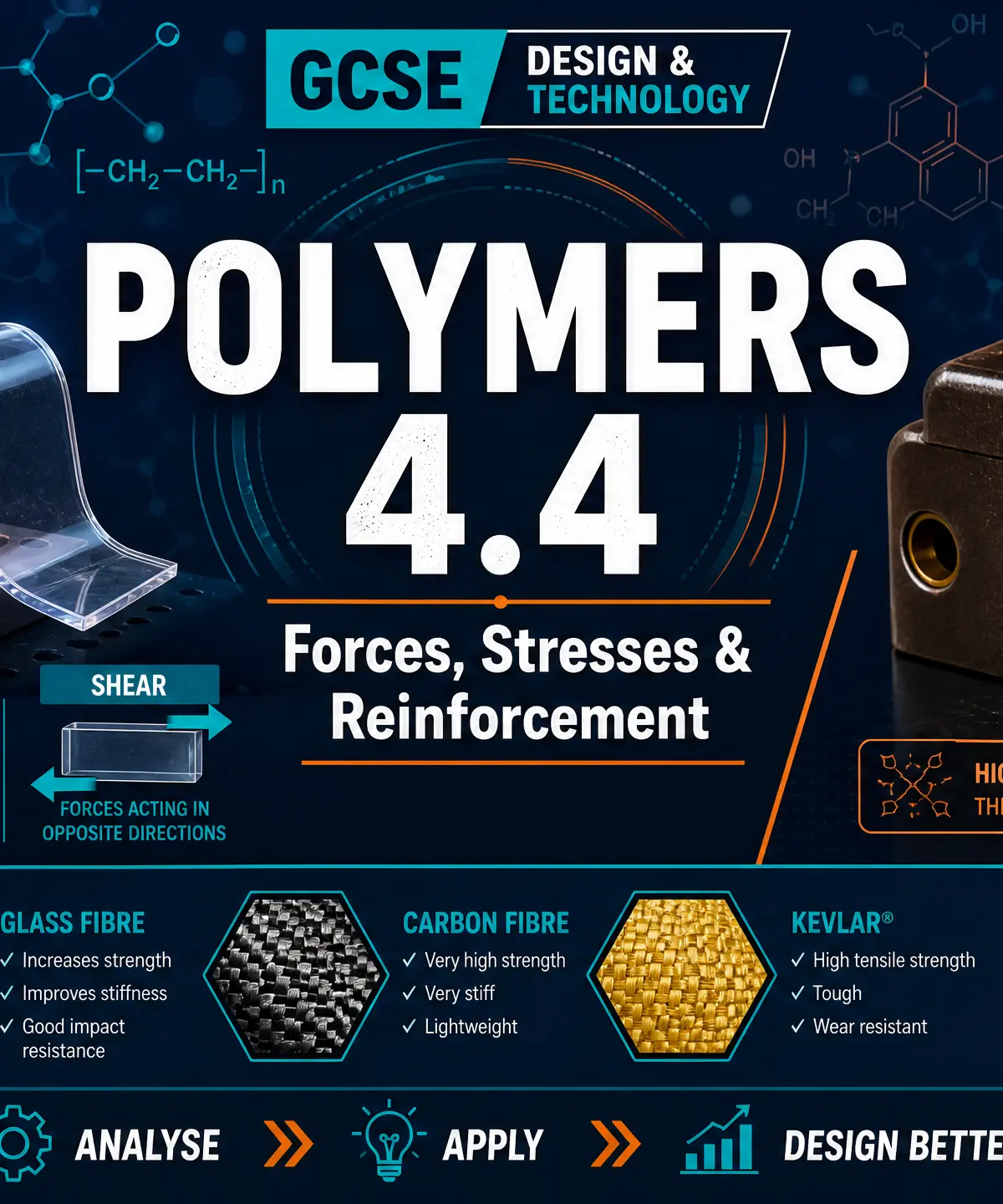
Polymers are ubiquitous in modern design and manufacturing. In Topic 4.4, we examine how these materials behave under different physical forces and stresses, and how their underlying molecular structure dictates their physical properties. We also explore how designers and engineers overcome material limitations by using reinforcement and stiffening techniques such as triangulation, frame structures, and additives.

Key Knowledge & Theory
Core Concepts
Polymer StructurePolymers are large molecules made up of long chains of repeating units called monomers. The way these chains interact determines the material's properties.
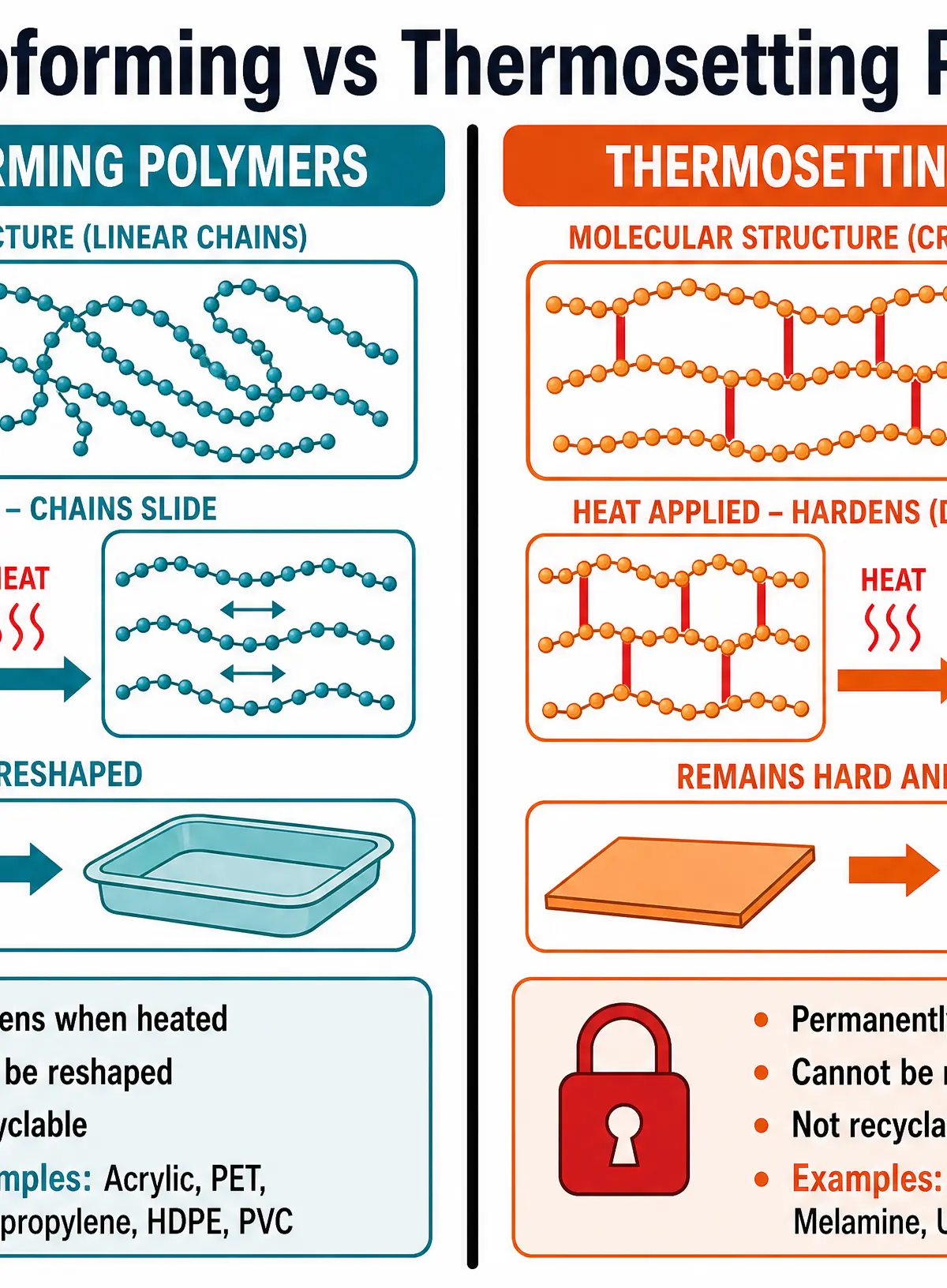
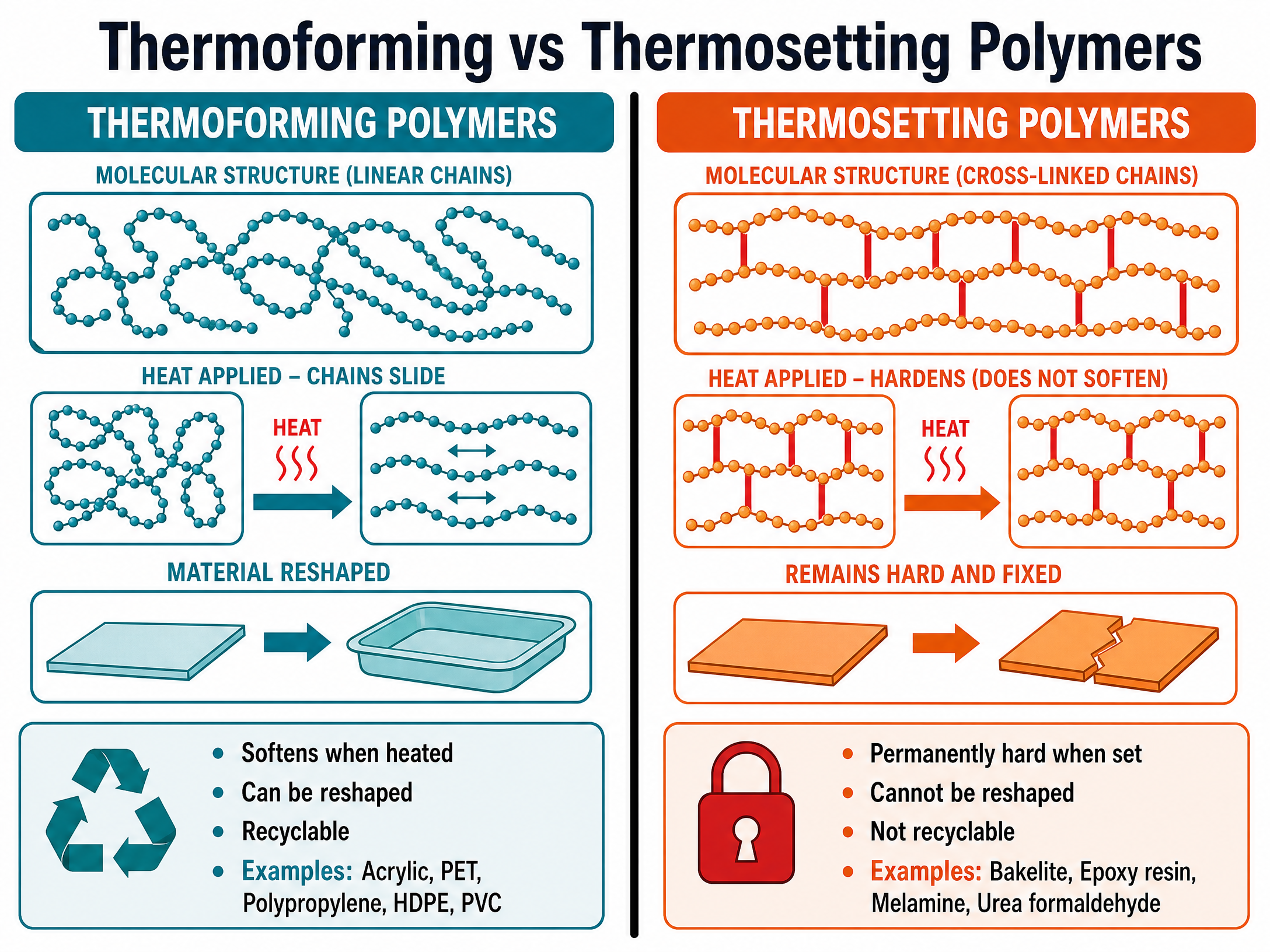
- Thermoforming Polymers (Thermoplastics): These have long, linear chain molecules that are tangled but not chemically bonded to each other. When heated, the chains can slide past one another, allowing the material to soften and be reshaped. When cooled, they harden again. This process can be repeated, making them highly recyclable.
- Thermosetting Polymers: These undergo a chemical change during their curing process. Strong covalent bonds, known as cross-links, form between the polymer chains, creating a rigid three-dimensional network. Once set, they cannot be softened by heat and will eventually char or burn. They are generally not recyclable.
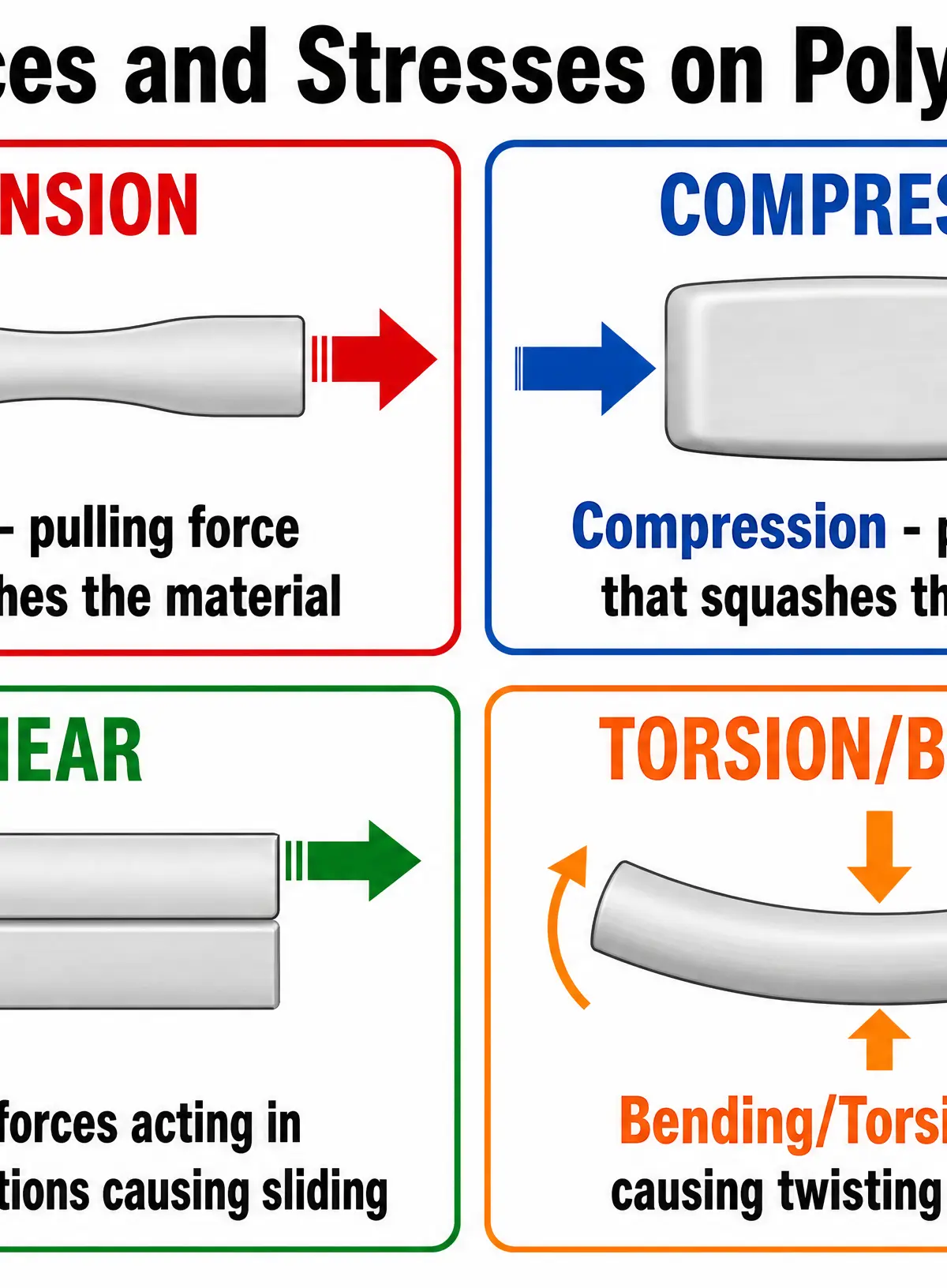
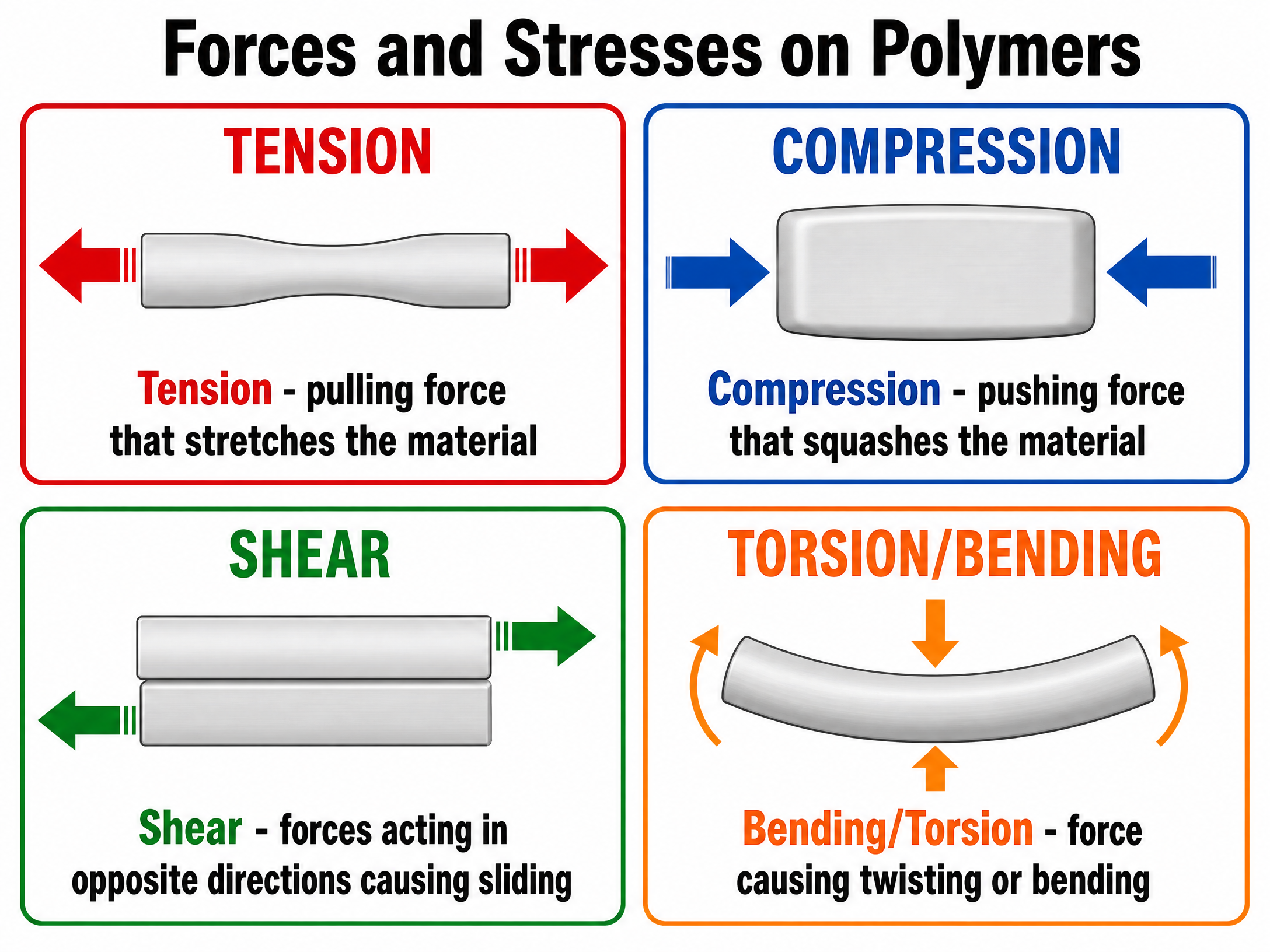
Forces and StressesWhen a product is used, it experiences forces that create internal stresses. Understanding these is critical for material selection.
| Force/Stress | Description | Effect on Polymers |
|---|---|---|
| Tension | A pulling force that stretches the material. | Thermoforming polymers are often ductile and stretch under tension. Thermosetting polymers are brittle and may snap. |
| Compression | A pushing force that squashes the material. | Both types can resist compression, but thermosets tend to be stiffer and more resistant to deformation. |
| Shear | Forces acting in opposite directions, causing layers to slide. | Can cause brittle polymers (like thermosets) to crack or split along a plane. |
| Torsion/Bending | Twisting or curving forces. Bending places one side under tension and the other under compression. | Flexible thermoforming polymers bend easily; rigid thermosets are likely to fracture under severe bending. |
Technical Vocabulary
- Ductile: The ability of a material to be stretched or deformed without breaking (typical of thermoforming polymers).
- Brittle: A material that breaks or shatters without significant deformation when subjected to stress (typical of thermosetting polymers).
- Cross-linking: The chemical bonds that link polymer chains together in thermosetting plastics.
- Matrix: The continuous phase in a composite material (often a polymer) that binds the reinforcement together.
Practical Skills
Reinforcement and Stiffening Techniques
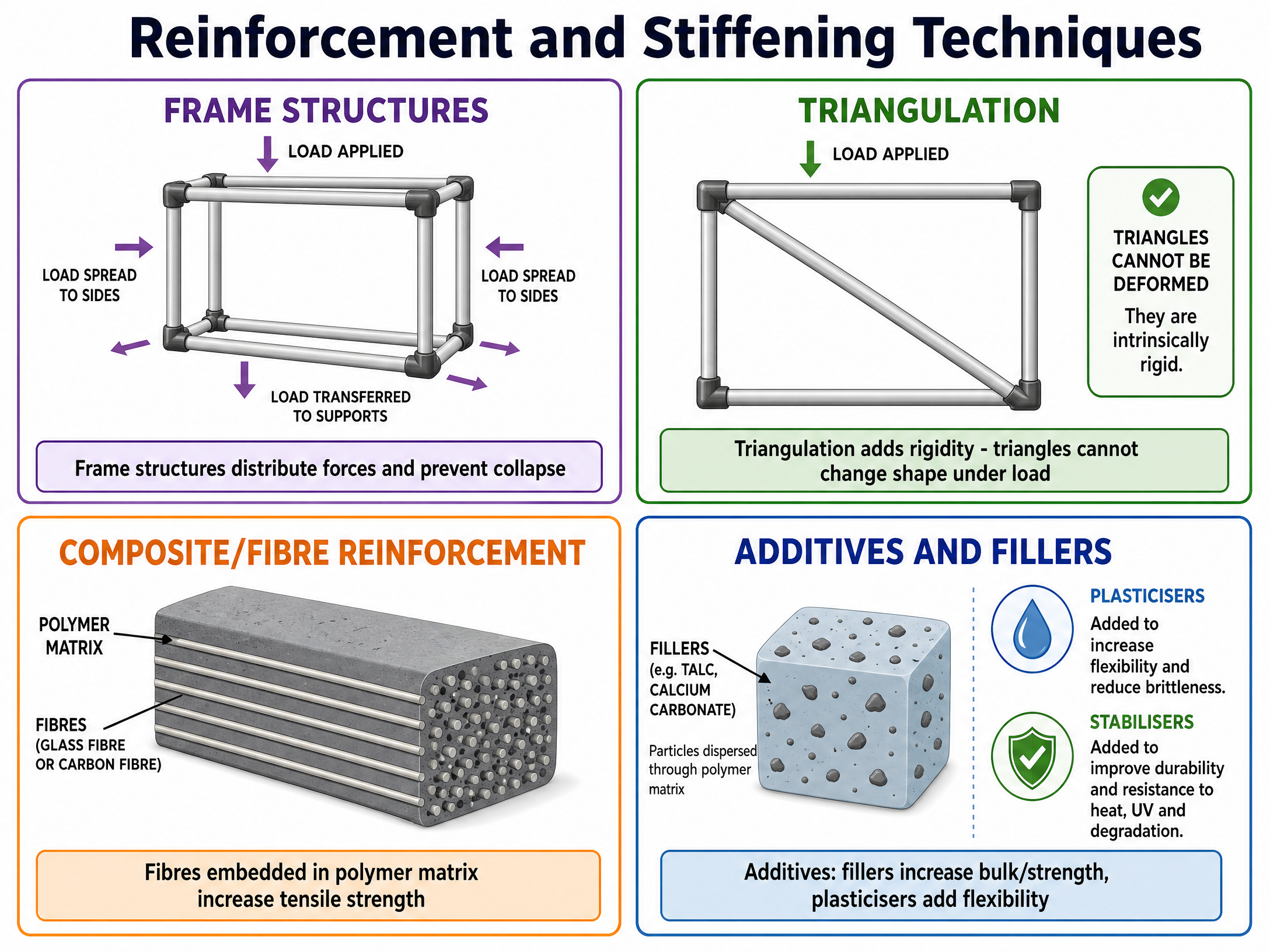
When a polymer alone does not have the required mechanical properties, designers must reinforce or stiffen it. You must be able to explain how and why these methods work.
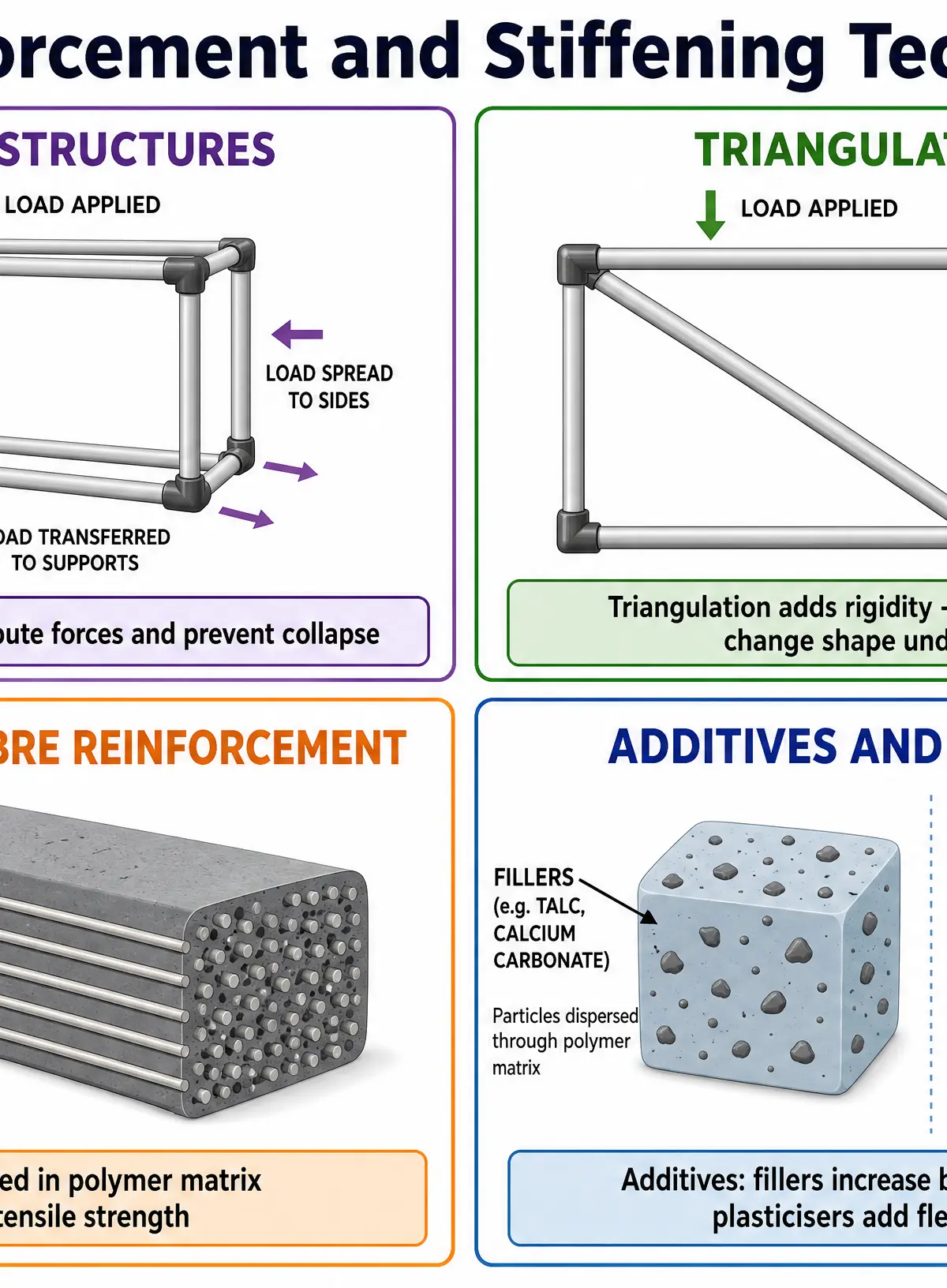
- Frame Structures: Using a skeleton of polymer tubes or rods to distribute loads across a wider area, preventing localized failure.
- Triangulation: Adding diagonal bracing to a rectangular frame. A triangle is the only polygon that cannot be deformed without changing the length of its sides, making it inherently rigid and highly resistant to racking forces.
- Composite Materials (Fibre Reinforcement): Embedding fibres (like glass or carbon) within a polymer matrix. The fibres provide high tensile strength, while the polymer matrix protects the fibres, holds them in place, and distributes the load.
- Additives: Modifying the polymer during manufacture.
- Fillers (e.g., talc, chalk) increase bulk and can improve rigidity.
- Plasticisers increase flexibility and reduce brittleness (e.g., making PVC suitable for flexible hoses).
- Stabilisers protect against degradation from heat or UV light.
Portfolio/Coursework Guidance
Assessment Criteria
Examiners look for evidence that you have considered forces and stresses when selecting materials for your NEA (Non-Exam Assessment). You must justify your material choices based on their mechanical properties and how they will perform in the intended context.
Building a Strong Portfolio
- Annotate for Forces: When sketching initial ideas, use arrows to indicate where tension, compression, or bending will occur in your product.
- Justify Material Selection: Do not just state "I will use acrylic because it is shiny." State: "I will use acrylic because it is a thermoforming polymer that can be easily line-bent to create the required shape, and it has sufficient compressive strength to support the weight of the display items."
- Show Structural Development: If your initial prototype is too weak, show how you used triangulation or added reinforcing ribs to stiffen the design.
Exam Component
Written Exam Knowledge
Questions on this topic often require you to link the molecular structure of a polymer to its physical properties, or to suggest and justify a method for reinforcing a specific product.
Exam Strategy
Always use specialist terminology. When asked to "explain," ensure you give the reason (the "why"). For example, "Thermosetting polymers cannot be reshaped because they have cross-links between their polymer chains that lock the structure permanently."
Visual Resources
3 diagrams and illustrations
Interactive Diagrams
1 interactive diagram to visualise key concepts
Conceptual Flow Outline
Material selection and reinforcement decision process
Worked Examples
3 worked examples — open one to explore the question and available guidance.
Practice Questions
Test your understanding — click to reveal model answers
State the type of force that occurs when a material is stretched. [1 mark]
Hint: Think of a rubber band being pulled.
Explain why urea formaldehyde is suitable for manufacturing electrical plug sockets. [3 marks]
Hint: Consider the safety requirements of a plug socket and the molecular structure of the material.
A manufacturer is designing a new plastic garden chair. Evaluate the use of a thermoforming polymer versus a thermosetting polymer for this product, considering forces, structure, and sustainability. [6 marks]
Hint: You need to discuss the pros and cons of both material types, reference specific forces the chair will face (like compression), and make a final recommendation.
Describe how the addition of plasticisers affects the properties of a polymer. [2 marks]
Hint: Think about what happens to PVC when it is used for flexible hoses compared to rigid pipes.