Pearson Edexcel · GCSE · Design and Technology
Polymers: The sources, origins, physical and working properties of thermoforming and thermosetting polymers and their social and ecological footprint
This topic covers the essential knowledge of polymers, including their origins from crude oil, the critical distinction between thermoforming and thermosetting plastics, and their manufacturing processes. Understanding these materials, alongside their social and ecological footprint, is crucial for making justified design decisions and securing high marks in your GCSE Design and Technology exam.
- 7 min read
- 3 worked examples
- 4 practice questions
- 6 key terms
Study Notes
Overview
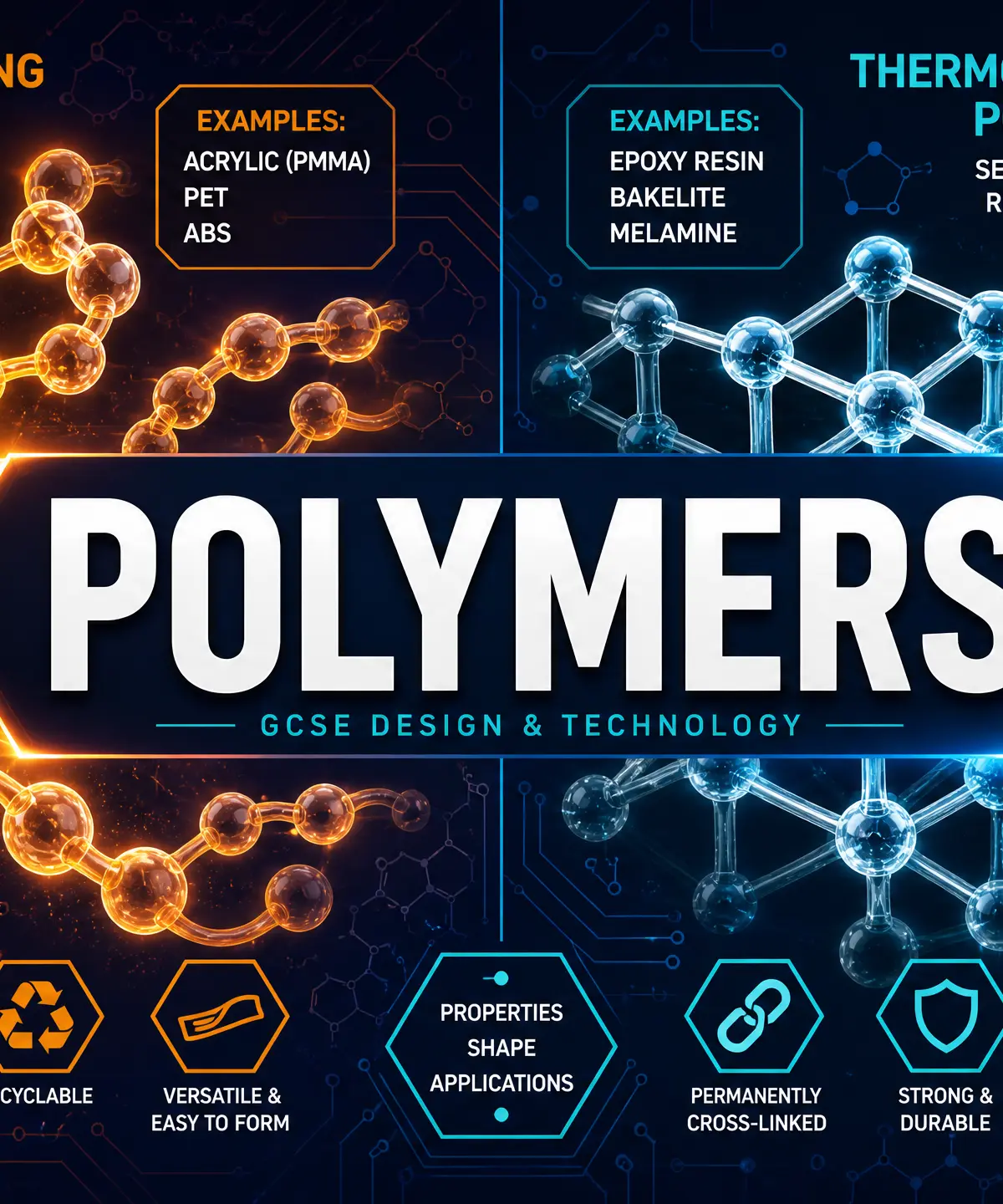
Polymers are ubiquitous in modern product design. From the casing of your smartphone to the bumper of a car, understanding polymers is fundamental to GCSE Design and Technology. This topic covers the origins of these materials, their physical and working properties, how they are formed into products, and the increasingly important social and ecological footprint they leave behind. Examiners expect you to be able to justify material choices and understand the environmental implications of those choices.
Audio Revision: Polymers Masterclass
Listen to our comprehensive revision podcast covering the entire topic, including exam tips and a quick-fire quiz:

Key Knowledge & Theory
Core Concepts: Origins and Classification
The vast majority of synthetic polymers are derived from crude oil, a fossil fuel extracted from countries like Saudi Arabia and Russia. Through a process called fractional distillation and cracking, the large hydrocarbons in crude oil are broken down into smaller molecules called monomers. These monomers are then joined together in long chains through polymerisation to create polymers.
The most critical distinction you must understand is between the two main families of polymers:
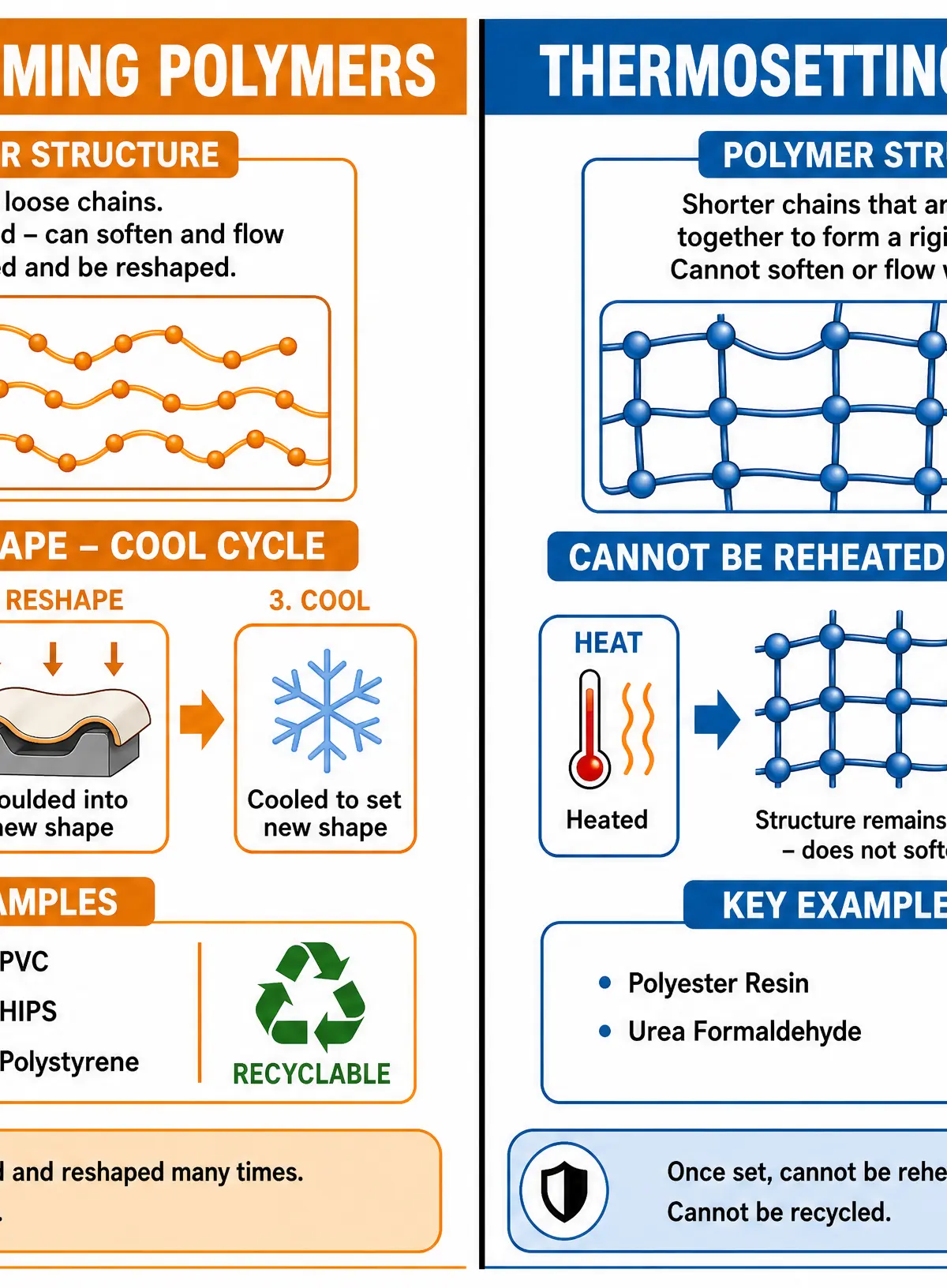
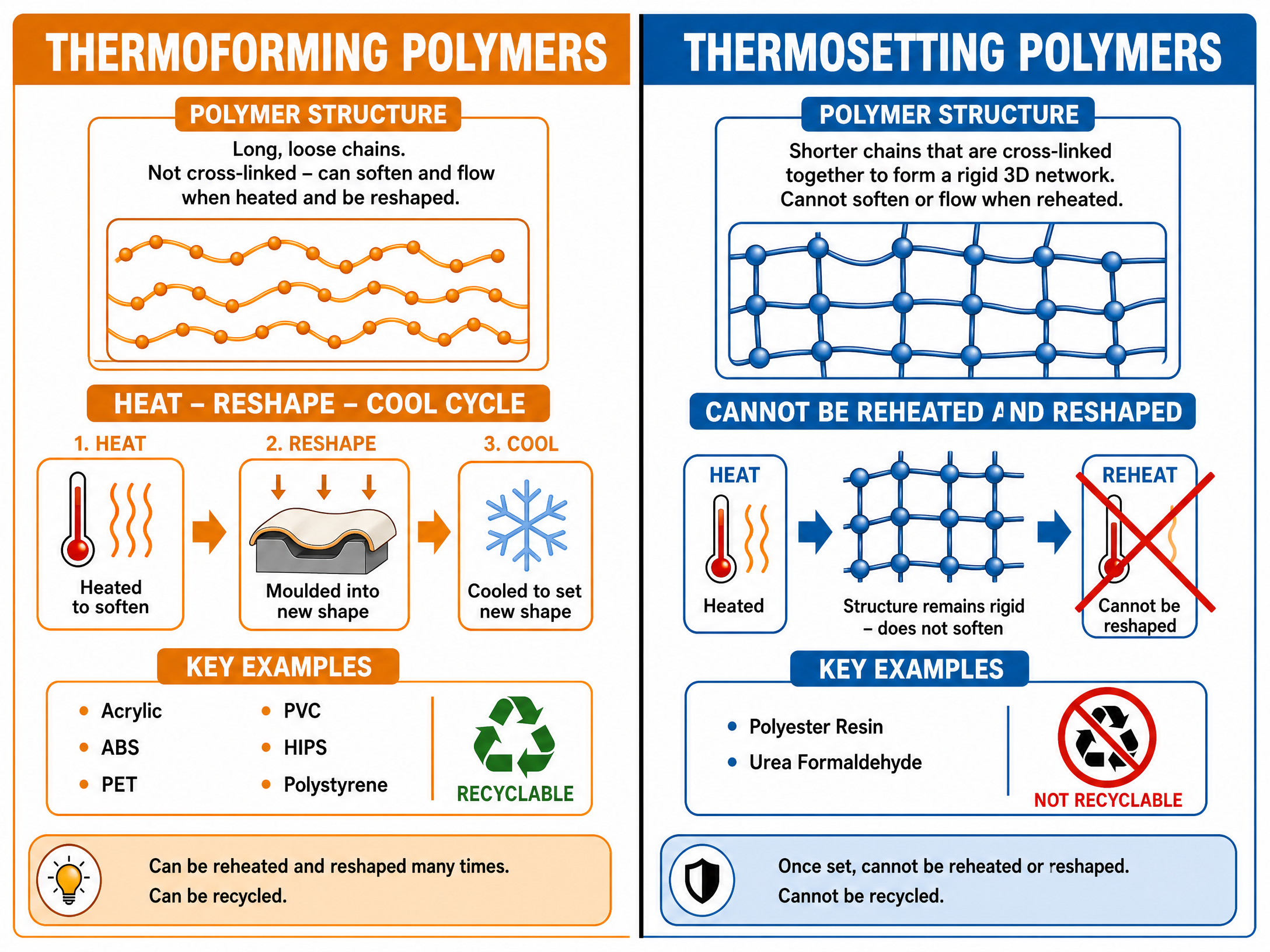
- Thermoforming Polymers (Thermoplastics): These have long, loosely tangled polymer chains with no permanent cross-links. Because the chains can slide past each other when heated, these polymers soften when heated and can be reshaped. This process is reversible, meaning they can be reheated and reshaped multiple times, making them highly recyclable.
- Thermosetting Polymers (Thermosets): During their manufacture, a chemical reaction occurs that creates permanent cross-links between the polymer chains, forming a rigid 3D network. Once set, they cannot be softened or reshaped by heat. If heated strongly, they will simply char and burn. Because they cannot be melted down, they are generally not recyclable.
Key Materials to Know
| Polymer Category | Name | Key Properties | Common Applications |
|---|---|---|---|
| Thermoforming | Acrylic (PMMA) | Optically clear, hard, good weather resistance, scratches easily | Display signs, bath panels, car light covers |
| Thermoforming | ABS | Very tough, high impact strength, good surface finish | LEGO bricks, phone cases, hard hats |
| Thermoforming | PET | Transparent, lightweight, good barrier to gases | Drinks bottles, food packaging |
| Thermoforming | HIPS | Good impact resistance, lightweight, easily vacuum formed | Food containers, yoghurt pots, model making |
| Thermosetting | Polyester Resin | Good electrical insulator, hard, brittle unless reinforced | GRP boat hulls, car body panels (when reinforced with glass fibre) |
| Thermosetting | Urea Formaldehyde | High tensile strength, good electrical and heat insulator, hard | Electrical fittings, plug sockets, toilet seats |
Technical Vocabulary
- Polymerisation: The chemical process of joining monomers together to form a polymer chain.
- Cross-linking: The permanent chemical bonds formed between polymer chains in thermosetting plastics.
- Plasticity: A working property describing a material's ability to be permanently deformed without breaking.
- Toughness: The ability to absorb impact force without fracturing.
- Stock Form: The standard shapes and sizes in which materials are commercially available (e.g., sheet, granule, tube).
Practical Skills
Manufacturing Processes
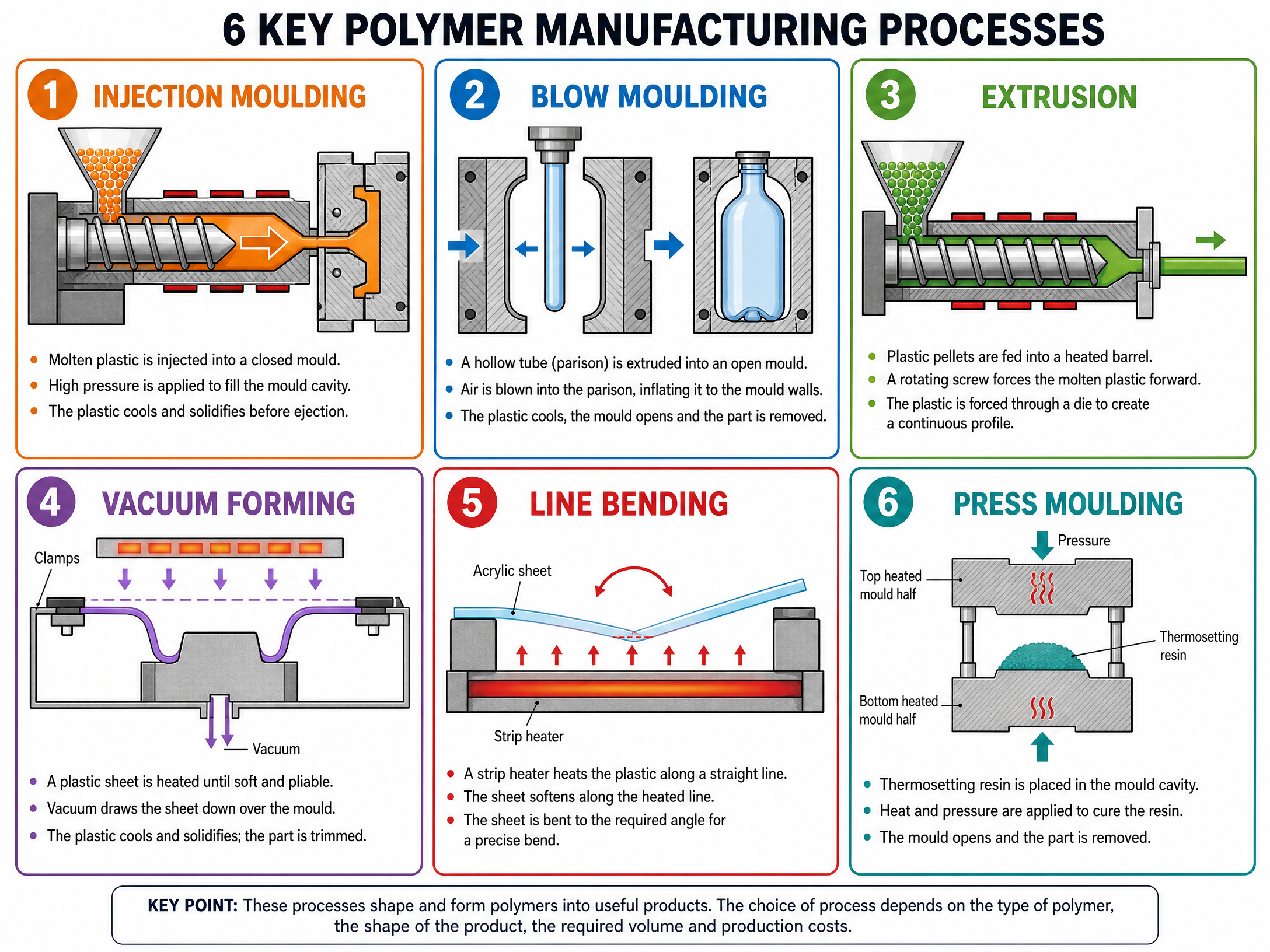
Understanding how stock forms are converted into products is vital for both your coursework and the written exam. You must be able to describe these processes sequentially.
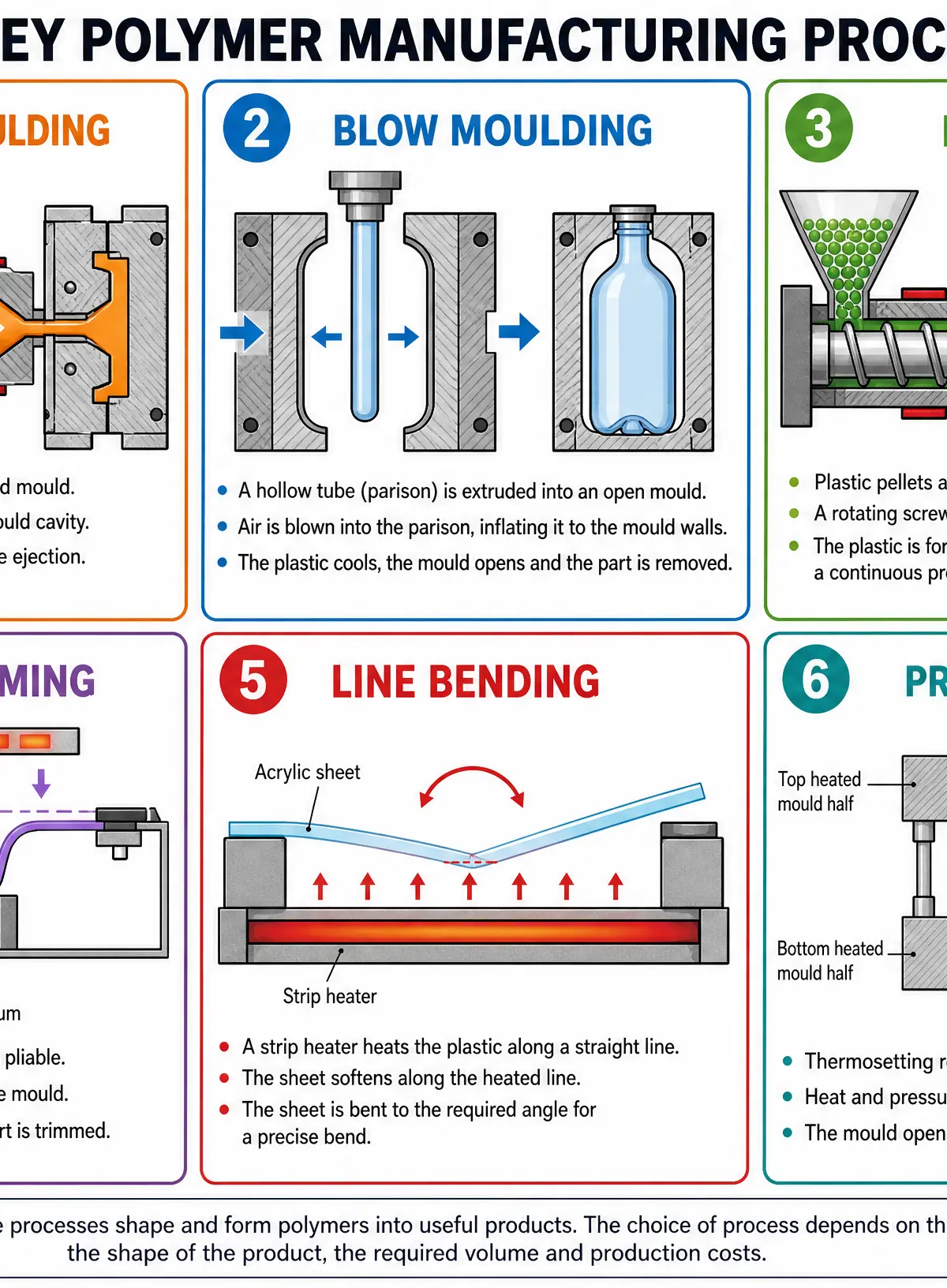
- Vacuum Forming: Used for thermoforming polymer sheets (like HIPS). The sheet is heated until pliable, then a vacuum draws it down tightly over a mould. Ideal for batch production of items like yoghurt pots or custom packaging.
- Injection Moulding: Used for complex 3D shapes. Polymer granules are melted and forced under high pressure into a closed split mould. Used for high-volume mass production of items like ABS LEGO bricks or casing parts.
- Blow Moulding: Used to create hollow products. A tube of heated polymer (a parison) is extruded into a mould, and air is blown inside to force the polymer against the mould walls. The standard process for PET drinks bottles.
- Line Bending: A strip heater is used to heat a narrow line on a thermoforming polymer sheet (like Acrylic) until it softens, allowing it to be bent to a precise angle. Common in school workshops for making display stands.
Social and Ecological Footprint
Examiners are increasingly setting extended response questions on sustainability. You must understand the full lifecycle impact:
- Extraction: Drilling for crude oil causes habitat destruction and risks oil spills, harming wildlife.
- Processing: Refining oil and polymerisation are highly energy-intensive, contributing significantly to greenhouse gas emissions.
- Disposal: While thermoforming polymers are recyclable, poor infrastructure means much ends up in landfill or oceans. Microplastics are a major threat to marine ecosystems. Thermosetting polymers are largely non-recyclable.
- Alternatives: Biopol is a biodegradable polymer derived from renewable plant sources, offering a more sustainable alternative to fossil-fuel-based plastics.
Portfolio/Coursework Guidance
Assessment Criteria
In your Non-Exam Assessment (NEA), marks are awarded for justifying your material choices. If you choose Acrylic for a prototype, you must explain why. Examiners look for clear links between the material's properties (e.g., optical clarity, ease of line bending) and the functional requirements of your design.
Building a Strong Portfolio
When documenting your practical work, photograph every stage of the manufacturing process. If you vacuum form a component, include photos of the mould creation, the heating process, and the final trimmed part. Annotate these photos using correct technical vocabulary (e.g., "I ensured the mould had a draft angle to allow the HIPS to release easily after vacuum forming").
Exam Component
Written Exam Knowledge
The theory paper will test your ability to select materials, describe processes, and evaluate environmental impacts. You will face a mix of short-answer recall questions (e.g., "Name a suitable polymer for a plug socket") and extended response questions (e.g., "Evaluate the environmental impact of using PET for drinks bottles compared to glass").
Always use the SCACE acronym (Social, Cost, Aesthetic, Cultural/Ethical, Environmental) when asked to evaluate or justify material choices in extended questions.
Interactive Diagrams
1 interactive diagram to visualise key concepts
Conceptual Flow Outline
The origins and classification of polymers.
Worked Examples
3 worked examples — open one to explore the question and available guidance.
Practice Questions
Test your understanding — click to reveal model answers
Identify one thermoforming polymer and one thermosetting polymer.
Hint: Think about materials used for bottles vs materials used for plug sockets.
Explain two reasons why Acrylic is a suitable material for an outdoor shop sign.
Hint: Think about what the sign needs to do (be seen) and where it is (outside).
Describe how you would manufacture a batch of 50 yoghurt pots using HIPS.
Hint: Which process is used for thin sheet polymers to make hollow, open shapes? Remember the sequence.
Evaluate the social and ecological footprint of using single-use PET water bottles.
Hint: Discuss both the positive social impacts (convenience, hygiene) and the negative ecological impacts (oil extraction, pollution, landfill).