Pearson Edexcel · GCSE · Design and Technology
Systems: The impact of forces and stresses on objects and how they can be reinforced and stiffened
This topic covers the critical engineering principles of how forces and stresses act upon systems, and the essential techniques used by designers to reinforce and stiffen structures against failure. Mastering these concepts is vital not only for the written exam but for justifying design decisions in your NEA portfolio.
- 6 min read
- 3 worked examples
- 3 practice questions
- 6 key terms
Study Notes
Overview
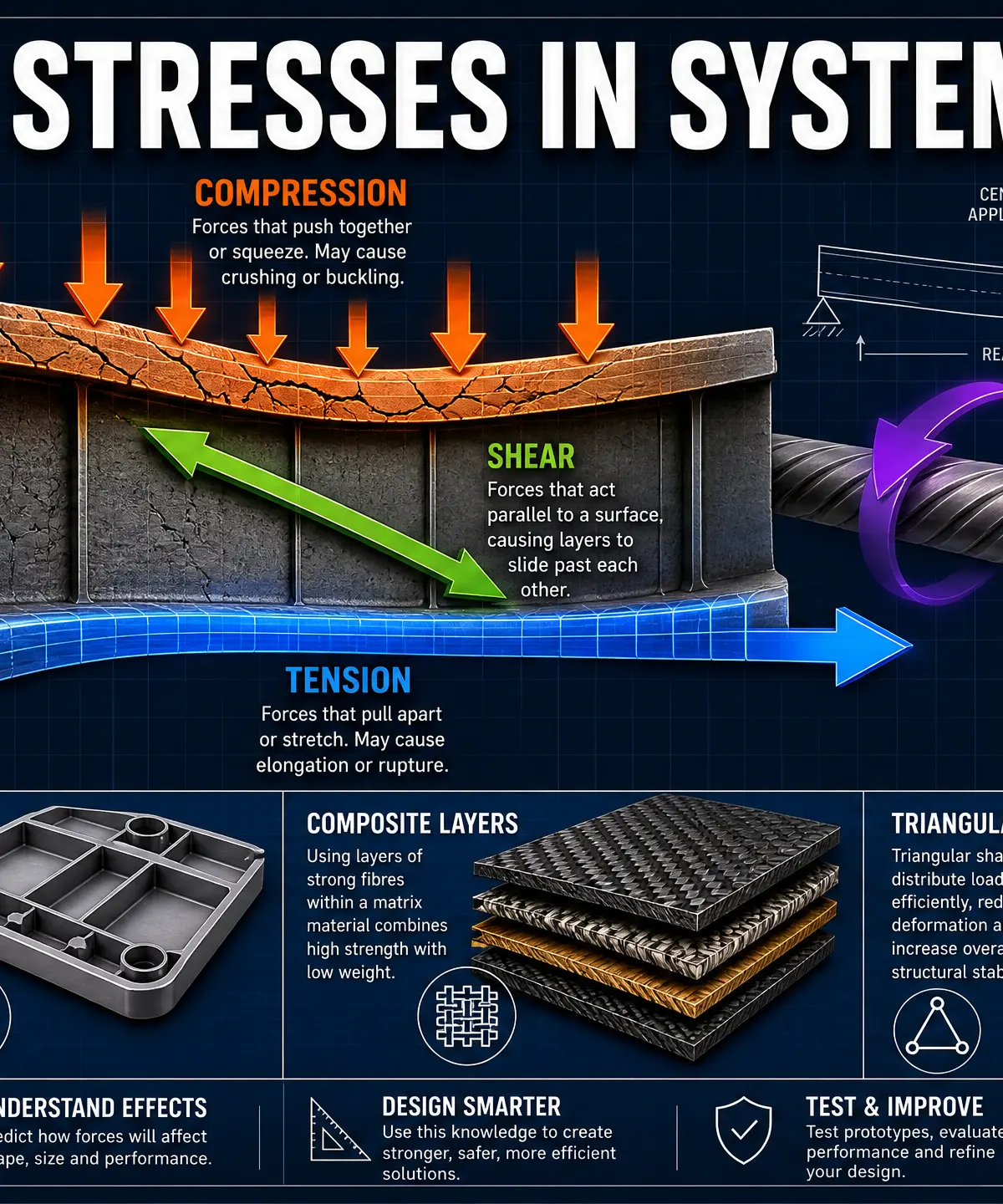
Understanding how forces act within systems is a fundamental aspect of Design and Technology. Every product, from a simple chair to a complex architectural structure, is subjected to various loads. Designers must predict these forces and employ specific reinforcement and stiffening techniques to prevent structural failure. This guide covers the four primary types of force, the concept of stress concentration, and the practical methods used to make products stronger, safer, and more efficient.
Key Knowledge & Theory
The Four Primary Forces
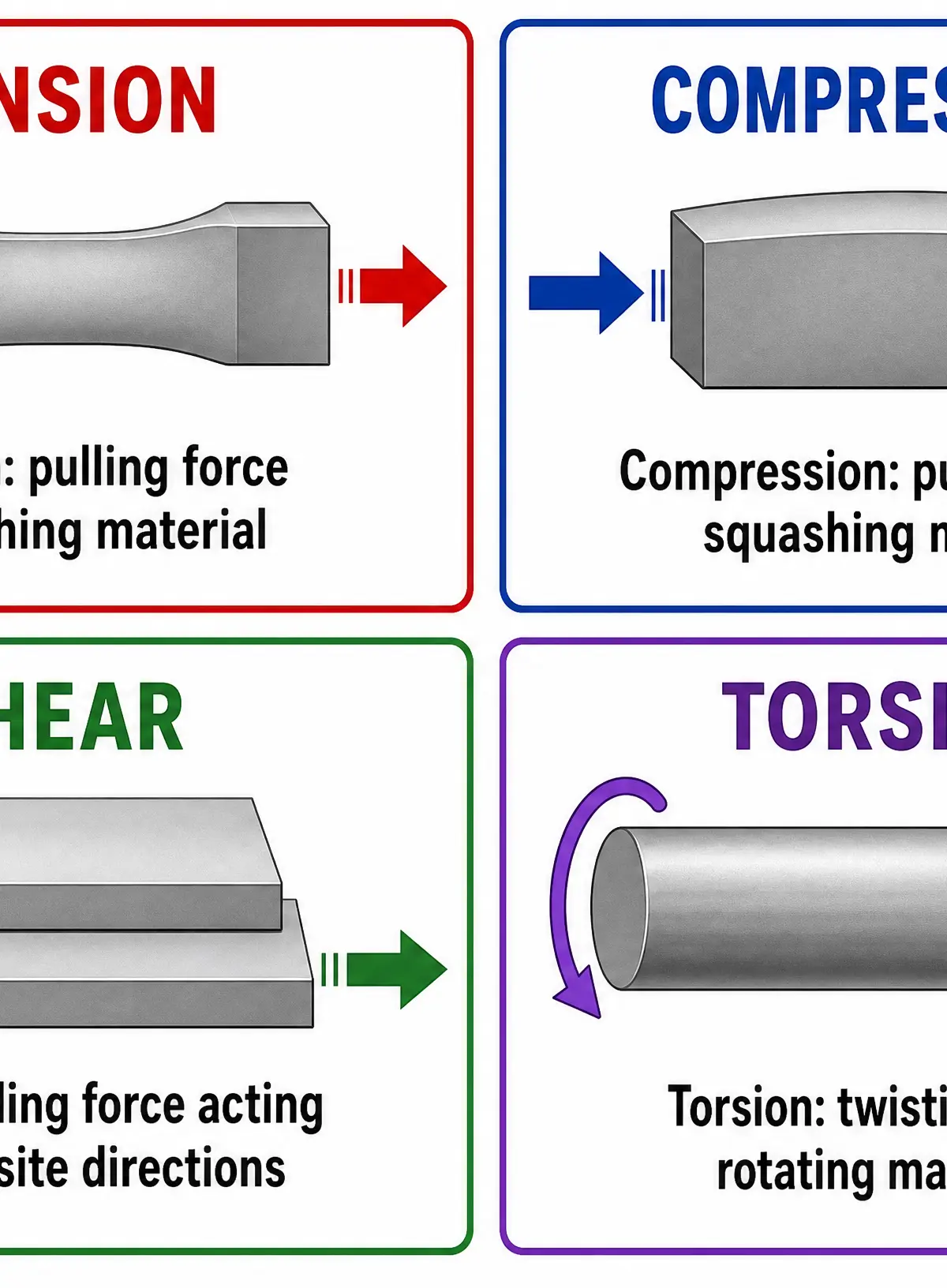
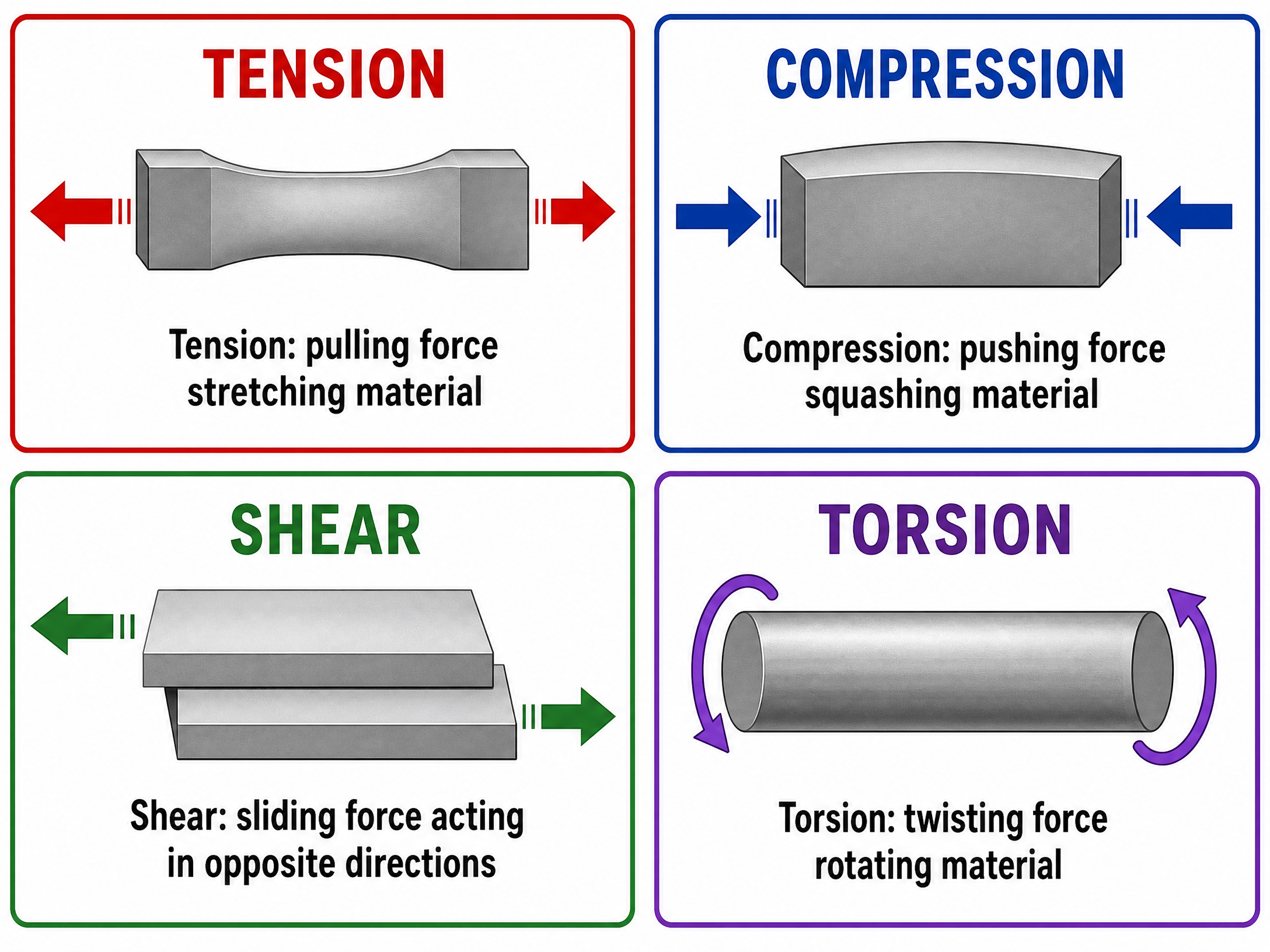
To design effective structures, candidates must be able to identify and describe the four main types of force that cause stress in materials. Stress is defined as the internal resistance of a material to a deforming force.
| Force Type | Description | Practical Example | Key Exam Vocabulary |
|---|---|---|---|
| Tension | A pulling force that stretches a material. | A crane cable supporting a load; a rubber band being pulled. | Elongation, stretching, tensile strength |
| Compression | A pushing force that squashes or shortens a material. | A table leg supporting a heavy weight; a foundation column. | Crushing, buckling, compressive strength |
| Shear | A force acting parallel to a surface, causing layers to slide past each other. | Scissors cutting paper; a rivet holding two plates together. | Sliding, opposing parallel forces, shearing stress |
| Torsion | A twisting force acting about an axis. | A screwdriver turning a screw; a vehicle drive shaft. | Twisting, rotational force, torsional failure |
Stress Concentration
When a force is applied, the resulting stress is rarely distributed evenly. It tends to concentrate at specific points, such as sharp internal corners, holes, or sudden changes in cross-section. This is known as stress concentration. To mitigate this, designers use fillets (rounded internal corners) and radii (rounded external corners) to distribute the stress more evenly, reducing the likelihood of crack propagation and failure.
Practical Skills & Application
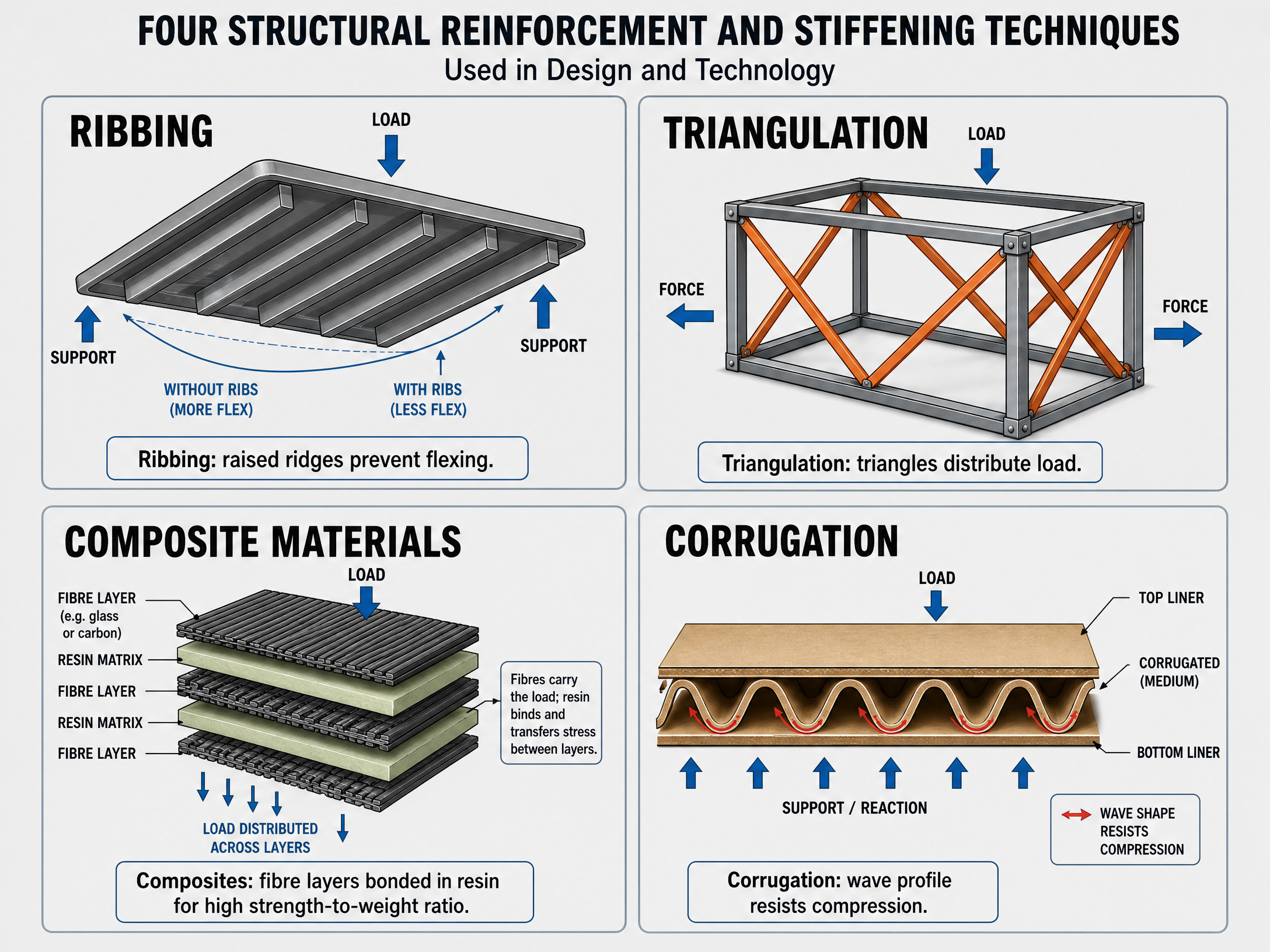
Reinforcement and Stiffening Techniques
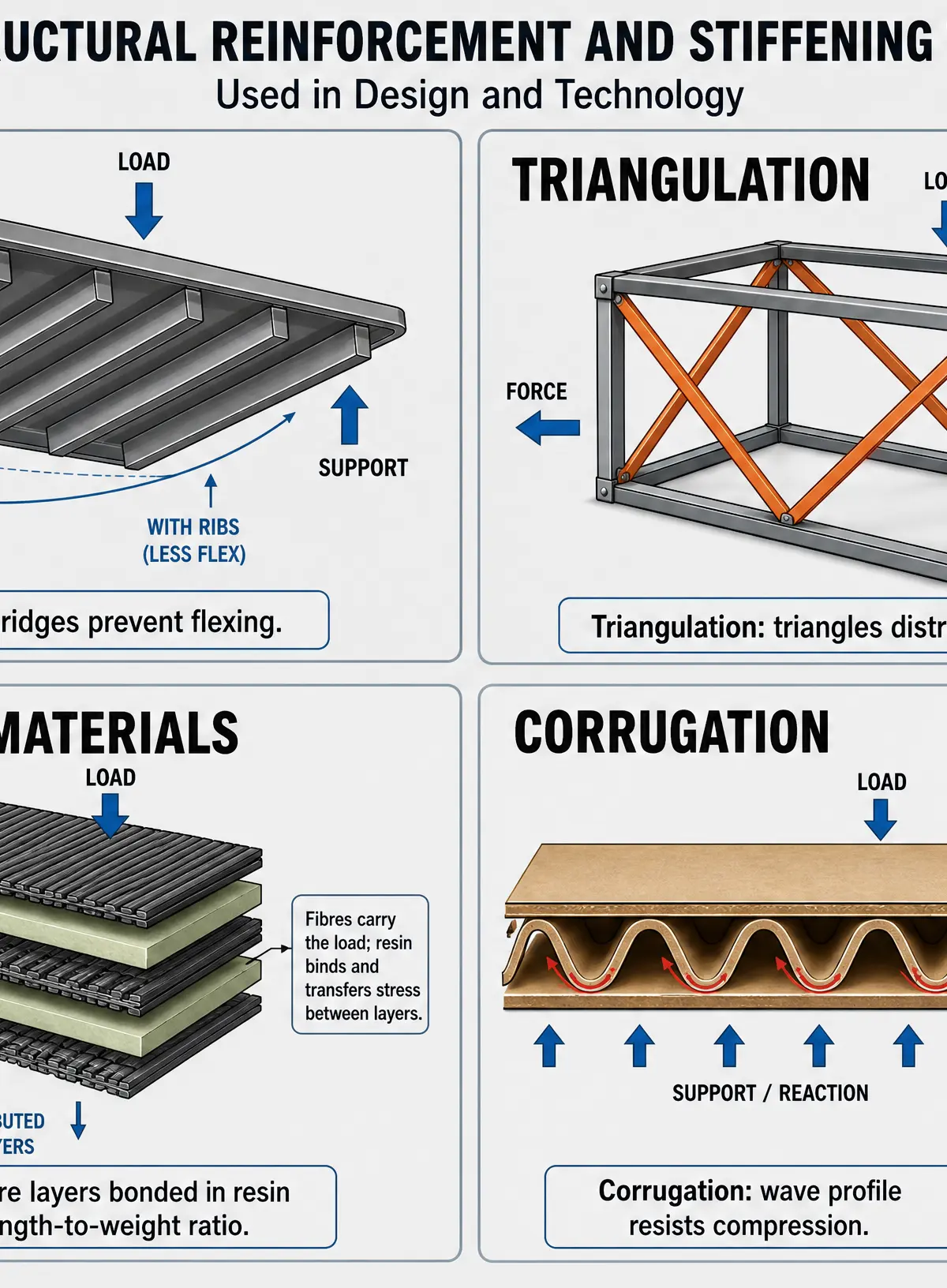
When a material alone is insufficient to resist applied forces, designers must employ reinforcement techniques. These methods increase stiffness (resistance to bending) and strength without necessarily adding significant weight.
1. Ribbing
Ribbing involves adding raised ridges (ribs) to the surface of a material, commonly seen in injection-moulded plastic casings.
- How it works: Ribs increase the effective depth of the cross-section (the second moment of area). This significantly increases the structure's resistance to bending forces (which are a combination of tension and compression) while minimizing material usage.
2. Triangulation
Triangulation is the use of triangular shapes within a framework.
- How it works: The triangle is the only geometric shape that is inherently rigid; it cannot be deformed without changing the length of one of its sides. By incorporating diagonal bracing into a square frame, the load is distributed, preventing the frame from 'racking' (collapsing sideways under shear forces).
3. Composite Materials
Composites combine two or more materials to create a new material with superior properties.
- How it works: In Glass-Reinforced Plastic (GRP), strong glass fibres (which resist tension) are embedded in a polymer resin matrix (which binds them and resists compression). This results in an exceptional strength-to-weight ratio.
4. Corrugation
Corrugation involves forming a material into a wave-like profile, such as corrugated cardboard or steel roofing.
- How it works: The fluted shape acts as a series of continuous arches. This profile converts compressive loads into a combination of tension and compression along the curves, dramatically increasing the material's stiffness compared to a flat sheet.

Portfolio/Coursework Guidance
Assessment Criteria
Examiners look for clear evidence that you have considered forces and stresses in your Non-Exam Assessment (NEA). High marks are awarded to candidates who actively use reinforcement techniques to solve structural problems in their prototypes.
Building a Strong Portfolio
- Annotation: When sketching initial ideas, explicitly annotate where forces will act. Use arrows to show tension, compression, shear, or torsion.
- Development: Document how your design evolved to handle these forces. Did you add ribbing to a 3D-printed part? Did you use triangulation in a timber frame? Explain why.
- Testing: Include photographs of physical testing. If a prototype fails, analyse the failure (e.g., "The joint failed under shear stress") and propose a reinforcement strategy.
Exam Component
Written Exam Knowledge
Theory questions on this topic often require you to identify forces from a diagram, explain why a specific reinforcement technique was chosen, or compare the suitability of different methods. You must use precise technical vocabulary.
Practical Exam Preparation
If your course includes a timed practical or design task, be prepared to sketch cross-sections showing reinforcement (like ribbing or corrugation) and clearly label the forces your design is intended to withstand.
Visual Resources
2 diagrams and illustrations
Interactive Diagrams
1 interactive diagram to visualise key concepts
Conceptual Flow Outline
The structural design and reinforcement process.
Worked Examples
3 worked examples — open one to explore the question and available guidance.
Practice Questions
Test your understanding — click to reveal model answers
Identify the type of force acting on the chain of a swing when a child sits on it. [1 mark]
Hint: Think about whether the chain is being stretched or squashed.
A manufacturer is designing a lightweight aluminium stepladder. Explain two ways the manufacturer could ensure the ladder is stiff enough to support a person safely. [4 marks]
Hint: Consider the shape of the metal extrusions and how the steps connect to the sides.
Evaluate the use of Glass-Reinforced Plastic (GRP) compared to solid timber for the hull of a small boat. [6 marks]
Hint: Discuss strength-to-weight ratio, resistance to specific forces, and environmental factors.