Pearson Edexcel · GCSE · Design and Technology
Systems: The sources, origins, physical and working properties of components and systems and their social and ecological footprint
This topic covers the fundamental building blocks of electronic systems, moving from input sensors through processing components to output devices. It crucially connects this technical knowledge to the real-world social and ecological impacts of manufacturing, using, and disposing of these technologies.
- 6 min read
- 3 worked examples
- 4 practice questions
- 6 key terms
Study Notes
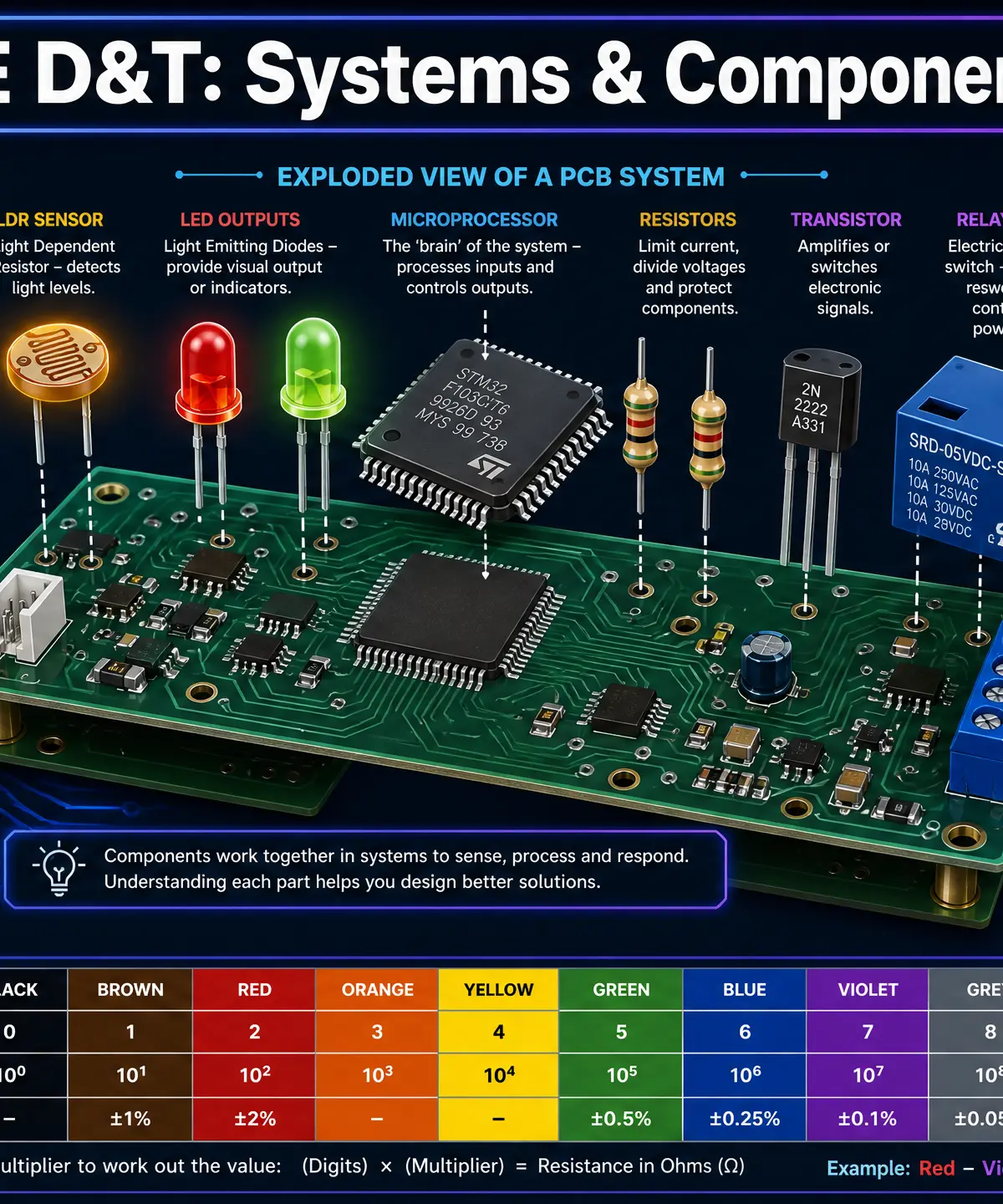
Overview
In GCSE Design and Technology, understanding systems is about recognising how individual components work together to sense the environment, process information, and produce a response. This topic (5.2) covers not only the technical function of these components but also the physical properties of the materials used to house them, and critically, the global social and ecological footprint of their production and disposal.
Key Knowledge & Theory
The Systems Approach
Almost all electronic systems can be broken down into three stages:
- Input: Where information or energy enters the system, typically via a sensor.
- Process: Where the input signal is evaluated or modified, typically by a control device.
- Output: Where the system responds with a physical action, light, or sound.
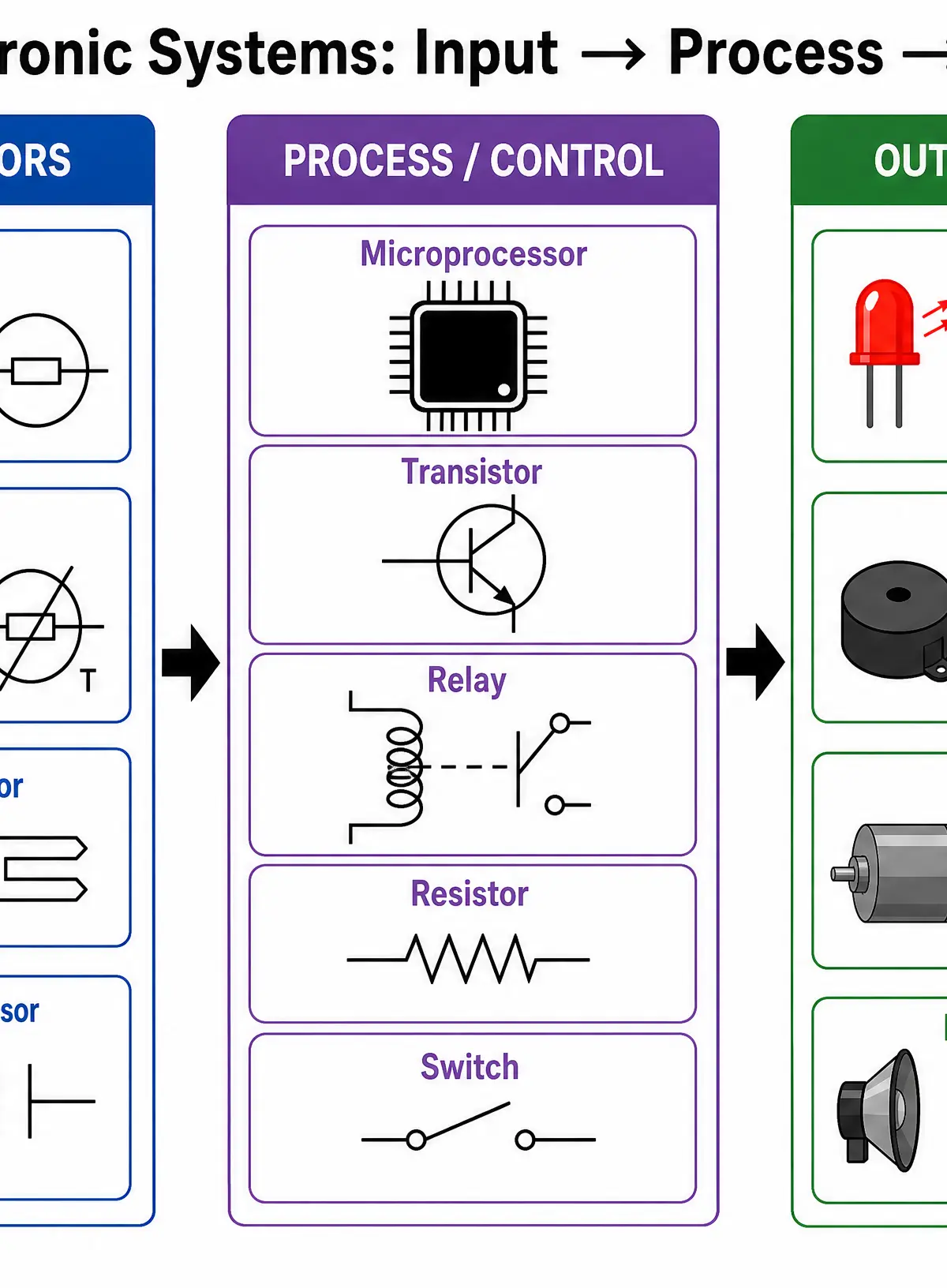
Core Components
Input Devices (Sensors)
- Light Dependent Resistor (LDR): A sensor whose resistance decreases as light intensity increases. Used in automatic street lighting and camera exposure controls.
- Thermistor: A temperature-sensitive resistor. Most are Negative Temperature Coefficient (NTC), meaning resistance decreases as temperature rises. Used in central heating thermostats and digital thermometers.
- Moisture Sensor: Detects the presence of water by completing a circuit between two conductive probes. Used in automated irrigation systems.
- Piezoelectric Sensor: Generates a small electrical voltage when physically deformed or subjected to vibration. Used in knock sensors and electronic drum pads.
Process/Control Devices
- Transistor: A solid-state semiconductor device used to amplify or switch electrical signals and power. A small current at the base terminal controls a much larger current between the collector and emitter.
- Relay: An electromechanical switch. A low-power signal energises an electromagnet, which pulls a physical contact to close a separate, high-power circuit. Essential for safety when interfacing low-voltage logic with mains electricity.
- Microprocessor: A programmable integrated circuit that acts as the 'brain' of a system, executing stored instructions to process inputs and control outputs.
- Resistor: A component designed to introduce a specific amount of resistance into a circuit, limiting current flow or dividing voltage. Resistance is calculated using Ohm's Law (V = I \times R).
Output Devices
- Light Emitting Diode (LED): A highly efficient semiconductor light source that emits light when current flows through it in the forward direction.
- Buzzer: An audio signalling device that converts an electrical signal into sound.
- Motor: Converts electrical energy into rotational mechanical energy.
- Loudspeaker: Converts electrical audio signals into corresponding sound waves by moving a cone.
Material Properties for Enclosures
When designing a product, the housing must protect the electronics and the user.
- Polymers (e.g., ABS): Chosen for their toughness, durability, ease of injection moulding into complex shapes, and excellent electrical insulation properties.
- Metals (e.g., Aluminium): Used for heat sinks due to high thermal conductivity, drawing heat away from sensitive components like microprocessors.
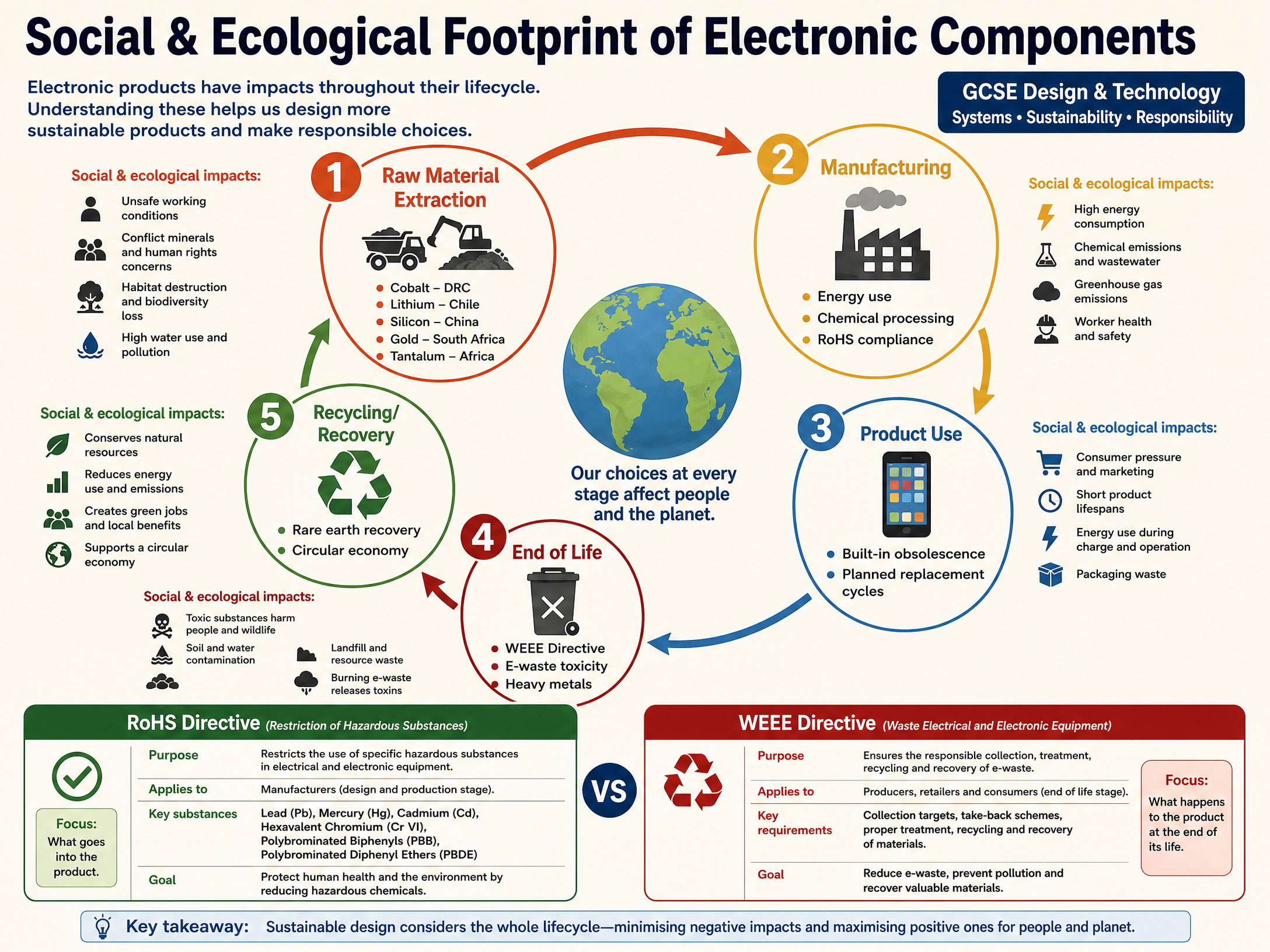
Social and Ecological Footprint
The creation and disposal of electronic components have profound global impacts. Examiners expect candidates to discuss these issues with specific examples.
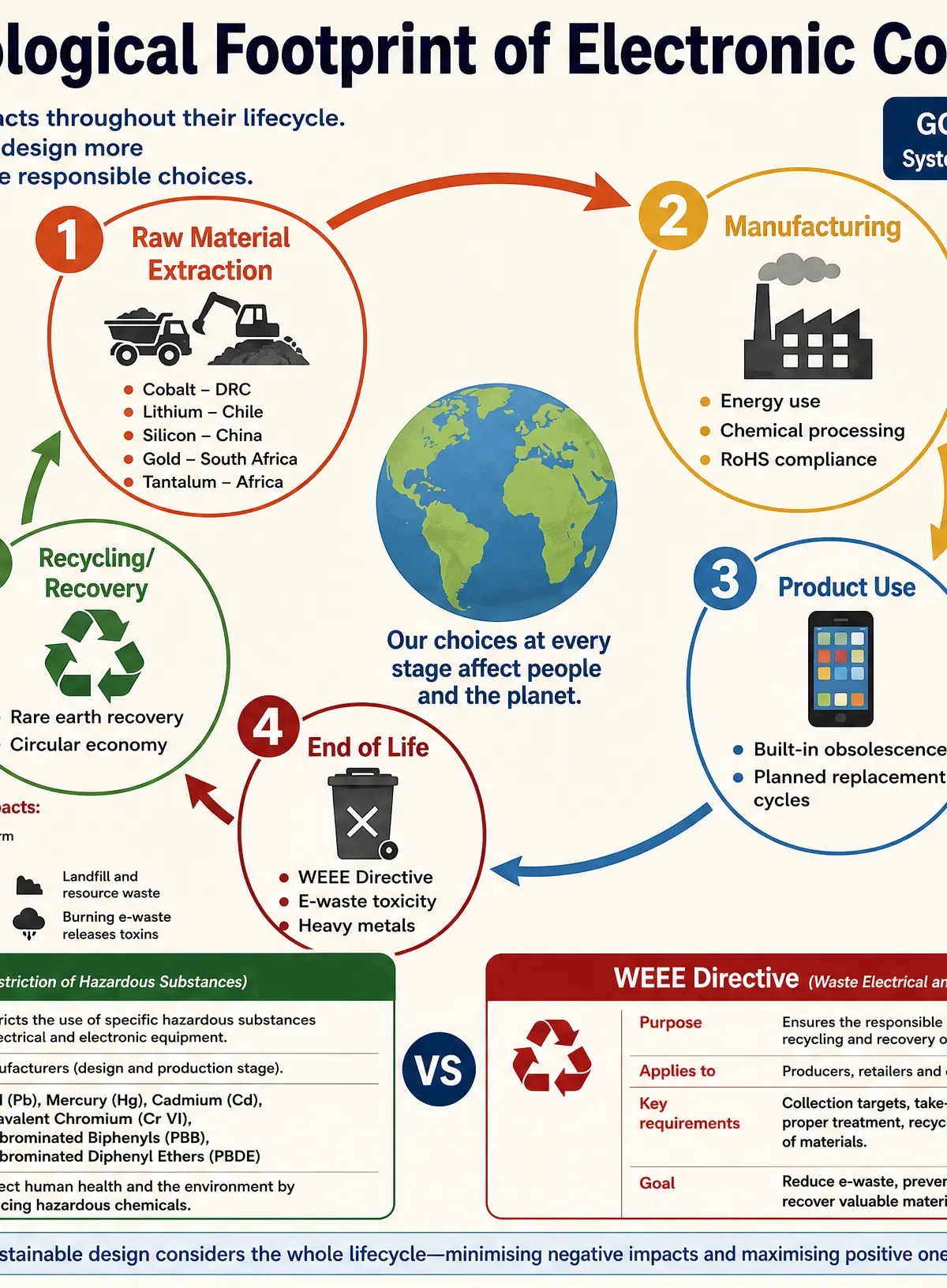
Raw Material Extraction
- Cobalt: Essential for lithium-ion batteries. Approximately 60% is mined in the Democratic Republic of Congo (DRC), often involving hazardous working conditions, child labour, and significant environmental degradation (Social and Ecological impact).
- Lithium: Extracted from salt flats in South America (Chile, Argentina). The process is highly water-intensive, threatening local ecosystems and indigenous water supplies (Ecological and Social impact).
- Tantalum: Derived from coltan, mined in Central Africa. Historically linked to funding armed conflict, earning it the label of a "conflict mineral" (Social impact).
- Silicon: The foundation of microchips. While silica is abundant, the purification process requires massive amounts of energy, contributing to greenhouse gas emissions if powered by fossil fuels (Ecological impact).
End of Life and Legislation
- Built-in Obsolescence: Designing products with an artificially limited useful life to encourage repeat purchases. This drives up resource consumption and waste generation.
- WEEE Directive (Waste Electrical and Electronic Equipment): European legislation requiring manufacturers to take responsibility for the collection, treatment, and recycling of e-waste to divert toxic materials (like heavy metals) from landfill.
- RoHS Directive (Restriction of Hazardous Substances): Legislation restricting the use of specific hazardous materials (like lead and mercury) in the manufacture of electronic and electrical equipment.
Audio Revision
Listen to this 16-minute revision podcast covering all the key concepts, exam tips, and a quick-fire recall quiz.

Visual Resources
2 diagrams and illustrations
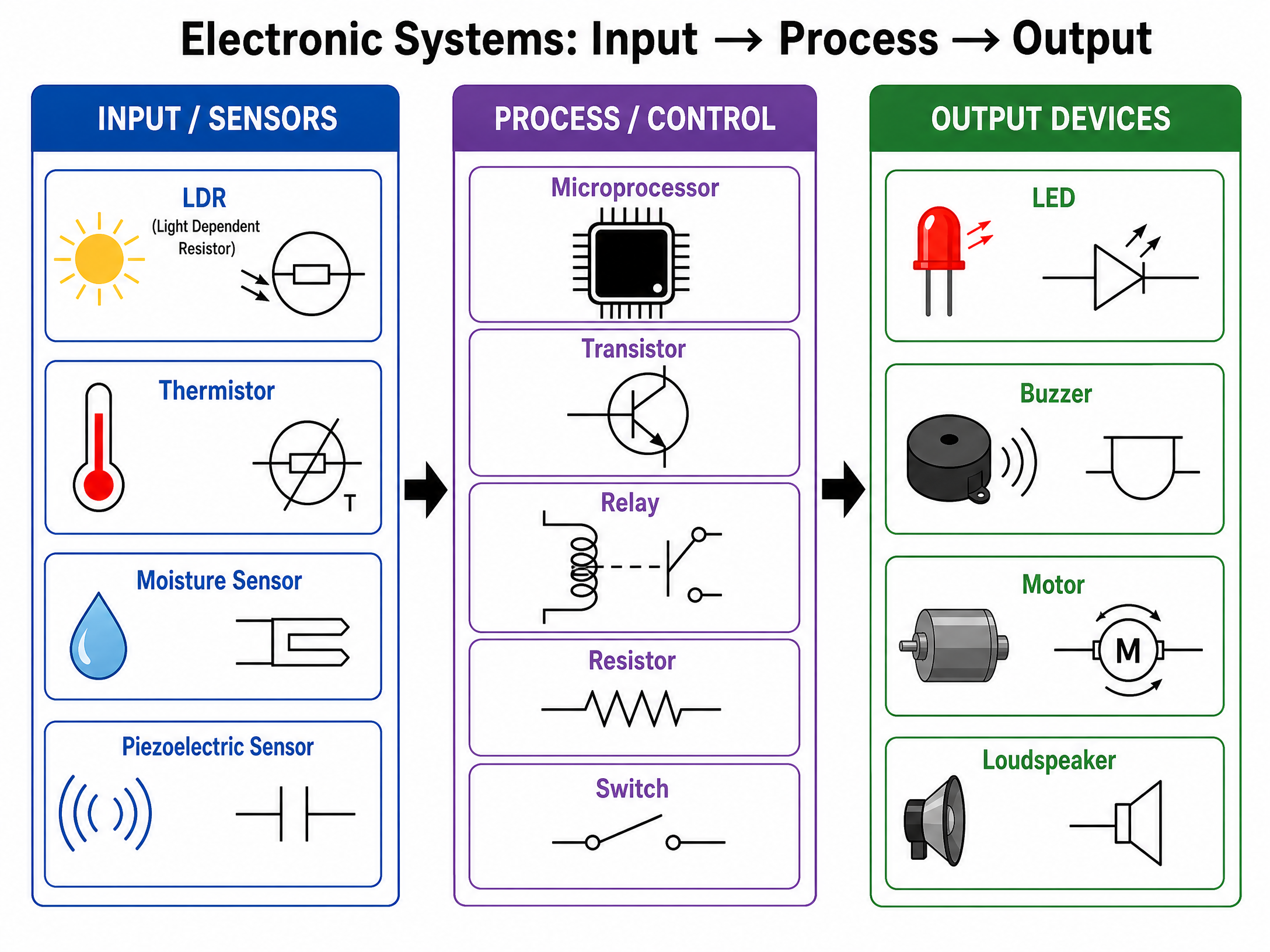
Interactive Diagrams
1 interactive diagram to visualise key concepts
Conceptual Flow Outline
Example signal flow from various sensors through processing logic to outputs.
Worked Examples
3 worked examples — open one to explore the question and available guidance.
Practice Questions
Test your understanding — click to reveal model answers
Identify the sensor that would be most appropriate for an automated garden watering system. (1 mark)
Hint: Think about what physical property needs to be detected in the soil.
A resistor has the colour bands Brown, Black, Red, Silver. Calculate its resistance and tolerance. (2 marks)
Hint: Use the mnemonic: Black Bears Rarely... Brown is 1, Black is 0, Red is the multiplier.
Explain two reasons why ABS polymer is frequently used for the external casing of electronic consumer products. (4 marks)
Hint: Think about safety (electricity) and durability in everyday use.
Analyse the ethical and environmental considerations a manufacturer must take into account when sourcing materials for a new smartphone. (6 marks)
Hint: Discuss specific materials (like Cobalt and Tantalum), where they come from, and the legislation (RoHS) governing the manufacturing process.