Pearson Edexcel · GCSE · Design and Technology
Textiles: Alternative processes that can be used to manufacture typical textile products to different scales of production
This topic covers the alternative manufacturing processes used to cut, shape, and produce textile products across different scales of production. Understanding these methods is essential for answering exam questions that ask you to justify how and why a product is manufactured efficiently.
- 7 min read
- 1 worked example
- 4 practice questions
- 6 key terms
Study Notes
Overview
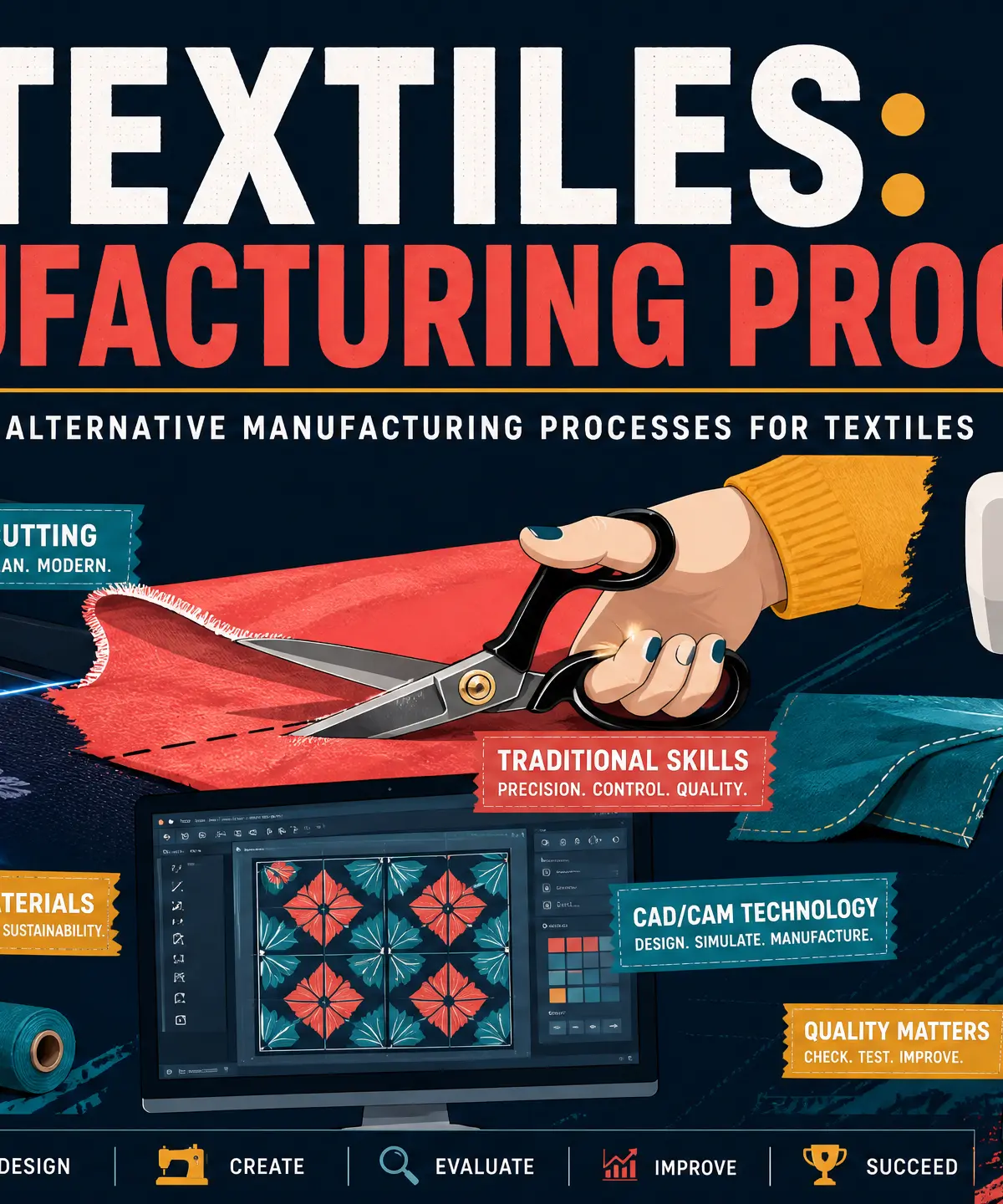
In GCSE Design and Technology: Textiles, understanding how products are manufactured in the real world is just as important as knowing how to design them. Topic 6.6 focuses on the alternative manufacturing processes used to cut and shape materials, and the techniques employed to ensure consistency and efficiency across different scales of production. Examiners frequently test your ability to not only name these processes but to justify why a specific method is appropriate for a given product and scale.
Listen to the revision podcast below for an in-depth review of these concepts:

Key Knowledge & Theory
Core Concepts: Scales of Production
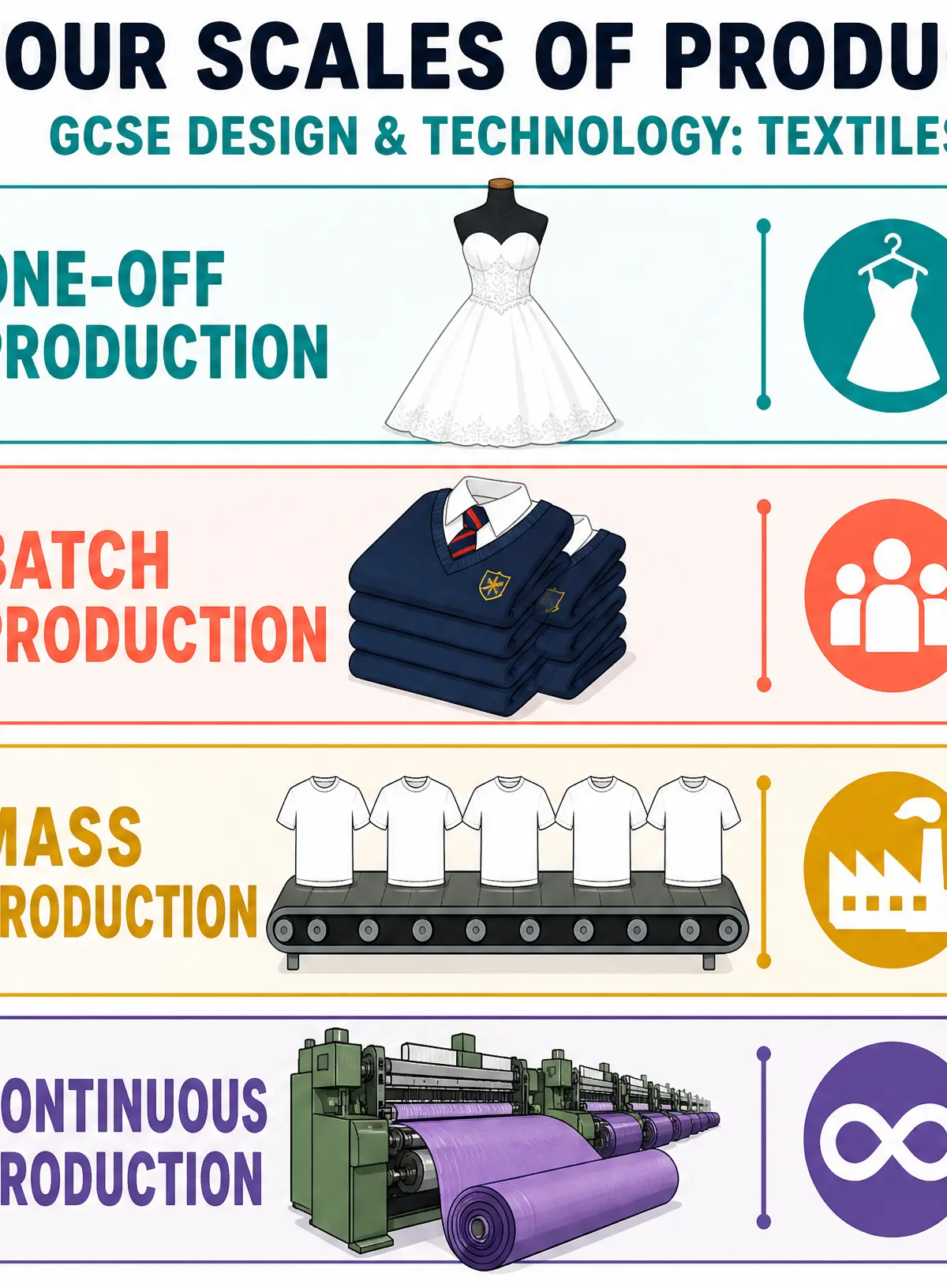
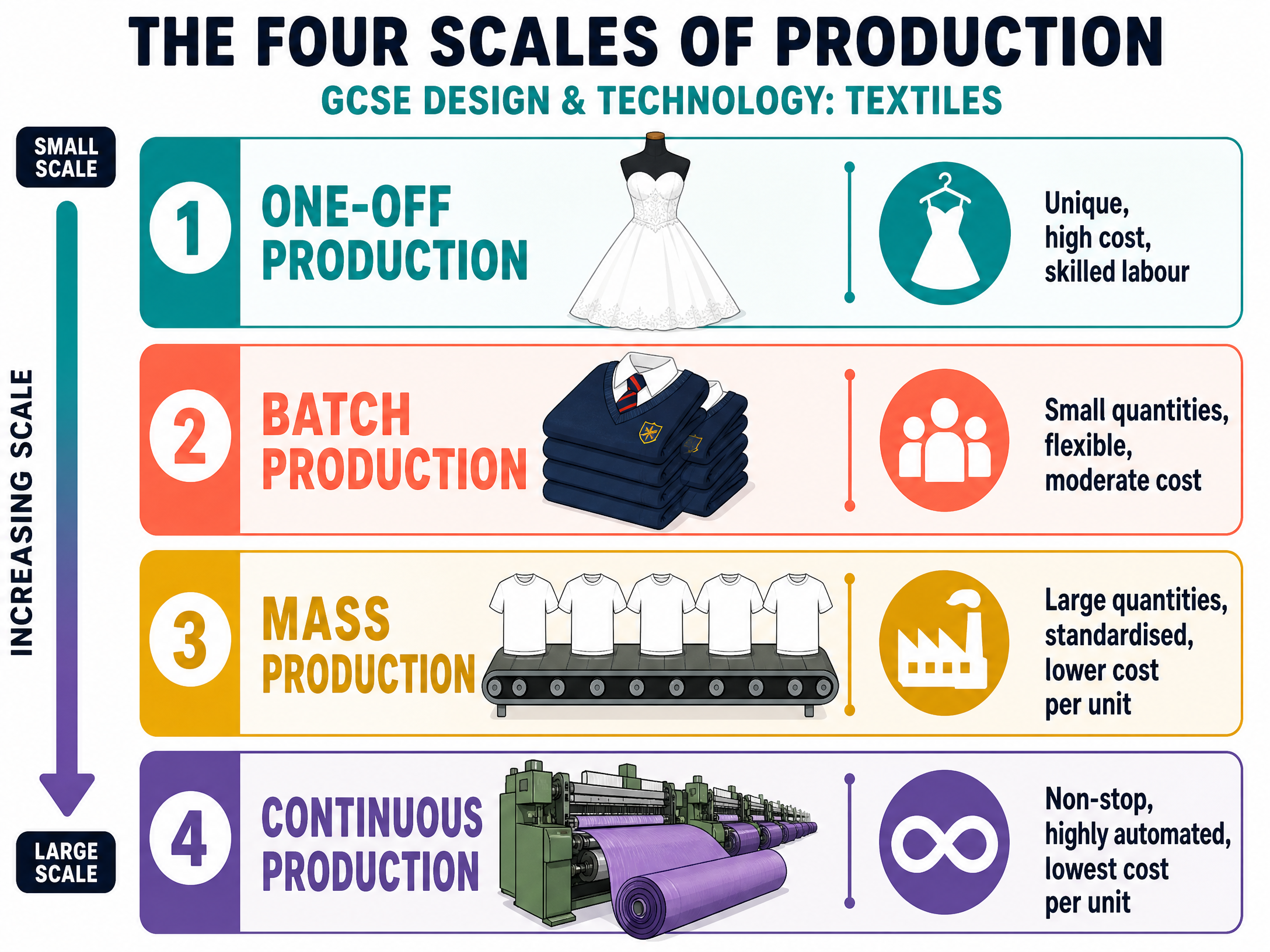
The scale of production refers to how many identical products are being made. This directly dictates the manufacturing processes, tools, and machinery used. There are four main scales you must know:
- One-off (Bespoke) Production: A single, unique item is made to a client's specific requirements. This relies heavily on skilled labour, uses traditional tools (like shears), and has the highest cost per unit. Example: A custom-made wedding dress or a bespoke theatre costume.
- Batch Production: A set quantity (a 'batch') of identical products is made. Once the batch is finished, the machinery can be reconfigured to make something else. This offers flexibility and a lower cost per unit than one-off production. Example: A seasonal fashion collection or school uniforms.
- Mass Production: Large quantities of identical products are manufactured continuously on a production line. The line is broken down into sub-assemblies, where workers or machines perform one specific task repeatedly. This is highly efficient and has a very low cost per unit, but setting up the machinery is expensive and inflexible. Example: High-street t-shirts or standard denim jeans.
- Continuous Production: The factory runs 24/7 without stopping, producing massive volumes of standard products. This is highly automated with the lowest cost per unit, but the initial setup cost is astronomical. In textiles, this is used for raw materials rather than finished garments. Example: Weaving rolls of cotton fabric or extruding polyester yarn.
Technical Vocabulary
To access the highest marks in your exam, you MUST use accurate technical terminology:
- CAM (Computer-Aided Manufacturing): Using computer-controlled machinery (like laser cutters) to manufacture products.
- Sub-assembly: Breaking down the manufacturing process into smaller stages, where parts are assembled separately before the final product is put together.
- Tolerance: The acceptable margin of error or variation in a measurement (e.g., a seam allowance of ±2mm).
- Quality Control (QC): Checks carried out during the manufacturing process to ensure the product meets the required standard.
Practical Skills
Techniques & Processes: Cutting and Shaping
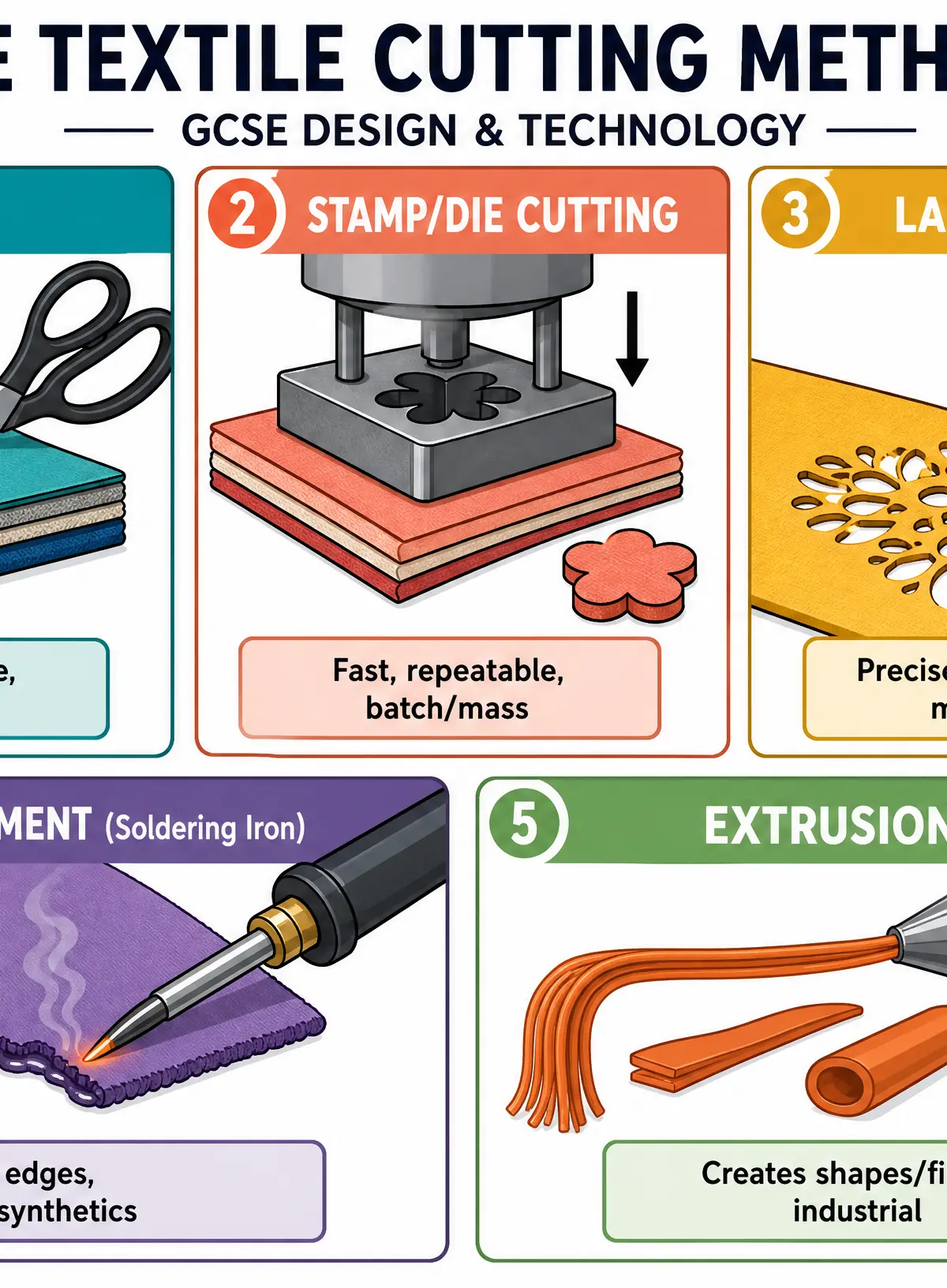
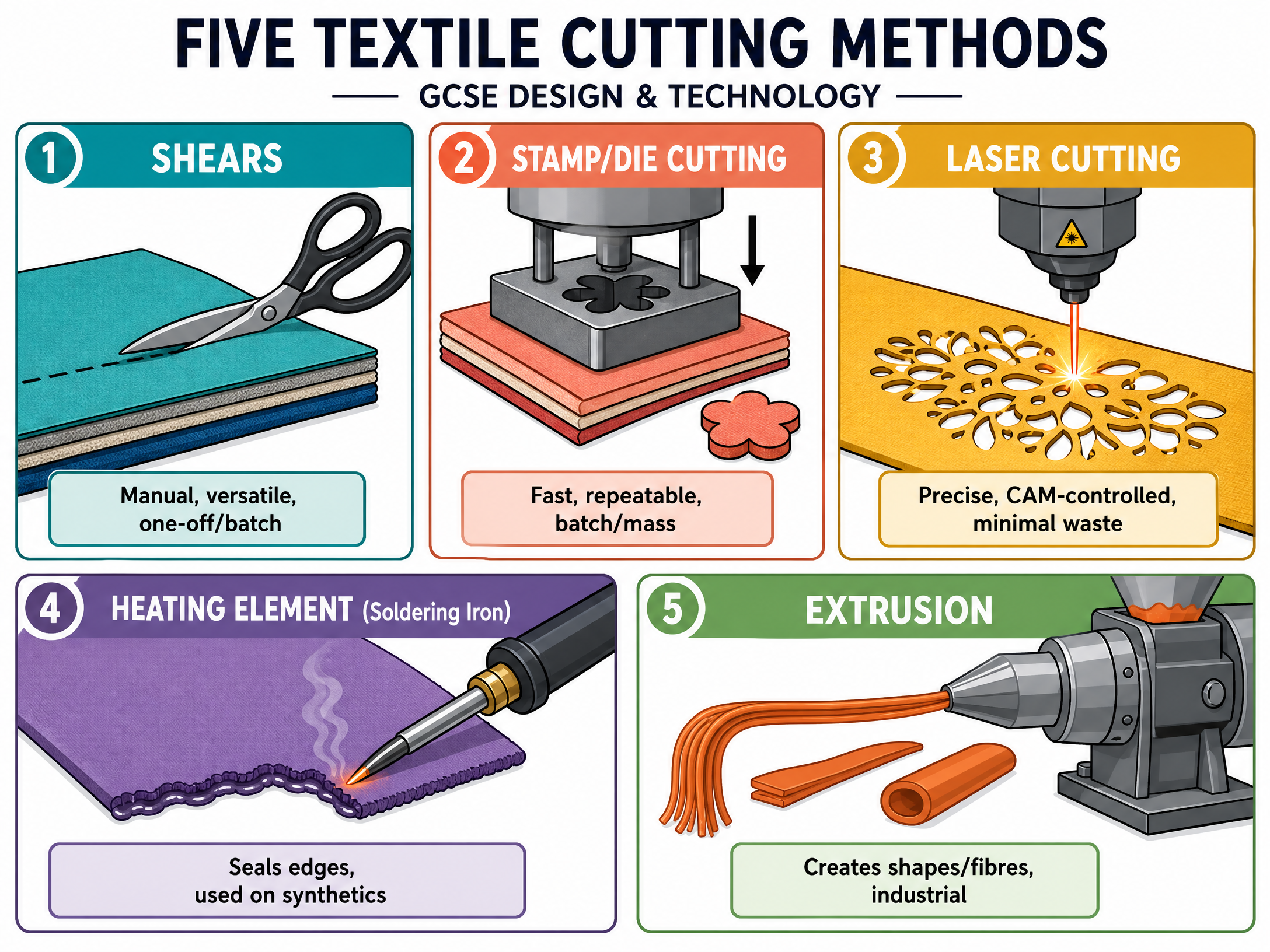
Before a textile product can be assembled, the fabric must be cut accurately. The method chosen depends entirely on the scale of production and the material being used.
- Shears: Large, heavy-duty scissors operated manually. They are versatile and require no setup, making them ideal for one-off production. However, they are slow and accuracy relies entirely on the skill of the operator.
- Stamp/Die Cutting: A shaped metal blade (the die) is pressed down through multiple layers of fabric using a hydraulic press, much like a giant cookie cutter. This is extremely fast and ensures every piece is identical. It is widely used in batch and mass production.
- Laser Cutting: A CAM process where a computer-controlled laser beam cuts the fabric. It is highly precise, can cut complex shapes impossible by hand, and minimises waste. Crucially, when used on synthetic fabrics, the heat of the laser seals the edges, preventing fraying without the need for additional finishing. Used in batch and mass production.
- Heating Element (Soldering Iron/Hot Wire): Used specifically for synthetic fabrics (like nylon or polyester). The hot tool melts the fibres as it cuts, sealing the edge to prevent fraying. Often used for finishing edges or cutting simple shapes.
- Extrusion: Unlike the other methods, extrusion creates new material rather than cutting existing fabric. Molten polymer is forced through a shaped nozzle (a spinneret) to form continuous filaments or fibres. This is an industrial process used in continuous production to create synthetic yarns like polyester.
Quantity Production Techniques
When manufacturing in large quantities (batch or mass), consistency is vital. Manufacturers use several techniques to ensure every product is identical and material waste is minimised:
- Templates and Patterns: A template is a rigid, pre-made shape (often card or plastic) used to draw or cut around. It eliminates human error in measuring. Patterns are the paper guides used to mark out garment pieces.
- Marking Out: Using reference points (like notches to align seams) and reference lines to guide cutting and stitching accurately.
- Pattern Lay Planning: Arranging the pattern pieces on the fabric as closely together as possible before cutting. This is often calculated by CAD software to maximise efficiency and minimise expensive fabric waste.
Portfolio/Coursework Guidance
Assessment Criteria
In your Non-Exam Assessment (NEA) portfolio, you will be assessed on your ability to select and use appropriate tools and processes. You must:
- Justify your choices: Don't just state that you used shears; explain why they were the most appropriate tool for your one-off prototype.
- Demonstrate quality control: Document the checks you made during making (e.g., measuring seam allowances to ensure they are within tolerance).
- Show commercial awareness: Even though you are making a one-off prototype, your portfolio should explain how your product could be manufactured on a larger scale (e.g., "If this bag were mass-produced, the fabric pieces would be die-cut rather than cut with shears to ensure consistency and speed.")
Exam Component
Written Exam Knowledge
Questions on manufacturing processes often appear as extended response (6-8 mark) questions. Examiners are looking for your ability to link a specific process to a scale of production and justify why it is suitable.
Always consider the cost, speed, accuracy, and material properties when evaluating a process. For example, laser cutting is excellent for accuracy and sealing synthetic edges, but the initial cost of the CAM machinery is high, making it unsuitable for a low-budget, one-off project.
Visual Resources
2 diagrams and illustrations
Interactive Diagrams
1 interactive diagram to visualise key concepts
Conceptual Flow Outline
Quality Control and Tolerance Workflow
Worked Examples
1 worked example — open one to explore the question and available guidance.
Practice Questions
Test your understanding — click to reveal model answers
Identify two methods of marking out fabric accurately before cutting. (2 marks)
Hint: Think about what you use to draw around, or marks placed on the fabric to help align pieces.
Explain one advantage of using sub-assembly in the mass production of a denim jacket. (2 marks)
Hint: Think about how breaking the job down affects the workers' speed and skill.
A designer is creating a limited edition run of 50 intricate, laser-cut silk scarves. Explain why batch production is the most appropriate scale of production for this product. (3 marks)
Hint: Define batch production and link its characteristics to the numbers and flexibility required for a 'limited edition'.
Evaluate the use of die cutting compared to laser cutting for manufacturing 10,000 simple, circular cotton patches. (6 marks)
Hint: Think about the material (cotton is natural, so how does it react to a laser?) and the shape (a simple circle doesn't need complex CAM).