Pearson Edexcel · GCSE · Design and Technology
Textiles: Typical stock forms, types and sizes used to calculate and determine the required quantity of textiles
This comprehensive guide covers the essential textile stock forms, standard fabric widths, and yarn measurements required for GCSE Design and Technology. It bridges theoretical knowledge with practical application, focusing on how to calculate fabric quantities efficiently and justify material choices in exam scenarios.
- 7 min read
- 3 worked examples
- 4 practice questions
- 6 key terms
Study Notes
Overview
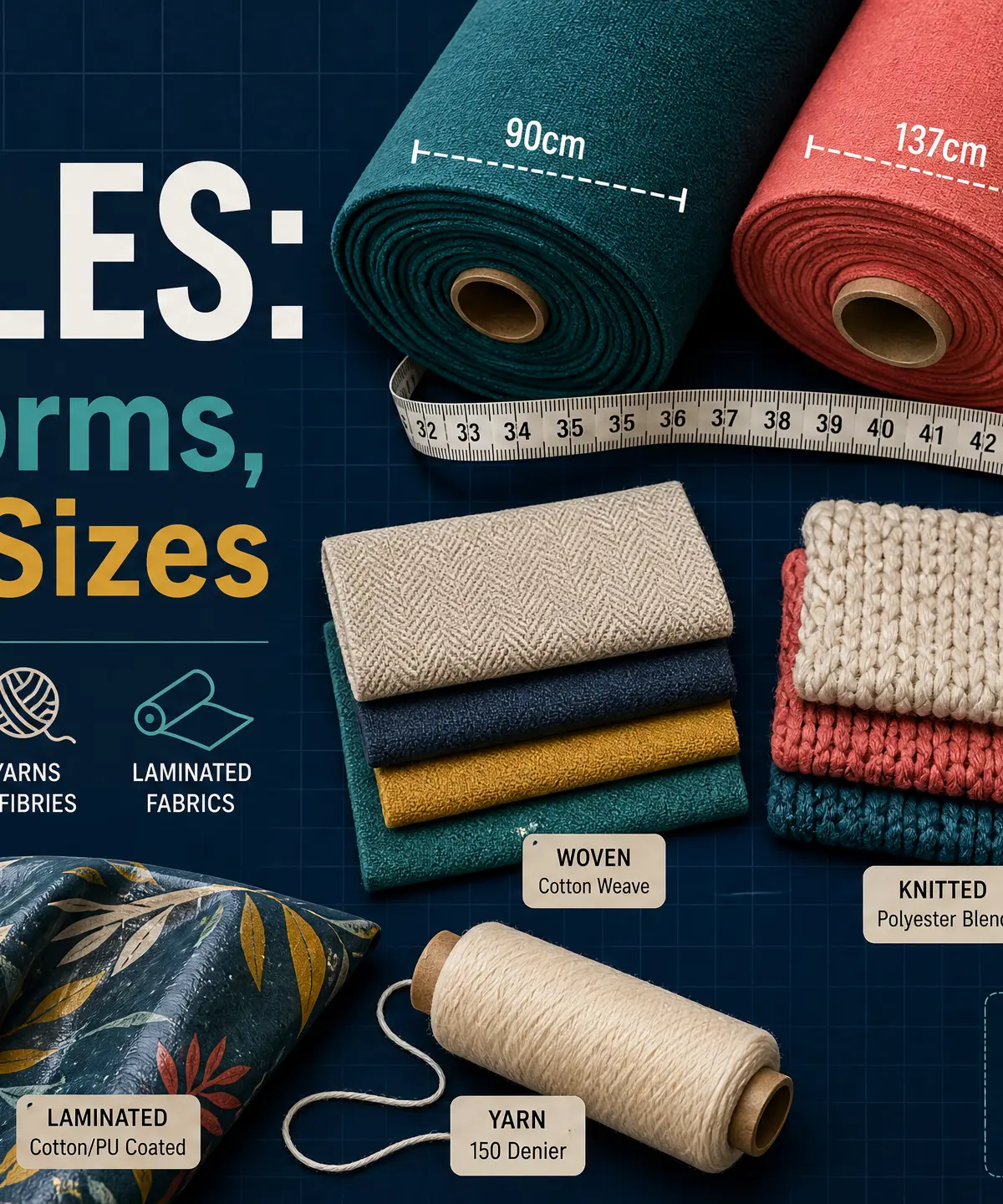
Welcome to Topic 6.5: Textiles stock forms, types, and sizes. This area of the specification bridges your theoretical knowledge of fibres with the practical realities of manufacturing. Examiners test this topic rigorously because it demonstrates whether you can think like a commercial designer: selecting the right format of material, calculating precise quantities to minimise waste, and justifying those choices based on product function.
Listen to the topic overview podcast below before diving into the details:

Key Knowledge & Theory
Standard Stock Forms
When materials are processed into standard formats for commercial sale and manufacturing, these are called stock forms. Understanding these forms is critical for your coursework planning and the written exam.
| Stock Form | Description | Typical Applications |
|---|---|---|
| Fabric Rolls | The most common form. Fabric wound onto cardboard tubes, sold by the metre. | Dressmaking, upholstery, mass-production garments |
| Blocks/Squares | Flat pieces of fabric cut to specific dimensions (e.g., 'fat quarters'). | Quilting, patchwork, small craft items |
| Yarn/Thread | Spun fibres wound onto cones, cops, or bobbins. | Knitting, weaving, sewing, embroidery |
| Laminates | Composite materials supplied on rolls, consisting of bonded layers. | Waterproof outdoor gear, technical textiles |
Standard Fabric Widths
Examiners expect you to know standard fabric widths because they directly impact pattern layout and cost calculations.
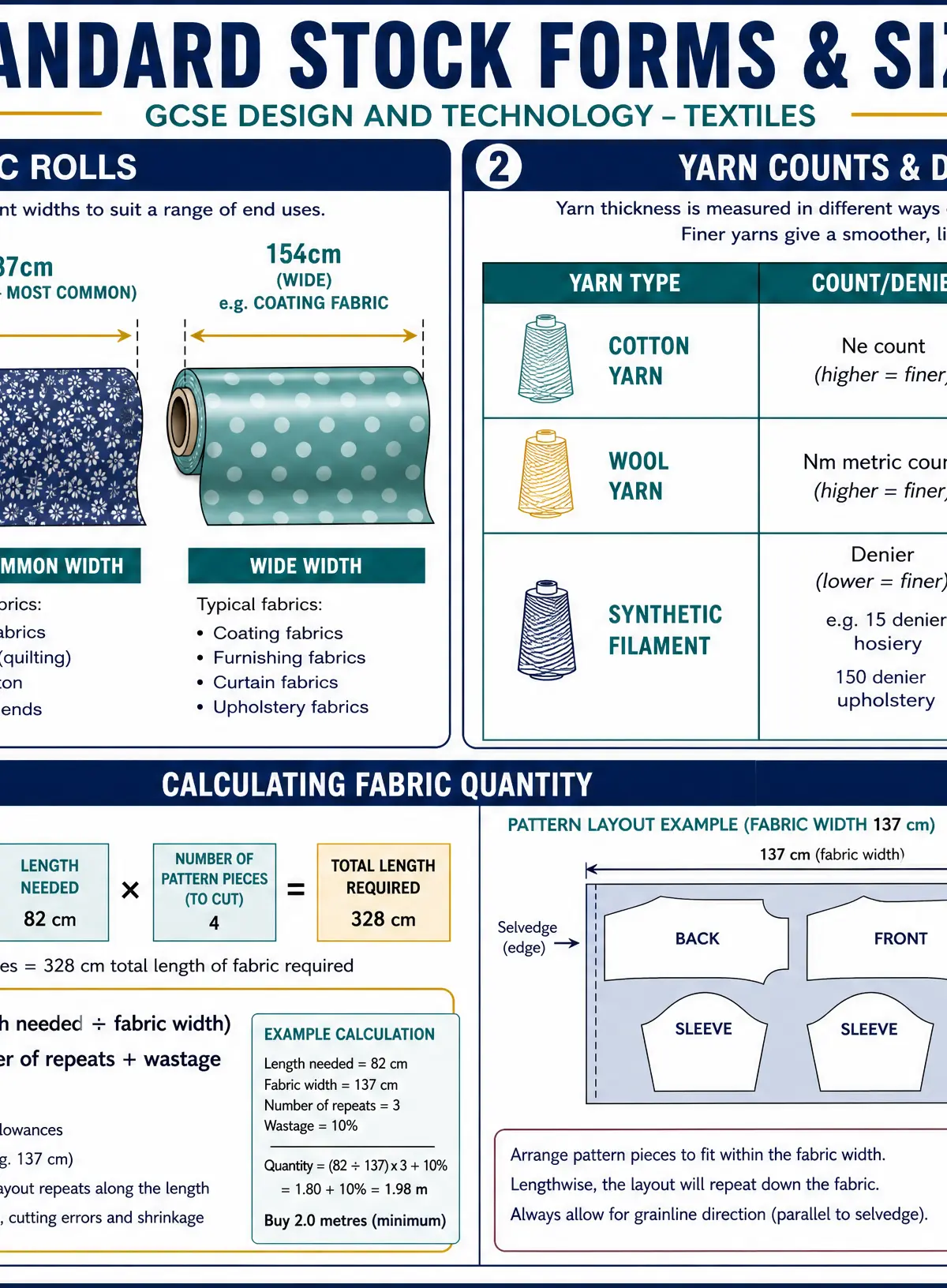
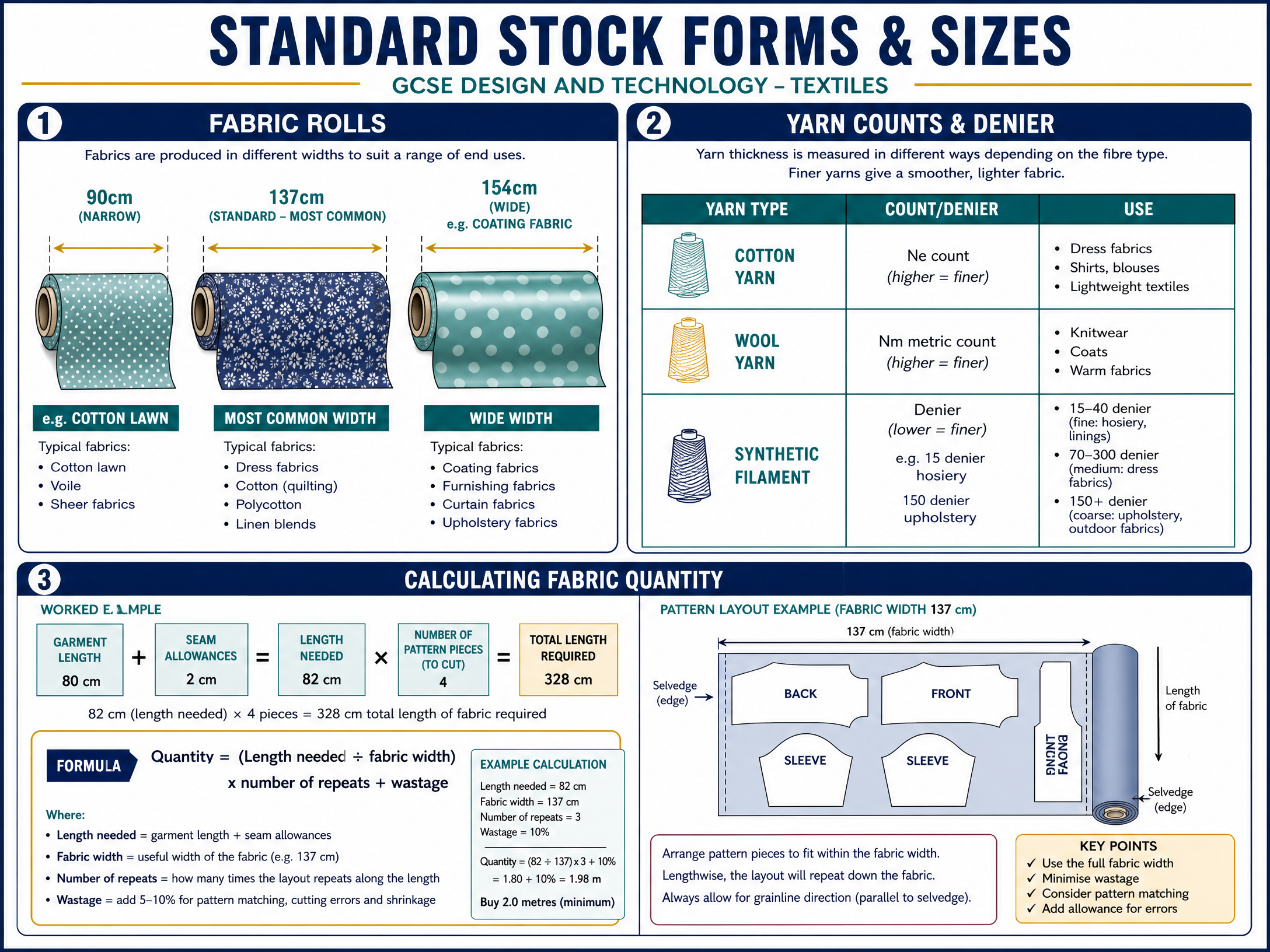
- 90 cm (Narrow): Often used for fine fabrics, sheer materials, and traditional cotton lawn.
- 137 cm (Standard): The most common width. Used for dressmaking fabrics, polycottons, and general textiles.
- 154 cm (Wide): Used for coating fabrics, heavy furnishings, and curtains where wider panels are needed.
Yarn Measurement Systems
You must understand how yarn thickness is measured, as this dictates the weight and feel of the final fabric.
**Denier (Synthetic Fibres)**Used for continuous filament synthetic fibres (like nylon or polyester).
- The Rule: Lower denier = finer yarn. Higher denier = thicker yarn.
- Example: 15 denier is used for sheer tights; 150 denier is used for durable upholstery.
**Count (Natural Fibres)**Used for staple fibres (like cotton).
- The Rule: Higher count = finer yarn. Lower count = thicker yarn.
- Example: 100-count cotton is very fine and soft; 20-count cotton is thick and coarse.
Fabric Construction Types
How a fabric is constructed completely changes its properties. You must be able to justify why a specific construction method is suitable for a given product.
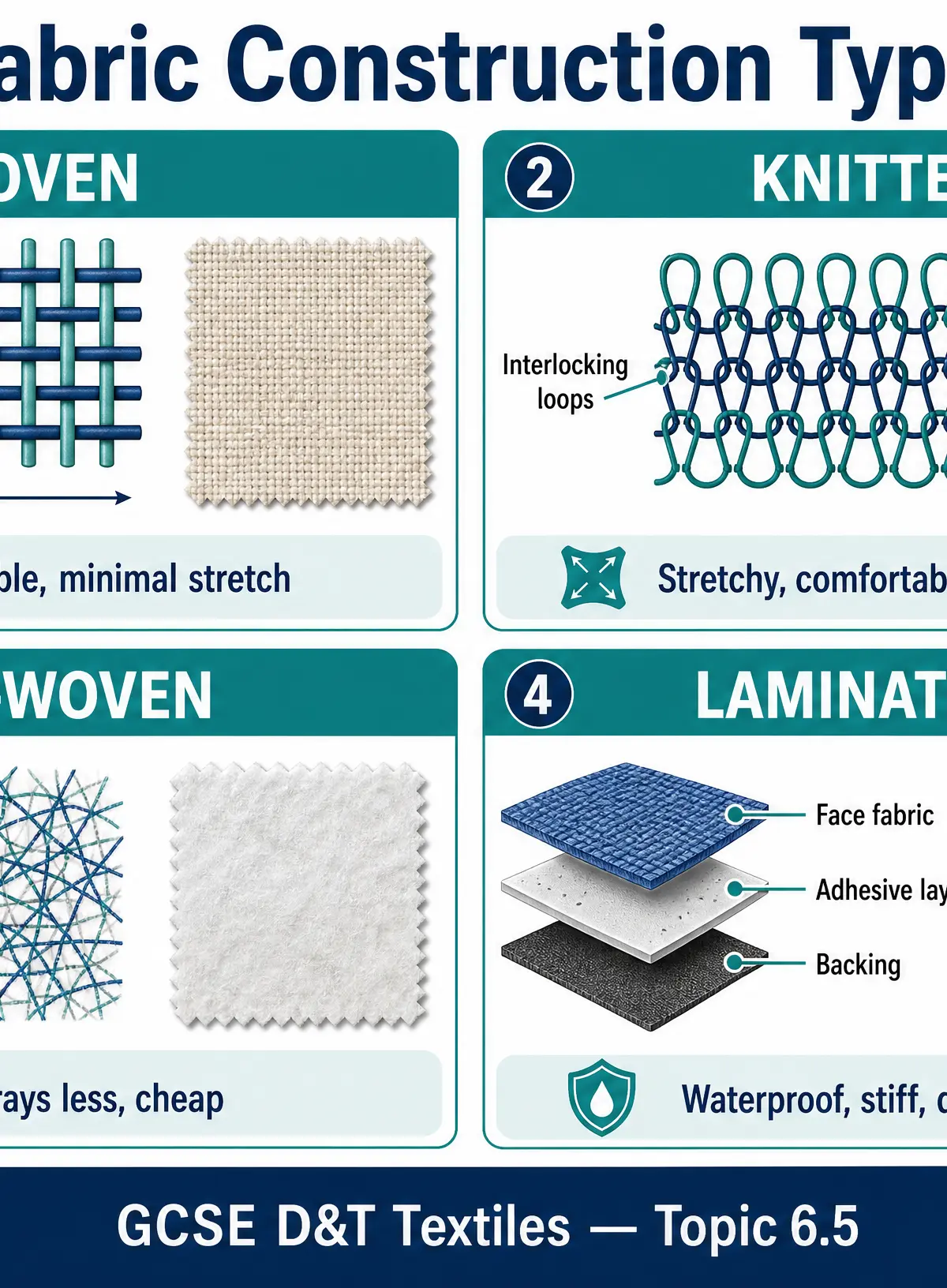
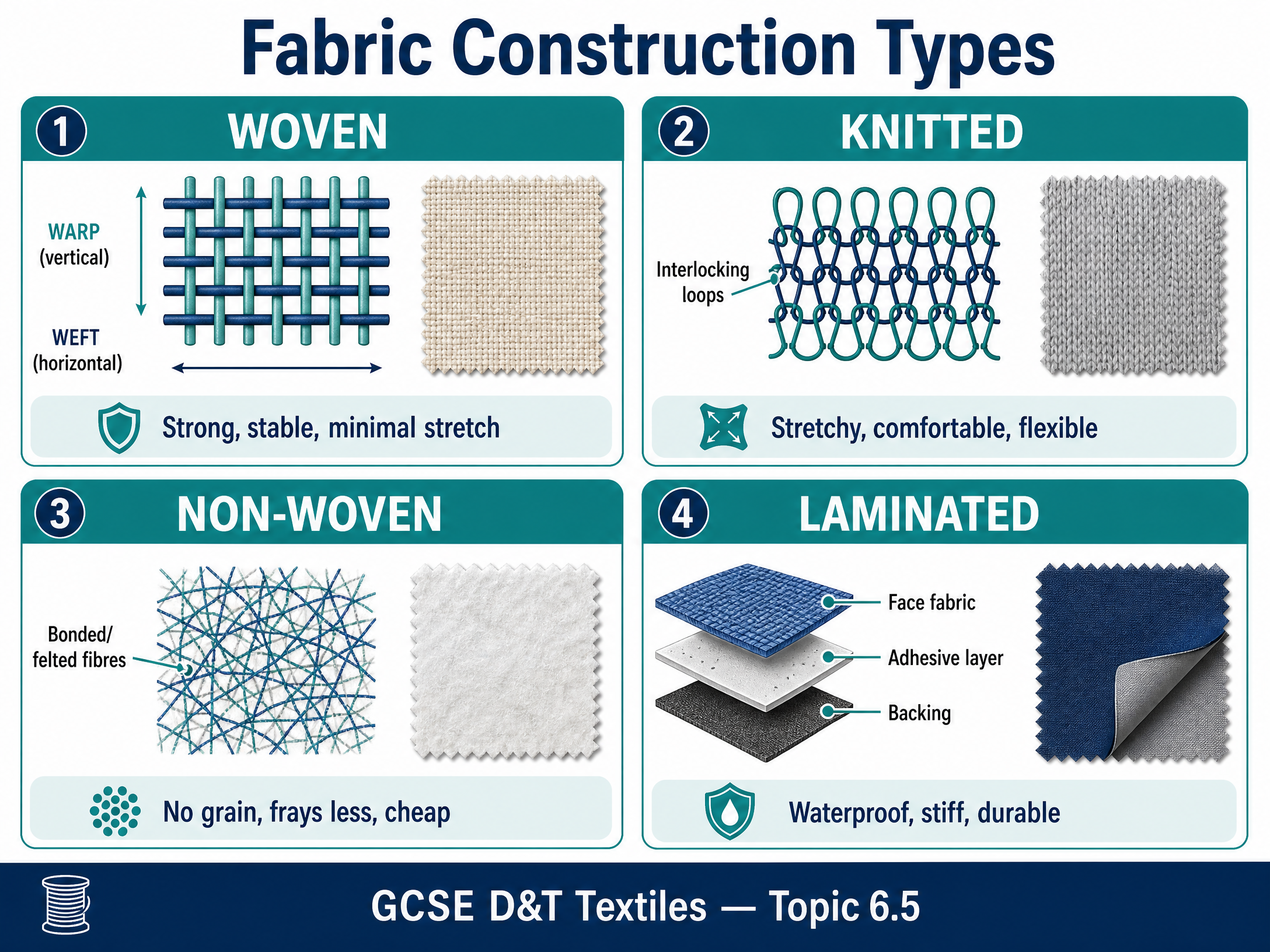
| Construction Type | How it is made | Key Properties | Exam Application |
|---|---|---|---|
| Woven | Interlacing warp (vertical) and weft (horizontal) threads on a loom. | Strong, stable, frays at cut edges, minimal stretch (unless elastane is added). | Best for tailored garments, bags, and products requiring structural stability. |
| Knitted | Interlocking loops of yarn (weft or warp knitting). | Stretchy, comfortable, flexible, unravels if cut (laddering). | Essential for sportswear, activewear, and comfortable casual clothing. |
| Non-Woven | Fibres bonded together using heat, chemicals, or friction (e.g., felt). | No grain direction, does not fray, relatively cheap, lacks drape. | Used for interfacing (stiffening), disposable medical textiles, and craft projects. |
| Laminated | Two or more layers bonded together with adhesive. | Combines properties (e.g., waterproof + breathable), stiff. | High-performance outerwear, technical sportswear, wipe-clean tablecloths. |
Technical Vocabulary
To access the top mark bands, you MUST use specialist terminology:
- Selvedge: The finished, woven edge of a fabric roll that prevents unravelling.
- Grainline: The direction of the warp threads, running parallel to the selvedge.
- Bias: The diagonal direction across a woven fabric (45 degrees to the selvedge), which has the most stretch.
- Warp: The strong, vertical threads held under tension on a loom.
- Weft: The horizontal threads woven over and under the warp.
- Wastage: The unusable fabric left over after cutting out pattern pieces.
Practical Skills & Calculations
Calculating Fabric Quantities
This is a highly examinable skill. You will be asked to calculate how much fabric is required for a specific product.
The 4-Step Calculation Method:
- Determine the dimensions of all pattern pieces required.
- Add seam allowances (typically 1.5 cm on each joining edge) and hems.
- Plan the layout within the given fabric width (e.g., 137 cm), ensuring the grainline is followed.
- Calculate total length required and add a wastage allowance (typically 5-10%) for cutting errors or pattern matching.
Formula: Quantity = (Length of layout) + Wastage Allowance
Efficient Pattern Layout
Examiners award marks for demonstrating how to minimise waste—a key sustainability principle.
- Place straight edges of pattern pieces along the straight grain or selvedge.
- Interlock pieces where possible (tessellation).
- Ensure one-way designs (directional prints) or fabrics with a nap (like velvet) are laid out with all pieces facing the same direction, even if this requires more fabric.
Portfolio/Coursework Guidance
Assessment Criteria Application
In your NEA (Non-Exam Assessment), your choice of stock forms must be explicitly justified:
- AO1 (Investigate): Research standard widths and costs when planning your product.
- AO2 (Design): Produce clear pattern layouts (lay plans) showing how you will fit your pieces onto your chosen fabric width.
- AO3 (Make): Demonstrate accurate cutting along the grainline and correct use of the selvedge.
- AO4 (Evaluate): Calculate your actual material wastage and suggest how a different stock form or width could have improved commercial viability.
Building a Strong Portfolio
Do not just write "I bought 2 metres of cotton." Instead, write: "I selected a 137cm width woven cotton roll. This standard width allowed me to tessellate my pattern pieces efficiently, resulting in only 8% wastage. The woven construction provides the necessary stability for the bag's structure."
Exam Component
Written Exam Preparation
Questions on this topic typically fall into three categories:
- Factual Recall (1-2 marks): Identifying standard widths, defining denier, or naming construction methods.
- Calculation (2-4 marks): Working out the length of fabric required or the percentage of wastage.
- Justification/Evaluation (4-6 marks): Explaining why a specific stock form, width, or construction type is appropriate for a given commercial product, often linking to cost and sustainability.
Visual Resources
2 diagrams and illustrations
Interactive Diagrams
1 interactive diagram to visualise key concepts
Conceptual Flow Outline
Process for Calculating Fabric Quantity
Worked Examples
3 worked examples — open one to explore the question and available guidance.
Practice Questions
Test your understanding — click to reveal model answers
State the three most common standard widths for fabric rolls. (3 marks)
Hint: Think about narrow, standard, and wide measurements in centimetres.
Explain why pattern pieces must be laid out following the grainline of the fabric. (2 marks)
Hint: What happens to the fabric if it is cut diagonally instead of straight?
A manufacturer is making circular tablecloths with a diameter of 140 cm. They require a 2 cm hem all the way around. They are choosing between a fabric roll of 137 cm width and 154 cm width. Justify which stock form they must choose. (3 marks)
Hint: Calculate the total width of the pattern piece first, including the hem on both sides.
Compare the use of woven fabrics and non-woven fabrics in commercial garment manufacturing, referring to their properties and stock forms. (6 marks)
Hint: Discuss structure, stretch, fraying, grainline, and typical applications for both.