Pearson Edexcel · GCSE · Design and Technology
The categorisation of the types, properties and structure of ferrous and non-ferrous metals
This topic covers the essential classification, properties, and structure of ferrous and non-ferrous metals. Understanding these characteristics is crucial for making informed material selections in your Design and Technology coursework and written exams.
- 6 min read
- 3 worked examples
- 3 practice questions
- 6 key terms
Study Notes
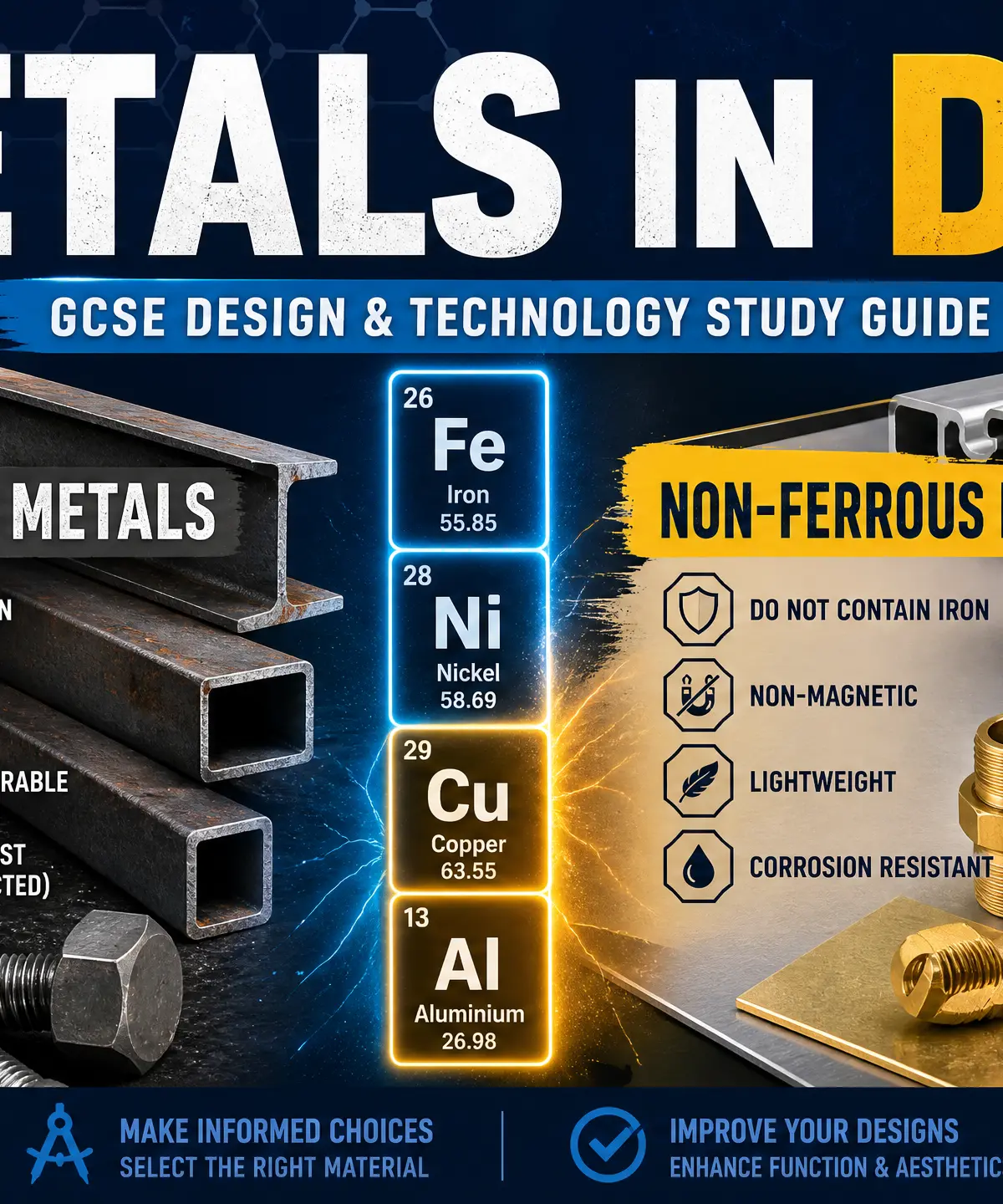
Overview
In Design and Technology, selecting the right material for a product is one of the most critical decisions a designer makes. Metals are a fundamental category of materials, generally known for being strong, hard, and good conductors of heat and electricity. However, to make informed choices, we must classify metals into two primary families: ferrous and non-ferrous.
This guide will walk you through the key differences, properties, and real-world applications of these metals. You will need this knowledge both to answer theory questions in your written exam and to justify your material choices in your Non-Exam Assessment (NEA) portfolio.
Listen to our revision podcast for an audio breakdown of this topic:

Key Knowledge & Theory
Core Concepts
1. Ferrous MetalsFerrous metals contain iron (from the Latin ferrum). Because of their iron content, they share two general characteristics:
- They are magnetic (with the exception of some grades of stainless steel).
- They are prone to corrosion (rusting) when exposed to moisture and oxygen, meaning they usually require a protective finish like paint or galvanisation.
2. Non-Ferrous MetalsNon-ferrous metals do not contain iron. Consequently:
- They are non-magnetic.
- They are generally much more resistant to corrosion.
- They often have a lower density (are lighter) than ferrous metals.
3. AlloysAn alloy is a mixture of two or more elements, where at least one is a metal. Alloying is done to improve the working properties or aesthetics of a pure metal. For example, mixing copper and zinc creates brass, which is stronger and more corrosion-resistant than pure copper.
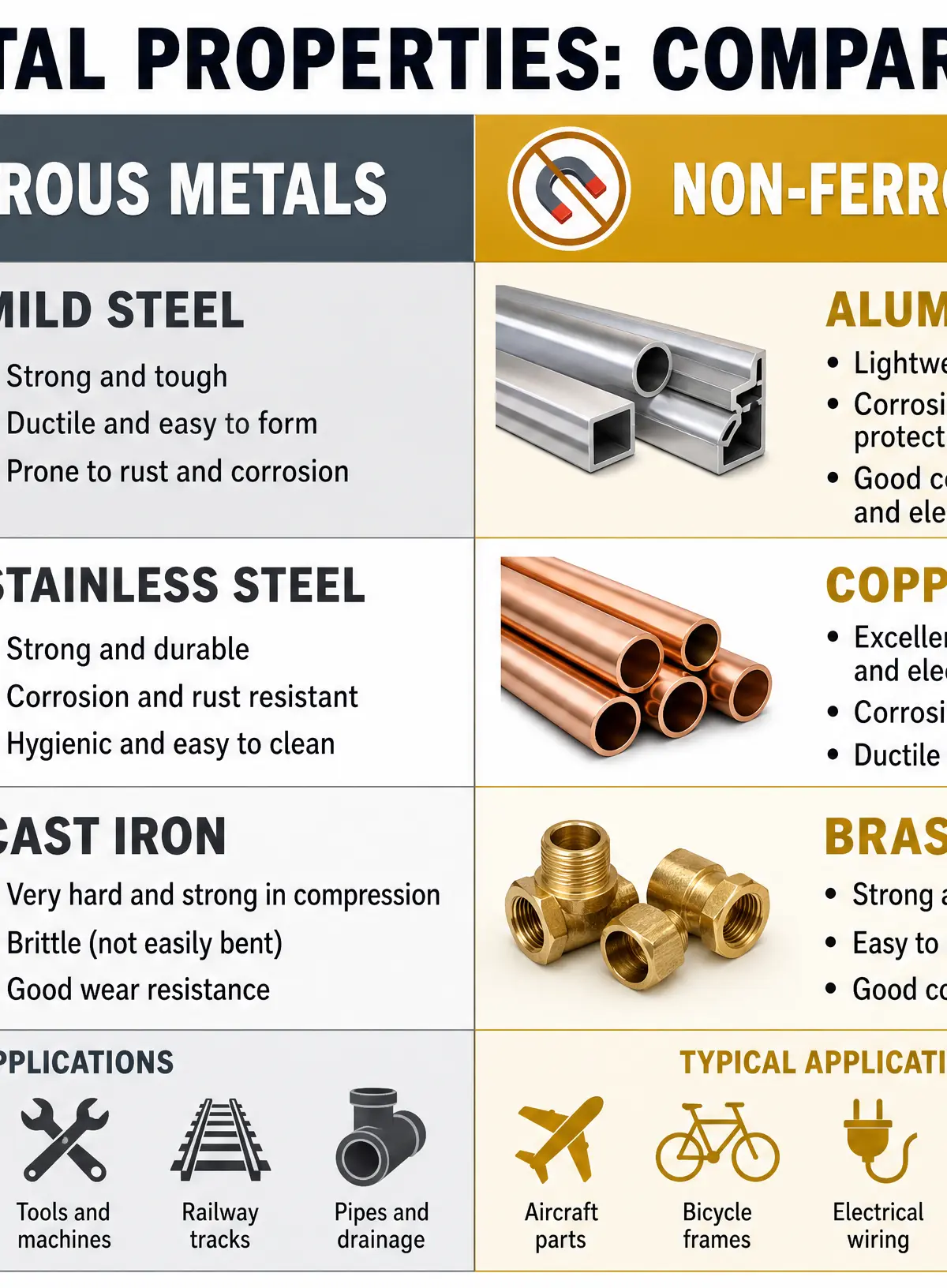
Key Materials to Know
| Metal | Type | Key Properties | Typical Applications |
|---|---|---|---|
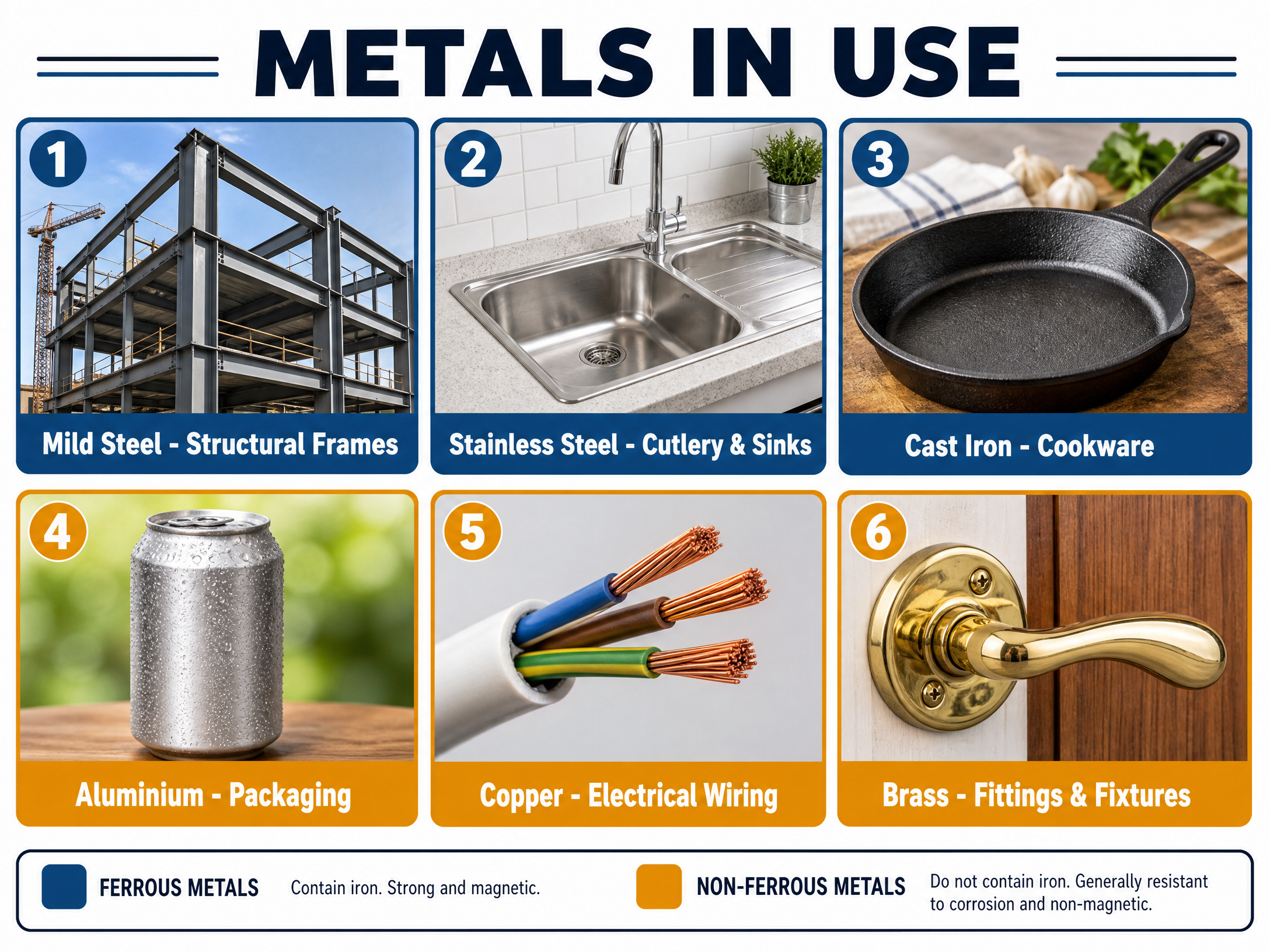
| Mild Steel | Ferrous | Strong, tough, highly ductile, cheap to produce. Prone to rust. | Structural steel girders, car body panels, nuts and bolts. |
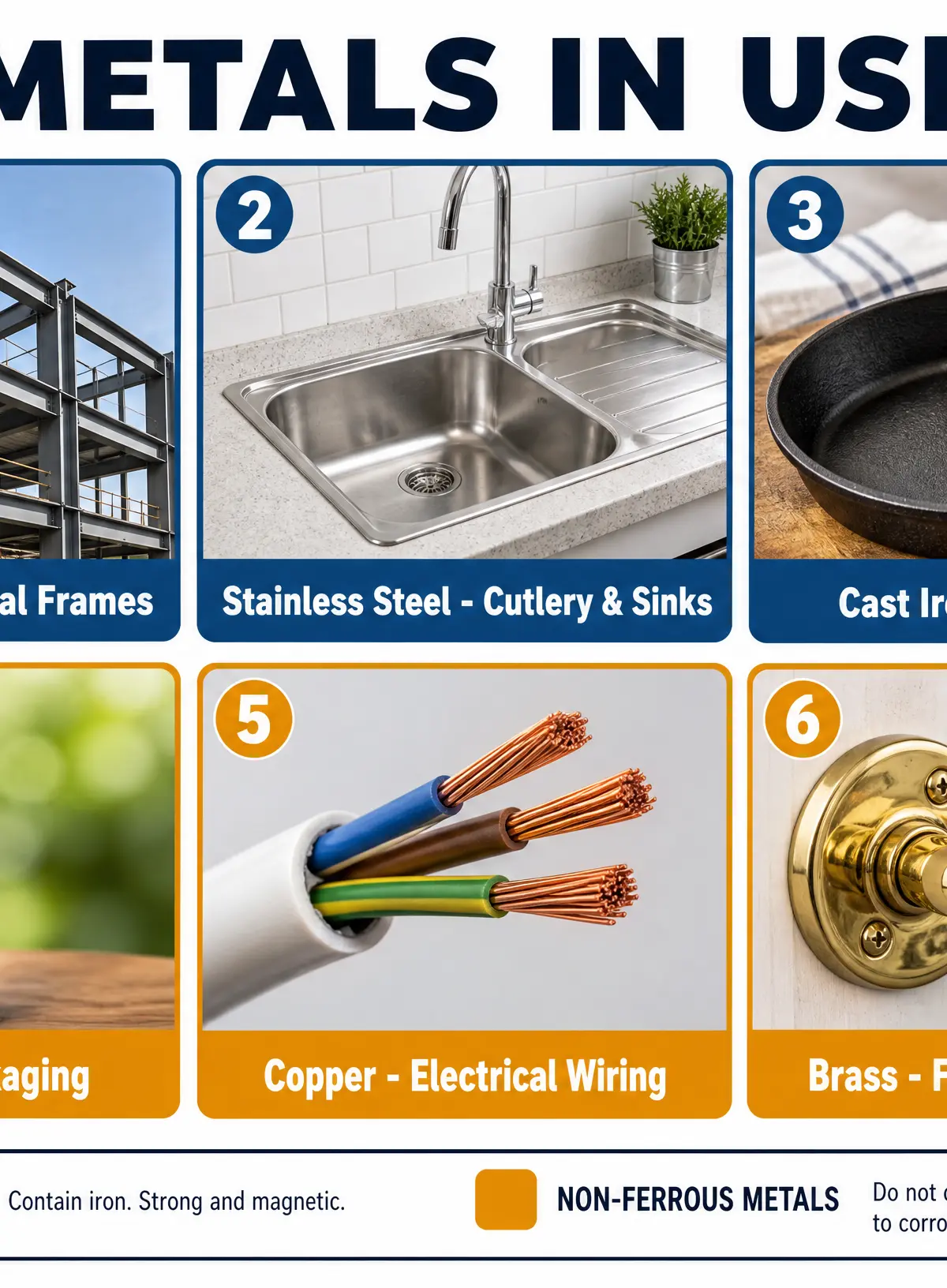
| Stainless Steel | Ferrous (Alloy) | Strong, highly resistant to corrosion and rust, hygienic. | Cutlery, kitchen sinks, surgical instruments. |
| Cast Iron | Ferrous | Very hard, strong in compression, but brittle (can snap under impact). | Manhole covers, engine blocks, heavy cookware. |
| Aluminium | Non-Ferrous | Lightweight, excellent corrosion resistance, malleable, good conductor. | Drinks cans, aircraft bodies, window frames. |
| Copper | Non-Ferrous | Excellent electrical and thermal conductor, highly ductile, corrosion-resistant. | Electrical wiring, plumbing pipes, circuit boards. |
| Brass | Non-Ferrous (Alloy) | Strong, corrosion-resistant, easy to machine, decorative gold appearance. | Door handles, musical instruments, plumbing fittings. |
Technical Vocabulary
To access the highest mark bands, you MUST use precise technical vocabulary when describing material properties:
- Ductility: The ability of a material to be drawn out into a thin wire without breaking (e.g., copper).
- Malleability: The ability of a material to be hammered, pressed, or rolled into thin sheets without cracking (e.g., aluminium).
- Hardness: The ability to resist scratching, wear, or indentation (e.g., cast iron).
- Toughness: The ability to absorb impact force without fracturing (e.g., mild steel).
- Brittleness: The tendency to fracture suddenly without deforming first when subjected to stress or impact (e.g., cast iron).
Practical Skills
Material Selection in Practice
When designing a product, you must evaluate the working environment and the required function to select the correct metal.
If you are designing a product for outdoor use, mild steel would be a poor choice unless you specify a protective coating like powder coating or galvanising. Aluminium or stainless steel would be better choices due to their natural corrosion resistance.
If you are designing a product where weight is a critical factor (e.g., a bicycle frame or aircraft part), aluminium is vastly superior to mild steel due to its low density.
Portfolio/Coursework Guidance
Assessment Criteria for Material Selection
In your NEA, examiners are looking for justified material choices. Simply stating "I will use aluminium because it is a good metal" will earn zero marks for material selection.
To access high marks, your portfolio annotation must:
- Identify the specific material (e.g., Aluminium).
- State its relevant working properties (e.g., lightweight and malleable).
- Explain exactly why those properties are necessary for your specific product.
Example of strong portfolio annotation:
"I have selected aluminium for the outer casing of my portable lamp. Aluminium is highly malleable, which will allow me to press-form the curved ergonomic shape of the casing without the material cracking. Furthermore, it is lightweight (having a low density), which is essential for a portable product that the user needs to carry easily."
Exam Component
Written Exam Knowledge
The written exam will test your ability to recall properties, identify materials from descriptions, and justify material choices for given contexts.
Expect questions structured like:
- Identify: Name a suitable material for [Product X]. (1 mark)
- Describe: Describe the property of malleability. (2 marks)
- Explain: Explain why [Material Y] is suitable for [Product Z]. (3-4 marks)
- Evaluate/Compare: Compare the suitability of mild steel and aluminium for a bicycle frame. (6-8 marks)
Visual Resources
2 diagrams and illustrations
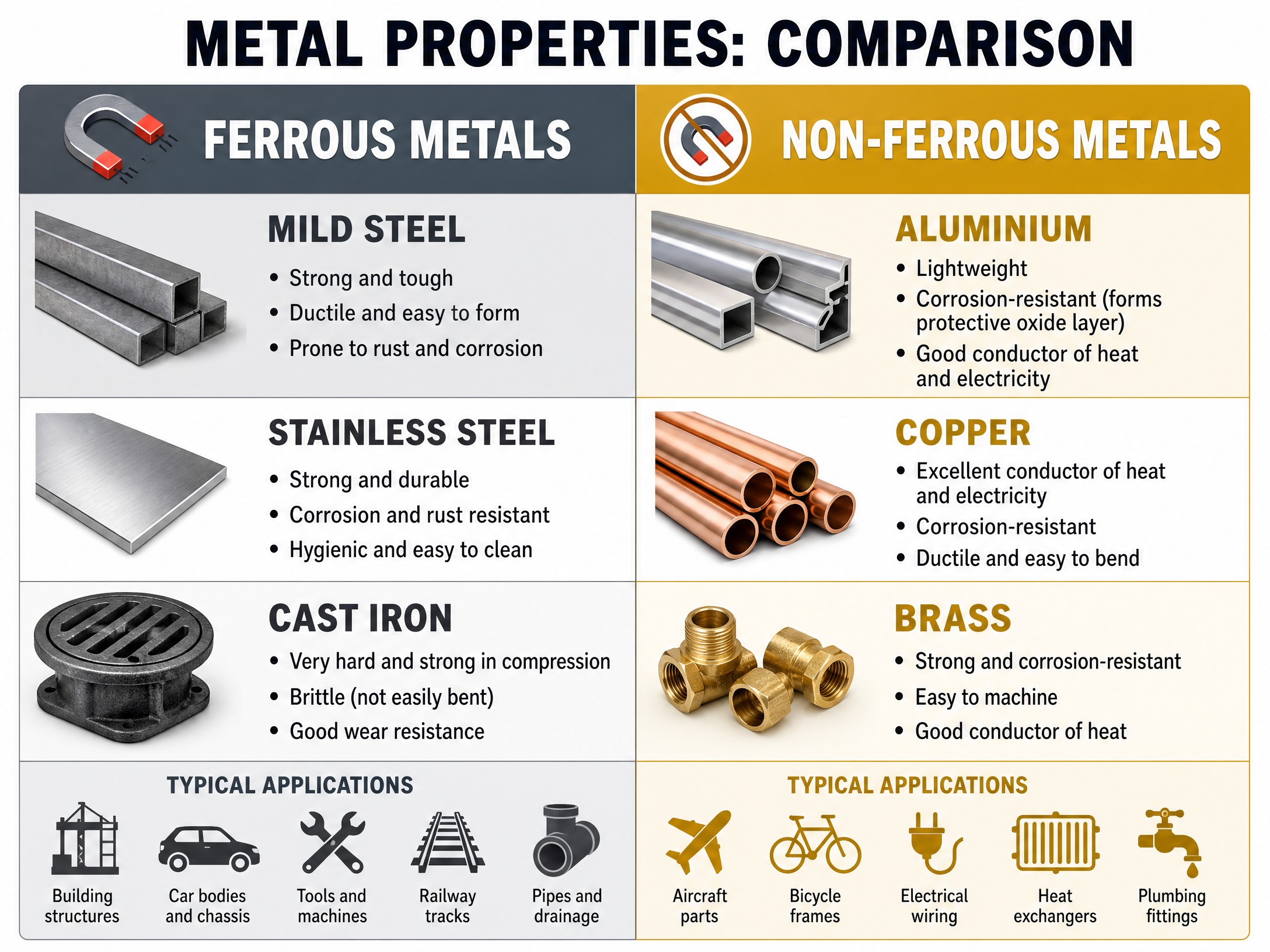
Interactive Diagrams
1 interactive diagram to visualise key concepts
Conceptual Flow Outline
Categorisation of Metals
Worked Examples
3 worked examples — open one to explore the question and available guidance.
Practice Questions
Test your understanding — click to reveal model answers
Identify one ferrous metal and one non-ferrous metal. (2 marks)
Hint: Remember the rule: Ferrous = Iron.
Explain two reasons why aluminium is commonly used to manufacture drinks cans. (4 marks)
Hint: Think about the weight of the can for transport, and what happens when metal touches liquid.
Evaluate the use of mild steel compared to stainless steel for a child's outdoor climbing frame. (6 marks)
Hint: Discuss strength, toughness, cost, and reaction to the outdoor environment for BOTH materials.