Pearson Edexcel · GCSE · Design and Technology
The categorisation of the types, properties and structure of natural and manufactured timbers
This topic covers the essential categorisation, properties, and structure of natural and manufactured timbers. Mastering this will allow you to confidently select and justify the use of specific woods for products, a core requirement in both your coursework and written exam.
- 7 min read
- 3 worked examples
- 3 practice questions
- 6 key terms
Study Notes
Overview
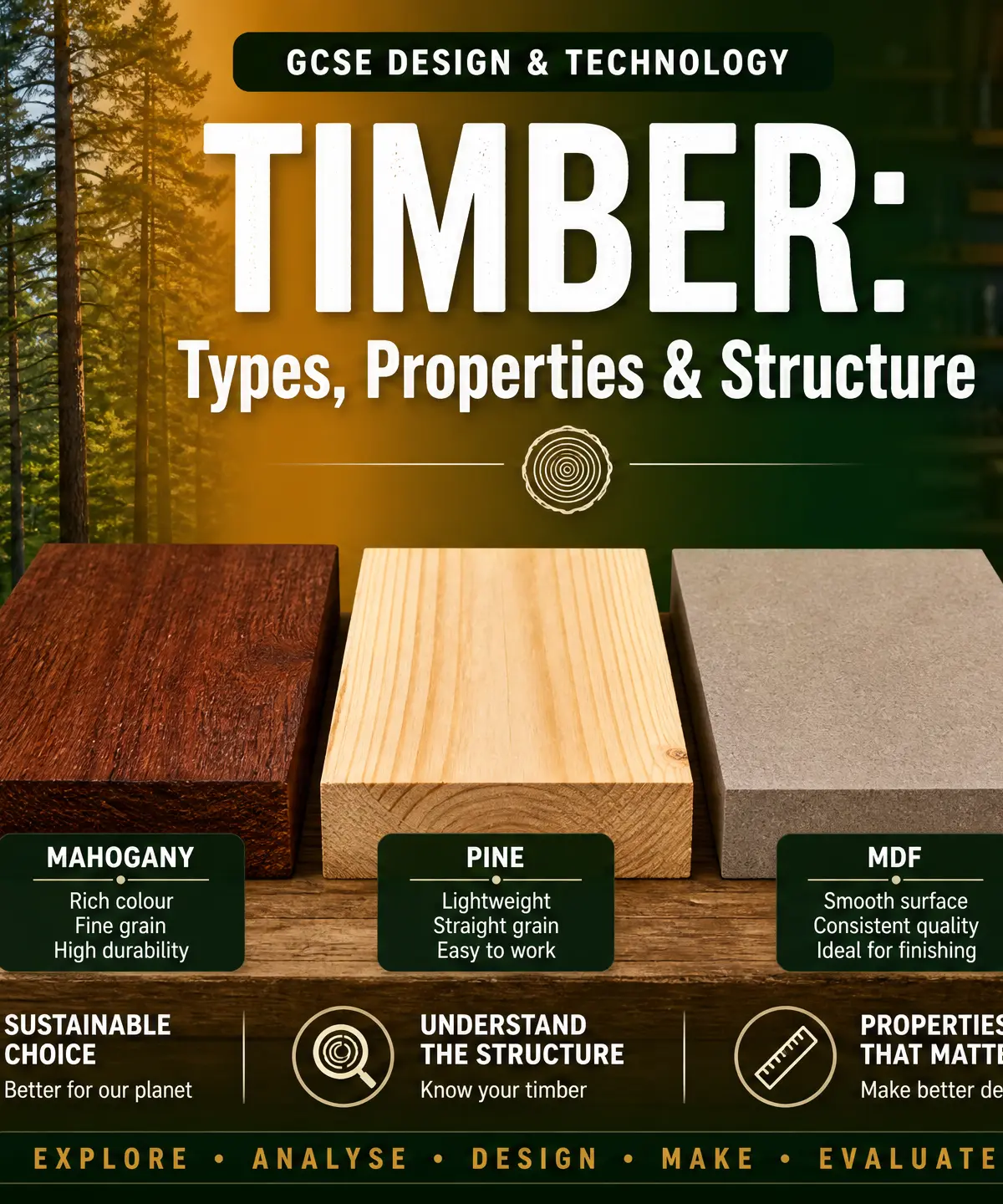
Timber is one of the most versatile and widely used materials in Design and Technology. In this topic, we explore how timber is categorised into hardwoods, softwoods, and manufactured boards. You will learn to identify key timbers, understand their specific properties, and relate the internal structure of wood to how it performs when being worked or used in a final product. This knowledge is crucial for making informed, justifiable material choices in your design coursework and exam answers.
Key Knowledge & Theory
Core Concepts
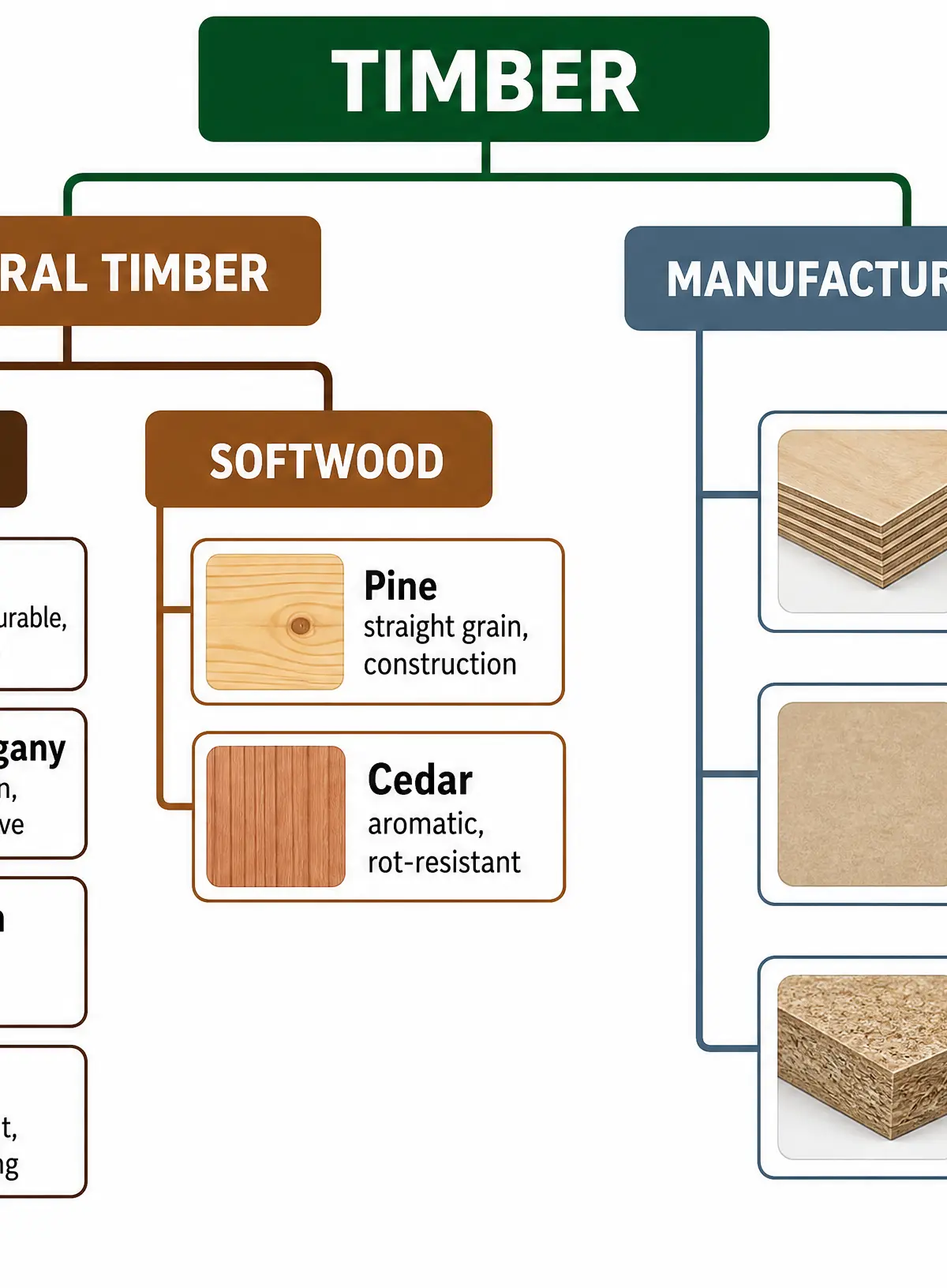
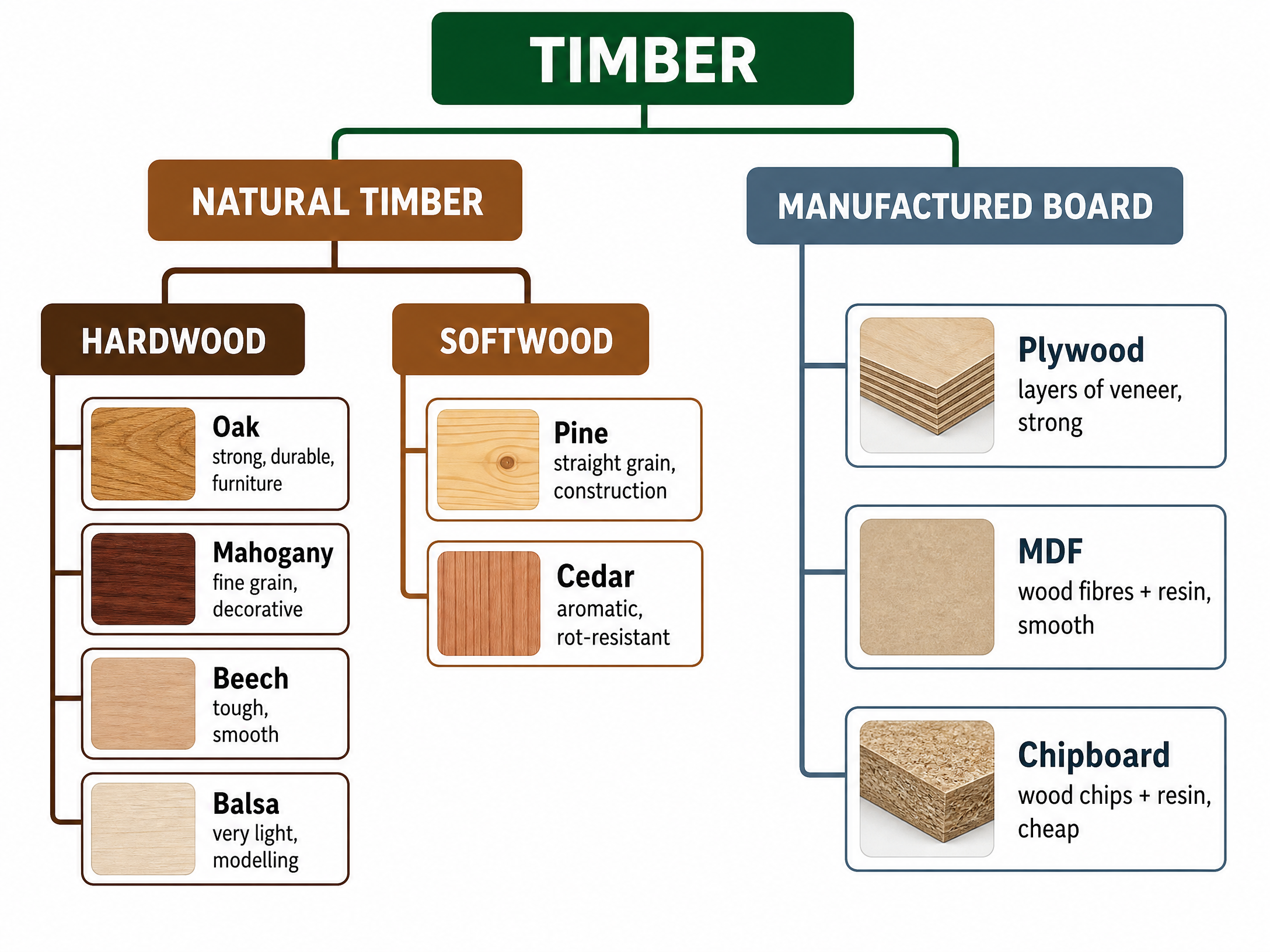
1. Natural Timbers: Hardwoods and SoftwoodsThe classification of natural timber is based on the botanical origin of the tree, not the physical hardness of the wood itself.
- Hardwoods come from broad-leaved, deciduous trees (trees that lose their leaves in winter). They generally grow slowly, making the timber denser, harder, and more expensive.
- Softwoods come from coniferous trees (evergreens with needles and cones). They grow relatively quickly, making the timber cheaper, lighter, and more widely available.
2. Manufactured BoardsThese are engineered materials made from wood fibres, chips, or veneers, bonded together using adhesives under heat and pressure. They are produced in large, uniform sheets, overcoming the size limitations and natural defects (like knots) found in solid timber.
Key Timber Categories
| Category | Timber Type | Key Properties | Common Applications |
|---|---|---|---|
| Hardwood | Oak | Very hard, tough, durable, attractive grain. | High-quality furniture, flooring, veneers. |
| Hardwood | Mahogany | Fine grain, durable, reddish-brown colour, good workability. | High-end indoor furniture, boat fittings. |
| Hardwood | Beech | Very tough, hard, close grain, does not splinter easily. | Tool handles, children's toys, workbenches. |
| Hardwood | Balsa | Extremely lightweight, soft, highly workable (cuts easily). | Prototyping, model making, aircraft models. |
| Softwood | Pine | Straight grain, lightweight, easy to work, relatively cheap. | Construction framing, flat-pack furniture, interior joinery. |
| Softwood | Cedar | Natural oils make it highly resistant to rot and weather, lightweight. | Outdoor cladding, garden furniture, fences. |
| Manufactured | Plywood | Very strong in all directions due to cross-grain layers, resists warping. | Structural work, furniture, boat building (marine ply). |
| Manufactured | MDF | Smooth uniform surface, easy to machine and paint, no grain. | Flat-pack furniture, shelving, templates. |
Wood Structure and Grain
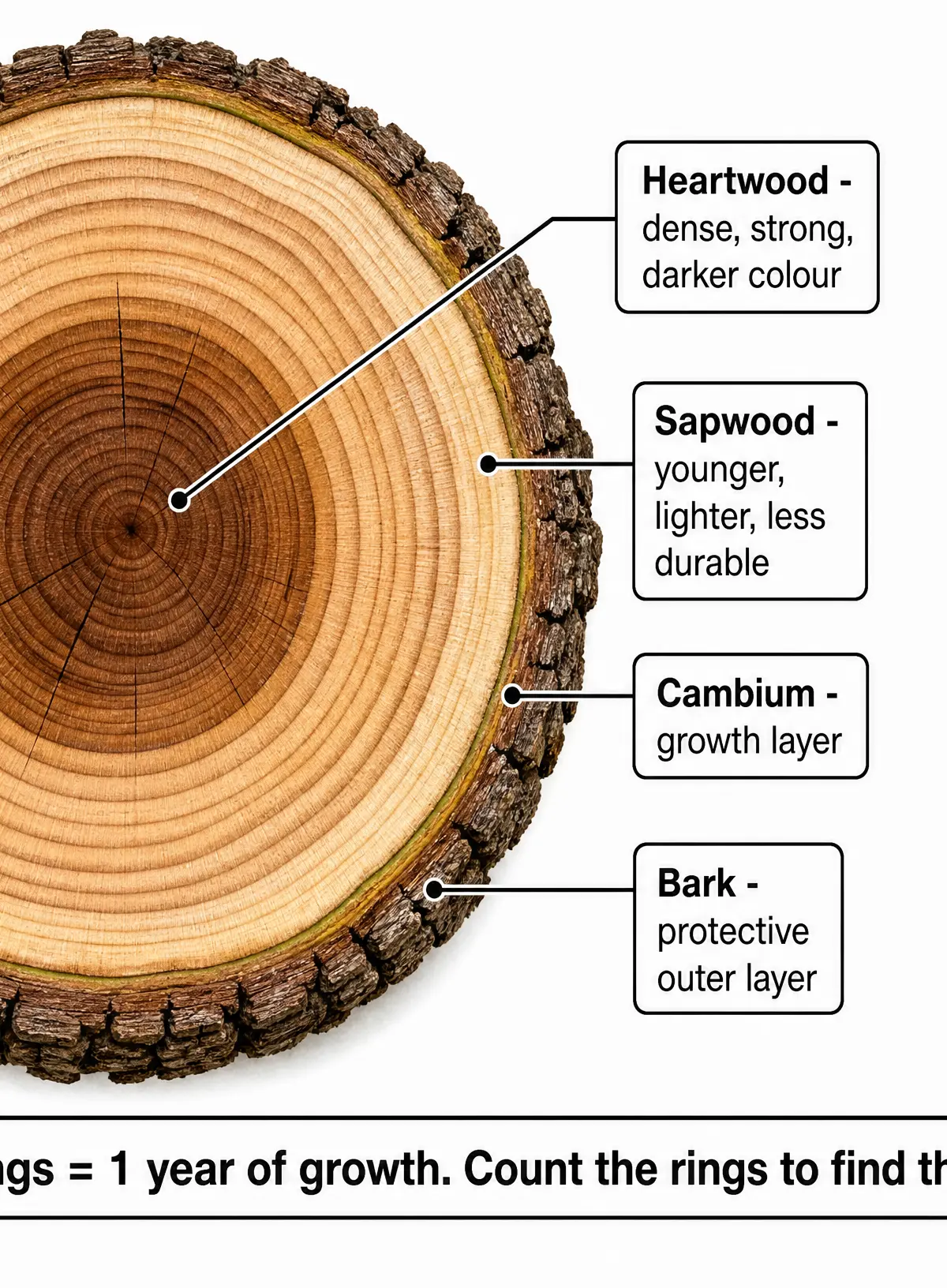
The internal structure of a tree directly affects its working properties.
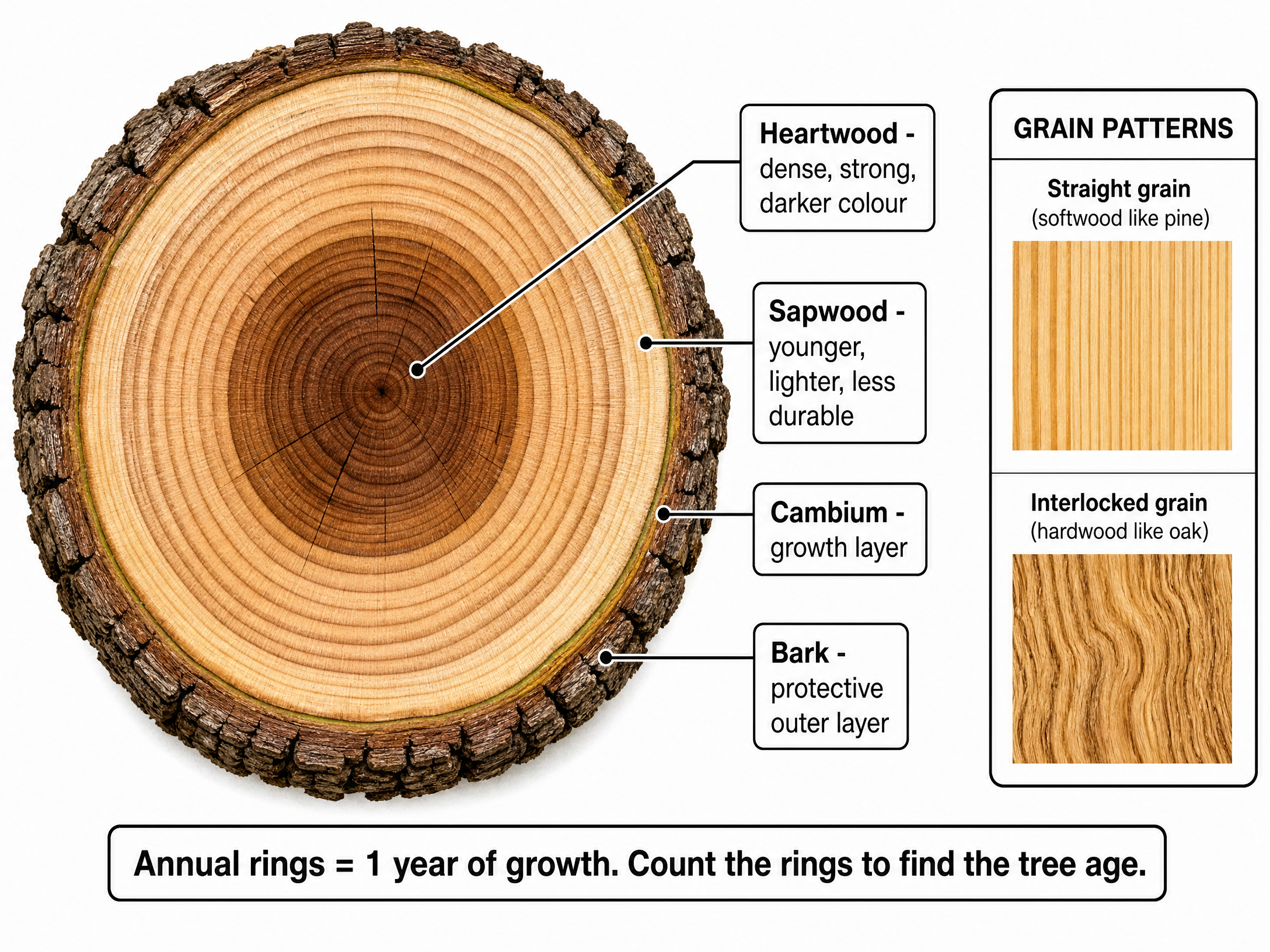
- Annual Rings: Each ring represents one year of growth. Closer rings indicate slower growth and denser timber.
- Heartwood: The older, darker wood at the centre of the tree. It is denser, stronger, and more naturally durable.
- Sapwood: The younger, lighter wood near the bark. It carries water and nutrients, making it less dense and more prone to rot and insect attack.
- Grain: The direction and arrangement of the wood fibres. Straight grain (like pine) is easier to cut and plane. Interlocked or wavy grain (like oak) is stronger but harder to work without tearing the fibres.
Technical Vocabulary
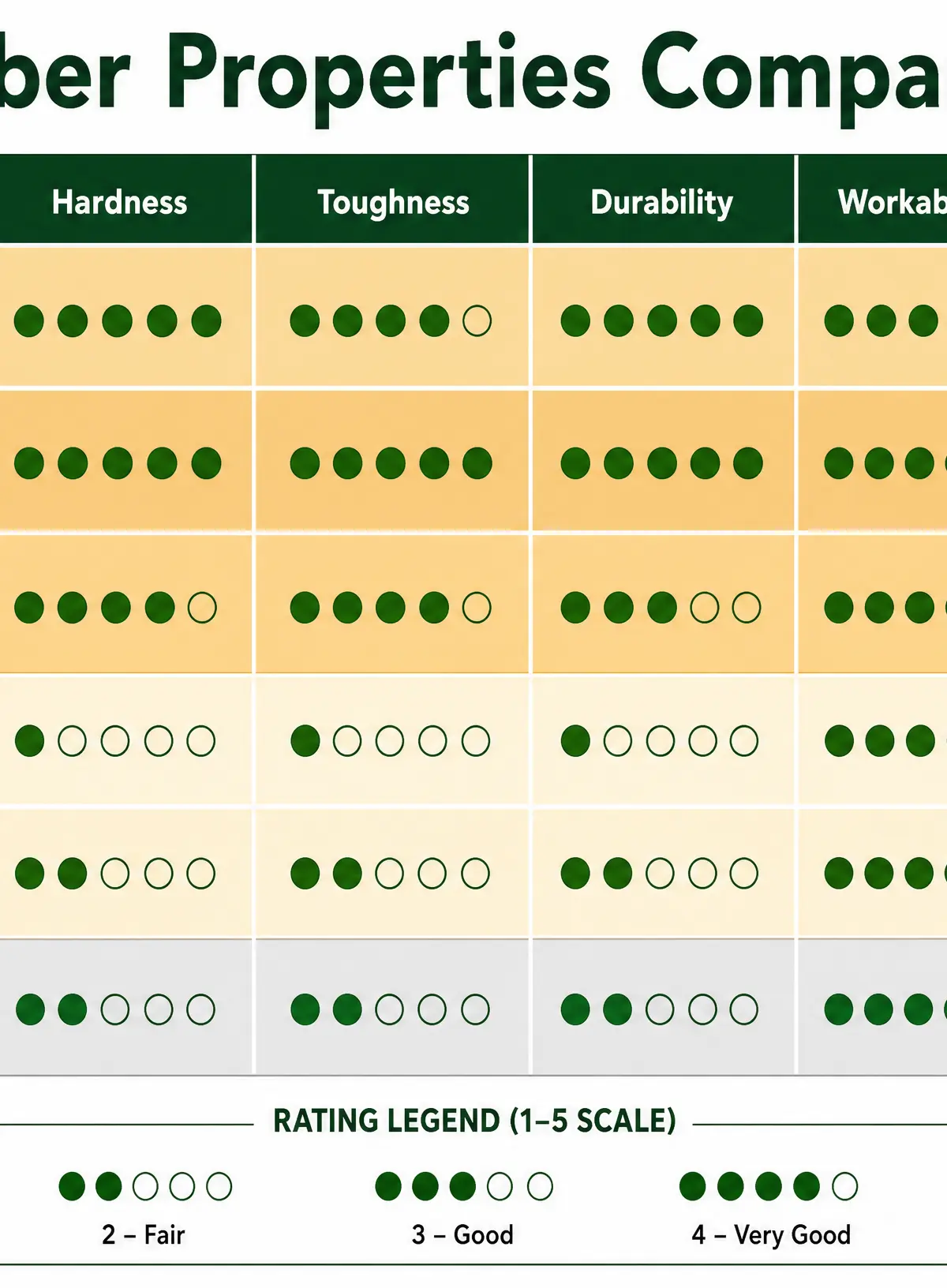
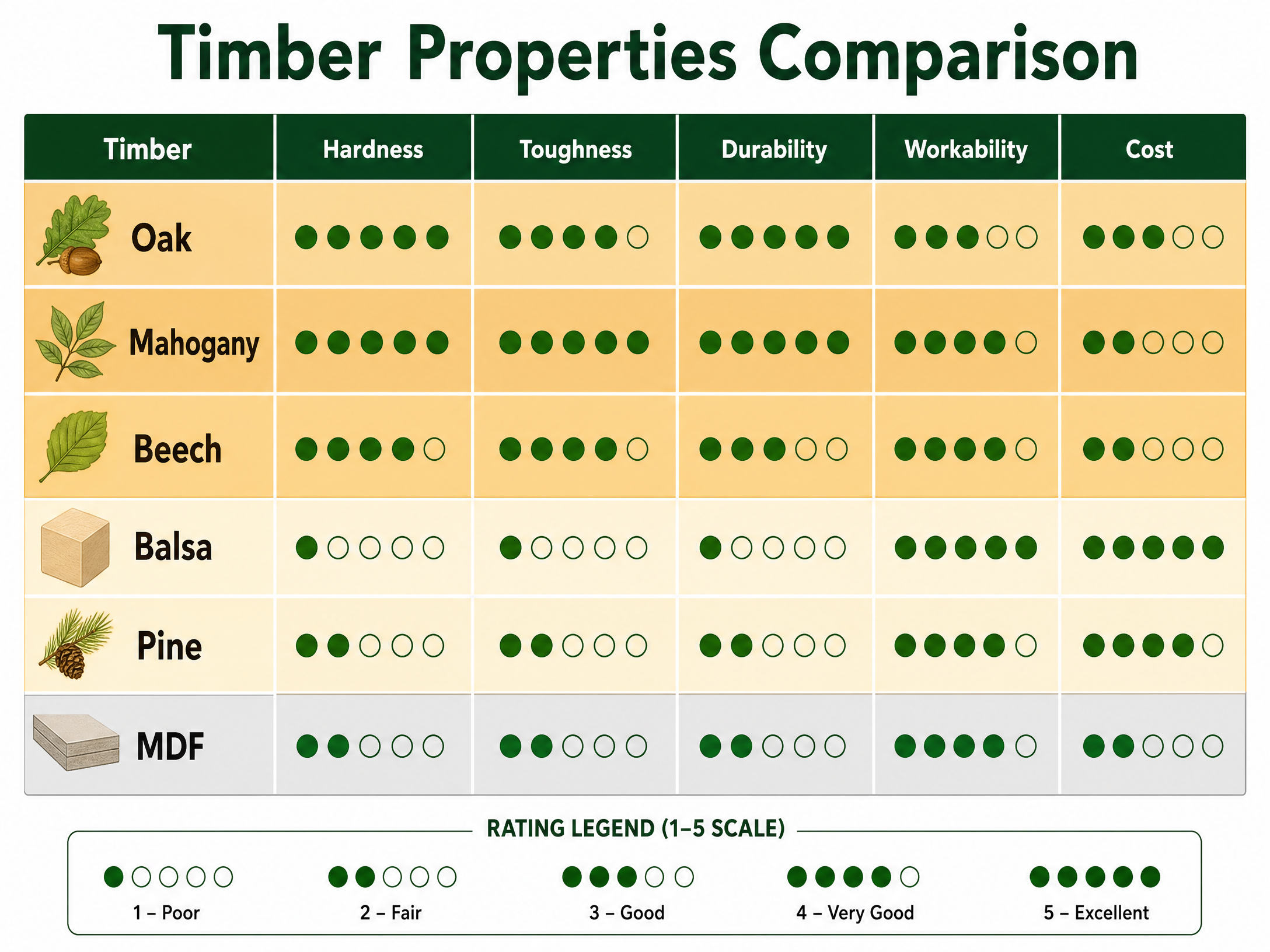
- Hardness: The ability of a timber to resist surface scratching, wear, and indentation.
- Toughness: The ability of a timber to absorb impact or sudden shocks without fracturing or breaking.
- Durability: The ability of a timber to resist decay, rot, weathering, and insect attack over time.
- Workability: How easily a timber can be cut, shaped, drilled, and finished using hand or machine tools.
- Veneer: A very thin slice of high-quality timber used to cover cheaper materials (like MDF or chipboard) for decorative purposes.
Practical Skills
Techniques & Processes
When working with timber in the workshop, understanding its properties is essential for selecting the right tools and processes:
- Cutting: Softwoods like pine can be cut quickly with a tenon saw. Hardwoods like oak require more effort and sharper tools. Manufactured boards like MDF cut easily but produce hazardous fine dust, requiring extraction and masks.
- Joining: Solid timbers (hardwoods and softwoods) can be joined using traditional wood joints (e.g., dovetail, mortise and tenon) because the grain holds the joint together. Manufactured boards like chipboard do not hold screws well on their edges and require specific knock-down fittings or biscuits.
- Finishing: MDF requires sealing before painting because its porous edges absorb moisture. Hardwoods like mahogany and oak are often finished with clear oils or varnishes to enhance their natural grain.
Materials & Equipment
- Health and Safety: Always use dust extraction and wear a well-fitted mask (FFP3) when cutting or routing MDF, as the fine dust and urea-formaldehyde resins are hazardous.
- Tool Selection: Use high-speed steel (HSS) or tungsten carbide-tipped (TCT) router bits when working with manufactured boards, as the adhesives within them blunt standard tools quickly.
Portfolio/Coursework Guidance
Assessment Criteria
Examiners look for clear, justified material selection in your design portfolio. You must not simply state "I will use wood." You must specify the exact timber (e.g., "I will use solid beech") and justify it using correct property terminology (e.g., "because its high toughness means it will withstand the repeated impacts required for this child's toy").
Building a Strong Portfolio
- Testing and Trialling: Show evidence of testing different timbers. For example, test how well pine takes a stain compared to MDF, or test the impact resistance of balsa versus beech. Photograph these tests and annotate the results.
- Environmental Considerations: Discuss the sustainability of your choices. Mention that softwoods are more sustainable as they grow faster, or that manufactured boards make good use of recycled wood waste.
Exam Component
Written Exam Knowledge
Questions on timber appear in almost every written paper. You will be expected to:
- Identify a suitable timber for a given product.
- Justify your choice using specific properties (hardness, toughness, durability).
- Compare natural timbers with manufactured boards, weighing up cost, aesthetics, and working properties.
Listen to the podcast below for a comprehensive review of this topic, including a quick-fire recall quiz.

Visual Resources
3 diagrams and illustrations
Interactive Diagrams
1 interactive diagram to visualise key concepts
Conceptual Flow Outline
Timber Selection Decision Tree
Worked Examples
3 worked examples — open one to explore the question and available guidance.
Practice Questions
Test your understanding — click to reveal model answers
State the name of one manufactured board and describe how it is constructed. (2 marks)
Hint: Think about the materials that make up flat-pack furniture or strong structural sheets.
A manufacturer is designing a wooden handle for a hammer. Explain why Beech would be a more suitable choice than Pine. (3 marks)
Hint: Think about what happens to a hammer when it is used. Which specific property is required?
Discuss the environmental and functional advantages of using manufactured boards rather than solid hardwoods for mass-produced furniture. (6 marks)
Hint: Structure your answer to cover both 'environmental' and 'functional' points. Think about tree growth rates, waste, board sizes, and warping.