Pearson Edexcel · GCSE · Design and Technology
The categorisation of the types, properties and structure of papers and boards
This topic covers the categorisation, properties, and structure of papers and boards. Understanding these materials is essential for making informed design decisions and justifying material selection in your exam and NEA portfolio.
- 6 min read
- 3 worked examples
- 4 practice questions
- 6 key terms
Study Notes
Overview
Welcome to Topic 1.9: The categorisation of the types, properties and structure of papers and boards.
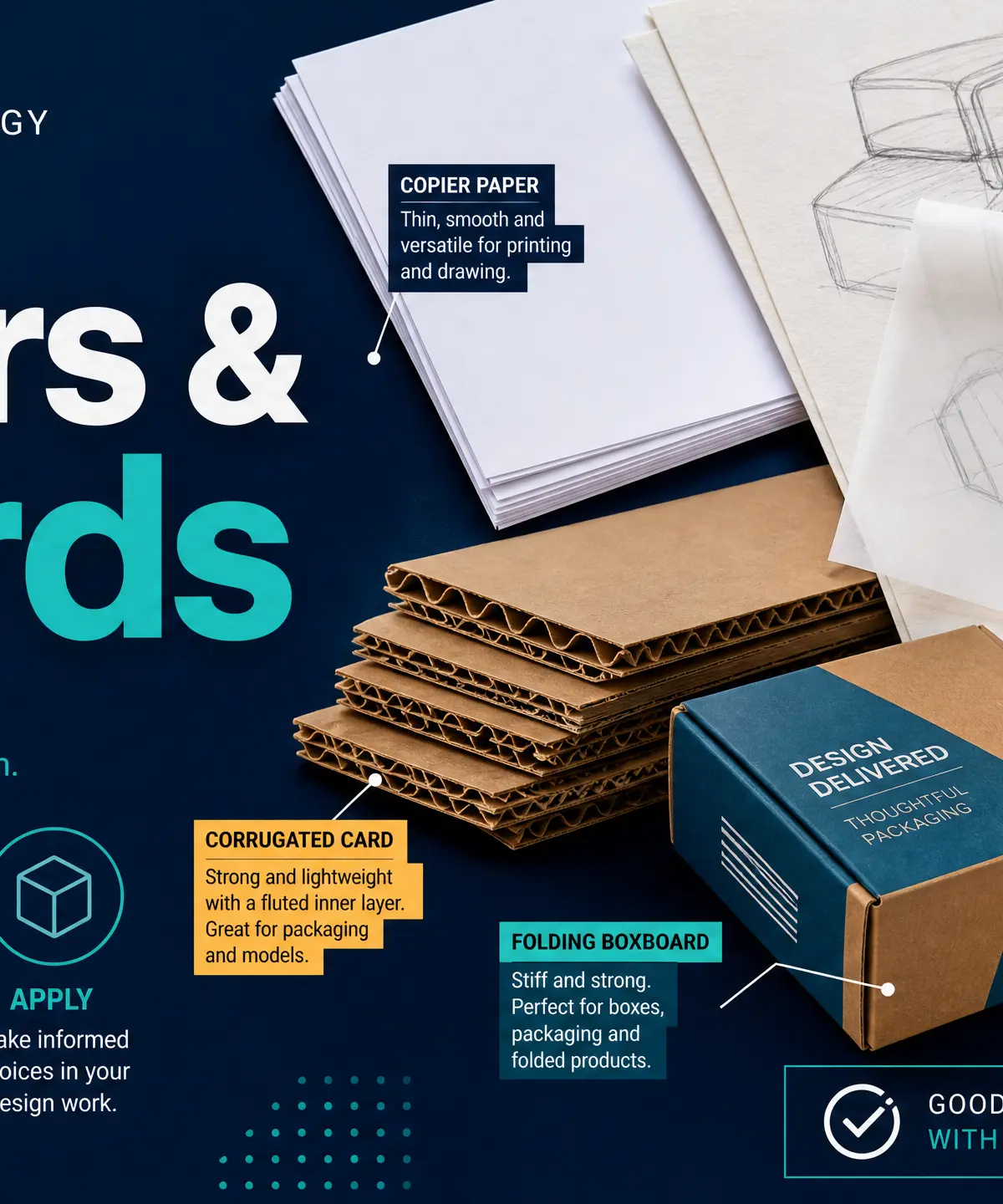
In Design and Technology, material selection is at the heart of the design process. Every product you design or analyse is made from specific materials chosen for their working properties. Examiners are not just looking for you to name a material; they want to see that you understand its properties and can link those properties to a specific application. This guide covers the essential knowledge you need to distinguish between different papers and boards, understand their structures, and justify their use in real-world contexts.
Listen to the Topic Podcast:

Key Knowledge & Theory
Core Concepts: Papers vs. Boards
The primary distinction between papers and boards is weight and rigidity.
- Papers are flexible, lightweight materials, typically measured in grams per square metre (gsm) up to around 200gsm.
- Boards are thicker, stiffer, and more structural, generally starting from 200gsm upwards, and are often measured in microns (thickness) as well as gsm.
Key Material Types
1. Papers
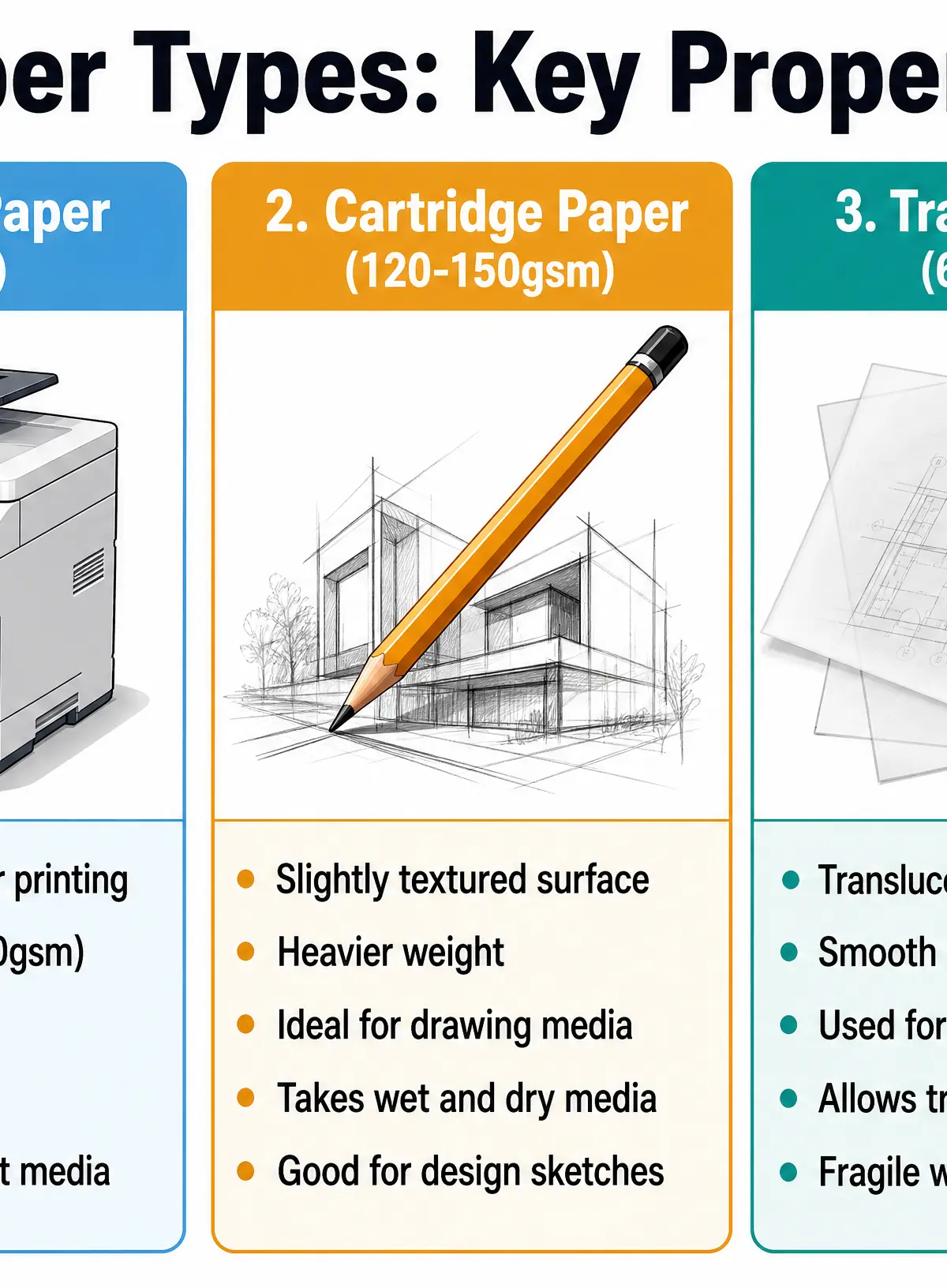
Papers are manufactured from cellulose fibres (usually wood pulp). You must know the properties of three specific types:
| Material | Typical Weight | Key Properties | Common Applications |
|---|---|---|---|
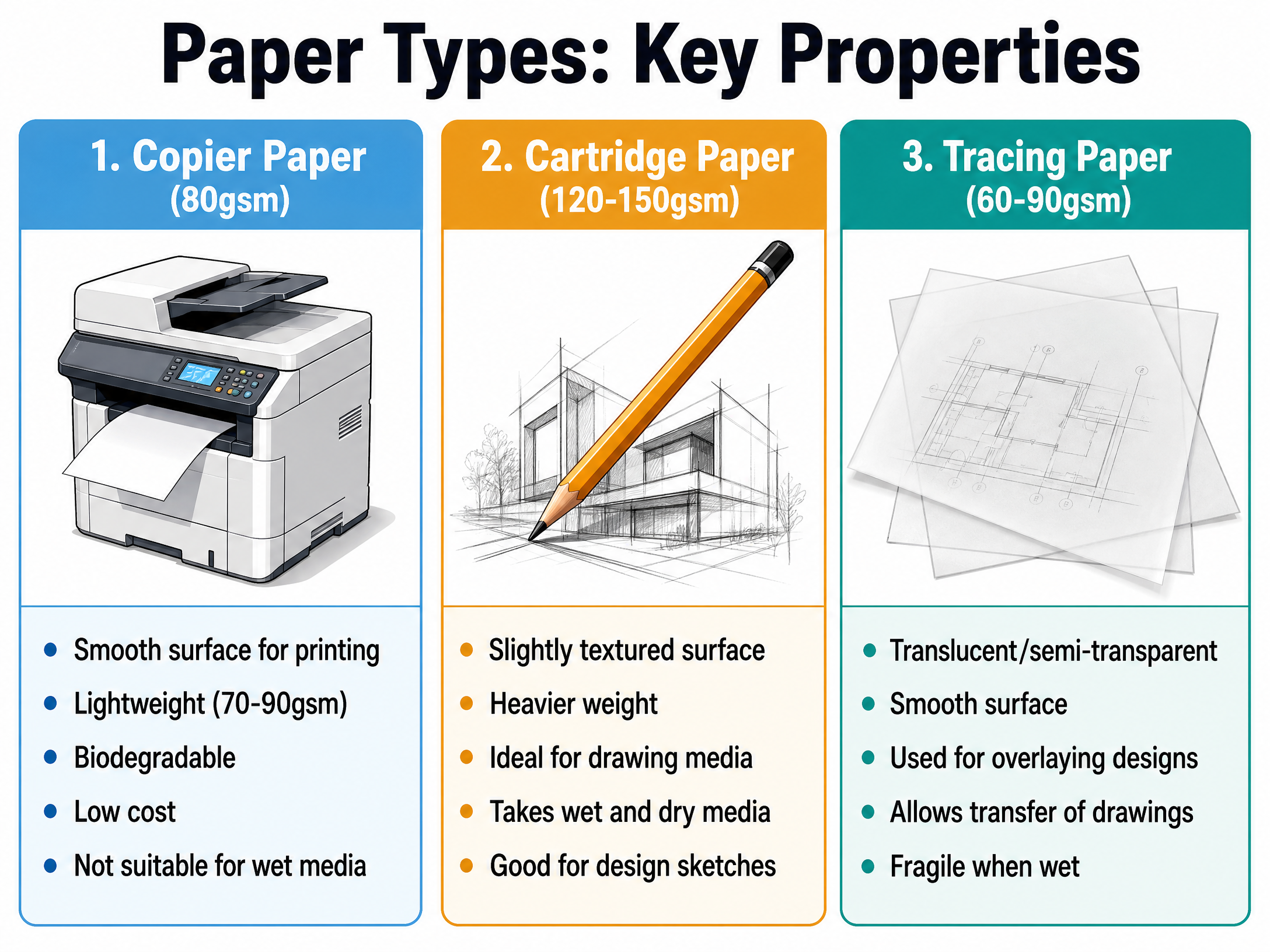
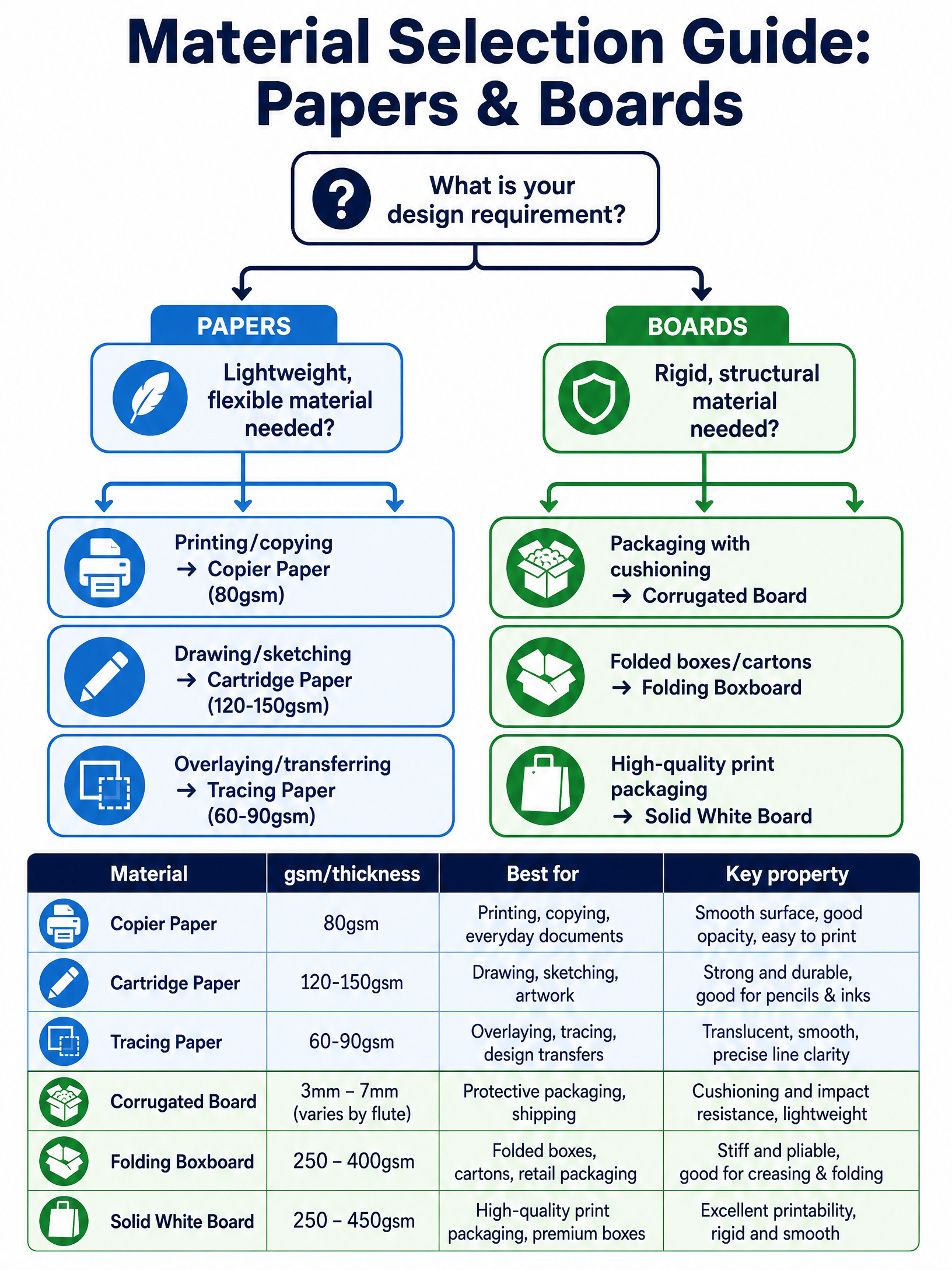
| Copier Paper | 80 gsm | Lightweight, smooth surface, biodegradable, low cost. Ink sits cleanly on the surface. Not suitable for wet media. | Printing, photocopying, everyday documents, sketching out quick ideas. |
| Cartridge Paper | 120-150 gsm | Slightly textured surface, heavier weight, opaque. The texture provides 'tooth' for drawing media to grip. | Drawing, design sketches, watercolours, marker pens, presentation drawings. |
| Tracing Paper | 60-90 gsm | Translucent (semi-transparent), very smooth surface. Fragile when wet. | Overlaying designs, copying drawings, transferring working drawings. |
2. Boards
Boards are used when structural rigidity and protection are required.
| Material | Typical Weight/Thickness | Key Properties | Common Applications |
|---|---|---|---|
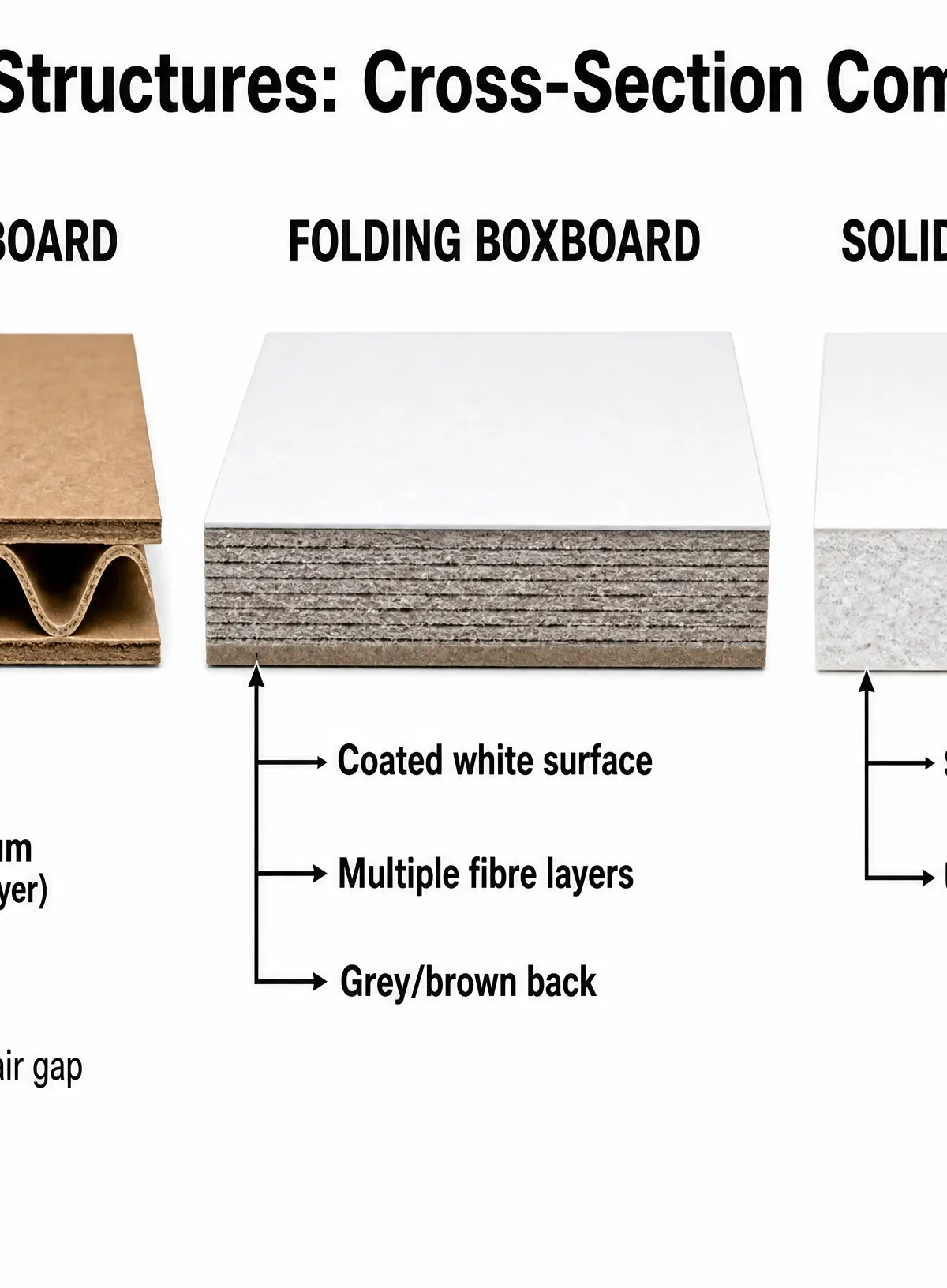
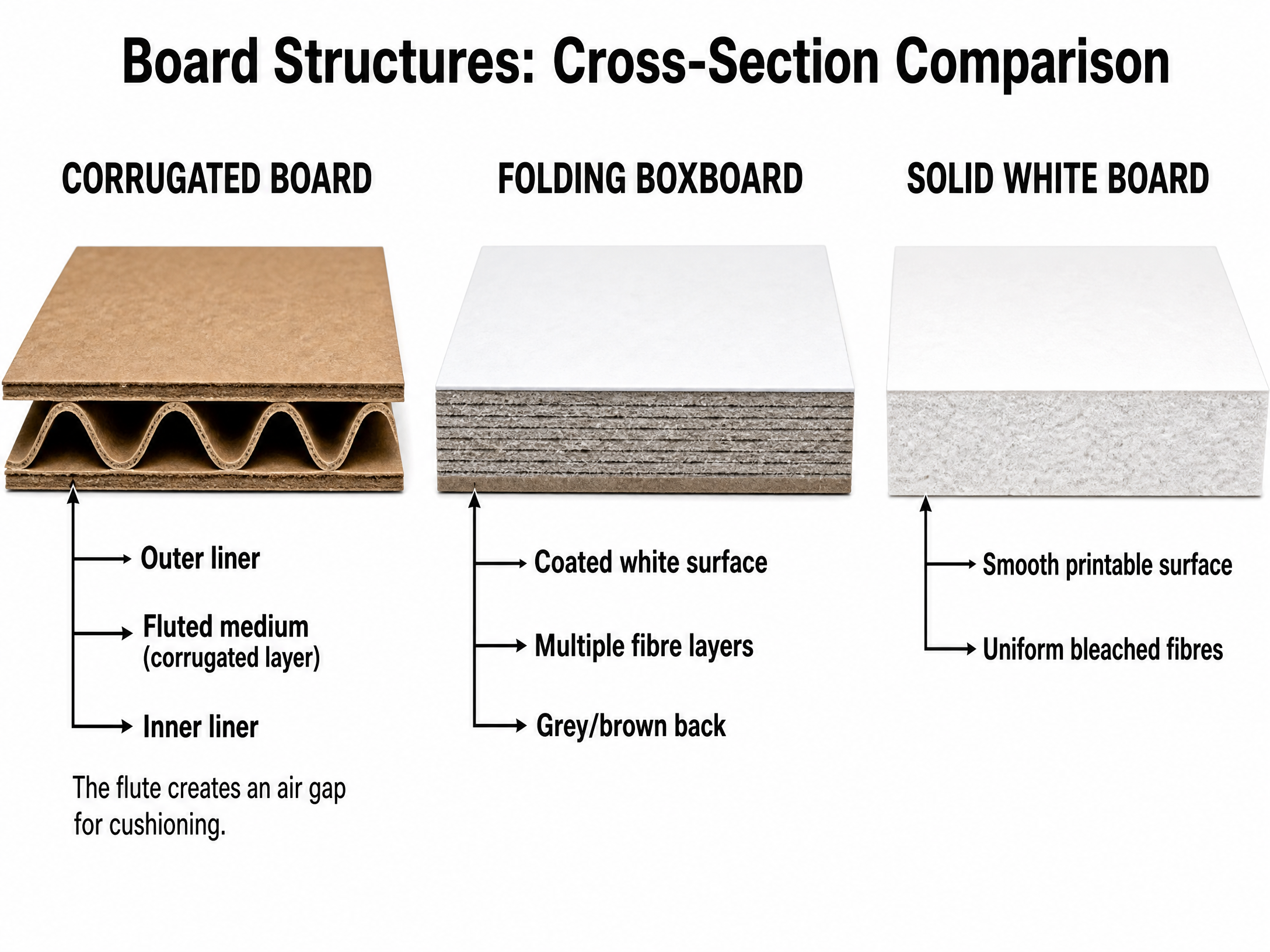
| Folding Boxboard | 250-400 gsm | Multi-layered. Coated white surface for printing, multiple compressed fibre layers, grey/brown back. Can be scored and folded without cracking. | Retail packaging, cereal boxes, cartons, cosmetics packaging. |
| Corrugated Board | 3mm - 7mm (varies by flute) | Structural composite. Two flat outer liners sandwiching a wavy 'fluted' inner layer. The flutes create air pockets for cushioning and impact resistance. Excellent strength-to-weight ratio. | Protective packaging, shipping boxes, point-of-sale displays. |
| Solid White Board | 250-450 gsm | Uniform bleached white fibres throughout. Very rigid, excellent smooth surface for high-quality printing. Less suitable for complex folding than boxboard. | Premium packaging, hardback book covers, high-end display boards. |
Technical Vocabulary
To access the highest marks (AO1 and AO2), you must use the correct terminology:
- gsm (grams per square metre): The standard measurement of paper and board weight.
- Translucency: Allowing light, but not detailed shapes, to pass through (e.g., tracing paper).
- Fluting / Fluted Medium: The wavy corrugated layer inside corrugated board that provides cushioning.
- Biodegradable: Capable of being decomposed by bacteria or other living organisms (a key sustainability point for papers/boards).
- Compressive Strength: The ability of a material (like corrugated board) to withstand being pushed or squashed.
Practical Skills & NEA Portfolio Guidance
Material Selection in your NEA
In your Non-Exam Assessment (NEA), you must justify the materials you use for both modelling and your final prototype.
Modelling Techniques
When developing ideas, you should use papers and boards to create quick, low-fidelity models.
- Initial Concept Modelling: Use cartridge paper or thin card to quickly fold and tape basic shapes.
- Structural Testing: Use corrugated board to test the structural integrity of a design (e.g., a chair or a stand).
- Nets and Developments: When designing packaging, you must draw a 'net' (the flat 2D shape that folds into a 3D object). Folding boxboard is the ideal material for testing these nets because it can be scored (creased) and folded cleanly.
Building a Strong Portfolio
Examiners look for evidence of iterative design.
- Sketching: Show your initial ideas on cartridge paper.
- Overlaying: Use tracing paper over your sketches to show how you have refined and developed a shape without having to redraw the whole thing. Annotate these overlays.
- Justification: In your materials research section, do not just list materials. Use a table to compare them (e.g., Corrugated Board vs. Solid White Board) and explicitly state why you chose one over the other based on their working properties.
Exam Component Preparation
Written Exam Knowledge
In the written paper, you will be tested on your ability to:
- Identify materials from a description or image.
- Explain why a specific material is used for a specific product.
- Compare two materials for a given application.
You must be able to link the structure of the material to its property, and then to its application.
Example Linkage:
Structure (Fluted inner layer) -> Property (Impact resistance/cushioning) -> Application (Protecting fragile electronics during shipping).
Visual Resources
3 diagrams and illustrations
Interactive Diagrams
1 interactive diagram to visualise key concepts
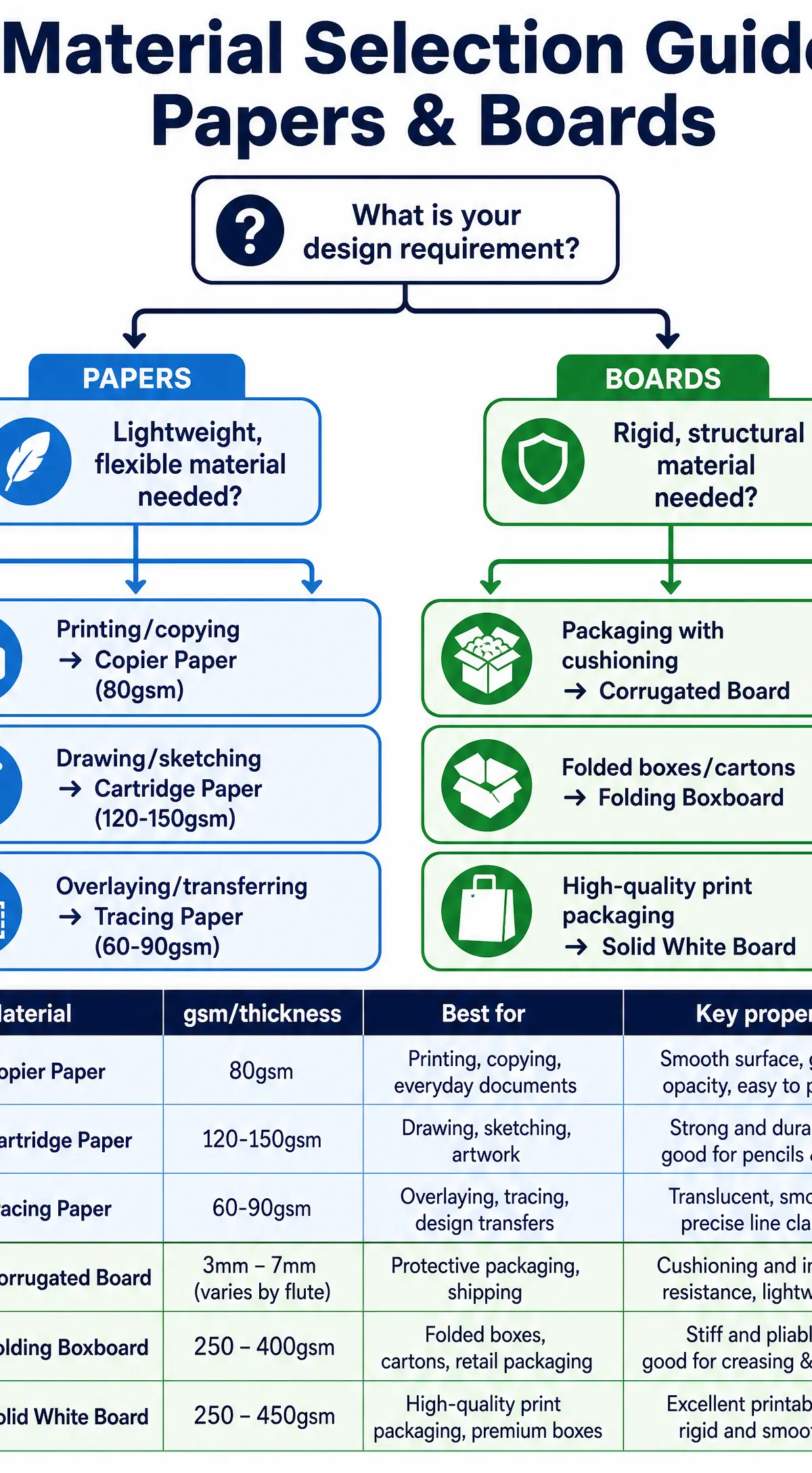
Conceptual Flow Outline
Material Selection Flowchart for Papers and Boards
Worked Examples
3 worked examples — open one to explore the question and available guidance.
Practice Questions
Test your understanding — click to reveal model answers
Identify the unit of measurement used to determine the weight of paper and board. (1 mark)
Hint: Think about the acronym that stands for grams per square metre.
Explain one reason why corrugated board is used for packaging laptop computers for delivery. (2 marks)
Hint: Think about the structure of the board and what a laptop needs during shipping.
A student is creating an architectural presentation. They have chosen to use 80gsm copier paper for their final watercolour visualisations. Evaluate this material choice and suggest a more appropriate alternative. (4 marks)
Hint: Consider how wet media interacts with lightweight paper. What paper is designed for drawing and painting?
Compare the structural properties and typical applications of folding boxboard and solid white board. (6 marks)
Hint: Break down the layers of each board. Which one folds better? Which one is more rigid?