Pearson Edexcel · GCSE · Design and Technology
The categorisation of the types, properties and structure of thermoforming and thermosetting polymers
This topic covers the fundamental categorisation, properties, and applications of thermoforming and thermosetting polymers. Understanding how molecular structure dictates a material's behaviour under heat is essential for justifying material selection in both exam questions and practical coursework.
- 6 min read
- 3 worked examples
- 3 practice questions
- 6 key terms
Study Notes
Overview
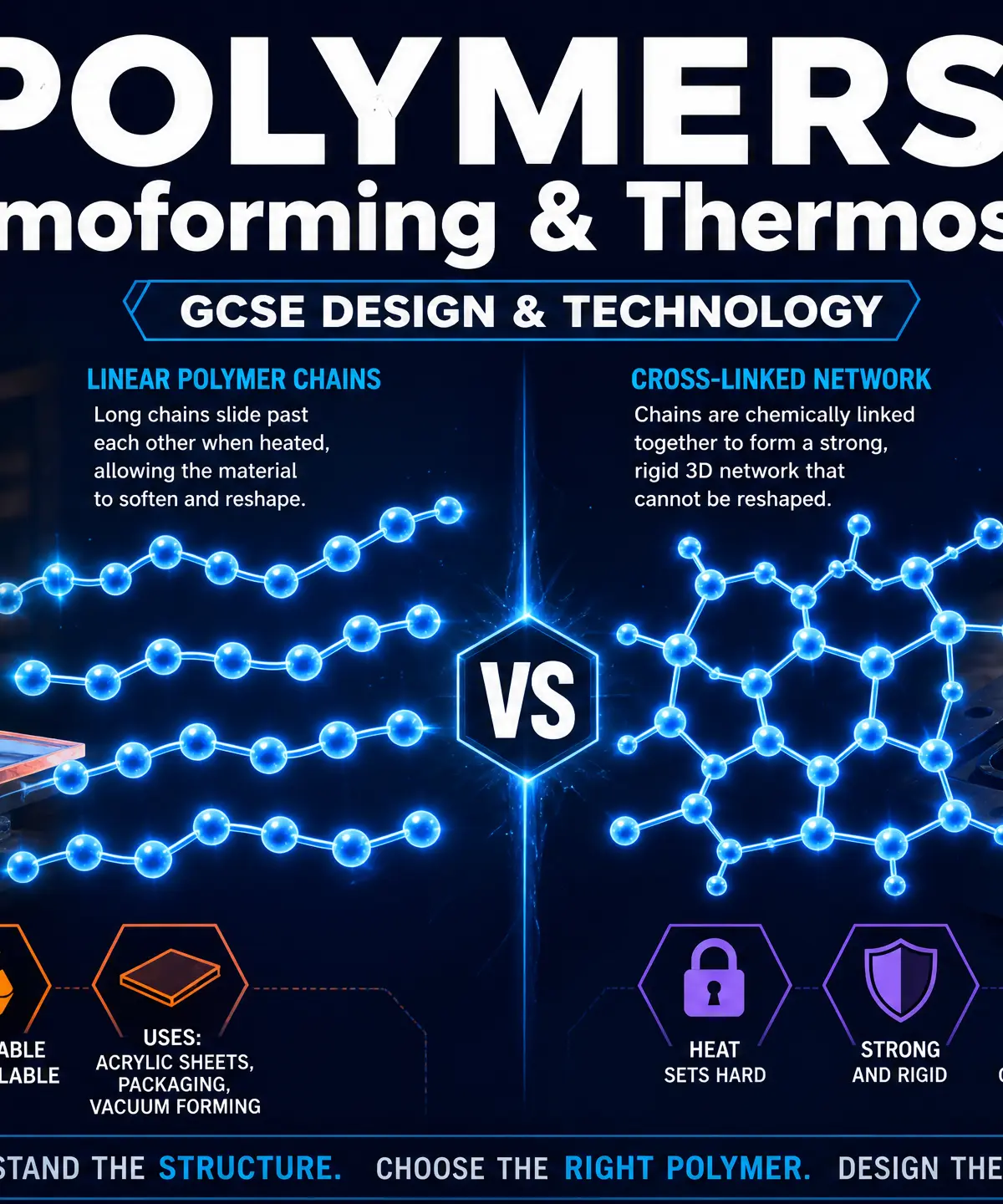
Topic 1.10 focuses on the categorisation of the types, properties, and structure of thermoforming and thermosetting polymers. In Design and Technology, polymers (commonly known as plastics) are ubiquitous. As a designer, you must be able to discriminate between different polymers to select the most appropriate material for a specific product. This requires a deep understanding of their working properties, their molecular structures, and how they behave when subjected to heat.
Key Knowledge & Theory
Core Concepts: The Heat Response
The fundamental distinction between the two main categories of polymers is their response to heat. This response is entirely dictated by their molecular structure.
Thermoforming Polymers soften when they are heated and can be reshaped. Once they cool down, they harden again into their new shape. This process is reversible; they can be heated and reshaped repeatedly. Because of this, thermoforming polymers can be recycled.
Thermosetting Polymers, conversely, undergo a permanent chemical change when heated and set. Once they have been formed and cured, they cannot be softened or reshaped by reheating. If excessive heat is applied, they will simply burn or char. Consequently, thermosetting polymers cannot be recycled.
Molecular Structure
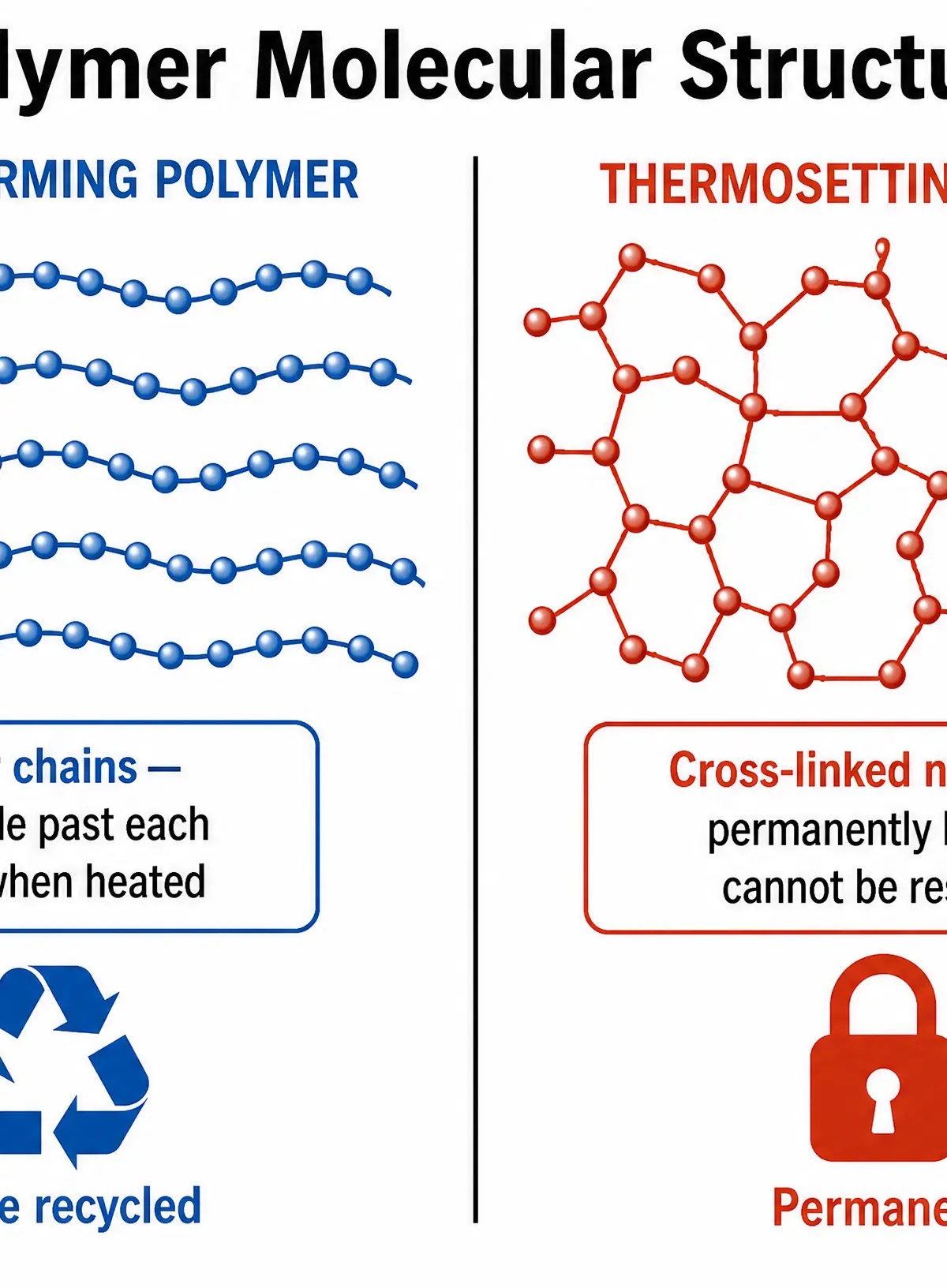
To access the highest marks (AO1 Knowledge and Understanding), you must use the correct structural terminology:
- Thermoforming Polymers consist of linear polymer chains. These long chains lie alongside each other and are held together by weak intermolecular forces. When heat is applied, these weak forces are overcome, allowing the chains to slide past one another, which is why the material softens and becomes mouldable.
- Thermosetting Polymers consist of a cross-linked network. During the initial heating and setting process, strong covalent bonds (cross-links) form between the polymer chains, locking them into a rigid, 3D network. This permanent structure prevents the chains from moving, meaning the material cannot be reshaped.
Key Materials and Applications
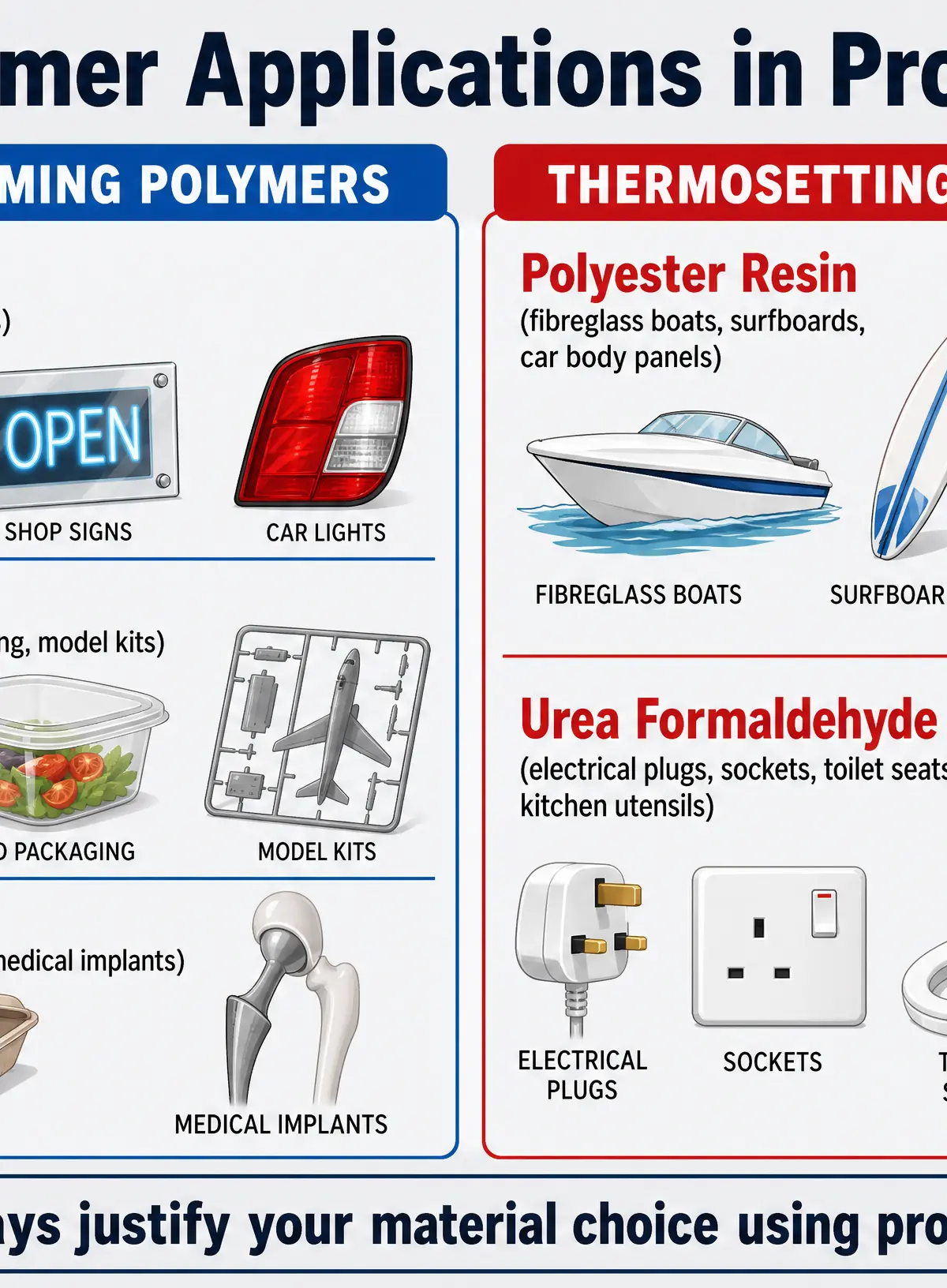
You must be able to identify specific polymers and link them to their applications.
Thermoforming Polymers:
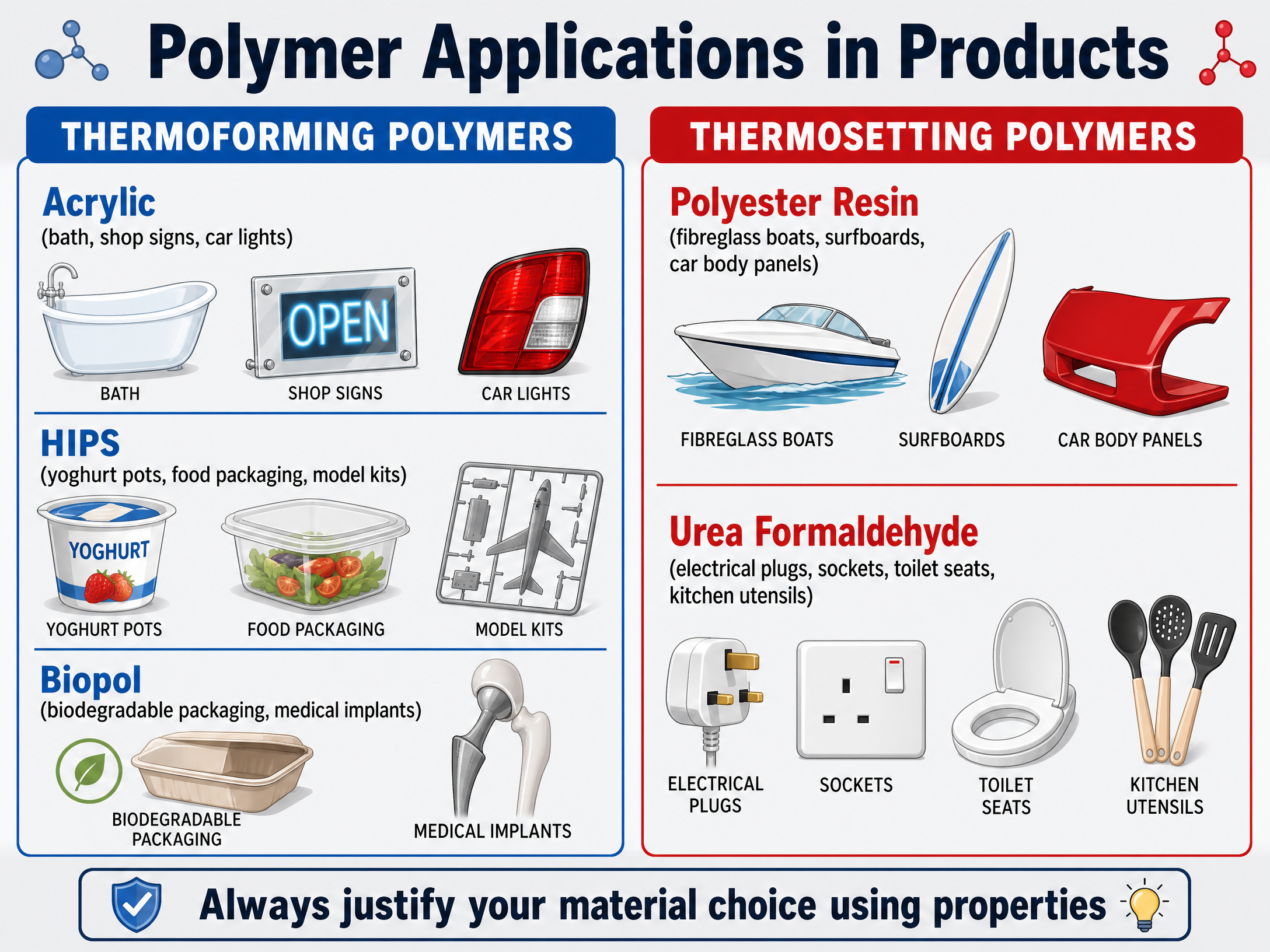
- Acrylic (PMMA): Stiff, hard, very durable, transparent, easily scratched. Uses: Shop signs, car light covers, bath panels.
- High Impact Polystyrene (HIPS): Light, strong, high impact resistance, easily vacuum formed. Uses: Yoghurt pots, food packaging, model kits.
- Biopol: A biodegradable polymer. Uses: Disposable packaging, medical implants.
Thermosetting Polymers:
- Polyester Resin: Stiff, hard, brittle unless reinforced. Uses: Combined with glass fibre (GRP) for boat hulls, surfboards, and car body panels.
- Urea Formaldehyde: Hard, strong, stiff, excellent electrical and thermal insulator. Uses: Electrical plugs, sockets, toilet seats.
Technical Vocabulary
- Insulator of heat: A material that does not easily allow heat to pass through it.
- Insulator of electricity: A material that does not easily allow electrical current to pass through it.
- Toughness: The ability of a material to absorb impact energy without fracturing.
- Linear chains: The molecular structure of thermoforming polymers.
- Cross-linked network: The molecular structure of thermosetting polymers.
Practical Skills
Material Selection in Coursework
In your Non-Examined Assessment (NEA), you will be required to select materials for your prototype. Examiners award marks (AO2 Application) for justifying your choices based on working properties.
If you are designing a product that requires a complex, curved casing that will be manufactured in a school workshop, a thermoforming polymer like HIPS is appropriate because it can be easily vacuum formed. If you are designing a product that will be exposed to high temperatures (like a kitchen utensil handle), a thermosetting polymer like Urea Formaldehyde must be selected because it is dimensionally stable under heat.
Manufacturing Processes
Understanding the category of polymer dictates the manufacturing processes available to you:
- Thermoforming: Can be vacuum formed, line bent (using a strip heater), injection moulded, or blow moulded.
- Thermosetting: Typically cast into moulds (like Polyester Resin) or compression moulded.
Portfolio/Coursework Guidance
Assessment Criteria
When documenting your material choices in your portfolio, examiners are looking for:
- Identification: Correctly naming the specific polymer (e.g., Acrylic, not just 'plastic').
- Property Linkage: Explicitly stating the working property that makes it suitable (e.g., 'Acrylic is transparent...').
- Application Justification: Explaining why that property is necessary for the product's function (e.g., '...which is essential for the display screen cover to allow the user to read the interface').
Exam Component
Written Exam Knowledge
In the written paper, you will face questions testing AO1 (Recall), AO2 (Application), and AO3 (Analysis/Evaluation).
Expect questions that ask you to:
- State the structural difference between the two categories.
- Explain why a specific polymer was chosen for a given product (e.g., "Explain why urea formaldehyde is suitable for an electrical plug").
- Evaluate the environmental impact of using thermosetting versus thermoforming polymers.

Visual Resources
2 diagrams and illustrations
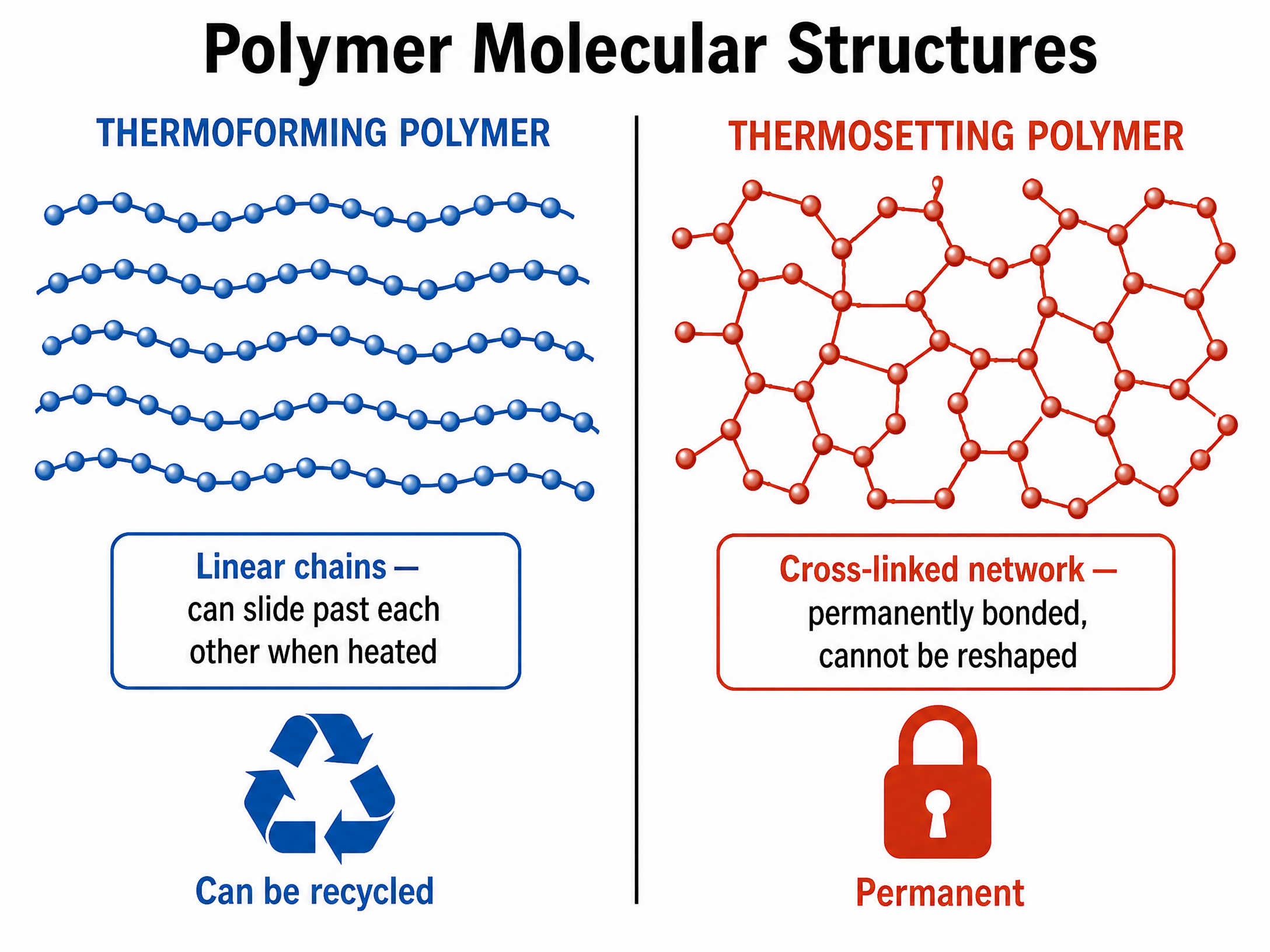
Interactive Diagrams
1 interactive diagram to visualise key concepts
Conceptual Flow Outline
Polymer Categorisation Flowchart
Worked Examples
3 worked examples — open one to explore the question and available guidance.
Practice Questions
Test your understanding — click to reveal model answers
Identify one thermoforming polymer and one thermosetting polymer. (2 marks)
Hint: Think about the materials used for a yoghurt pot versus an electrical plug.
Explain why acrylic is a suitable material for a car's rear light cover. (2 marks)
Hint: What does a light cover need to do? What physical properties does acrylic have?
A manufacturer is deciding between HIPS and Polyester Resin for the casing of a new portable radio. Justify which material would be more appropriate. (4 marks)
Hint: Compare the manufacturing processes and physical properties required for a portable, mass-produced item.