Pearson Edexcel · GCSE · Design and Technology
Timbers: Alternative processes that can be used to manufacture typical timber products to different scales of production
Master the essential timber manufacturing processes and understand how production scales impact manufacturing choices. This topic bridges theoretical knowledge of routing, sawing, mortising, and bag pressing with the practical realities of one-off, batch, mass, and continuous production.
- 6 min read
- 2 worked examples
- 3 practice questions
- 6 key terms
Study Notes
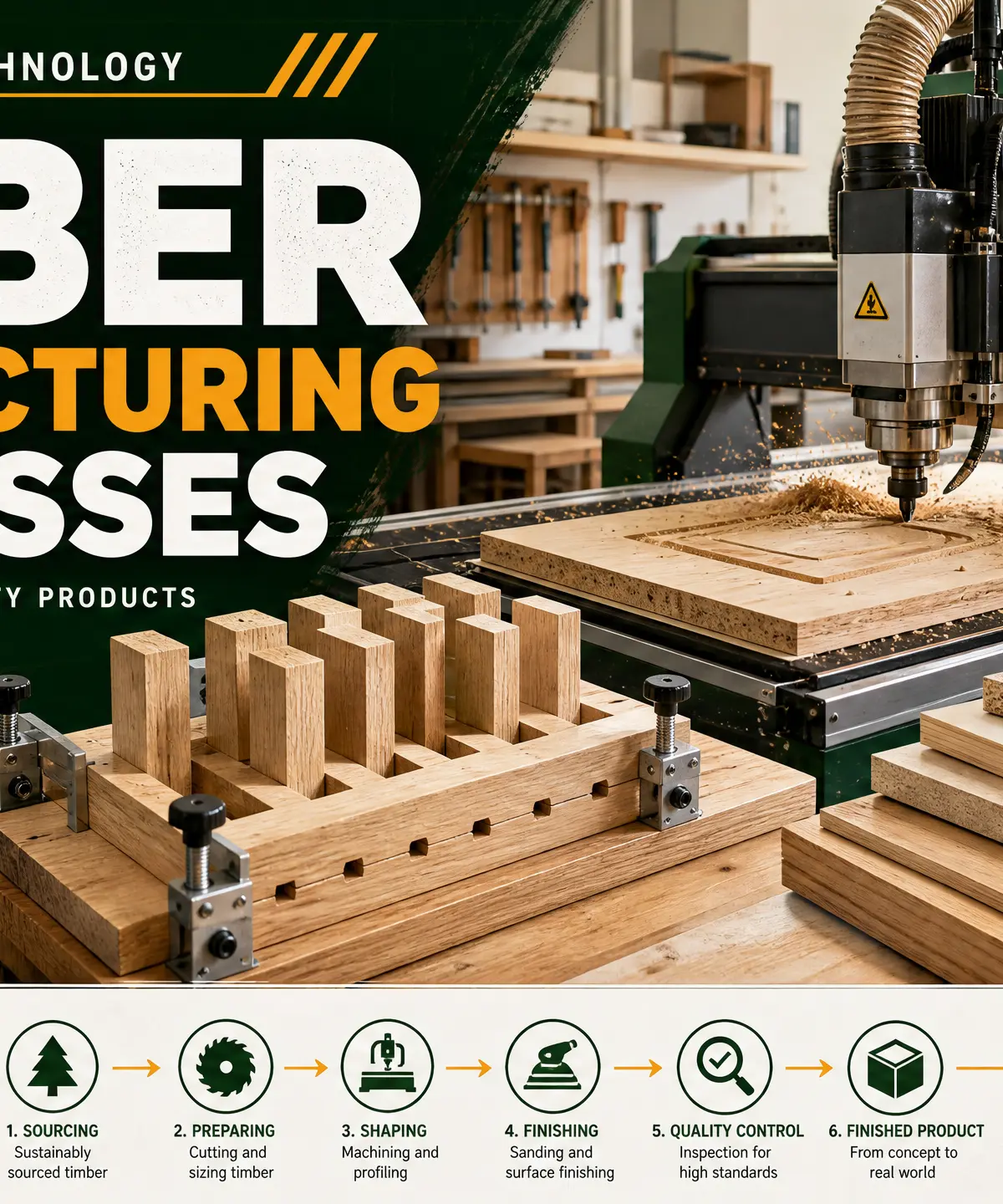
Overview
Understanding alternative manufacturing processes for timber is a cornerstone of GCSE Design and Technology. This topic area (7.6) requires you to not only know how timber is cut and shaped but also why specific processes are chosen based on the scale of production. Examiners will test your ability to discriminate between processes and justify your choices for specific timber products.
Key Knowledge & Theory
Core Concepts: Scales of Production
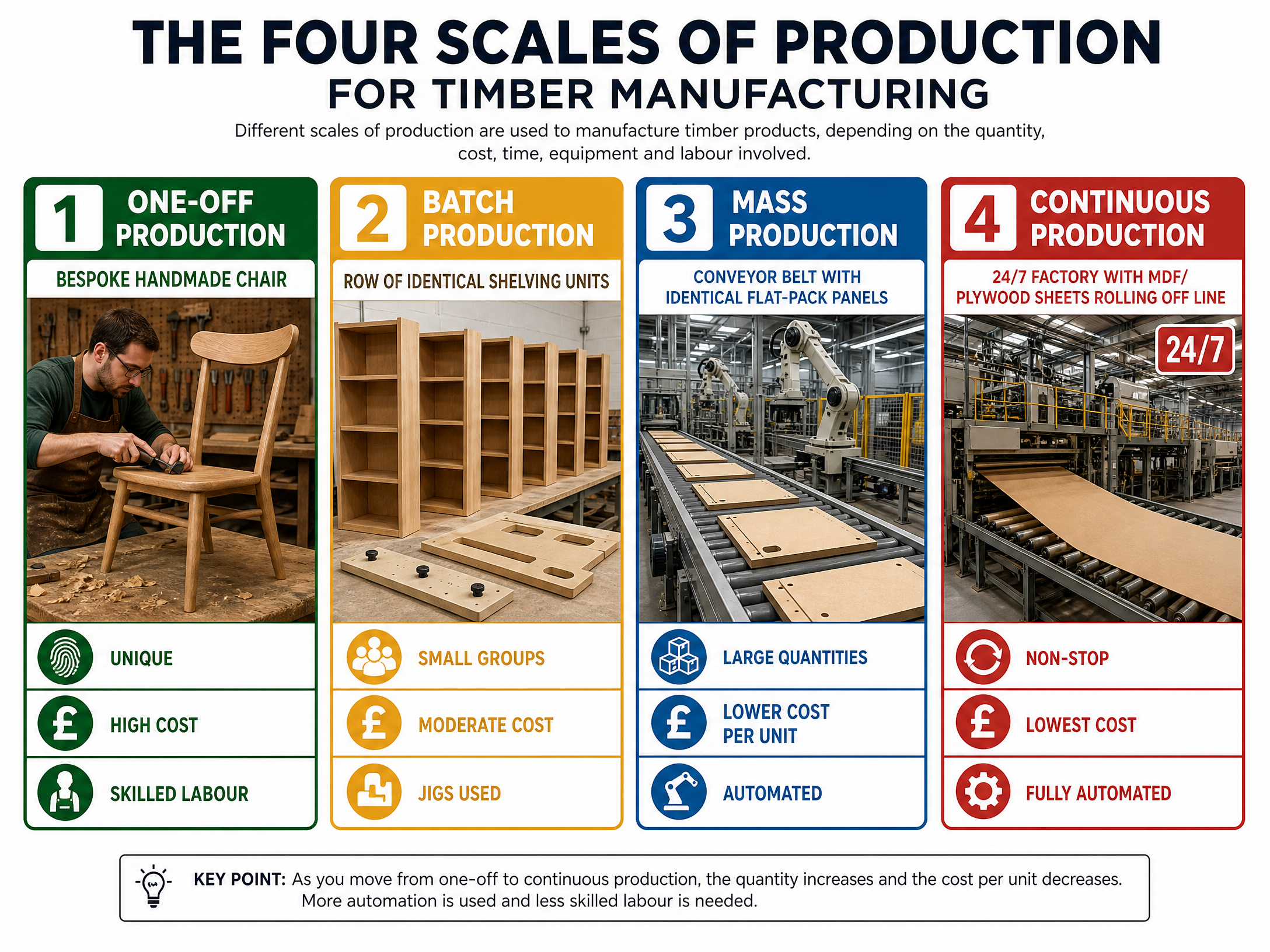
The scale of production dictates the manufacturing methods, the level of automation, and the tools required. You must be able to distinguish between the four main scales:
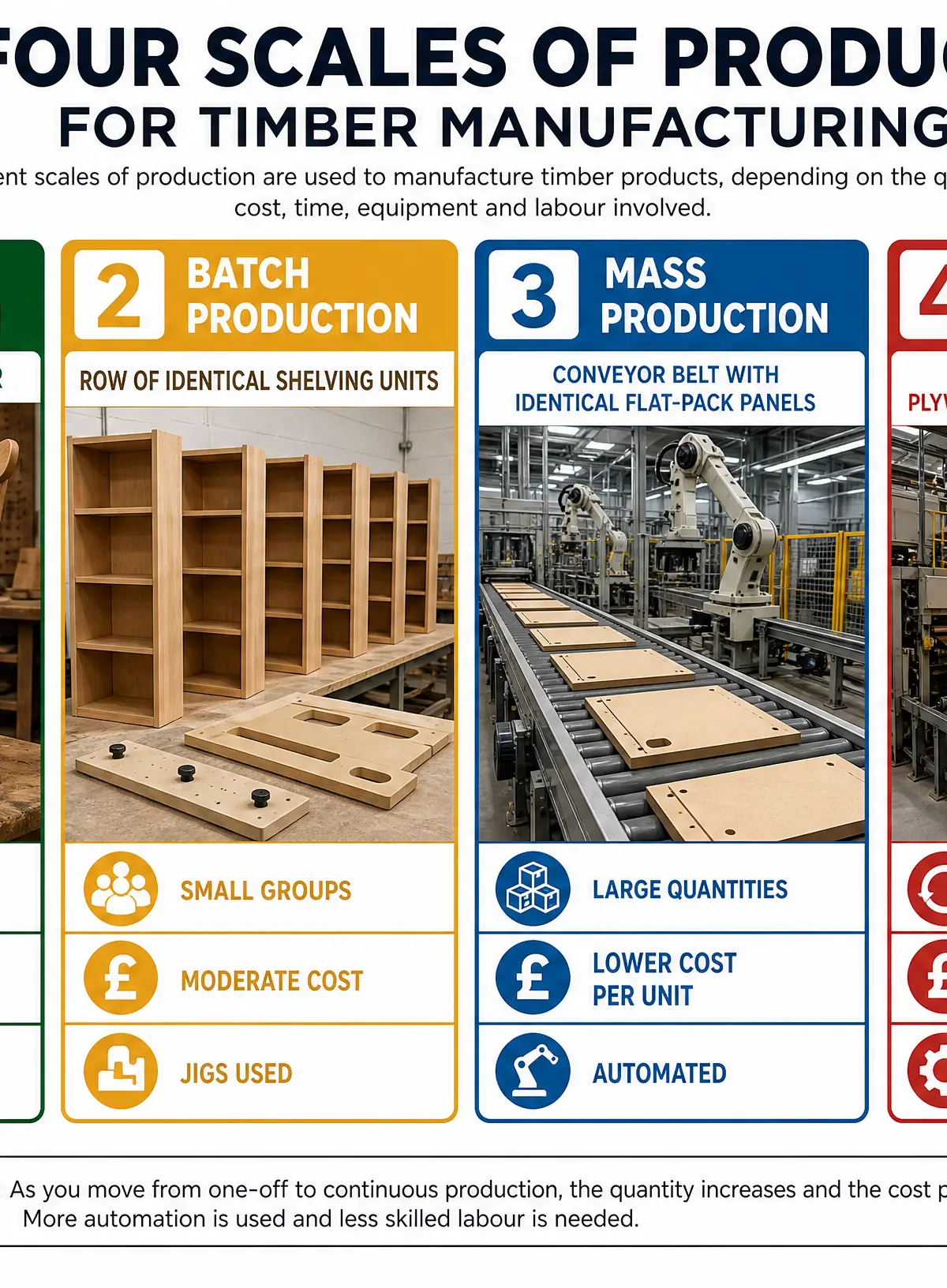
- One-off Production: Creating a single, bespoke product (e.g., a custom-built reception desk). It relies on highly skilled labour, traditional hand tools, and basic machinery. Cost per unit is high, and jigs/templates are rarely used.
- Batch Production: Manufacturing a set number of identical items (e.g., 50 dining chairs). This scale heavily utilises jigs, fixtures, and templates to ensure accuracy and speed up the process without needing fully automated lines.
- Mass Production: Producing very large quantities of identical products (e.g., flat-pack furniture). It involves high initial setup costs but low unit costs. It relies heavily on CNC (Computer Numerical Control), CAM (Computer-Aided Manufacture), sub-assembly lines, and rigorous quality control.
- Continuous Production: Running 24/7 without interruption. In timber manufacturing, this applies to the production of sheet materials like MDF, chipboard, and plywood. It is fully automated with minimal human intervention to maximise efficiency and minimise waste.
Key Manufacturing Processes
| Process | Description | Typical Application | Scale Suitability |
|---|---|---|---|
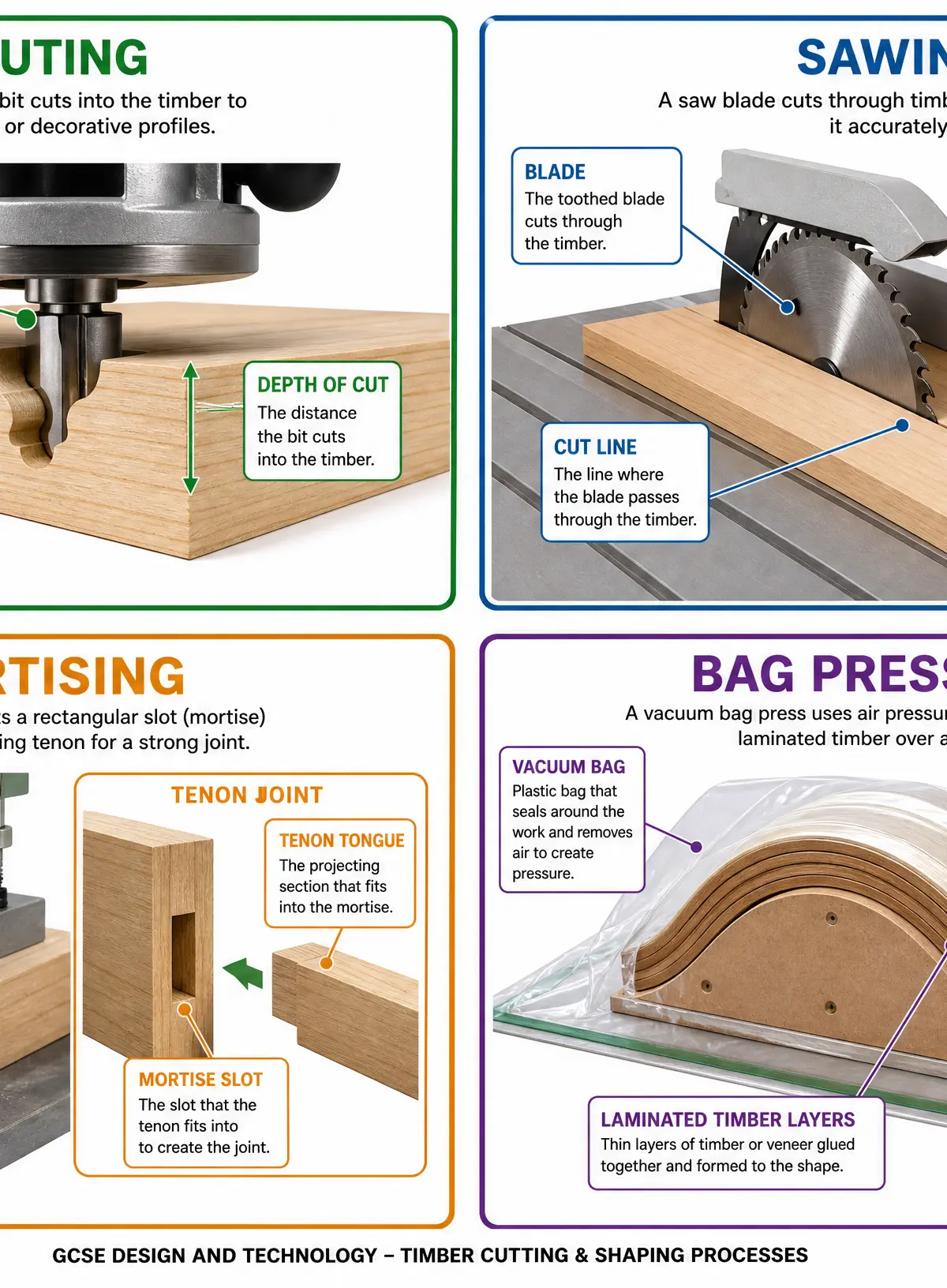
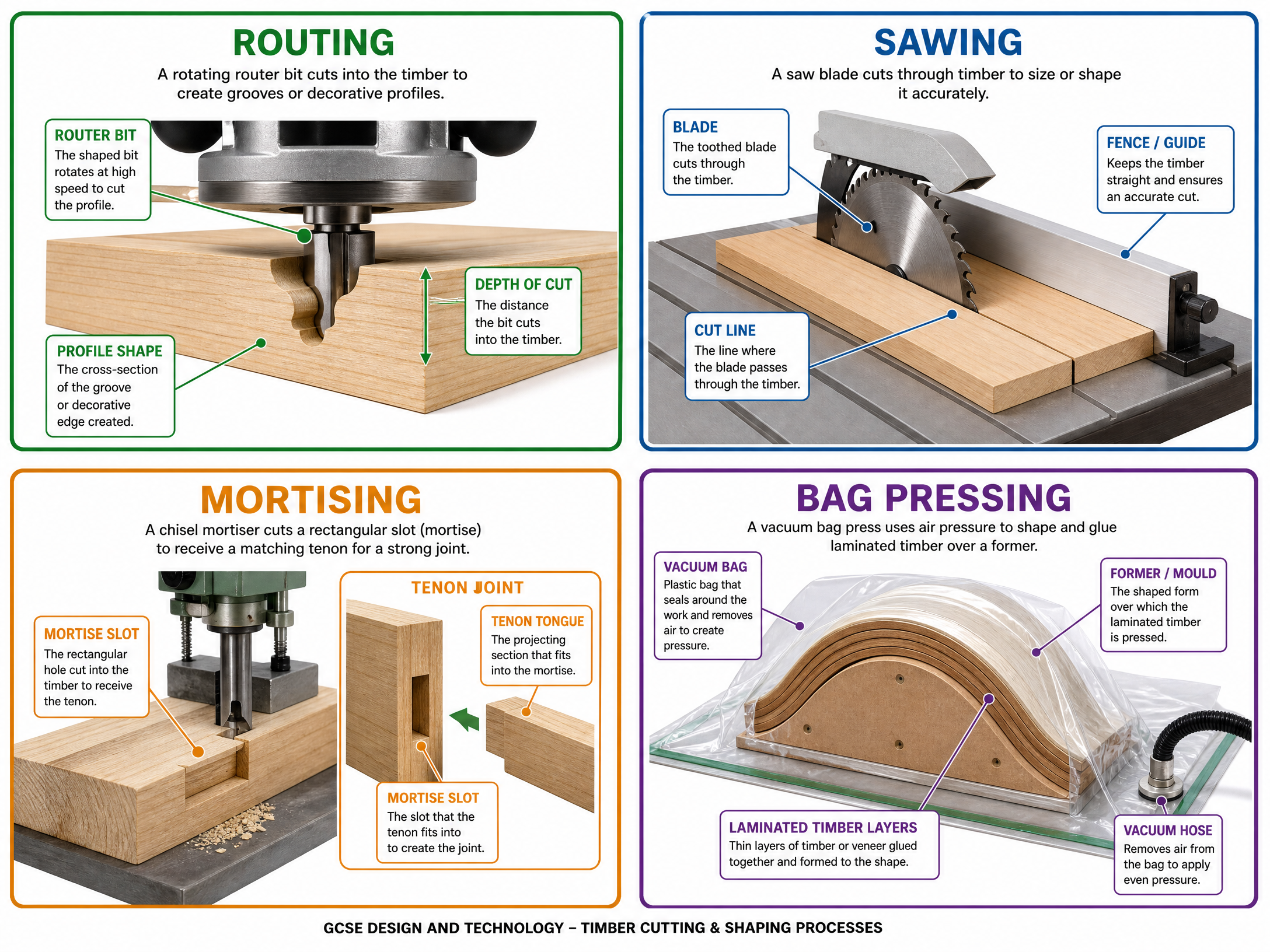
| Routing | Using a high-speed rotating bit to cut grooves, rebates, or decorative edge profiles. | Cabinet doors, decorative mouldings, housing joints. | One-off (hand router), Mass (CNC router). |
| Sawing | Cutting timber to size or shape. Includes circular saws (straight cuts), band saws (curves), and panel saws (sheet materials). | Sizing timber blanks, cutting manufactured boards. | All scales (tool choice varies). |
| Mortising | Using a specialised machine (chisel mortiser) to cut a rectangular slot (mortise) for a joint. | Creating mortise and tenon joints for strong frame construction. | Batch, Mass. |
| Bag Pressing | Using a vacuum bag to press glued layers of thin timber or veneer over a former to create a curved shape. | Curved chair backs, skateboard decks. | Batch. |
Technical Vocabulary
To access higher mark bands, you MUST use specialist terminology correctly:
- Jig: A device that holds a workpiece and guides a tool, ensuring repeatable accuracy.
- Template: A guide used to mark out identical shapes quickly.
- Tolerance: The acceptable margin of error in a dimension (e.g., ±1mm) ensuring parts fit together.
- Sub-assembly: Assembling smaller parts of a product before final assembly on the main production line.
- CAM (Computer-Aided Manufacture): Using software to control machine tools (like CNC routers) to manufacture parts automatically.
Practical Skills
Techniques & Processes: Implementing Jigs in Batch Production
When undertaking batch production in your coursework, demonstrating the use of jigs is an excellent way to show manufacturing efficiency:
- Identify the repetitive task: E.g., drilling three holes in the exact same location on 20 side panels.
- Design the jig: Create a robust guide (often from MDF or acrylic) that fits securely over the workpiece.
- Incorporate stops: Add physical stops to the jig so the workpiece always registers in the exact same position.
- Test and refine: Test the jig on a scrap piece to ensure accuracy before starting the main batch.
- Manufacture: Use the jig to rapidly process all components without needing to mark out each one individually.
Materials & Equipment: Safe Use of Machinery
Understanding the safe application of these processes is critical. For example, when routing, the workpiece must be securely clamped, and the correct feed direction must be maintained to prevent the cutter from grabbing the wood. When using a chisel mortiser, ensuring the timber is clamped firmly against the fence prevents it from lifting when the chisel is withdrawn.
Portfolio/Coursework Guidance
Assessment Criteria
Examiners look for clear evidence that you have considered the scale of production when planning your practical outcome. If you are making a prototype for a product intended for batch production, your portfolio must document how you would adapt your manufacturing methods (e.g., designing jigs, specifying CNC processes) for that larger scale.
Building a Strong Portfolio
- Documenting Efficiency: Include photographs of any templates or jigs you create, alongside the finished components, to prove you understand batch production techniques.
- Justifying Choices: Don't just list the tools you used. Explain why a router was better than a chisel for a specific task, referencing speed, accuracy, and finish.
- Quality Control: Show evidence of checking your work against a specification or working drawing (checking tolerances) during manufacture.
Exam Component
Written Exam Knowledge
In the written paper, you will frequently encounter questions asking you to compare processes or justify the use of a specific technique for a given product and scale. You must be able to link the process (e.g., bag pressing) to its advantages (consistent curves, strong lamination) and its suitability for a specific scale (batch production).
Audio Revision
Listen to the podcast episode below for a comprehensive review of this topic, including an examiner's perspective on how to structure your answers for maximum marks.

Visual Resources
2 diagrams and illustrations
Interactive Diagrams
1 interactive diagram to visualise key concepts
Conceptual Flow Outline
How scale of production determines manufacturing choices
Worked Examples
2 worked examples — open one to explore the question and available guidance.
Practice Questions
Test your understanding — click to reveal model answers
Identify the scale of production most suitable for manufacturing 10,000 identical flat-pack bookshelves.
Hint: Think about the quantity involved and the need for identical, interchangeable parts.
Explain two ways that the use of a template improves the manufacturing process when making a batch of 20 wooden toy cars.
Hint: Think about speed and accuracy compared to measuring each piece individually.
Evaluate the use of bag pressing compared to cutting a curved shape from a solid block of timber. [6 marks]
Hint: Consider material waste, strength (grain direction), and setup time.