Pearson Edexcel · GCSE · Design and Technology
Timbers: Typical stock forms, types and sizes used to calculate and determine the required quantity of each natural and manufactured timber
Master the essential timber stock forms, standard sizes, and quantity calculations required for GCSE Design and Technology. This guide covers the critical differences between natural and manufactured timbers, providing you with the exact knowledge needed to score high marks in both written exams and coursework planning.
- 6 min read
- 3 worked examples
- 4 practice questions
- 6 key terms
Study Notes
Overview
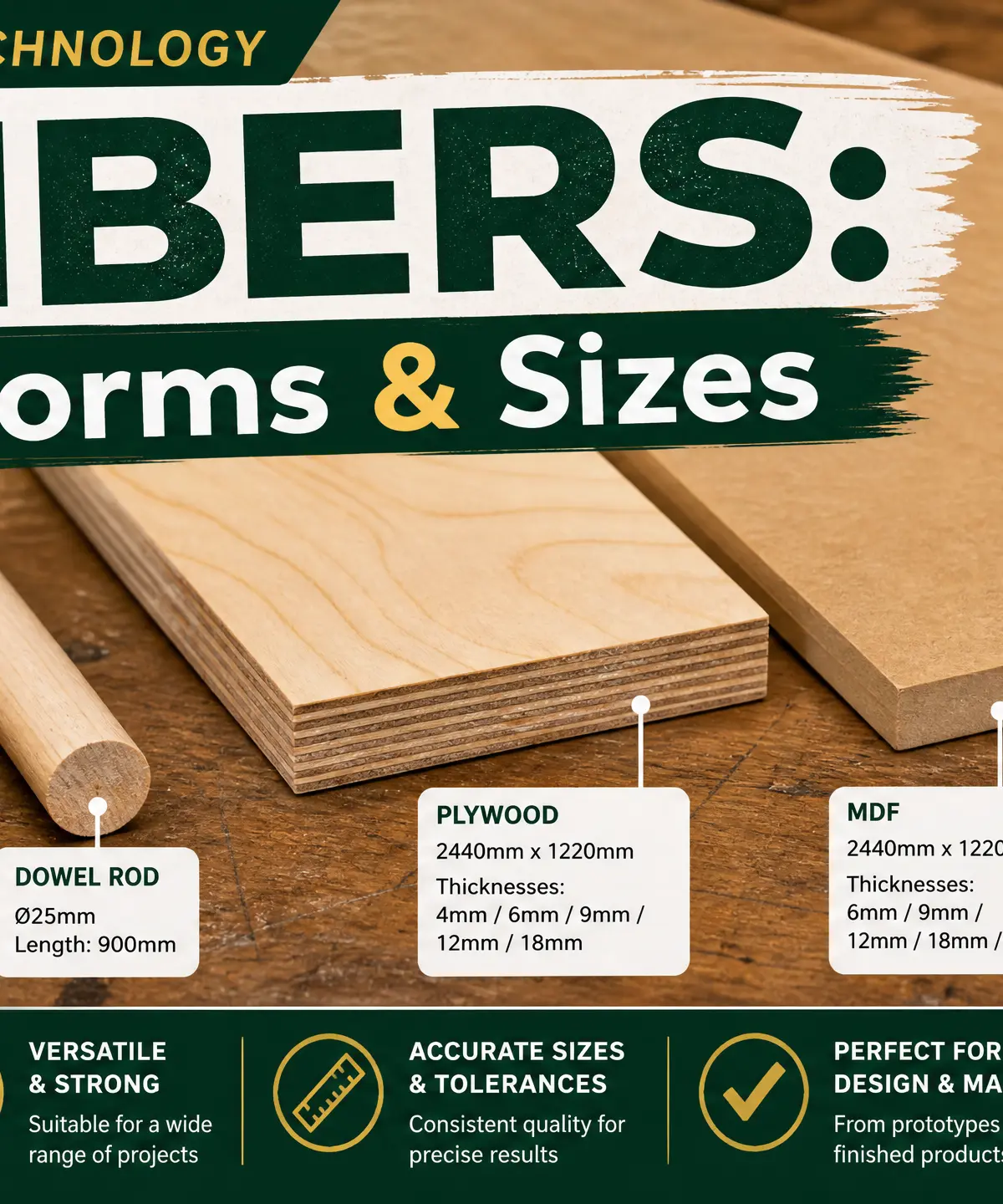
Understanding timber stock forms is a foundational skill in GCSE Design and Technology. When designing and manufacturing products, you cannot simply summon material in any shape or size you desire. Timber is processed, transported, and sold in specific, standardised formats known as stock forms. Knowing these forms allows you to design efficiently, minimise waste, and accurately calculate the quantities required for your projects.
Examiners consistently test this knowledge. They expect candidates to identify correct stock forms, understand standard dimensions, and apply mathematical skills to calculate material requirements from a given cutting list.

Key Knowledge & Theory
Core Concepts: What is a Stock Form?
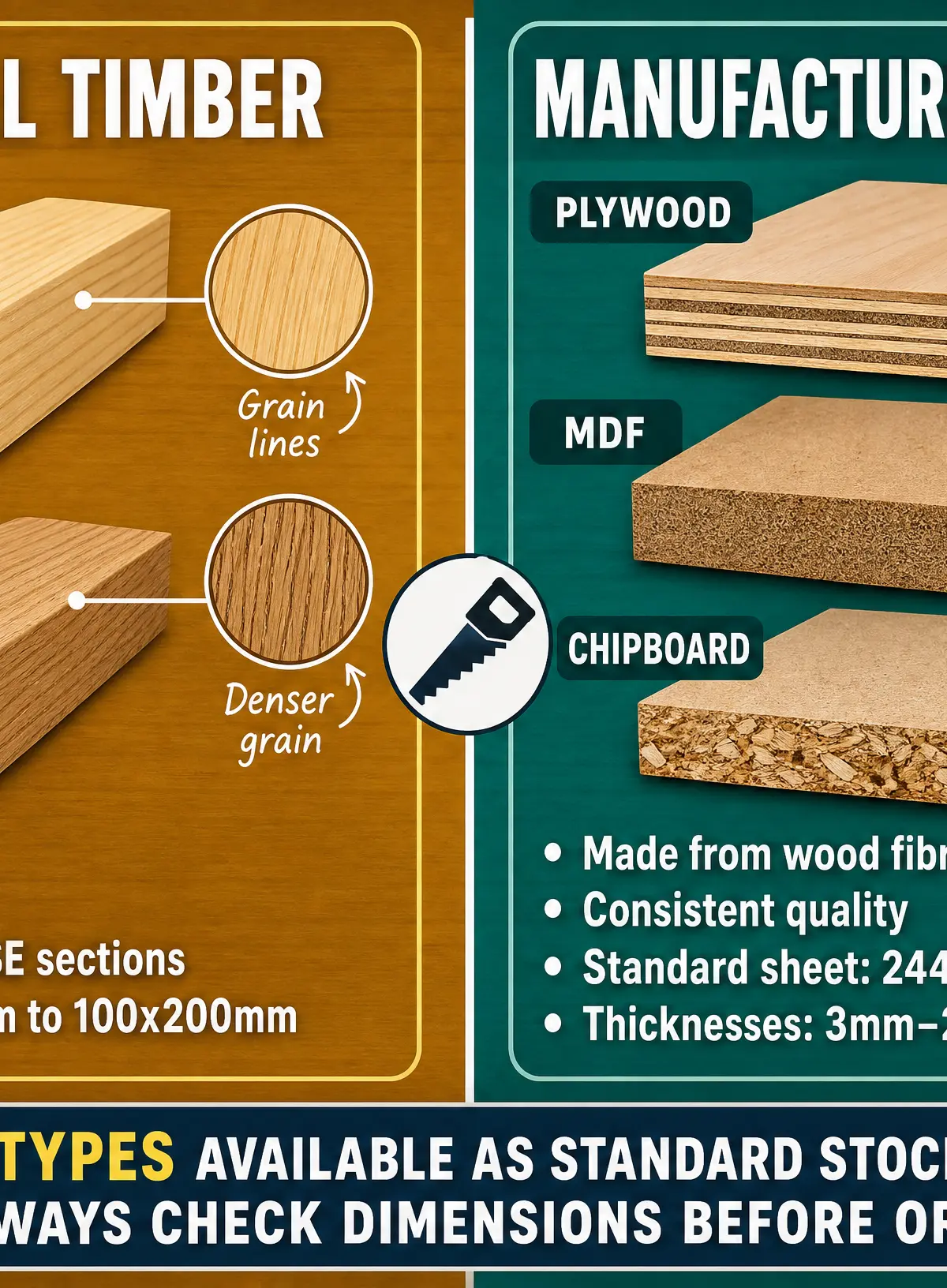
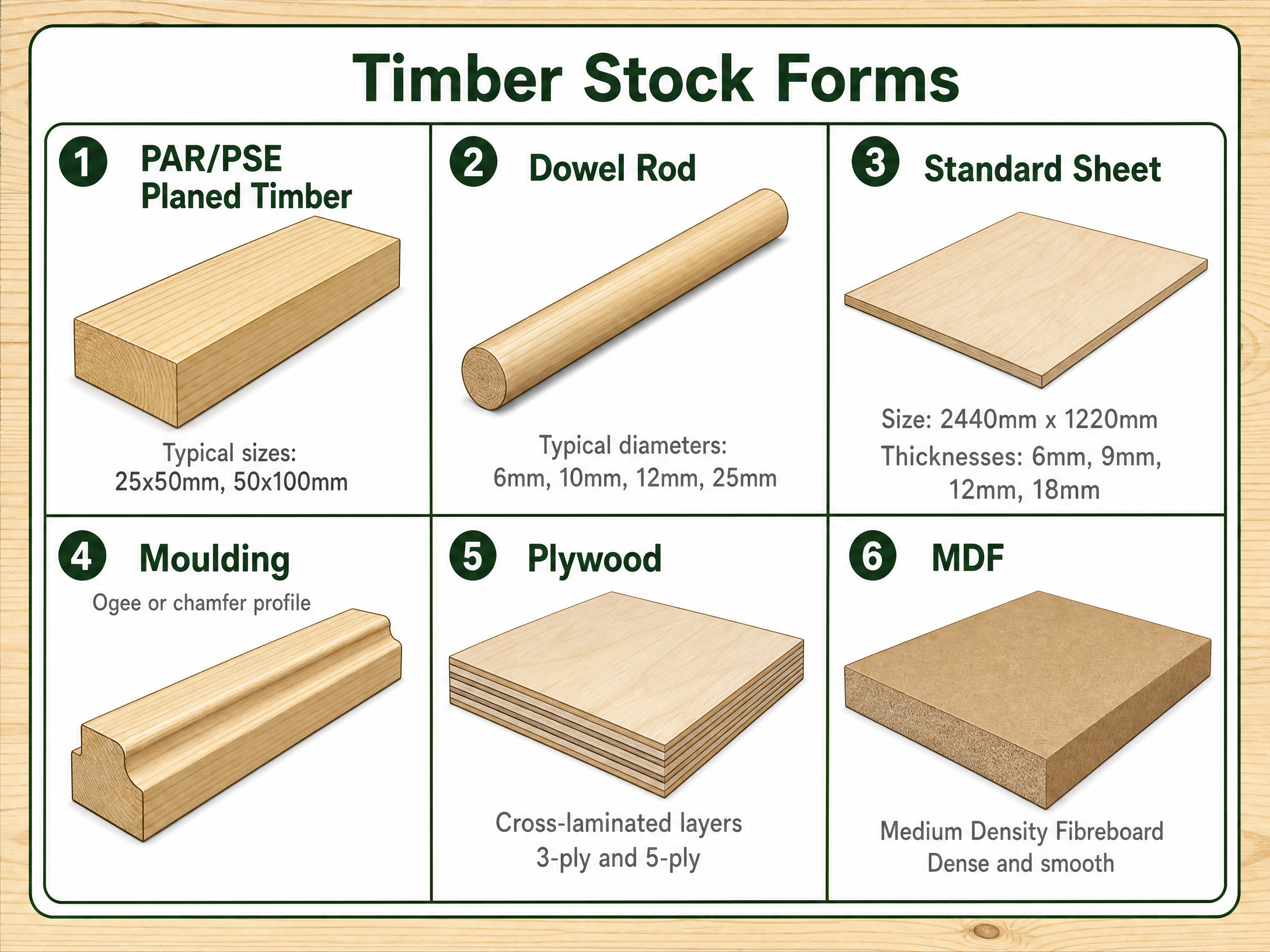
A stock form is the standard shape and size in which a material is commercially available. For timbers, these are the primary stock forms you must know:
- Regular Sections: Lengths of timber with a consistent cross-sectional shape (e.g., square or rectangular). They are sold in standard lengths (typically 1.8m, 2.4m, or 3m).
- Mouldings: Lengths of timber machined to have a decorative or functional profile (e.g., skirting boards, architraves, picture rails).
- Dowels: Cylindrical wooden rods with a circular cross-section. Common diameters include 6mm, 8mm, 10mm, 12mm, and 25mm.
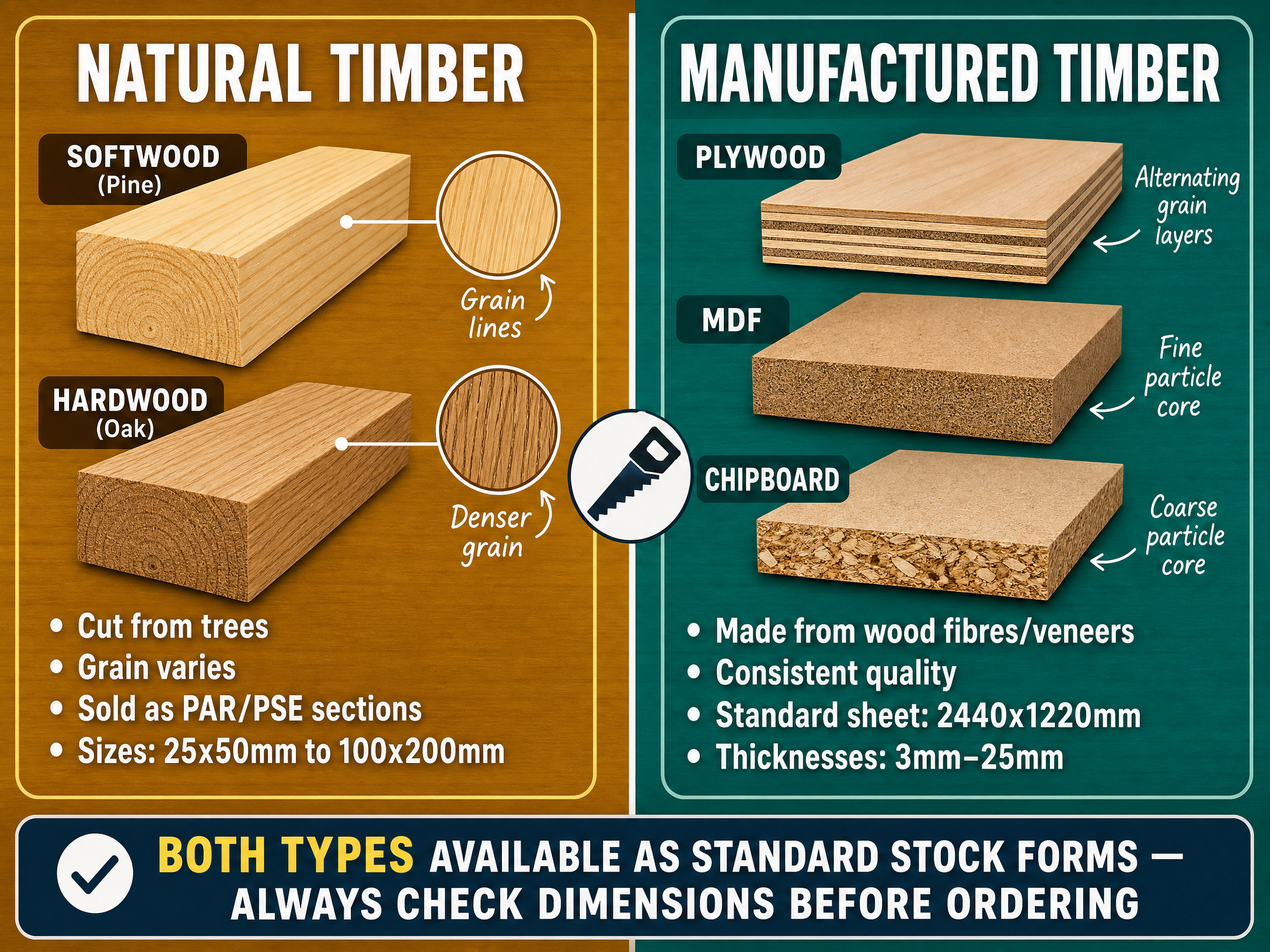
- Sheets (Boards): Large, flat panels primarily used for manufactured timbers. The standard full sheet size is universally 2440mm × 1220mm.
Natural vs. Manufactured Timber
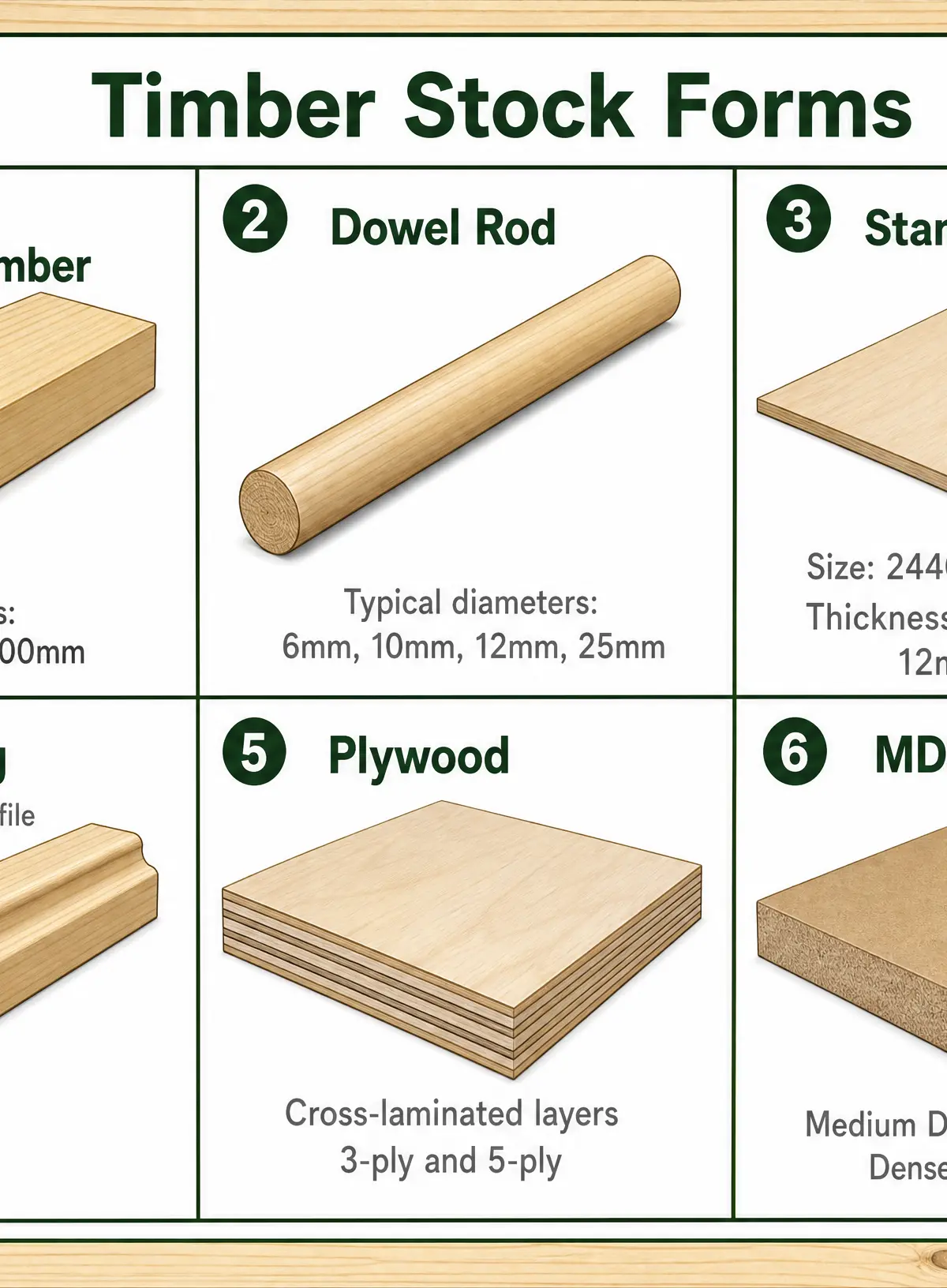
It is crucial to distinguish between how natural and manufactured timbers are supplied.
**Natural Timber (Softwoods and Hardwoods)**Natural timber is cut directly from trees. Because trees are round and have natural defects (knots, splits), natural timber is typically sold in sections rather than wide sheets.
When buying natural timber, you will encounter two key terms:
- PAR (Planed All Round): All four surfaces have been planed smooth.
- PSE (Planed Square Edge): The edges have been planed perfectly square.
Examiner Tip: The stated size of PAR/PSE timber is its nominal size before planing. The actual finished size will be about 3mm smaller on each planed surface. For example, a 50mm × 100mm nominal section might actually measure 44mm × 94mm.
**Manufactured Timber (Plywood, MDF, Chipboard)**Manufactured boards are engineered by bonding wood fibres, particles, or veneers with adhesives under heat and pressure. Because they are engineered, they do not suffer from the size limitations of tree trunks. Therefore, they are sold in large standard sheets.
Technical Vocabulary
- Cross-sectional area: The shape and dimensions of the end face of a piece of timber.
- Tolerance: The acceptable margin of error in a dimension or measurement.
- Wastage: Material that is lost during the manufacturing process (e.g., the width of the saw blade, known as the kerf).
- Cutting List: A detailed table listing every individual component required for a product, including its material, quantity, and exact dimensions.
Practical Skills
Calculating Quantities
One of the most common exam questions involves calculating how many standard lengths or sheets are needed for a project.
Step-by-Step Calculation Method:
- Analyse the Cutting List: Identify the dimensions and quantity of the components needed.
- Identify the Stock Form: Note the standard size available (e.g., 2.4m length, or 2440mm × 1220mm sheet).
- Calculate Yield per Unit: Divide the standard dimension by the component dimension to find out how many pieces fit into one standard unit. Always round down to the nearest whole number (you cannot use a fraction of a piece if it's too small).
- Calculate Total Units: Divide the total number of components needed by the yield per unit. Always round up to the nearest whole number (you cannot buy half a standard length).
- Account for Waste: In practical coursework, always add approximately 10% to your final material order to account for saw kerf and mistakes.
Portfolio/Coursework Guidance
Assessment Criteria
In your Non-Examined Assessment (NEA), examiners look for evidence that you have considered stock forms during the design phase.
Marks are awarded for:
- Designing components that fit efficiently onto standard sheet sizes to minimise waste.
- Producing an accurate cutting list prior to manufacture.
- Selecting the appropriate stock form for the specific application (e.g., choosing a 12mm dowel for a joint rather than trying to round off a square section yourself).
Building a Strong Portfolio
To secure top marks, include a visual cutting plan (a 'nesting diagram') in your portfolio. Draw a scaled rectangle representing a 2440mm × 1220mm sheet of MDF, and draw your component shapes inside it to prove you have arranged them efficiently. Annotate this page to explain how your arrangement reduces waste and saves money.
Exam Component
Written Exam Knowledge
In the written paper, expect a mix of short-answer recall questions (e.g., "State the standard size of a sheet of plywood") and applied mathematical questions (e.g., "Calculate the number of 2.4m lengths required to produce twelve 450mm table legs").
You must also be prepared to justify why a manufacturer would choose a specific stock form. For example, why buy pre-machined mouldings instead of making them from PAR timber? (Answer: It saves manufacturing time, ensures consistency across a batch, and reduces the need for specialist routing equipment).
Visual Resources
2 diagrams and illustrations
Interactive Diagrams
1 interactive diagram to visualise key concepts
Conceptual Flow Outline
Step-by-step process for calculating timber quantities.
Worked Examples
3 worked examples — open one to explore the question and available guidance.
Practice Questions
Test your understanding — click to reveal model answers
State the standard dimensions of a full sheet of manufactured board. (1 mark)
Hint: Remember the 'Two-Four, One-Two' memory hook.
Explain one reason why a manufacturer producing flat-pack wardrobes would choose to use manufactured boards rather than natural timber. (2 marks)
Hint: Think about the size limitations of trees versus the size of a wardrobe panel.
A student needs to cut 18 lengths of 25mm diameter dowel, each measuring 150mm long. The dowel is sold in 900mm lengths. Calculate how many 900mm lengths must be purchased. Show your working. (3 marks)
Hint: First, find out how many 150mm pieces fit into one 900mm length.
A company is manufacturing wooden toy boxes. The lid of the box measures 600mm × 400mm and is made from 9mm plywood. Calculate the maximum number of lids that can be cut from a standard 2440mm × 1220mm sheet. Show your working and state which orientation produces the least waste. (4 marks)
Hint: You must calculate the yield for both possible orientations (Lengthways and Widthways) to prove which is better.