Pearson Edexcel · IGCSE · English Literature
Kindertransport
Kindertransport by Diane Samuels is a profound and emotionally charged play that explores the long-term psychological impact of displacement and the Holocaust. It offers rich opportunities for analyzing complex character dynamics, non-linear structure, and powerful symbolism, making it an incredibly rewarding text for achieving top marks in IGCSE Literature.
- 6 min read
- 2 worked examples
- 4 practice questions
- 8 key terms
Study Notes
Overview

Diane Samuels' Kindertransport is a modern classic that examines the traumatic legacy of the Kindertransport—the rescue effort that brought thousands of Jewish children to Britain before World War II. For Edexcel IGCSE candidates, this text is a goldmine for AO2 (analysis of writer's methods). Examiners look for perceptive analysis of the play's dual-timeline structure, its use of powerful symbolism (like the sewing box and the Ratcatcher), and the complex, often painful relationships between mothers and daughters. Strong responses will seamlessly weave in AO3 (context), showing how the historical reality of Nazi persecution and the refugee experience shapes the psychological landscape of the characters.
Plot/Content Overview
1939 (Hamburg to England): Nine-year-old Eva is prepared by her mother, Helga, to leave Germany on the Kindertransport. Eva arrives in England, speaking only German, and is fostered by Lil. Over time, she changes her name to Evelyn, suppressing her Jewish and German identity to assimilate.
1980s (England): Evelyn is now a middle-aged English woman. Her daughter, Faith, is preparing to leave home. Faith discovers a box in the attic containing Eva's documents and letters from Helga, uncovering Evelyn's hidden past. The timelines overlap as Evelyn is forced to confront the trauma she has buried for decades, leading to a dramatic climax where the past and present collide.
Themes
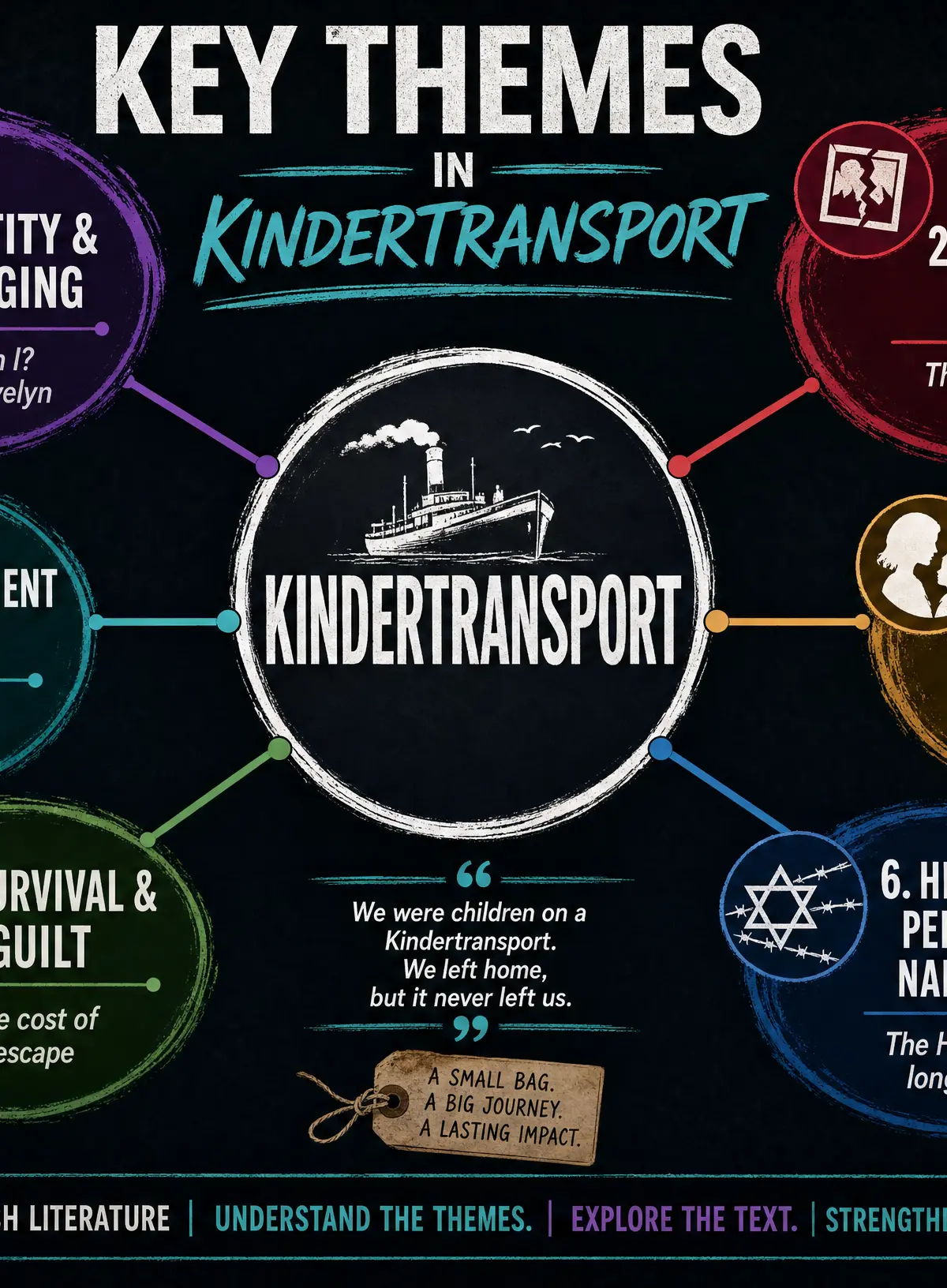
Theme 1: Identity and Belonging
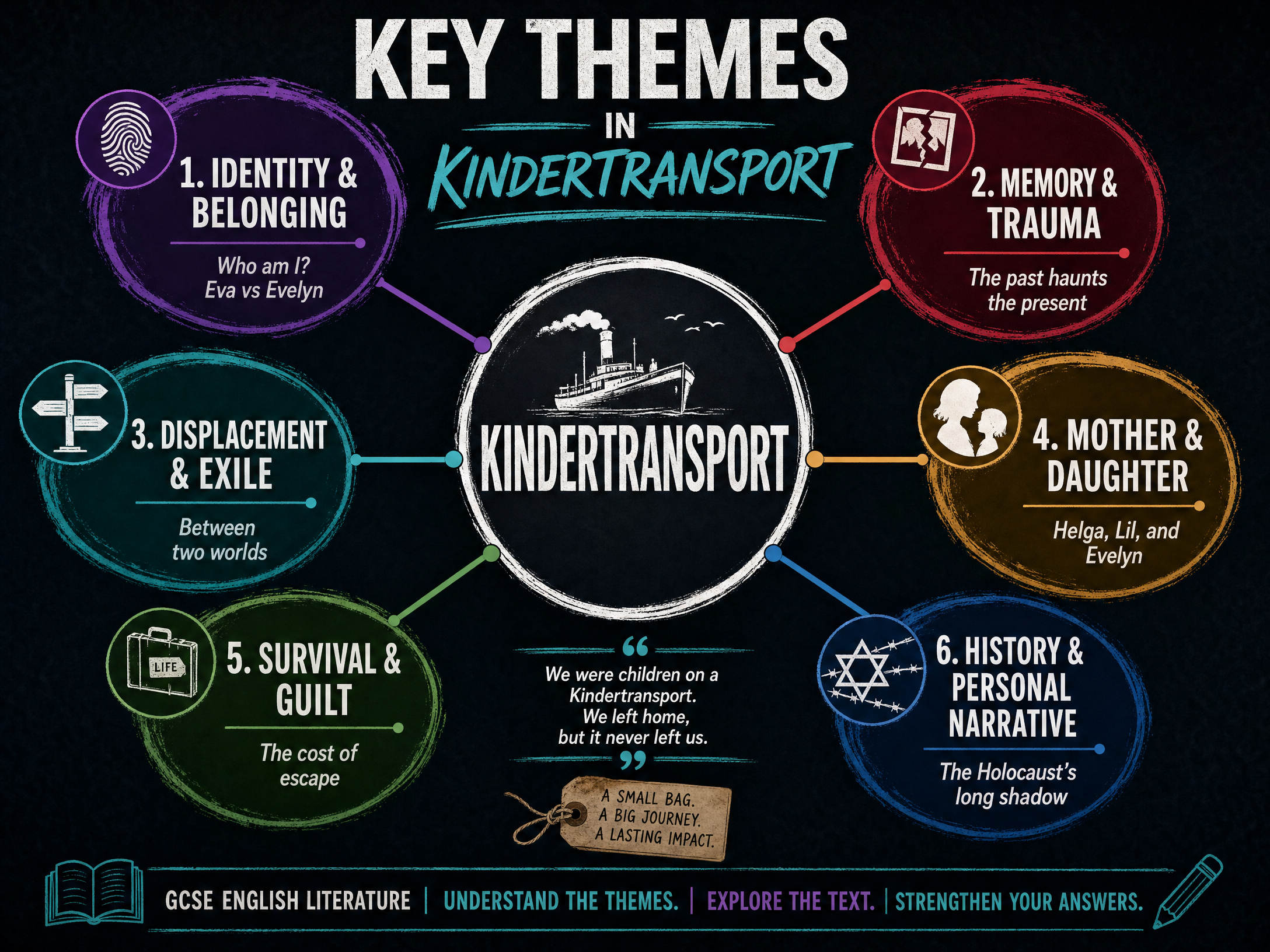
The play explores the profound cost of assimilation. Eva's transformation into Evelyn is a survival mechanism, but it requires the erasure of her true self. She exists in a liminal space—neither fully German nor fully English.
Key Quotes:
- "I am English." (Evelyn) - Evelyn's desperate assertion of her constructed identity, highlighting her fear of her past.
- "You are my little girl. You are Eva." (Helga) - Helga's attempt to reclaim the daughter who has fundamentally changed, showing the tragic disconnect caused by separation.
Theme 2: Memory and Trauma
Samuels presents trauma as something that cannot be neatly boxed away. The past constantly intrudes upon the present, demonstrating that for survivors, memory is a living, active force.
Key Quotes:
- "The past is a foreign country. They do things differently there." (Often misattributed, but captures the essence of Evelyn's view of her past as something she has exiled herself from.)
- "It's just a box. It's just a box of old papers." (Evelyn) - Evelyn's attempt to minimize the significance of her past, contrasting sharply with her physical terror of opening the box.
Theme 3: Mother-Daughter Relationships
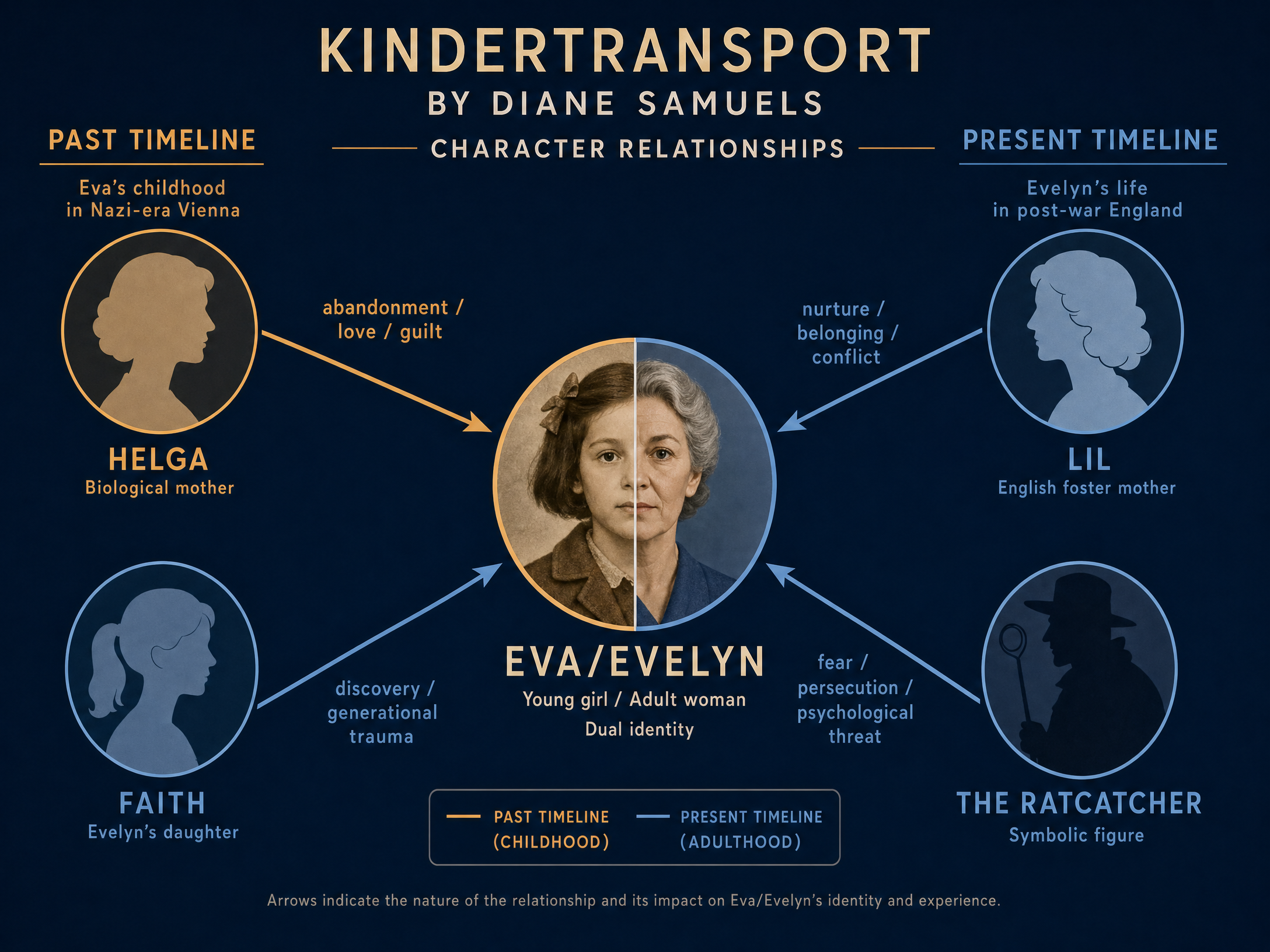
The play presents a triad of mother-daughter dynamics (Helga/Eva, Lil/Evelyn, Evelyn/Faith), all fraught with guilt, love, and misunderstanding.
Key Quotes:
- "I sent you away to save your life!" (Helga) - The ultimate sacrifice of the Kindertransport parents, which Eva experienced as abandonment.
- "You made me into an English girl." (Evelyn to Lil) - An accusation that reveals Evelyn's complex feelings toward Lil's nurturing, which facilitated her identity loss.
Character Analysis
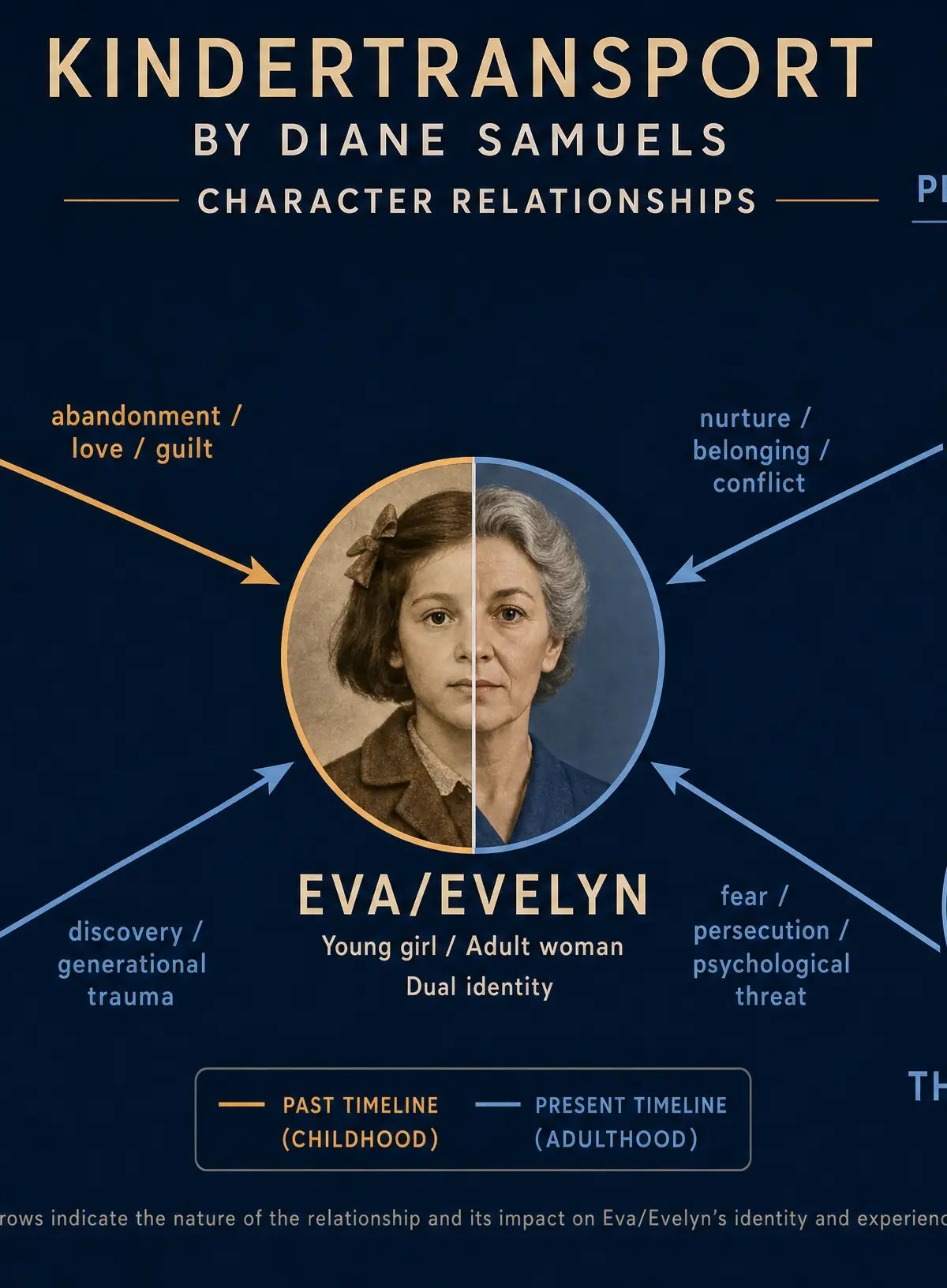
Eva / Evelyn
Role: The protagonist, representing the fractured identity of the Kindertransport survivor.
Key Traits: Traumatized, resilient, defensive, conflicted.
Character Arc: Moves from a terrified but hopeful child (Eva) to a closed-off, fearful adult (Evelyn) who must finally face the truth she has hidden from her own daughter.
Essential Quotes:
- "I don't want to be Eva anymore!"
- "There is no Eva!"
Helga
Role: Eva's biological mother; represents the lost past and the ultimate sacrifice.
Key Traits: Dignified, desperate, loving, ultimately broken.
Character Arc: Makes the agonizing choice to send her daughter away, survives the camps, but finds she has lost her daughter anyway to assimilation and time.
Essential Quotes:
- "You must be a good girl and be brave."
- "Why did you not come back to me?"
The Ratcatcher
Role: A symbolic, mythical figure drawn from German folklore.
Key Traits: Menacing, omnipresent, symbolic.
Character Arc: He does not change; rather, he appears at moments of high anxiety to represent Eva/Evelyn's internalized fear of persecution and abandonment.
Essential Quotes:
- "I will take the heart of your happiness away."
Writer's Methods
Dual-Timeline Structure: The interweaving of the 1930s and 1980s is Samuels' most crucial method. By having past and present characters on stage simultaneously, she visually demonstrates that trauma is timeless. Examiners reward candidates who analyze why a past scene interrupts a present scene.
Symbolism: The sewing box is a physical manifestation of repressed memory. The Ratcatcher is the embodiment of Nazi terror and psychological trauma. The train symbolizes both salvation and devastating loss.
Stage Directions: Samuels uses detailed stage directions to convey what characters cannot say. For example, Evelyn's physical inability to touch the contents of the box speaks volumes about her trauma. Always analyze stage directions for AO2.
Context
The Kindertransport: The historical reality of the rescue of Jewish children from Nazi-occupied territories (1938-1940). Examiners expect you to understand the emotional reality of this: parents making the impossible choice to send their children away to save them, knowing they might never see them again.
Post-War Assimilation: The pressure on refugees to assimilate into British culture, often at the expense of their heritage. Evelyn's rejection of her Jewish identity reflects a common coping mechanism for survivors who wanted to belong and feel safe.
Podcast Revision
Listen to the full revision podcast for an in-depth discussion of themes, characters, and exam technique:

Visual Resources
2 diagrams and illustrations
Interactive Diagrams
1 interactive diagram to visualise key concepts
Conceptual Flow Outline
The trajectory of Eva's identity and trauma.
Worked Examples
2 worked examples — open one to explore the question and available guidance.
Practice Questions
Test your understanding — click to reveal model answers
Explore how Samuels presents the theme of identity and belonging in Kindertransport. (30 marks + 4 AO4)
Hint: Consider the significance of the name change from Eva to Evelyn, the role of language (German vs English), and the impact of the sewing box.
How does Samuels present the relationship between Evelyn and Faith? (30 marks + 4 AO4)
Hint: Look at how Evelyn's past trauma creates a barrier between her and her daughter. How does the discovery of the box change their dynamic?
Explore the significance of the Ratcatcher in the play. (30 marks + 4 AO4)
Hint: The Ratcatcher is not a real person. What does he symbolize? When does he appear?
Starting with the extract where Eva leaves Helga at the train station, explore how Samuels presents the experience of separation. (30 marks + 4 AO4)
Hint: Look closely at the language Helga uses in the extract. How does it contrast with the emotional reality? Then link to the long-term effects of this separation in the wider play.