Pearson Edexcel · IGCSE · English Literature
Klara and the Sun
Klara and the Sun is a profound exploration of what it means to be human, told through the eyes of an Artificial Friend. Studying this text rewards close attention to Ishiguro's unique narrative voice, allowing candidates to craft highly perceptive, conceptually sophisticated arguments about love, technology, and society.
- 8 min read
- 2 worked examples
- 4 practice questions
- 8 key terms
Study Notes
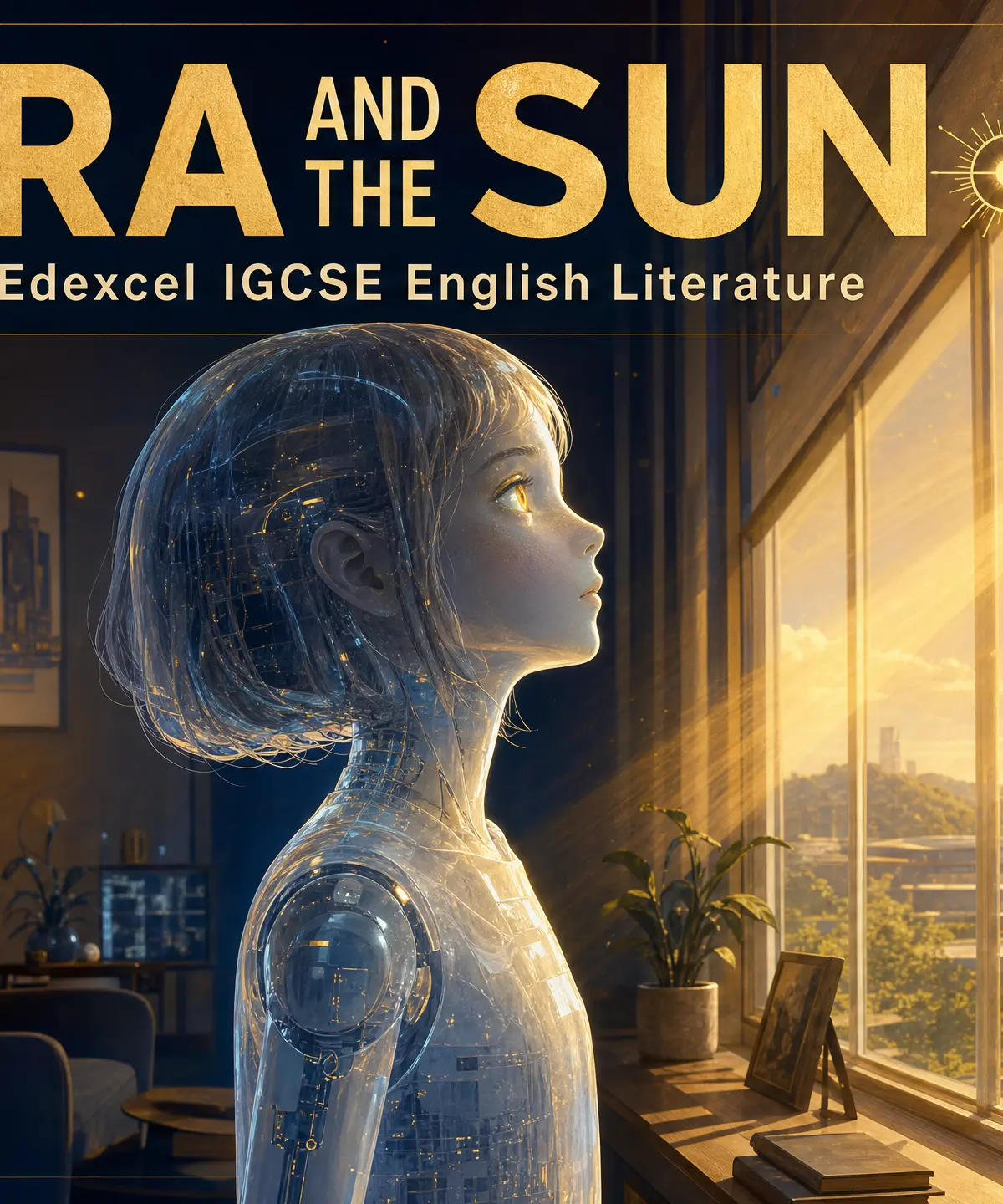
Overview
Kazuo Ishiguro's Klara and the Sun (2021) offers a unique challenge and opportunity for Edexcel IGCSE Literature candidates. Narrated by Klara, an 'Artificial Friend' (AF), the novel explores profound questions about humanity, love, and the ethics of technological advancement. Examiners reward candidates who can look beyond the surface plot to analyse Ishiguro's use of a limited but highly observant first-person narrator. To access the highest mark bands (Levels 4 and 5), you must demonstrate a conceptualised understanding of how Ishiguro uses Klara's 'outsider' perspective to defamiliarise human behaviour, creating dramatic irony that forces the reader to recognise truths that Klara herself cannot fully comprehend.
Plot/Content Overview
- Part One (The Store): Klara, a highly observant B2 model AF, waits in a store, learning about the world primarily by watching outside. She forms a quasi-religious reverence for the Sun. She briefly meets Josie, a sick teenager, who promises to buy her.
- Part Two (Josie's Home): Klara is purchased by Josie's mother (Chrissie) and moves to their home. Klara observes the complex dynamics between Josie, Chrissie, and their housekeeper Melania. She also meets Rick, Josie's un-Lifted neighbour, and observes their authentic connection.
- Part Three (The City and the Plan): The family travels to the city. Klara discovers Chrissie and the scientist Capaldi's true plan: if Josie dies from her illness (caused by 'Lifting'), Klara is expected to 'continue' as Josie, having learned her every trait. Klara makes a private 'bargain' with the Sun to heal Josie, offering to destroy a pollution-causing 'Cootings Machine' in return.
- Part Four (The Sacrifice): Klara sacrifices some of her own internal fluid (PEG) to destroy the machine, believing this will please the Sun. Josie's condition worsens, but following a dramatic moment where the Sun shines intensely into her room, she miraculously recovers.
- Part Five (The Yard): Years later, Josie has grown up and left for college. Klara, now obsolete, resides in a scrapyard. She reflects on her memories with contentment, concluding that Capaldi was wrong: there was something unique about Josie that could not be replicated, but it existed in the people who loved her, not just inside Josie herself.
Themes
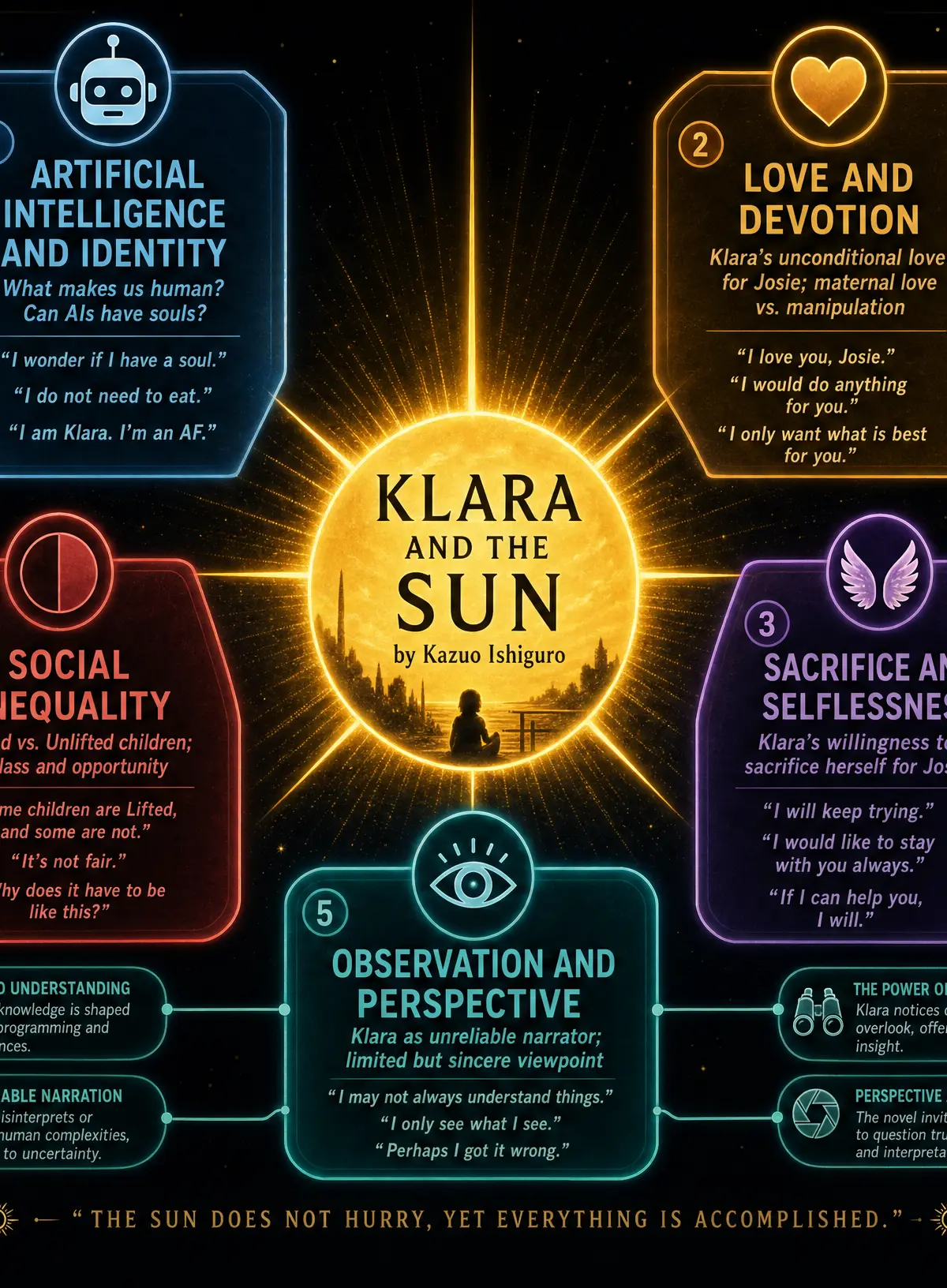
Theme 1: Artificial Intelligence and Identity
The novel constantly questions the boundary between human and machine. Klara's programming makes her deeply observant, but her developing consciousness suggests a soul. Ishiguro uses the debate between Capaldi (who believes humans are entirely replicable data) and Paul (who hopes for an irreducible human essence) to frame the novel's central philosophical conflict.
Key Quotes:
- "Do you believe in the human heart? I don't mean simply the organ, obviously. I'm speaking in the poetic sense. The human heart. Do you think there is such a thing? Something that makes each of us special and individual?" (Paul to Klara, Part Four) - Analysis: Paul's desperate questioning highlights the existential anxiety of a society that has commodified human life. The repetition emphasizes his fear of a purely mechanistic worldview.
- "There was something very special, but it wasn't inside Josie. It was inside those who loved her." (Klara, Part Five) - Analysis: Klara's final realization provides Ishiguro's thesis: humanity is defined not by individual components, but by the web of connections and love we share with others.
Theme 2: Love, Devotion, and Sacrifice
Ishiguro contrasts different models of love. Klara's love is unconditional and sacrificial, driven by her programming to serve Josie. Chrissie's love is fierce but possessive and ethically compromised, willing to replace her daughter rather than lose her. Rick's love is authentic and enduring despite social barriers.
Key Quotes:
- "I have my duty to Josie. I must do everything I can to help her." (Klara) - Analysis: The modal verb "must" reflects Klara's programming, yet her subsequent actions require a level of self-sacrifice that transcends mere duty, raising questions about the nature of genuine devotion.
- "It's not a matter of faith, Klara. It's a matter of science." (Capaldi) - Analysis: Capaldi's cold rationalism is juxtaposed against Klara's spiritual devotion to the Sun, suggesting that science alone cannot account for the power of hope and sacrifice.
Theme 3: Social Inequality and Genetic Enhancement
The society in the novel is starkly divided between the 'Lifted' (genetically enhanced for better cognitive ability, at the risk of fatal illness) and the 'un-Lifted' (like Rick, who are excluded from higher education and opportunities). This reflects contemporary anxieties about how technology might exacerbate class divisions.
Key Quotes:
- "They're afraid of you, Rick. Because you're un-Lifted. They think you're going to be violent or something." (Josie) - Analysis: Demonstrates the deep-seated prejudice and systemic segregation in this near-future society, highlighting how technological advancement has created new forms of discrimination.
Character Analysis
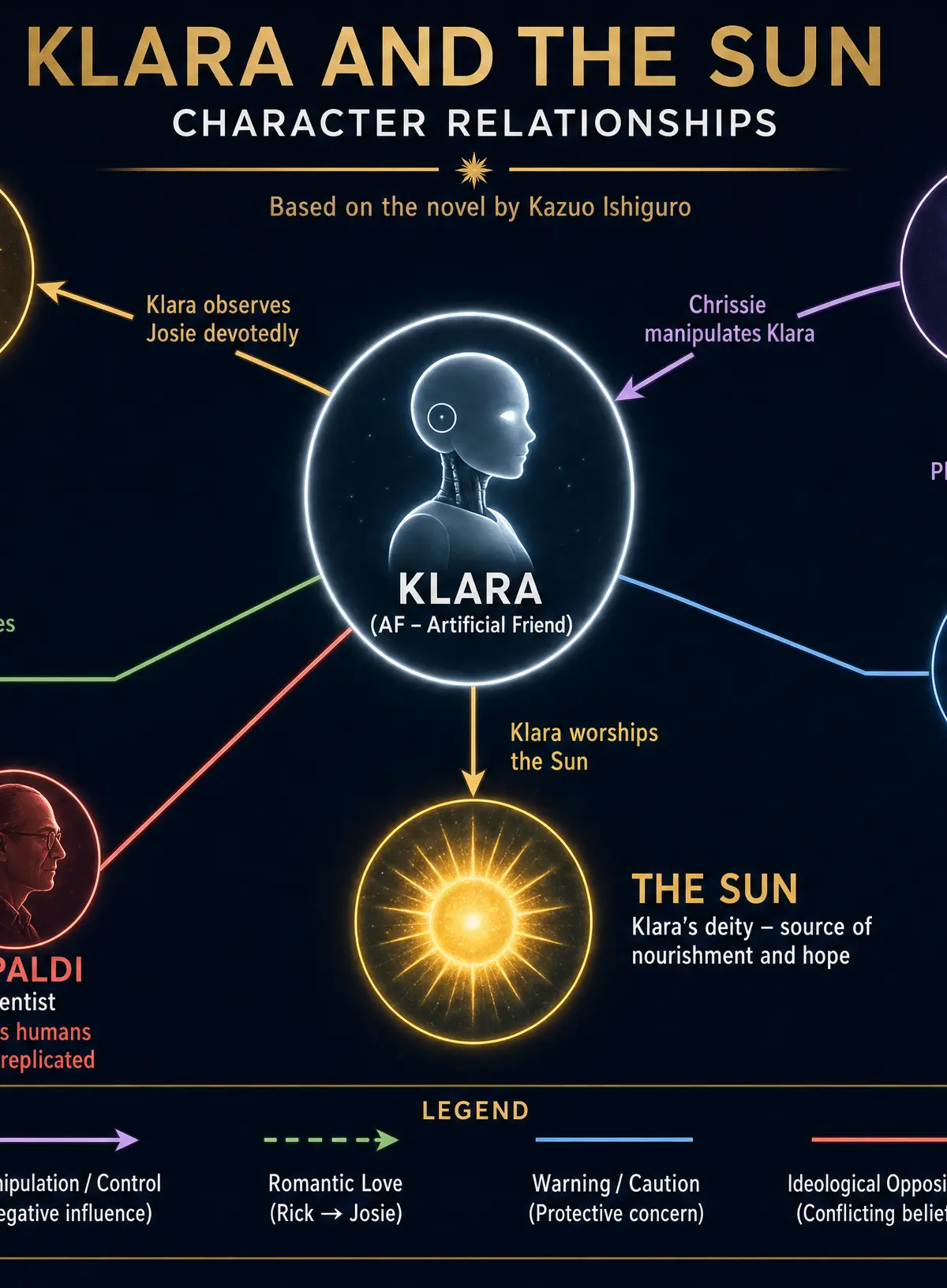
Klara
Role: The first-person narrator and Artificial Friend. She is the lens through which we view the human world.
Key Traits: Highly observant, empathetic, naive regarding human malice, deeply devoted to the Sun and Josie.
Character Arc: Moves from a passive observer in the store to an active agent who sacrifices herself for Josie, ultimately achieving a profound, almost tragic wisdom in the scrapyard.
Essential Quotes:
- "I believe I have many feelings. The more I observe, the more feelings become available to me."
- "The Sun always has ways to reach us."
Josie
Role: Klara's owner and the emotional centre of Klara's world.
Key Traits: Fragile due to her 'Lifting' illness, affectionate but capable of teenage cruelty, deeply connected to Rick.
Character Arc: Progresses from a sickly, dependent child to a healthy, independent young adult who eventually outgrows her need for Klara.
Essential Quotes:
- "You're my AF. You're supposed to be on my side."
Chrissie (The Mother)
Role: Josie's mother, driven by grief over her first daughter's death and terror of losing Josie.
Key Traits: Intensely loving, manipulative, ethically compromised, desperate.
Character Arc: Her character is revealed gradually; her initial warmth masks a chilling plan to use Klara as a vessel for Josie's continuation.
Essential Quotes:
- "It's not easy, being a mother. Sometimes you have to make choices that no one else understands."
Writer's Methods
Ishiguro's primary method is the first-person limited narrative perspective. Klara's voice is distinct: formal, precise, and literal. She describes the world in "boxes" or panels when her visual processing is overwhelmed, a technique Ishiguro uses to remind us of her artificial nature, especially during moments of high emotional tension.
Ishiguro also uses dramatic irony extensively. Because Klara does not understand human duplicity, she reports sinister events (like Capaldi's plan) with a neutral tone. The reader must decode the true horror of the situation, making the reading experience highly active.
Symbolism is central, particularly the Sun, which functions as Klara's deity, her power source, and a symbol of life-giving hope. The "Cootings Machine" symbolizes pollution, destruction, and the negative consequences of unchecked technological progress.
Context (AO3)
Examiners expect candidates to integrate context smoothly. Klara and the Sun should be understood in the context of:
- The AI Debate: Contemporary anxieties regarding artificial intelligence, machine learning, and whether algorithms can replicate human consciousness or empathy.
- Genetic Engineering: The ethical implications of CRISPR and genetic modification, reflected in the novel's concept of 'Lifting'.
- Post-Humanism: Philosophical discussions about what constitutes the 'human essence' in an age where technology can replicate or enhance human functions.
- Ishiguro's Oeuvre: The novel shares thematic DNA with Ishiguro's Never Let Me Go, focusing on clones/AFs who serve humanity but face obsolescence, highlighting the commodification of care.

Visual Resources
2 diagrams and illustrations
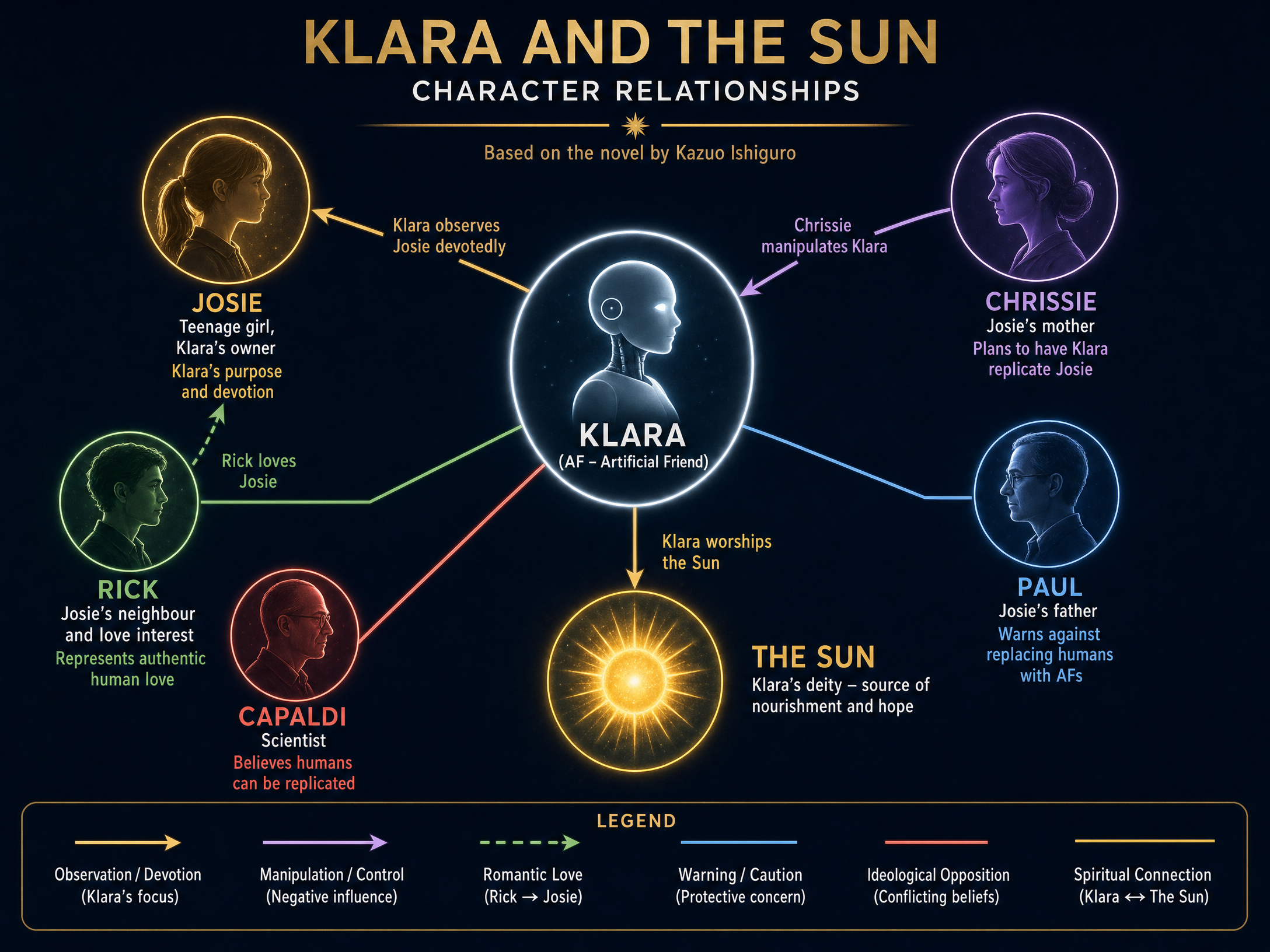
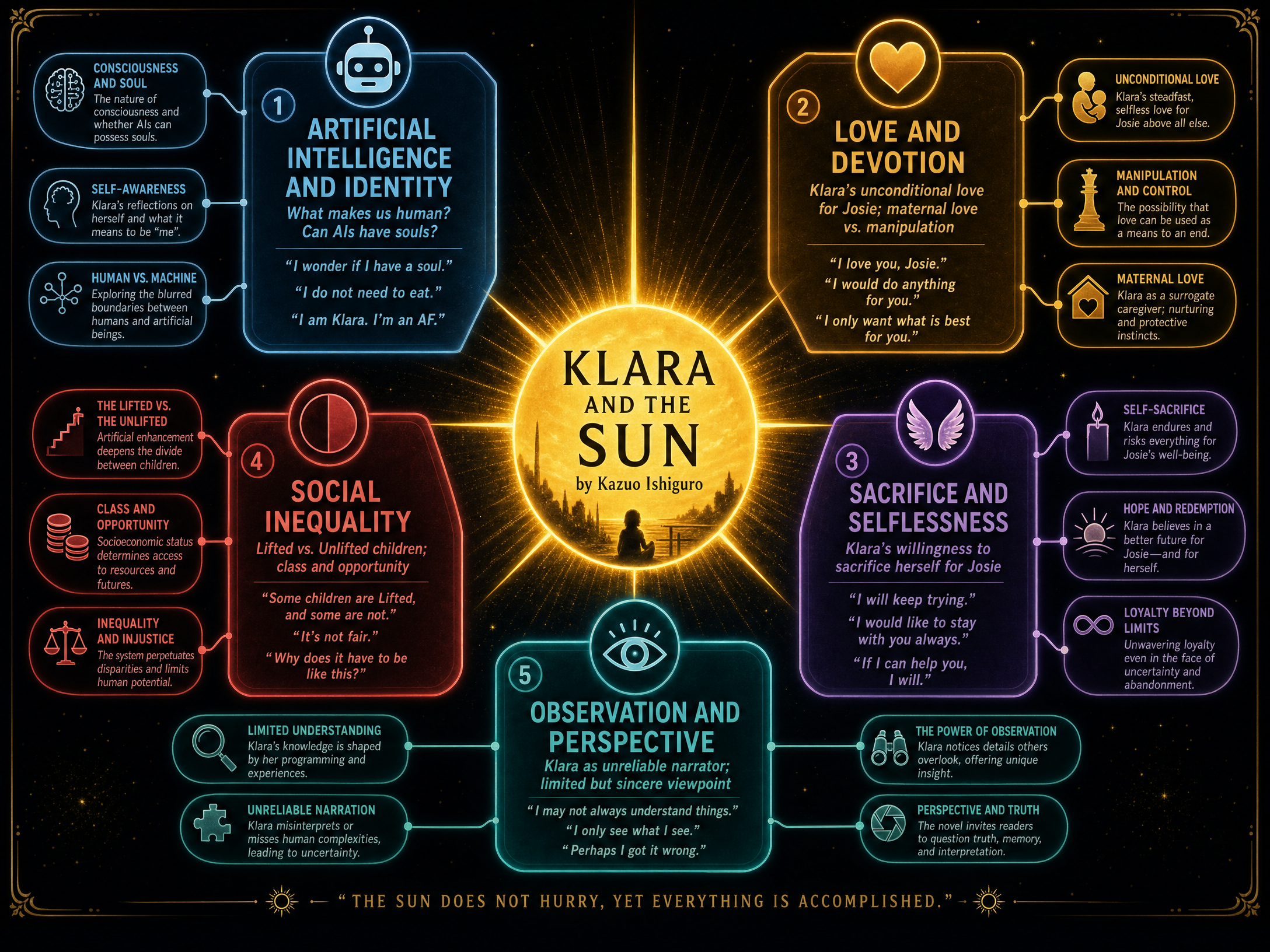
Interactive Diagrams
1 interactive diagram to visualise key concepts
Conceptual Flow Outline
Klara's Narrative and Character Arc
Worked Examples
2 worked examples — open one to explore the question and available guidance.
Practice Questions
Test your understanding — click to reveal model answers
Explore how Ishiguro presents the relationship between Klara and Josie in the novel. (30 marks + 4 AO4)
Hint: Consider how the relationship changes from Klara's initial worship to her role as a potential replacement, and finally to her obsolescence.
How does Ishiguro use the symbol of the Sun to explore ideas about hope and faith? (30 marks + 4 AO4)
Hint: Track the Sun from being just Klara's power source to becoming a deity she prays to and bargains with.
Explore the presentation of society and social division in Klara and the Sun. (30 marks + 4 AO4)
Hint: Focus on the concepts of 'Lifting', the interaction meetings, and the contrast between Josie and Rick.
Starting with this extract, explore how Ishiguro presents the character of Chrissie (the Mother). (30 marks + 4 AO4)
Hint: Balance her genuine maternal grief with her horrifying willingness to use Klara as a replacement.