Pearson Edexcel · IGCSE · English Literature
Of Mice and Men
Steinbeck's masterpiece offers a profound exploration of the American Dream, isolation, and the harsh realities of 1930s itinerant farm workers. For Edexcel IGCSE candidates, it provides incredibly rich opportunities to analyse character development, structural foreshadowing, and how socio-historical context shapes human tragedy.
- 7 min read
- 2 worked examples
- 4 practice questions
- 8 key terms
Study Notes
Overview
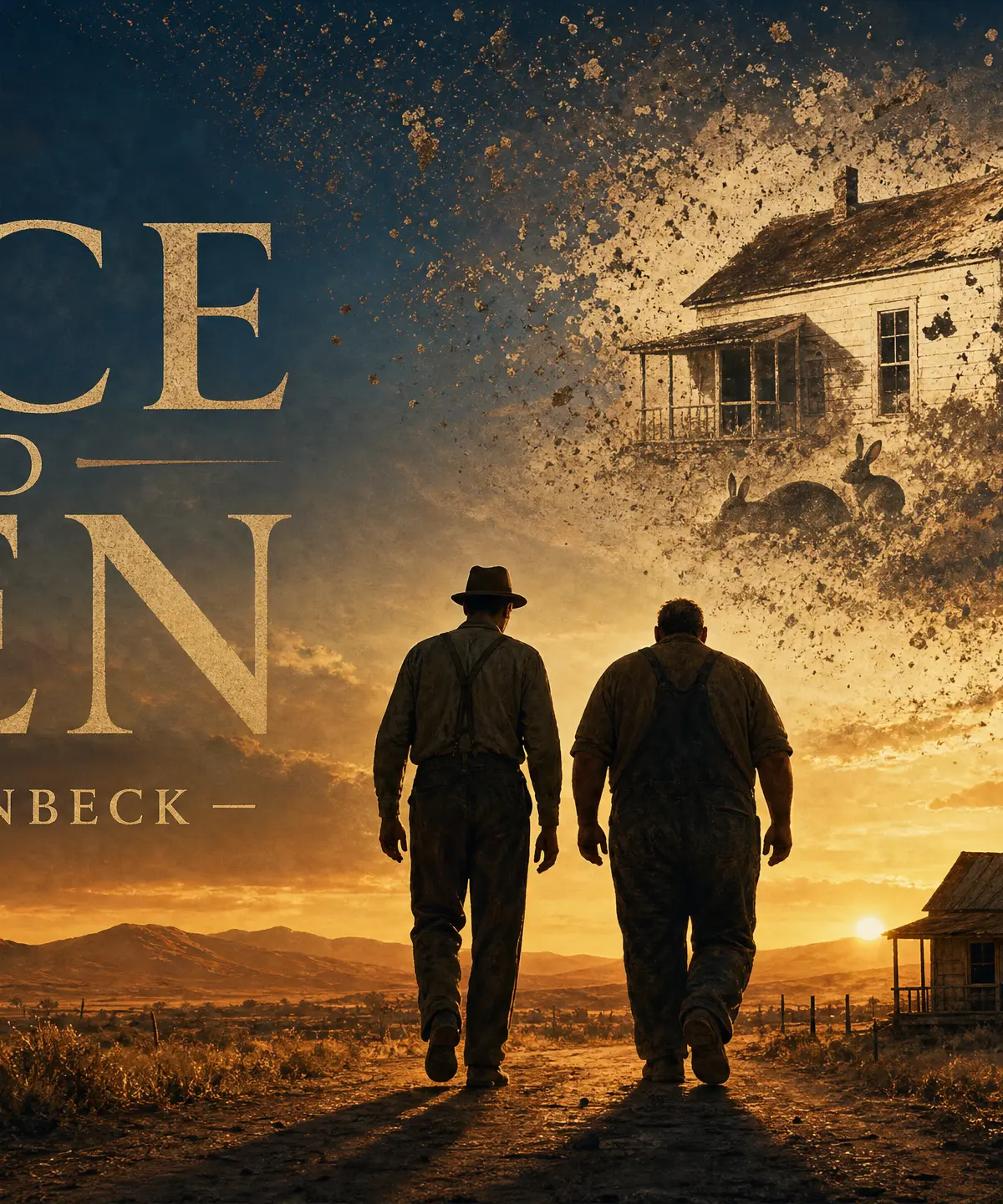
Of Mice and Men by John Steinbeck is a cornerstone of the Edexcel IGCSE Literature specification. Set against the brutal backdrop of the Great Depression, this "play-novella" explores the deep bond between two itinerant workers, George and Lennie, whose shared dream of owning land ultimately ends in tragedy. Examiners reward candidates who move beyond plot summary to explore how Steinbeck constructs meaning. High-level responses will consistently analyse his sparse, dialogue-heavy form, his deliberate use of cyclical structure and foreshadowing, and his nuanced integration of 1930s socio-economic context into character motivations.
Plot/Content Overview
- Chapter 1: George and Lennie arrive at a pool near the Salinas River. We learn of their dream to "live off the fatta the lan'" and the trouble in Weed that forced them to flee.
- Chapter 2: They arrive at the Tyler ranch. We meet the key secondary characters: Candy, the Boss, Curley, Curley's Wife, and Slim. The tension is established immediately.
- Chapter 3: Carlson shoots Candy's dog (crucial foreshadowing). Candy joins the dream, making it seem possible. Curley attacks Lennie, resulting in Curley's hand being crushed.
- Chapter 4: Lennie visits Crooks' room. Candy and Curley's Wife enter. This chapter highlights the deep isolation of the marginalised characters.
- Chapter 5: In the barn, Lennie accidentally kills his puppy, then accidentally kills Curley's Wife while stroking her hair. He flees to the pool.
- Chapter 6: The cyclical structure completes. George finds Lennie at the pool and shoots him mercifully before Curley's lynch mob arrives, ending both Lennie's life and the dream.

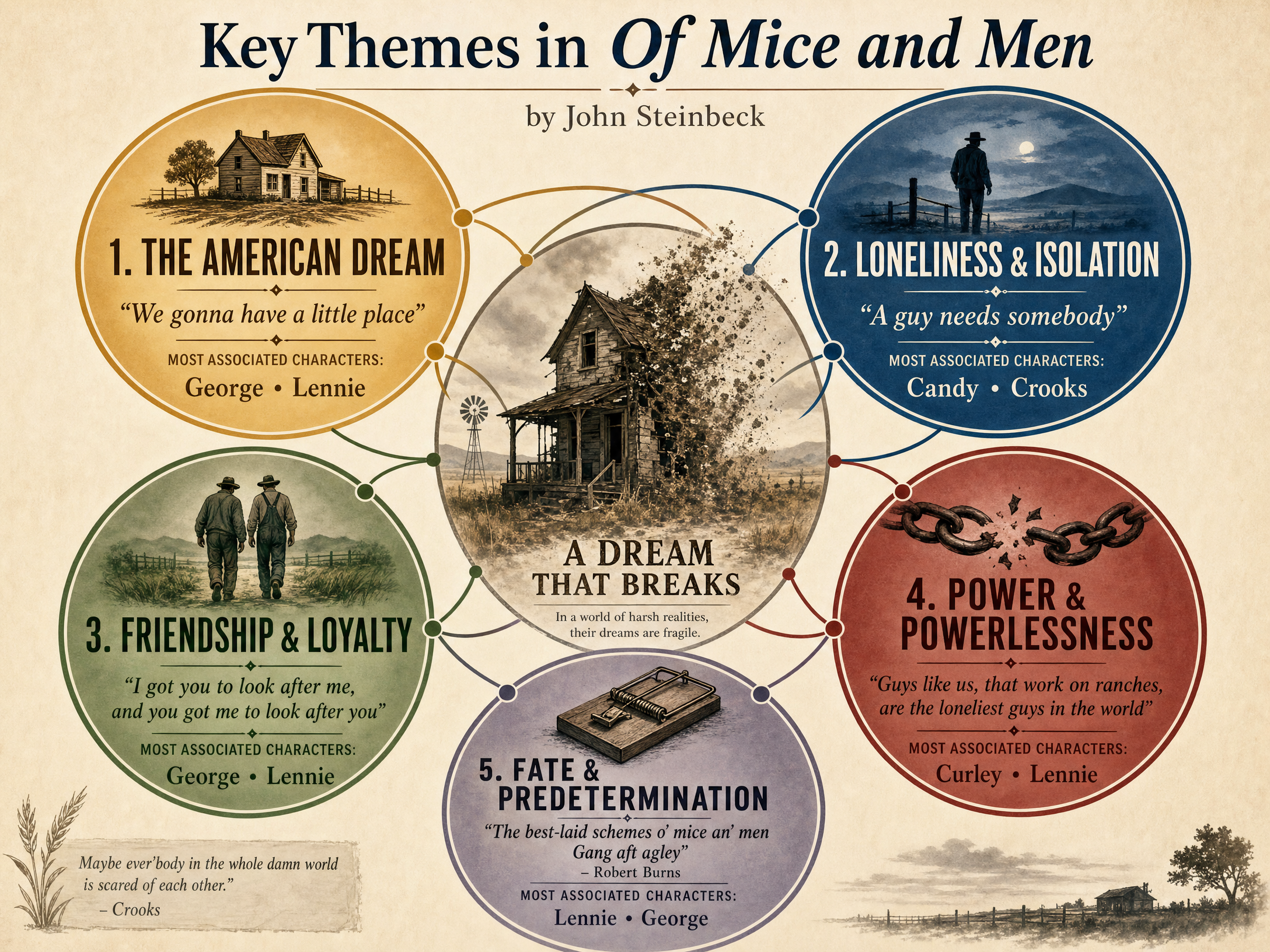
Themes
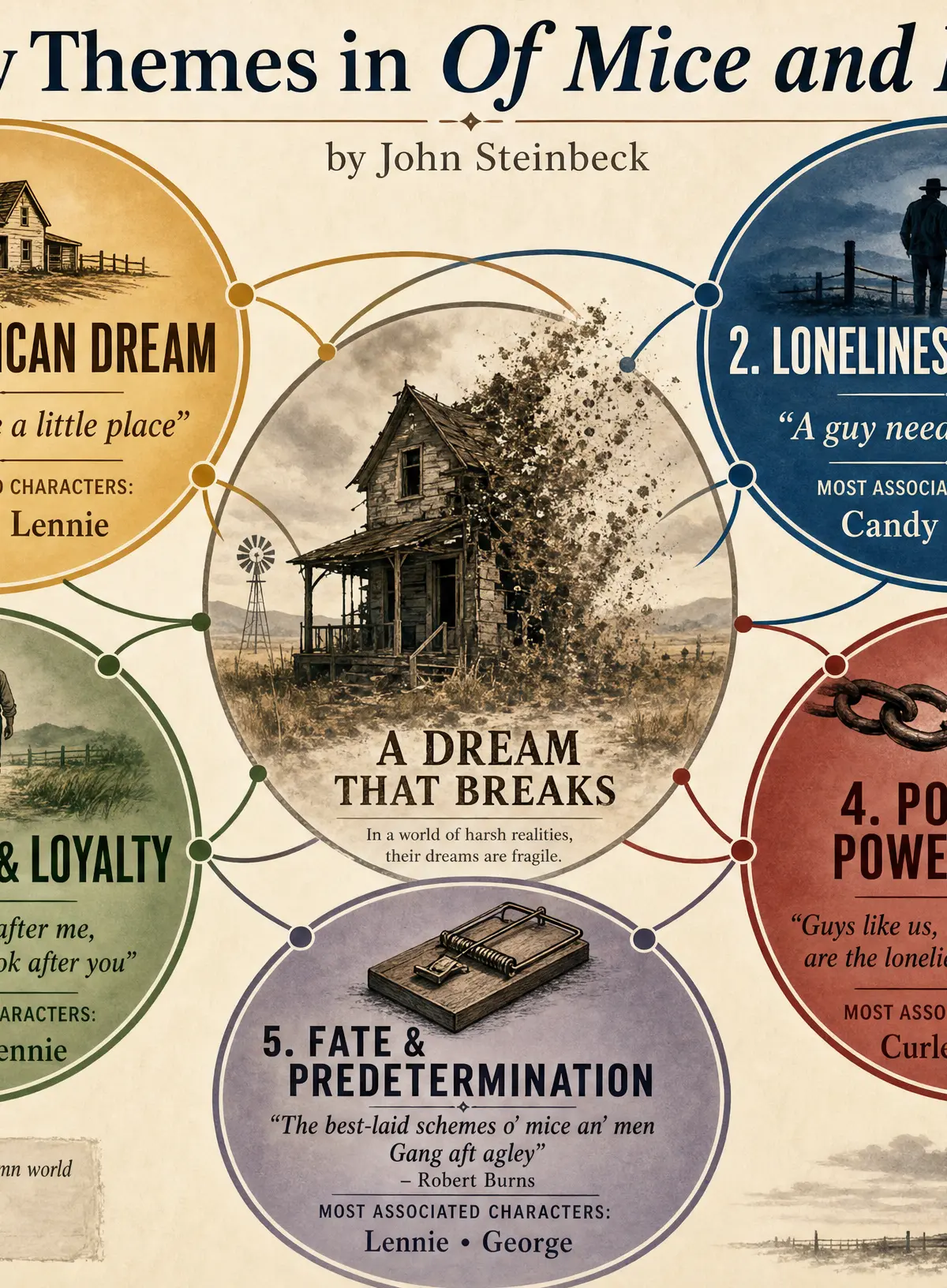
Theme 1: The Impossibility of the American Dream
The American Dream—the belief that hard work guarantees success—is presented as a necessary but destructive myth. Steinbeck shows how the dream sustains the men emotionally, yet the harsh reality of their socio-economic position makes it impossible.
Key Quotes:
- "We gonna have a little place... an' live off the fatta the lan'" (Ch 1) - The dream is repeated like a comforting litany or bedtime story, highlighting its fictional nature.
- "I seen hundreds of men come by... every damn one of 'em's got a little piece of land in his head. An' never a God damn one of 'em ever gets it." (Ch 4) - Crooks acts as the voice of cynical reality, destroying the romanticism of the dream.
Theme 2: Loneliness and Isolation
Steinbeck portrays a world where companionship is rare and suspicion is the norm. Almost every character suffers from profound isolation, driven by the competitive nature of itinerant work and systemic societal prejudices.
Key Quotes:
- "Guys like us, that work on ranches, are the loneliest guys in the world." (Ch 1) - George establishes the norm of isolation, making his and Lennie's bond exceptional.
- "A guy needs somebody―to be near him... A guy goes nuts if he ain't got nobody." (Ch 4) - Crooks articulates the psychological damage of enforced segregation and loneliness.
Theme 3: Power and Powerlessness
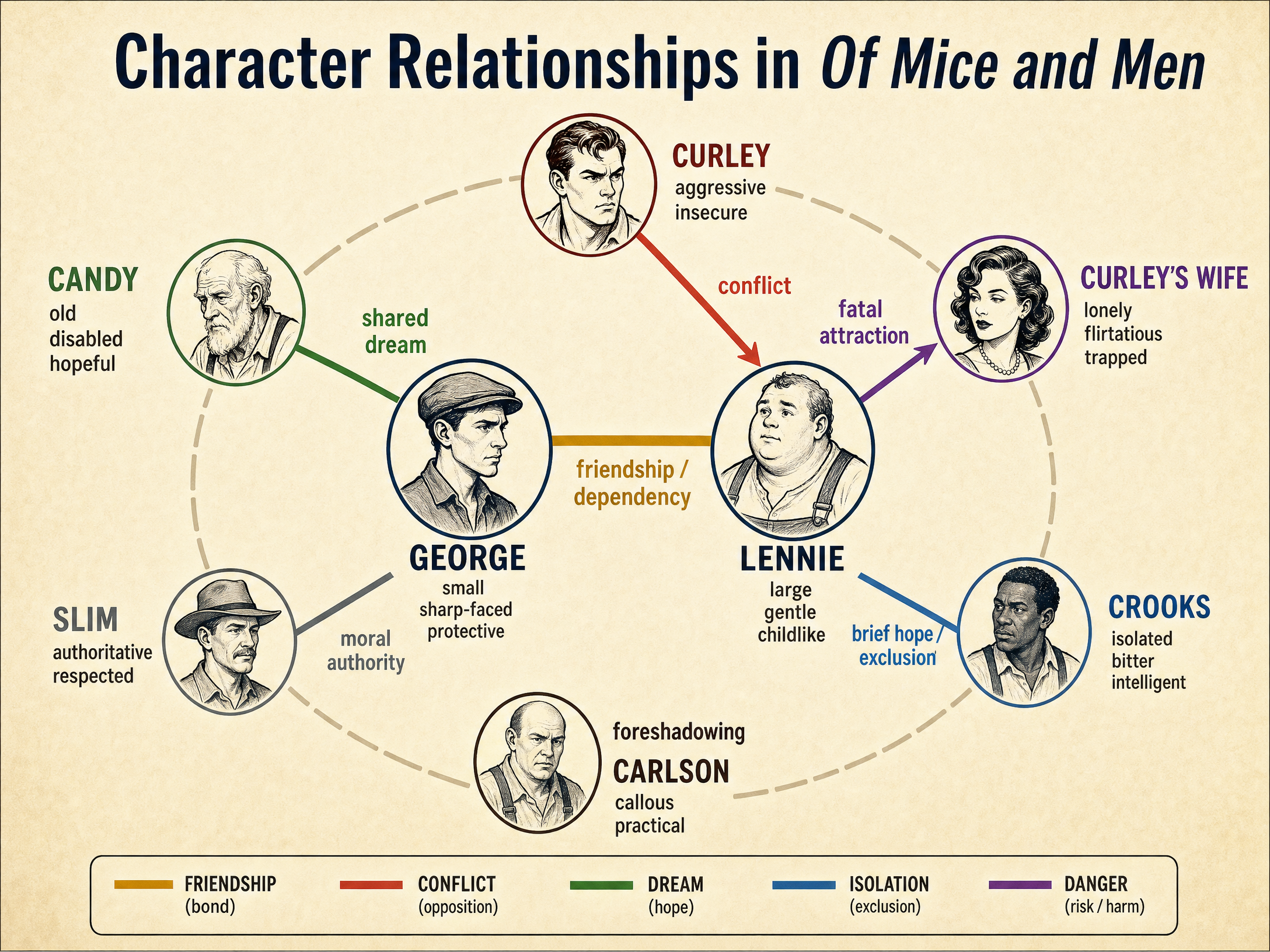
The ranch is a microcosm of 1930s society, strictly governed by a hierarchy of power. Power is derived from ownership (the Boss), aggression (Curley), or moral authority (Slim), while the marginalised (Crooks, Candy, Curley's Wife) are rendered powerless.
Key Quotes:
- "Well, you keep your place then, Nigger. I could get you strung up on a tree so easy it ain't even funny." (Ch 4) - Curley's Wife weaponises her racial privilege when her gender privilege fails, demonstrating how the powerless turn on each other.
- "He hates big guys. He's alla time picking scraps with big guys." (Ch 2) - Candy explains Curley's Napoleonic complex, showing how his physical insecurity drives his aggressive assertion of power.
Character Analysis
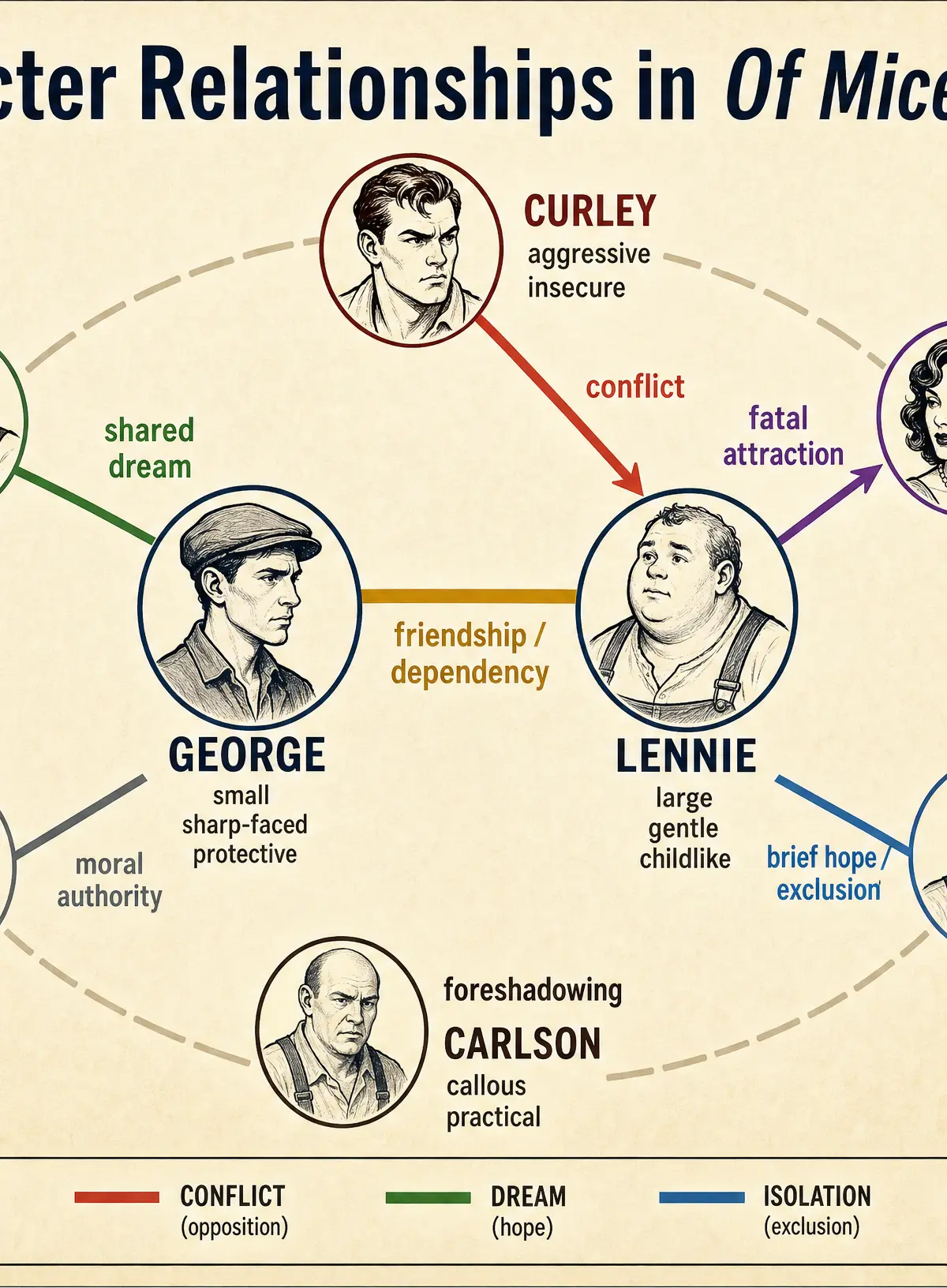
George Milton
Role: The pragmatic protector and planner.
Key Traits: Sharp, cautious, burdened, ultimately tragic.
Character Arc: George moves from hopeful protector to broken realist. His journey represents the death of idealism. By shooting Lennie, he saves his friend but condemns himself to the lonely existence of a typical ranch worker.
Essential Quotes:
- "God, you're a lot of trouble... I could get along so easy and so nice if I didn't have you on my tail." (Ch 1)
- "No, Lennie. I ain't mad. I never been mad, an' I ain't now." (Ch 6)
Lennie Small
Role: The innocent catalyst for tragedy.
Key Traits: Childlike, physically powerful, animalistic, uncomprehending.
Character Arc: Lennie is static; he does not learn or develop. His inability to control his strength in a fragile world makes his tragic end inevitable. He is associated with soft things that he inadvertently destroys.
Essential Quotes:
- "Snorting into the water like a horse." (Ch 1)
- "I done a bad thing. I done another bad thing." (Ch 5)
Curley's Wife
Role: The victim of patriarchal isolation.
Key Traits: Lonely, naive, flirtatious (as a defense mechanism), trapped.
Character Arc: Initially presented through the men's misogynistic viewpoint as "jail bait," Steinbeck reveals her vulnerability and dashed dreams in Chapter 5. In death, she is finally granted peace and innocence.
Essential Quotes:
- "I never get to talk to nobody. I get awful lonely." (Ch 5)
- "And the meanness and the plannings and the discontent and the ache for attention were all gone from her face." (Ch 5)
Writer's Methods
Cyclical Structure: The novella begins and ends at the exact same pool by the Salinas River. This structural choice reinforces the theme of predetermination and the inescapable trap of the itinerant worker's life. The characters literally go nowhere.
Foreshadowing: Steinbeck heavily telegraphs the tragic ending. The death of the mouse foreshadows the puppy, which foreshadows Curley's Wife. Most importantly, Carlson's shooting of Candy's old, useless dog directly parallels George's "mercy killing" of Lennie.
Animal Imagery: Lennie is frequently described using animalistic metaphors ("like a bear," "like a terrier"). This not only highlights his physical strength and lack of intellectual refinement but also aligns him with the natural world, suggesting he is unfit for the complex social rules of human society.
Context
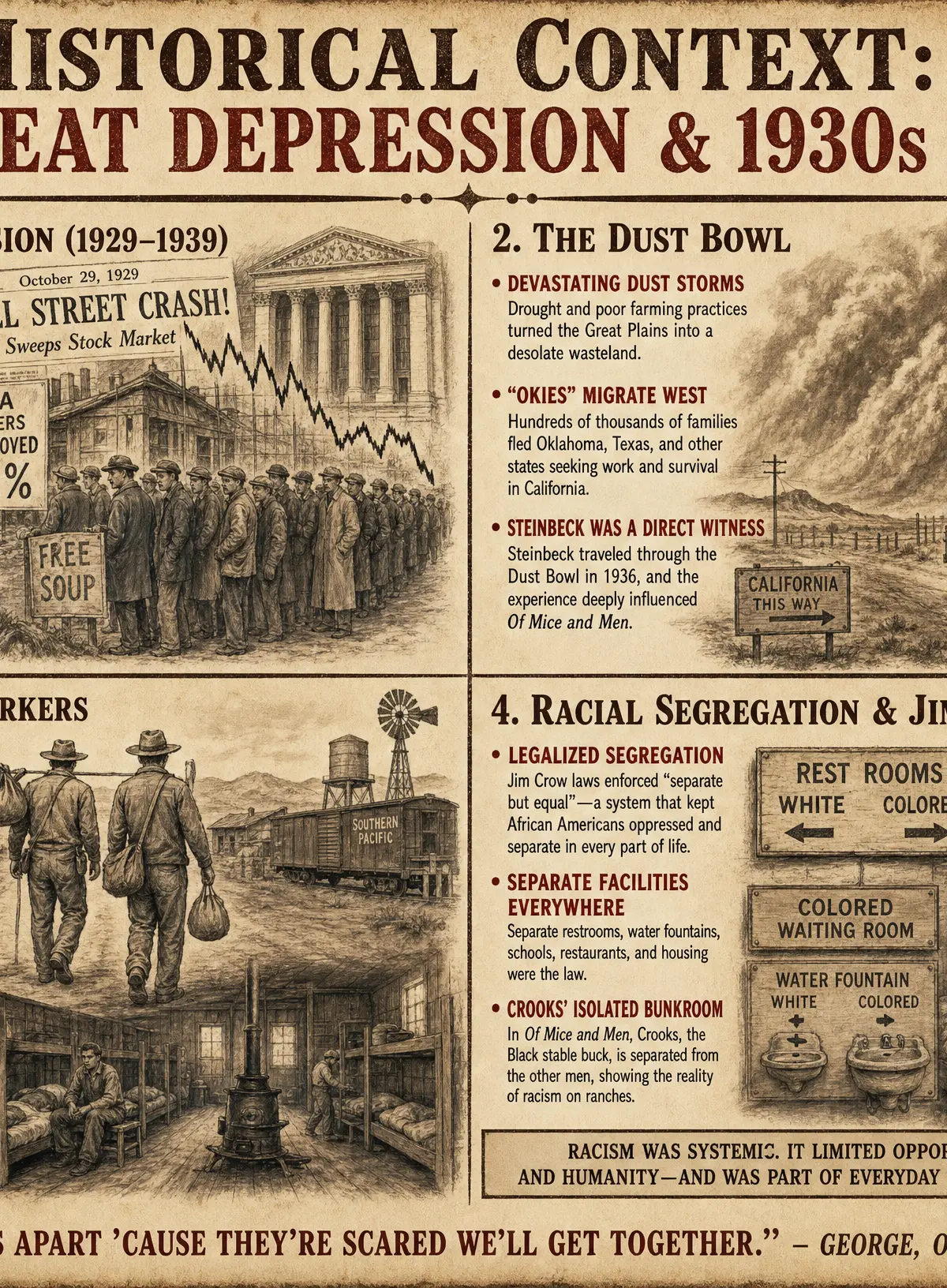
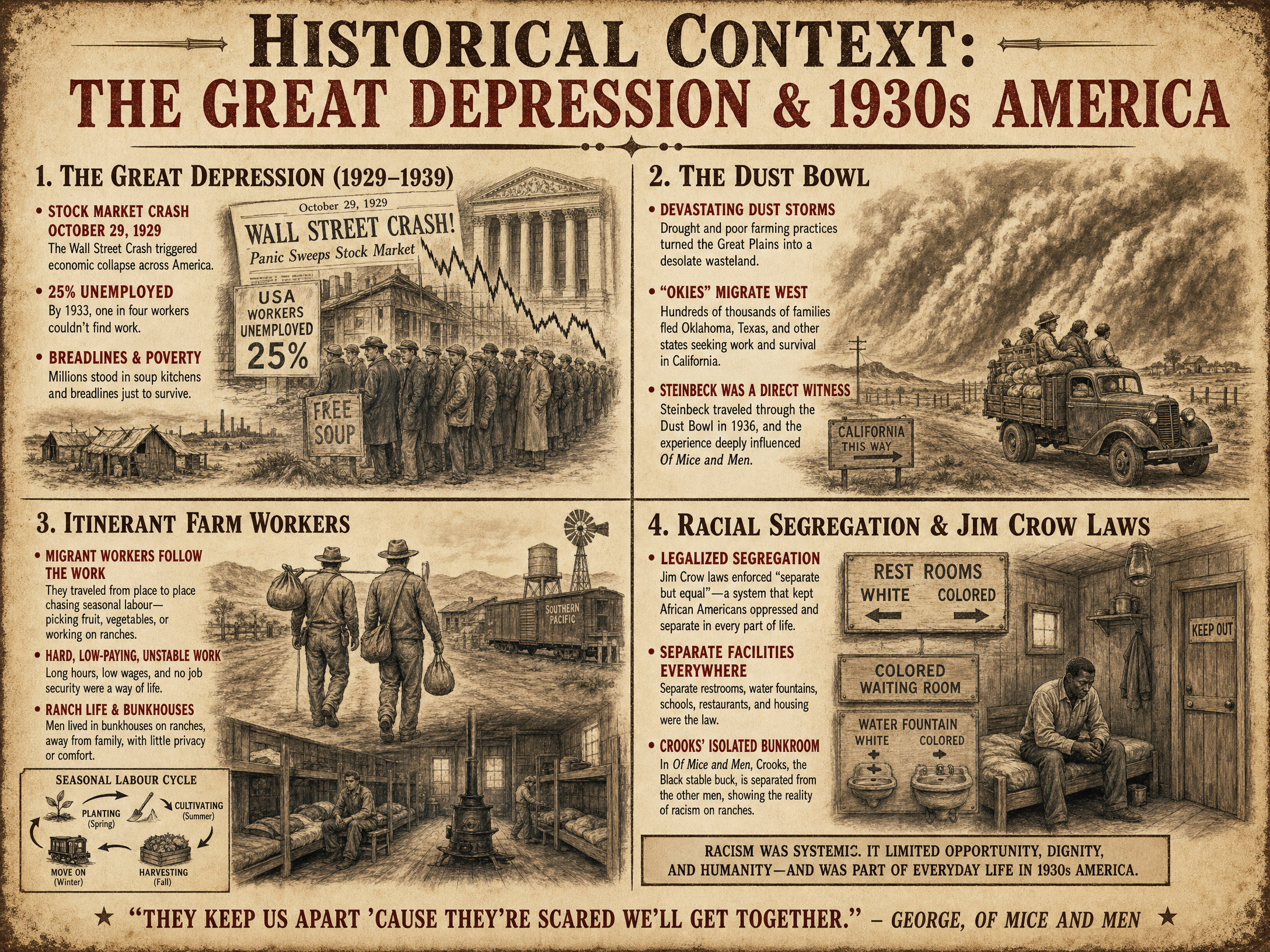
To achieve high AO3 marks, candidates must integrate context seamlessly. The Great Depression following the 1929 Wall Street Crash forced millions into poverty, creating a transient workforce of desperate men competing for scarce jobs. This economic brutality destroys solidarity, explaining the pervasive suspicion on the ranch. Furthermore, the Jim Crow laws and systemic racism of the era are embodied in Crooks' physical segregation and vulnerability to lynching threats, highlighting the intersection of economic and racial oppression.
Visual Resources
3 diagrams and illustrations
Interactive Diagrams
1 interactive diagram to visualise key concepts
Conceptual Flow Outline
The Cyclical Narrative Structure of Of Mice and Men
Worked Examples
2 worked examples — open one to explore the question and available guidance.
Practice Questions
Test your understanding — click to reveal model answers
Explore how Steinbeck presents the theme of power and powerlessness in Of Mice and Men. (30 marks + 4 AO4)
Hint: Consider the different types of power (physical, economic, racial) and how those without power treat each other.
Starting with the extract where Carlson shoots Candy's dog, explore how Steinbeck presents the harshness of ranch life. (30 marks + 4 AO4)
Hint: Link the treatment of the dog directly to the treatment of the workers (utilitarianism).
Explore the significance of the title Of Mice and Men. (30 marks + 4 AO4)
Hint: You must reference the Robert Burns poem 'To a Mouse' and the theme of fate.
How does Steinbeck present the relationship between George and Lennie? (30 marks + 4 AO4)
Hint: Avoid just saying 'they are good friends'. Look at the complexity, the burden, and the tragic ending.