Pearson Edexcel · IGCSE · English Literature
The Curious Incident of the Dog in the Night-time
The Curious Incident of the Dog in the Night-time offers a uniquely compelling first-person narrative that challenges our understanding of truth, family, and communication. Studying this text rewards close attention to how Mark Haddon's structural choices and precise language construct Christopher's distinctive worldview.
- 7 min read
- 2 worked examples
- 4 practice questions
- 8 key terms
Study Notes
Overview
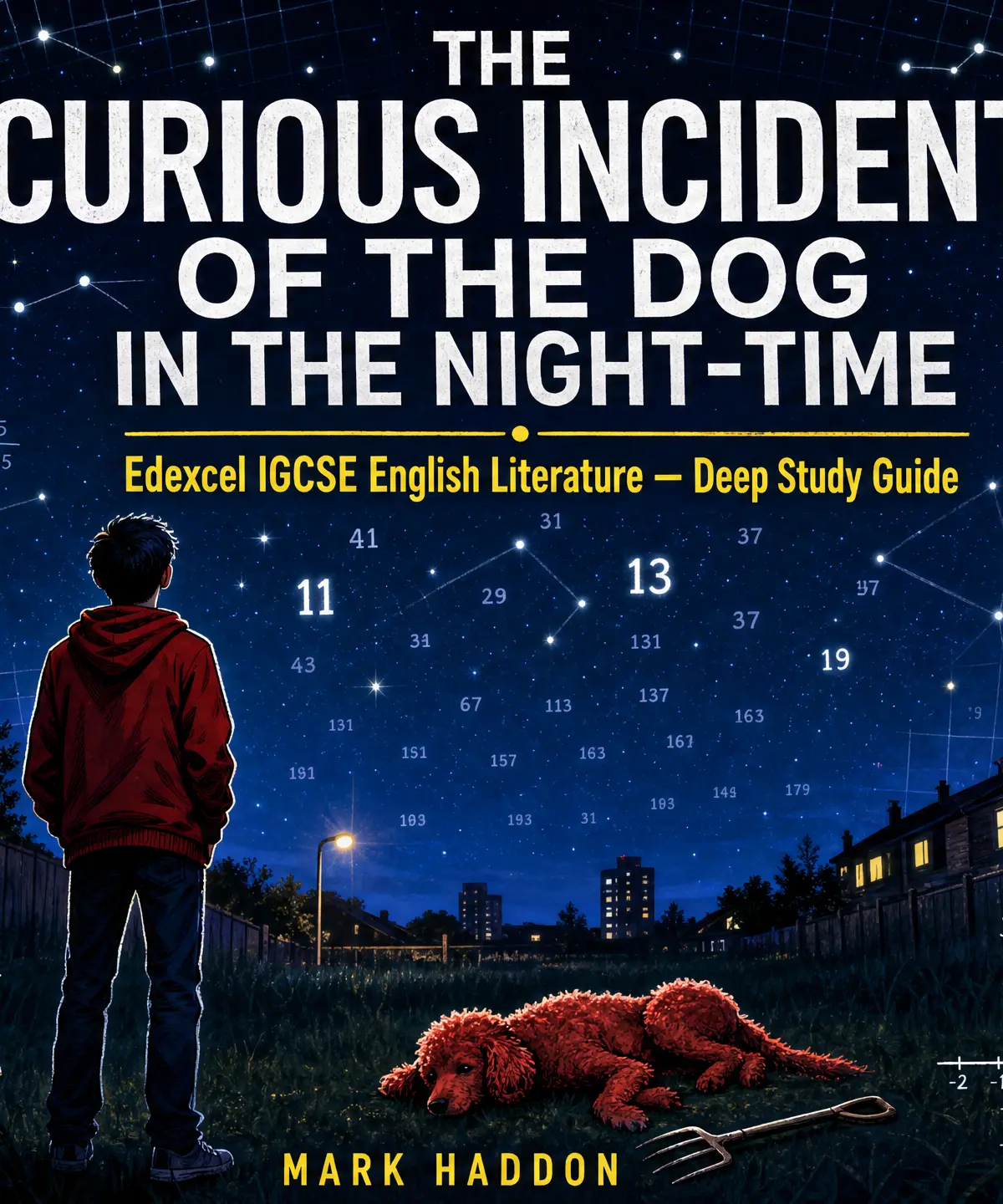
Mark Haddon's The Curious Incident of the Dog in the Night-time is a masterclass in narrative voice and perspective. For Edexcel IGCSE Literature, examiners are looking for your ability to analyse how Haddon constructs Christopher's unique worldview. You must move beyond simply describing Christopher's traits to analysing the literary effects of his narration: the dramatic irony created by the gap between his understanding and the reader's, the structural significance of the prime number chapters, and the precise, literal language that reveals profound emotional truths he himself cannot articulate.
Listen to our comprehensive revision podcast to solidify your understanding:

Plot/Content Overview
The novel follows 15-year-old Christopher Boone as he investigates the murder of his neighbour's dog, Wellington. His detective work uncovers a much deeper family mystery. When he discovers letters from his mother (who he believed was dead) hidden in his father's room, the revelation shatters his trust in his father, who also confesses to killing the dog. Terrified, Christopher undertakes a perilous, overwhelming journey to London to find his mother. The novel concludes with Christopher living with his mother in Swindon, taking his A-level Maths exam, and looking towards an independent future, having proved to himself that he can navigate the complex, unpredictable world.
Themes
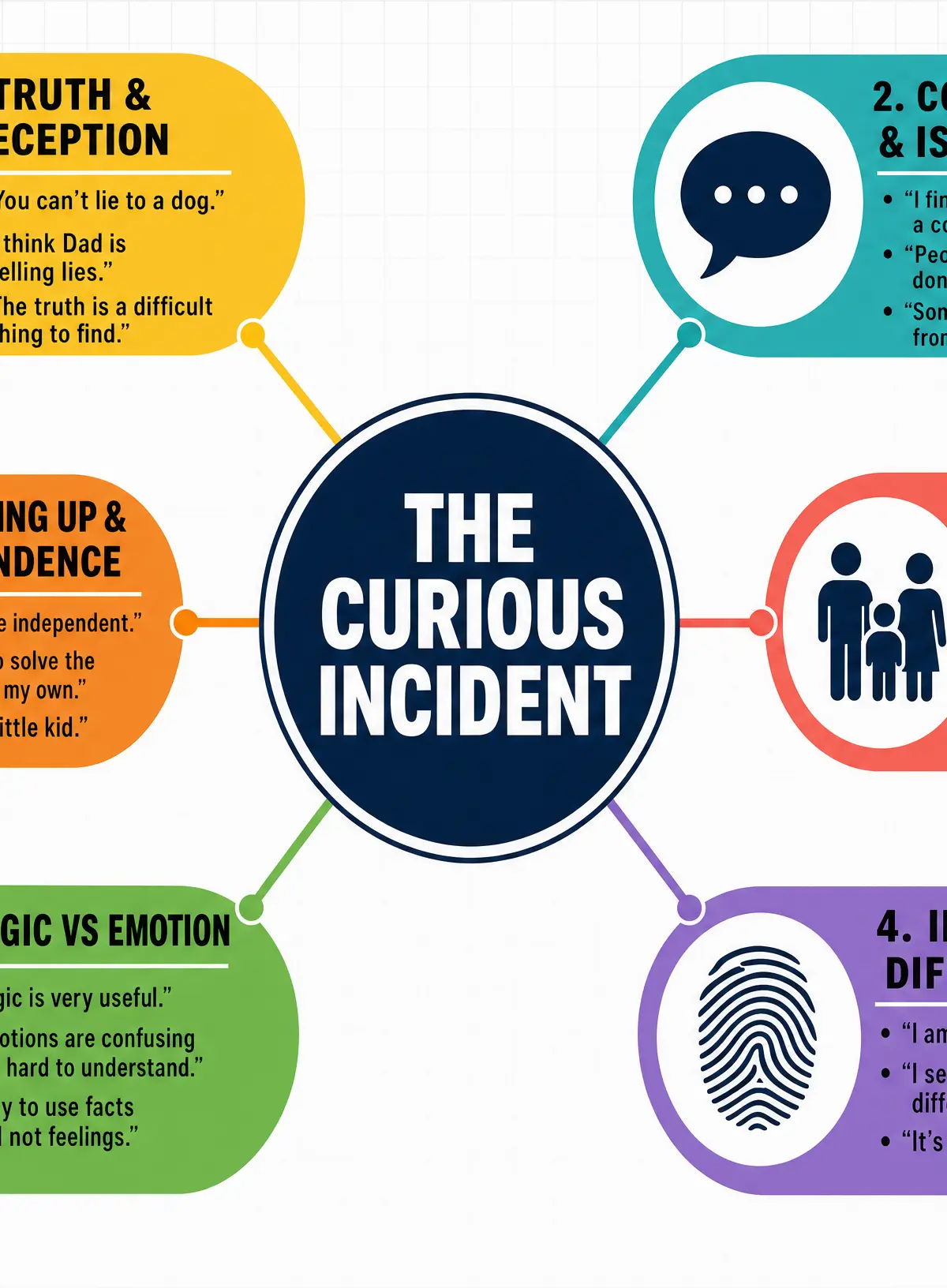
Theme 1: Truth and Deception
Truth is Christopher's absolute baseline for understanding the world, yet his world is built on profound deception. Haddon uses this tension to explore the complexity of human morality. While Christopher views truth in binary terms (true/false), the adult characters operate in a world of grey areas, where lies are told out of protection, shame, or fear. The novel's structure mirrors this: it begins as a search for the truth about a dog and becomes a search for the truth about a family.
Key Quotes:
- "I do not tell lies. Mother used to say that this was because I was a good person. But it is not because I am a good person. It is because I can't tell lies." (Chapter 37) - Christopher equates truth with logic, not morality.
- "I had to get out of the house. Father had murdered Wellington. That meant he could murder me..." (Chapter 167) - Christopher's rigid logic cannot accommodate the nuance of his father's actions.
Theme 2: Communication and Isolation
Communication is fraught with difficulty throughout the novel. Christopher's inability to read facial expressions or understand metaphors isolates him, but Haddon brilliantly demonstrates that the 'neurotypical' adults are equally isolated by their inability to communicate honestly. The letters, the book itself, and the physical gestures (the fan of fingers) are all attempts to bridge the communication gap.
Key Quotes:
- "I find it hard to know what people are thinking... it is like being in a room with a one-way mirror in a spy film." (Chapter 37) - A rare use of simile that highlights his profound sense of isolation.
- "He held up his right hand and spread his fingers out in a fan... We do this because sometimes Father wants to give me a hug, but I do not like hugging people." (Chapter 31) - Shows the adaptation of communication within the family.
Theme 3: Logic vs Emotion
Christopher attempts to impose order on a chaotic world through mathematics, lists, and strict routines. Haddon contrasts this rigid logical framework with the messy, unpredictable emotional lives of the adults around him. The tragedy (and comedy) of the novel often arises from Christopher applying mathematical logic to emotional situations.
Key Quotes:
- "Prime numbers are what is left when you have taken all the patterns away. I think prime numbers are like life." (Chapter 19) - Structural reflection of Christopher's worldview.
- "Sometimes we get sad about things and we don't like to tell other people that we are sad about them. We like to keep it a secret. Or sometimes, we are sad but we really don't know why we are sad, so we say we aren't sad but we really are." (Chapter 157) - Ed Boone trying to explain emotional complexity to Christopher.
Character Analysis
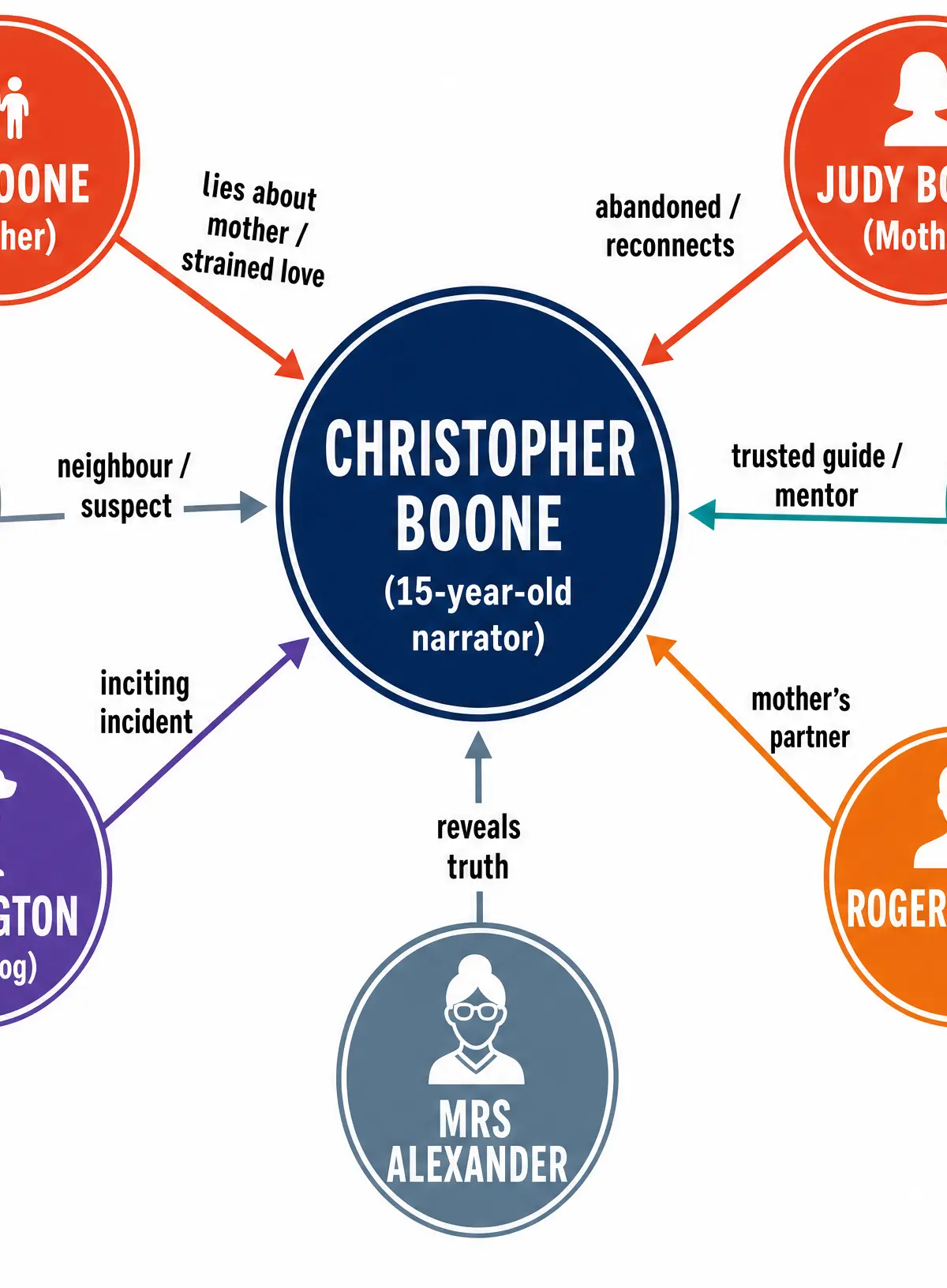
Christopher Boone
Role: Protagonist and First-Person Narrator
Key Traits: Logical, observant, literal, easily overwhelmed by sensory input, unable to understand complex emotions.
Character Arc: Moves from a constricted world (rarely leaving his street) to demonstrating remarkable resilience and independence by travelling to London alone.
Essential Quotes:
- "I like dogs. You always know what a dog is thinking. It has four moods. Happy, sad, cross and concentrating."
- "And I know I can do this because I went to London on my own, and because I solved the mystery of Who Killed Wellington? and I found my mother and I was brave and I wrote a book and that means I can do anything."
Ed Boone (Father)
Role: Primary caregiver, antagonist (in Christopher's eyes, temporarily)
Key Traits: Patient, loving, quick-tempered, deeply flawed.
Character Arc: From devoted protector to exposed liar, desperately trying to rebuild trust.
Essential Quotes:
- "I did it for your good, Christopher. Honestly I did. I never meant to lie."
- "You have to learn to trust me... And I don't care how long it takes... Because this is important. This is more important than anything else."
Judy Boone (Mother)
Role: The absent parent, the catalyst for the journey
Key Traits: Loving but overwhelmed, impulsive, honest about her failings.
Character Arc: Revealed through letters from the past, moves from absence to attempting to re-establish her role as a mother.
Essential Quotes:
- "I was not a very good mother, Christopher. Maybe if things had been different, maybe if you'd been different, I might have been better at it."
Writer's Methods
Narrative Perspective: The sustained first-person narration is Haddon's primary method. It creates dramatic irony—we constantly infer things that Christopher describes but doesn't understand (e.g., his father's grief, his mother's affair).
Structure: The use of prime numbers for chapters reflects Christopher's desire for logical order. The inclusion of diagrams, maps, and mathematical puzzles visually represents his thought processes and disrupts conventional novel form.
Language: Christopher's language is characteristically precise, literal, and devoid of metaphor (which he considers a "lie"). He relies heavily on polysyndeton (repeated use of "and") to create a flat, unhierarchical flow of information, showing how he processes all details with equal weight.
Context
Examiners expect you to understand the context of the early 2000s in the UK. While Haddon explicitly stated he did not intend the book to be a medical textbook on Asperger's or autism, the novel reflects a growing societal awareness of neurodiversity. More importantly, it reflects universal themes of family breakdown, the challenges of parenting, and the modern crisis of communication. The context is less about historical events and more about the social realities of modern family life and the spectrum of human experience.
Visual Resources
2 diagrams and illustrations
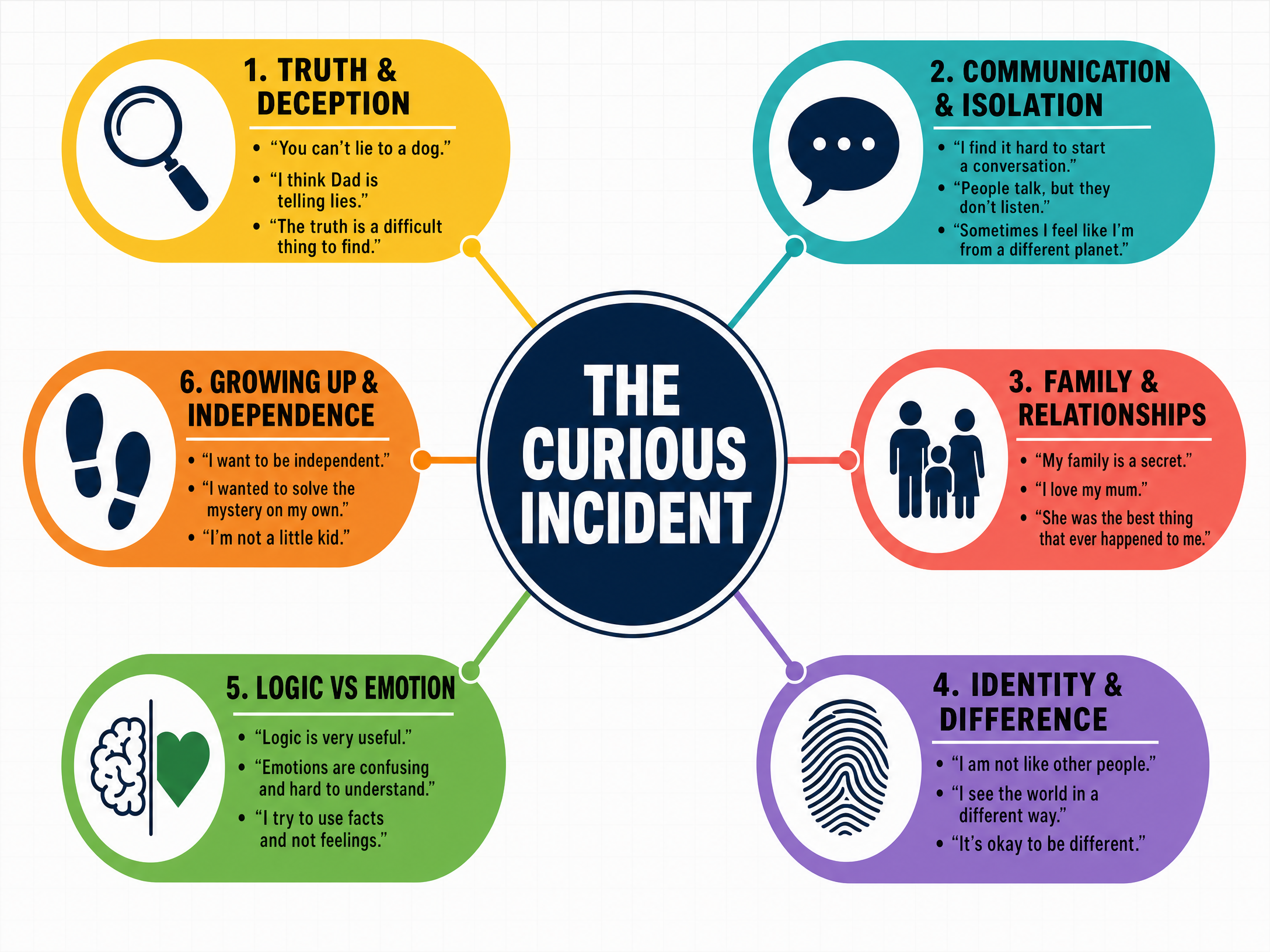
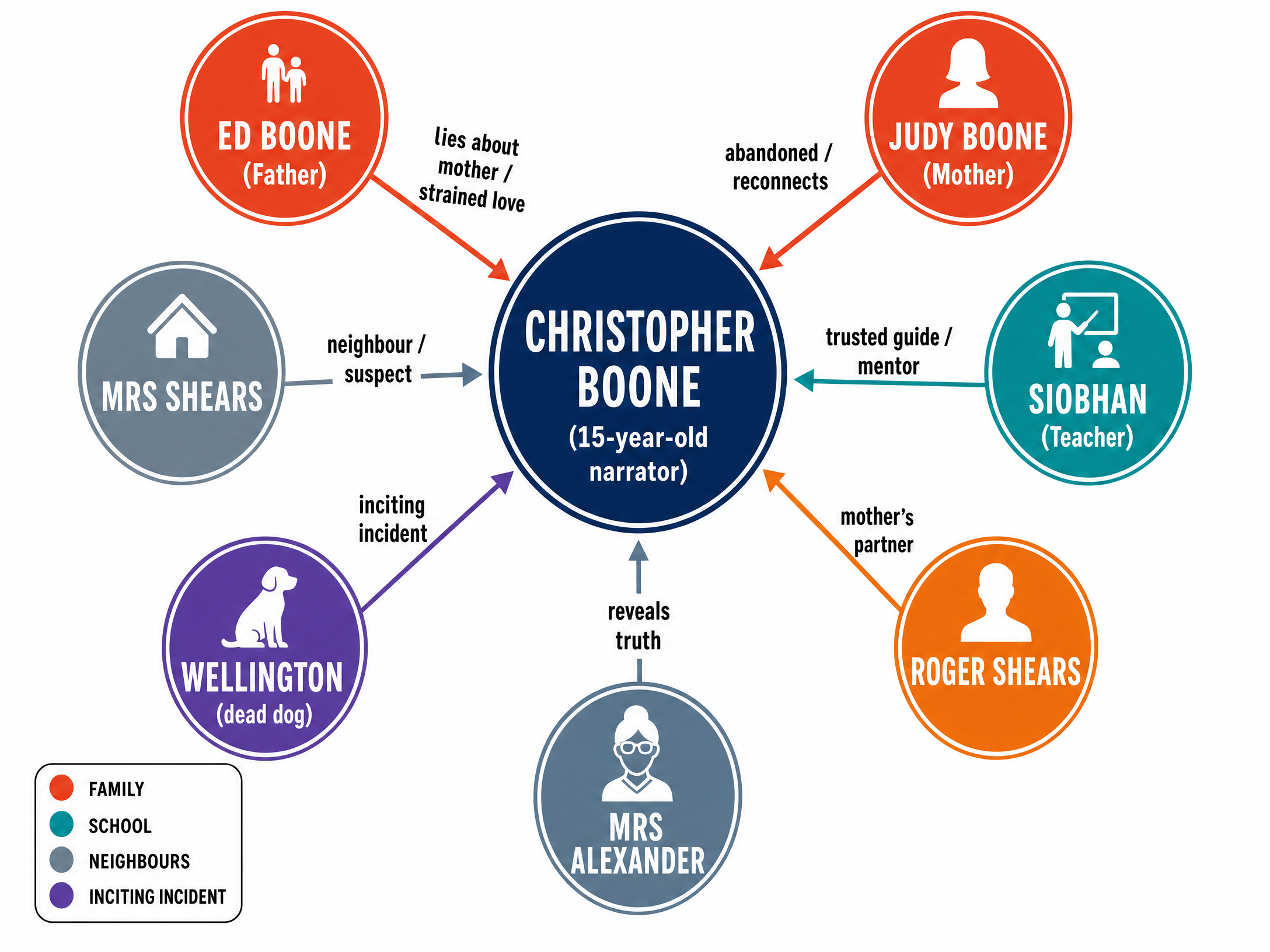
Interactive Diagrams
1 interactive diagram to visualise key concepts
Conceptual Flow Outline
Narrative Arc of The Curious Incident
Worked Examples
2 worked examples — open one to explore the question and available guidance.
Practice Questions
Test your understanding — click to reveal model answers
Explore how Haddon presents the relationship between Christopher and his father. You must refer to the context of the novel in your answer. (30 marks)
Hint: Don't just say 'they have a bad relationship'. Look at the complexity: the genuine care vs the ultimate betrayal. How does Haddon show Ed's frustration?
Starting with the extract where Christopher finds the letters, explore how Haddon uses structure to create tension and reveal truth. (30 marks)
Hint: Focus heavily on AO2. Think about the epistolary form (the letters), the prime number chapters, and the pacing of the revelations.
Explore how Haddon presents the theme of independence in the novel. (30 marks)
Hint: Contrast Christopher's physical boundaries at the start of the novel with his journey to London. What does the A-level maths exam represent?
How does Haddon present the character of Judy Boone (Mother)? (30 marks)
Hint: Look at how she is presented initially (as dead), then through her letters, and finally in person. How does her communication style differ from Ed's?