Pearson Edexcel · IGCSE · English Literature
The Joy Luck Club
Master Amy Tan's masterpiece with this comprehensive guide to The Joy Luck Club. Uncover the intricate narrative structure, explore the profound mother-daughter conflicts, and learn exactly how to secure top marks in your Edexcel IGCSE Literature exam by analysing the writer's methods.
- 7 min read
- 2 worked examples
- 2 practice questions
- 8 key terms
Study Notes
Overview
The Joy Luck Club by Amy Tan is a seminal text for the Edexcel IGCSE English Literature specification. Published in 1989, it offers a profound exploration of the immigrant experience, cultural identity, and the complex, often fraught relationships between Chinese immigrant mothers and their American-born daughters. Examiners highly reward candidates who can move beyond plot summary to critically analyse Tan's intricate, non-linear narrative structure and her use of symbolism. To achieve top bands, you must demonstrate how the writer's methods (AO2) reveal the tension between heritage and assimilation, and seamlessly integrate contextual factors (AO3) such as the Sino-Japanese War and the cultural expectations of 1940s China versus 1980s America.
Listen to the podcast episode for a deep dive into the core themes and exam strategies:

Plot/Content Overview
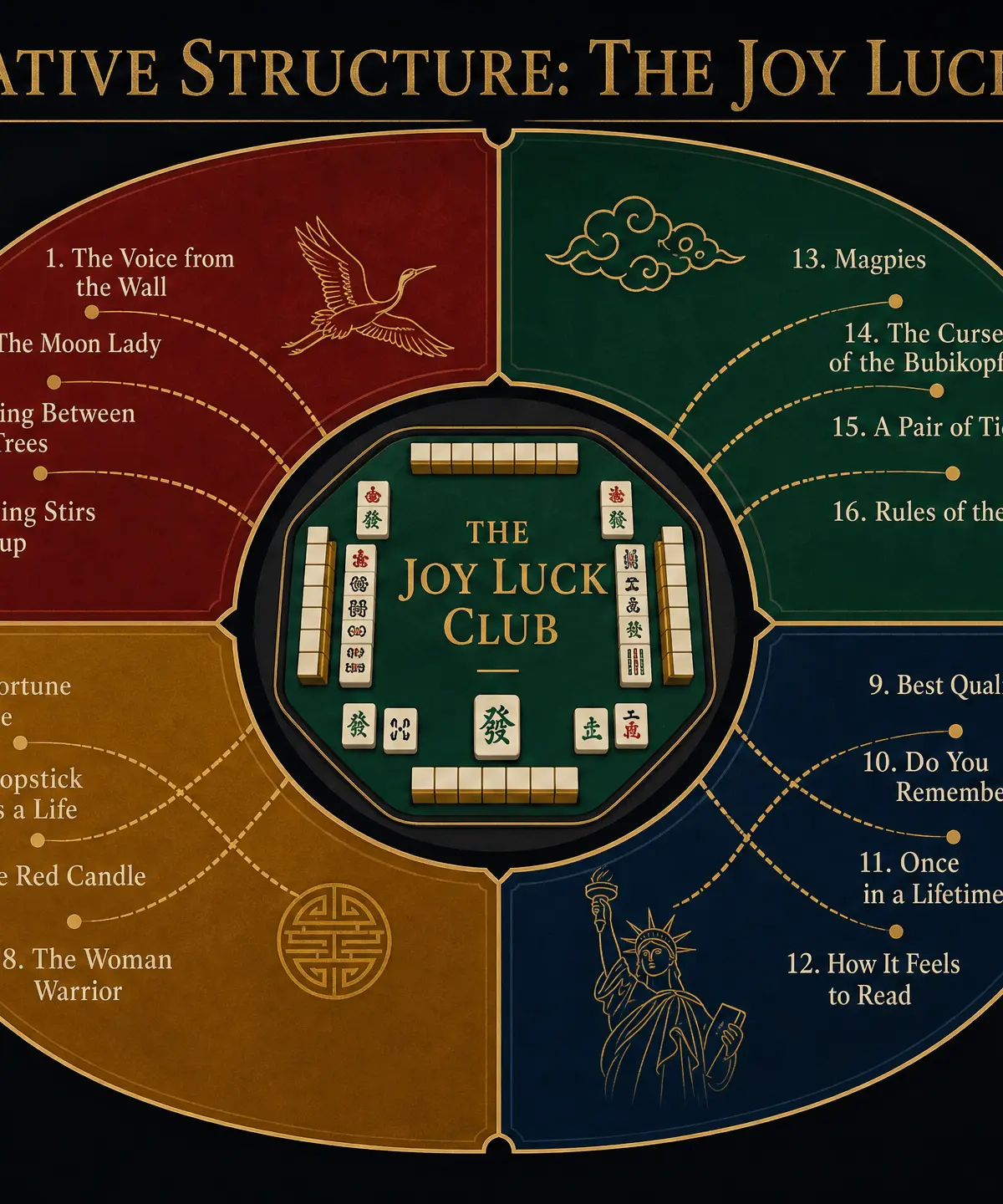
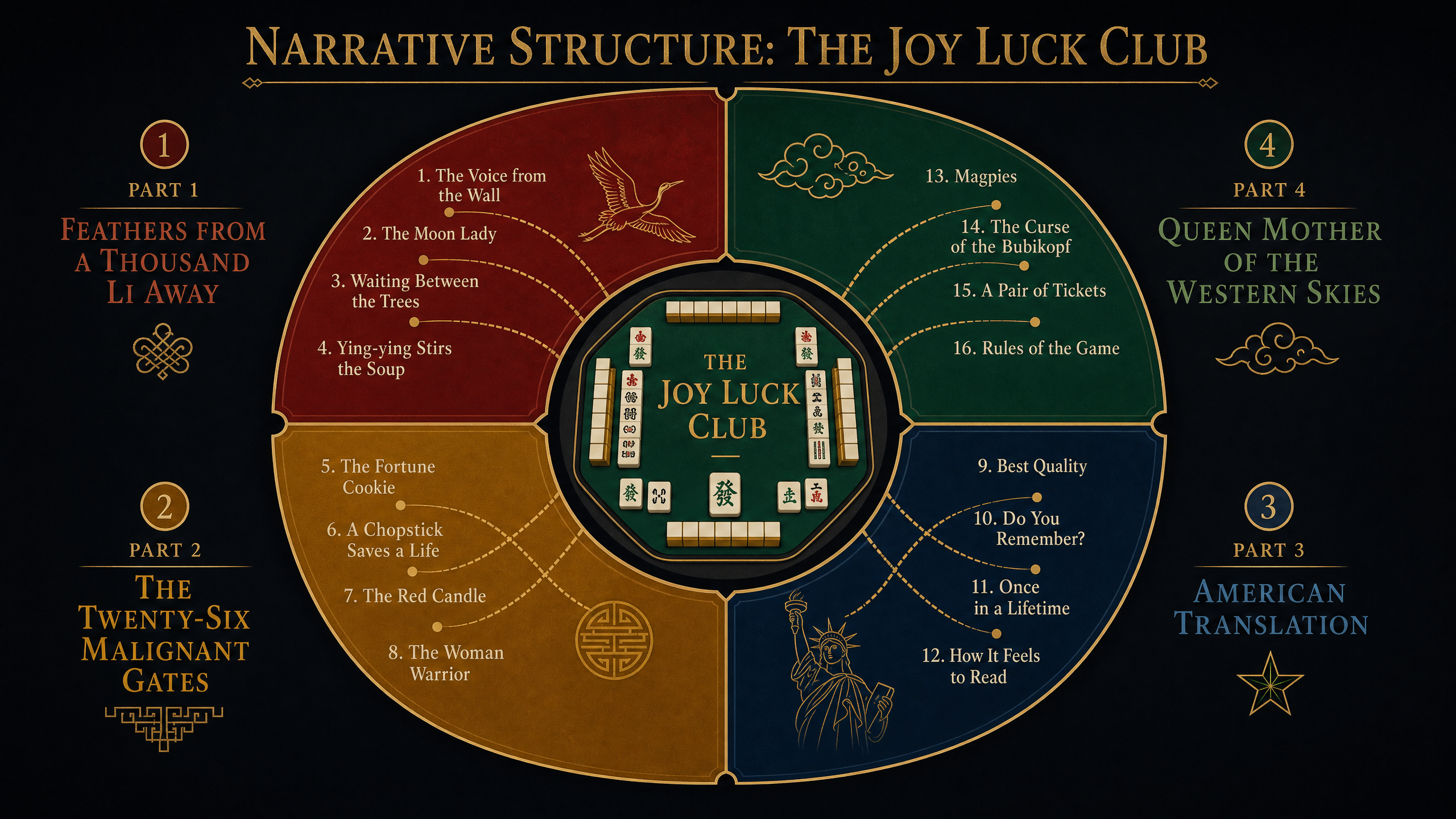
The novel is uniquely structured into sixteen interwoven stories, divided into four parts, resembling the four rounds of a mahjong game.
- Part 1: Feathers from a Thousand Li Away: Introduces the mothers' histories in China. Following Suyuan Woo's death, her daughter June (Jing-mei) takes her place at the mahjong table and learns of her mother's lost twin daughters.
- Part 2: The Twenty-Six Malignant Gates: Focuses on the daughters' childhoods in America, highlighting their early conflicts with their mothers' traditional expectations and their struggles with cultural duality.
- Part 3: American Translation: The daughters as adults facing crises in their marriages and careers. They begin to realize that their mothers' seemingly harsh advice is rooted in deep love and painful experience.
- Part 4: Queen Mother of the Western Skies: The mothers' final stories, revealing their deepest secrets and sacrifices. The novel concludes with June travelling to China to meet her half-sisters, achieving a profound cross-generational and cross-cultural resolution.
Themes
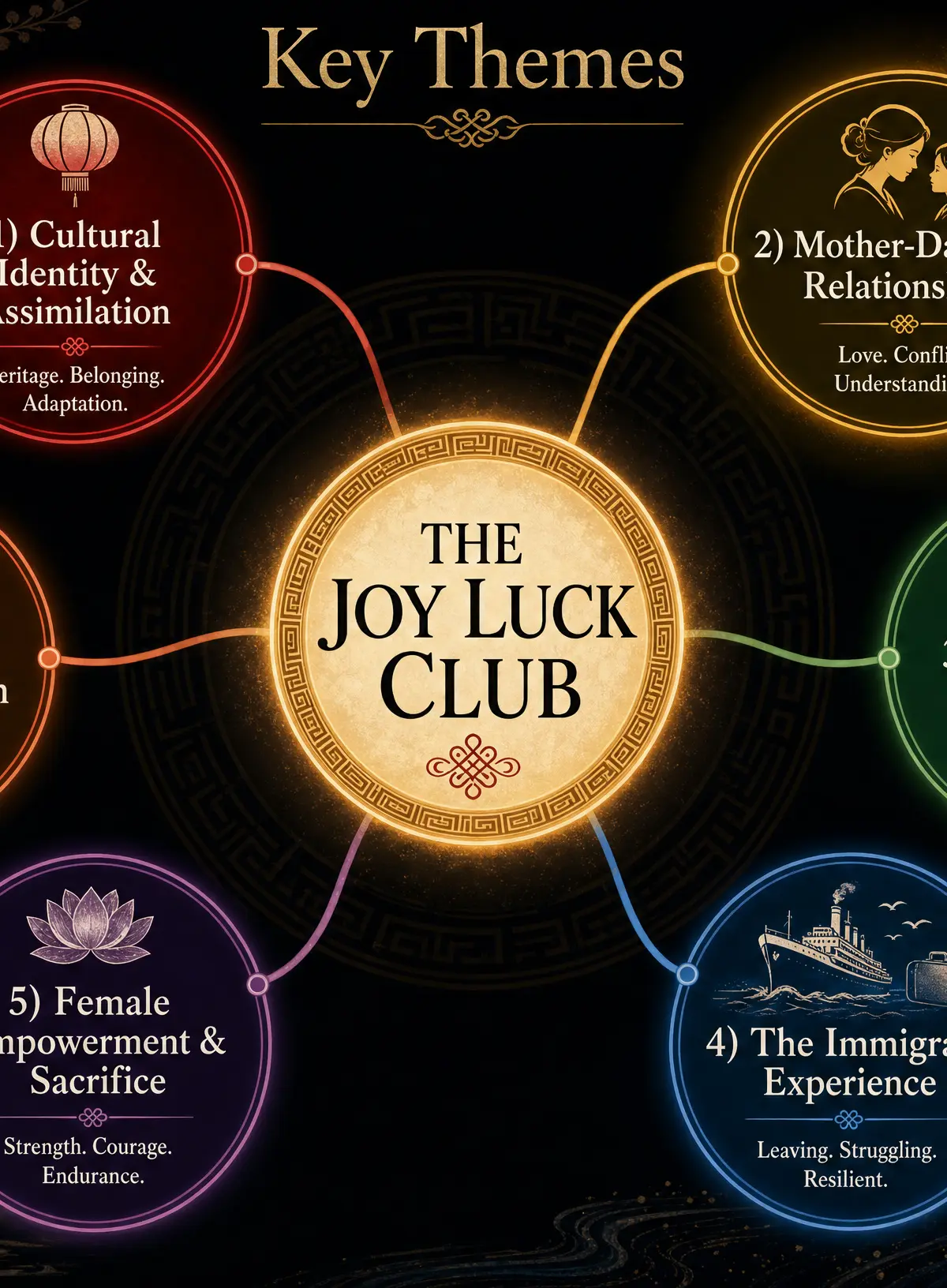
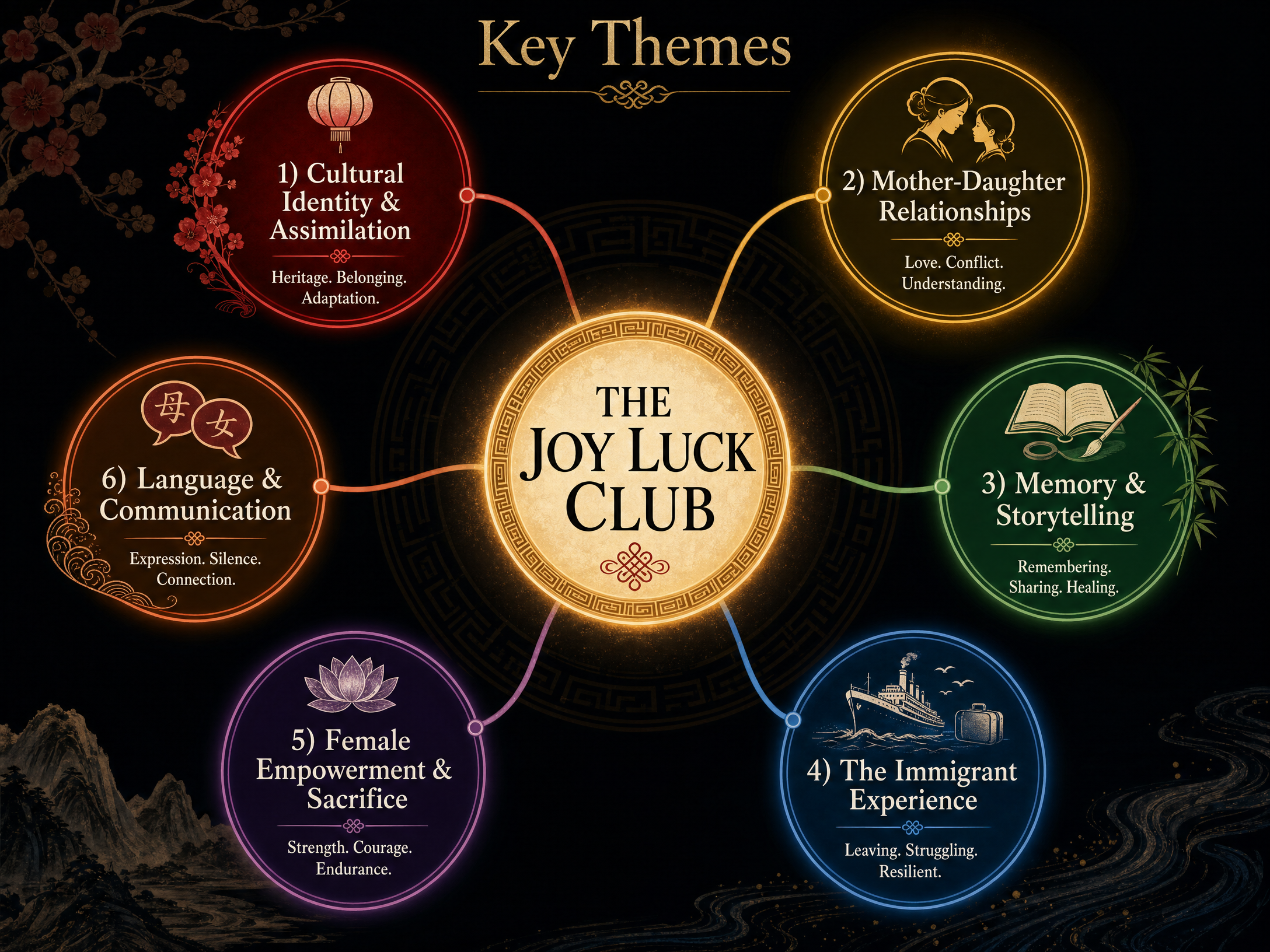
Theme 1: Mother-Daughter Relationships
The central tension of the novel lies in the profound love yet frequent misunderstanding between the two generations. The mothers wish to protect their daughters and pass on their strength, but the daughters often perceive this as criticism and control.
Key Quotes:
- "She sees only bad things that affect our family. And she knows what causes them. But now she laments that she never did anything to stop them." (June on Suyuan) - Highlights the mothers' perceived omniscience and the daughters' frustration.
- "I was raised the Chinese way: I was taught to desire nothing, to swallow other people's misery, to eat my own bitterness." (An-mei) - Reveals how the mothers' traumatic pasts shape their parenting styles in America.
Theme 2: Cultural Identity and Assimilation
The daughters struggle to balance their Chinese heritage with their American environment, leading to a fractured sense of self. The mothers fear their daughters have lost their 'Chinese character' (strength and inner worth) in exchange for American superficiality.
Key Quotes:
- "These kinds of explanations made me feel my mother and I spoke two different languages, which we did. I talked to her in English, she answered back in Chinese." (June) - Symbolizes the cultural and linguistic chasm between the generations.
- "I wanted my children to have the best combination: American circumstances and Chinese character. How could I know these two things do not mix?" (Lindo) - Encapsulates the central tragedy of the immigrant parent's hope.
Theme 3: Memory and Storytelling
Storytelling is presented as an act of survival and a means of preserving identity. The mothers use stories to impart wisdom, while the daughters must learn to 'listen' to these stories to understand their mothers and themselves.
Key Quotes:
- "I will use this sharp pain to penetrate my daughter's tough skin and cut her tiger spirit loose." (Ying-ying) - Shows storytelling as an active, sometimes painful, tool for empowerment.
- "My mother has told me this story many times... but I never really listened." (June) - Emphasizes the theme of delayed understanding.
Character Analysis
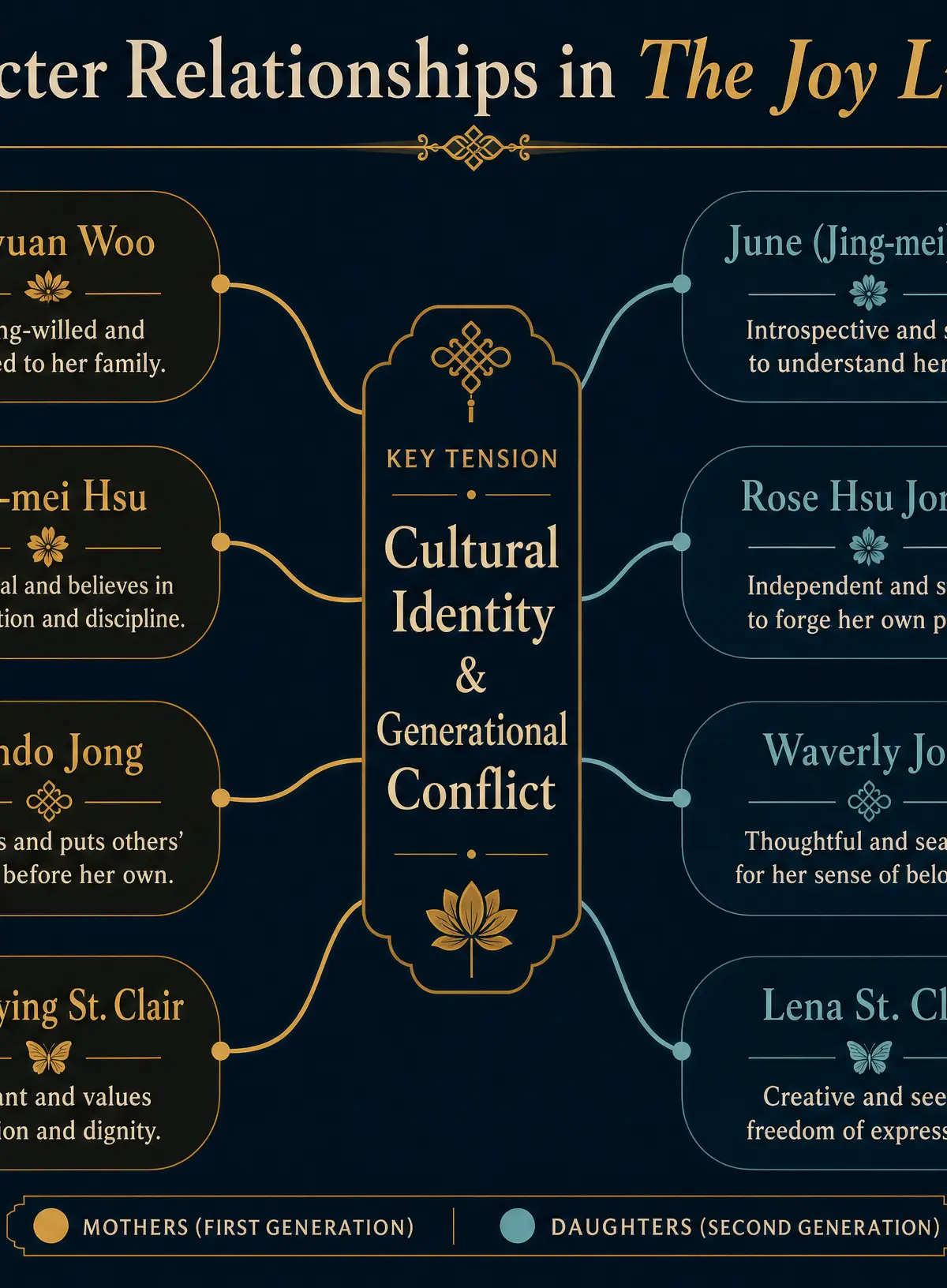
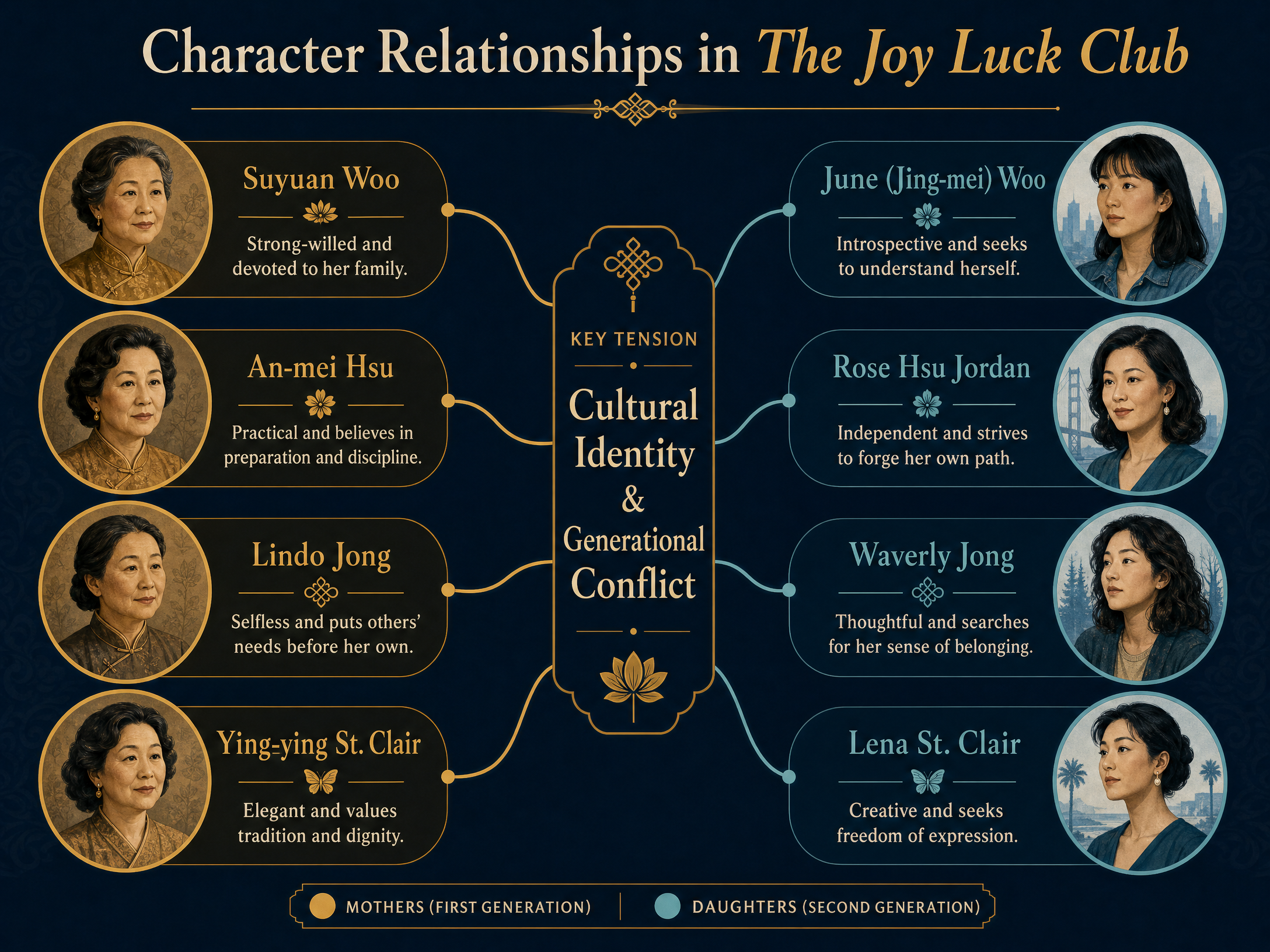
Suyuan Woo & June (Jing-mei) Woo
Role: Suyuan is the founder of the Joy Luck Club; June is the narrative bridge connecting the generations.
Key Traits: Suyuan is resilient, demanding, and haunted by her past. June is insecure, introspective, and desperate for her mother's approval.
Character Arc: June moves from feeling inadequate to understanding her mother's profound love and accepting her own dual heritage during her trip to China.
Essential Quotes:
- "Only two kinds of daughters... Those who are obedient and those who follow their own mind!" (Suyuan)
- "And now I also see what part of me is Chinese. It is so obvious. It is my family. It is in our blood." (June)
Lindo Jong & Waverly Jong
Role: The most fiercely competitive mother-daughter pair.
Key Traits: Lindo is strategic, proud, and survivor of an arranged marriage. Waverly is ambitious, Americanized, and resents her mother's control.
Character Arc: Waverly learns that her success in chess (and life) is partly due to the 'invisible strength' she inherited from Lindo.
Essential Quotes:
- "Strongest wind cannot be seen." (Lindo)
- "I saw what I had been fighting for: It was for me, a scared child, who had run away a long time ago to what I had imagined was a safe place." (Waverly)
Writer's Methods
- Non-Linear, Multi-Perspective Structure: Tan's use of sixteen interlocking narratives mirrors the fragmented experience of immigration and the slow, piecemeal process of understanding one's heritage.
- Symbolism: Objects carry heavy cultural weight. The swan feather represents untranslatable good intentions; the jade pendant represents self-worth; the Joy Luck Club itself symbolizes resilience against despair.
- Language and 'Chinglish': Tan captures the authentic cadence of immigrant speech. The linguistic barrier is a metaphor for the cultural barrier, emphasizing the theme of 'lost in translation'.
- Parables: Each of the four sections begins with a brief myth or parable, setting the thematic tone and highlighting the oral storytelling tradition of Chinese culture.
Context
- Historical: The mothers' stories are deeply informed by the turmoil of early 20th-century China, including the Sino-Japanese War (which forces Suyuan to abandon her twins) and oppressive patriarchal traditions (like Lindo's arranged marriage and An-mei's mother's concubinage).
- Social: The daughters' experiences reflect the 1980s American immigrant experience—the pressure to assimilate, the generational divide, and the 'model minority' myth.
- Literary: Fits into the tradition of Asian-American literature, giving voice to female experiences that were historically marginalized.
Visual Resources
3 diagrams and illustrations
Interactive Diagrams
1 interactive diagram to visualise key concepts
Conceptual Flow Outline
The Narrative Arc of Generational Conflict and Resolution
Worked Examples
2 worked examples — open one to explore the question and available guidance.
Practice Questions
Test your understanding — click to reveal model answers
Explore how Tan presents the impact of the past on the present in The Joy Luck Club. You must refer to the context of the novel in your answer. (30 marks + 4 AO4)
Hint: Consider how the mothers' traumatic experiences in China dictate their parenting styles in America, and how the daughters must uncover this past to understand their own present.
How does Tan present the character of June (Jing-mei) Woo as a bridge between two cultures? (30 marks + 4 AO4)
Hint: Focus on her role as the narrator who opens and closes the novel, her struggle with her mother's expectations, and her final journey to China.