Pearson Edexcel · IGCSE · English Literature
The Scarlet Letter
Nathaniel Hawthorne's 'The Scarlet Letter' is a profound exploration of sin, guilt, and identity in Puritan New England. Studying this text rewards candidates who can analyse the evolution of powerful symbols and the psychological complexity of characters struggling against a rigid, unforgiving society.
- 8 min read
- 2 worked examples
- 4 practice questions
- 8 key terms
Study Notes
Overview
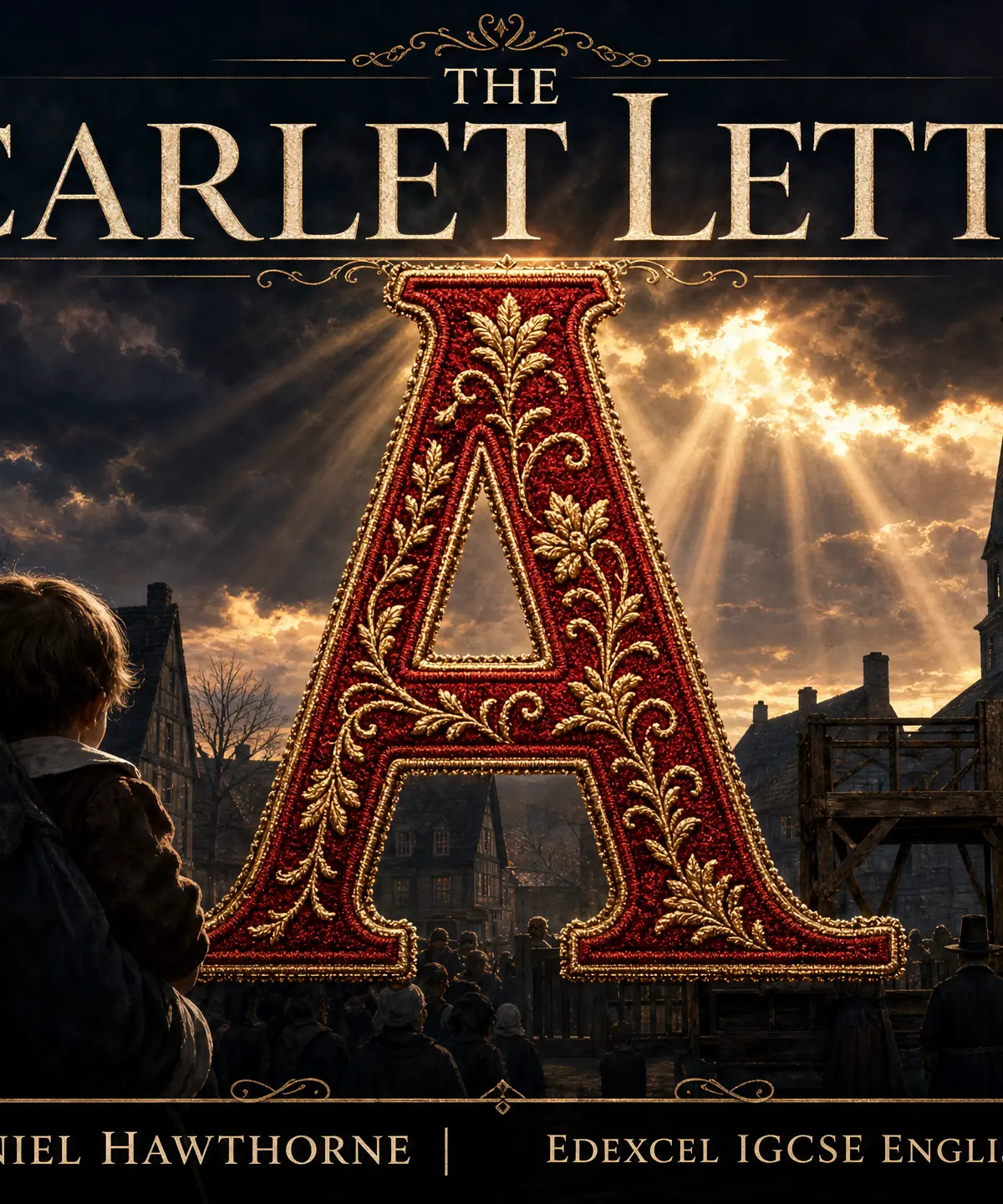
'The Scarlet Letter' (1850) is a foundational text of American Romanticism, set in 17th-century Puritan Boston. It explores the consequences of a single act of adultery on three individuals: Hester Prynne, who wears her punishment publicly; Arthur Dimmesdale, the minister who suffers in secret; and Roger Chillingworth, the husband consumed by revenge. Examiners for Edexcel IGCSE Literature look for perceptive analysis of Hawthorne's intricate symbolism, his critique of Puritan hypocrisy, and his exploration of psychological torment. High-scoring responses will integrate an understanding of how Hawthorne uses the omniscient narrative voice to shape our moral judgement.
Plot/Content Overview
The Custom-House (Preface): The narrator claims to find a scarlet 'A' and a manuscript, establishing a frame narrative that distances Hawthorne and introduces themes of ancestral guilt.
Chapters 1-4 (The First Scaffold Scene): Hester Prynne emerges from prison with her infant, Pearl, and stands on the scaffold wearing the scarlet letter 'A'. She refuses to name her lover, despite the urging of the young minister, Arthur Dimmesdale. Her husband, adopting the name Roger Chillingworth, watches from the crowd.
Chapters 5-8 (Isolation and the Elf-Child): Hester lives on the outskirts of town, supporting herself through exquisite needlework. Pearl grows into a wild, intuitive child, acting as the living embodiment of the scarlet letter.
Chapters 9-12 (The Leech and the Second Scaffold Scene): Chillingworth becomes Dimmesdale's physician ('the leech') to uncover his secret. Dimmesdale's health deteriorates under immense guilt. In Chapter 12, Dimmesdale holds a midnight vigil on the scaffold, joined by Hester and Pearl. A meteor traces an 'A' in the sky.
Chapters 13-19 (The Forest Interview): Seven years have passed. Hester's 'A' is now often read as 'Able' by the community. Hester and Dimmesdale meet in the forest, a space free from Puritan law. They plot to escape to Europe. Hester removes the letter, but Pearl refuses to approach until she puts it back on.
Chapters 20-24 (The Final Scaffold Scene): On Election Day, Dimmesdale delivers a powerful sermon. Knowing he is dying, he calls Hester and Pearl to the scaffold, confesses his sin to the community, reveals a mark on his own chest, and dies. Chillingworth dies a year later, leaving his fortune to Pearl. Hester eventually returns to Boston, voluntarily wearing the letter until her death.
Themes
Theme 1: Sin, Guilt, and Redemption
Hawthorne explores three distinct experiences of sin: Hester's public exposure, Dimmesdale's concealed agony, and Chillingworth's unpardonable malice. The text suggests that public acknowledgement, while painful, leads to redemption, whereas hidden sin destroys the soul.
Key Quotes:
- "Be true! Be true! Be true! Show freely to the world, if not your worst, yet some trait whereby the worst may be inferred!" (Chapter 24) - The narrator's explicit moral lesson, highlighting the destructive nature of hypocrisy.
- "Here had been her sin; here, her sorrow; and here was yet to be her penitence." (Chapter 24) - Explains Hester's voluntary return, showing redemption is an active, chosen process.
Theme 2: The Individual vs. Society
Hawthorne uses Hester's isolation to critique the rigid, unforgiving nature of Puritan society. The community values conformity over compassion, creating a system where outward piety masks inner corruption.
Key Quotes:
- "The scarlet letter was her passport into regions where other women dared not tread." (Chapter 18) - The symbol of her punishment paradoxically grants her intellectual and moral freedom.
- "It was an age in which the human intellect, newly emancipated, had taken a more active and a wider range than for many centuries before." (Chapter 18) - Contextualises Hester's independent thought against the restrictive Puritan backdrop.
Theme 3: Identity and Transformation
The meaning of the scarlet letter evolves significantly, reflecting Hawthorne's view that identity is fluid and shaped by action rather than dictated by society.
Key Quotes:
- "They said that it meant Able; so strong was Hester Prynne, with a woman's strength." (Chapter 13) - Demonstrates the community's forced re-evaluation of Hester based on her charitable actions.
- "The scarlet letter had not done its office." (Chapter 13) - Ironic observation; instead of crushing her, the punishment has made her stronger and more independent.
Character Analysis
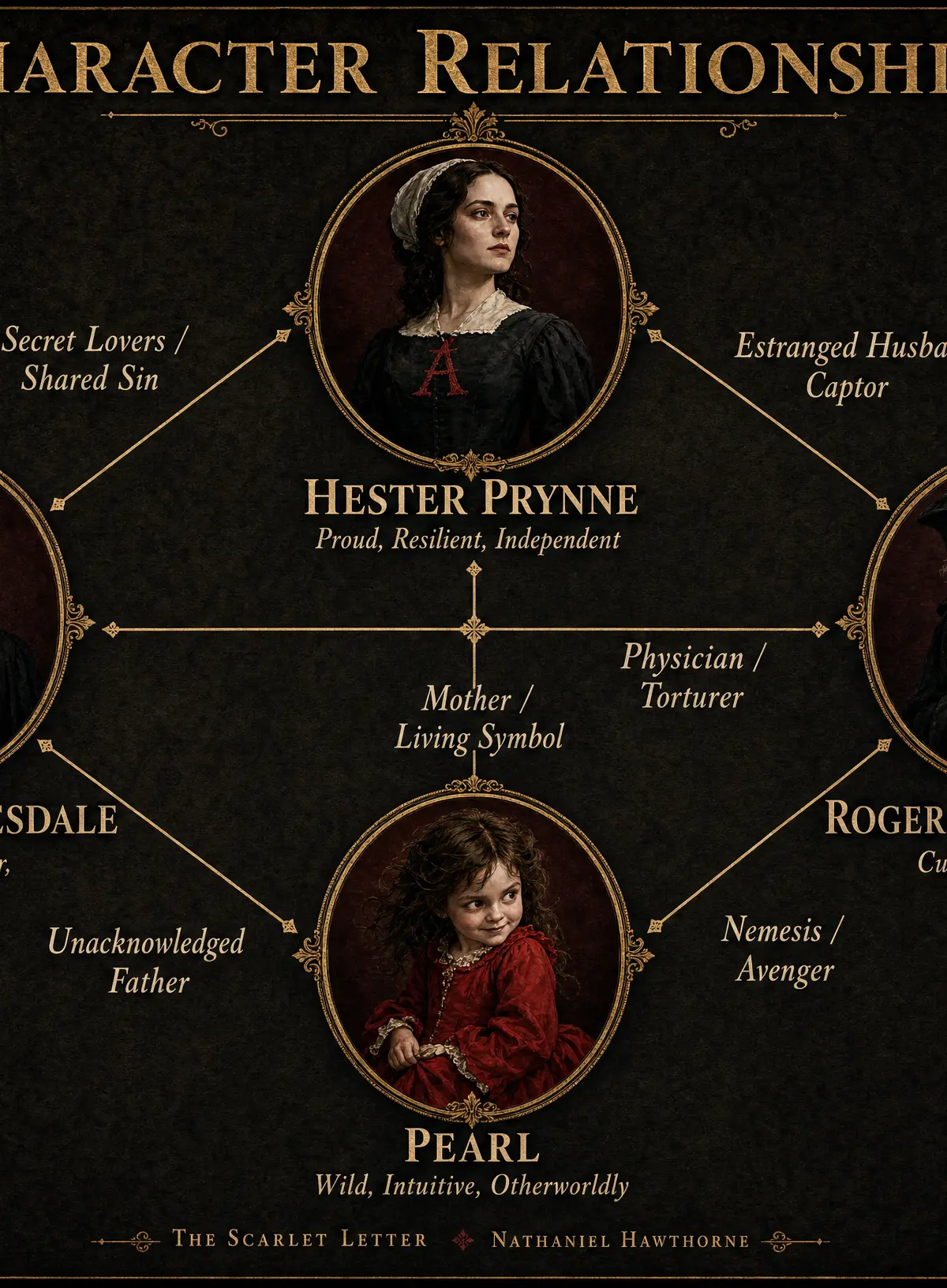
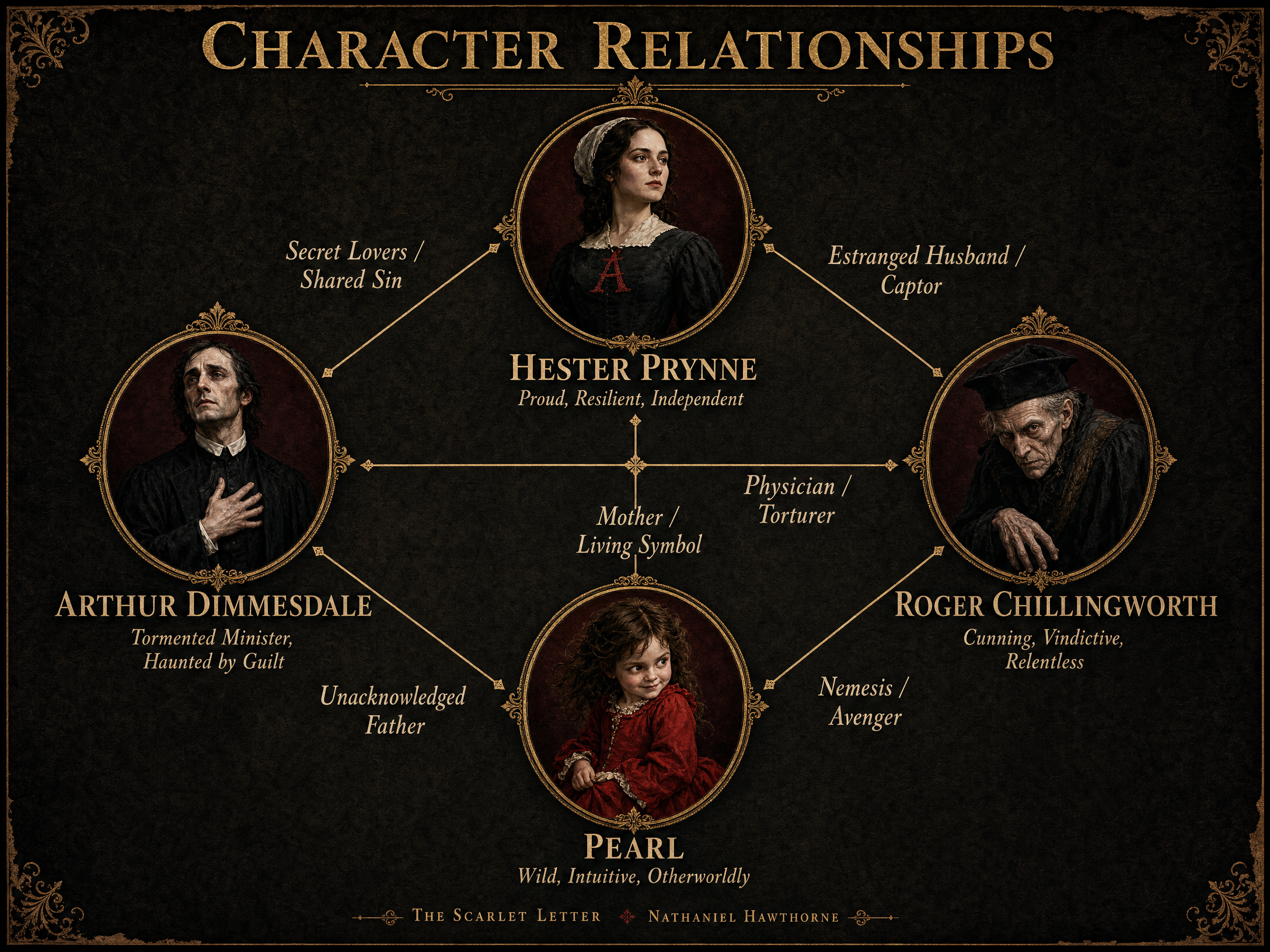
Hester Prynne
Role: The protagonist and moral centre; the public sinner who achieves true redemption.
Key Traits: Resilient, independent, compassionate, artistically gifted.
Character Arc: Evolves from a shamed outcast on the scaffold to a respected, independent thinker, and finally to a voluntary bearer of her symbol as a mark of her lived experience.
Essential Quotes:
- "She had not known the weight until she felt the freedom." (Chapter 18 - removing the letter in the forest)
- "a specimen of her delicate and imaginative skill" (Chapter 2 - describing her embroidery of the 'A')
Arthur Dimmesdale
Role: The hypocritical Puritan minister; Pearl's unacknowledged father.
Key Traits: Eloquent, cowardly, spiritually tormented, physically fragile.
Character Arc: Declines from a revered spiritual leader into a physically and psychologically broken man, achieving peace only through a desperate, final public confession.
Essential Quotes:
- "He loved the truth, and loathed the lie, as few men ever did. Therefore, above all things else, he loathed his miserable self!" (Chapter 11)
- "To the untrue man, the whole universe is false." (Chapter 11)
Roger Chillingworth
Role: The antagonist; Hester's estranged husband who embodies the true "unpardonable sin" of violating the human heart.
Key Traits: Cold, intellectual, vindictive, parasitic.
Character Arc: Transforms from a scholarly, somewhat detached husband into a literal "fiend" consumed entirely by his desire for revenge.
Essential Quotes:
- "He violated, in cold blood, the sanctity of a human heart." (Chapter 24 - Dimmesdale's assessment of Chillingworth's sin)
- "A mortal man, with once a human heart, has become a fiend for his especial torment!" (Chapter 14)
Pearl
Role: The living embodiment of the scarlet letter; the catalyst for truth.
Key Traits: Wild, intuitive, otherworldly, defiant.
Character Arc: Exists as an "elf-child" disconnected from human sympathy until Dimmesdale's confession, at which point she weeps and becomes fully human.
Essential Quotes:
- "the scarlet letter endowed with life!" (Chapter 7)
- "Pearl kissed his lips. A spell was broken." (Chapter 24)
Writer's Methods
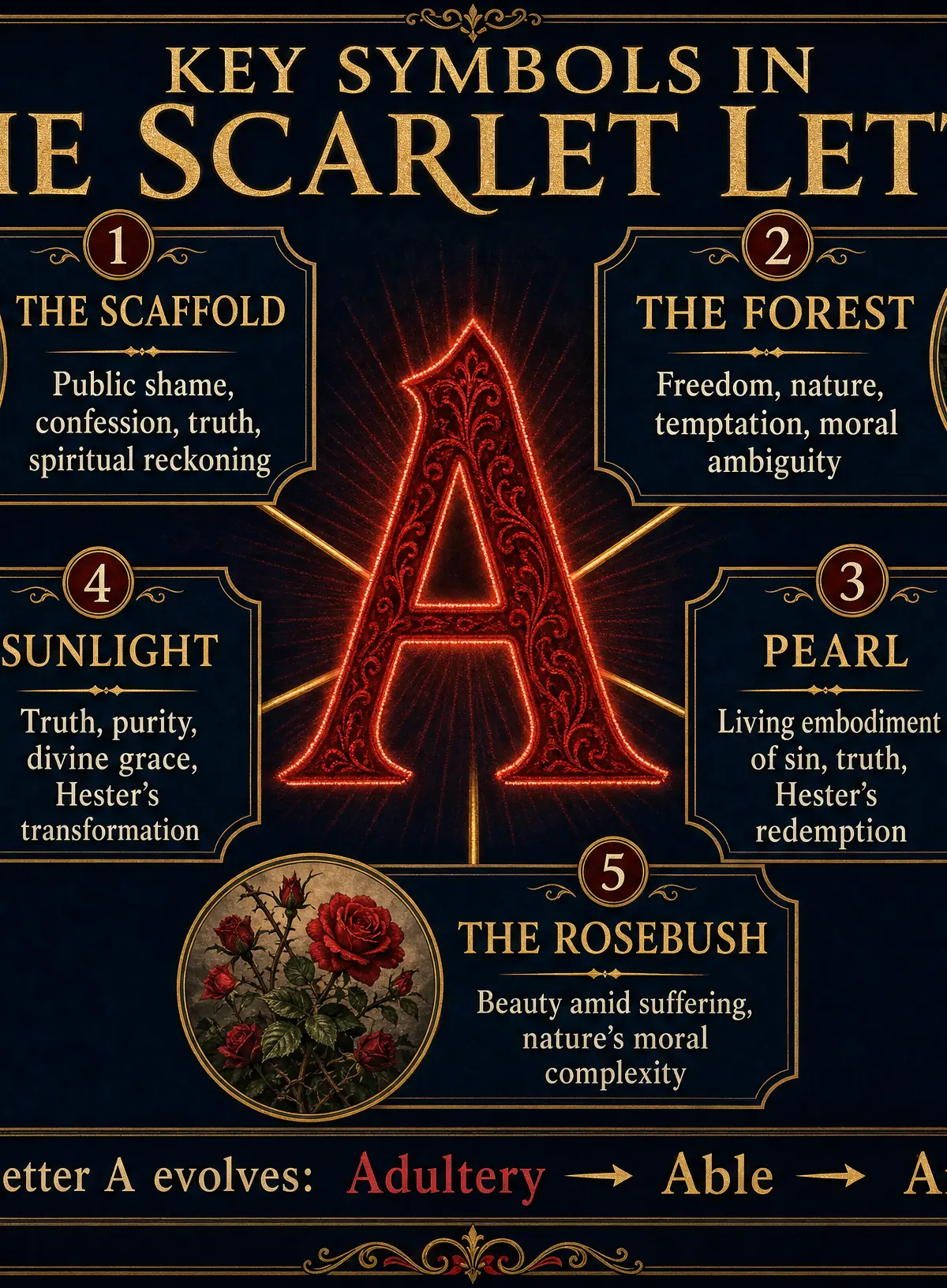
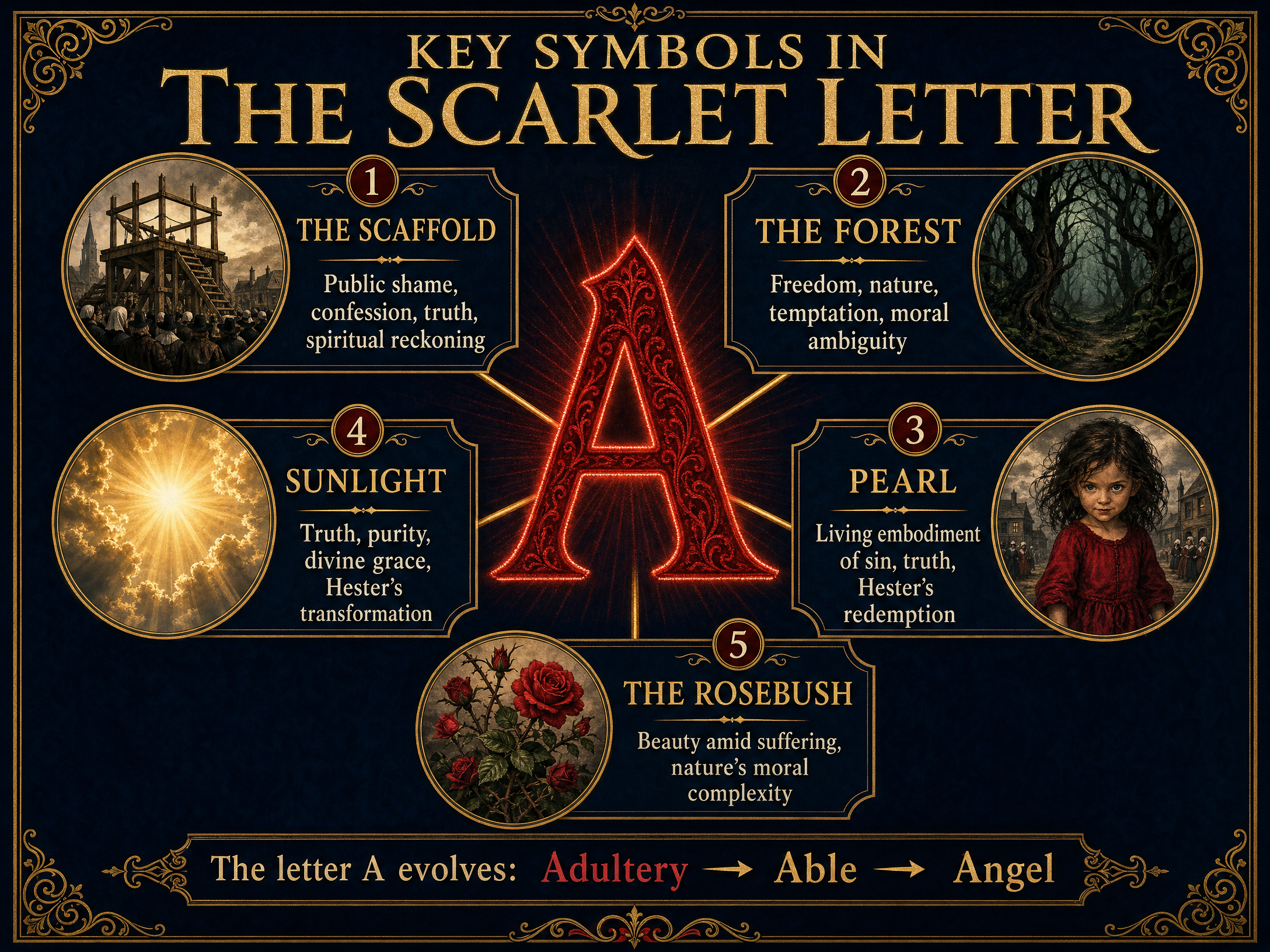
Symbolism and Allegory: Hawthorne's use of symbols is dynamic, not static. The Scarlet Letter itself changes meaning (Adultery -> Able -> Angel). The Forest represents moral ambiguity, freedom, and the Devil's domain, contrasting with the Scaffold, which represents public truth, shame, and ultimately, redemption.
Narrative Voice: The omniscient narrator is intrusive, ironic, and often deliberately ambiguous (e.g., refusing to confirm exactly what was on Dimmesdale's chest). This forces the reader to actively interpret the text rather than passively consume it.
Structural Symmetry: The novel is built around three scaffold scenes (Chapters 2, 12, 24) representing public shame, private guilt, and public redemption. This tight structure focuses the psychological intensity of the narrative.
Chiaroscuro (Light and Dark): Hawthorne constantly uses the interplay of sunlight and shadow to represent truth/grace and secrecy/sin. Sunlight actively avoids Hester until she removes the letter in the forest.
Context
Puritanism: Set in 1640s Boston, the novel critiques the rigid, theocratic society of the Puritans, who believed in predestination, public surveillance, and harsh punishment for moral transgressions. Examiners expect you to show how characters react against this oppressive environment.
American Romanticism: Written in 1850, the novel reflects Romantic ideals: the celebration of the individual over society, the belief in the moral complexity of nature (the forest), and a fascination with the psychological depths of human emotion.
Biographical Context: Hawthorne was haunted by his ancestor, John Hathorne, a judge in the Salem Witch Trials. The novel can be read as an act of literary penance for his family's role in Puritan persecution.
Audio Revision
Listen to this 10-minute podcast episode covering core concepts, exam tips, and a quick-fire recall quiz:

Visual Resources
2 diagrams and illustrations
Interactive Diagrams
1 interactive diagram to visualise key concepts
Conceptual Flow Outline
The Structural Symmetry of the Scaffold Scenes
Worked Examples
2 worked examples — open one to explore the question and available guidance.
Practice Questions
Test your understanding — click to reveal model answers
Explore how Hawthorne presents the relationship between Hester and Pearl. (30 marks + 4 AO4)
Hint: Consider how Pearl functions both as a realistic child and as a living symbol of Hester's sin and potential redemption.
Explore the significance of the forest setting in 'The Scarlet Letter'. (30 marks + 4 AO4)
Hint: Contrast the forest with the town. Think about what the forest represents to the Puritans vs. what it represents to Hester and Dimmesdale.
Starting with this extract (Chapter 14, Hester's confrontation with Chillingworth), explore how Hawthorne presents the character of Roger Chillingworth. (30 marks + 4 AO4)
Hint: Focus on his transformation from a scholar to a 'fiend'. Look at the language of parasitism and demonic possession.
How does Hawthorne use the omniscient narrator to influence the reader's judgement in the novel? (30 marks + 4 AO4)
Hint: Think about moments where the narrator interrupts the story to give an opinion, or moments where the narrator deliberately refuses to give a clear answer.