Pearson Edexcel · IGCSE · English Literature
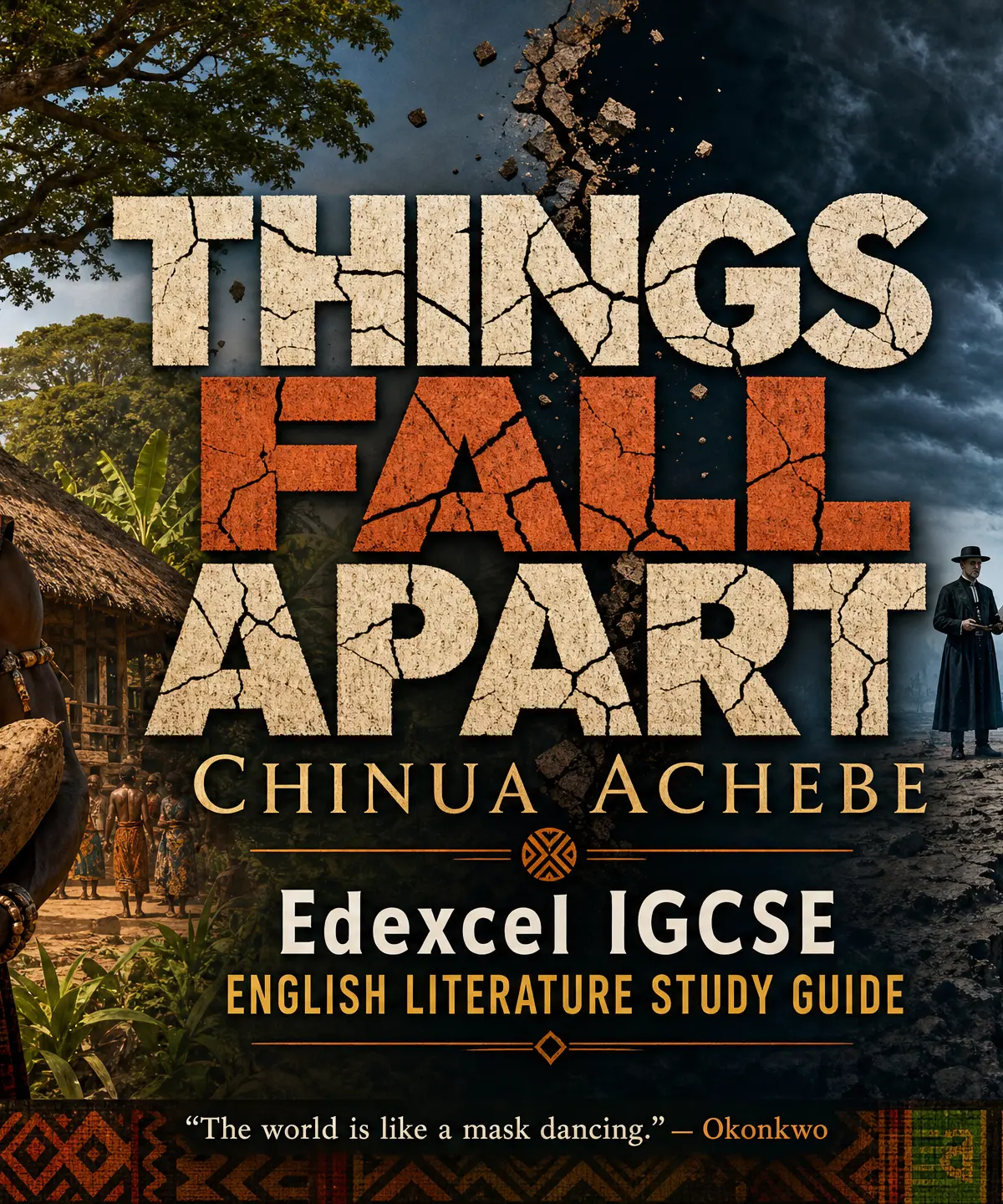
Things Fall Apart
Things Fall Apart is a masterpiece of postcolonial literature that reclaims the African narrative from European perspectives. Studying this text rewards candidates who can analyse the complex intersection of personal tragedy and historical collapse, making it a powerful vehicle for exploring identity, tradition, and the devastating impact of colonialism.
- 8 min read
- 2 worked examples
- 4 practice questions
- 8 key terms
Study Notes
Overview
Chinua Achebe's Things Fall Apart (1958) is a foundational text in African literature, written explicitly to challenge Eurocentric portrayals of Africa as primitive and voiceless (such as Joseph Conrad's Heart of Darkness). For the Edexcel IGCSE Literature paper, examiners reward candidates who can seamlessly weave this postcolonial context (AO3) into their analysis of Achebe's methods (AO2) and character development (AO1). The novel traces the life of Okonkwo, a respected warrior in the Igbo village of Umuofia, whose personal downfall mirrors the tragic disintegration of his society under British colonial rule. To achieve the highest marks, candidates must avoid simplistic readings—neither idealising Igbo culture nor viewing Okonkwo as purely heroic or villainous—and instead explore the profound psychological and social complexities Achebe presents.
Plot/Content Overview
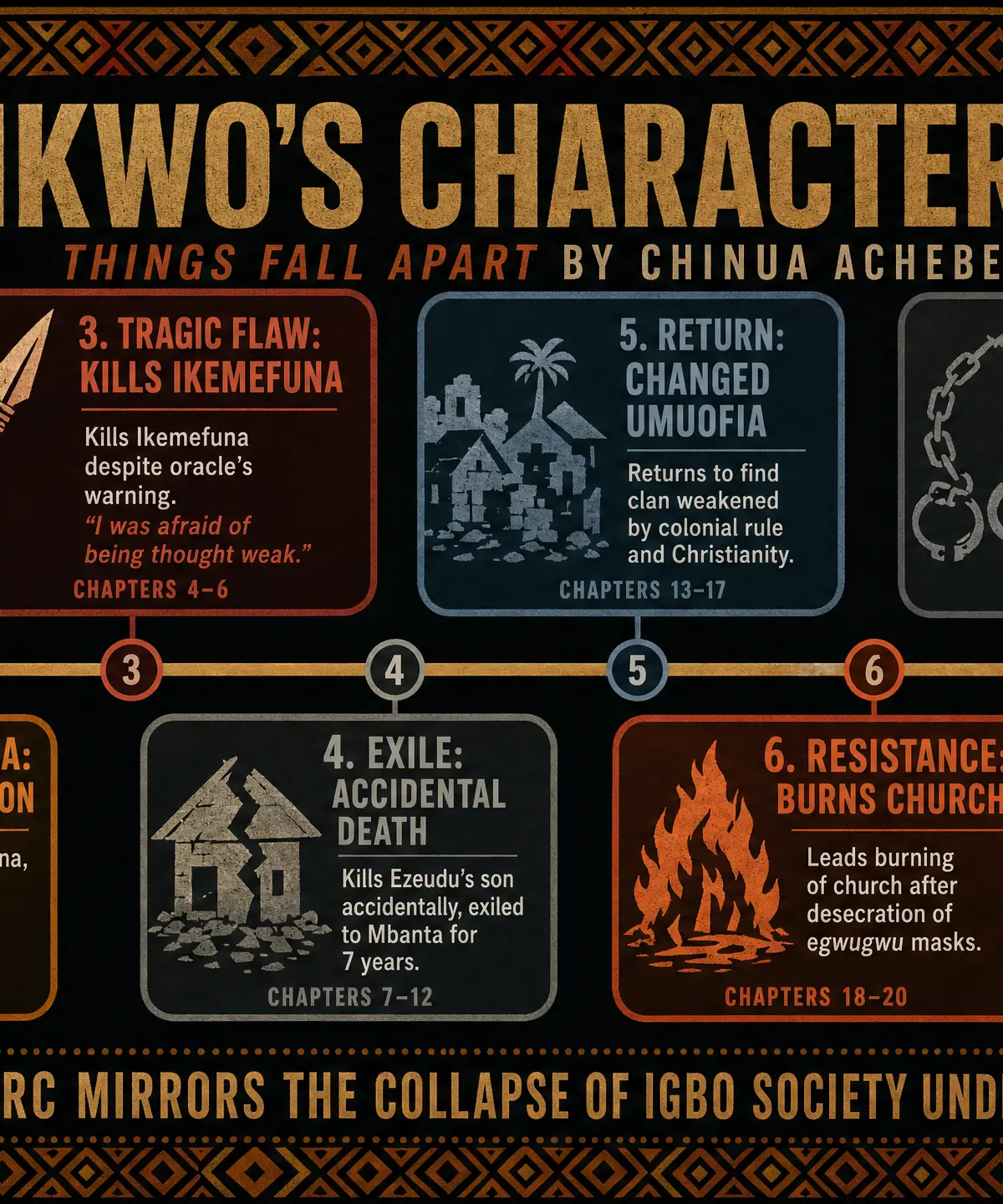
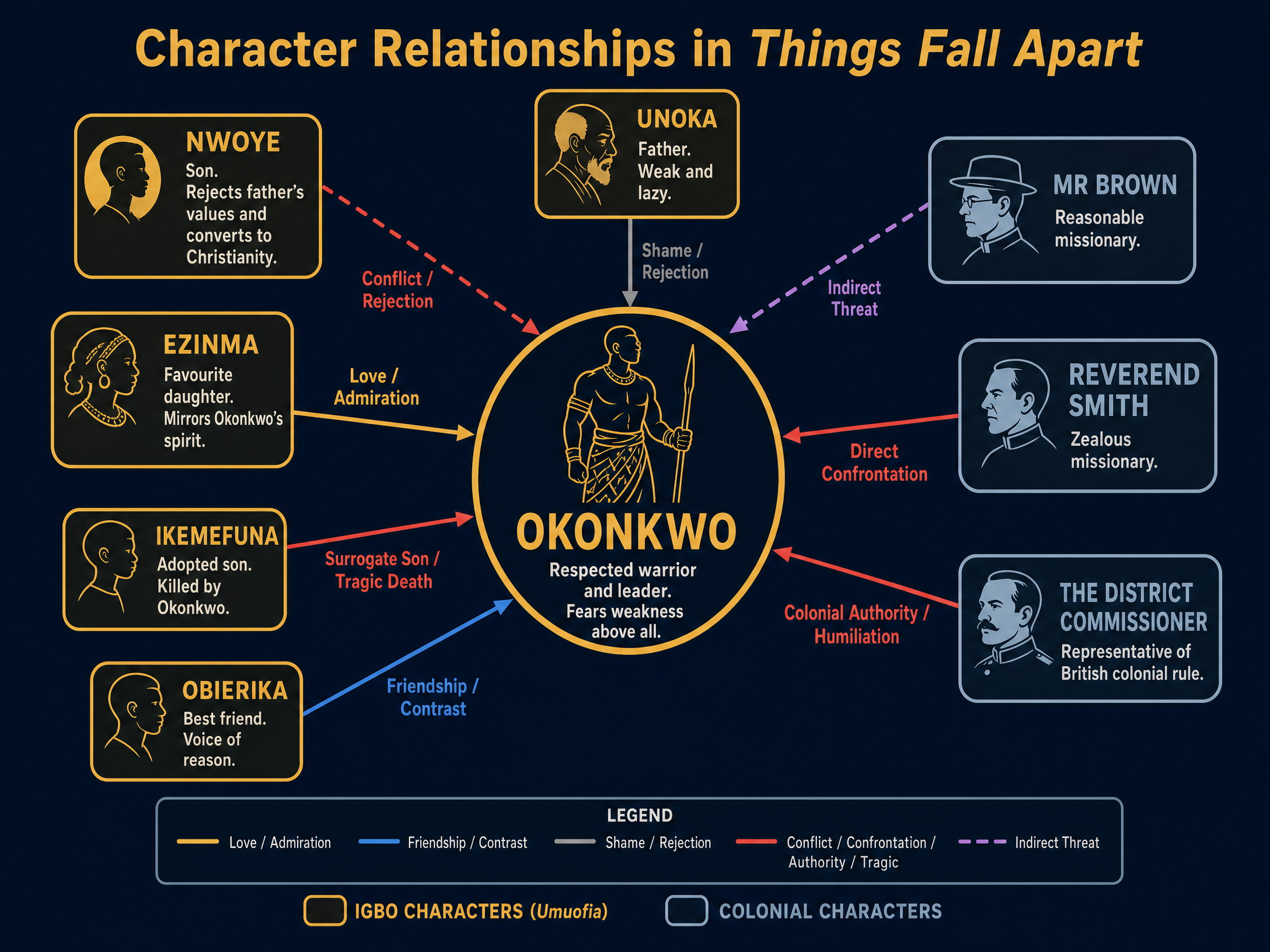
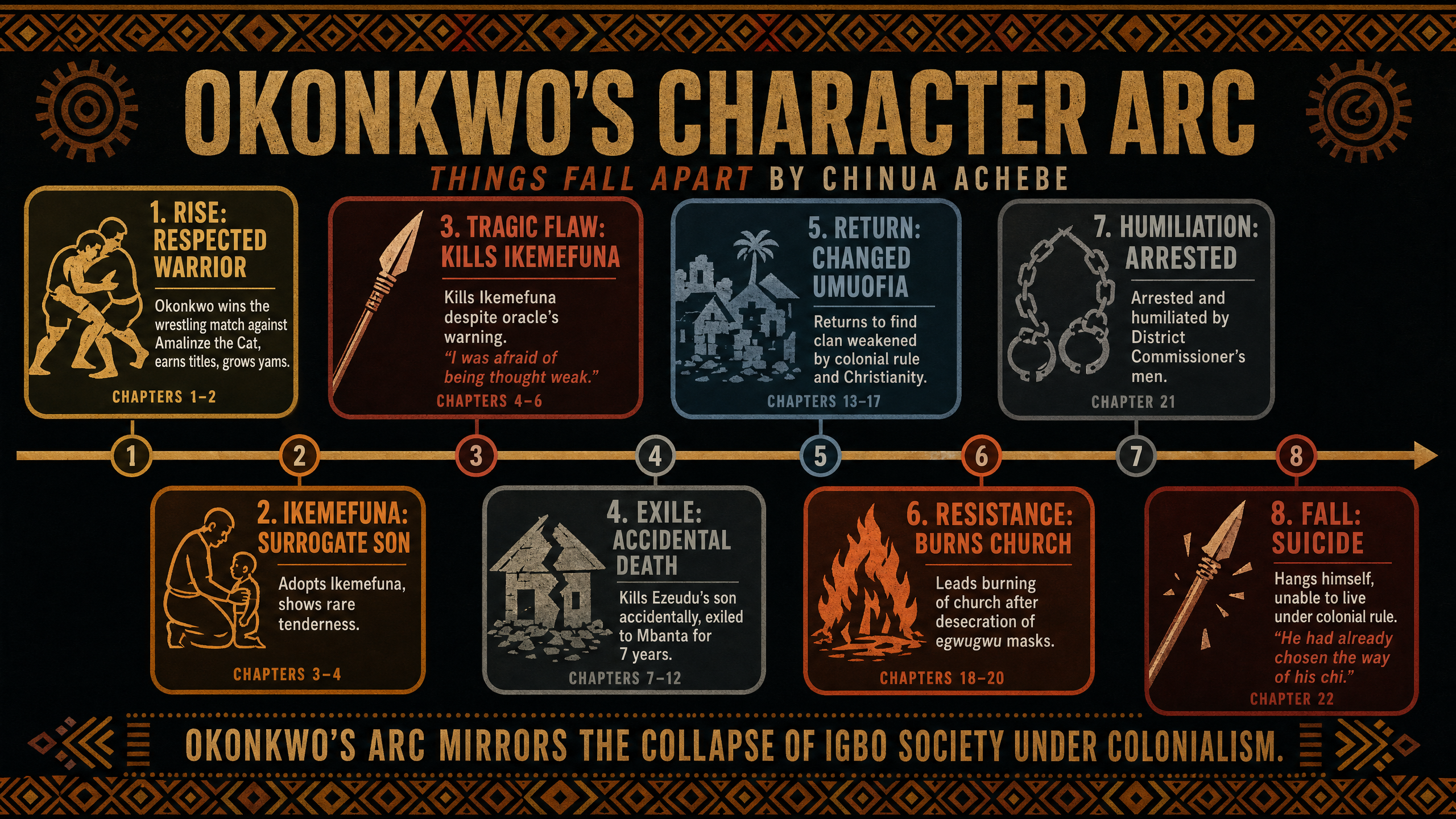
Part One (Chapters 1-13): Pre-Colonial UmuofiaThe narrative establishes the rich, complex, and functioning society of Umuofia. We meet Okonkwo, a self-made man driven by the fear of resembling his lazy father, Unoka. Okonkwo's rigidity leads to tragic errors, most notably his participation in the execution of his surrogate son, Ikemefuna, against the advice of elders. This section culminates in Okonkwo accidentally killing a clansman, resulting in his seven-year exile.
Part Two (Chapters 14-19): Exile in MbantaOkonkwo lives in his motherland, Mbanta. During this time, British missionaries arrive and begin converting outcasts and marginalized individuals, including Okonkwo's own son, Nwoye. The colonial presence gradually takes root, establishing a church and a government.
Part Three (Chapters 20-25): The FallOkonkwo returns to a changed Umuofia. The clan is fractured, and the colonial administration is deeply entrenched. Following the unmasking of an egwugwu by a zealous convert, the clan burns the church. The District Commissioner retaliates by arresting and humiliating the leaders. In a final act of desperate resistance, Okonkwo kills a colonial messenger. Realising his clan will not go to war, Okonkwo hangs himself—an abomination in Igbo culture. The novel ends chillingly from the perspective of the District Commissioner, who plans to reduce Okonkwo's tragedy to a mere paragraph in his colonial memoir.
Themes
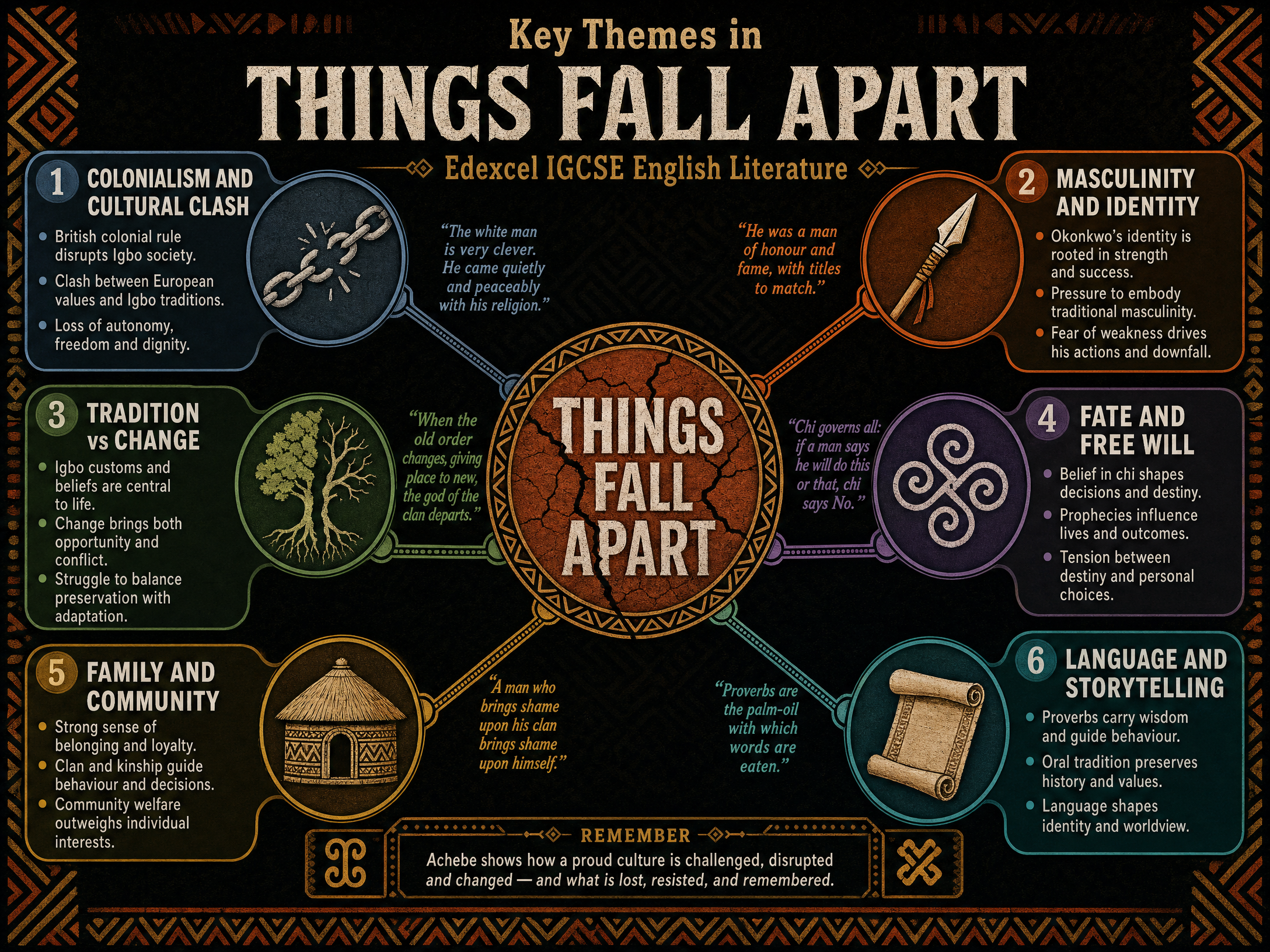
Theme 1: Colonialism and Cultural Clash
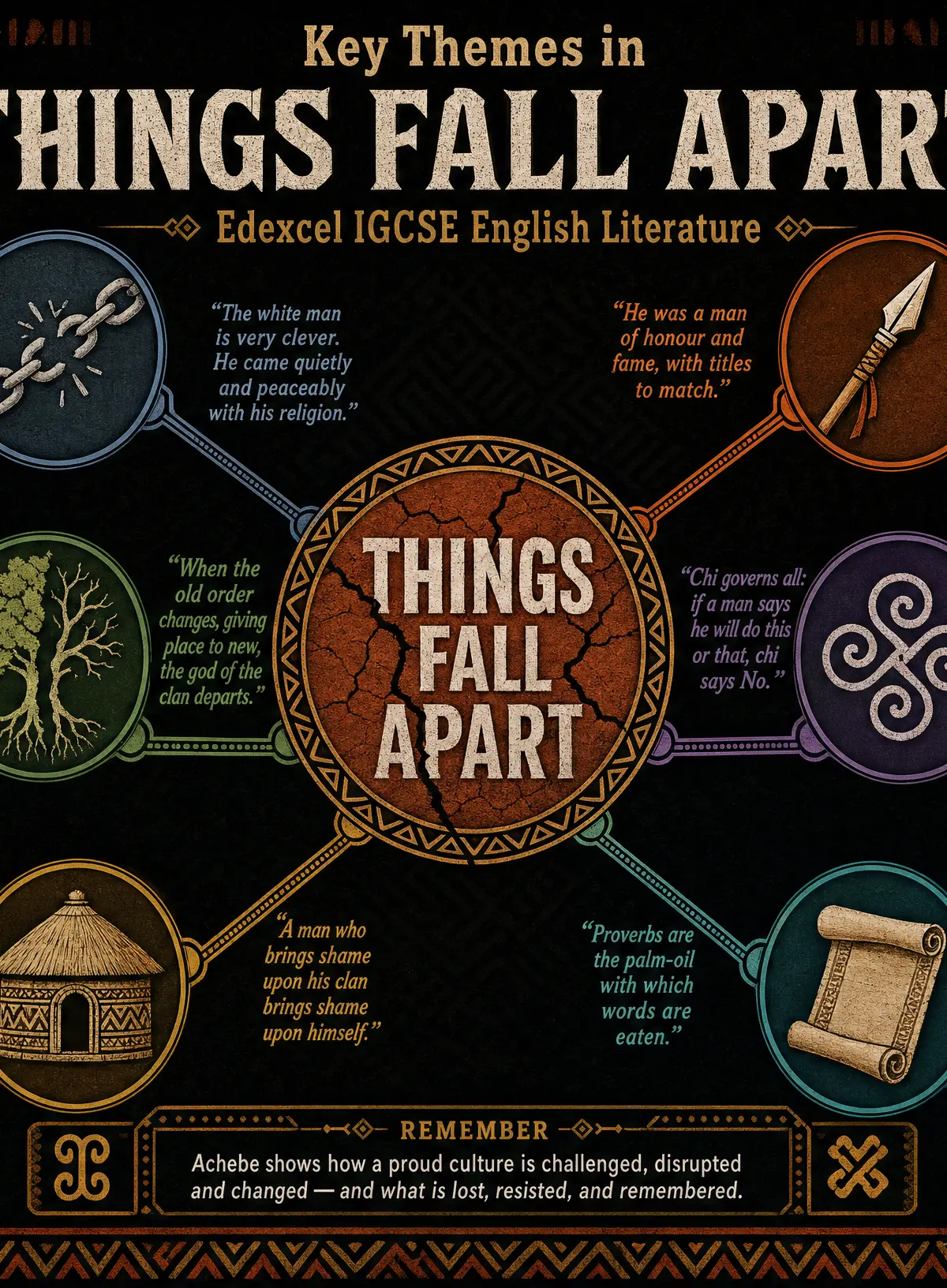
Achebe presents colonialism not as an immediate military conquest, but as an insidious erosion of cultural cohesion. The tragedy lies in the gradual dismantling of a complex society. Examiners reward analysis that shows how colonialism exploits existing fractures within Umuofia.
Key Quotes:
- "The white man is very clever. He came quietly and peaceably with his religion... He has put a knife on the things that held us together and we have fallen apart." (Chapter 20) - Obierika's metaphor of the knife highlights the violent severance of communal bonds.
- "Does the white man understand our custom about land?" (Chapter 20) - Highlights the fundamental incompatibility of the two systems and the imposition of foreign law.
Theme 2: Masculinity and Identity
Okonkwo's identity is entirely constructed around a rigid, aggressive definition of masculinity, driven by his deep-seated fear of weakness. This thematic focus is crucial for character analysis.
Key Quotes:
- "He was afraid of being thought weak." (Chapter 2) - The defining sentence of Okonkwo's character; his tragic flaw (hamartia).
- "He had no patience with unsuccessful men. He had had no patience with his father." (Chapter 1) - The parallel phrasing underscores how his past trauma dictates his present intolerance.
Theme 3: Tradition vs. Change
Achebe portrays a society that is rich in tradition but also possesses flaws (e.g., the treatment of twins, the osu). The conflict arises because colonial change is absolute and uncompromising, leaving no room for organic adaptation.
Key Quotes:
- "When the old order changes, giving place to new, the god of the clan departs." (Chapter 18) - A lament for the loss of spiritual and cultural integrity.
Theme 4: Language and Storytelling
Achebe uses English to subvert colonial narratives, embedding Igbo proverbs to validate the oral tradition. This is a vital AO2/AO3 crossover point.
Key Quotes:
- "Proverbs are the palm-oil with which words are eaten." (Chapter 1) - A metaphor demonstrating that language is an art form and a carrier of wisdom in Igbo culture.
Character Analysis
Okonkwo
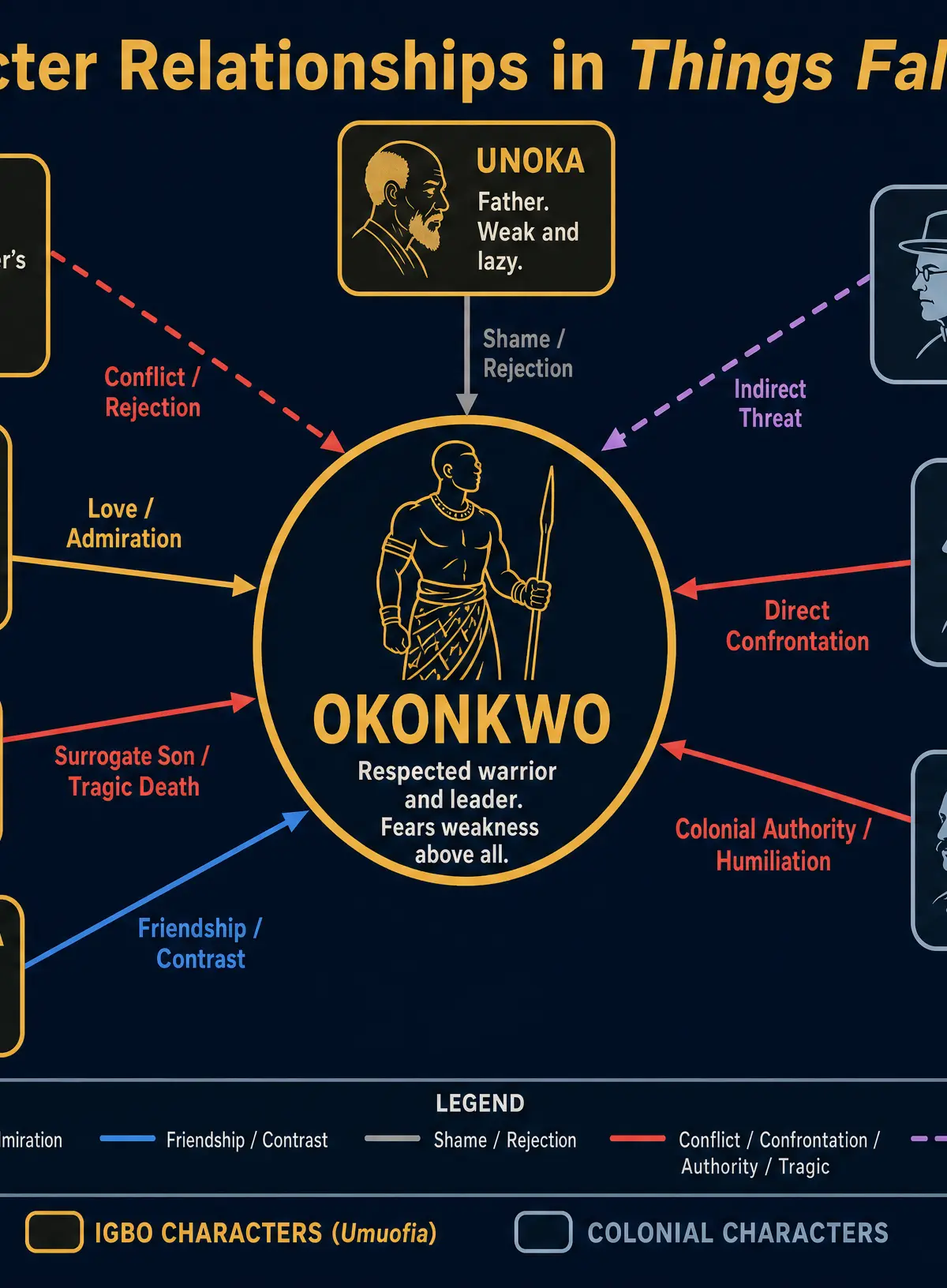
Role: Tragic protagonist; embodies the rigid, hyper-masculine ideals of his culture.
Key Traits: Hardworking, aggressive, deeply fearful of failure, emotionally repressed.
Character Arc: Rises from poverty to greatness, commits a tragic error (killing Ikemefuna), suffers exile, and ultimately chooses suicide over submission to colonial rule.
Essential Quotes:
- "He was a man of action, a man of war." (Chapter 1)
- "His whole life was dominated by fear, the fear of failure and of weakness." (Chapter 2)
Nwoye
Role: Okonkwo's son; represents the internal fractures within Igbo society that colonialism exploits.
Key Traits: Sensitive, thoughtful, alienated by his father's violence.
Character Arc: Moves from seeking his father's approval to total rejection of his culture, converting to Christianity to find peace.
Essential Quotes:
- "It was not the mad logic of the Trinity that captivated him... It was the poetry of the new religion, something felt in the marrow." (Chapter 16)
Obierika
Role: Okonkwo's best friend; the voice of reason and the novel's philosophical centre.
Key Traits: Reflective, questioning, loyal but critical.
Character Arc: Remains steadfast but serves as the witness to the tragic collapse of both his friend and his society.
Essential Quotes:
- "Why should a man suffer so grievously for an offence he had committed inadvertently?" (Chapter 13)
The District Commissioner
Role: The embodiment of colonial authority and Eurocentric arrogance.
Key Traits: Dismissive, bureaucratic, utterly lacking in empathy or understanding.
Essential Quotes:
- "One could almost write a whole chapter on him. Perhaps not a whole chapter but a reasonable paragraph, at any rate." (Chapter 25)
Writer's Methods
- Narrative Voice: Achebe employs a third-person omniscient narrator who speaks from within the Igbo cultural framework, validating its worldview before the devastating shift to the District Commissioner's perspective in the final paragraph.
- Proverbs and Idioms: The integration of Igbo proverbs (AO2) acts as a structural device to convey communal wisdom and counter colonial assumptions of linguistic poverty (AO3).
- Tragic Structure: The novel's three-part structure mirrors classical tragedy (Rise, Exile/Limbo, Fall) while charting the historical timeline of colonial invasion.
- Symbolism: Yams symbolise masculinity and wealth; the locusts foreshadow the arrival of the colonisers, who will consume the resources of the land.
Context
- Postcolonial Purpose: Written in 1958, on the eve of Nigerian independence, Achebe aimed to restore dignity to the African past and challenge the dehumanising narratives of European literature.
- Igbo Society: A complex, democratic, and deeply religious society governed by consensus, elders, and spiritual entities (egwugwu, chi), directly contradicting the colonial myth of the 'savage'.
- The Scramble for Africa: The late 19th-century historical backdrop where European powers aggressively partitioned Africa, imposing foreign religious and legal systems.
Listen to the full 25-minute podcast episode for an in-depth discussion of themes, characters, and exam techniques.

Visual Resources
3 diagrams and illustrations
Interactive Diagrams
1 interactive diagram to visualise key concepts
Conceptual Flow Outline
The structural arc of colonialism in the novel
Worked Examples
2 worked examples — open one to explore the question and available guidance.
Practice Questions
Test your understanding — click to reveal model answers
Explore how Achebe presents the relationship between fathers and sons in the novel. (30 marks + 4 AO4)
Hint: Contrast Okonkwo's relationship with Unoka against his relationship with Nwoye. Consider Ikemefuna as a surrogate son.
How does Achebe present the importance of tradition and custom in Umuofia? (30 marks + 4 AO4)
Hint: Look at the Week of Peace, the justice of the egwugwu, and the consequences of breaking rules.
Explore the significance of the ending of Things Fall Apart. (30 marks + 4 AO4)
Hint: Focus on Okonkwo's suicide and the shift to the District Commissioner's perspective.
How does Achebe present women in Igbo society? (30 marks + 4 AO4)
Hint: Look beyond Okonkwo's misogyny. Consider Ekwefi, Ezinma, and Chielo the priestess.