Pearson Edexcel · IGCSE · English Literature
To Kill a Mockingbird
Dive into the moral complexities of 1930s Alabama with Harper Lee's masterpiece. This guide unpacks the novel's profound themes of racial injustice, moral courage, and empathy, equipping you with the critical insights and contextual knowledge needed to secure top marks in your Edexcel IGCSE Literature exam.
- 9 min read
- 2 worked examples
- 4 practice questions
- 8 key terms
Study Notes
Overview
To Kill a Mockingbird is a seminal American novel that explores the deeply ingrained racial prejudices and rigid social hierarchies of the Deep South during the 1930s. For Edexcel IGCSE English Literature, examiners are looking for a nuanced understanding of how Harper Lee uses the innocent, yet retrospective, narrative voice of Scout Finch to expose the moral failings of Maycomb society. High-scoring candidates will move beyond mere plot summary to critically evaluate Lee's craft—analysing how characters serve as symbolic constructs, how language choices shape reader response, and how the oppressive historical context (Jim Crow laws, the Great Depression) is inextricably linked to the narrative's central conflicts. Your ability to dissect the tension between law and justice, and the varying forms of courage depicted, is crucial for achieving top bands.
Plot/Content Overview
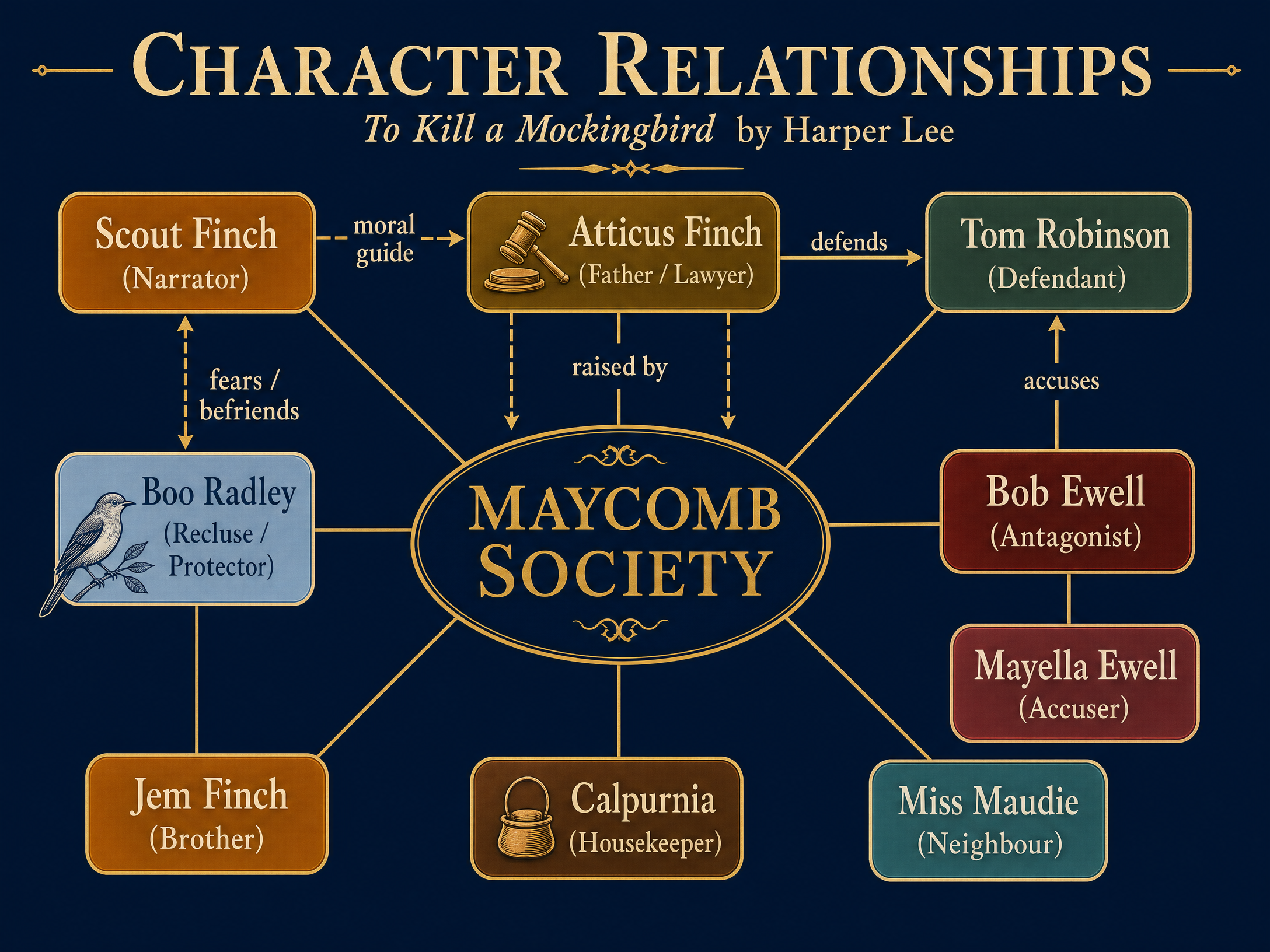
Part One: Childhood Innocence and the Radley MythThe novel begins by establishing the setting of Maycomb and introducing the Finch family: Atticus, Scout, and Jem. The children's early focus is on their reclusive neighbour, Boo Radley, whom they view through a lens of Gothic superstition. However, as the summer progresses and they find small gifts in the knothole of the Radley oak tree, their perception slowly begins to shift from fear to curiosity. During this time, the looming trial of Tom Robinson begins to cast a shadow over the town, and Atticus faces criticism for agreeing to defend him.
Part Two: The Trial and Loss of InnocenceThe narrative shifts to the stark reality of racial injustice. The trial of Tom Robinson forms the dramatic core of the novel. Despite Atticus proving beyond reasonable doubt that Tom's disabled left arm makes it impossible for him to have committed the crime against Mayella Ewell, the all-white jury convicts him based on racial prejudice. Tom is subsequently killed while trying to escape prison. The aftermath sees Bob Ewell seeking revenge against those involved in the trial. He attacks Jem and Scout on their way home from a school pageant, but they are saved by Boo Radley, who fatally stabs Ewell. The novel concludes with Scout standing on the Radley porch, finally understanding Atticus's lesson about empathy as she views the town from Boo's perspective.
Themes
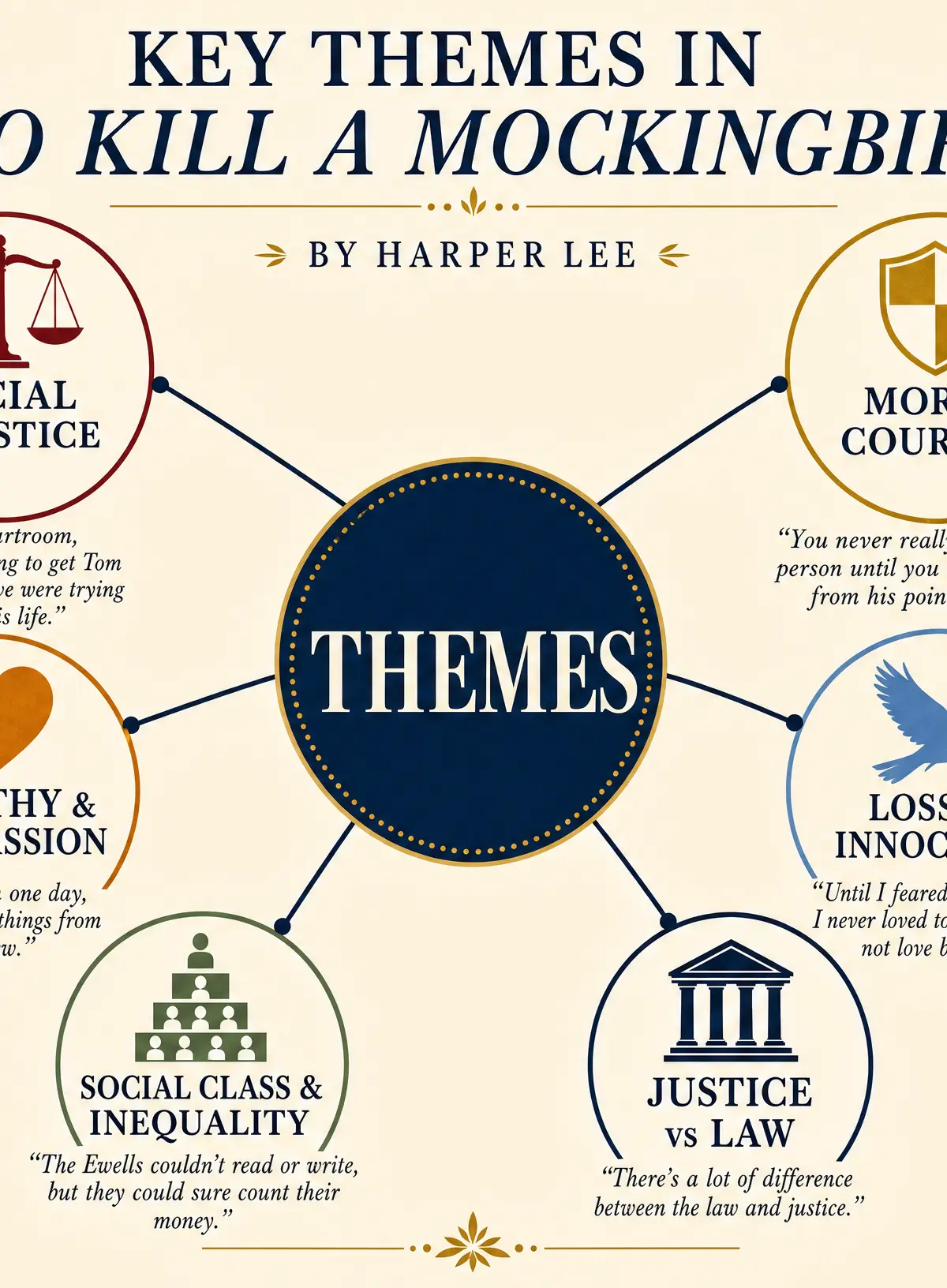
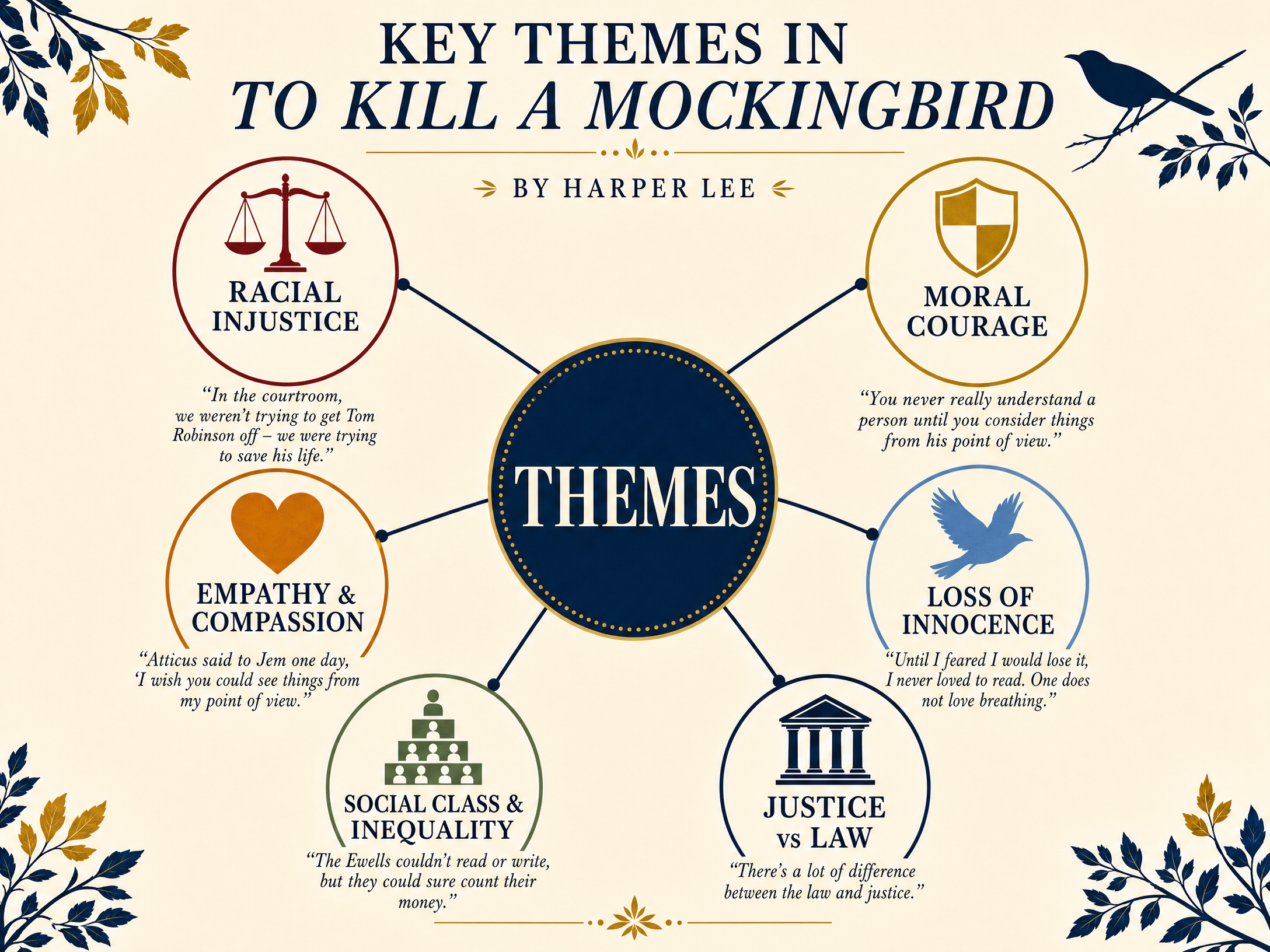
Theme 1: Racial Injustice and Prejudice
Lee presents racial prejudice not merely as individual bigotry, but as a systemic disease that corrupts the entire legal and social structure of Maycomb. The trial of Tom Robinson is the ultimate manifestation of this; it demonstrates that in a society governed by Jim Crow laws, truth and evidence are powerless against entrenched racism. Lee uses the courtroom setting to expose the hypocrisy of a justice system that claims to be blind but is deeply prejudiced.
Key Quotes:
- "In our courts, when it's a white man's word against a black man's, the white man always wins." (Chapter 23) - Atticus highlights the systemic nature of racism; the legal system is rigged.
- "Cry about the simple hell people give other people—without even thinking. Cry about the hell white people give colored folks, without even stopping to think that they're people, too." (Chapter 20) - Dolphus Raymond's comment underscores the normalisation of cruelty in Maycomb society.
Theme 2: Moral Courage
Lee explores courage as a multifaceted concept, contrasting the traditional, masculine idea of physical bravery with profound moral fortitude. Atticus is the embodiment of moral courage; he takes on a case he knows he will lose because it is the right thing to do. However, Lee also highlights the quiet courage of Mrs. Dubose facing her addiction, and Tom Robinson speaking the truth in a hostile courtroom.
Key Quotes:
- "I wanted you to see what real courage is, instead of getting the idea that courage is a man with a gun in his hand. It's when you know you're licked before you begin but you begin anyway and you see it through no matter what." (Chapter 11) - Atticus redefines courage for Jem, moving it away from violence towards moral integrity.
- "Because if I didn't I couldn't hold up my head in town, I couldn't represent this county in the legislature, I couldn't even tell you or Jem not to do something again." (Chapter 9) - Atticus links his defence of Tom to his personal morality and parental authority.
Theme 3: Empathy and Compassion
The development of empathy is central to Scout and Jem's coming-of-age journey. Atticus's core teaching is that true understanding requires stepping outside of one's own perspective. This theme is resolved in the novel's conclusion when Scout stands on the Radley porch and literally views the town from Boo's physical and metaphorical standpoint.
Key Quotes:
- "You never really understand a person until you consider things from his point of view... until you climb into his skin and walk around in it." (Chapter 3) - The central moral thesis of the novel, establishing empathy as the antidote to prejudice.
- "Atticus, he was real nice... Most people are, Scout, when you finally see them." (Chapter 31) - The novel's closing lines affirm the fundamental goodness of humanity when viewed with empathy.
Character Analysis
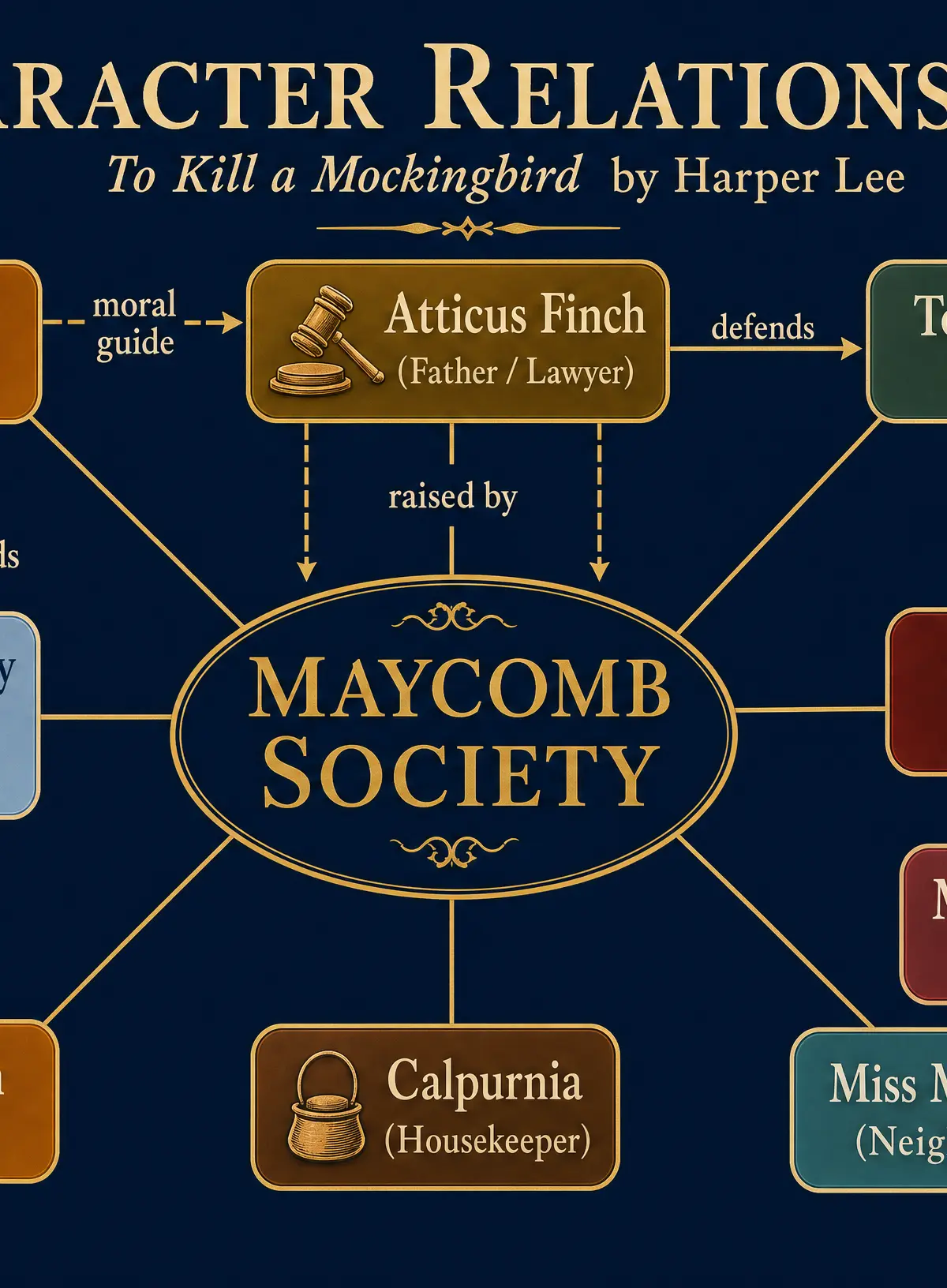
Atticus Finch
Role: The moral compass of the novel, a lawyer, and father to Scout and Jem.
Key Traits: Principled, egalitarian, courageous, stoic, and empathetic.
Character Arc: Atticus does not undergo a significant change; rather, he remains a steadfast pillar of morality. The 'arc' belongs to the town's (and his children's) evolving understanding of his integrity.
Essential Quotes:
- "The one place where a man ought to get a square deal is in a courtroom, be he any color of the rainbow, but people have a way of carrying their resentments right into a jury box."
- "Before I can live with other folks I've got to live with myself. The one thing that doesn't abide by majority rule is a person's conscience."
Scout (Jean Louise) Finch
Role: The narrator and protagonist; the lens through which the reader views Maycomb.
Key Traits: Tomboyish, inquisitive, fiercely loyal, initially naive but highly observant.
Character Arc: Scout moves from a state of childhood innocence, governed by superstition and immediate reactions, to a mature understanding of human complexity, empathy, and systemic injustice.
Essential Quotes:
- "I think there's just one kind of folks. Folks."
- "Well, it'd be sort of like shootin' a mockingbird, wouldn't it?"
Boo (Arthur) Radley
Role: A symbolic figure representing the destruction of innocence; the 'mockingbird' of the title.
Key Traits: Reclusive, misunderstood, gentle, protective.
Character Arc: Transitions in the children's minds from a Gothic monster to a vulnerable human being and ultimately their saviour.
Essential Quotes:
- "Inside the house lived a malevolent phantom." (Early perception)
- "Will you take me home?" (His only spoken words, revealing his vulnerability)
Writer's Methods
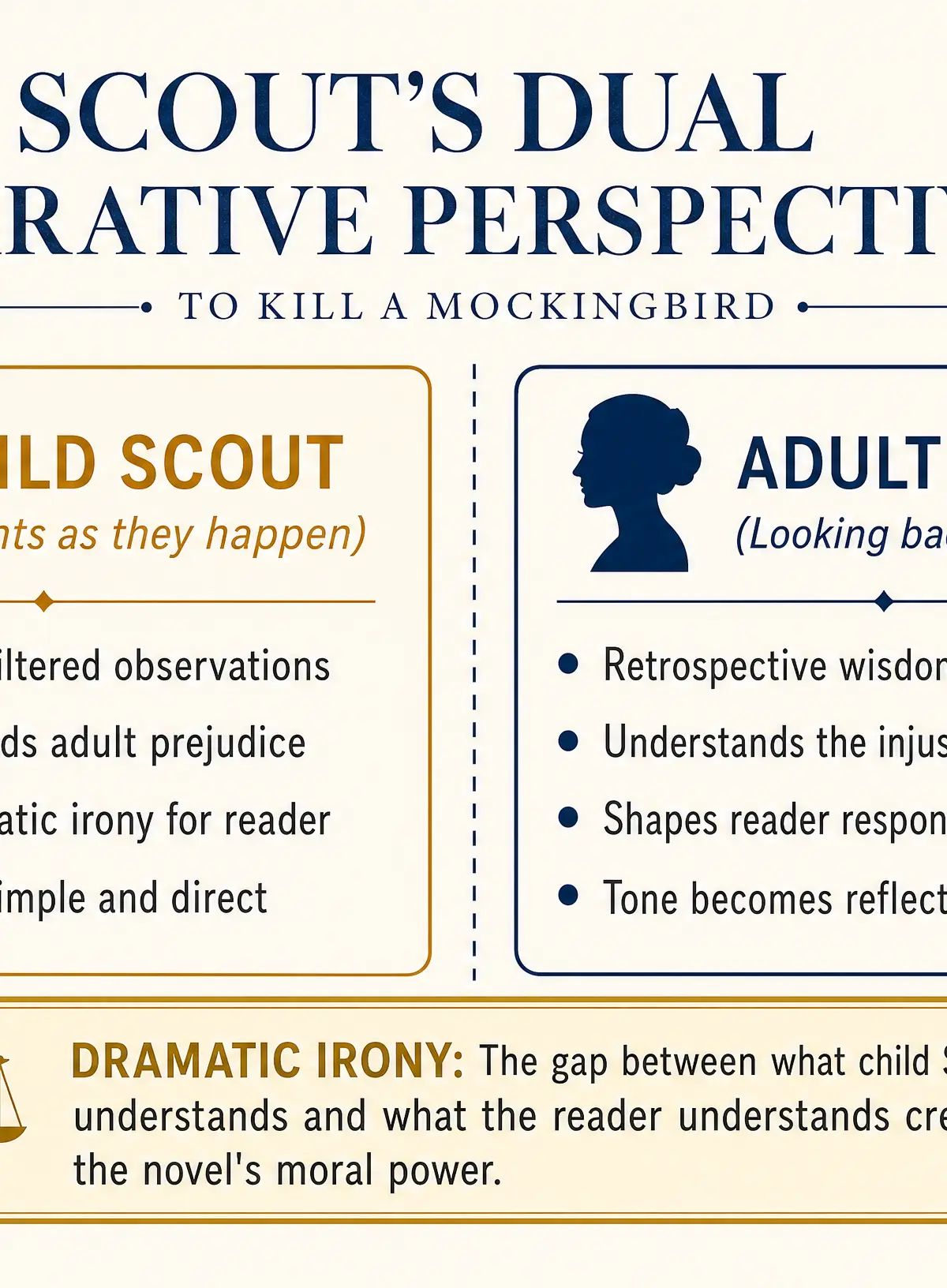
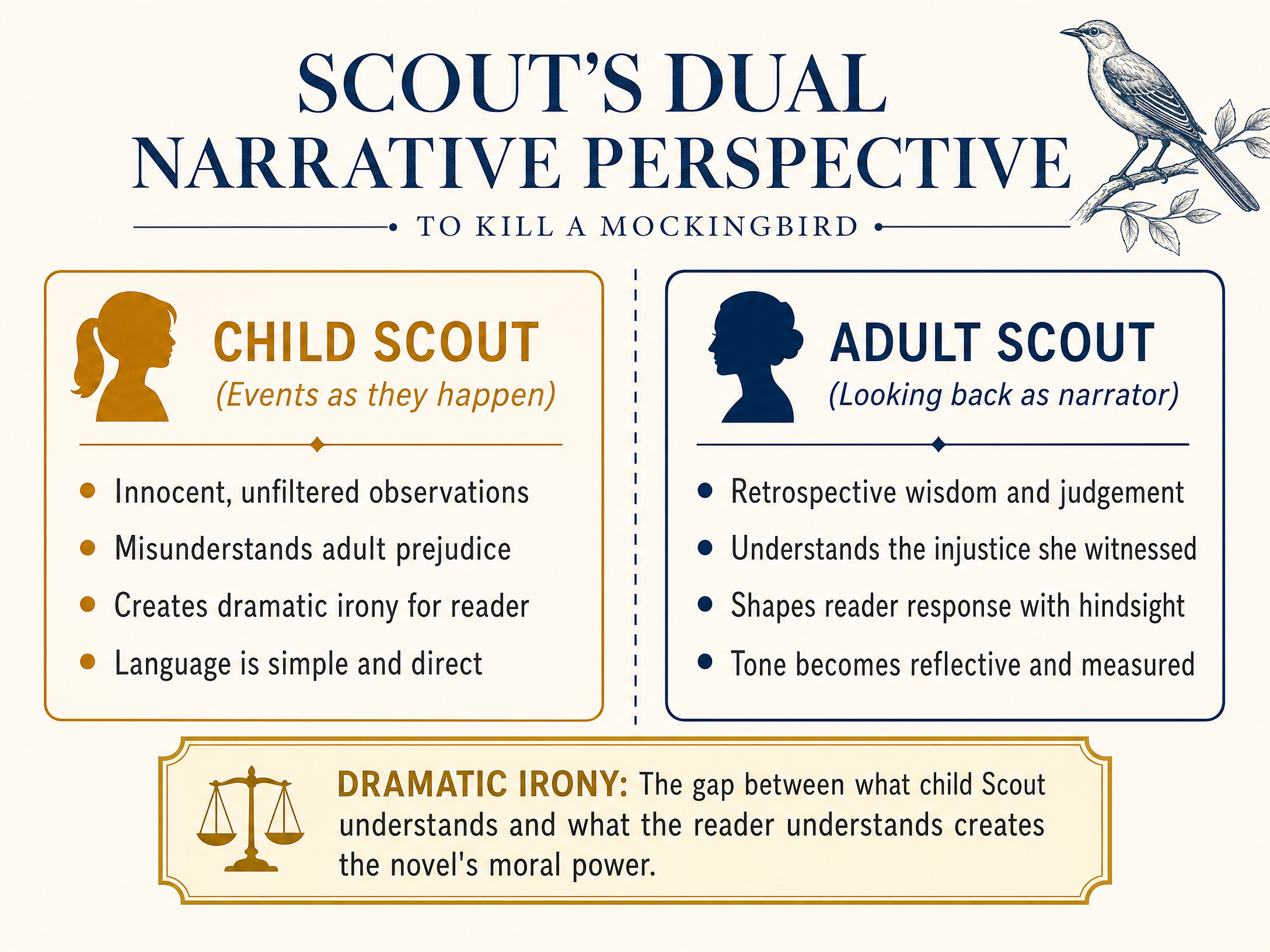
Narrative Voice and Perspective: Lee's most significant structural choice is the dual narrative perspective. The story is told by an adult Scout looking back on her childhood. This allows Lee to present the raw, unfiltered observations of a child, while simultaneously offering mature, retrospective commentary. The gap between what child Scout understands and what the reader understands creates powerful dramatic irony, forcing the reader to critically engage with the prejudices Scout innocently reports.
Symbolism: The mockingbird is the central motif, symbolising innocence and goodness that is destroyed by evil. Both Tom Robinson and Boo Radley are identified as 'mockingbirds'. Lee uses this symbol to argue that it is a sin to harm those who do no harm to others.
Structure: The novel is divided into two parts. Part One focuses on childhood fears (Boo Radley) and the microcosm of the neighbourhood. Part Two shifts to adult realities (the trial) and the macrocosm of societal racism. The structure reflects the children's transition from innocence to experience, with Boo Radley serving as the narrative bridge that connects the two halves at the climax.
Context
To achieve high marks in AO3, candidates must seamlessly integrate contextual knowledge into their analysis.
The Great Depression (1930s): The novel is set during a period of severe economic hardship. This poverty exacerbates social tensions and class divisions in Maycomb, making the Ewells' resentment and the Cunninghams' pride central to the narrative dynamics.
Jim Crow Laws and Segregation: The South operated under a strict system of racial segregation. Black citizens were disenfranchised and subjected to systemic violence. The trial of Tom Robinson reflects the historical reality of the Scottsboro Boys trials (1931), where nine Black teenagers were falsely accused of raping two white women and convicted by all-white juries despite overwhelming evidence of their innocence.
The Civil Rights Movement (1960s): Although set in the 30s, Lee wrote the novel during the height of the Civil Rights Movement. The novel can be read as a plea for empathy and racial equality directed at a contemporary 1960s audience grappling with desegregation.
Audio Resource
Listen to our comprehensive 10-minute revision podcast covering core concepts, exam tips, and a quick-fire recall quiz:

Visual Resources
3 diagrams and illustrations
Interactive Diagrams
1 interactive diagram to visualise key concepts
Conceptual Flow Outline
The Bildungsroman Structure: Scout and Jem's Moral Development
Worked Examples
2 worked examples — open one to explore the question and available guidance.
Practice Questions
Test your understanding — click to reveal model answers
Explore how Harper Lee presents the theme of social class and inequality in To Kill a Mockingbird. You must refer to the context of the novel in your answer.
Hint: Consider the hierarchy of Maycomb: the Finches, the Cunninghams, the Ewells, and the Black community. How does Lee use these groups to criticise prejudice?
Starting with this extract (Chapter 10, the shooting of the mad dog), explore how Harper Lee presents Atticus Finch. Write about the extract and the novel as a whole.
Hint: Think about the mad dog as a symbol. What disease is Atticus really fighting in Maycomb?
Explore the significance of the mockingbird symbol in the novel.
Hint: Identify who the 'mockingbirds' are (Tom and Boo) and explain how society treats them.
How does Harper Lee present the experience of growing up in To Kill a Mockingbird?
Hint: Focus on the transition from innocence to experience for Scout and Jem.