Pearson Edexcel · IGCSE · English Literature
Unseen Poetry (Edexcel iGCSE)
Master the art of deconstructing unfamiliar poetry under exam conditions. This guide provides the frameworks, techniques, and examiner insights needed to secure top marks in the Edexcel IGCSE Unseen Poetry section.
- 4 min read
- 2 worked examples
- 4 practice questions
- 8 key terms
Study Notes
Overview
The Unseen Poetry section of the Edexcel IGCSE English Literature paper tests your raw analytical ability. Examiners are looking for a personal, well-supported response to a poem you have never seen before. Success requires a balance of clear interpretation (AO1) and detailed analysis of the writer's methods (AO2). You must move beyond merely spotting techniques to explaining how they create meaning and what effect they have on the reader.
The Core Framework: SMILE
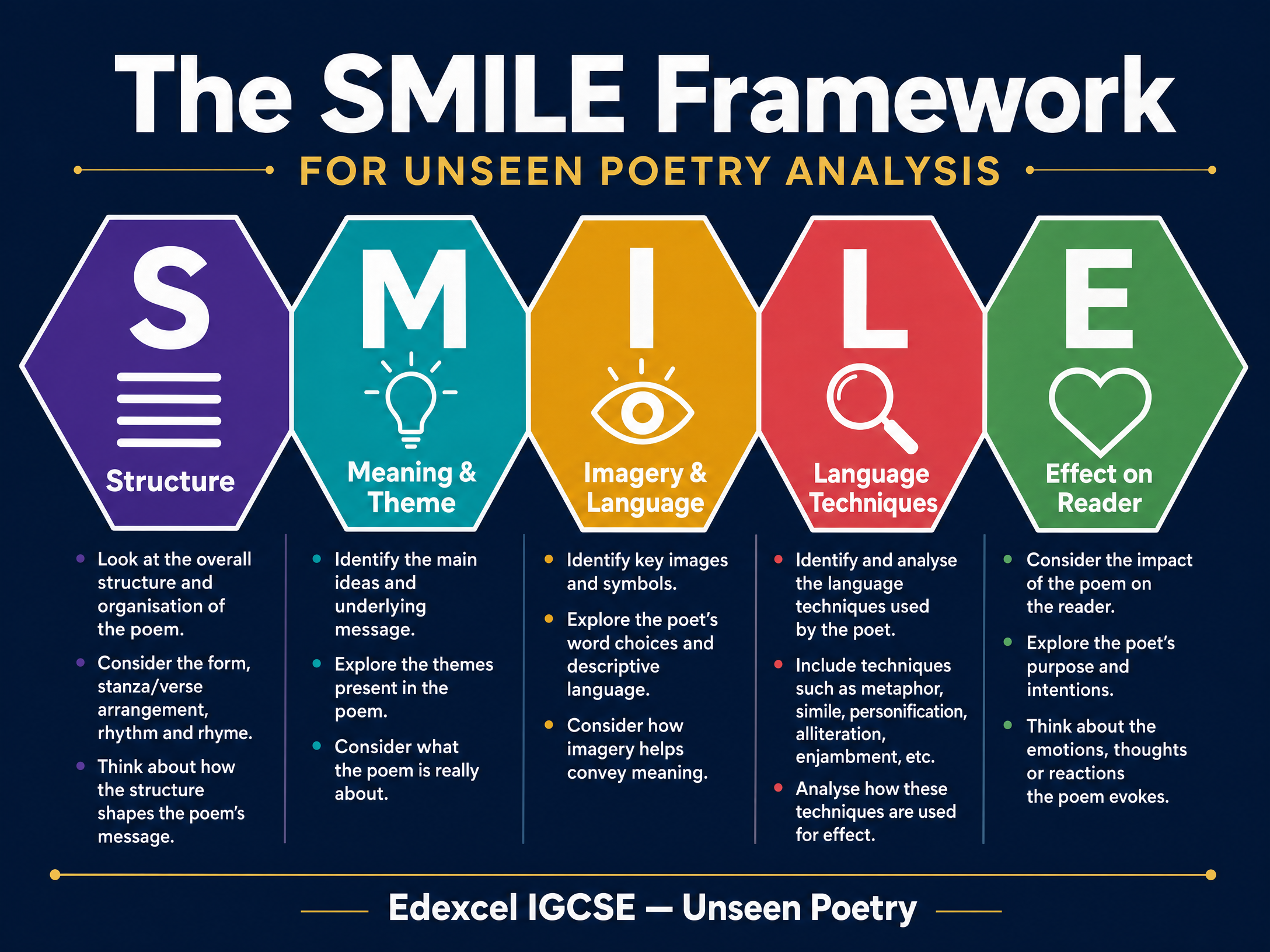
When faced with an unseen poem, structure your initial reading and planning using the SMILE framework:
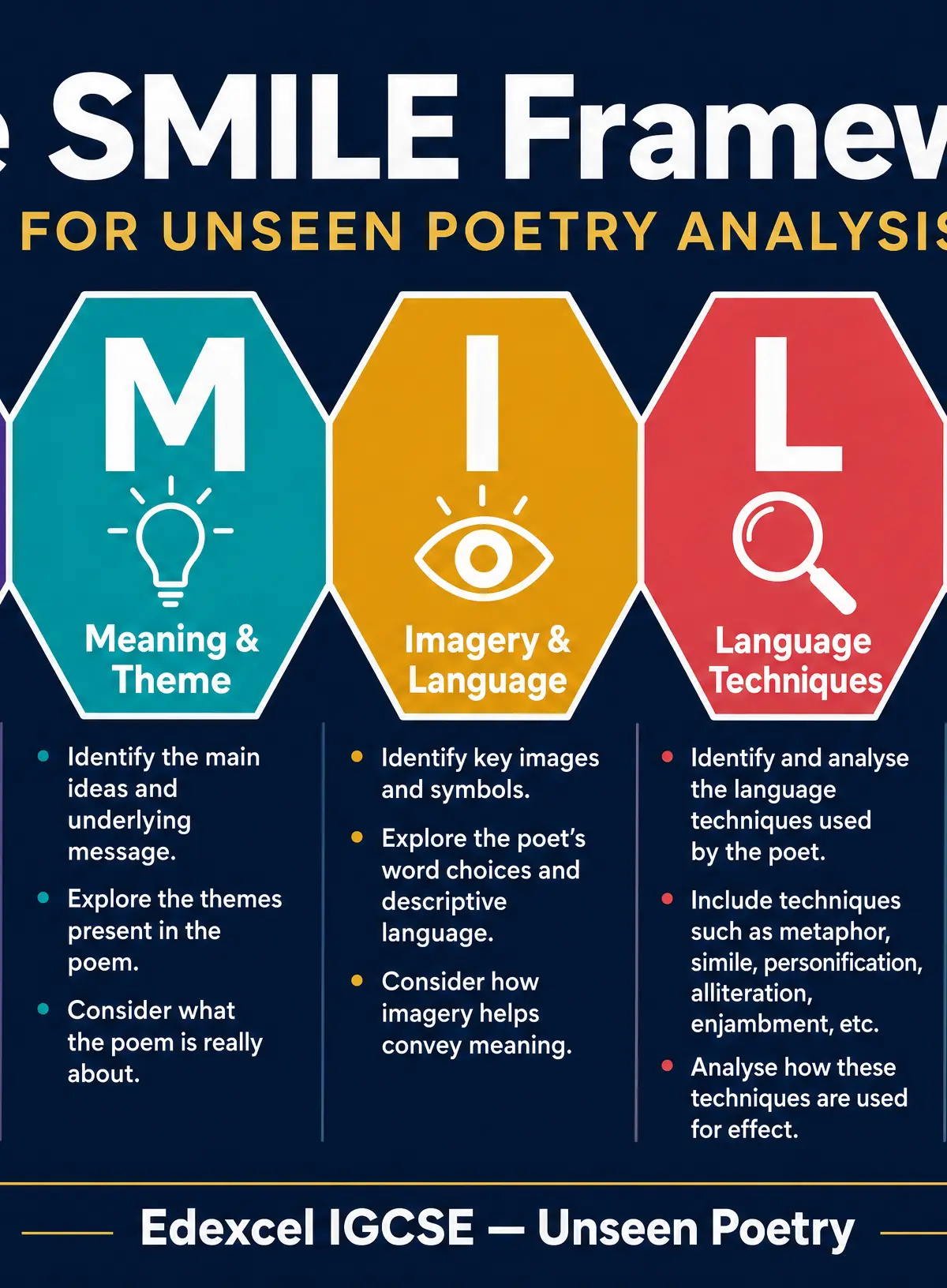
Structure
Examine how the poem is built. Look at stanza length, line length, rhythm, and rhyme scheme. Is it a sonnet, free verse, or a dramatic monologue? Where does the poem shift or turn (the volta)? Structure is the skeleton of the poem, holding its meaning together.
Meaning & Theme
What is the poem about on the surface, and what is its deeper, underlying message? Identify the central themes (e.g., love, loss, nature, conflict, time) and consider the poet's perspective on these themes.
Imagery & Language
Look for the pictures the poet paints with words. Identify key images and symbols. How do metaphors, similes, and personification help to convey the poem's meaning? Imagery is how the poet makes the abstract concrete.
Language Techniques
This is where you identify specific literary devices.
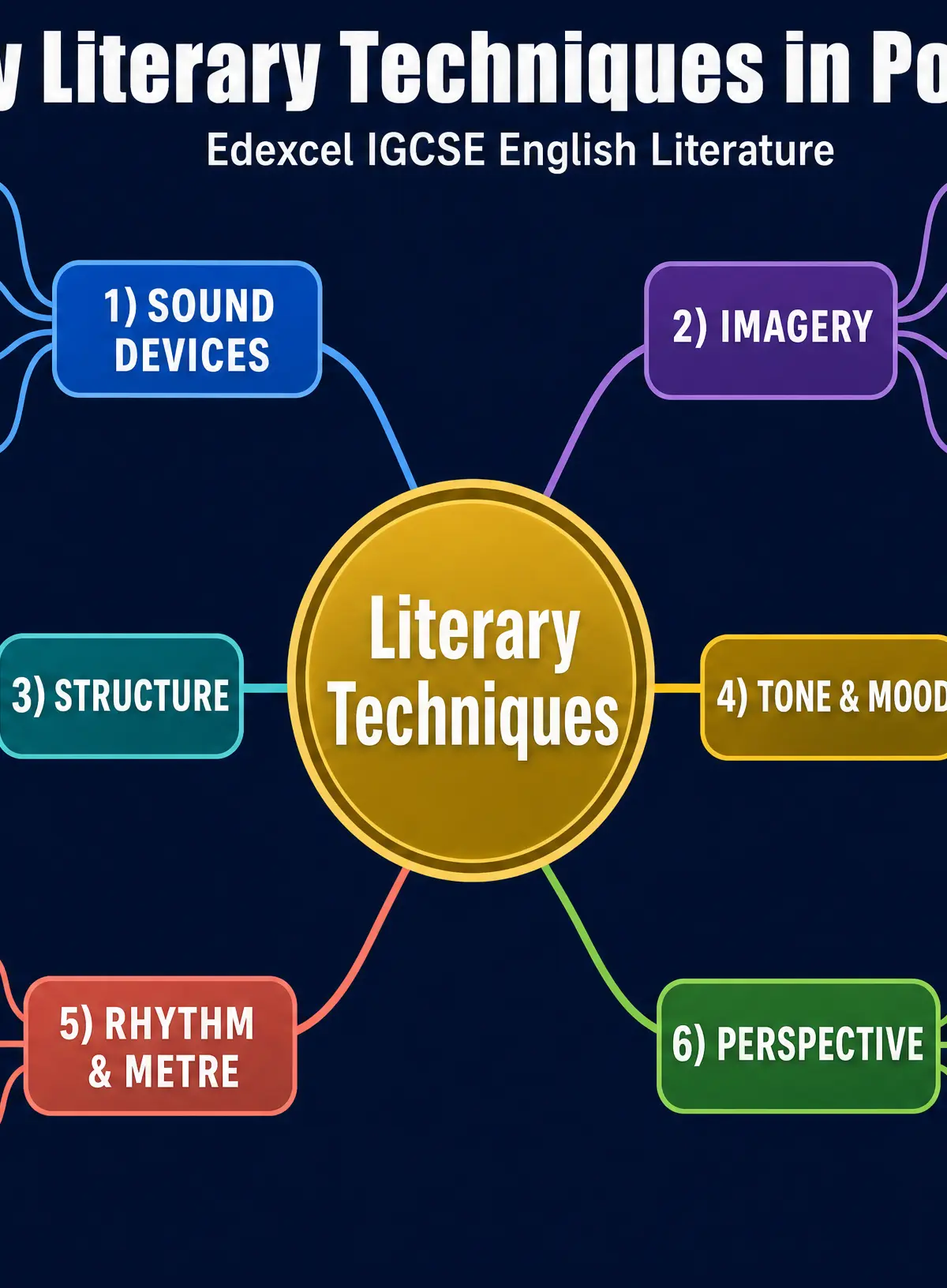
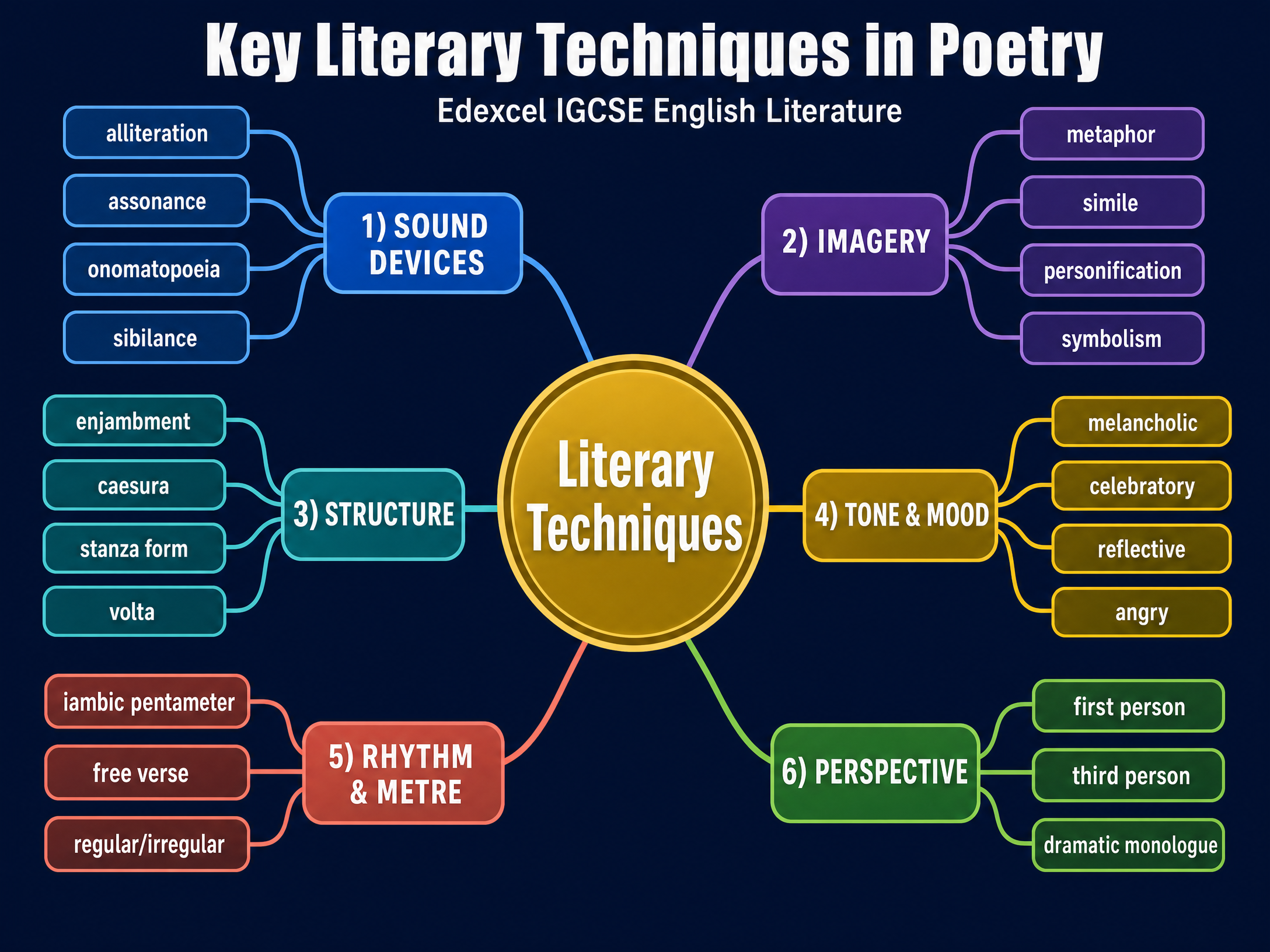
Focus on sound devices (alliteration, assonance, sibilance) and structural devices within lines (enjambment, caesura). Remember, spotting the technique is only the first step; you must explain its function.
Effect on Reader
How does the poem make you feel? What emotional response or intellectual reaction is the poet trying to provoke? Your personal engagement with the text is crucial for achieving higher bands in the mark scheme.
Listen to the Podcast
For a comprehensive 10-minute audio guide covering exam technique, common mistakes, and a quick-fire recall quiz, listen to our dedicated podcast episode:

Writer's Methods (AO2 Focus)
Examiners heavily reward the analysis of how a poet creates meaning. This means moving from the 'what' (the poem's content) to the 'how' (the techniques used).
Analysing Language
When analysing language, zoom in on specific word choices. Discuss the connotations of verbs, adjectives, and nouns. For example, instead of saying "the poet describes a tree," analyse how the poet describes it: "The use of the harsh adjective 'gnarled' suggests age, struggle, and resilience."
Analysing Form and Structure
Form and structure are often neglected by candidates, making them a great way to stand out.
- Enjambment (lines flowing into one another without punctuation) can create a sense of speed, urgency, or conversational flow.
- Caesura (a pause within a line, usually marked by punctuation) can create hesitation, disruption, or emphasize the word preceding it.
- Rhyme Scheme can create harmony and predictability (if regular) or discord and unease (if irregular or broken).
Exam Strategy
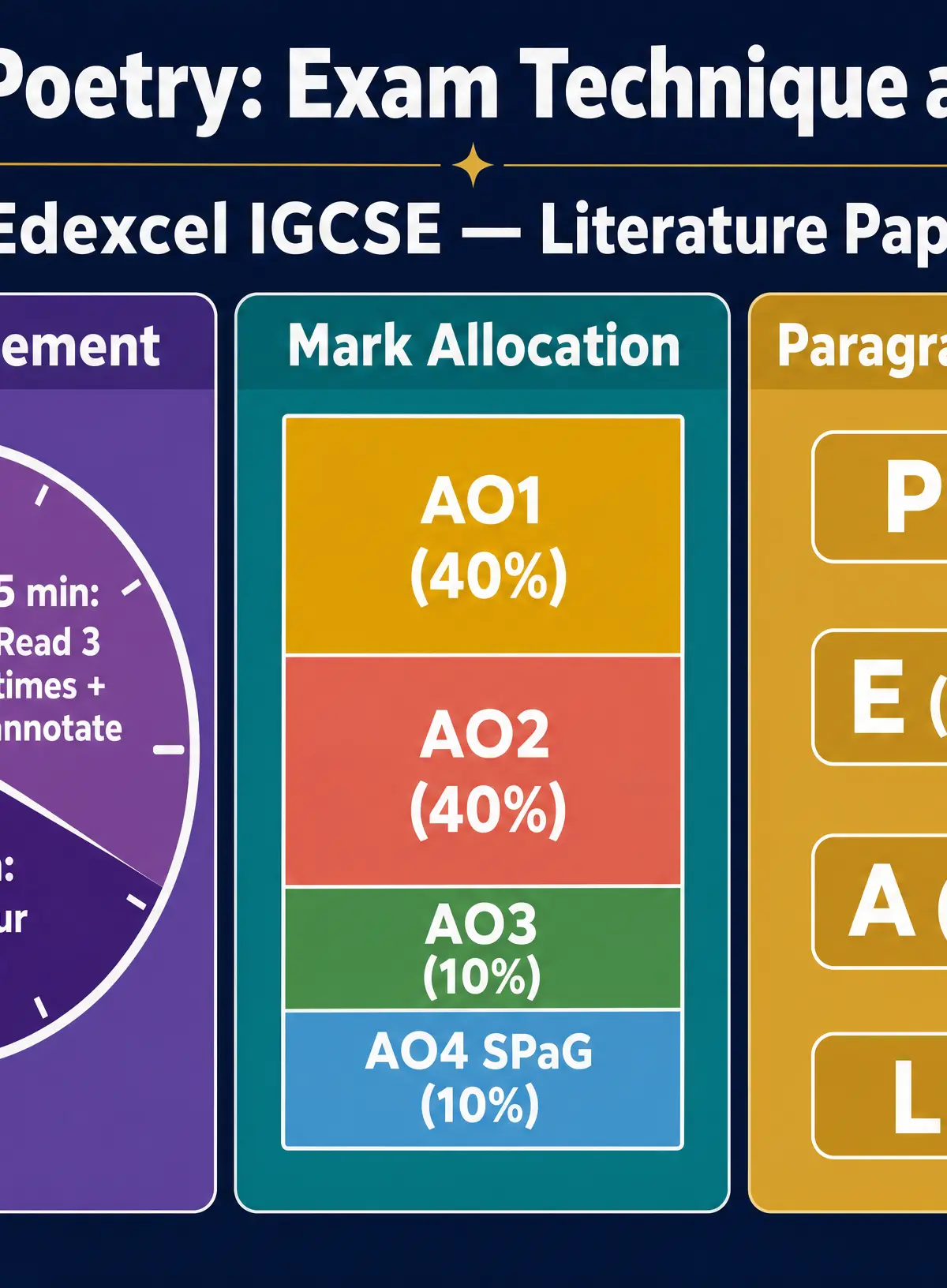
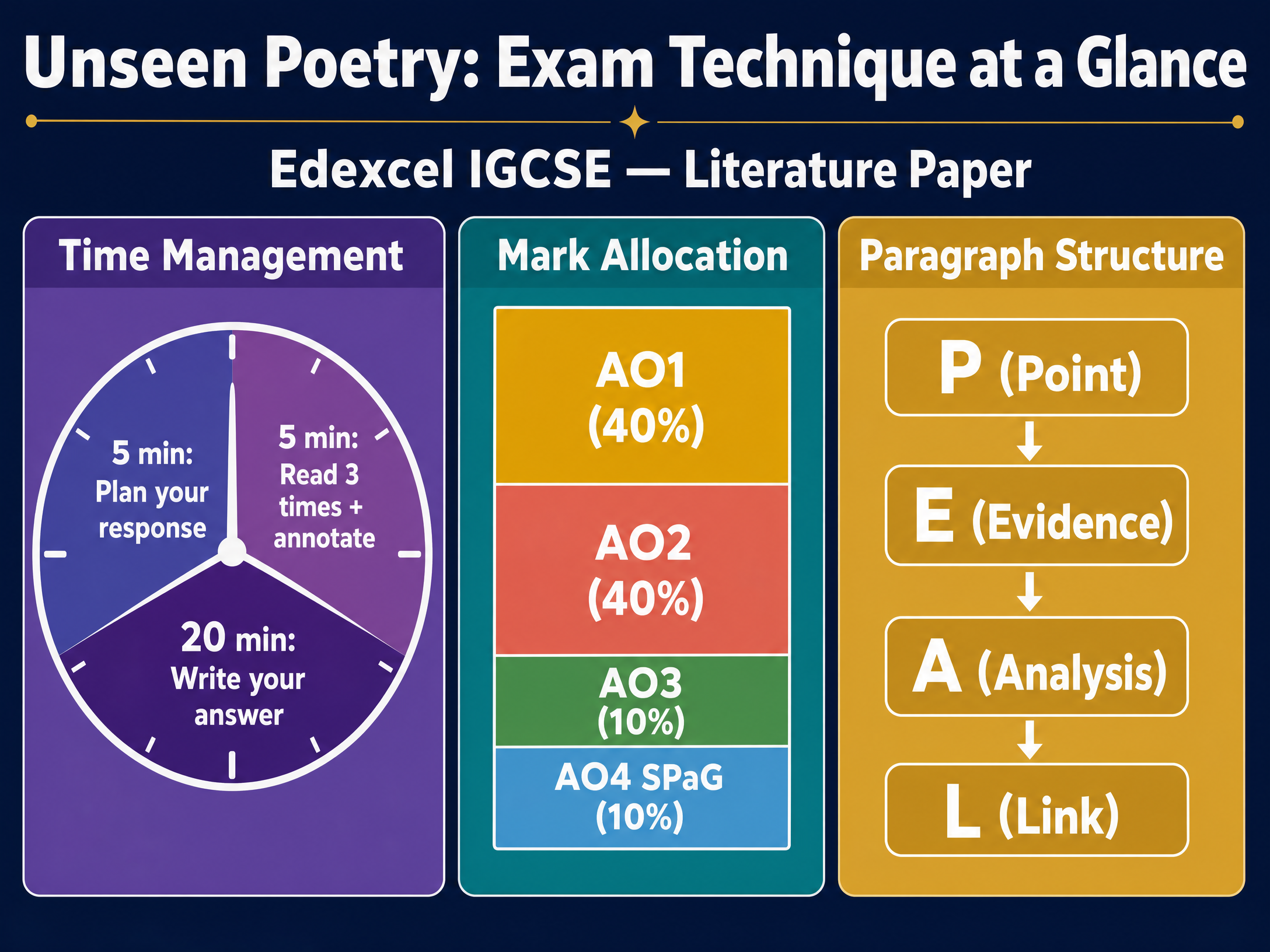
Time management is critical. Spend the first 5 minutes reading the poem three times (for impression, understanding, and technique-spotting) and annotating. Spend the next 5 minutes planning your response. Use the remaining time to write, ensuring you cover the whole poem and maintain a clear focus on the question.
Visual Resources
3 diagrams and illustrations
Interactive Diagrams
1 interactive diagram to visualise key concepts
Conceptual Flow Outline
The Unseen Poetry Workflow
Worked Examples
2 worked examples — open one to explore the question and available guidance.
Practice Questions
Test your understanding — click to reveal model answers
Read the unseen poem 'The City's Breath'. Explore how the poet presents the experience of living in a modern city. Write about:
- how the poet uses language and imagery
- how the poet uses form and structure (20 marks)
Hint: Look for the contrast between human elements and mechanical/industrial imagery. Consider how the rhythm of the poem reflects the pace of city life.
Compare how the writers present the passing of time in Poem X and Poem Y. (20 marks)
Hint: Identify the central metaphor for time in each poem. Does time heal, or does it destroy? How does the stanza structure reflect the movement of time?
Explore how the poet creates a sense of tension in the provided unseen poem. (20 marks)
Hint: Tension is often created through structure. Look for short sentences, caesura, and shifts in perspective.
How does the poet present the relationship between humanity and nature? (20 marks)
Hint: Is nature presented as a victim, a conqueror, or a harmonious partner? Look for semantic fields.