Pearson Edexcel · A-Level · Geography
Health, Human Rights and Intervention
This topic explores the critical relationship between development aid, global health inequalities, and human rights. It provides the nuanced understanding examiners look for regarding how aid is used as both a humanitarian lifeline and a strategic geopolitical tool.
- 6 min read
- 3 worked examples
- 2 practice questions
- 6 key terms
Study Notes
Overview
Health, Human Rights and Intervention is a crucial thematic study in GCSE Geography. It examines the stark inequalities in global health and the various ways the international community attempts to intervene. Examiners expect candidates to move beyond simplistic 'aid is good' or 'aid is bad' arguments. Instead, you must demonstrate a nuanced understanding of the mixed record of development aid, supported by specific, contrasting case studies. You will also need to understand how superpowers use aid not just for humanitarian purposes, but as a strategic extension of their foreign policy to secure resources, build alliances, and project power.

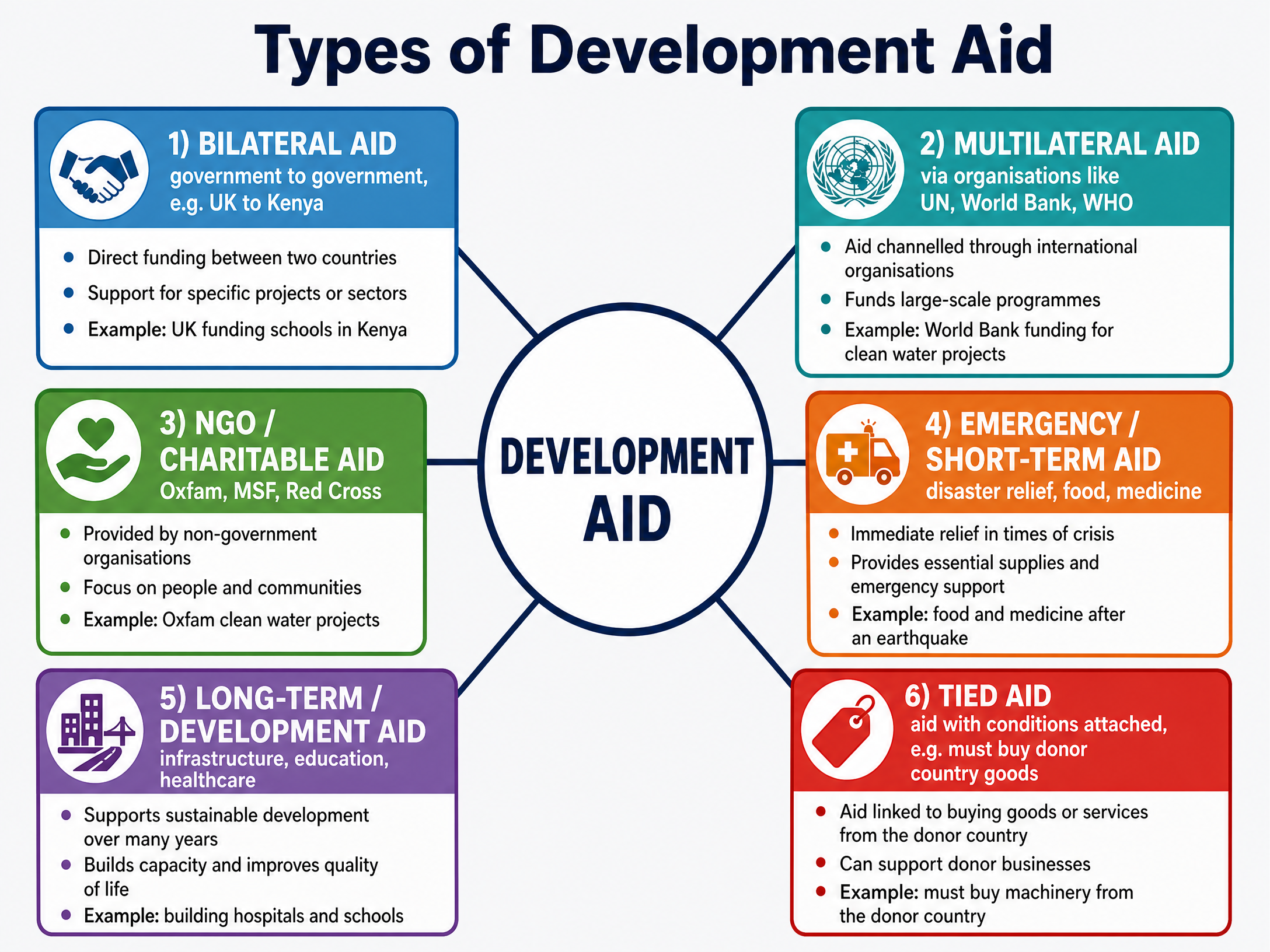
Types of Development Aid
Understanding the different mechanisms of aid is essential for AO1 (Knowledge) marks.
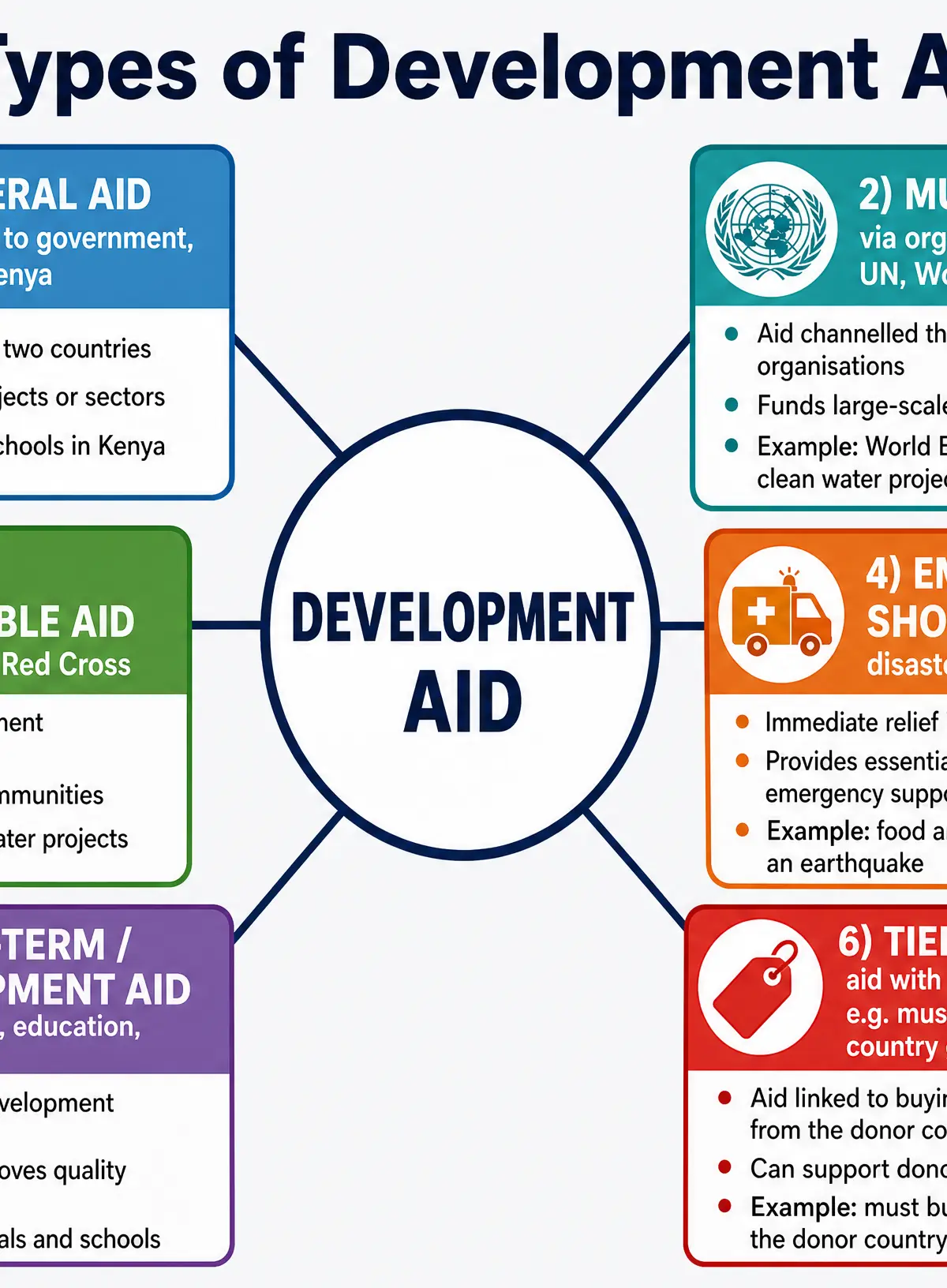
Bilateral Aid
Definition: Aid given directly from one government to another.
Example: The UK's Department for International Development (now FCDO) funding education programmes directly in Kenya.
Pros/Cons: Can be highly targeted, but often comes with political conditions attached.
Multilateral Aid
Definition: Aid channelled through international organisations like the UN, World Bank, or WHO.
Example: World Bank funding for large-scale clean water infrastructure.
Pros/Cons: Pools resources for massive projects, but can be bureaucratic and slow.
NGO / Charitable Aid
Definition: Aid provided by Non-Governmental Organisations.
Example: Oxfam, Médecins Sans Frontières (MSF), WaterAid.
Pros/Cons: Excellent at reaching grassroots communities and emergency response, but lacks the financial scale of government aid.
Tied Aid
Definition: Aid given with conditions attached, usually requiring the recipient to buy goods/services from the donor country.
Example: A loan for building a railway, conditional on using the donor country's construction firms.
Pros/Cons: Benefits the donor's economy, but reduces the true value of the aid to the recipient and can undermine sovereignty.
The Mixed Record of Aid: Case Studies
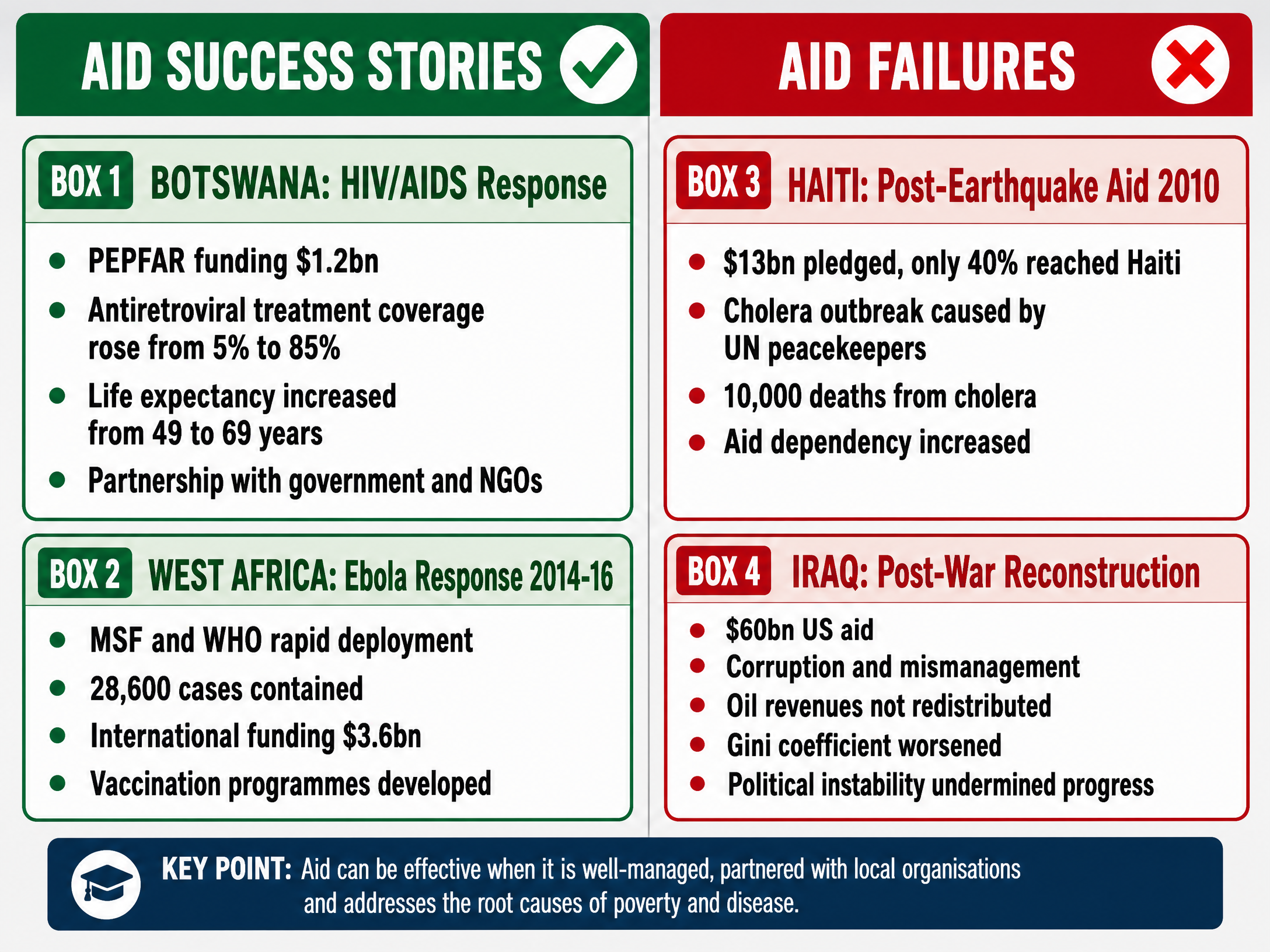
Examiners heavily reward the use of contrasting case studies to evaluate aid effectiveness (AO3).
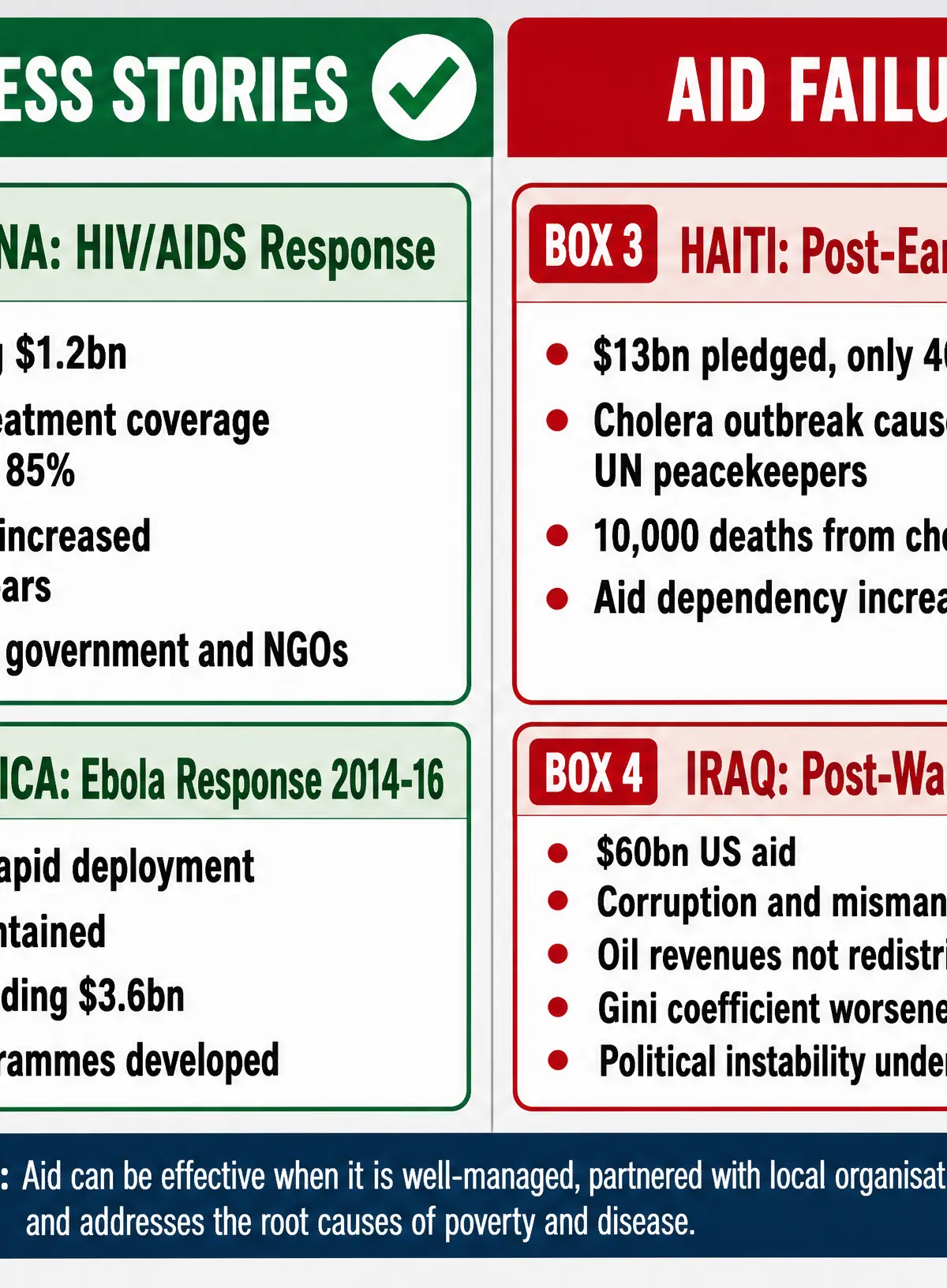
Success: Botswana & HIV/AIDS
Context: In the early 2000s, Botswana faced an HIV prevalence rate of 37% among adults. Life expectancy collapsed to 49 years.
Intervention: The US launched PEPFAR (President's Emergency Plan for AIDS Relief) in 2004, investing $1.2bn in Botswana.
Outcome: Antiretroviral treatment coverage rose from 5% to 85%. Life expectancy recovered to 69 years.
Why it worked: Strong partnership between international donors and a stable, committed local government.
Success: West Africa Ebola Outbreak (2014-16)
Context: A highly contagious outbreak threatened global health security.
Intervention: Rapid deployment by MSF and WHO, backed by $3.6bn in international funding.
Outcome: The outbreak was contained (28,600 cases), and the rVSV-ZEBOV vaccine was successfully developed.
Why it worked: Massive, coordinated international response focusing on an acute, specific medical crisis.
Failure: Haiti Earthquake Response (2010)
Context: A devastating earthquake killed over 200,000 people and destroyed infrastructure.
Intervention: $13bn was pledged internationally.
Outcome: Only ~40% of funds reached Haiti directly. A UN peacekeeping base accidentally introduced cholera, killing 10,000 people. Haiti remained heavily aid-dependent.
Why it failed: Poor coordination, bypassing of local government, and unintended health consequences from the intervention itself.
Failure: Iraq Post-War Reconstruction (Post-2003)
Context: Rebuilding infrastructure following the US-led invasion.
Intervention: $60bn committed by the USA.
Outcome: Widespread corruption and mismanagement. Oil revenues were not equitably distributed, leading to a worsening Gini coefficient (increased inequality).
Why it failed: Pouring money into a politically unstable, corrupt environment without strong governance.
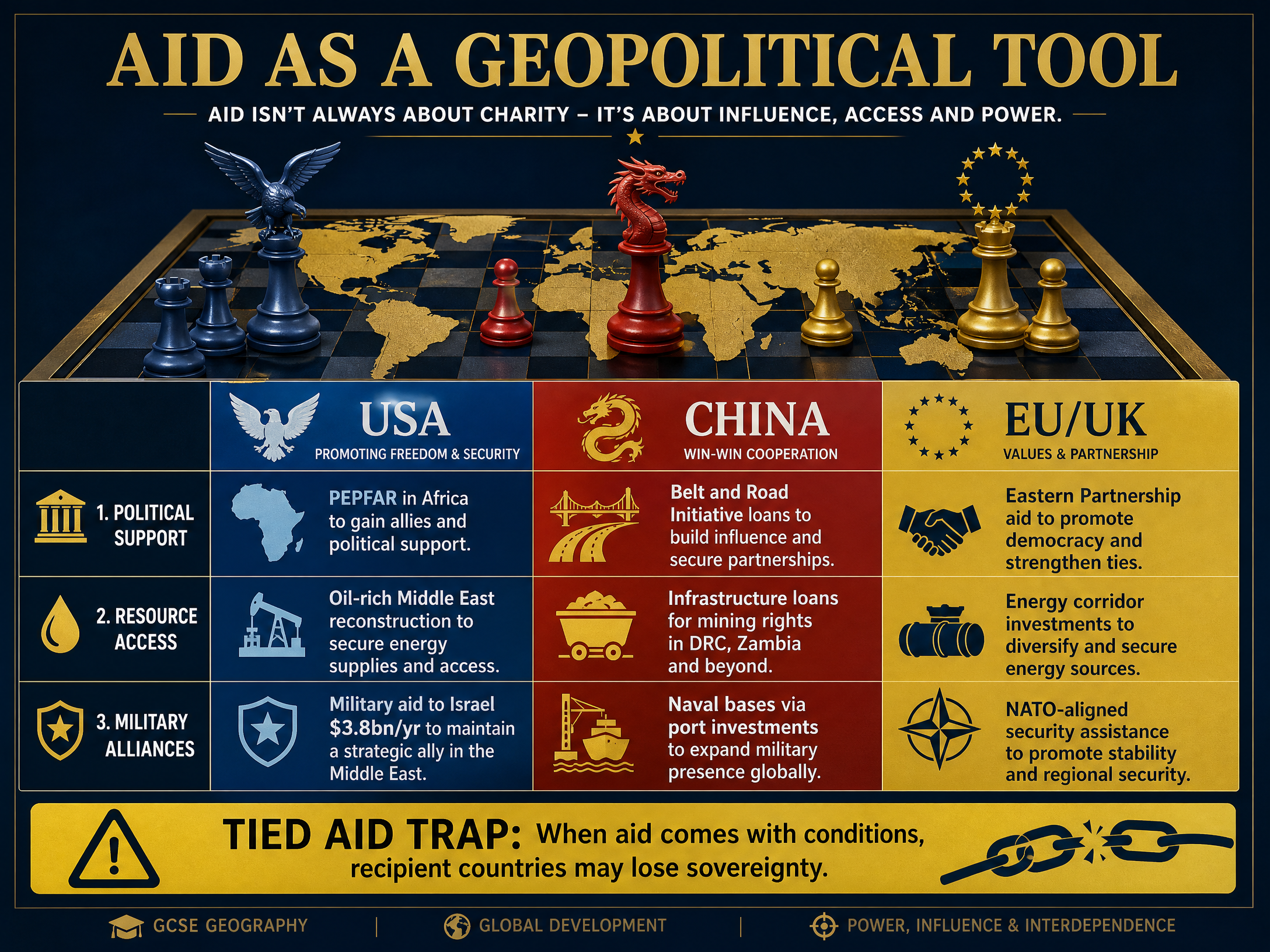
Aid as a Geopolitical Tool
This is where top-grade answers are made. Superpowers use aid as an extension of foreign policy.
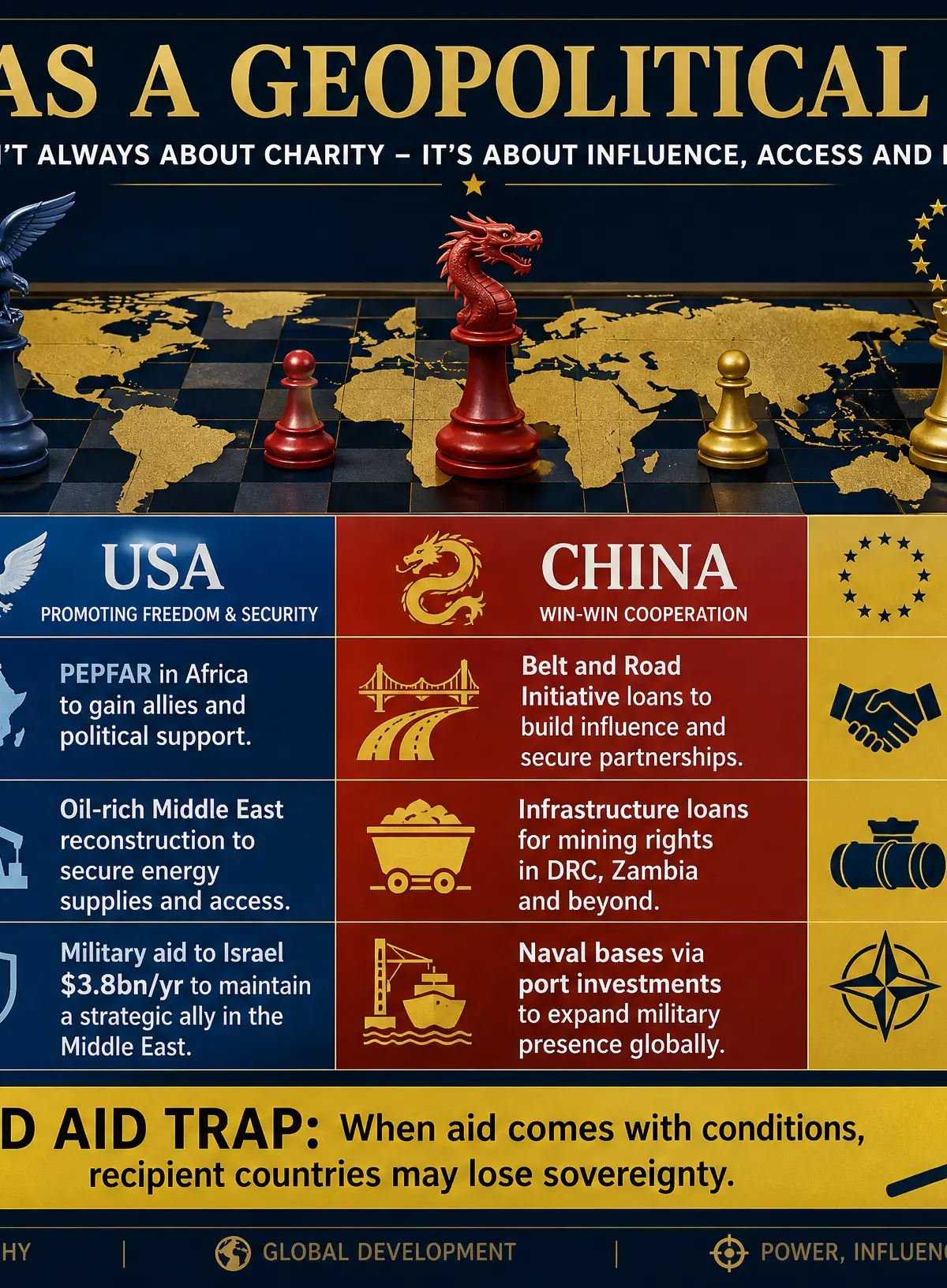
1. Securing Political Support
Superpowers use aid to build alliances and voting blocs in the UN.
Example: China's Belt and Road Initiative (BRI) provides massive infrastructure loans across Africa and Asia, building deep diplomatic ties and expanding its sphere of influence.
2. Accessing Resources
Aid is often directed to countries rich in strategic minerals or energy.
Example: Chinese infrastructure investments in the Democratic Republic of Congo (DRC) and Zambia are frequently tied to securing long-term access to copper and cobalt mining rights.
3. Military Alliances
Financial support is used to maintain strategic military footholds.
Example: The USA provides approximately $3.8bn annually in military aid to Israel to maintain a strong strategic ally in the Middle East.
Second-Order Concepts in Geography
Causation
Why do health inequalities exist? (Historical colonialism, unfair trade terms, debt burdens, corrupt governance, physical environment factors like endemic malaria).
Consequence
What are the impacts of intervention? (Positive: rising life expectancy, eradicated diseases. Negative: aid dependency, debt traps, loss of sovereignty).
Evaluation / Judgment
Making a reasoned assessment of whether an intervention was successful, weighing up the social, economic, and political outcomes for different stakeholders.
Visual Resources
3 diagrams and illustrations
Interactive Diagrams
1 interactive diagram to visualise key concepts
Conceptual Flow Outline
Geopolitical motives for development aid
Worked Examples
3 worked examples — open one to explore the question and available guidance.
Practice Questions
Test your understanding — click to reveal model answers
Using a named example, explain why some development aid projects fail to achieve their objectives. (6 marks)
Hint: Choose either Haiti or Iraq. Focus on what went wrong with the management or distribution of the funds.
'Development aid is primarily used by superpowers to expand their global influence, rather than to help people.' To what extent do you agree with this statement? (9 marks)
Hint: You need a balanced argument. Paragraph 1: Agree (Geopolitics/Tied Aid). Paragraph 2: Disagree (Humanitarian successes). Conclusion: Judgement.