Pearson Edexcel · GCSE · Geography
A number of physical and human processes work together to create distinct UK landscapes
The UK landscape is a dramatic tapestry shaped by deep geological time, powerful physical forces, and centuries of human activity. This guide breaks down the complex interactions between rocks, ice, rivers, and people to help you secure top marks in your GCSE Geography exam.
- 6 min read
- 3 worked examples
- 5 practice questions
- 6 key terms
Study Notes
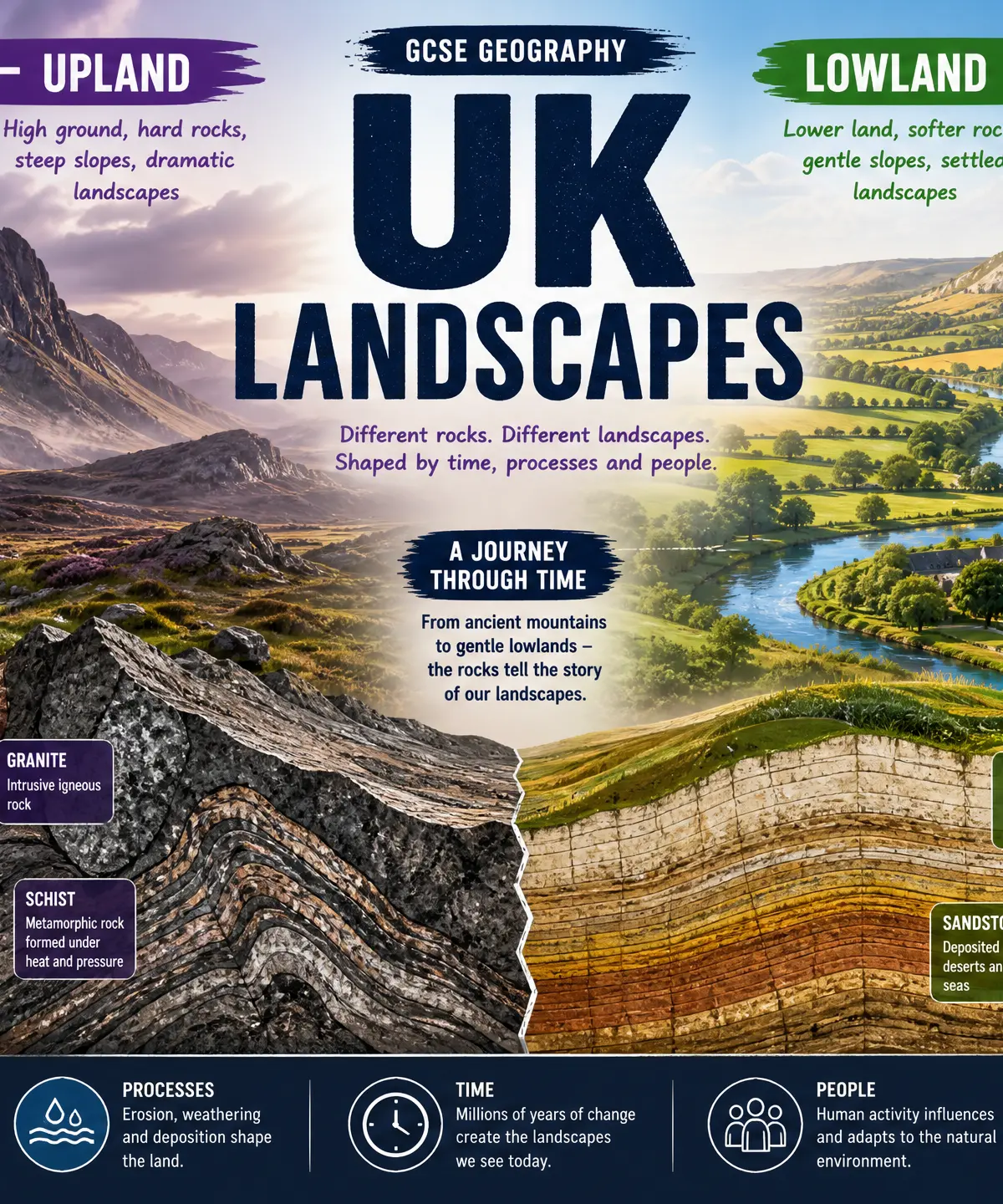
Overview
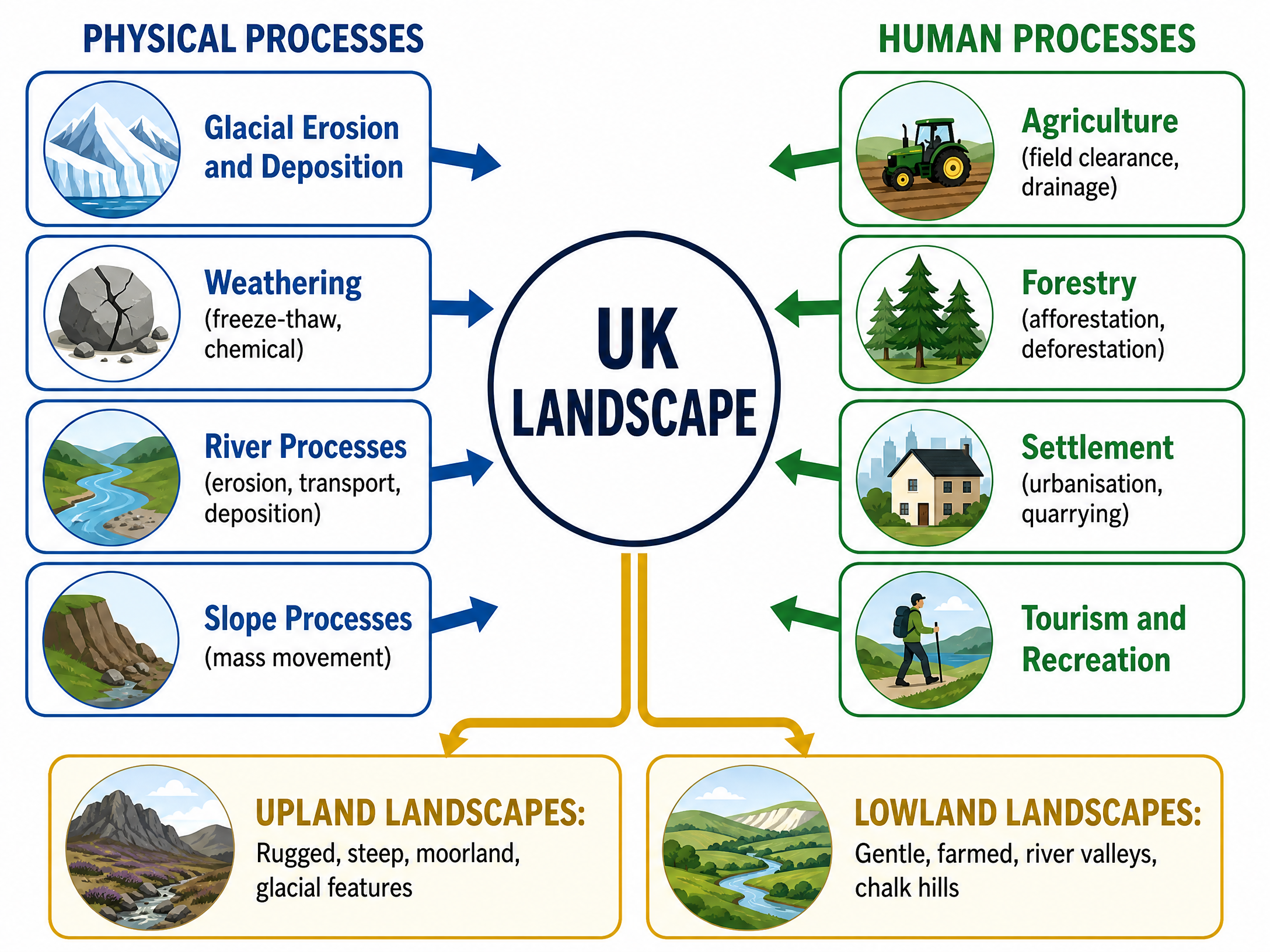
The United Kingdom, despite its relatively small size, boasts an astonishing diversity of landscapes. From the rugged, imposing peaks of the Scottish Highlands to the gentle, rolling chalk hills of the South Downs, the visual character of the UK is a product of millions of years of history. For GCSE Geography, you need to understand that these landscapes are not accidental. They are the result of the complex interaction between geology (the underlying rocks), physical processes (like glaciation, weathering, and river erosion), and human activity (such as agriculture, forestry, and settlement). Examiners are particularly keen on your ability to link these factors together. They want to see that you understand how a specific rock type, acted upon by specific processes, results in a specific landform.
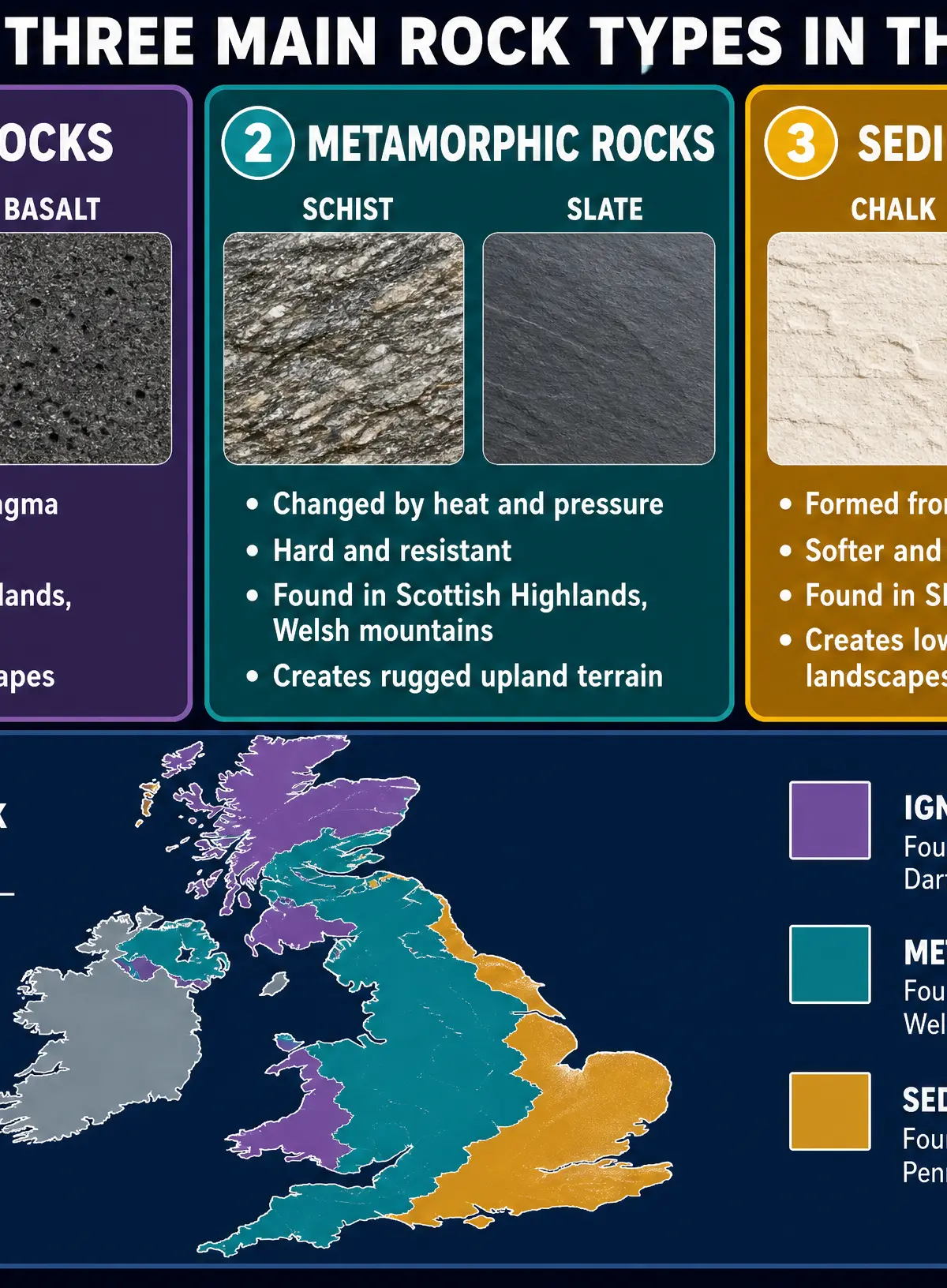
Geology and Landscape
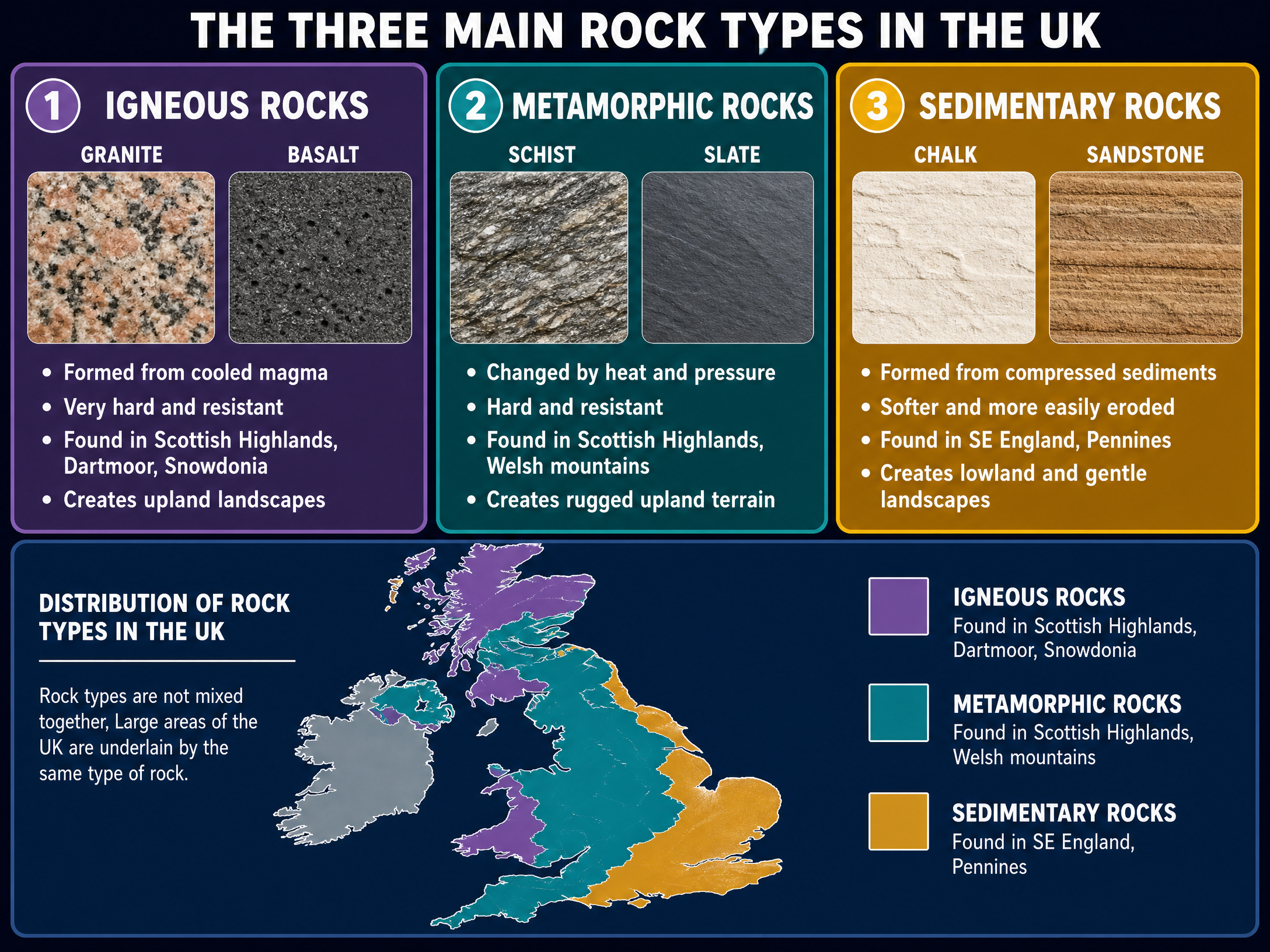
The foundation of any landscape is its geology. The UK has a distinct geological divide, roughly following a line from the River Tees in the north-east to the River Exe in the south-west (the Tees-Exe line).
Igneous Rocks
Characteristics: Formed from cooled magma or lava. They consist of interlocking crystals, making them extremely hard and resistant to erosion.
Examples: Granite (intrusive, cooled slowly underground) and Basalt (extrusive, cooled quickly on the surface).
Landscape Impact: Found primarily in the north and west of the UK (e.g., Scottish Highlands, Dartmoor, Snowdonia). They form high, rugged upland landscapes with steep slopes and thin soils.
Metamorphic Rocks
Characteristics: Formed when existing rocks are changed by intense heat and pressure deep within the Earth's crust. They are typically very hard and resistant.
Examples: Slate (formed from mudstone) and Schist.
Landscape Impact: Found in the north and west (e.g., Scottish Highlands, North Wales). They contribute to dramatic, mountainous upland terrain.
Sedimentary Rocks
Characteristics: Formed from layers of sediment (sand, mud, organic remains) compacted over millions of years. They are generally softer and less resistant to erosion than igneous or metamorphic rocks.
Examples: Chalk (formed from marine organisms) and Sandstone.
Landscape Impact: Found mainly in the south and east of England (e.g., the South Downs, the Weald, the Cotswolds). They create gentler, lower-lying landscapes, such as rolling hills and wide vales.
Physical Processes
Physical processes have sculpted the geological foundation into the landforms we see today.
Glaciation
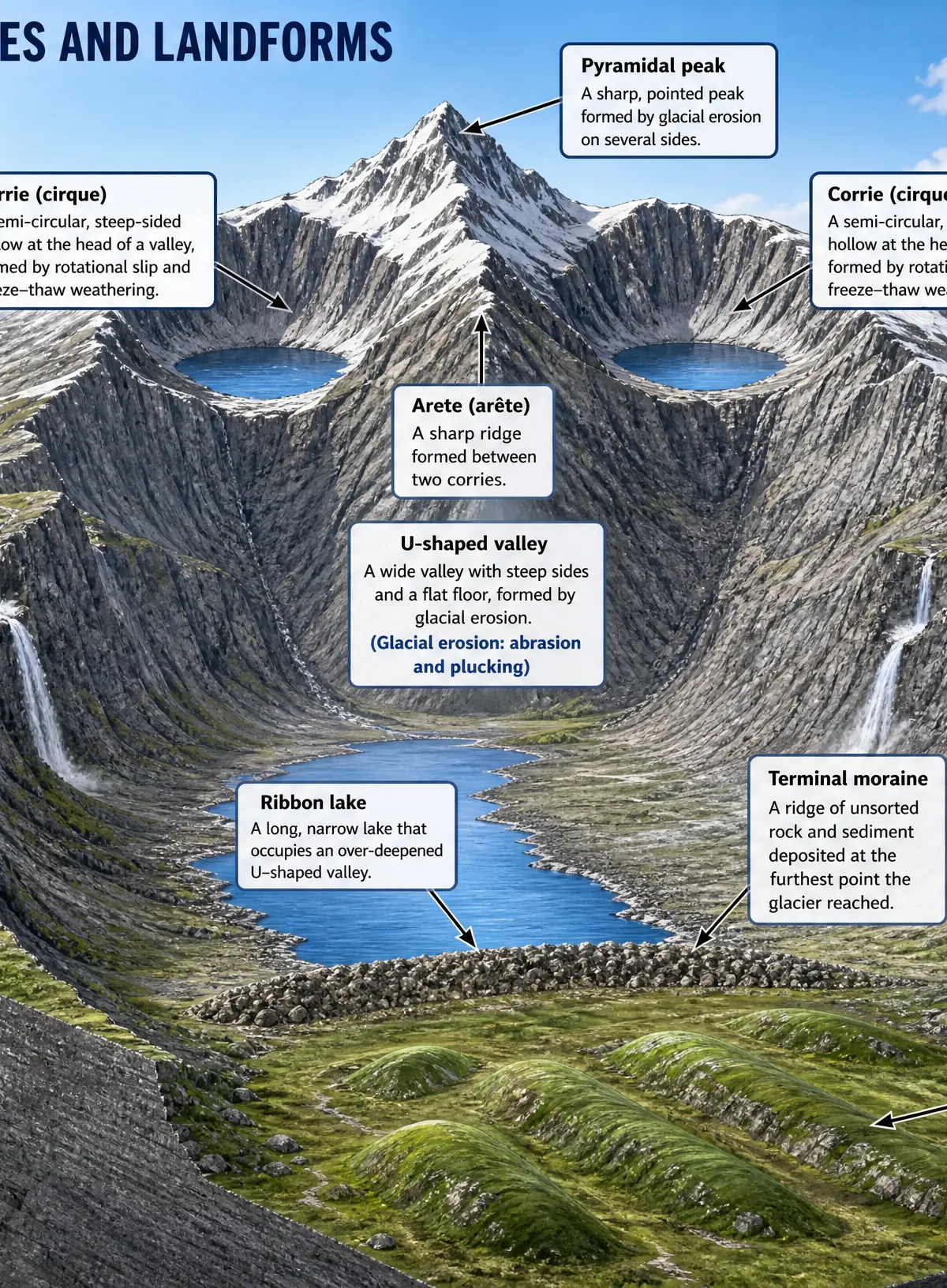
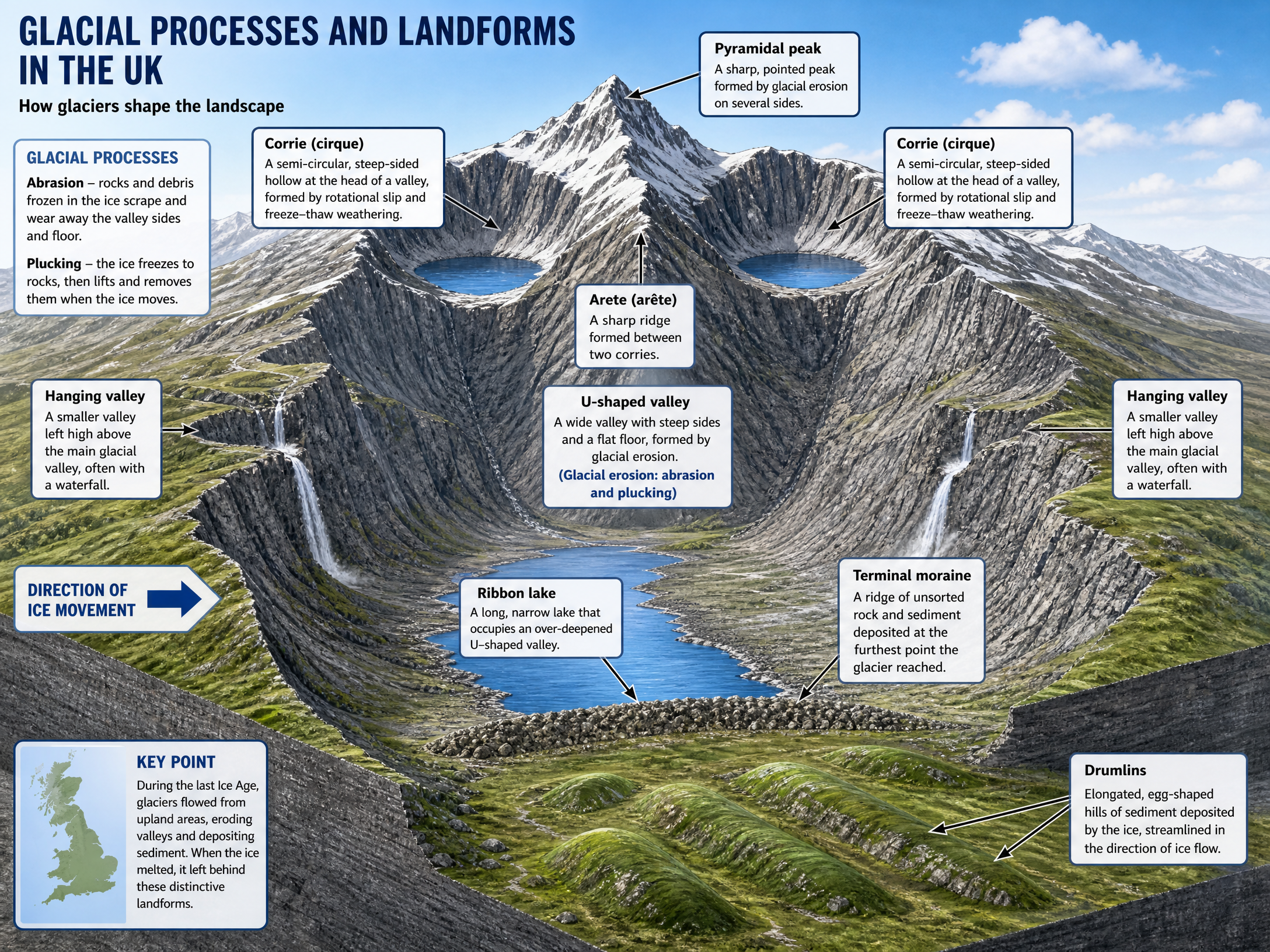
During the last Ice Age, much of the UK was covered by ice. Glaciers were the most powerful erosional force in shaping our upland landscapes. The two main processes of glacial erosion are abrasion (the sandpaper effect of rocks frozen in the ice grinding the bedrock) and plucking (ice freezing to the bedrock and tearing chunks away).
Key Landforms:
- Corrie (Cirque): An armchair-shaped hollow high on a mountain side (e.g., Red Tarn in the Lake District).
- Arête: A sharp, knife-edge ridge formed between two corries (e.g., Striding Edge).
- U-shaped Valley: A wide, flat-floored, steep-sided valley carved by a glacier moving down a pre-existing river valley (e.g., Great Langdale).
- Ribbon Lake: A long, narrow lake in the floor of a U-shaped valley.
Weathering and Slope Processes
- Freeze-thaw weathering: Crucial in uplands. Water enters cracks, freezes, expands, and eventually shatters the rock, creating scree slopes.
- Chemical weathering: Crucial in lowlands. Slightly acidic rainwater dissolves calcium carbonate in chalk and limestone landscapes (solution).
- Mass movement: Landslides, slumping, and soil creep shape slopes, particularly where rocks are soft or saturated.
River Processes
Post-glacial river action continues to modify the landscape, carving V-shaped valleys in the uplands and creating wide floodplains, meanders, and oxbow lakes in the lowlands through a combination of erosion, transportation, and deposition.
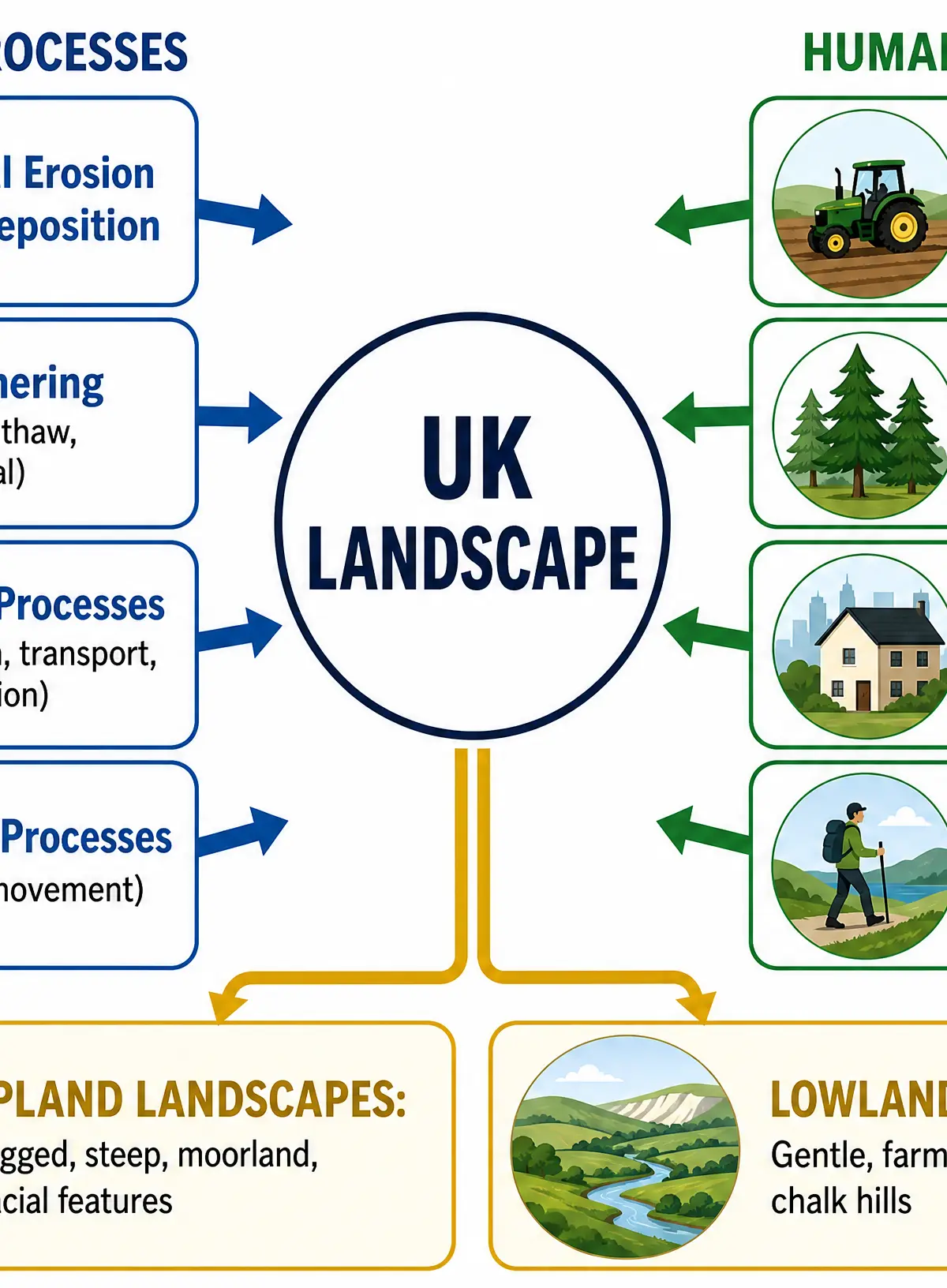
Human Activity
UK landscapes are 'cultural landscapes' — heavily modified by human intervention over thousands of years.
Agriculture
Farming has arguably had the greatest impact. In lowland areas, the clearance of ancient woodlands for arable farming has created the patchwork of fields and hedgerows typical of East Anglia and the Midlands. In upland areas, centuries of sheep grazing have prevented tree regeneration, maintaining the open moorland landscapes of the Pennines and Dartmoor.
Forestry
While the UK was once heavily forested, much was cleared. In the 20th century, the Forestry Commission planted large areas of fast-growing, non-native conifer trees (afforestation), particularly in upland areas like Wales and Scotland, significantly altering the visual landscape.
Settlement and Infrastructure
The growth of towns, cities, and transport networks has paved over natural landscapes. Additionally, quarrying for building materials (e.g., slate in North Wales, limestone in the Peak District) has left permanent scars on the physical environment.
Podcast Revision
Listen to this 4-minute audio guide covering the core concepts, common mistakes, and a quick-fire recall quiz to test your knowledge.

Visual Resources
3 diagrams and illustrations
Interactive Diagrams
1 interactive diagram to visualise key concepts
Conceptual Flow Outline
The relationship between geology and UK landscapes.
Worked Examples
3 worked examples — open one to explore the question and available guidance.
Practice Questions
Test your understanding — click to reveal model answers
Study Figure 1 (an OS map extract of a UK upland area). Using map evidence, describe the physical characteristics of this landscape. (4 marks)
Hint: Look for contour lines, spot heights, and drainage patterns. Remember to 'describe' (say what you see), not 'explain' (say why).
Explain how human activity has modified lowland landscapes in the UK. (6 marks)
Hint: Think about agriculture, settlement, and historical changes. You need two developed points.
Assess the relative importance of physical processes and human activity in shaping the landscape of the UK. (9 marks)
Hint: You must discuss both physical AND human factors, provide specific examples for both, and come to a clear conclusion about which is more important (or how they interact).
Explain the formation of a corrie. (4 marks)
Hint: Start with snow accumulating in a hollow, mention the specific erosional processes, and describe the final shape.
State two characteristics of sedimentary rocks. (2 marks)
Hint: Think about how they are formed and how hard they are.