Pearson Edexcel · GCSE · Geography
A variety of physical processes interact to shape coastal landscapes
Dive into the dynamic world of Coastal Landscapes, where the relentless power of the sea shapes the UK's dramatic cliffs and sweeping beaches. Mastering this topic is essential for understanding physical geography processes, and examiners highly reward candidates who can confidently link geology, wave action, and human intervention to specific landforms.
- 5 min read
- 3 worked examples
- 5 practice questions
- 6 key terms
Study Notes
Overview
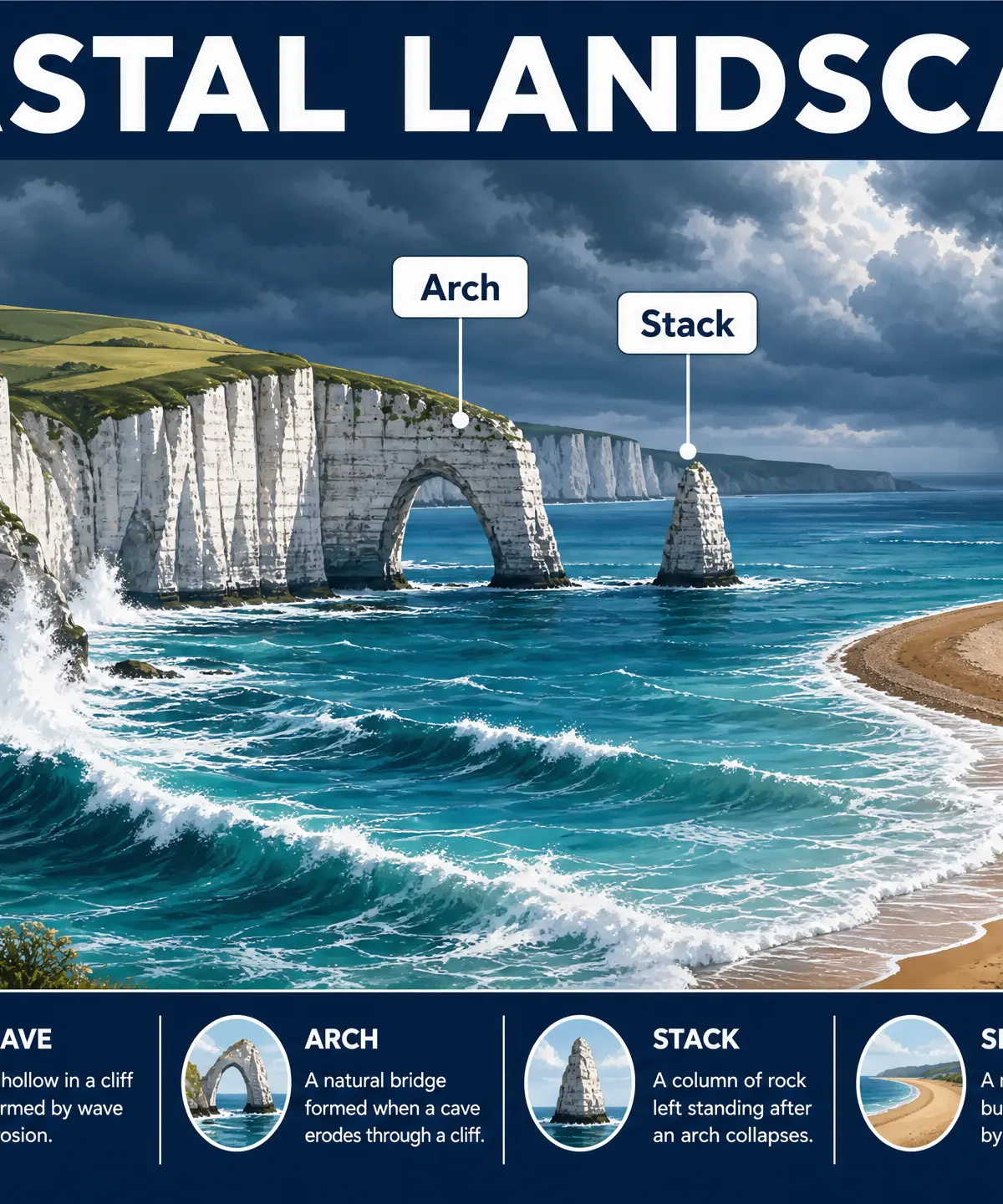
This study guide covers the physical processes that interact to shape coastal landscapes, a cornerstone topic in GCSE Geography. You will explore how weathering, mass movement, erosion, transport, and deposition work together to create distinct erosional and depositional landforms. Examiners expect you to go beyond simply listing processes; you must demonstrate a clear understanding of how and why these processes operate, particularly in relation to geological structure (concordant and discordant coastlines) and wave type (constructive and destructive).
Furthermore, this topic examines the critical interaction between human activities and coastal environments. You will need to evaluate various coastal management strategies—both hard and soft engineering—weighing their advantages against their disadvantages. Precise use of terminology and specific named UK examples (such as Holderness, the Jurassic Coast, and Spurn Head) are vital for accessing the highest mark bands.
Audio Revision: Coastal Landscapes Podcast
Listen to our comprehensive 10-minute revision podcast covering all key concepts, exam tips, and a quick-fire recall quiz.

Key Physical Processes
Weathering and Mass Movement
Weathering is the breakdown of rock in situ (in its original place). It weakens cliffs, making them more susceptible to erosion.
- Mechanical (Physical): E.g., freeze-thaw action where water freezes in cracks, expands, and breaks the rock.
- Chemical: E.g., carbonation, where slightly acidic rain dissolves minerals in rocks like chalk and limestone.
- Biological: Plant roots or burrowing animals breaking rocks apart.
Mass Movement is the downhill movement of material under the influence of gravity.
- Sliding: A sudden movement of material along a flat slip plane.
- Slumping (Rotational Slip): Saturated soil and weak rock slumps down a curved slip plane, often seen on boulder clay cliffs like those at Holderness.
Coastal Erosion
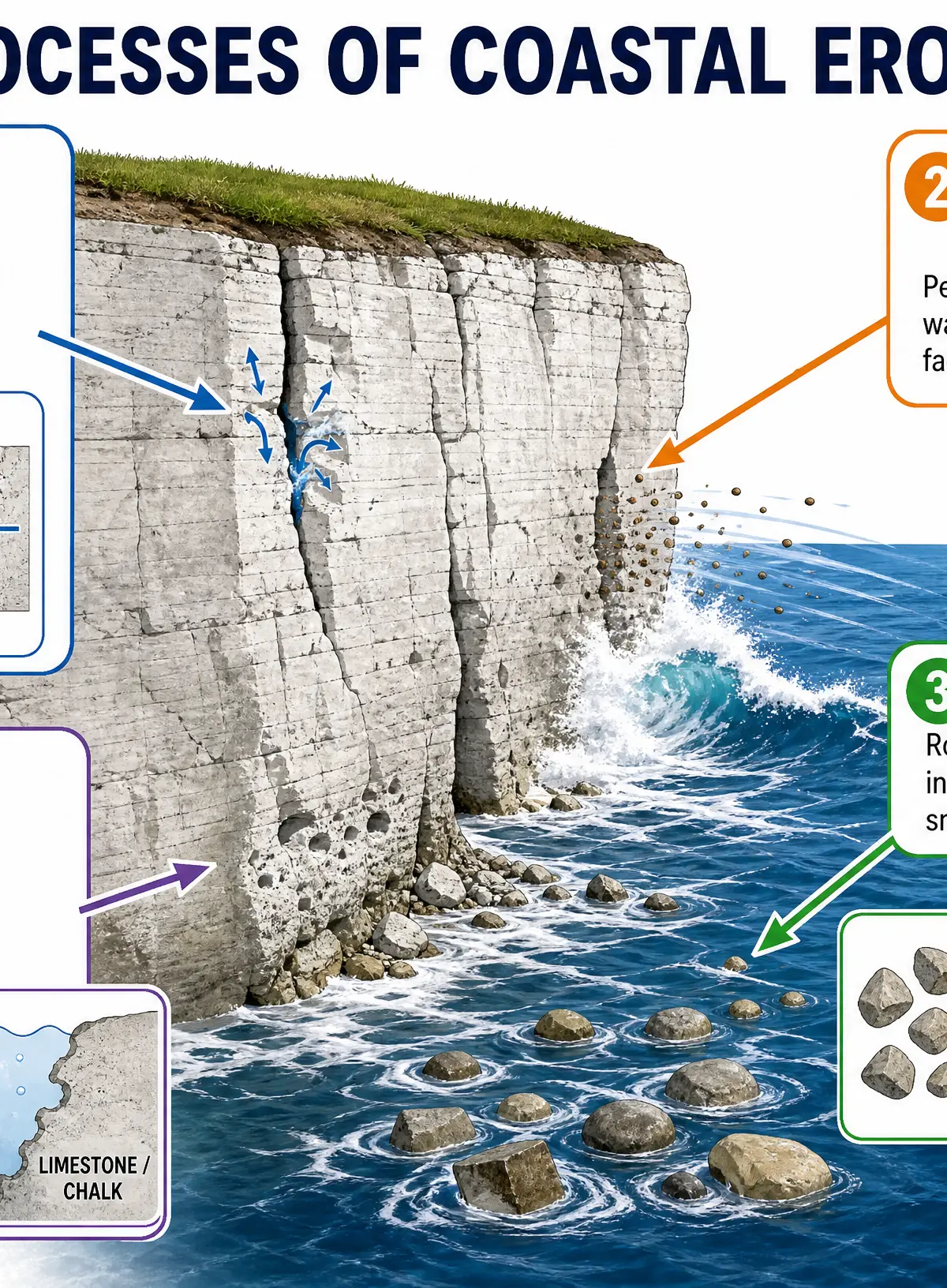
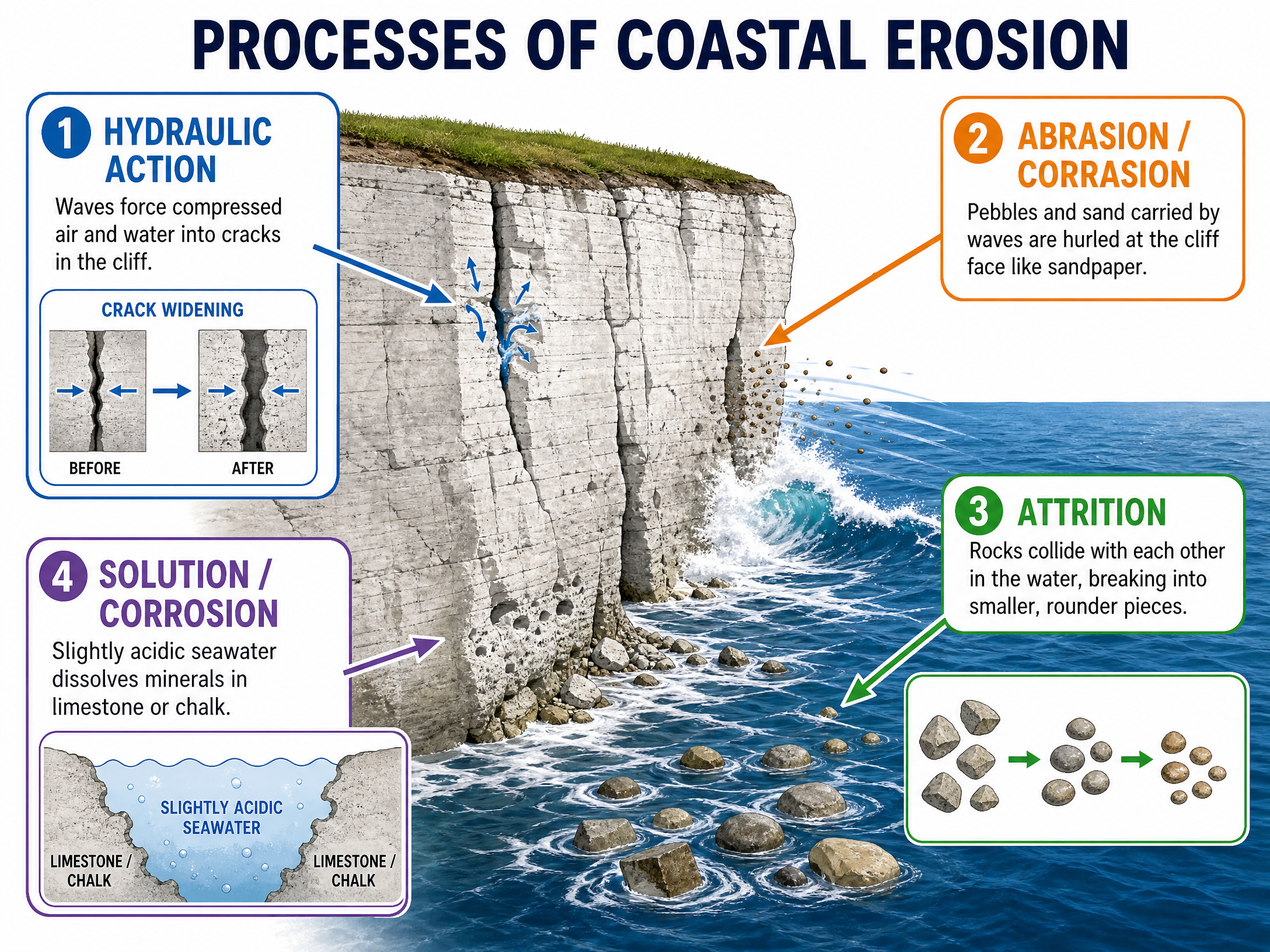
Erosion is the wearing away and removal of material by wave action. There are four main processes:
- Hydraulic Action: The sheer force of water compressing air into cliff cracks, forcing them apart.
- Abrasion (Corrasion): Sediment thrown against the cliff face by waves, acting like sandpaper.
- Attrition: Rocks and pebbles carried by the sea colliding and breaking into smaller, smoother pieces.
- Solution (Corrosion): Seawater chemically dissolving specific rock types (e.g., limestone).
Transport and Deposition
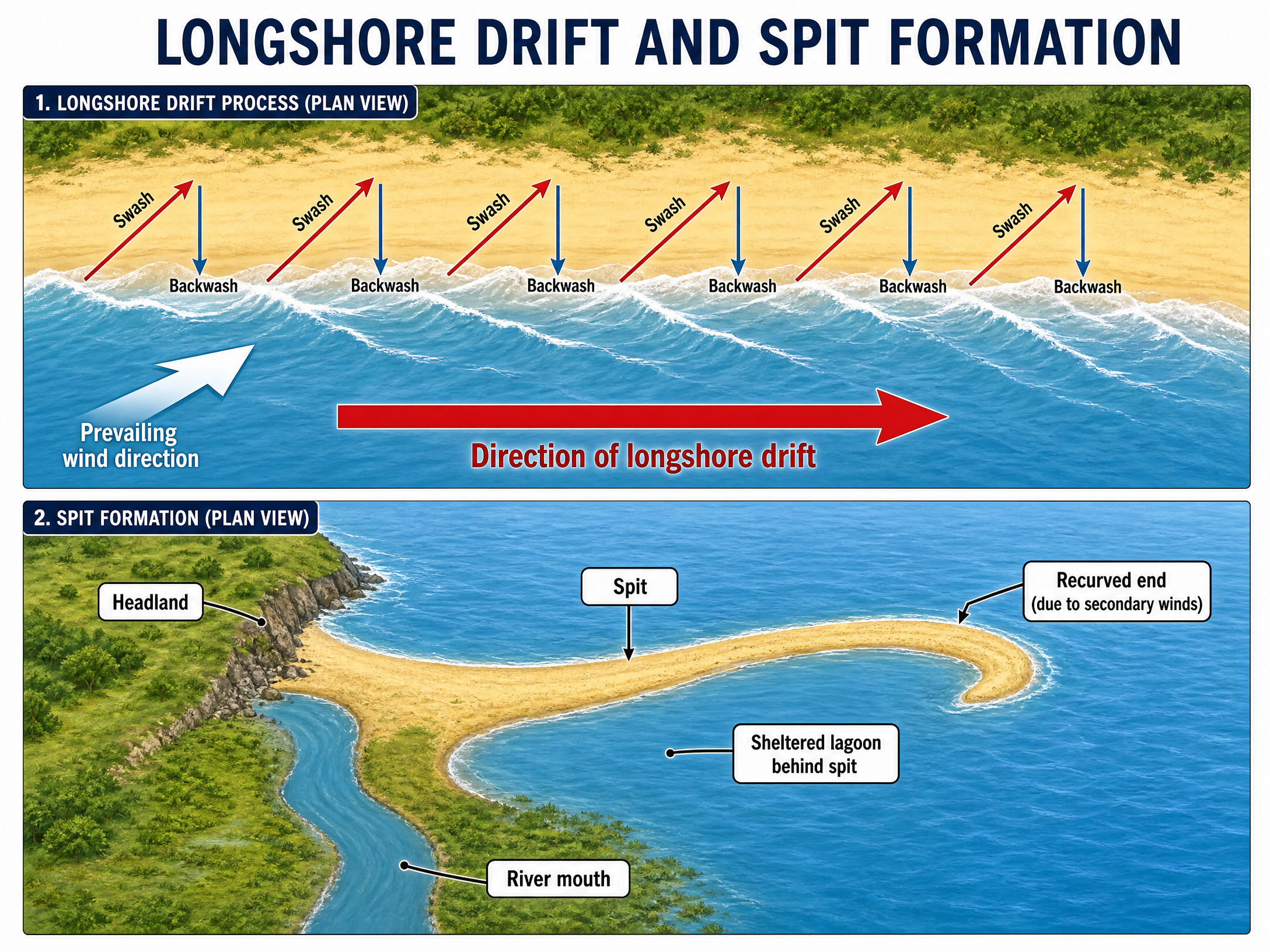
Material eroded from the coast is transported by the sea. The most significant transport process for shaping coastlines is Longshore Drift.
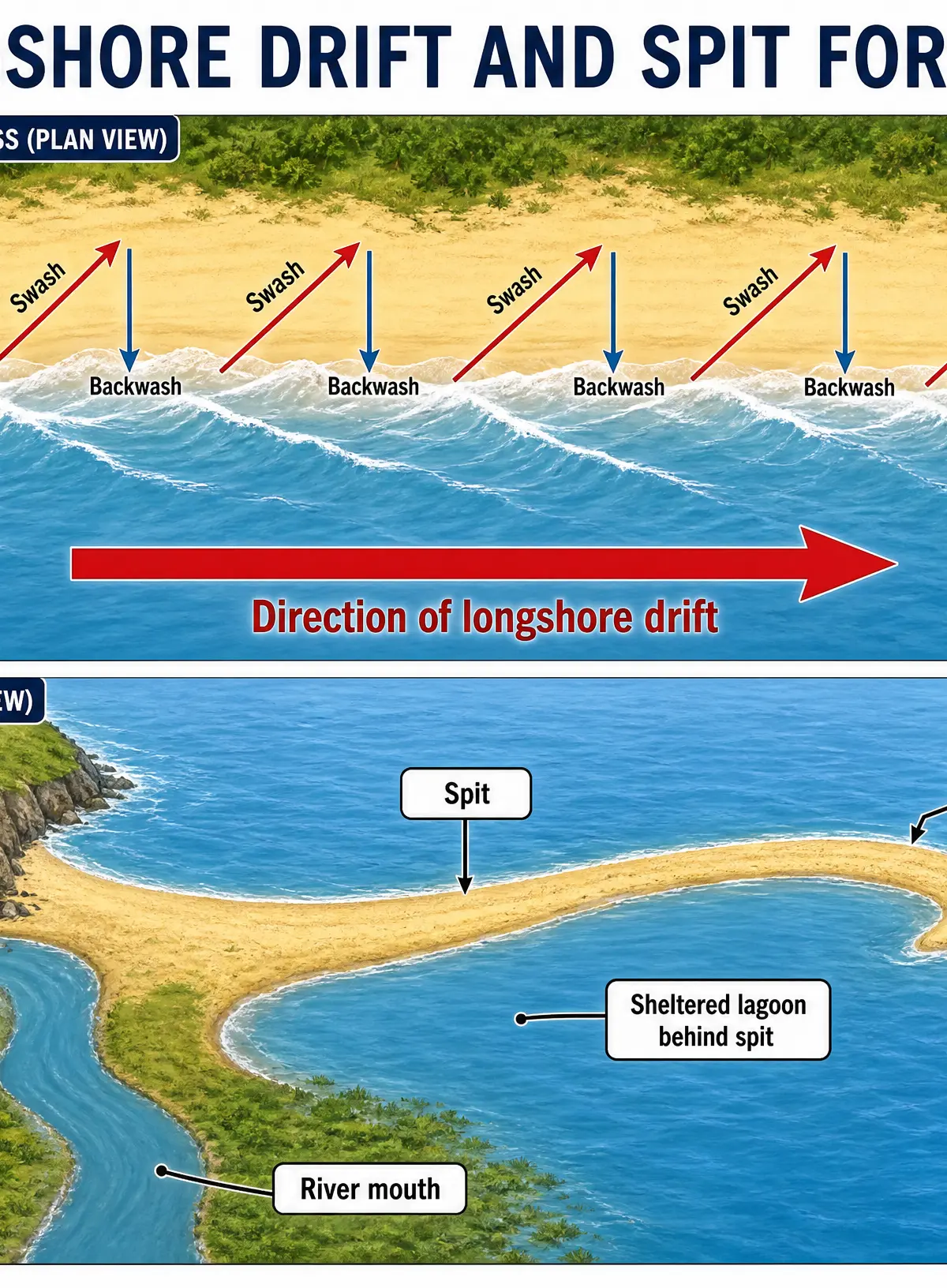
Deposition occurs when wave energy decreases, causing the sea to drop the sediment it is carrying. This typically happens in sheltered bays or where constructive waves dominate, forming beaches and spits.
Coastal Landforms
Erosional Landforms
Erosional landforms typically form on discordant coastlines (where bands of hard and soft rock run perpendicular to the sea). The softer rock erodes faster, forming bays, while the harder rock resists erosion, jutting out as headlands.
The Cave, Arch, Stack, Stump Sequence:
- Waves refract around a headland, concentrating energy on weaknesses (faults/joints).
- Hydraulic action and abrasion widen these weaknesses into caves.
- If two caves erode through a headland, an arch forms (e.g., Durdle Door).
- The unsupported roof of the arch collapses, leaving an isolated pillar of rock called a stack (e.g., Old Harry Rocks).
- Further erosion at the base causes the stack to collapse into a stump.
Depositional Landforms
- Beaches: Formed by constructive waves depositing sand or shingle in sheltered areas.
- Spits: Long, narrow ridges of sand/shingle extending into the sea or across a river estuary, formed by longshore drift. The end often curves (recurved end) due to secondary winds.
- Bars: Formed when a spit grows entirely across a bay, trapping a freshwater lagoon behind it.
Coastal Management
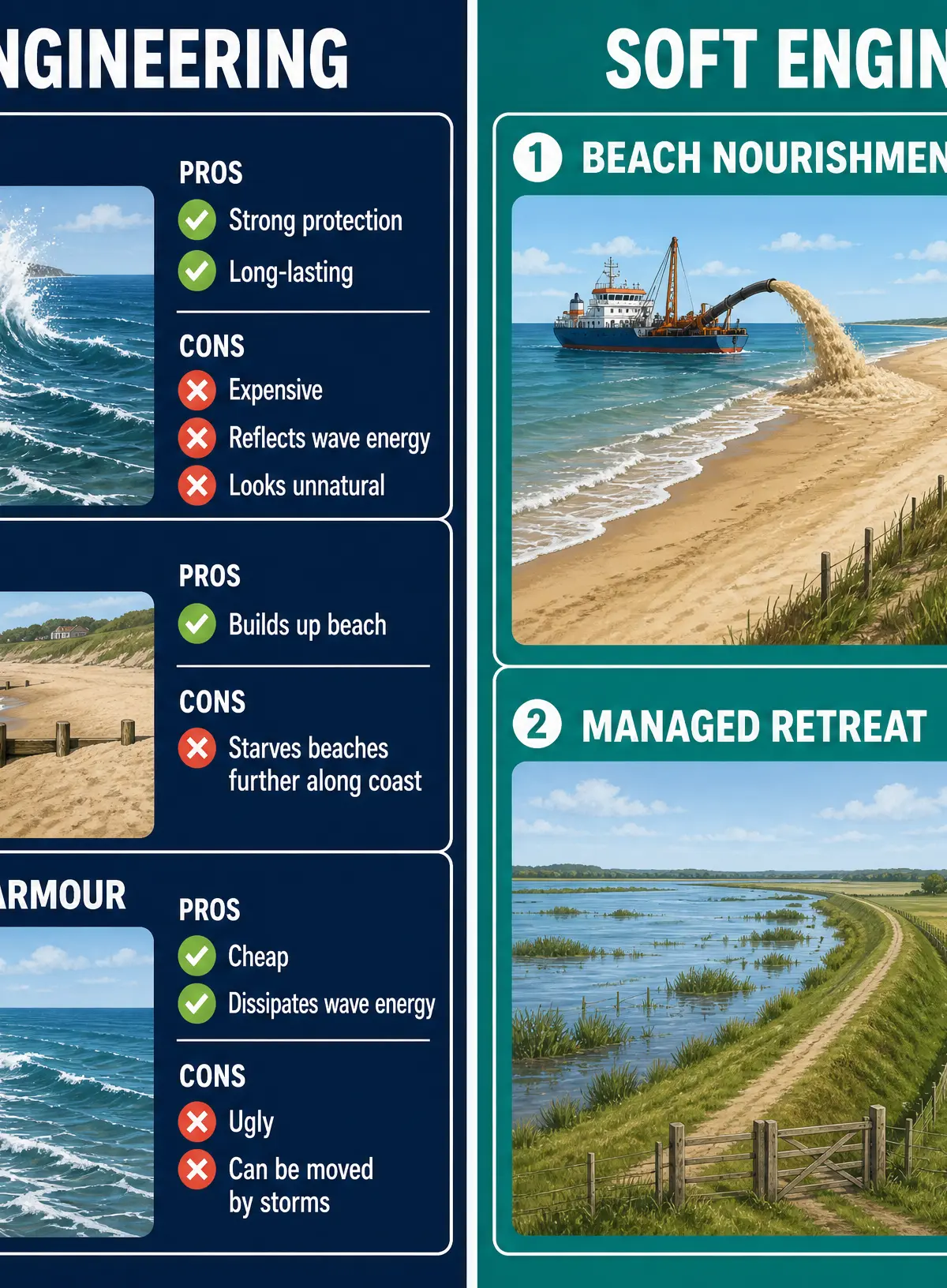
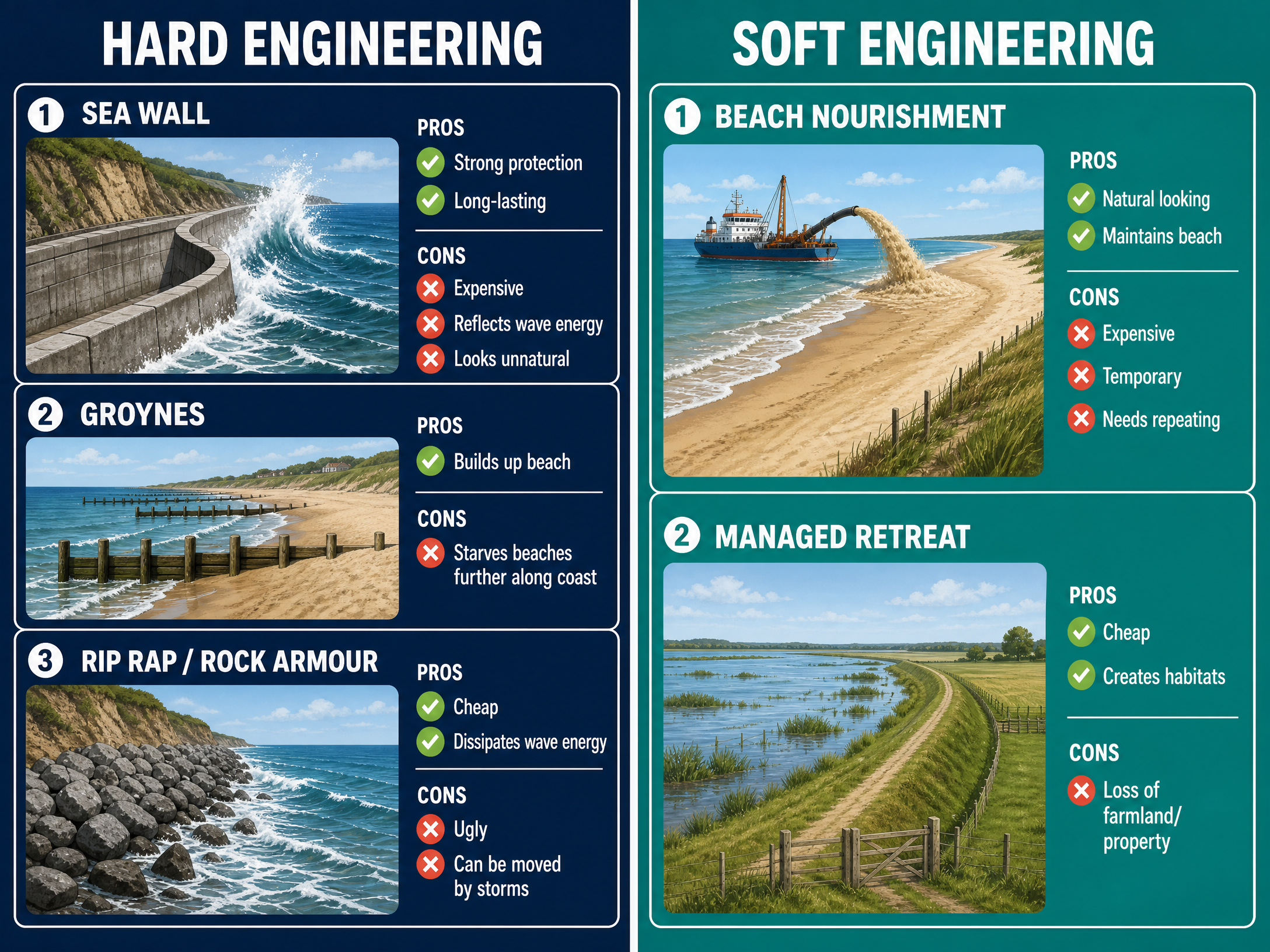
Coastal landscapes are dynamic, and human intervention is often required to prevent flooding and coastal recession. Strategies are broadly categorized into Hard and Soft Engineering.
- Hard Engineering: Artificial, man-made structures (e.g., Sea Walls, Groynes, Rock Armour). Generally more expensive and longer-lasting, but can be visually intrusive and disrupt natural processes elsewhere.
- Soft Engineering: Working with natural processes (e.g., Beach Nourishment, Managed Retreat). Generally cheaper and more environmentally friendly, but often require ongoing maintenance.
Visual Resources
3 diagrams and illustrations
Interactive Diagrams
1 interactive diagram to visualise key concepts
Conceptual Flow Outline
The interaction of physical processes on the coast
Worked Examples
3 worked examples — open one to explore the question and available guidance.
Practice Questions
Test your understanding — click to reveal model answers
Explain the formation of a wave-cut platform. (4 marks)
Hint: Start at the base of the cliff and explain the sequence of collapse and retreat.
Assess the risks of coastal recession for people and the environment. (6 marks)
Hint: Provide distinct impacts for 'people' (economic/social) and 'environment' (ecological).
State two types of mass movement that occur on coasts. (2 marks)
Hint: Think about how material moves downhill under gravity.
Explain how physical processes work together to form a stack. (6 marks)
Hint: Use the C-A-S-S sequence and name the specific erosion and weathering processes.
Evaluate the use of soft engineering strategies for coastal management. (9 marks + 3 SPaG)
Hint: Discuss pros and cons of methods like beach nourishment and managed retreat, and provide a final judgement.