Pearson Edexcel · GCSE · Geography
Coastal erosion and deposition create distinctive landforms within the coastal landscape
This study guide covers the dynamic physical processes of erosion and deposition that shape our coastlines, creating spectacular landforms from caves and stacks to beaches and spits. Understanding how waves interact with geology is crucial for mastering GCSE Geography and earning top marks in physical landscape questions.
- 6 min read
- 3 worked examples
- 5 practice questions
- 6 key terms
Study Notes

Overview
Coastlines are some of the most dynamic environments on Earth, constantly changing due to the power of the sea. This topic explores how physical processes of erosion and deposition interact with geological structure and wave action to create distinctive landforms. Examiners expect you to understand not just what these landforms look like, but the step-by-step processes that create them, the influence of rock type, and the difference between constructive and destructive waves. Mastering the link between process and landform is the key to achieving high grades in physical geography questions.
Listen to our comprehensive revision podcast to reinforce your understanding of these concepts:

Wave Types and Energy
Waves are the engine that drives coastal change. Their energy depends on the strength of the wind, how long it blows, and the fetch (the distance of open water over which the wind blows).
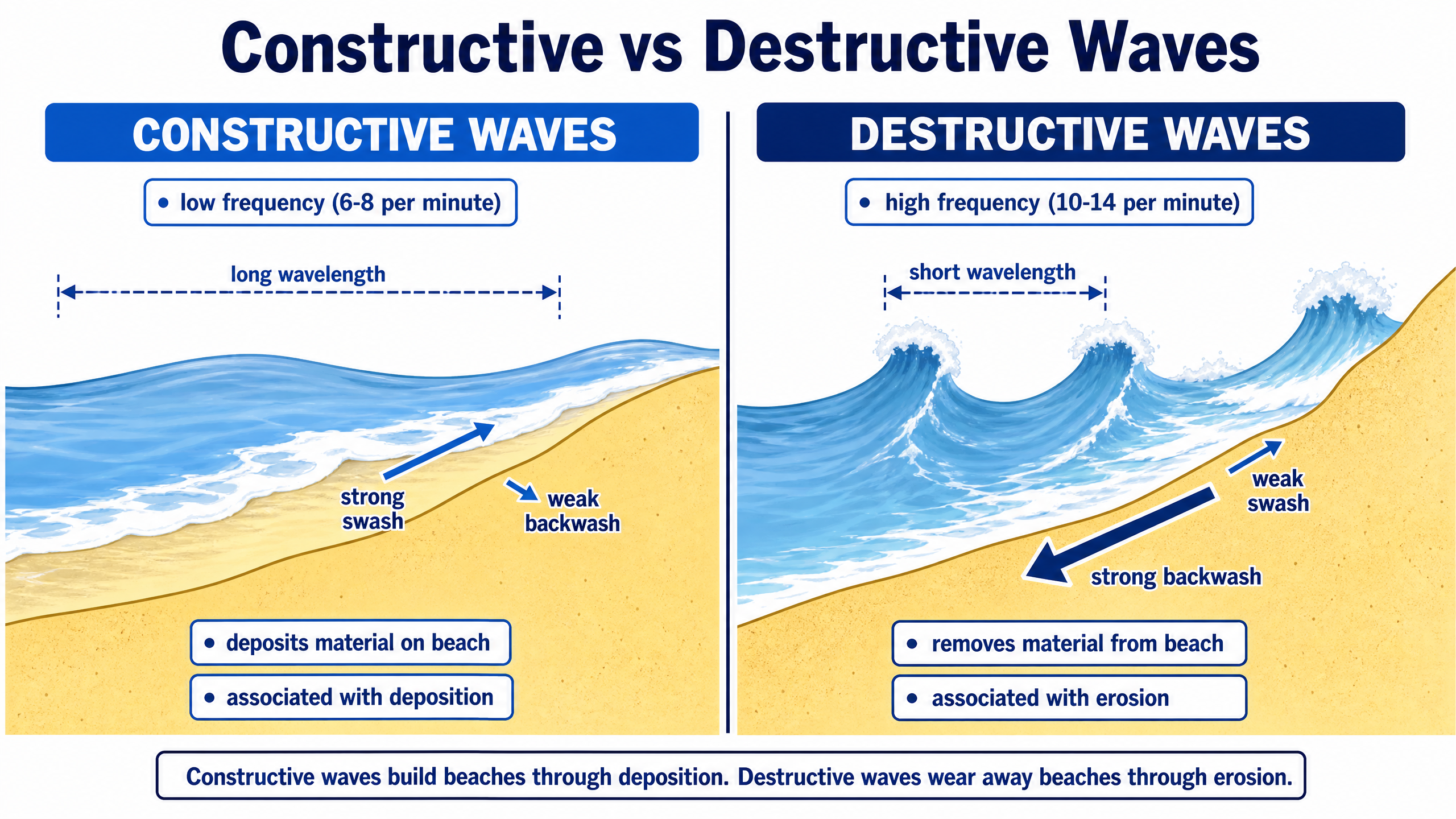
Constructive Waves
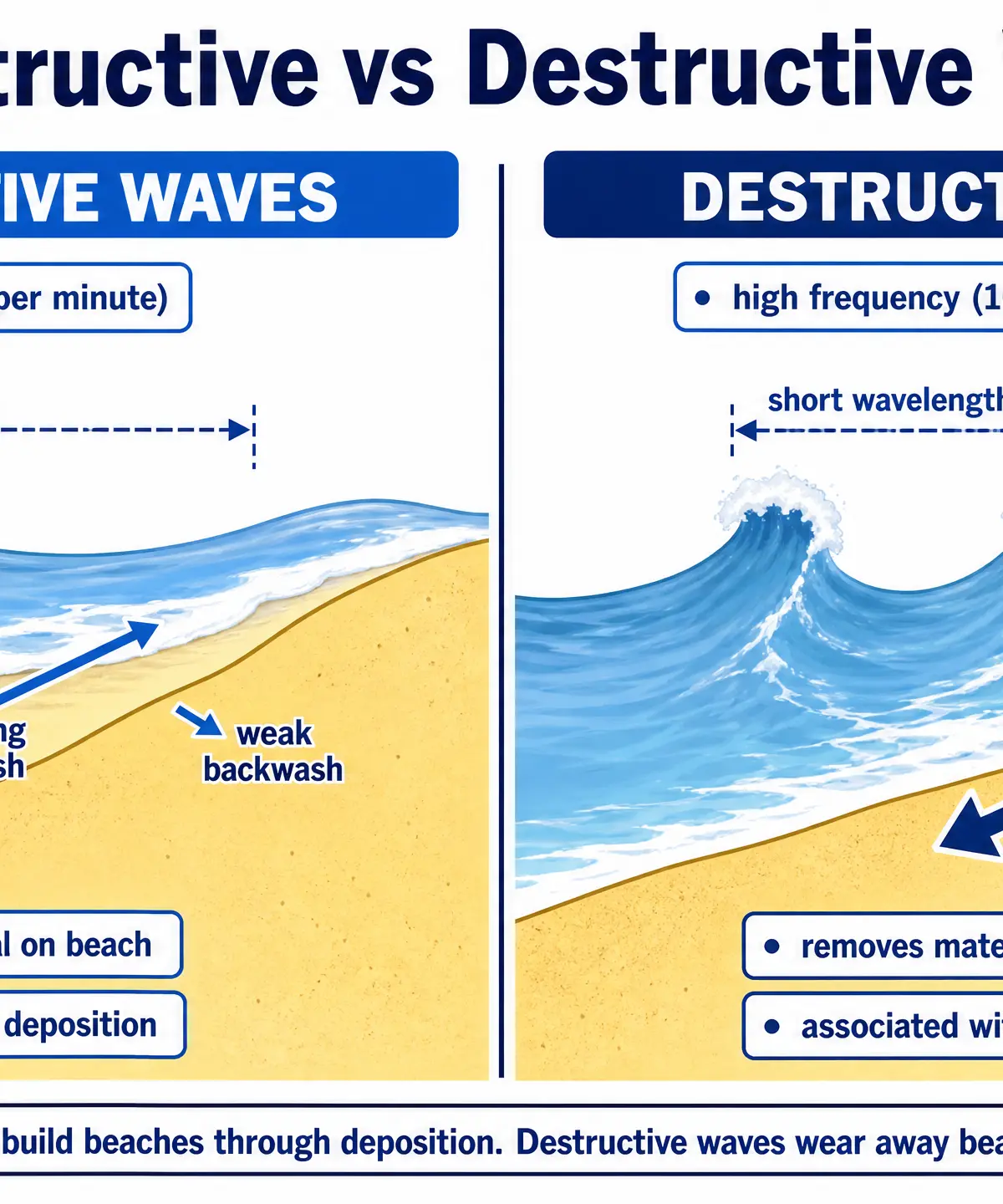
Characteristics: Low frequency (6-8 per minute), long wavelength, low wave height.
Action: Strong swash pushes material up the beach; weak backwash means material is left behind.
Impact: Associated with deposition and building up beaches.
Destructive Waves
Characteristics: High frequency (10-14 per minute), short wavelength, tall and steep.
Action: Weak swash but a very strong backwash that drags material back down the beach.
Impact: Associated with erosion and removing material from the coast.
Processes of Coastal Erosion
Erosion is the wearing away of rock along the coastline. You must know the four main processes:
- Hydraulic Action: The sheer power of the waves crashing against the cliff. Air is trapped in cracks and faults in the rock; the pressure forces the crack to widen, eventually breaking pieces of rock off.
- Abrasion (Corrasion): Waves pick up sand, pebbles, and boulders and hurl them against the cliff face like sandpaper, grinding it away.
- Attrition: Rocks and pebbles carried by the sea knock against each other, breaking into smaller, smoother, and rounder pieces over time.
- Solution (Corrosion): Seawater is slightly acidic and chemically dissolves certain types of rock, particularly chalk and limestone.
The Role of Geology
Geology (rock type and structure) is a massive factor in coastal landforms:
- Hard Rock: (e.g., granite, chalk) is more resistant to erosion and forms high cliffs and headlands.
- Soft Rock: (e.g., clay, sand) erodes quickly and forms bays.
- Discordant Coastlines: Bands of hard and soft rock run at right angles to the sea, creating headlands and bays.
- Concordant Coastlines: Bands of rock run parallel to the sea, creating a more uniform coastline (though coves can form if the outer hard rock is breached).
- Joints and Faults: Natural cracks and weaknesses in the rock that are exploited by hydraulic action and abrasion.
Erosional Landforms
Headlands and Bays
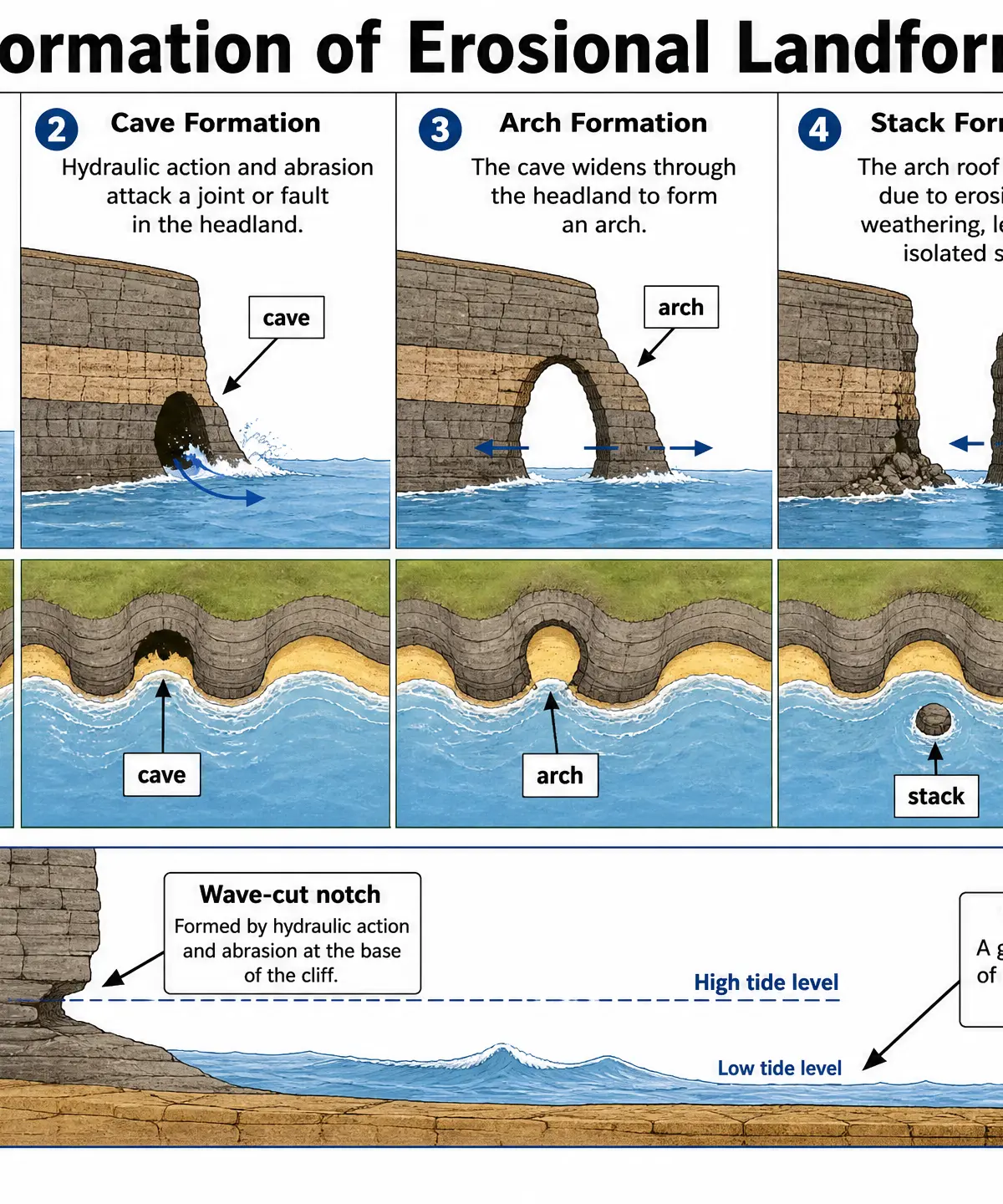
Form on discordant coastlines. The softer rock erodes faster to form sheltered bays (where deposition then occurs, forming beaches), while the harder rock is left sticking out as headlands.
Named Example: Swanage Bay (soft clay) and Peveril Point (hard chalk) in Dorset.
Caves, Arches, Stacks, and Stumps
This is a classic sequence that occurs on headlands:
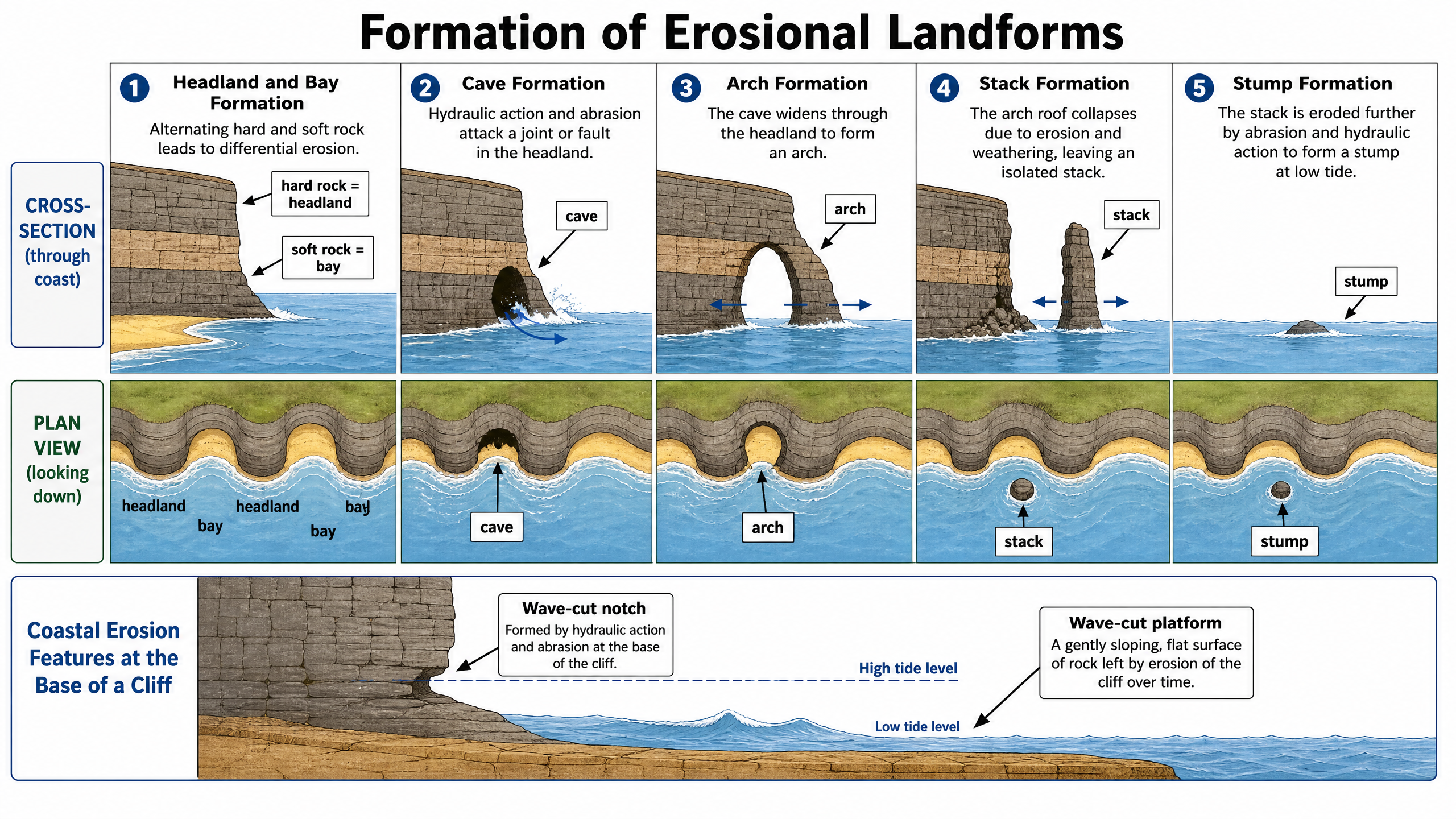
- Crack/Joint: Waves attack a line of weakness in the headland via hydraulic action.
- Cave: The crack widens into a cave through continued hydraulic action and abrasion.
- Arch: The cave is eroded all the way through the headland to form an arch.
- Stack: The roof of the arch is eroded from below and weathered from above until it collapses, leaving an isolated pillar of rock (a stack).
- Stump: The stack is undercut at its base and collapses, leaving a stump visible only at low tide.
Named Example: Old Harry Rocks (stacks) and Old Harry's Wife (stump) in Dorset.
Cliffs and Wave-Cut Platforms
Destructive waves attack the base of a cliff between high and low tide, forming a wave-cut notch. As the notch deepens, the cliff above becomes unsupported and collapses. The cliff retreats landwards, leaving behind a gently sloping, rocky wave-cut platform at the base.
Depositional Landforms
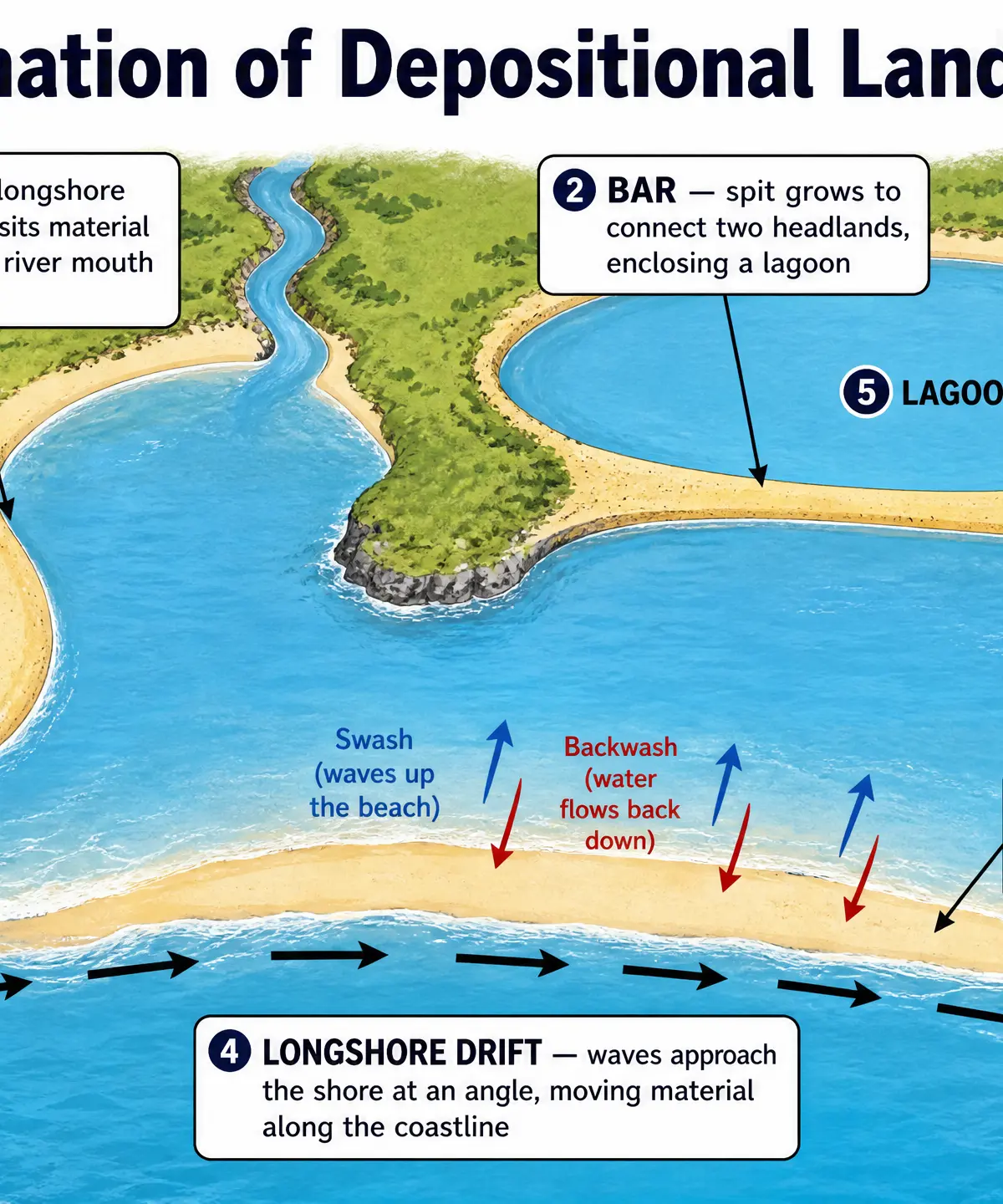
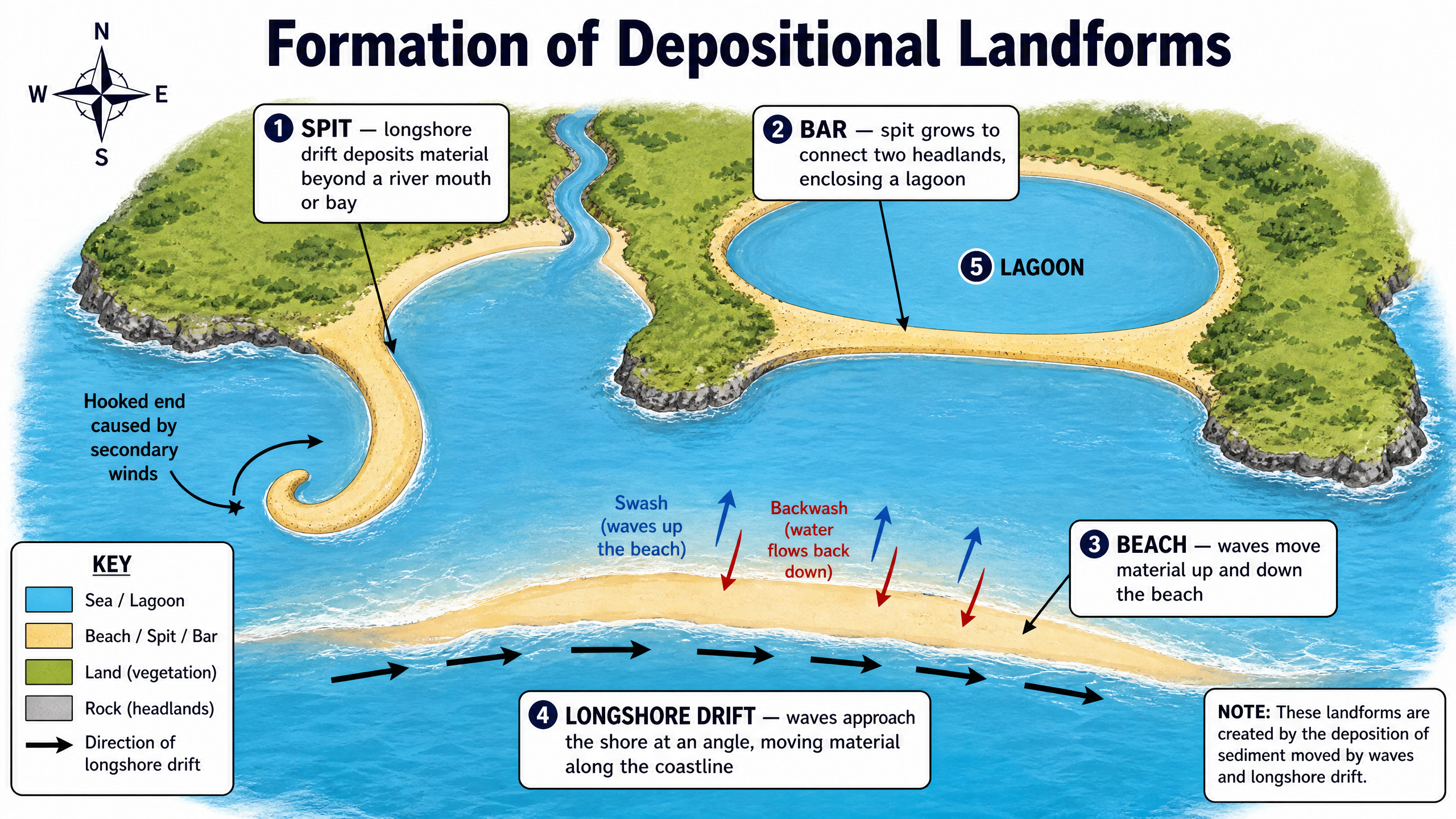
Deposition occurs when waves lose energy and drop the material they are carrying. This is driven by longshore drift — the zigzag movement of sediment along the coast caused by waves approaching at an angle to the prevailing wind.
Beaches
Formed by constructive waves depositing sand or shingle in sheltered areas like bays.
Spits
A long, narrow ridge of sand or shingle extending out from the coast into the sea or across a river estuary. Formed by longshore drift continuing to deposit material where the coastline changes direction. The end is often hooked or recurved due to a change in wind direction.
Named Example: Spurn Head, Holderness Coast.
Bars
Formed when a spit grows entirely across a bay, connecting two headlands and cutting off the water behind it to form a lagoon.
Named Example: Slapton Ley, Devon.
Visual Resources
3 diagrams and illustrations
Interactive Diagrams
2 interactive diagrams to visualise key concepts
Conceptual Flow Outline
The sequence of headland erosion
Conceptual Flow Outline
The process of longshore drift leading to spit formation
Worked Examples
3 worked examples — open one to explore the question and available guidance.
Practice Questions
Test your understanding — click to reveal model answers
Describe the differences between constructive and destructive waves. (4 marks)
Hint: Think about wave height, frequency, and the strength of the swash vs backwash.
Explain how a spit is formed. (6 marks)
Hint: Start with the prevailing wind and longshore drift, then explain what happens when the coastline changes shape.
Explain the role of hydraulic action in the formation of a cave. (3 marks)
Hint: Define the process and explain exactly what it does to the rock.
Using a named example, describe the features of a headland. (3 marks)
Hint: Remember to use the command word 'describe' — focus on what it looks like, not how it formed.
Explain how a bar is formed. (4 marks)
Hint: A bar is essentially an extension of a spit. What does it connect?