Pearson Edexcel · GCSE · Geography
Countries at different levels of development have water supply problems
Water is essential for life, yet its availability varies drastically across the globe. This study guide explores why countries at different levels of development—from the UK to Ethiopia—face unique water supply challenges, and how these impact people and economies.
- 5 min read
- 3 worked examples
- 2 practice questions
- 6 key terms
Study Notes
Overview
Fresh water covers only about 3% of all water on Earth, and most of that is locked in ice caps and glaciers. Consequently, the amount of accessible fresh water for humans is remarkably small. This topic is crucial for GCSE Geography because it requires you to understand the delicate balance between water supply and demand at different scales. Examiners expect candidates to distinguish clearly between the challenges faced by High-Income Countries (HICs) like the UK, and Low-Income Countries (LICs) or emerging economies. While the UK struggles with regional imbalances and ageing infrastructure, developing nations often face severe physical scarcity and a lack of basic infrastructure, leading to a devastating human cost.
Listen to the revision podcast for a comprehensive overview of this topic:

Water Supply Problems in the UK
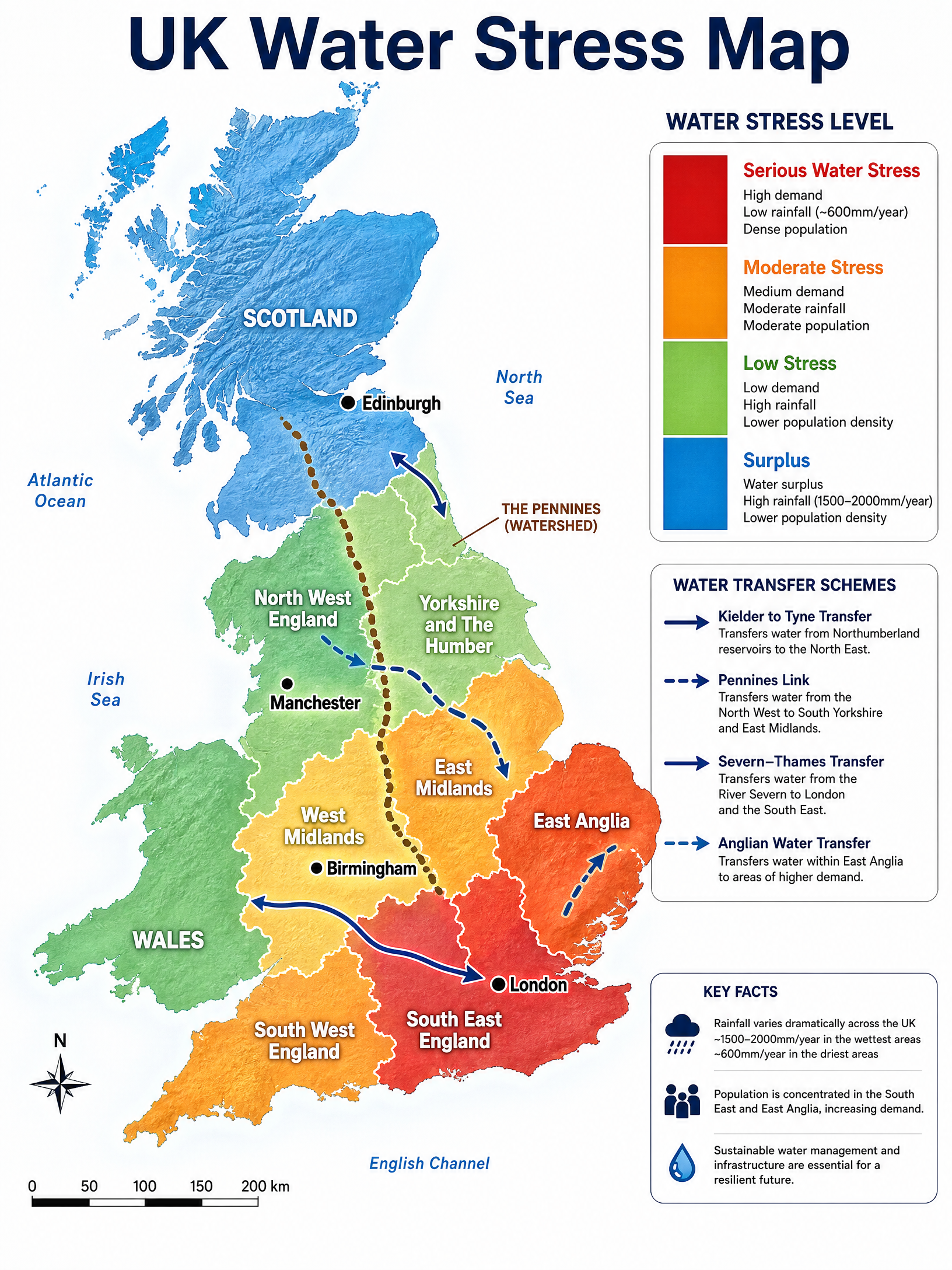
Despite its reputation for rainy weather, the UK faces significant water supply challenges. The core issue is not a total lack of water, but a geographical mismatch between supply and demand.
The North-South Divide
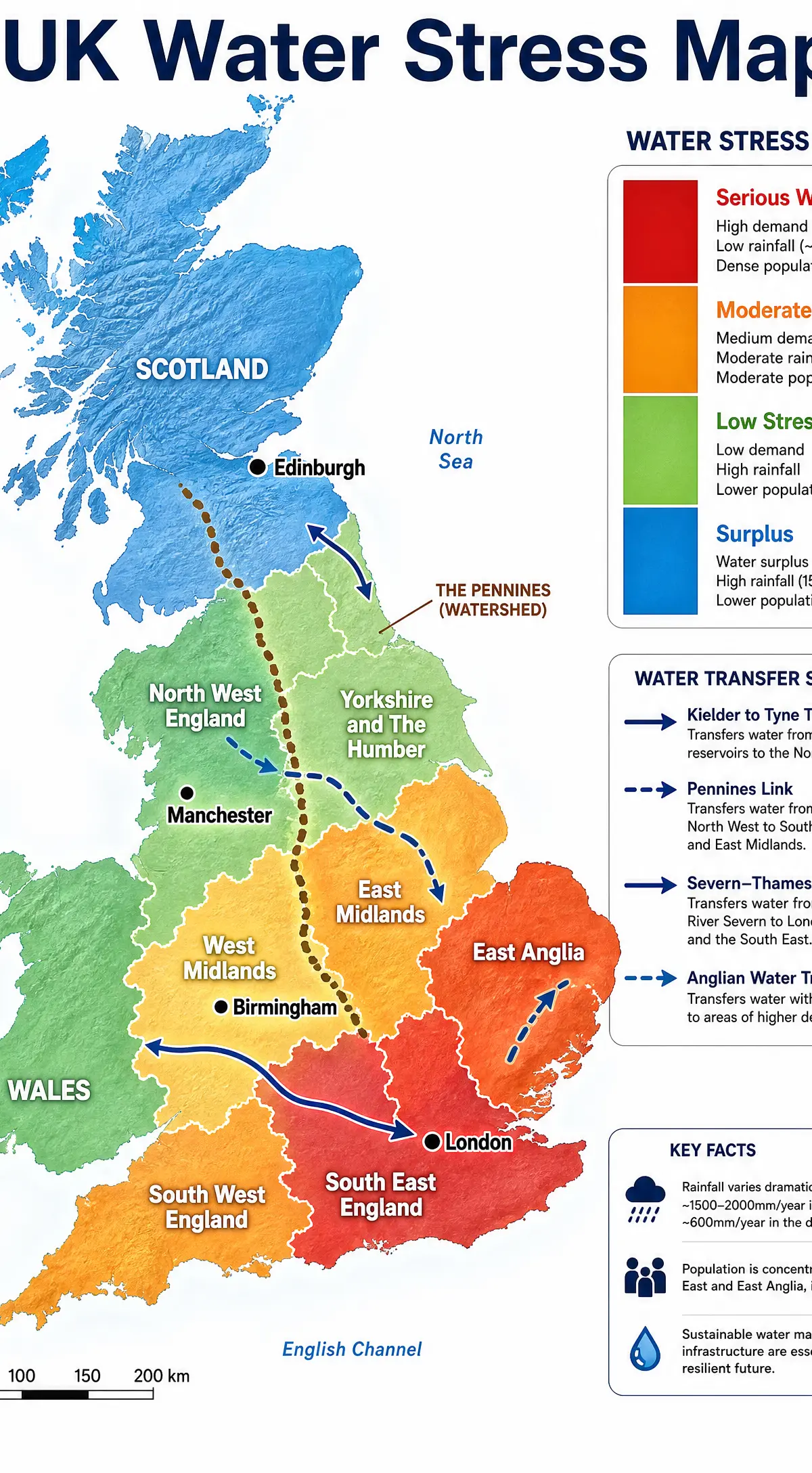
The Problem: The UK has a major geographical imbalance. The north and west (e.g., Scotland, Wales, the Lake District) receive very high rainfall, sometimes over 1500mm per year. However, the south and east (e.g., London, East Anglia) receive much less, sometimes as little as 600mm per year.
Why it matters: Crucially, the drier south and east are also where most of the UK population lives and where agricultural and industrial demand is highest. This creates areas of water deficit (where demand exceeds supply) in the south-east, while the north-west enjoys a water surplus.
Ageing Infrastructure
The Problem: Much of the UK's water pipe network was built during the Victorian era (the 1800s). These old pipes are prone to bursting and leaking.
Specific Knowledge: Water companies in England and Wales lose approximately 3 billion litres of water every single day through leakage. Thames Water alone loses around 600 million litres daily.
Seasonal Imbalances
The Problem: Even in wetter regions, rainfall is not spread evenly throughout the year. The UK typically receives more rainfall in winter, but water demand peaks in summer when people water gardens, fill paddling pools, and take more showers.
Water Supply Problems in Developing Countries
In emerging and developing countries, water supply challenges are often far more severe and directly threaten human life and economic development. The causes are a combination of physical and human factors.
Physical Causes
Low Annual Rainfall: Countries in sub-Saharan Africa, such as Mali, Niger, and Ethiopia, receive very little rainfall (often less than 300mm per year).
Seasonal Unreliability: The rainfall they do receive is highly seasonal and unreliable. When the seasonal rains fail, communities face severe drought.
Human Causes
Lack of Infrastructure: In many developing countries, there is simply not enough capital to invest in water treatment plants, extensive pipe networks, or modern sanitation systems.
Pollution: People often rely on untreated water from rivers, lakes, and shallow wells. These sources are frequently contaminated by untreated sewage, agricultural chemicals, or industrial waste.
Specific Knowledge: Around 2 billion people worldwide currently lack access to safely managed drinking water services.
Case Study: Ethiopia
Location: A landlocked country in the Horn of Africa.
Population: Over 120 million people.
The Challenge: Around 60% of the population lacks access to safe drinking water.
The Human Cost: Women and girls bear the brunt of this crisis, often walking several kilometres every day just to collect water. This time-consuming task prevents girls from attending school and women from engaging in economic activities, perpetuating the cycle of poverty.
Global Water Consumption Patterns
The way water is used varies enormously depending on a country's level of economic development.
Low-Income Countries (LICs)
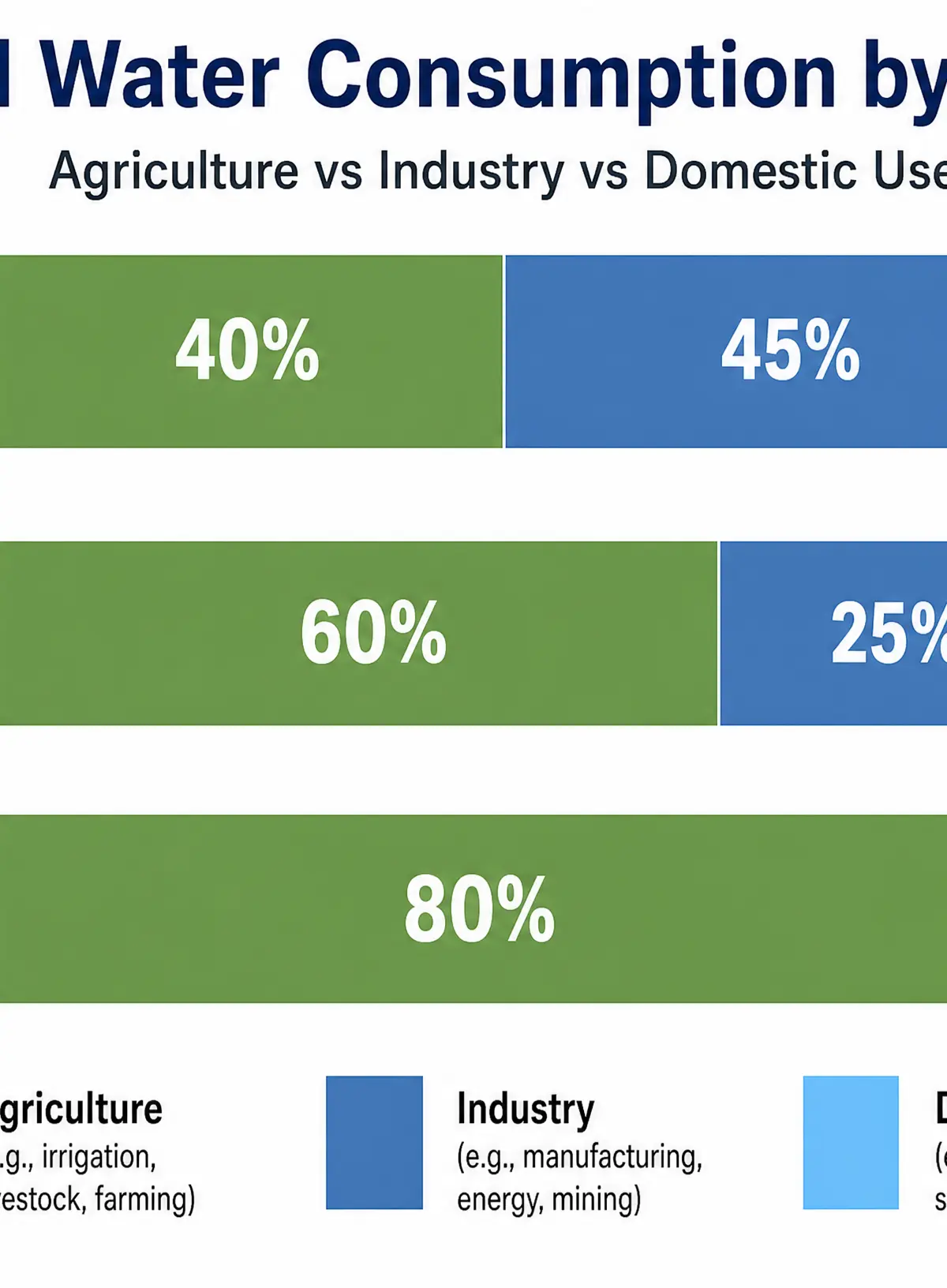
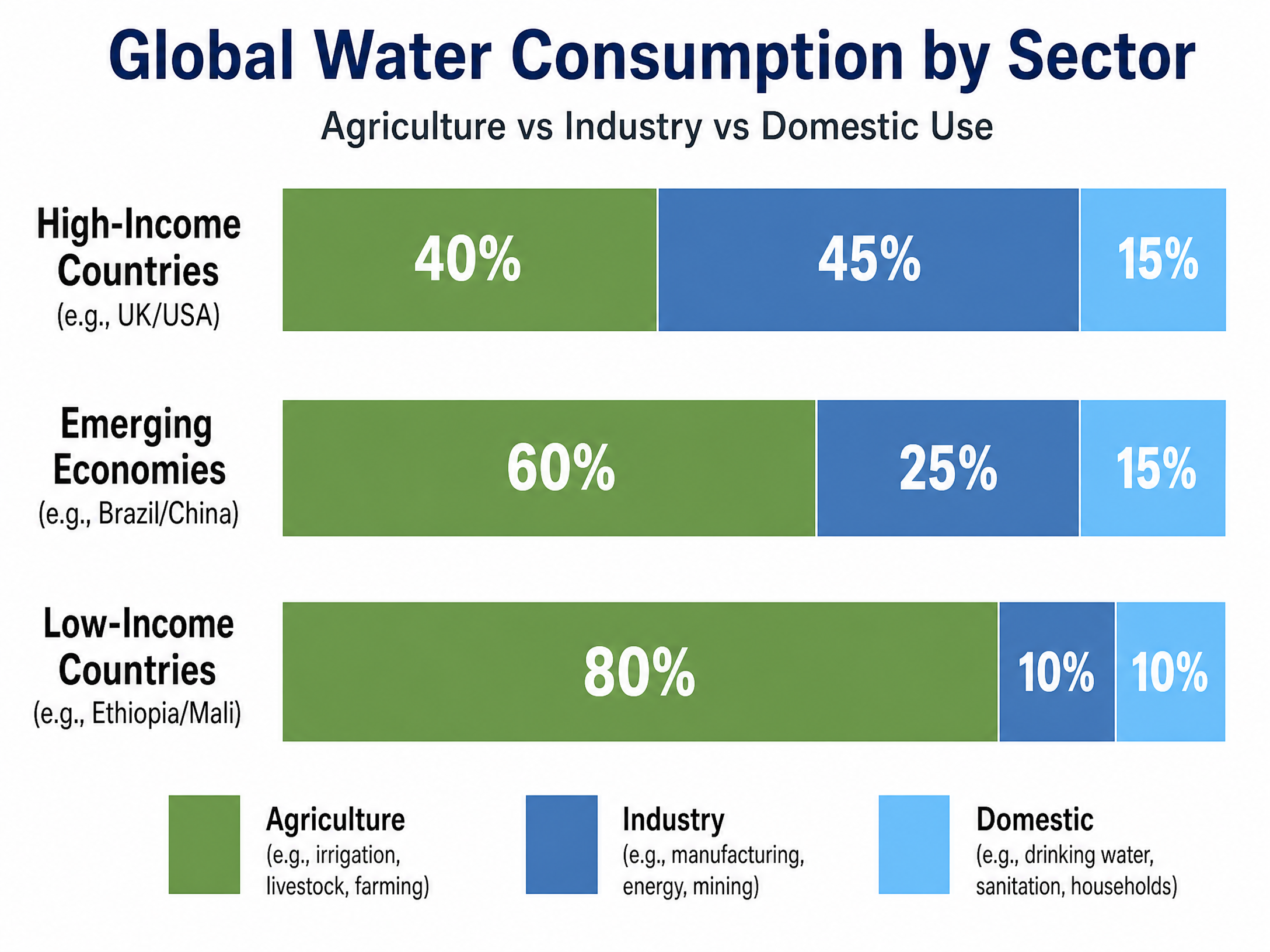
- Agriculture: Accounts for around 80% of all water use. Subsistence farming is the main livelihood, and irrigation is essential for survival.
- Industry: Uses very little (approx. 10%) due to a lack of manufacturing.
- Domestic: Around 10%.
High-Income Countries (HICs)
- Industry: The biggest user, accounting for around 45% of water use (e.g., cooling systems in power stations, manufacturing).
- Agriculture: Uses around 40%.
- Domestic: Around 15%.
This shift reflects economic development; as countries industrialise, water demand from the industrial sector grows significantly.
Visual Resources
2 diagrams and illustrations
Interactive Diagrams
1 interactive diagram to visualise key concepts
Conceptual Flow Outline
The interaction of physical and human factors causing water scarcity in developing countries.
Worked Examples
3 worked examples — open one to explore the question and available guidance.
Practice Questions
Test your understanding — click to reveal model answers
Explain how water consumption patterns change as a country becomes more economically developed. (4 marks)
Hint: Think about the shift from farming to manufacturing.
Outline one human and one physical cause of water supply problems in a named developing country. (4 marks)
Hint: Name your country first! Then give one climate reason and one money/infrastructure reason.