Pearson Edexcel · GCSE · Geography
Distinctive coastal landscapes are the outcome of the interaction between physical and human processes
Distinctive coastal landscapes are dynamic environments shaped by the constant interaction of physical forces and human intervention. Understanding this interplay is essential for explaining how iconic landforms develop and why coastal management decisions often have unintended consequences.
- 6 min read
- 2 worked examples
- 5 practice questions
- 6 key terms
Study Notes
Overview
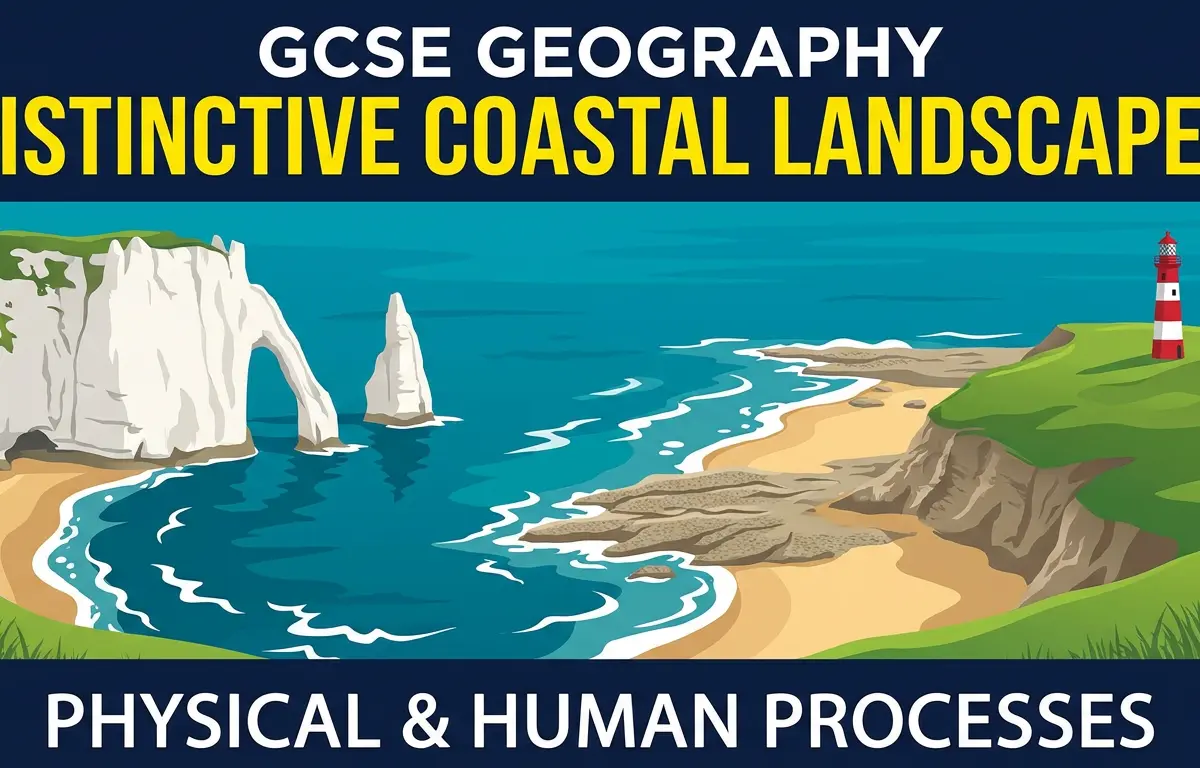
The UK coastline stretches for over 17,000 kilometres, featuring some of the most dynamic and distinctive landscapes in Europe. This topic focuses on the continuous interaction between physical processes (erosion, transportation, and deposition) and human activities (coastal management and settlement). Examiners expect candidates to not only describe physical landforms but to explain the complex relationship between natural forces and human intervention, using a specific named case study. For this guide, we focus on the Holderness Coast in East Yorkshire, renowned as the fastest eroding coastline in Europe.
Audio Revision
Listen to the companion podcast for this topic:

Physical Processes
Wave Types
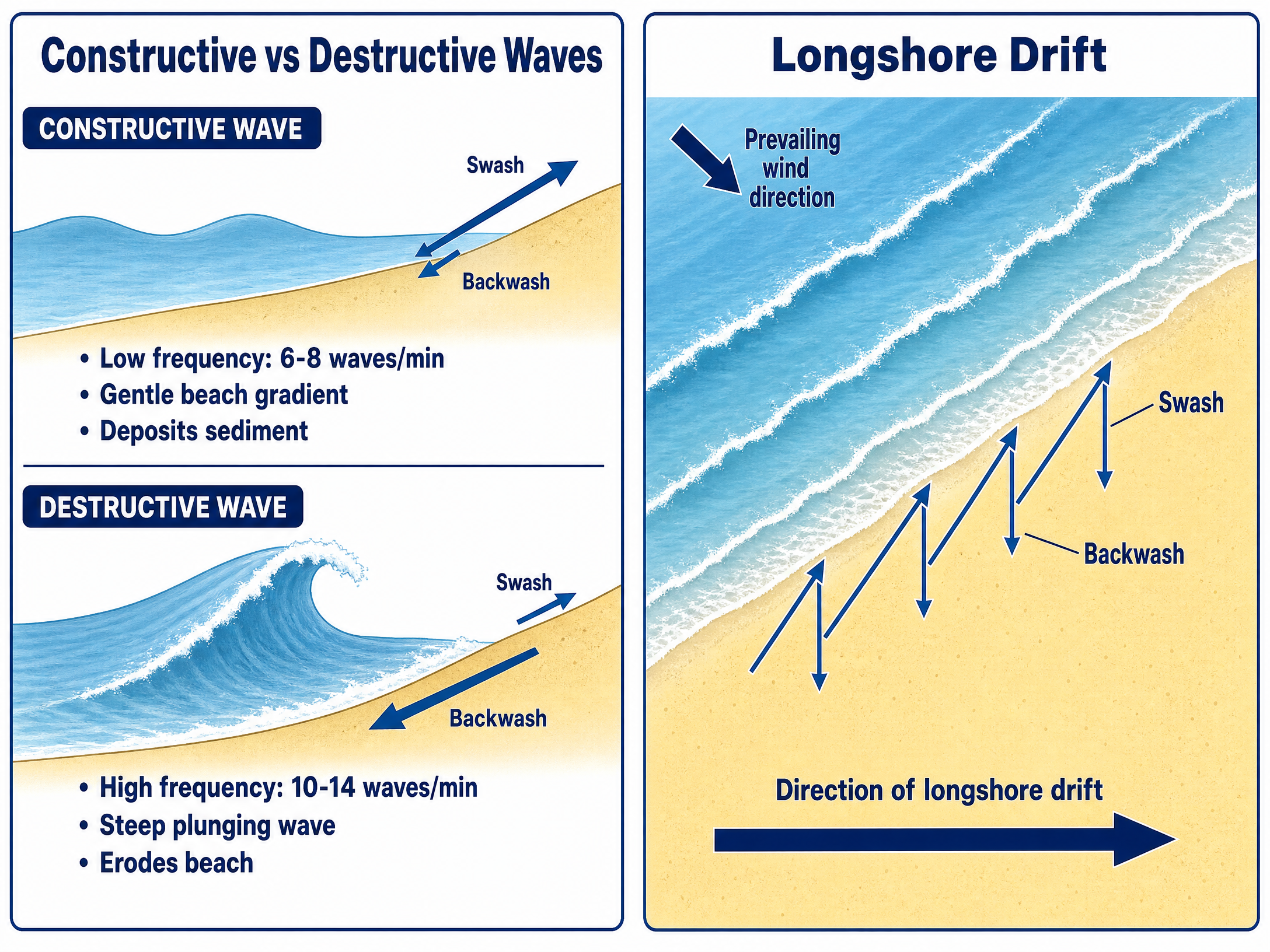
Waves are the primary physical force shaping the coast. They are created by wind blowing over the sea surface. The distance the wind blows is called the fetch.
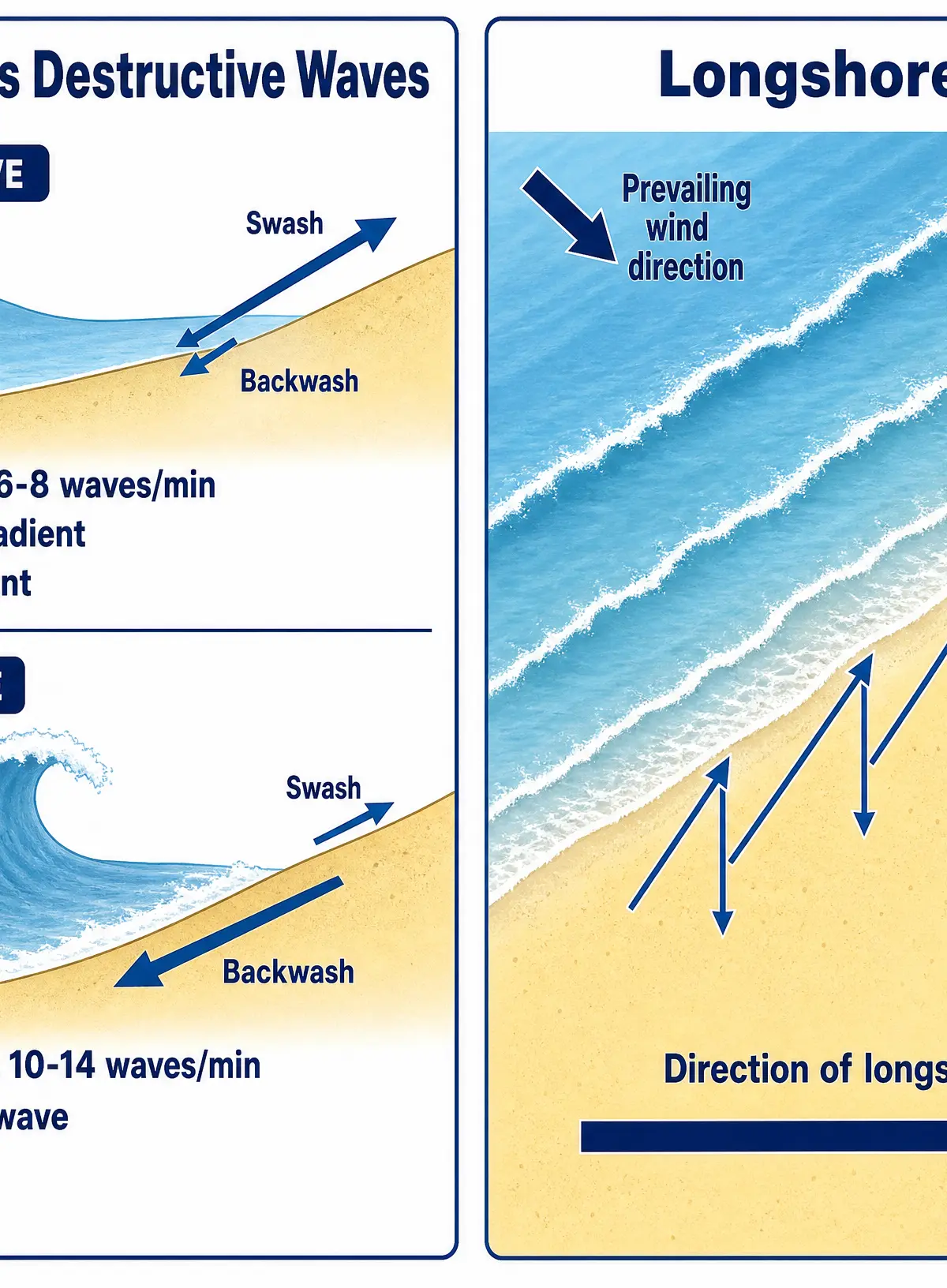
Destructive Waves:
- Formed by strong winds and long fetches.
- High frequency (10-14 waves per minute).
- Steep and plunging.
- Weak swash, strong backwash (they erode the beach).
Constructive Waves:
- Formed by gentle winds and short fetches.
- Low frequency (6-8 waves per minute).
- Low and long.
- Strong swash, weak backwash (they build up the beach).
Processes of Erosion
There are four key processes of coastal erosion that you must be able to explain:
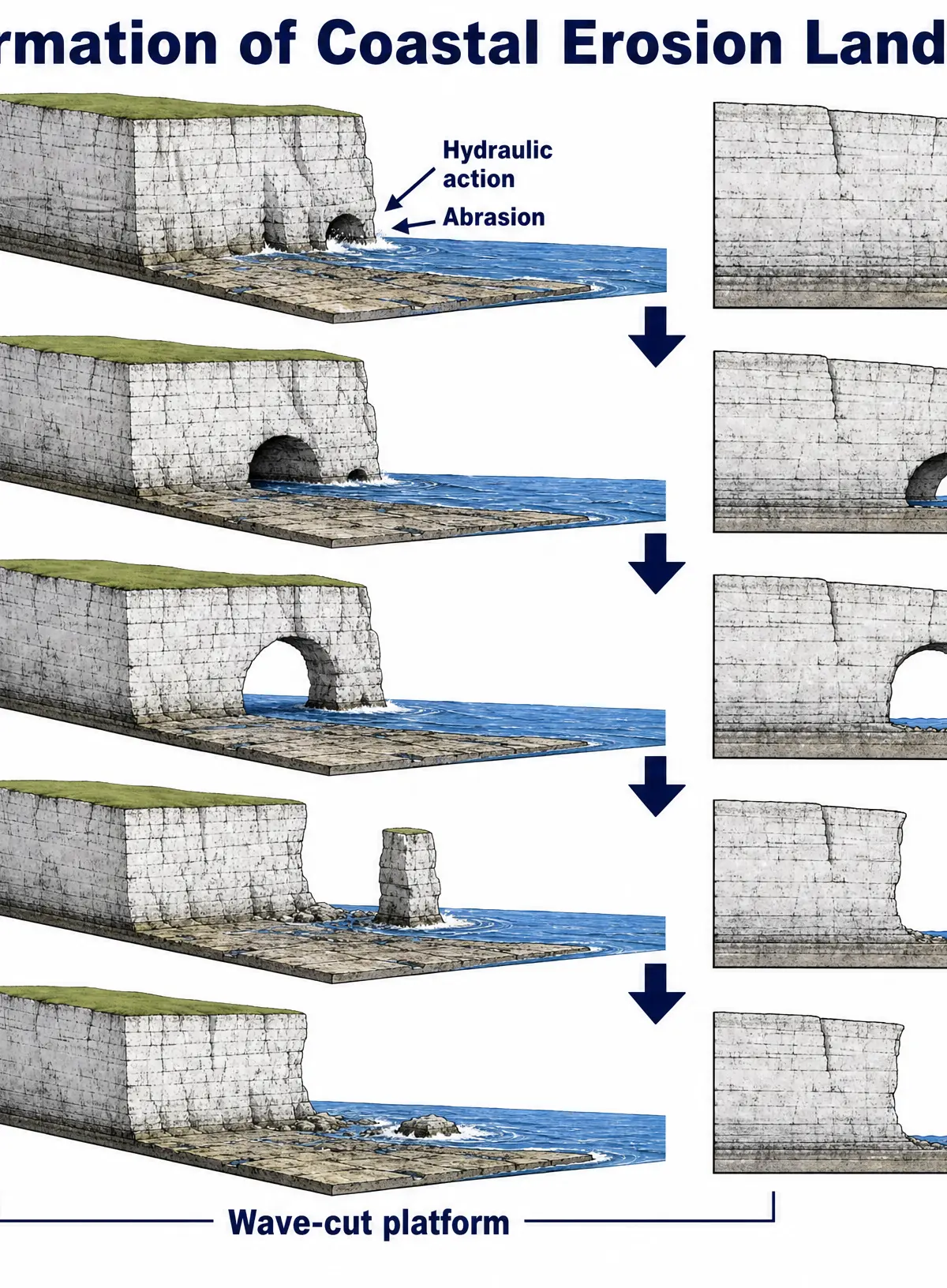
- Hydraulic Action: The sheer force of waves crashing against the cliff face compresses air into cracks and joints. As the wave retreats, the air expands explosively, shattering the rock.
- Abrasion (Corrasion): Waves pick up sediment (sand, pebbles, boulders) and hurl it against the cliff face, wearing it away like sandpaper.
- Attrition: Rocks and pebbles carried by the sea collide with each other, breaking into smaller, smoother, and rounder pieces over time.
- Solution (Corrosion): Slightly acidic seawater dissolves soluble minerals in certain rock types, such as chalk and limestone.
Coastal Landforms of Erosion
Erosion creates a distinctive sequence of landforms, particularly on coastlines with alternating bands of hard and soft rock (discordant coastlines).
Headlands and Bays
Headlands are promontories of harder rock (e.g., chalk or limestone) that jut out into the sea because they are more resistant to erosion. Bays form where softer rock (e.g., clay or sand) is eroded more rapidly, creating an indentation in the coastline, often featuring a beach.
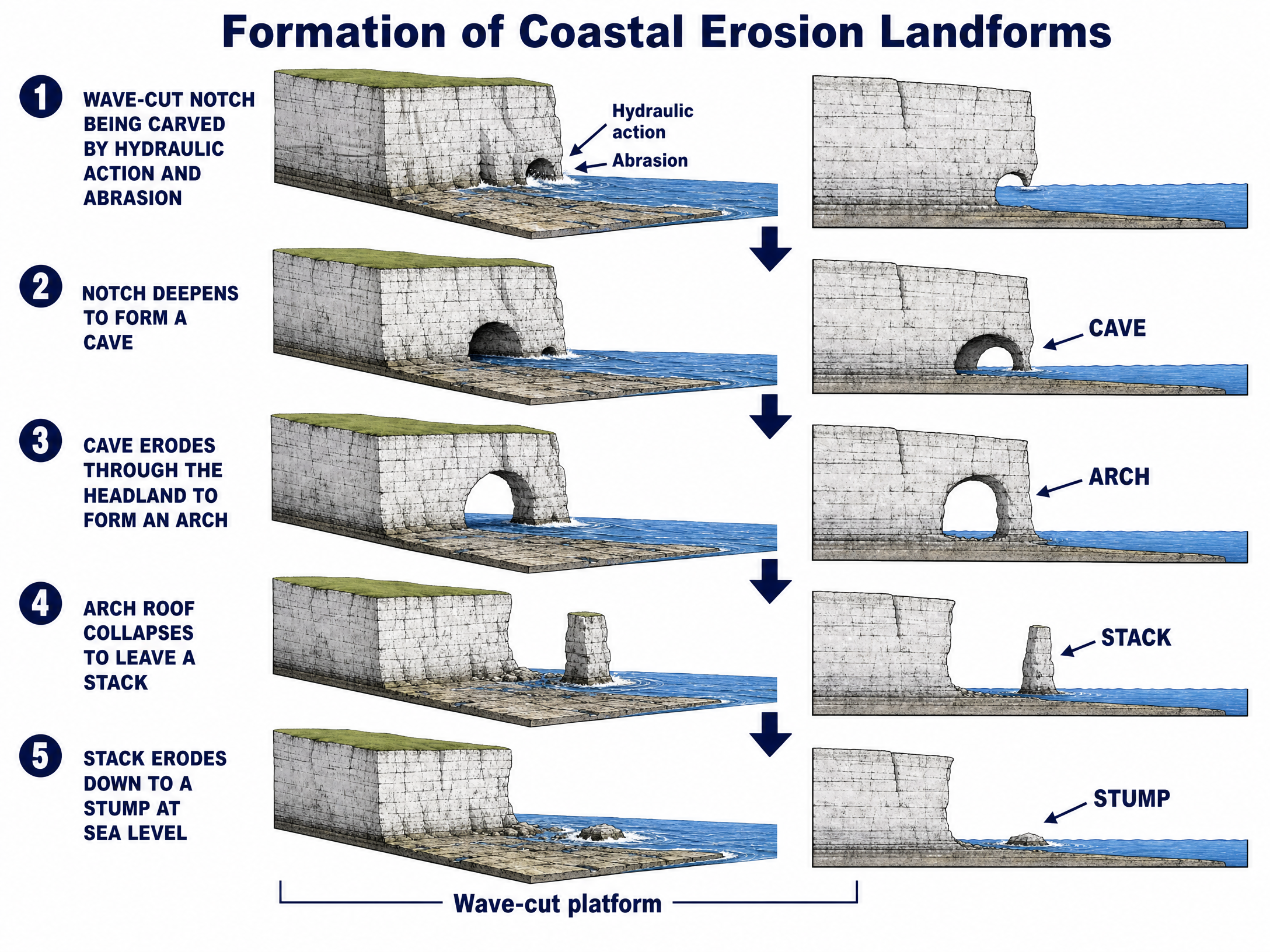
The Cave, Arch, Stack, Stump Sequence
- Crack: Hydraulic action and abrasion exploit weaknesses (joints/faults) in a headland.
- Cave: Continued erosion widens the crack into a cave.
- Arch: If the cave erodes all the way through the headland, an arch is formed.
- Stack: Weathering weakens the arch roof, and eventually it collapses, leaving an isolated pillar of rock (a stack).
- Stump: The stack is eroded at its base and eventually collapses to form a stump, visible only at low tide.
Processes of Transportation and Deposition
Longshore Drift
Sediment is transported along the coast by longshore drift.
- Prevailing winds cause waves to approach the beach at an angle.
- The swash carries sediment diagonally up the beach.
- Gravity pulls the backwash straight back down the beach at a 90-degree angle.
- This creates a zigzag movement of sediment along the coastline.
Depositional Landforms
When waves lose energy (e.g., in sheltered bays or where the coastline changes direction), they drop their sediment load. This forms features such as:
- Beaches: Accumulations of sand and shingle in bays.
- Spits: Long, narrow ridges of sand or shingle extending out into the sea or across an estuary, formed when longshore drift continues past a change in coastal direction.
Case Study: The Holderness Coast
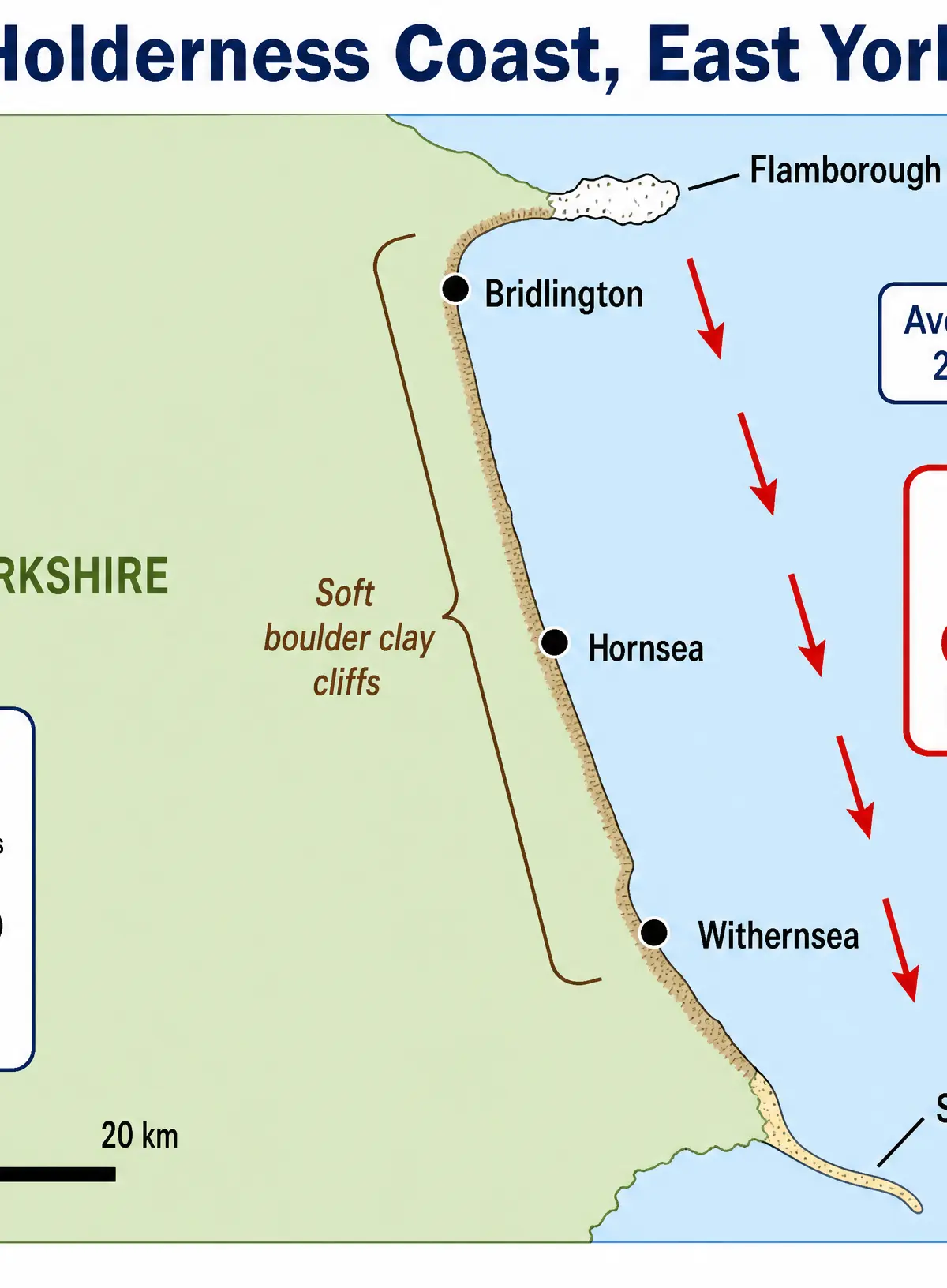
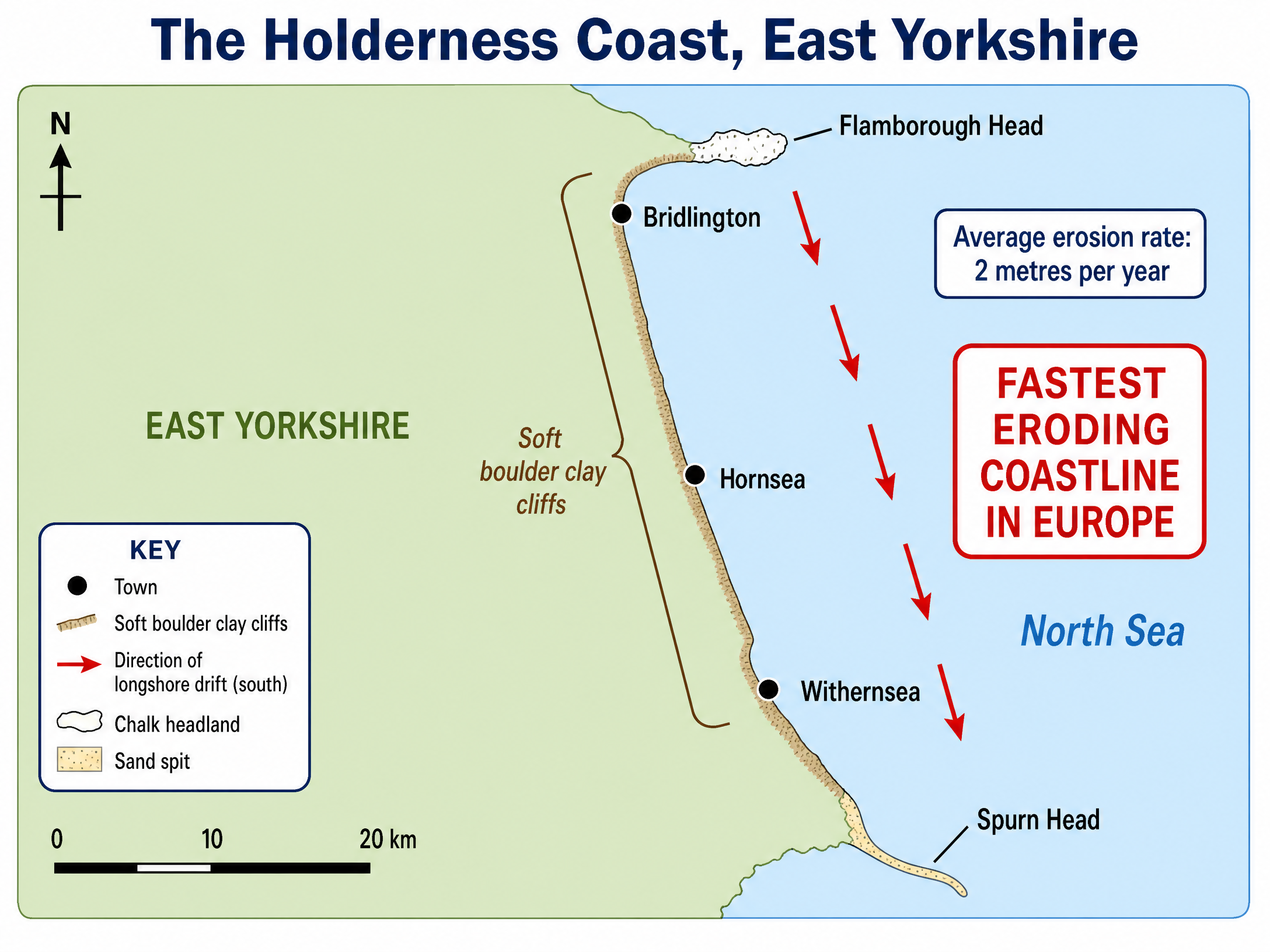
The Holderness Coast in East Yorkshire is an essential case study demonstrating the interaction of physical and human processes.
Key Facts:
- Stretches 61km from Flamborough Head to Spurn Head.
- Fastest eroding coastline in Europe (average 2 metres per year).
- Over 30 villages lost since Roman times.
Physical Factors Causing Rapid Erosion
- Geology: The cliffs are made of soft boulder clay (glacial till), which offers little resistance to erosion and is prone to slumping when wet.
- Fetch: The coast is exposed to powerful destructive waves driven by strong winds across the North Sea, with a fetch extending to Scandinavia.
- Beach Profile: The beaches are narrow, providing little friction to absorb wave energy before it hits the cliffs.
Human Intervention and Its Impacts
Human management at specific locations has had profound unintended consequences elsewhere.
Mappleton (1991):
- Action: £2 million spent on rock armour and two rock groynes to protect the village and the B1242 coastal road.
- Local Impact: The groynes successfully trapped sediment, building up a wider beach and protecting Mappleton from erosion.
- Wider Impact: By trapping sediment, the groynes starved the beaches to the south (e.g., Great Cowden) of material. This process is called terminal groyne syndrome. Without a protective beach, the cliffs to the south experienced accelerated erosion, causing farmers to lose valuable agricultural land.
The Spurn Head Conflict
Spurn Head is a 5.5km sand and shingle spit at the southern tip of Holderness. It relies entirely on sediment eroded from the cliffs further north. If human intervention completely stopped erosion along the Holderness Coast, Spurn Head would be starved of sediment and eventually wash away, destroying a vital nature reserve and leaving the Humber Estuary vulnerable.
Visual Resources
3 diagrams and illustrations
Interactive Diagrams
1 interactive diagram to visualise key concepts
Conceptual Flow Outline
The Process of Longshore Drift
Worked Examples
2 worked examples — open one to explore the question and available guidance.
Practice Questions
Test your understanding — click to reveal model answers
Explain how physical and human processes interact to cause rapid coastal erosion at a named location. (6 marks)
Hint: You must name a location (e.g., Holderness). Discuss both the natural geology/waves AND how human management (groynes) has worsened erosion elsewhere.
Describe the characteristics of constructive waves. (2 marks)
Hint: Think about their shape, frequency, and the balance between swash and backwash.
Explain the formation of a spit. (4 marks)
Hint: Start with longshore drift, mention what happens when the coast changes direction, and describe deposition.
Outline one physical factor that affects the rate of coastal erosion. (2 marks)
Hint: Choose one factor (e.g., rock type or wave energy) and state how it changes the speed of erosion.
To what extent do physical processes control the development of coastal landforms? (9 marks)
Hint: Evaluate the importance of physical processes (erosion/deposition) versus human processes (coastal management). Reach a conclusion.