Pearson Edexcel · GCSE · Geography
Globalisation and economic change create challenges for the chosen UK city that require long-term solutions
This study guide explores how globalisation and economic change have transformed major UK cities like Manchester. It examines the causes of deindustrialisation, the resulting social inequalities, and the long-term sustainable strategies needed to manage these urban challenges.
- 5 min read
- 3 worked examples
- 5 practice questions
- 6 key terms
Study Notes
Overview
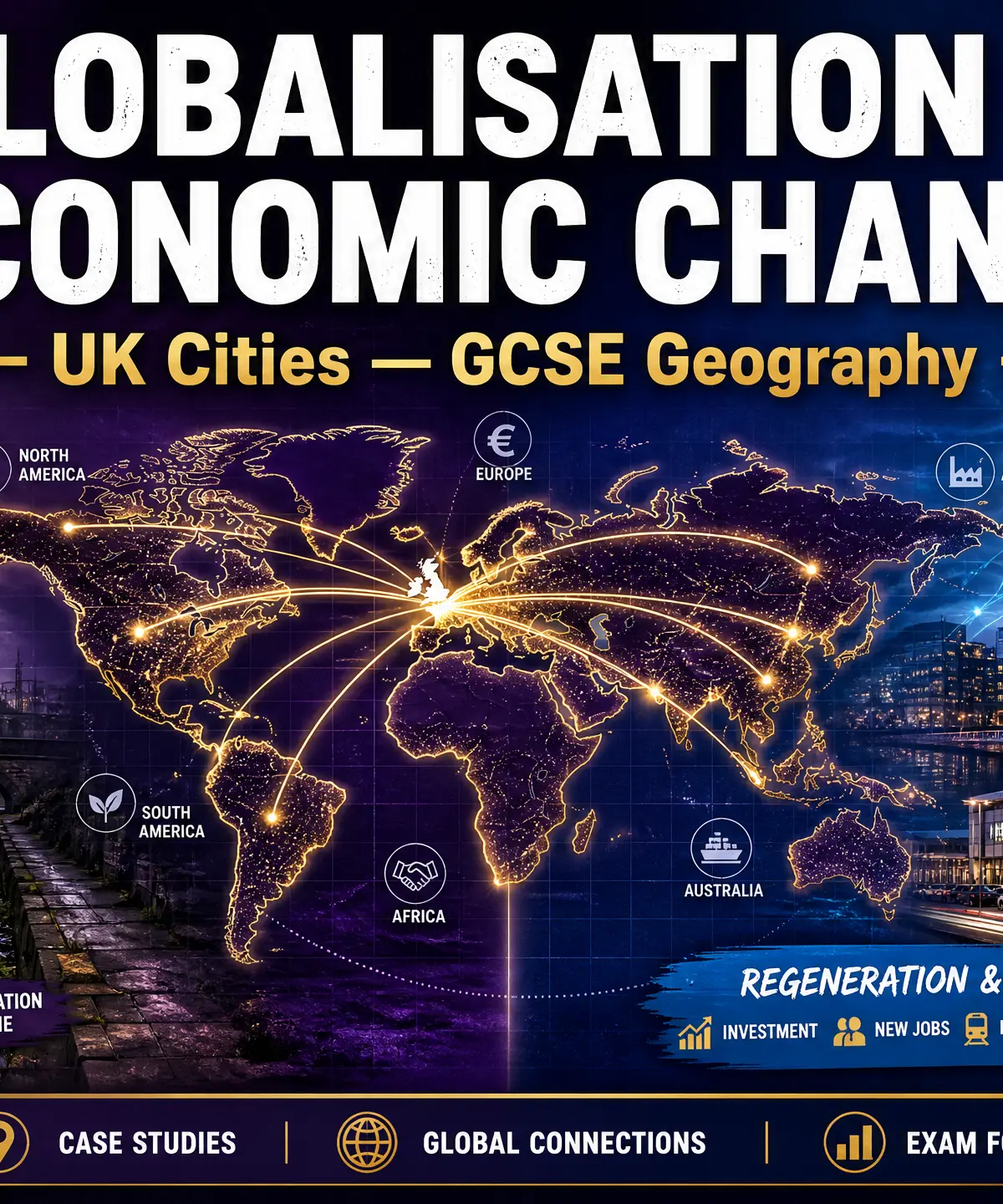
This topic examines how globalisation and economic change impact the structure, population, and sustainability of a chosen major UK city (our case study is Manchester). Examiners expect candidates to understand the historical shift from a manufacturing-based economy to a service and digital economy, and how this transition has created both opportunities and profound challenges.
You must be able to explain the causes of deindustrialisation, evaluate its social and economic impacts (such as rising inequality and changes in quality of life), and assess the shift in retailing away from the Central Business District (CBD). Crucially, examiners reward students who can critically evaluate the long-term strategies implemented to create sustainable urban living.
Key Geographical Processes
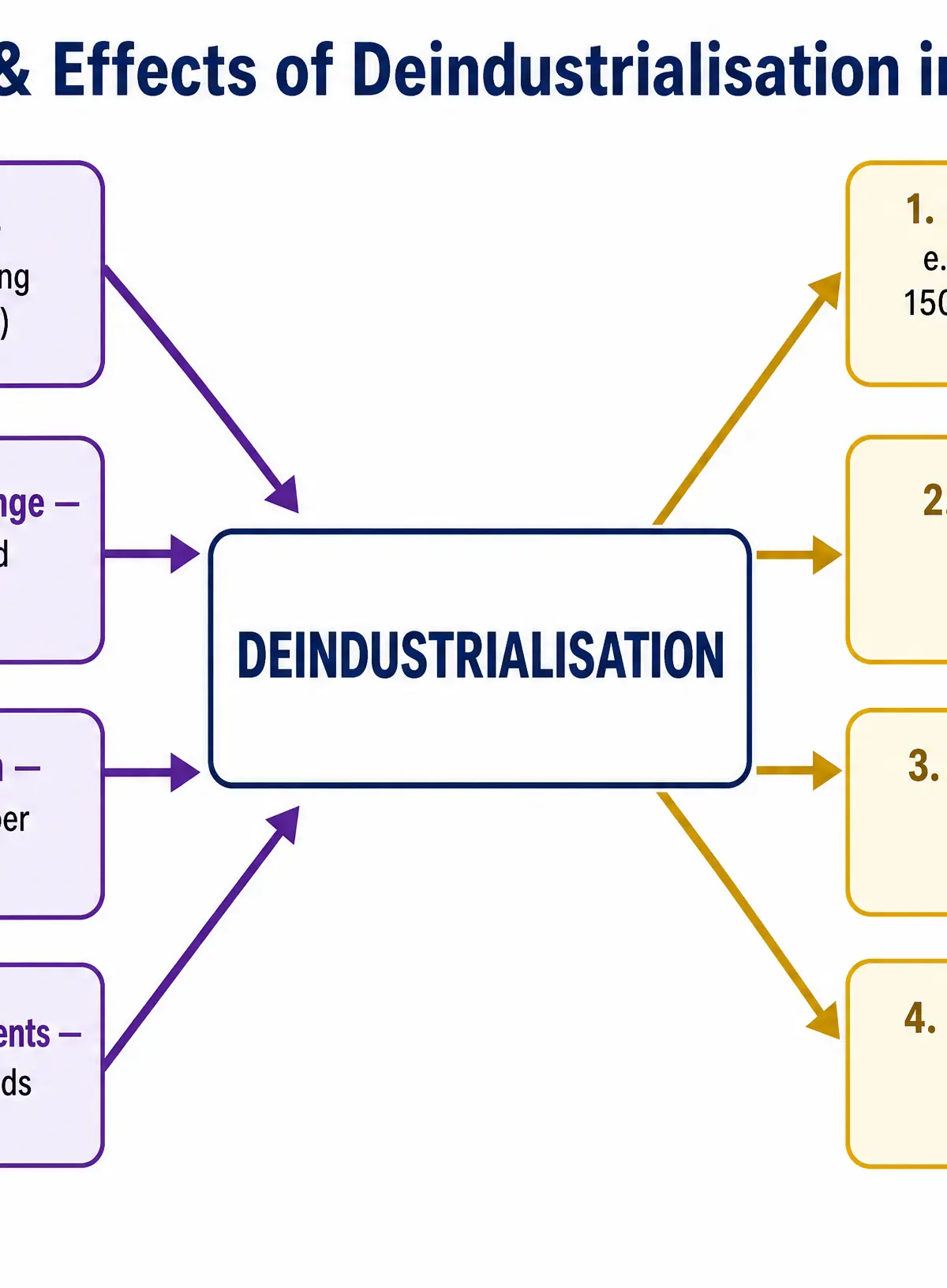
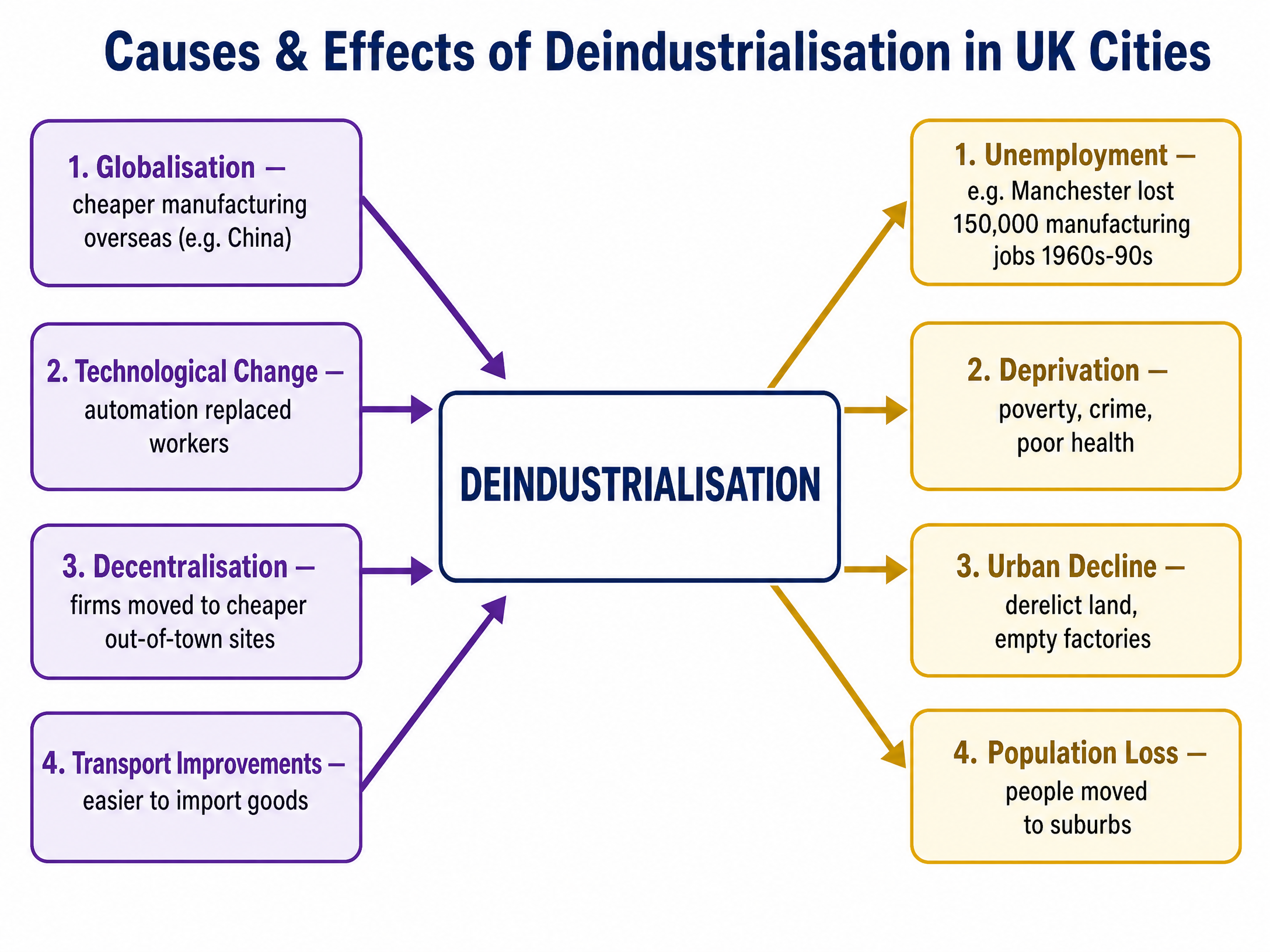
Deindustrialisation
Definition: The decline of manufacturing industry in an area or country.
Causes:
- Globalisation: Cheaper labour costs in newly emerging economies (NEEs) like China meant UK manufacturers could not compete.
- Technological Advances: Automation and computerisation replaced human workers in factories.
- Decentralisation: Firms moved from cramped inner-city sites to cheaper, more spacious out-of-town industrial estates.
- Transport Developments: Containerisation and improved logistics made it cheaper to import goods rather than produce them locally.
Impacts on Manchester: Manchester lost around 150,000 manufacturing jobs between the 1960s and 1990s, leading to widespread dereliction in inner-city areas like Ancoats and Hulme.
Economic Change and Inequality
The shift from manufacturing to a knowledge-based economy created severe urban inequality. While some residents secured high-paying jobs in finance and media, former industrial workers faced structural unemployment.
Evidence from Manchester (2011 Census):
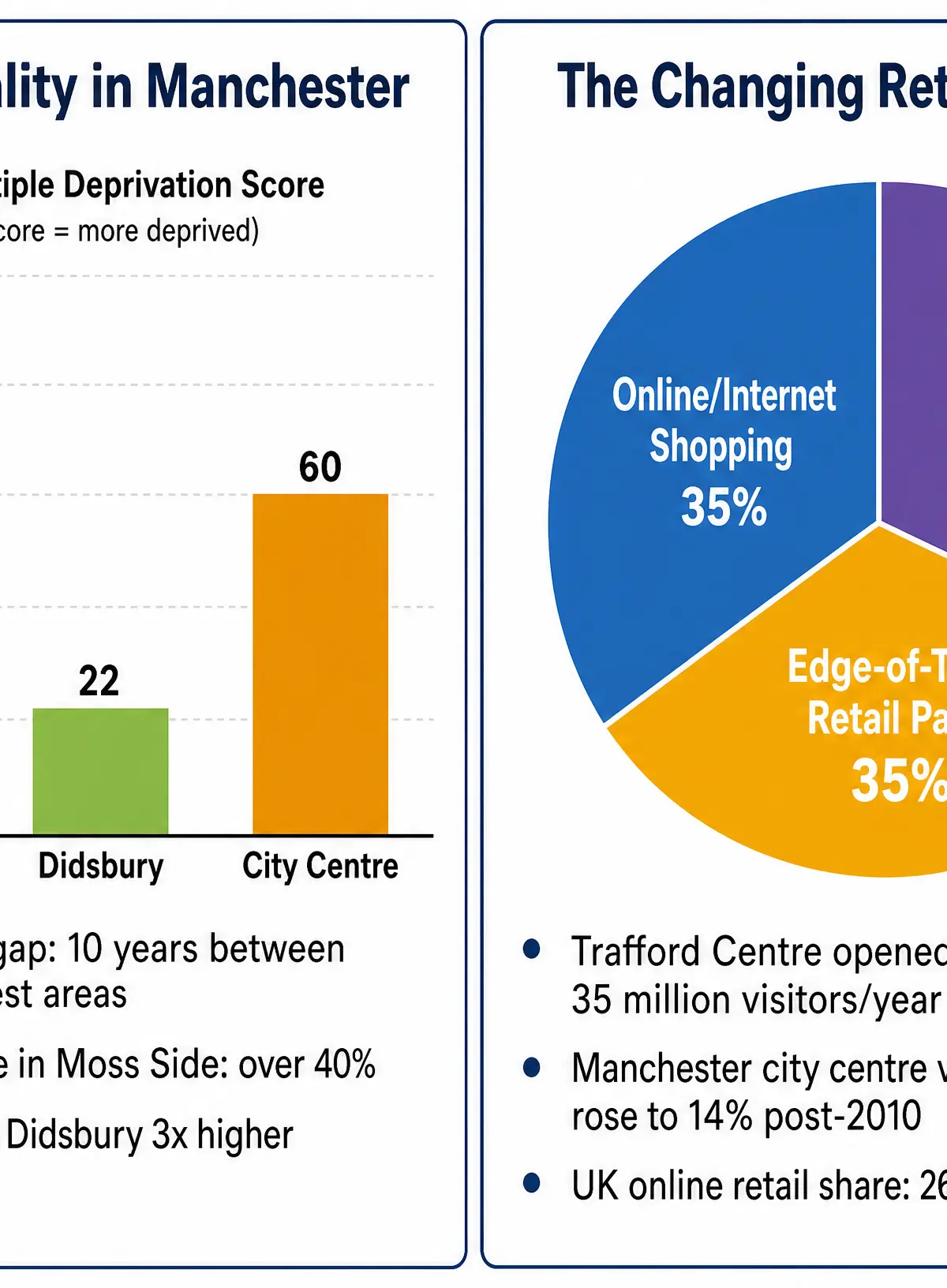
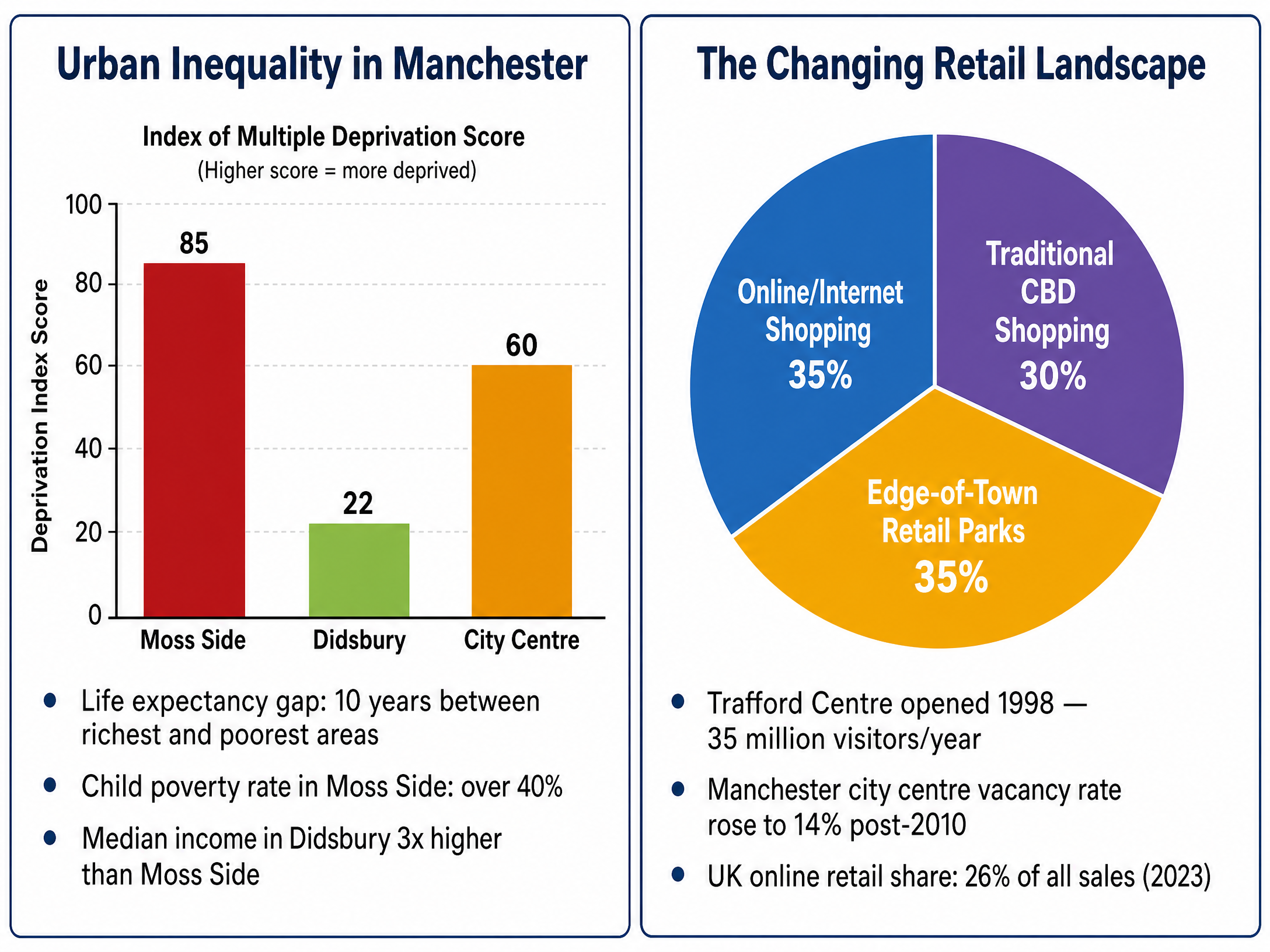
- Life Expectancy Gap: There is an approximate 10-year gap in life expectancy between affluent areas like Didsbury and deprived inner-city wards like Moss Side.
- Child Poverty: Rates exceeded 40% in some inner-city wards compared to under 10% in affluent suburbs.
- Housing: Deprived areas suffer from lower quality housing, higher crime rates, and poorer health outcomes, creating a 'cycle of deprivation'.
Changes in Retailing
The Decline of the CBD:
The traditional city centre faced intense competition from two main sources:
- Edge-of-Town Retail Parks: e.g., The Trafford Centre (opened 1998), offering free parking and weather-proof shopping, attracting 35 million visitors annually.
- Internet Shopping: Online retail accounted for 26% of UK sales by 2023, causing high street chains to close and increasing city centre vacancy rates (reaching 14% post-2010).
Strategies for Sustainable Urban Living
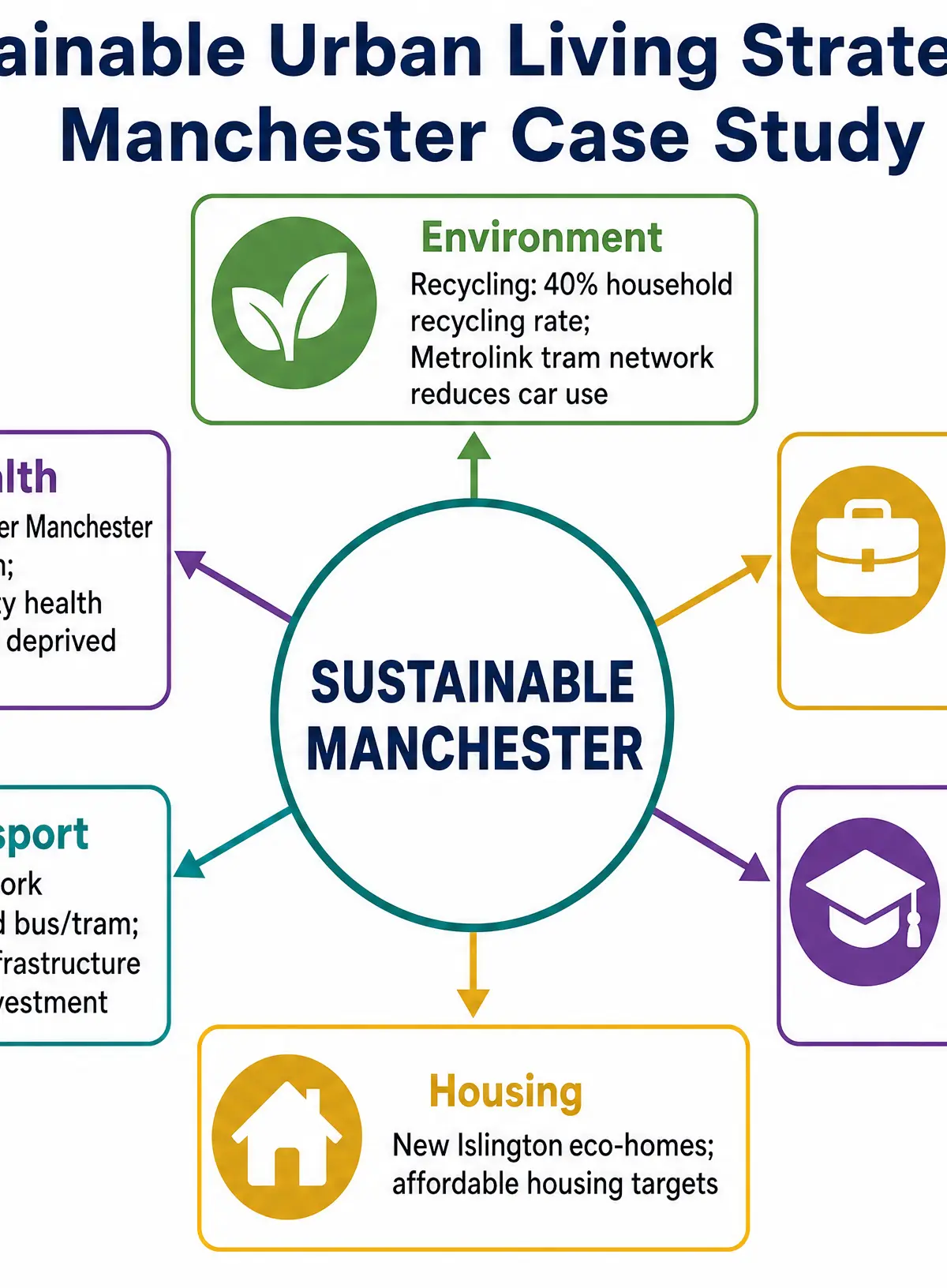
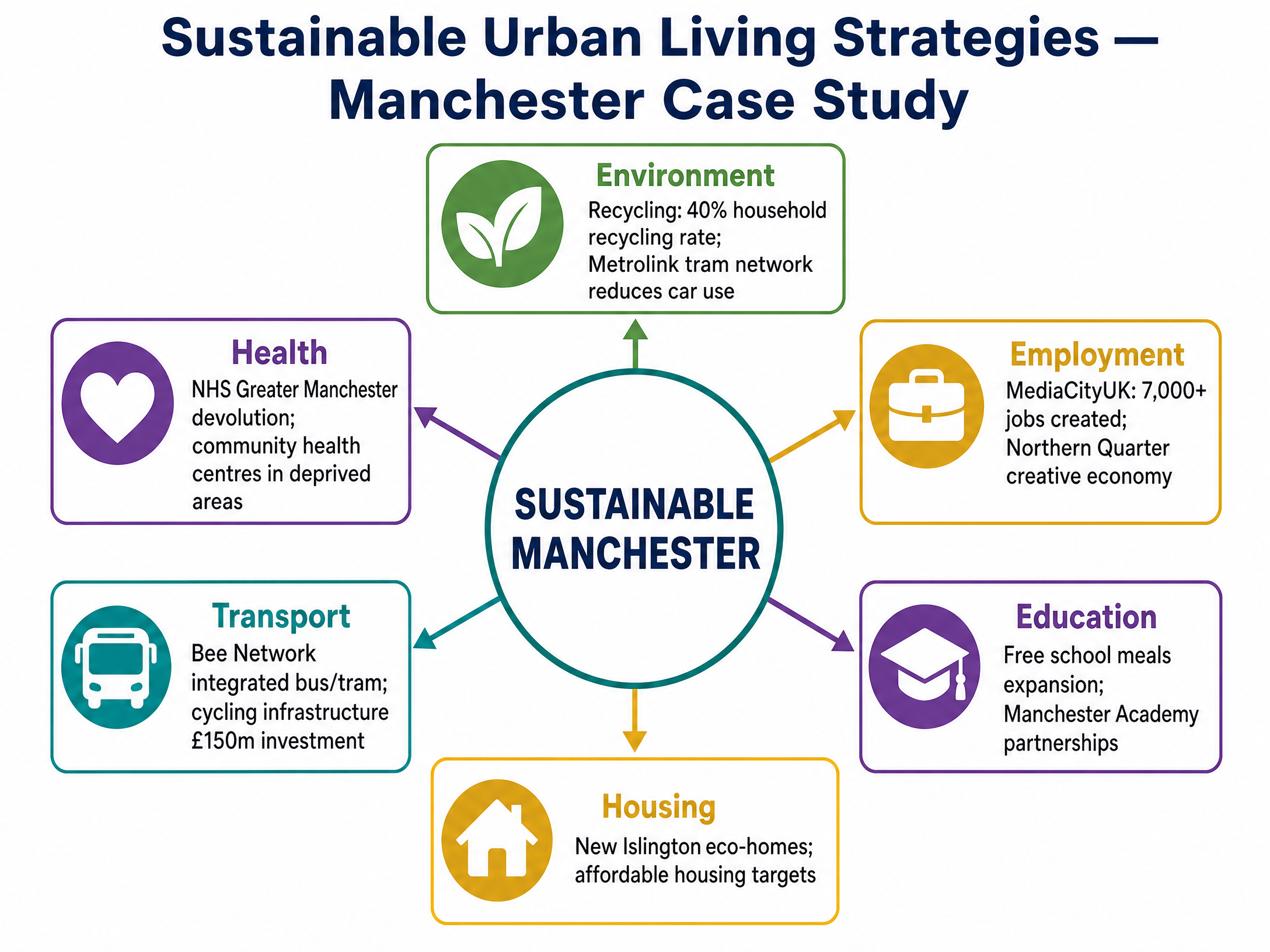
To combat these challenges, Manchester has implemented various long-term sustainability strategies:
Employment: MediaCityUK in Salford regenerated former docks, creating over 7,000 jobs in media and tech (BBC, ITV). Evaluation: Successful economically, but many jobs went to highly-skilled commuters rather than deprived local residents.
Transport: The Metrolink tram network and the integrated Bee Network reduce car dependency. Evaluation: Excellent for reducing carbon emissions, but tickets can be expensive for low-income families.
Housing: Projects like New Islington provide eco-friendly homes on brownfield sites. Evaluation: Improves the environment, but 'gentrification' often prices out original local residents.
Environment: Manchester aims to be zero-carbon by 2038, with household recycling rates reaching 40%.
Podcast Revision
Listen to this 12-minute revision podcast covering all the key concepts, specific Manchester case study facts, and examiner tips for this topic.

Visual Resources
3 diagrams and illustrations
Interactive Diagrams
1 interactive diagram to visualise key concepts
Conceptual Flow Outline
The chain of causation from Globalisation to Urban Inequality
Worked Examples
3 worked examples — open one to explore the question and available guidance.
Practice Questions
Test your understanding — click to reveal model answers
State two causes of deindustrialisation in the UK. (2 marks)
Hint: Think about GTDT.
Explain how changes in retailing have affected the Central Business District (CBD) of a UK city you have studied. (4 marks)
Hint: Mention edge-of-town parks and internet shopping, and give a specific fact about your city.
Evaluate the success of strategies to improve transport sustainability in a named UK city. (6 marks)
Hint: Evaluate means you need successes and limitations. Use the SEE pillars.
Explain how economic change has created inequality in a UK city you have studied. (6 marks)
Hint: Contrast a deprived area with an affluent area using Census data.
Assess the impacts of deindustrialisation on the physical environment of UK cities. (4 marks)
Hint: Focus on the physical landscape, not the people or the economy.