Pearson Edexcel · GCSE · Geography
Large-scale ecosystems are found in different parts of the world and are important
This study guide covers the global distribution and characteristics of large-scale ecosystems, known as biomes. You will explore how climate, altitude, and soils shape these environments, understand the biosphere's crucial role as a resource provider, and examine the unique terrestrial and marine ecosystems found in the UK.
- 7 min read
- 3 worked examples
- 5 practice questions
- 6 key terms
Study Notes
Overview
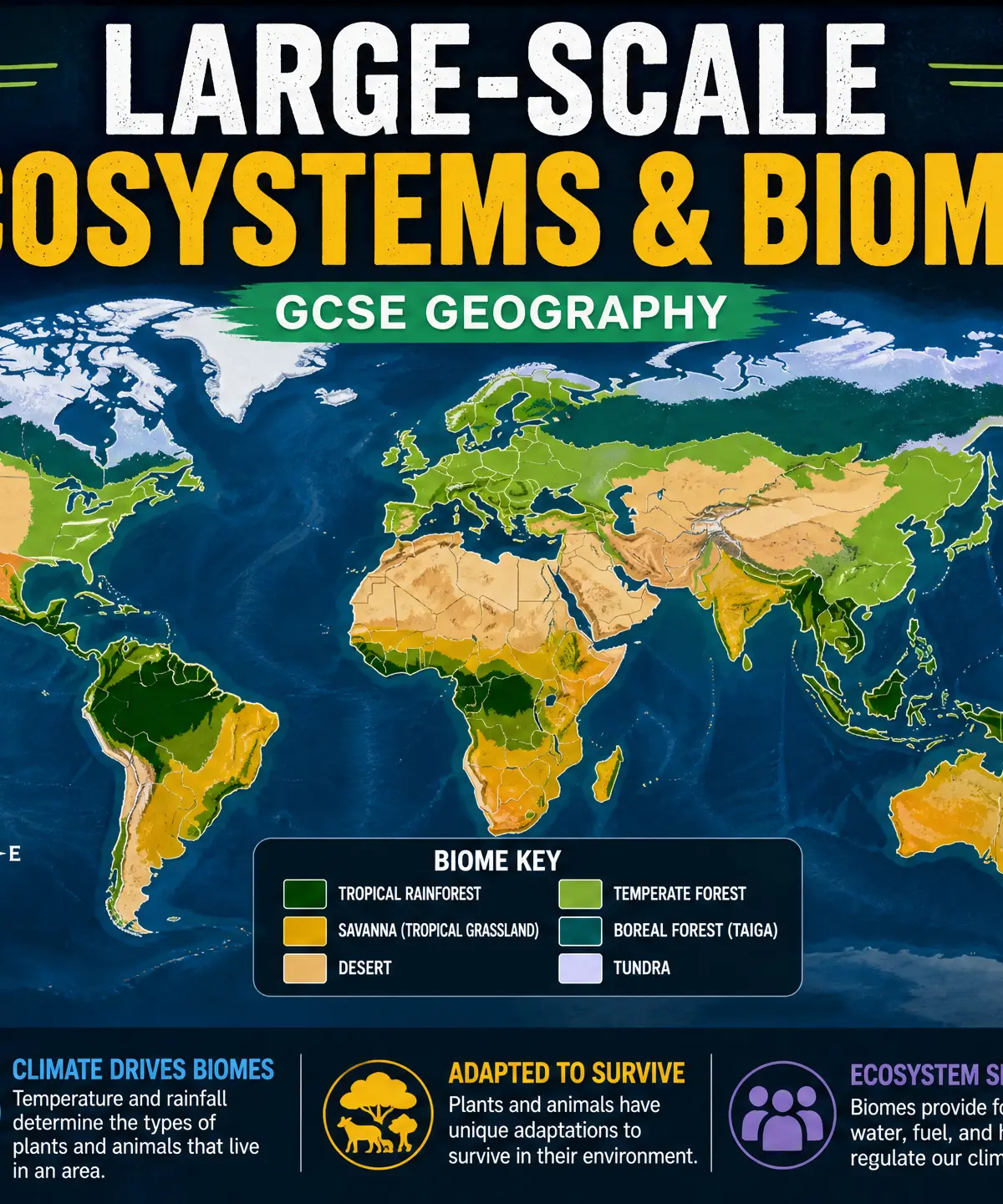
Large-scale ecosystems, or biomes, are vast areas of the Earth's surface defined by their unique climate and the plants and animals adapted to live there. Understanding these biomes is central to GCSE Geography because it links physical processes (like climate) with human interactions (like resource exploitation). Examiners expect you to know the characteristics and distribution of the major global biomes, specifically tropical rainforests, savannas, hot deserts, temperate grasslands, temperate forests, boreal forests (taiga), and tundra.
Crucially, you must be able to explain why these biomes are located where they are, focusing on temperature and precipitation, while also considering local factors like altitude and soils. Furthermore, the specification requires an understanding of the biosphere as a vital system that provides essential resources (food, medicine, building materials, and fuel) and the tension between sustainable use and commercial exploitation. Finally, you will need to apply this knowledge to the UK, identifying key terrestrial ecosystems (moorlands, heathlands, woodlands, wetlands) and marine environments, and discussing the human impacts degrading them.
Global Biomes and Climate
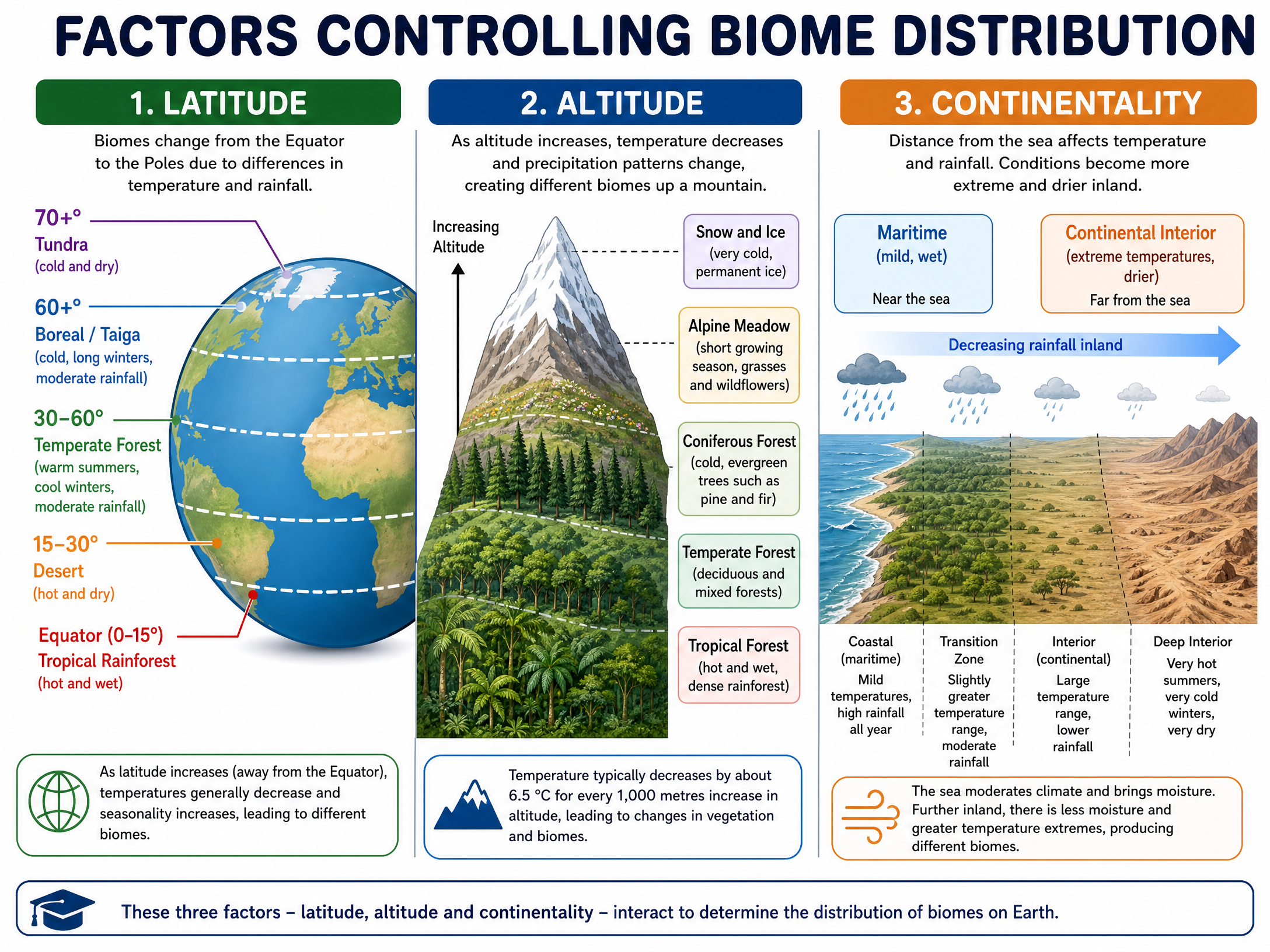
The distribution of biomes is primarily controlled by the global climate, specifically temperature and rainfall, which are influenced by latitude, atmospheric pressure belts, and ocean currents.
Tropical Rainforests
Location: Centred on the Equator (0° to 10° N/S), e.g., Amazon Basin, Congo Basin.
Climate: Hot (approx. 27°C) and wet (over 2000mm rainfall) all year round. Low pressure dominates.
Characteristics: Dense, multi-layered canopy; extremely high biodiversity; nutrient-poor soils (latosols) due to rapid leaching.
Tropical Grasslands (Savanna)
Location: Between 5° and 20° N/S of the Equator, e.g., East Africa (Serengeti).
Climate: Hot all year, but with distinct wet and dry seasons.
Characteristics: Tall grasses, scattered drought-resistant trees (e.g., Acacia, Baobab); supports large herds of grazing herbivores and their predators.
Hot Deserts
Location: Roughly 15° to 30° N/S of the Equator, e.g., Sahara, Atacama.
Climate: Extremely low rainfall (under 250mm/year); huge diurnal temperature range (very hot days, freezing nights). High pressure dominates.
Characteristics: Sparse vegetation adapted to drought (xerophytes like cacti); sandy or rocky soils.
Temperate Forests
Location: Mid-latitudes (40° to 60° N/S), e.g., Western Europe, Eastern USA.
Climate: Four distinct seasons; moderate rainfall (600-1500mm/year); warm summers, cool winters.
Characteristics: Deciduous trees (oak, ash) that shed leaves in winter to reduce water loss; rich brown earth soils.
Boreal Forests (Taiga)
Location: High latitudes (60° to 70° N), e.g., Canada, Russia.
Climate: Long, bitterly cold winters; short, mild summers; low precipitation.
Characteristics: Coniferous, evergreen trees (pine, spruce) with needle-like leaves to survive cold and reduce transpiration.
Tundra
Location: Extreme high latitudes (above 60° N), e.g., Arctic circle.
Climate: Temperatures below freezing for most of the year; very low precipitation.
Characteristics: Treeless landscape; vegetation limited to mosses, lichens, and dwarf shrubs; presence of permafrost (permanently frozen ground).
Local Factors Influencing Biomes
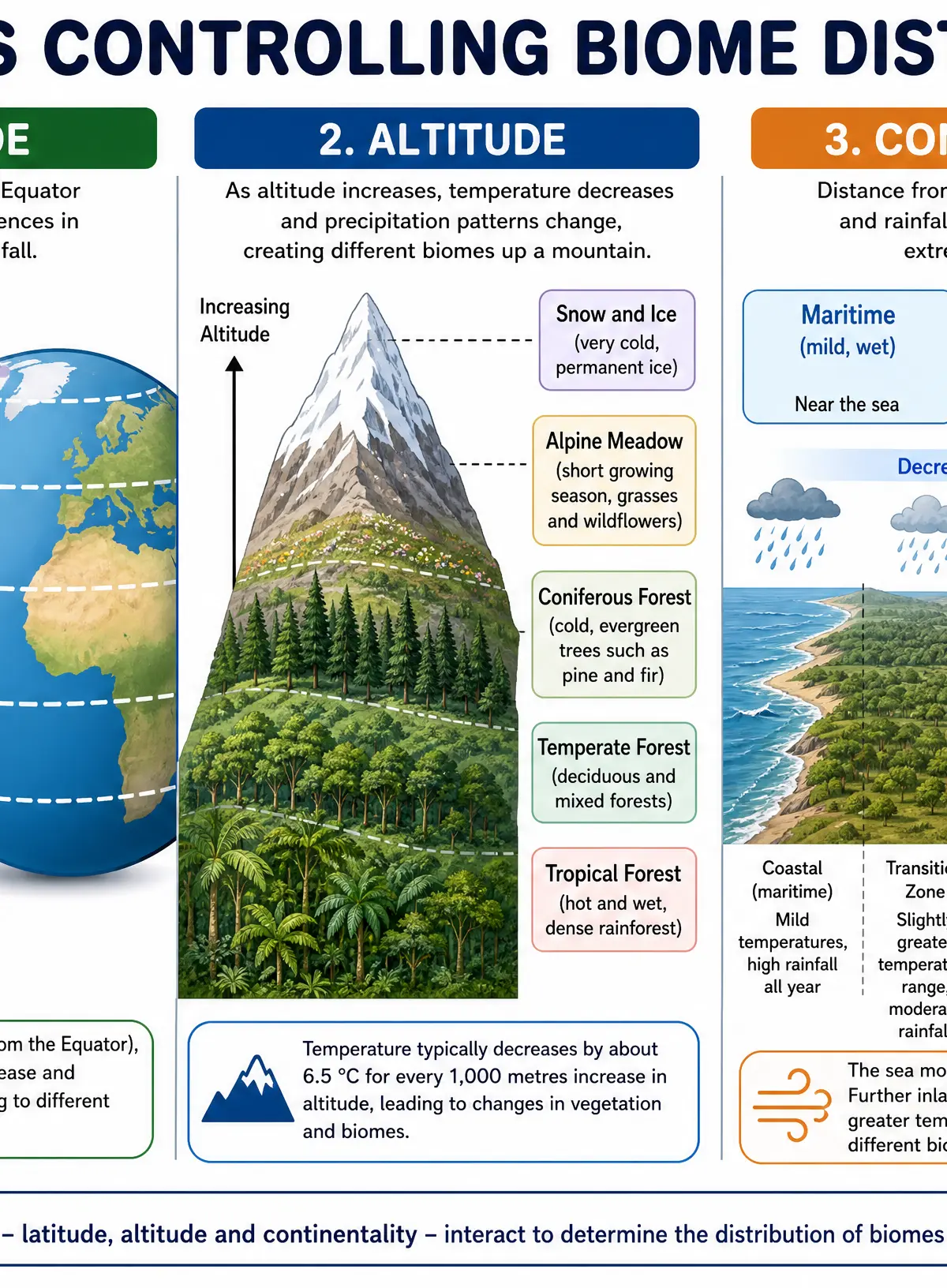
While latitude determines the global pattern, local factors create variations:
- Altitude: Temperatures decrease by approximately 6.5°C for every 1000m gained in height. This creates altitudinal zonation, where biomes change as you move up a mountain (e.g., from tropical forest at the base to alpine tundra at the peak).
- Soils: Underlying geology affects soil type. Sandy, acidic soils support heathland, while waterlogged soils support wetlands.
- Distance from the Sea (Continentality): Coastal areas have milder, wetter climates (maritime). Inland areas experience greater temperature extremes and lower rainfall (continental).
The Biosphere as a Resource System
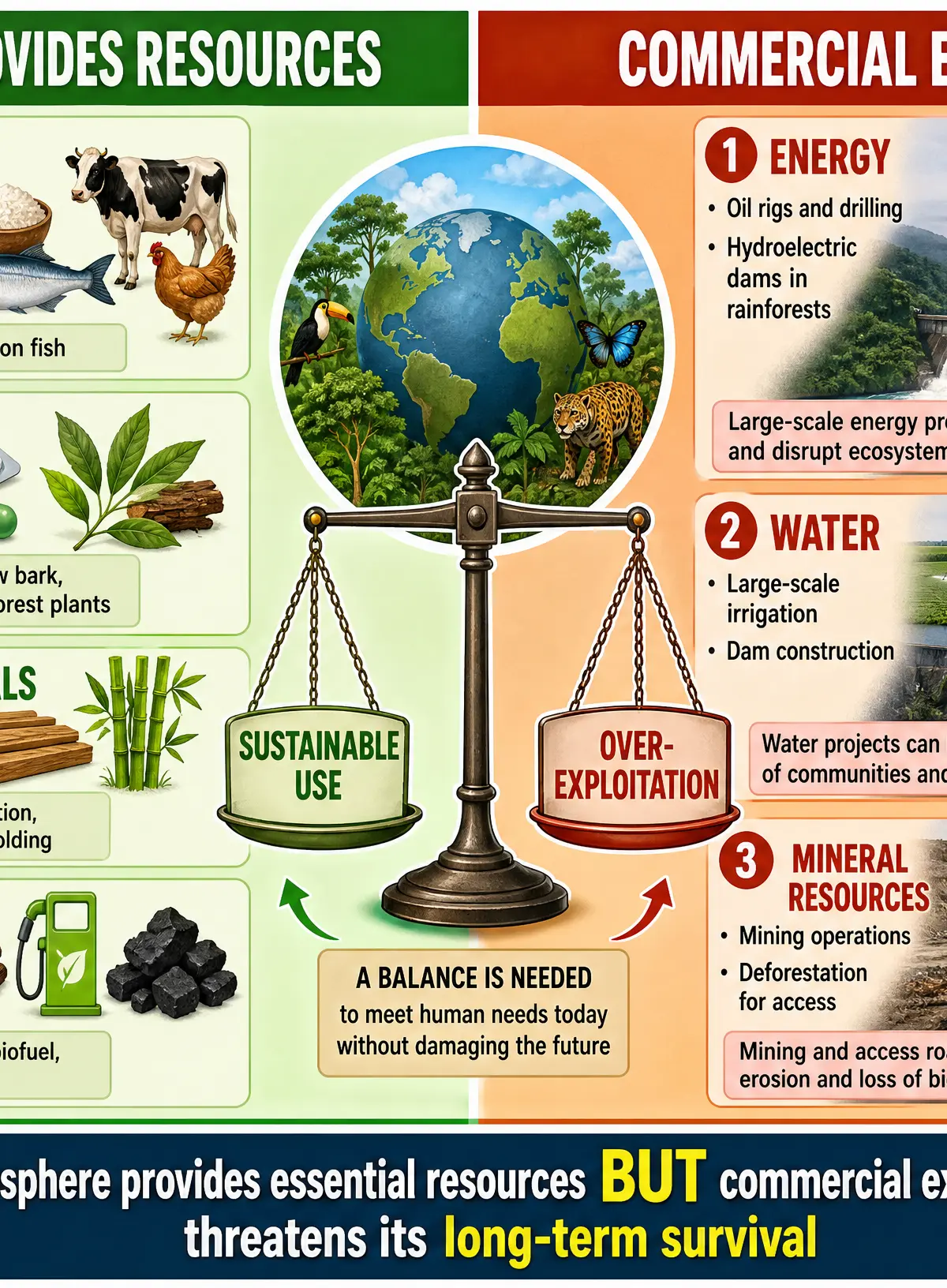
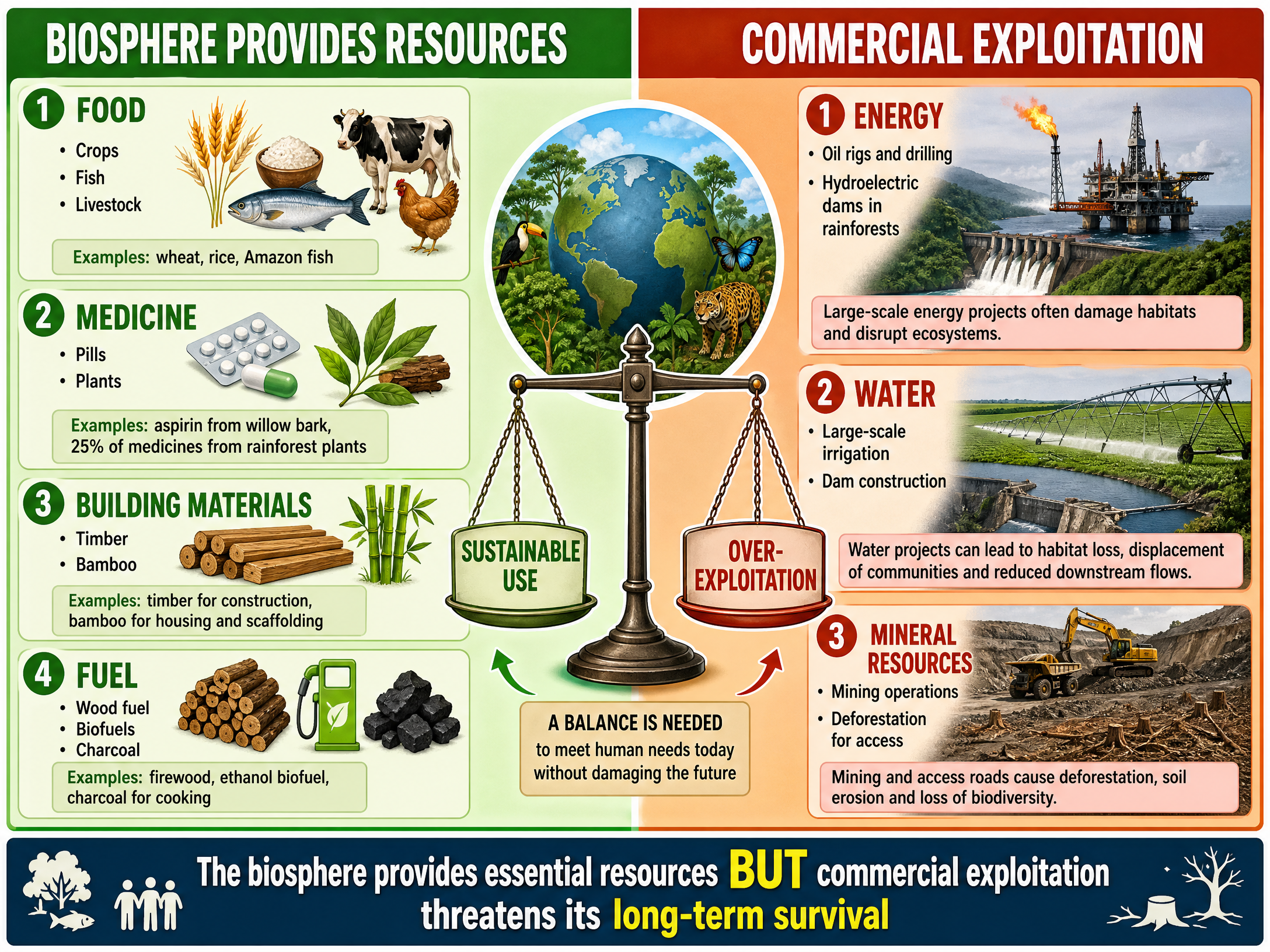
The biosphere provides essential resources for human survival, but increasing demand leads to commercial exploitation.
Provision of Resources
- Food: Crops (wheat, rice), livestock, and fish.
- Medicine: Over 25% of modern medicines originate from rainforest plants (e.g., Aspirin from willow bark, Quinine from the cinchona tree).
- Building Materials: Timber (pine, oak) for construction; bamboo and rattan.
- Fuel: Wood and charcoal remain the primary energy source for billions in developing nations; biofuels (ethanol).
Commercial Exploitation
- Energy: Oil and gas extraction in sensitive areas (e.g., the Arctic or Amazon) causes habitat destruction and pollution risk.
- Water: Large-scale dams (e.g., Belo Monte in Brazil) flood vast forest areas and disrupt river ecosystems.
- Mineral Resources: Open-cast mining for gold, copper, and rare earth metals requires extensive deforestation and pollutes local water sources.
UK Terrestrial and Marine Ecosystems
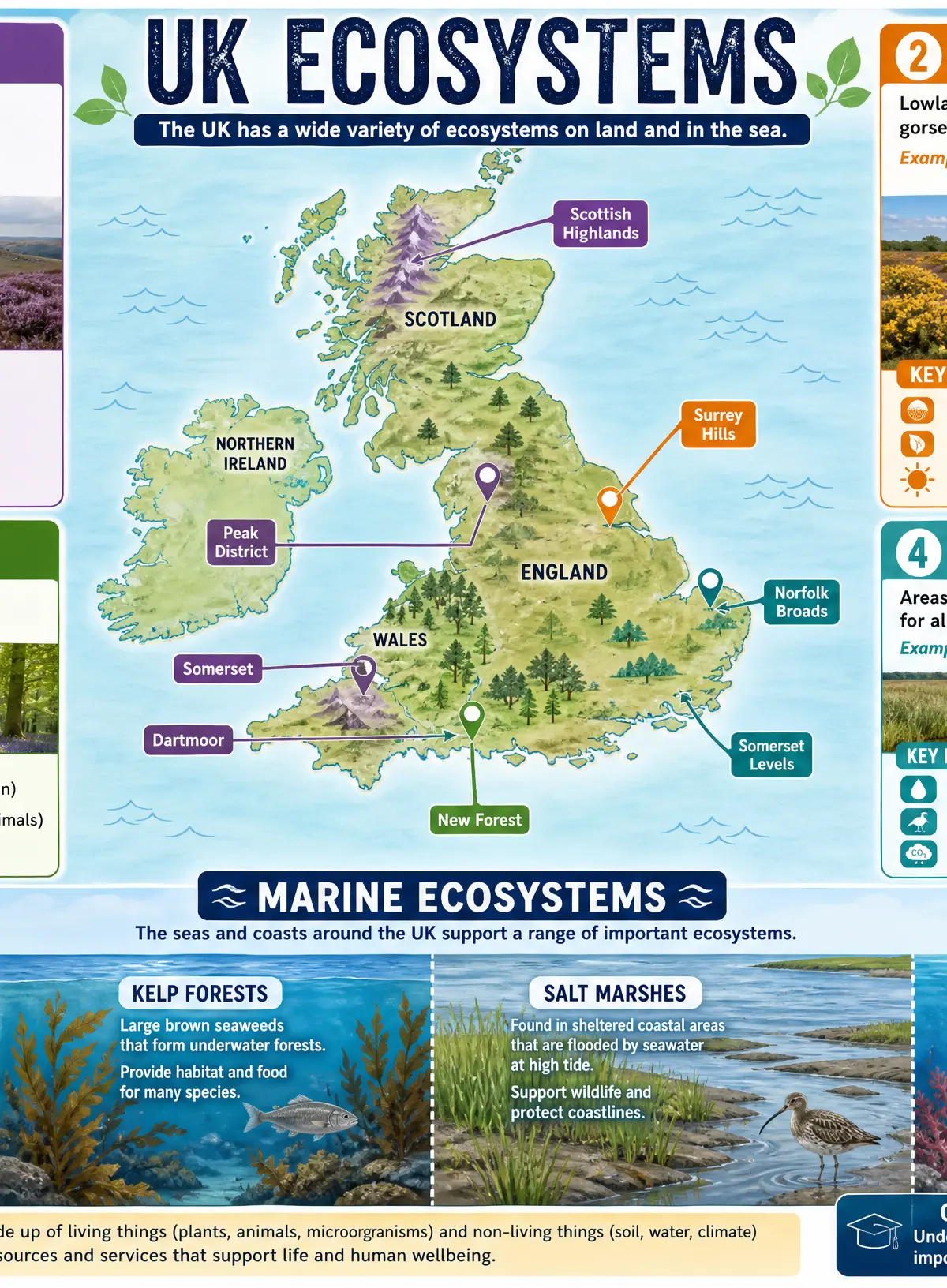
The UK features a diverse range of ecosystems, shaped by its temperate maritime climate, varied geology, and long history of human management.
Terrestrial Ecosystems
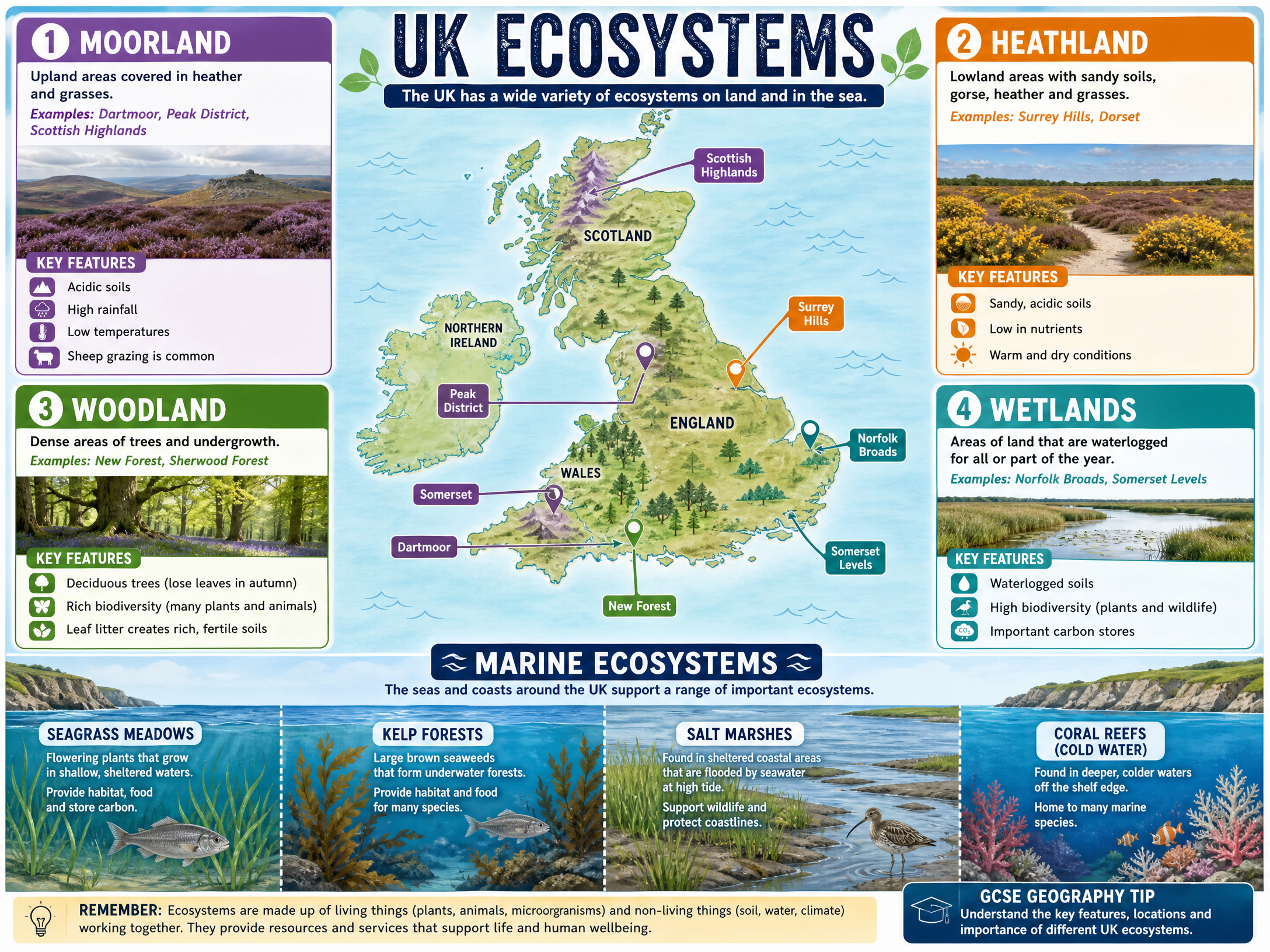
- Moorlands: Found in upland areas (e.g., Dartmoor, Scottish Highlands). Characterised by high rainfall, acidic peat soils, and vegetation like heather and bracken. Important for carbon storage.
- Heathlands: Found in lowland areas (e.g., Surrey Hills, New Forest). Characterised by sandy, free-draining, nutrient-poor soils. Dominated by gorse and heather. Highly threatened by urban development.
- Woodlands: Ancient deciduous woodlands (e.g., Sherwood Forest) are rich in biodiversity. Coniferous plantations (e.g., Kielder Forest) are managed for timber.
- Wetlands: Areas of waterlogged land (e.g., Norfolk Broads, Somerset Levels). Support rich bird and insect life but have been historically drained for agriculture.
Marine Ecosystems
- Habitats: Include seagrass meadows, kelp forests, salt marshes, and cold-water coral reefs.
- Importance: Provide nursery grounds for commercial fish species, protect coastlines from erosion, and act as significant carbon sinks (blue carbon).
- Degradation: Threatened by overfishing (depleting stocks), bottom trawling (destroying seabed habitats), agricultural runoff (causing eutrophication), and plastic pollution.
Audio Revision: Biomes Podcast
Listen to this 4-minute revision podcast to consolidate your knowledge on Large-Scale Ecosystems and Biomes. It covers all the key concepts, includes an exam technique breakdown, and features a quick-fire recall quiz.

Visual Resources
3 diagrams and illustrations
Interactive Diagrams
1 interactive diagram to visualise key concepts
Conceptual Flow Outline
Flowchart showing how climate and local factors interact to determine biome distribution.
Worked Examples
3 worked examples — open one to explore the question and available guidance.
Practice Questions
Test your understanding — click to reveal model answers
Outline one reason why tropical rainforests have a high level of biodiversity. (2 marks)
Hint: Think about the climate conditions and what plants need to grow.
Explain how local factors can alter the biome found in a specific area. (4 marks)
Hint: Discuss altitude and soils.
Evaluate the impact of commercial exploitation on the biosphere. (9 marks)
Hint: Discuss the economic benefits of exploitation against the environmental damage, using specific examples.
Describe the distribution of the Boreal Forest (Taiga) biome. (3 marks)
Hint: Use compass directions, latitude degrees, and name continents/countries.
Explain why UK marine ecosystems are currently experiencing degradation. (6 marks)
Hint: Think about fishing practices, pollution, and climate change.