Pearson Edexcel · GCSE · Geography
Meeting the demands for water resources could involve technology and interventions by different interest groups
This topic explores the critical challenge of meeting growing global water demand in the 21st century. It examines the tension between technological solutions like desalination and the competing priorities of different stakeholders, from governments to local communities.
- 6 min read
- 3 worked examples
- 3 practice questions
- 6 key terms
Study Notes
Overview
Water is the fundamental resource for human survival and economic development, yet it is becoming increasingly scarce. This study covers the drivers of rising water demand, the technological interventions used to secure supply, and the complex, often conflicting perspectives of different stakeholders regarding how water should be managed. Examiners expect you to be able to distinguish between these different interest groups, evaluate technological solutions critically, and apply specific knowledge from case studies in both a developed and an emerging or developing country.
Listen to the Podcast

Key Drivers of Water Demand
Population Growth
What is happening: The global population has surpassed 8 billion and continues to grow, particularly in regions already facing water stress like sub-Saharan Africa and South Asia.
Why it matters: Every individual requires water for drinking, sanitation, and food production. The sheer volume of people places unprecedented strain on existing water supplies.
Specific Knowledge: Global population is projected to reach 9.7 billion by 2050, requiring a massive increase in water provision.
Economic Development & Industry
What is happening: As countries develop, they build more water-intensive industries, power stations, and agricultural systems.
Why it matters: Industrialization shifts water usage patterns dramatically. Agriculture remains the largest user, but industrial demand grows fastest in emerging economies.
Specific Knowledge: It takes approximately 1,000 litres of water to produce 1kg of wheat, and up to 15,000 litres to produce 1kg of beef. Agriculture accounts for ~70% of global freshwater withdrawals.
Climate Change
What is happening: Global warming is altering precipitation patterns, increasing the frequency and severity of droughts in many regions while causing floods in others.
Why it matters: It makes water supply less predictable and reliable, forcing governments to seek drought-proof technological solutions.
Specific Knowledge: The IPCC projects that by 2050, over 5 billion people could face water scarcity at some point during the year.
Changing Consumption Habits
What is happening: Rising living standards lead to increased domestic water use (e.g., washing machines, dishwashers, longer showers, irrigated gardens).
Why it matters: Per capita consumption in high-income countries is significantly higher than in low-income countries, exacerbating stress on local resources.
Technological Interventions
Desalination
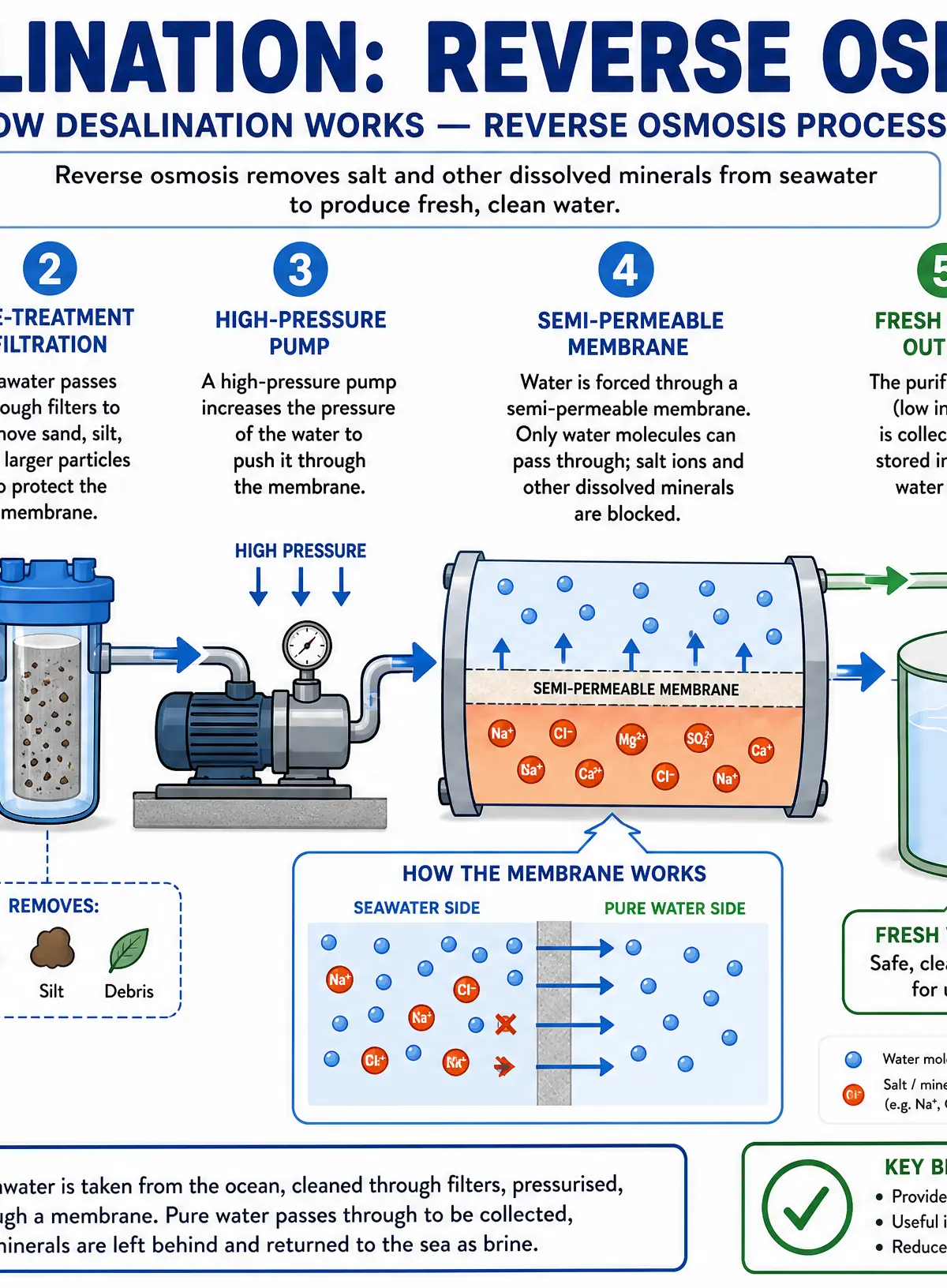
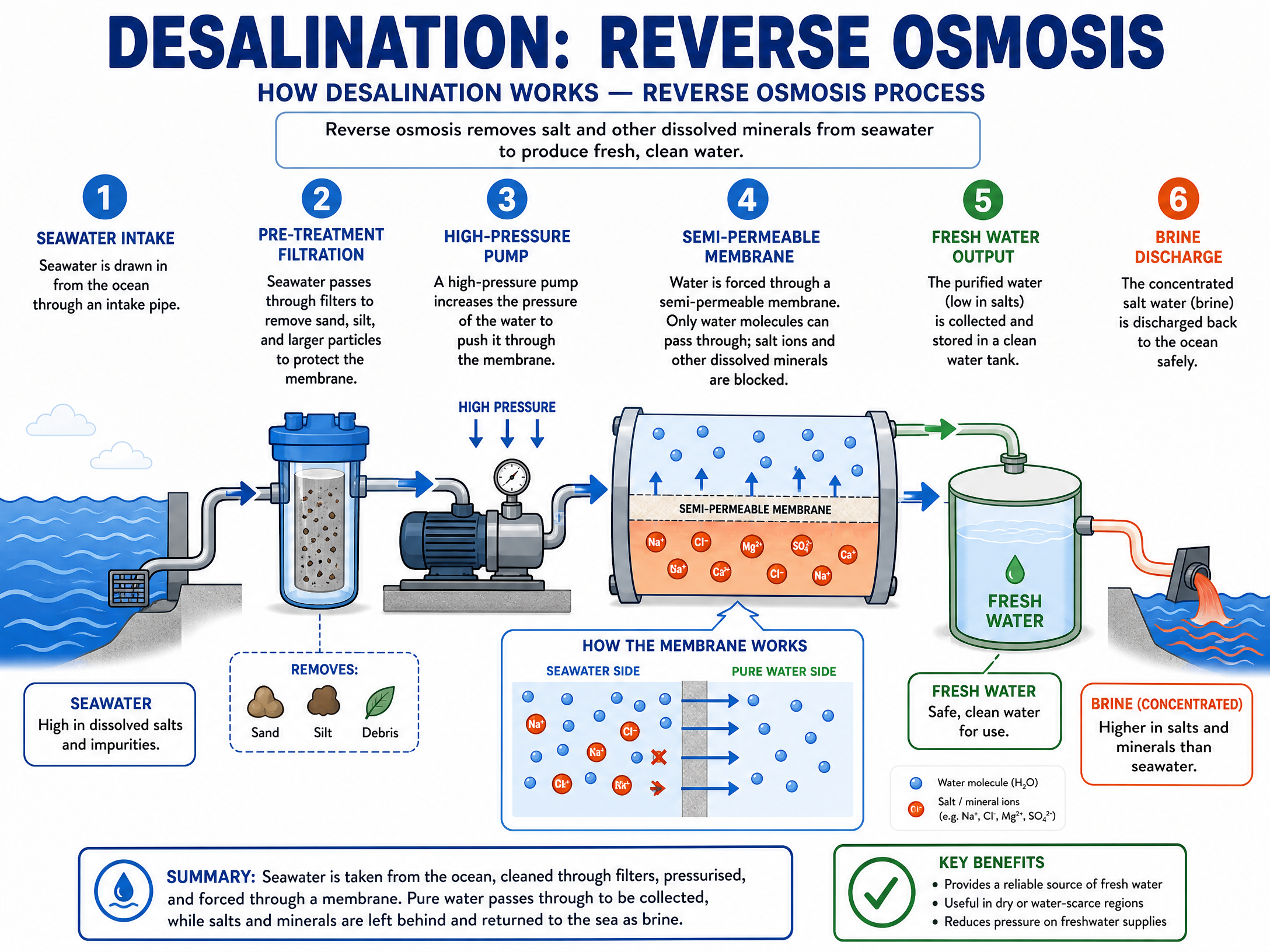
Process: Removing salt and dissolved minerals from seawater, typically using reverse osmosis (forcing water through a semi-permeable membrane at high pressure).
Advantages: Provides a reliable, drought-proof water supply independent of rainfall.
Disadvantages: Extremely energy-intensive (large carbon footprint), expensive infrastructure, and the concentrated brine discharge can harm marine ecosystems.
Specific Knowledge: Saudi Arabia gets ~50% of its drinking water from desalination. The Sorek plant in Israel produces 627,000 cubic metres of fresh water daily but cost over $500 million to build.
Water Transfer Schemes
Process: Moving water from areas of surplus to areas of deficit via canals, pipelines, or tunnels.
Advantages: Can supply large industrial or urban areas and boost agricultural output in dry regions.
Disadvantages: High capital cost, disrupts ecosystems in the source area, and can displace local communities along the route.
Specific Knowledge: China's South-to-North Water Diversion Project is the world's largest, transferring water from the Yangtze basin to the drier, industrial north.
Stakeholder Perspectives
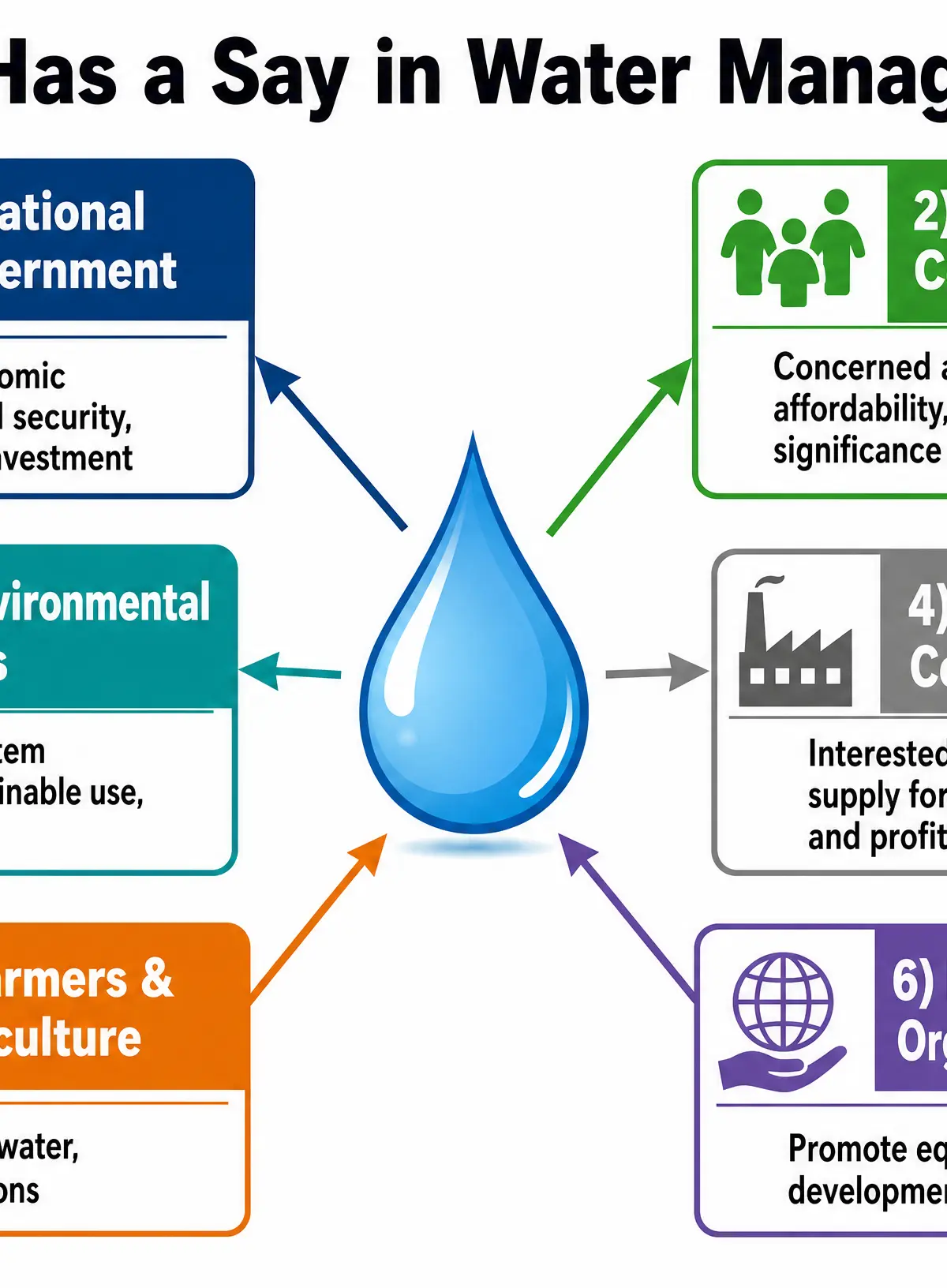
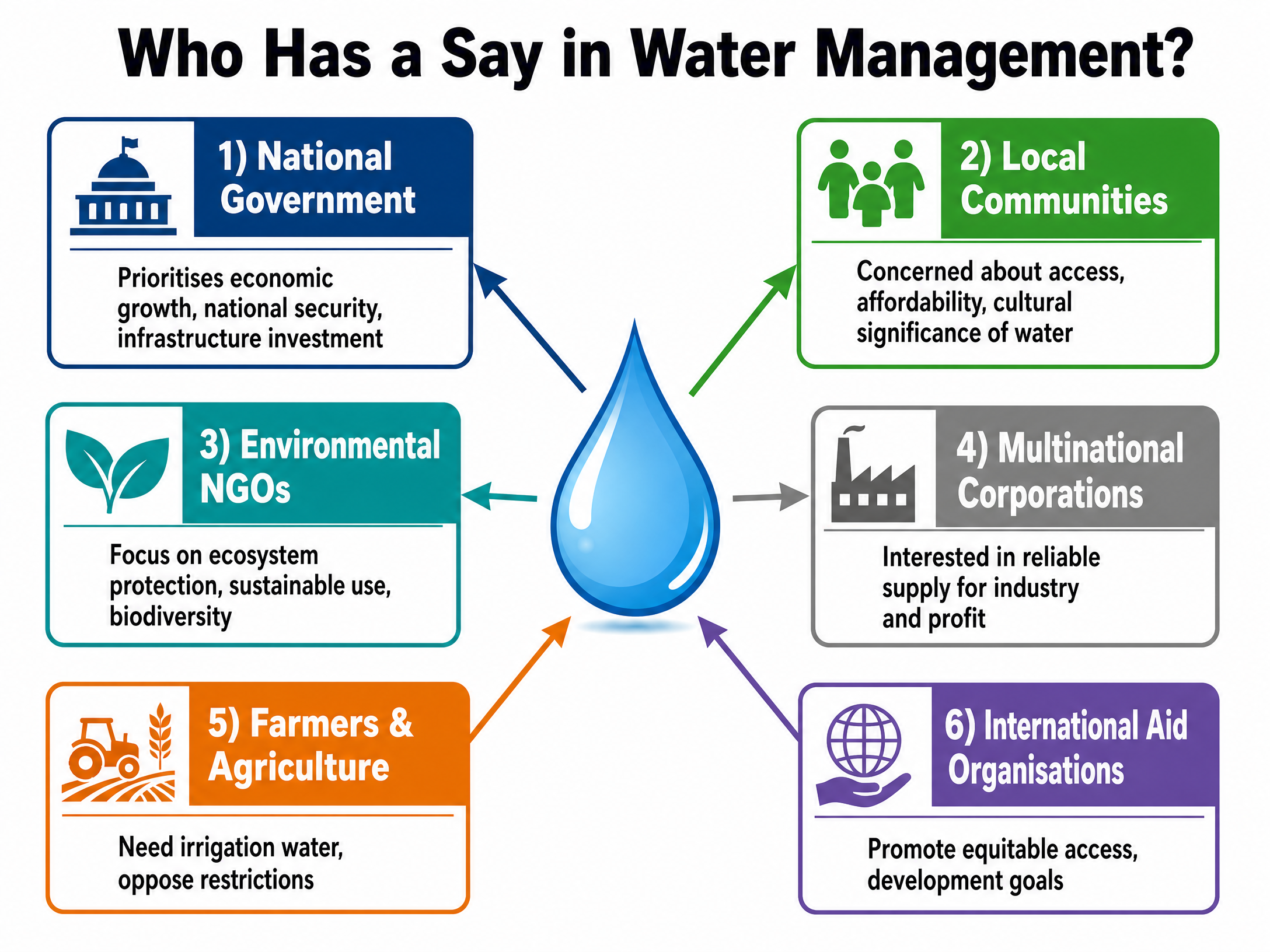
National Governments
Perspective: Prioritise national water security and economic growth.
Actions: Invest in large-scale infrastructure (dams, desalination) and negotiate treaties.
Local Communities
Perspective: Concerned with daily access, affordability, and the protection of local environments or cultural sites.
Actions: May oppose large infrastructure projects that threaten displacement (e.g., over 1 million displaced by China's Three Gorges Dam).
Environmental NGOs
Perspective: Focus on sustainable management, ecosystem protection, and biodiversity.
Actions: Advocate for conservation, efficiency, and natural water management rather than hard engineering.
Multinational Corporations
Perspective: Require reliable, large-scale water supplies for manufacturing (especially food, beverage, and tech).
Actions: May lobby governments for guaranteed access, sometimes competing with local needs.
Farmers & Agriculture
Perspective: Depend heavily on irrigation for crop yields and livelihoods.
Actions: Often resist water pricing increases or extraction limits that threaten their economic viability.
Case Studies
Developed Country: Australia (Murray-Darling Basin)
Context: Australia's most important agricultural region, providing water for ~3 million people.
The Issue: Over-extraction for irrigation led to severe environmental degradation; the river mouth sometimes closed entirely.
The Management: The 2012 Murray-Darling Basin Plan set legally binding limits on extraction, aiming to return 2,750 gigalitres per year to the environment by buying back water licences.
Significance: A clear example of government intervention balancing competing stakeholders (farmers vs. environmentalists).
Emerging Country: India
Context: India has 18% of the world's population but only 4% of freshwater resources. Over 60% of districts face groundwater stress.
The Issue: Rapid economic development and the Green Revolution led to massive over-abstraction of groundwater.
The Management: The Jal Jeevan Mission (2019) aims to provide piped water to every rural household (over 190 million households). Locally, traditional harvesting structures (johads, stepwells) are being revived in Rajasthan.
Significance: Illustrates the challenge of funding massive infrastructure while promoting local, sustainable practices.
Visual Resources
2 diagrams and illustrations
Interactive Diagrams
1 interactive diagram to visualise key concepts
Conceptual Flow Outline
Flowchart showing drivers of water demand and resulting management strategies.
Worked Examples
3 worked examples — open one to explore the question and available guidance.
Practice Questions
Test your understanding — click to reveal model answers
State two reasons why global demand for water is increasing. (2 marks)
Hint: Think of the acronym P-I-C-C.
Using a named example, explain how technology can be used to resolve water resource shortages. (6 marks)
Hint: Choose either desalination or water transfer schemes. Explain the process and give a specific location.
To what extent is the sustainable management of water resources achievable? Use case study evidence to support your answer. (9 marks + 3 SPaG)
Hint: You need to evaluate. Show examples where it is working (or being attempted) and examples of the barriers preventing it.