Pearson Edexcel · GCSE · Geography
The atmosphere operates as a global system transferring heat and energy
Master the complex system of global atmospheric circulation that drives our planet's climate and weather. This study guide breaks down the Hadley, Ferrel, and Polar cells, pressure belts, and ocean currents, ensuring you understand exactly how heat is redistributed from the equator to the poles.
- 5 min read
- 3 worked examples
- 5 practice questions
- 6 key terms
Study Notes
Overview
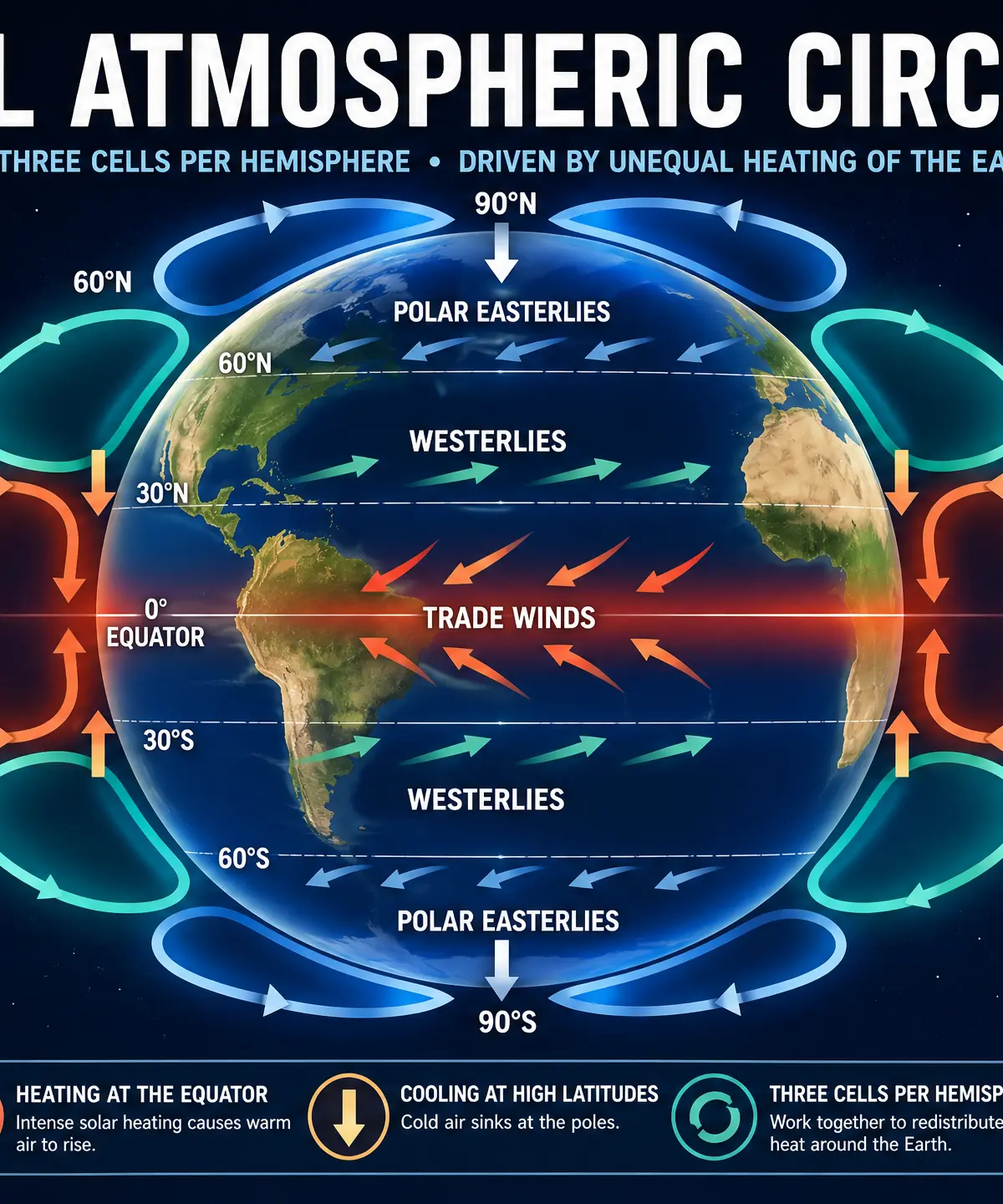
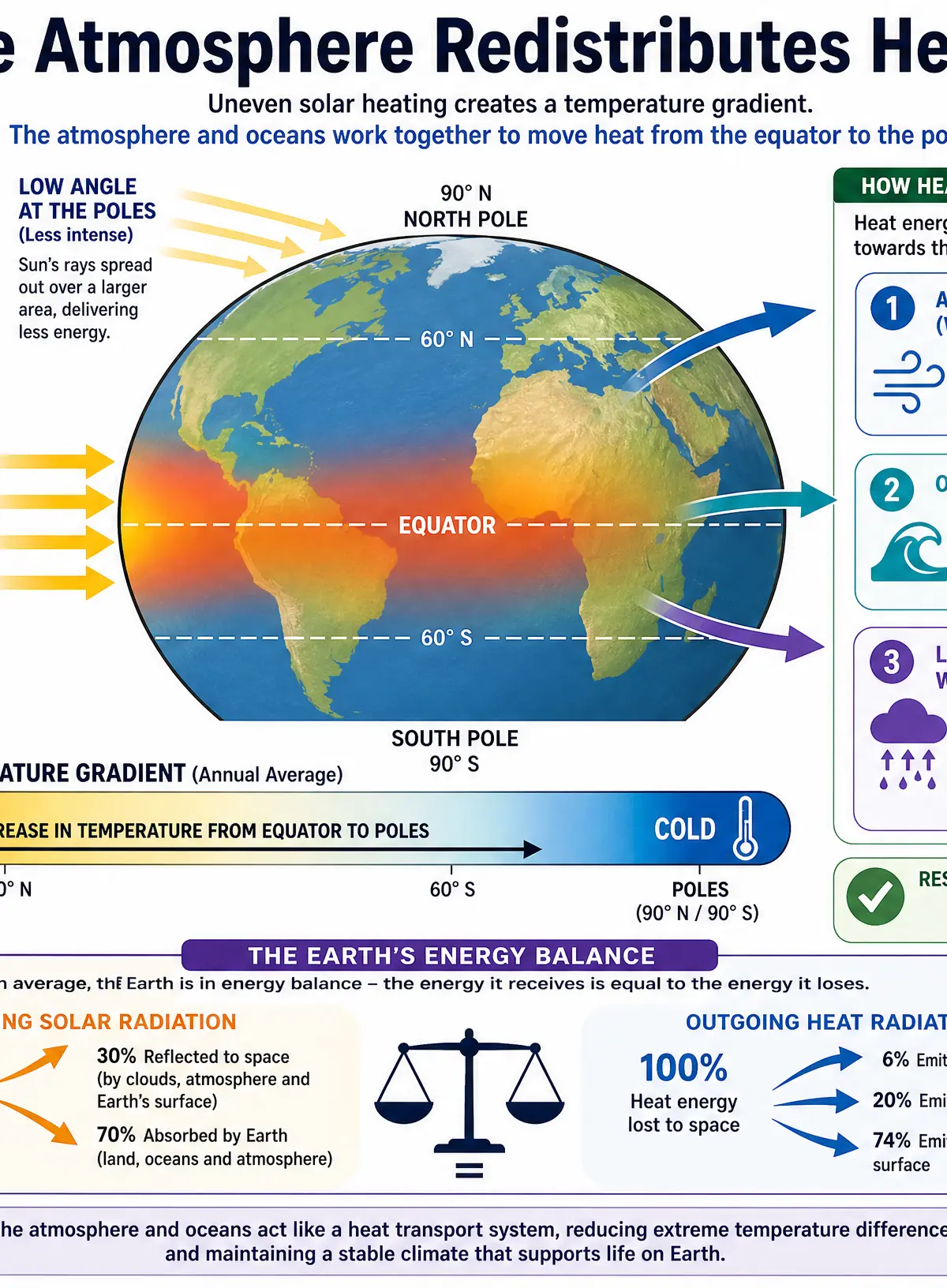
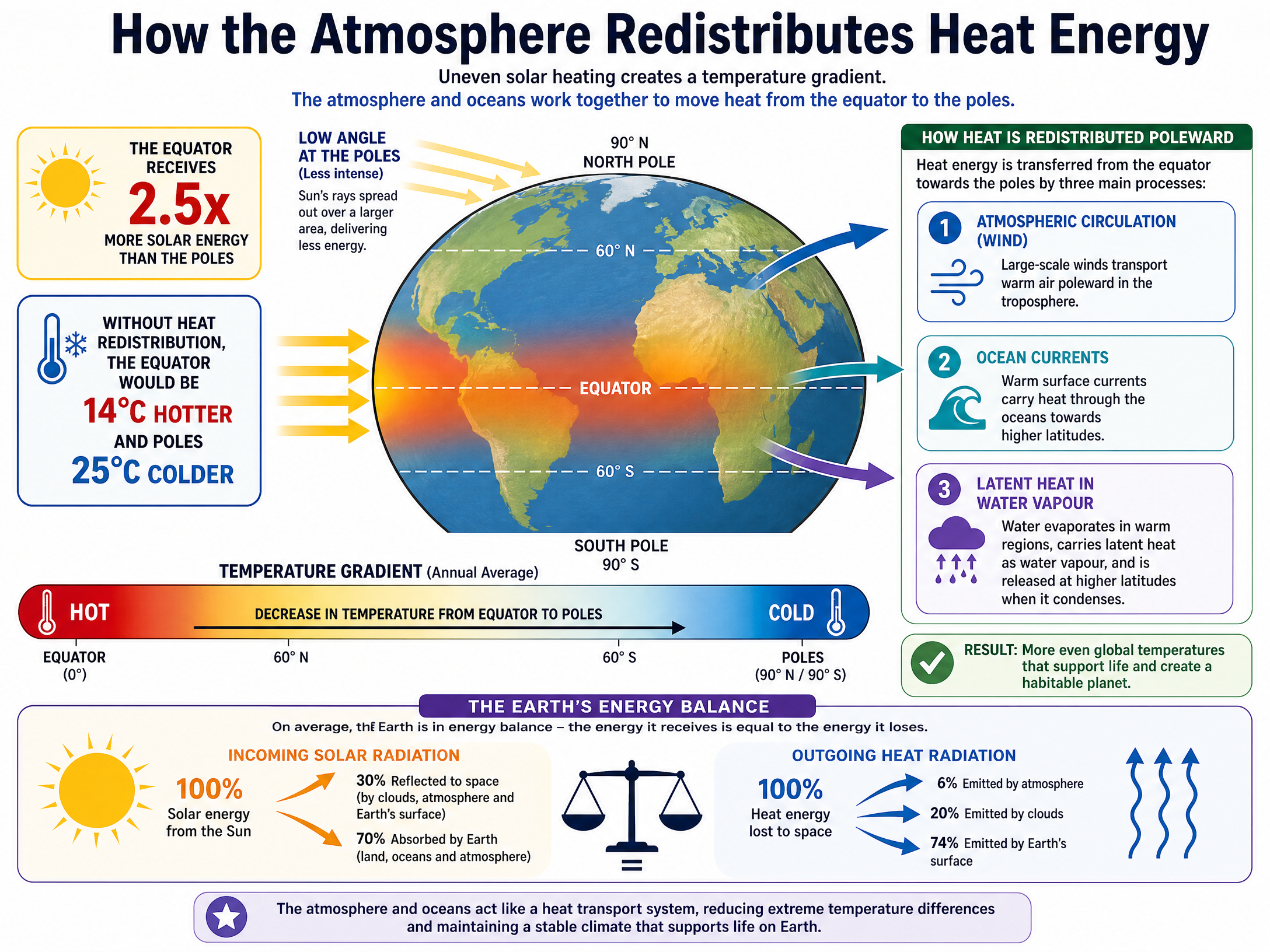
The atmosphere operates as a vast, continuous global system designed to redistribute heat energy across the Earth. Because the Earth is spherical, solar radiation strikes the equator directly but hits the poles at a low angle, spreading the same amount of energy over a larger area. This uneven heating means the equator receives 2.5 times more solar energy than the poles. If this heat wasn't moved, the equator would be unbearably hot (14°C hotter) and the poles freezing (25°C colder).
Examiners expect candidates to understand the precise mechanisms of this redistribution: the three atmospheric circulation cells (Hadley, Ferrel, Polar), the resulting global pressure belts, surface wind patterns, and the crucial role of ocean currents. You must be able to explain the processes involved, not just describe them, using accurate geographical terminology.
Key Components of Atmospheric Circulation
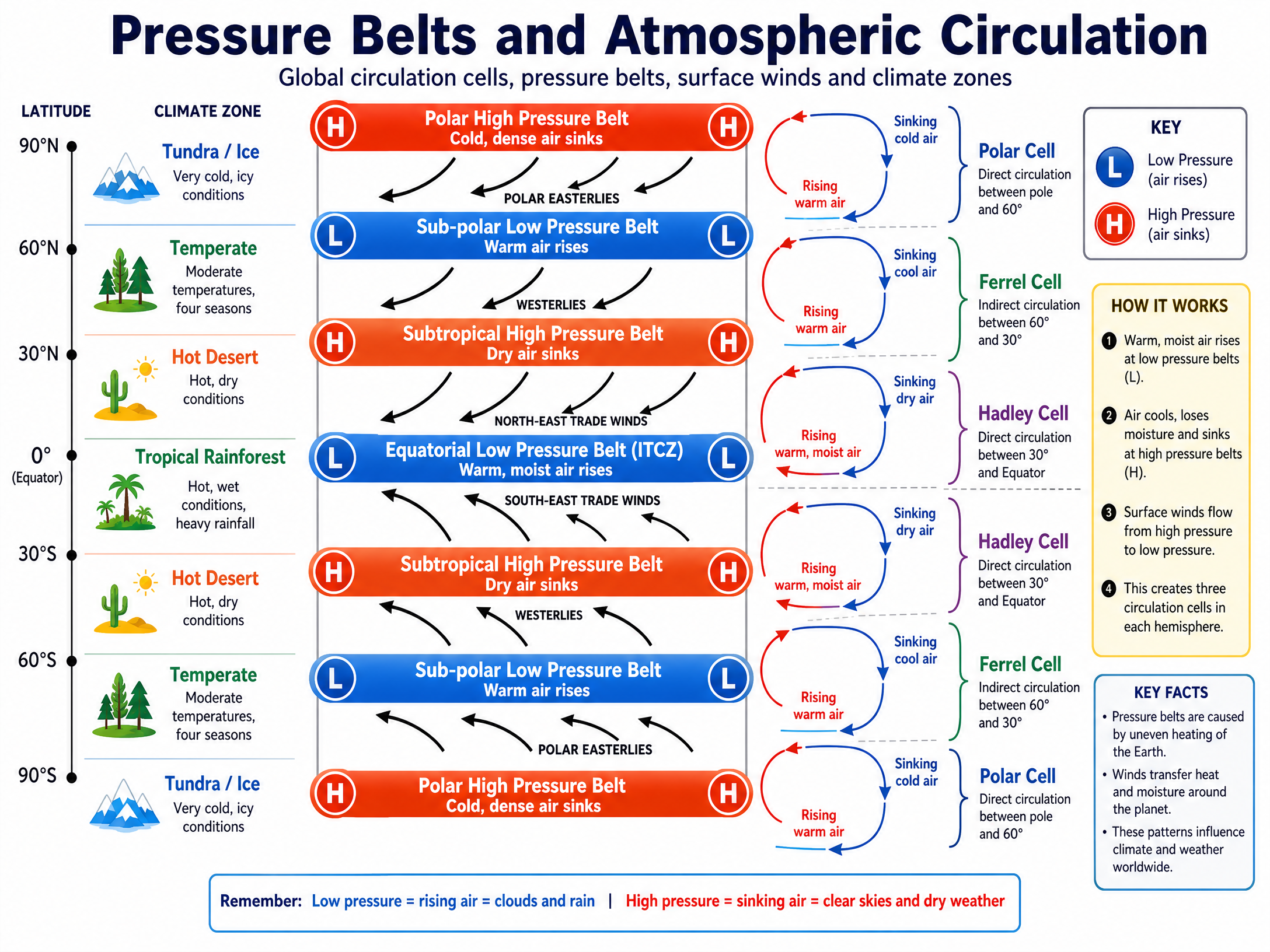
The Hadley Cell
Location: Between 0° (Equator) and 30° North/South
Process: Intense solar heating at the equator causes warm, moist air to rise (convection). As it rises, it cools, condenses, and forms heavy rain (tropical rainforests). This rising air creates the Equatorial Low Pressure Belt (the ITCZ). The air then moves poleward at high altitudes. By 30° N/S, it has cooled and become denser, so it sinks. Sinking air creates the Subtropical High Pressure Belt, bringing dry, cloudless conditions (hot deserts). The air returns to the equator along the surface as the Trade Winds.
Significance: This is the most powerful cell, directly driven by solar heating, and it dictates the location of the world's rainforests and major deserts.
The Ferrel Cell
Location: Between 30° and 60° North/South
Process: This is an indirect cell, driven by the movement of the Hadley and Polar cells. Surface air from the subtropical high (30°) moves poleward. The Coriolis effect deflects these winds, creating the Westerlies. At around 60° N/S, this warm air meets cold air moving down from the poles. The warmer, lighter air is forced to rise over the cold air, creating the Sub-polar Low Pressure Belt (bringing unsettled weather to places like the UK).
Significance: Responsible for the prevailing Westerly winds and the temperate, changeable climate of the mid-latitudes.
The Polar Cell
Location: Between 60° and 90° (Poles) North/South
Process: At the poles, the air is extremely cold and dense, so it sinks, creating the Polar High Pressure Belt. This air flows equatorward at the surface as the Polar Easterlies. When it reaches 60° N/S, it meets the warmer air of the Ferrel cell, forces the warm air to rise, and completes the cycle.
Significance: Drives cold air away from the poles, helping to cool the mid-latitudes.
Global Pressure Belts and Surface Winds
Pressure Belts
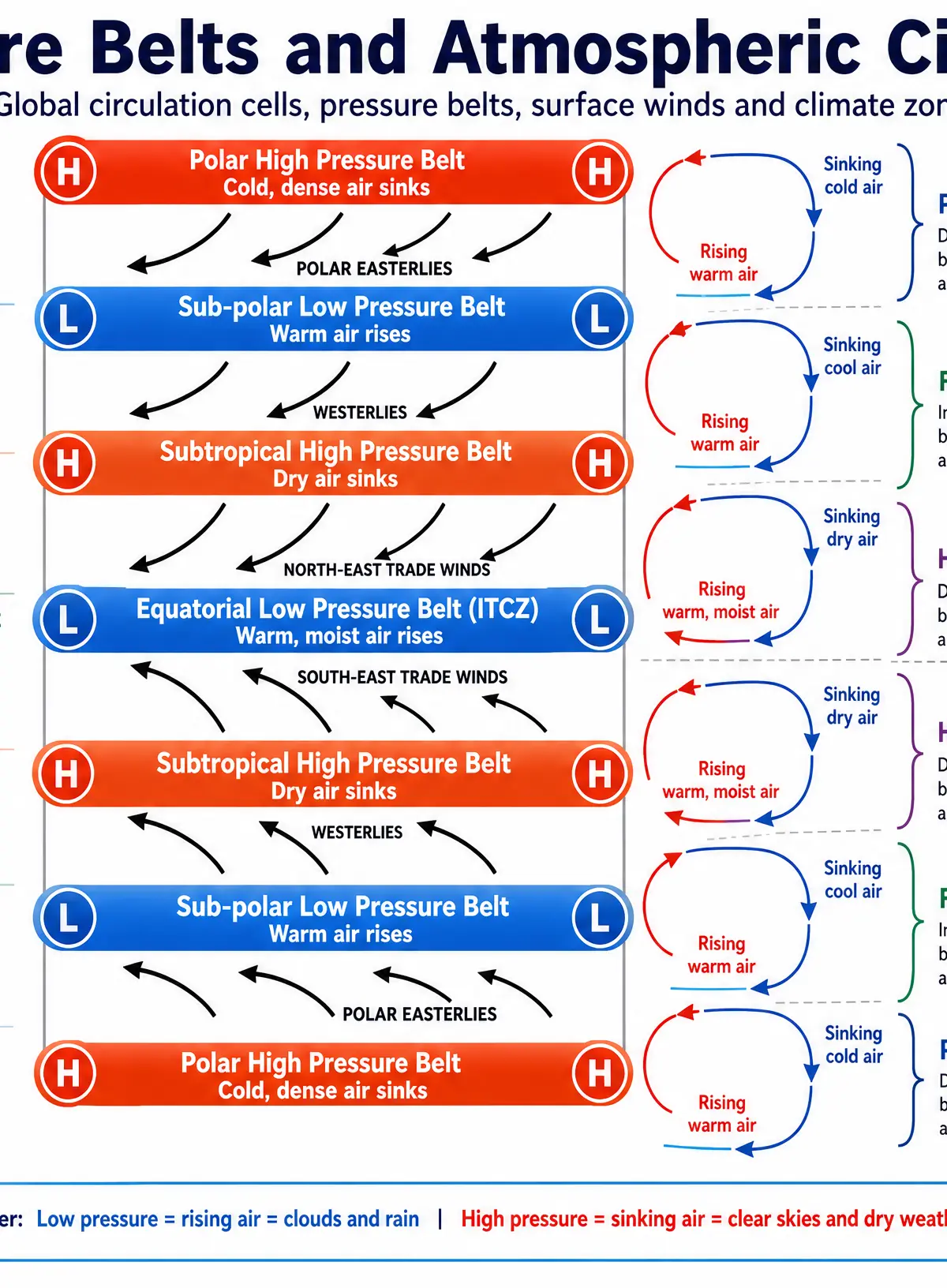
- Equatorial Low (0°): Rising air, clouds, heavy rain.
- Subtropical High (30° N/S): Sinking air, clear skies, arid conditions.
- Sub-polar Low (60° N/S): Rising air, frontal rain, unsettled weather.
- Polar High (90° N/S): Sinking air, very cold, dry conditions.
Surface Winds
- Trade Winds: Blow from the subtropical high (30°) to the equatorial low (0°).
- Westerlies: Blow from the subtropical high (30°) to the sub-polar low (60°).
- Polar Easterlies: Blow from the polar high (90°) to the sub-polar low (60°).
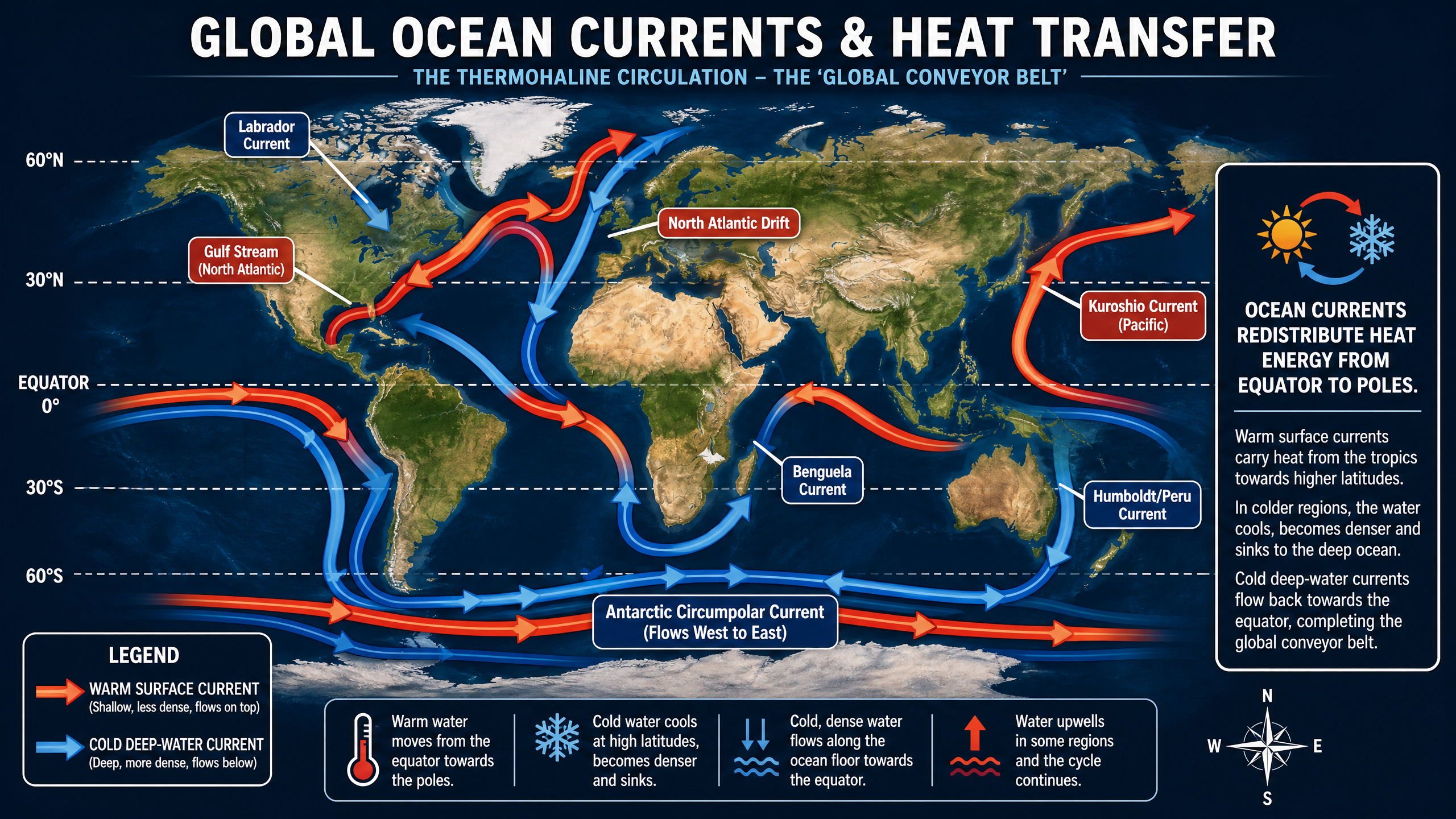
The Role of Ocean Currents
Ocean currents work alongside atmospheric circulation to transfer roughly 20% of global heat.
Surface Currents
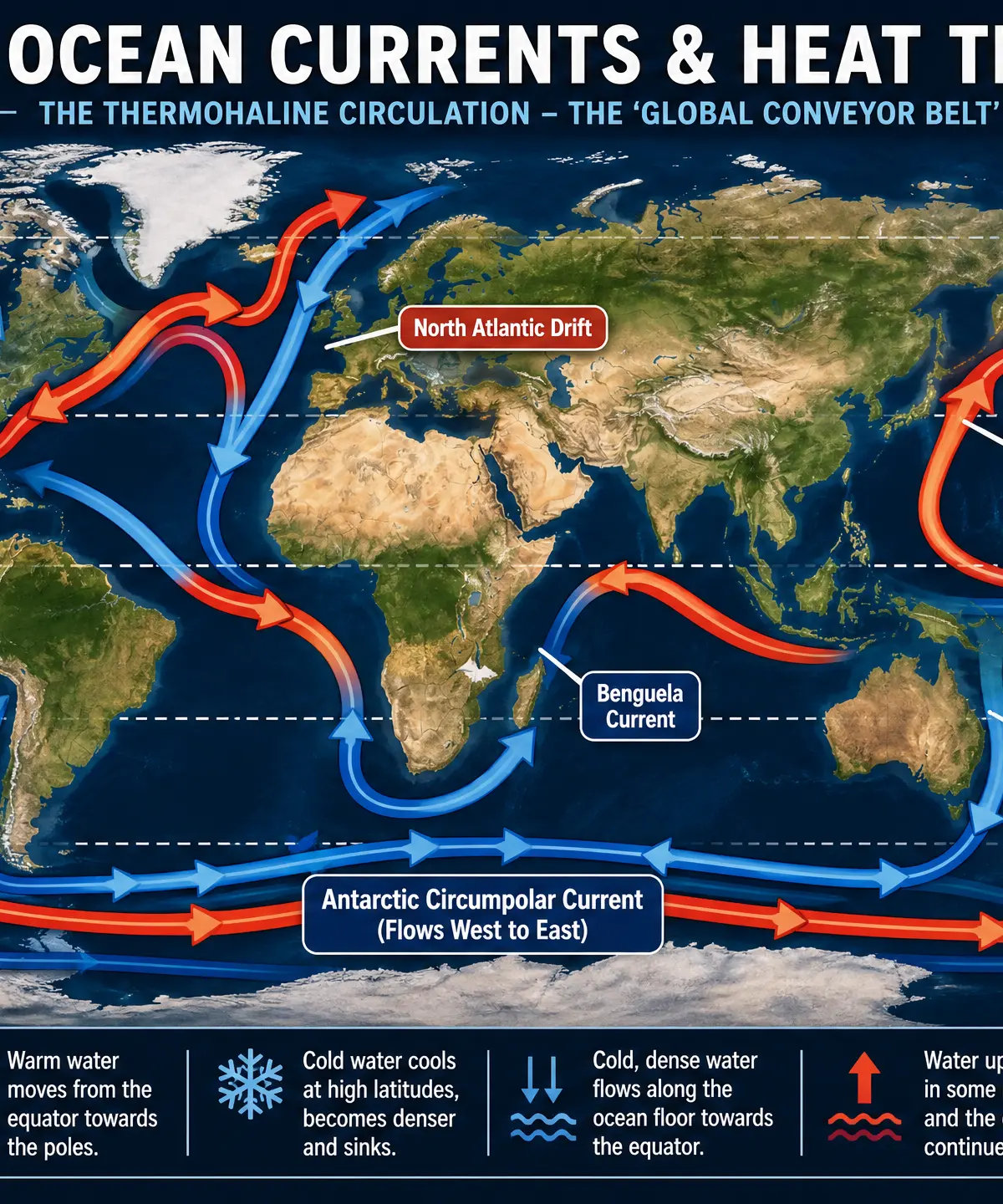
Driven by prevailing surface winds. They transfer warm water from the equator towards the poles.
- Named Example: The Gulf Stream carries warm water from the Gulf of Mexico across the Atlantic as the North Atlantic Drift, keeping the UK and Western Europe significantly warmer than other places at the same latitude (e.g., Labrador, Canada).
Deep-Water Currents (Thermohaline Circulation)
Driven by differences in water density, which is controlled by temperature (thermo) and salinity (haline). Cold, salty water at the poles is dense and sinks, flowing towards the equator along the ocean floor. This creates the 'global conveyor belt'.
Heat Energy Redistribution Summary
Listen to the podcast below for a complete audio summary of this topic, including exam tips and a quick-fire quiz!

Visual Resources
3 diagrams and illustrations
Interactive Diagrams
1 interactive diagram to visualise key concepts
Conceptual Flow Outline
Flowchart showing the sequence of processes in the Hadley Cell
Worked Examples
3 worked examples — open one to explore the question and available guidance.
Practice Questions
Test your understanding — click to reveal model answers
Explain why there is an area of low pressure at the equator. (3 marks)
Hint: Think about what the sun's energy does to the air.
Describe the difference between the Hadley Cell and the Ferrel Cell. (4 marks)
Hint: Compare their locations and what drives them.
Explain the role of the Coriolis effect in global atmospheric circulation. (2 marks)
Hint: What does the Earth's rotation do to moving air?
Using an example, explain how ocean currents can affect regional climates. (4 marks)
Hint: Use the UK as your case study.
'Global atmospheric circulation is the only factor that determines the Earth's climate zones.' To what extent do you agree with this statement? (9 marks)
Hint: Agree that it's the main factor, but bring in ocean currents and perhaps altitude/relief to disagree.