Pearson Edexcel · GCSE · Geography
The causes of drought are complex with some locations more vulnerable than others
This topic explores the complex, interacting causes of drought and why some locations are inherently more vulnerable than others. Understanding these mechanisms—from global atmospheric circulation to human activities—is crucial for explaining the unequal distribution of this hazard.
- 3 min read
- 3 worked examples
- 5 practice questions
- 6 key terms
Study Notes
Overview
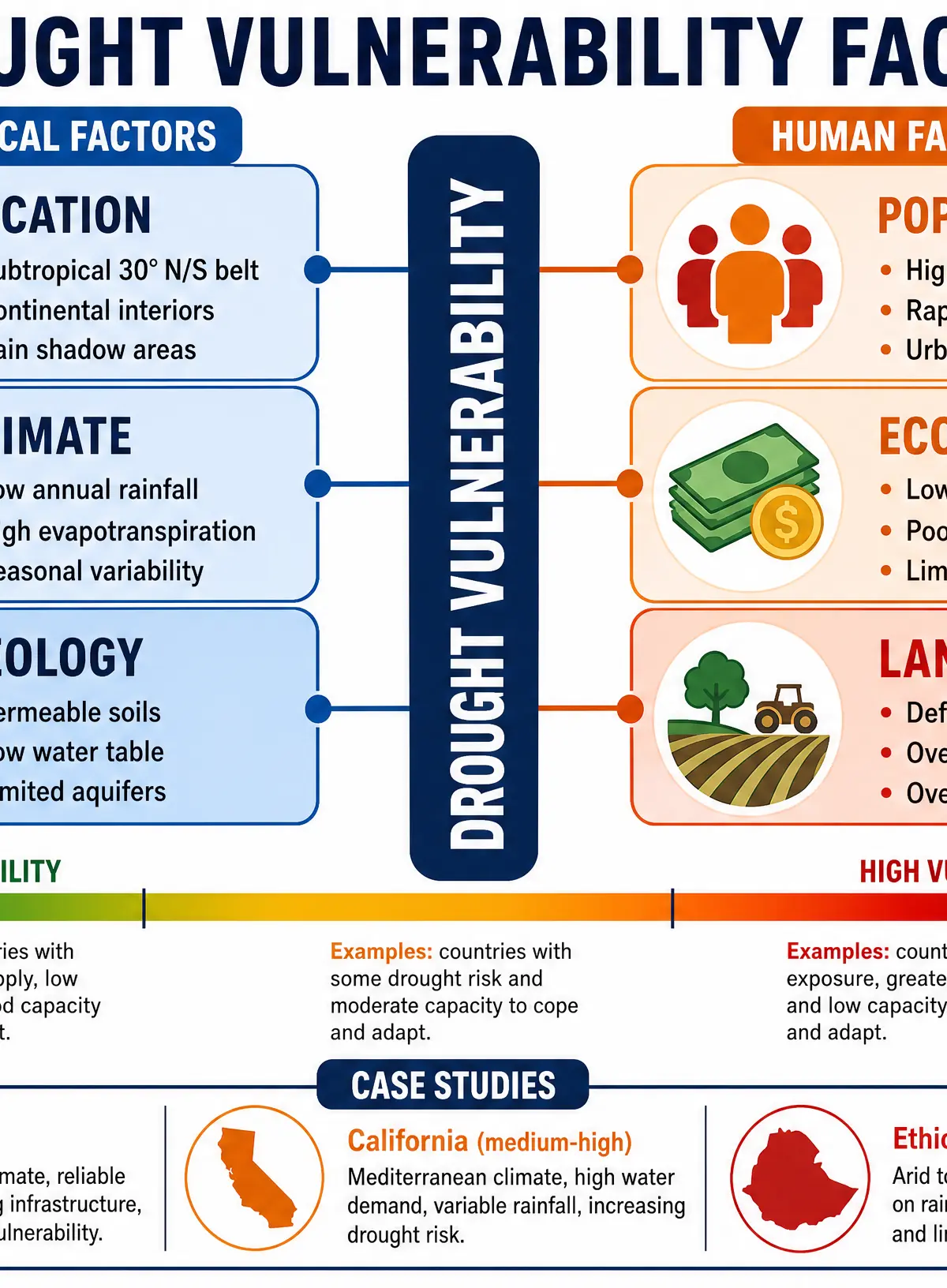
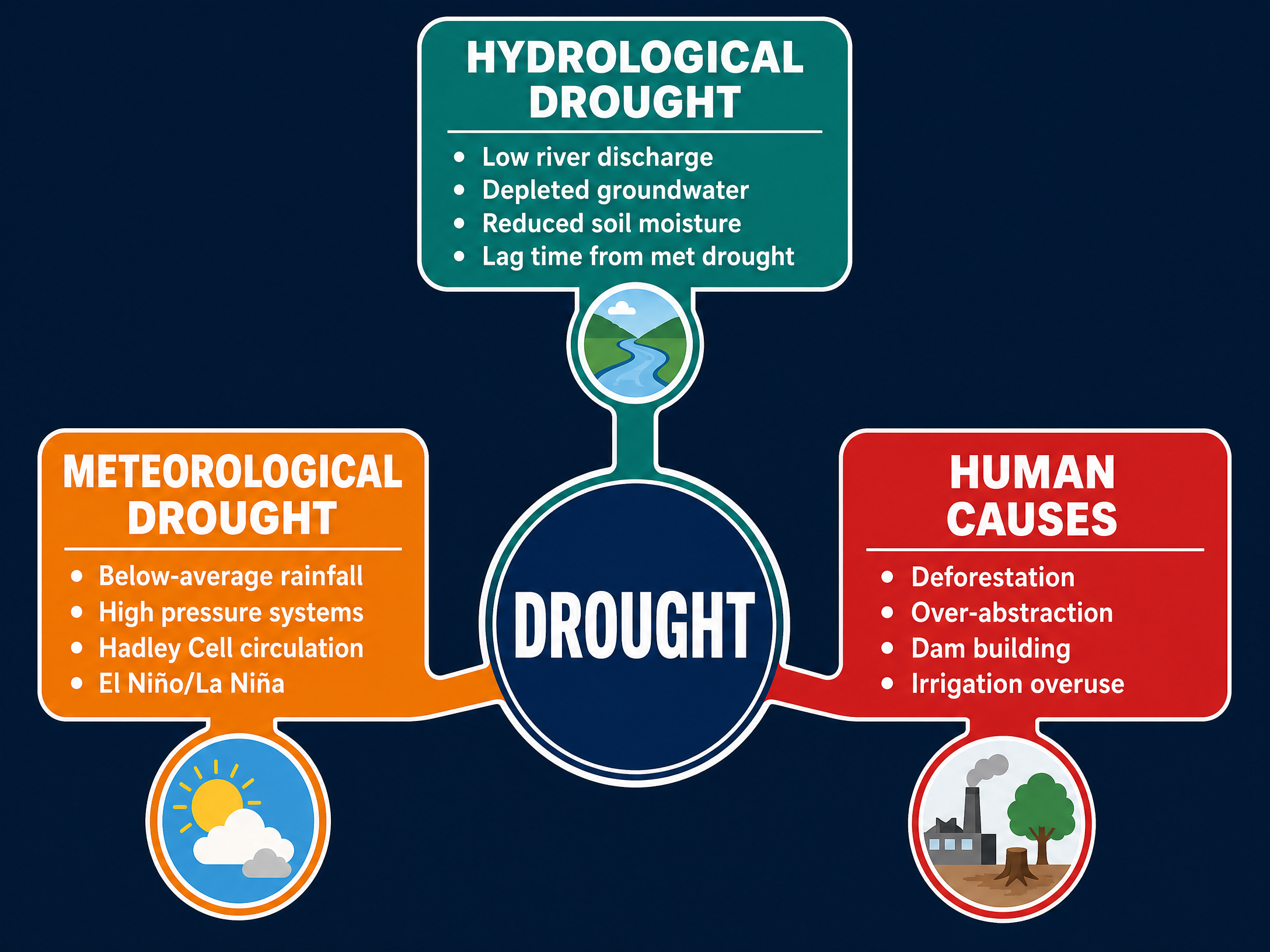
Drought is a complex natural hazard caused by a combination of physical and human factors. It is defined as a prolonged period of abnormally low rainfall leading to a water shortage. Examiners expect candidates to understand that drought is a relative concept—it represents a departure from normal conditions, not simply an arid climate. You must be able to distinguish between meteorological, hydrological, and human causes, and explain how global atmospheric circulation makes certain regions inherently vulnerable.
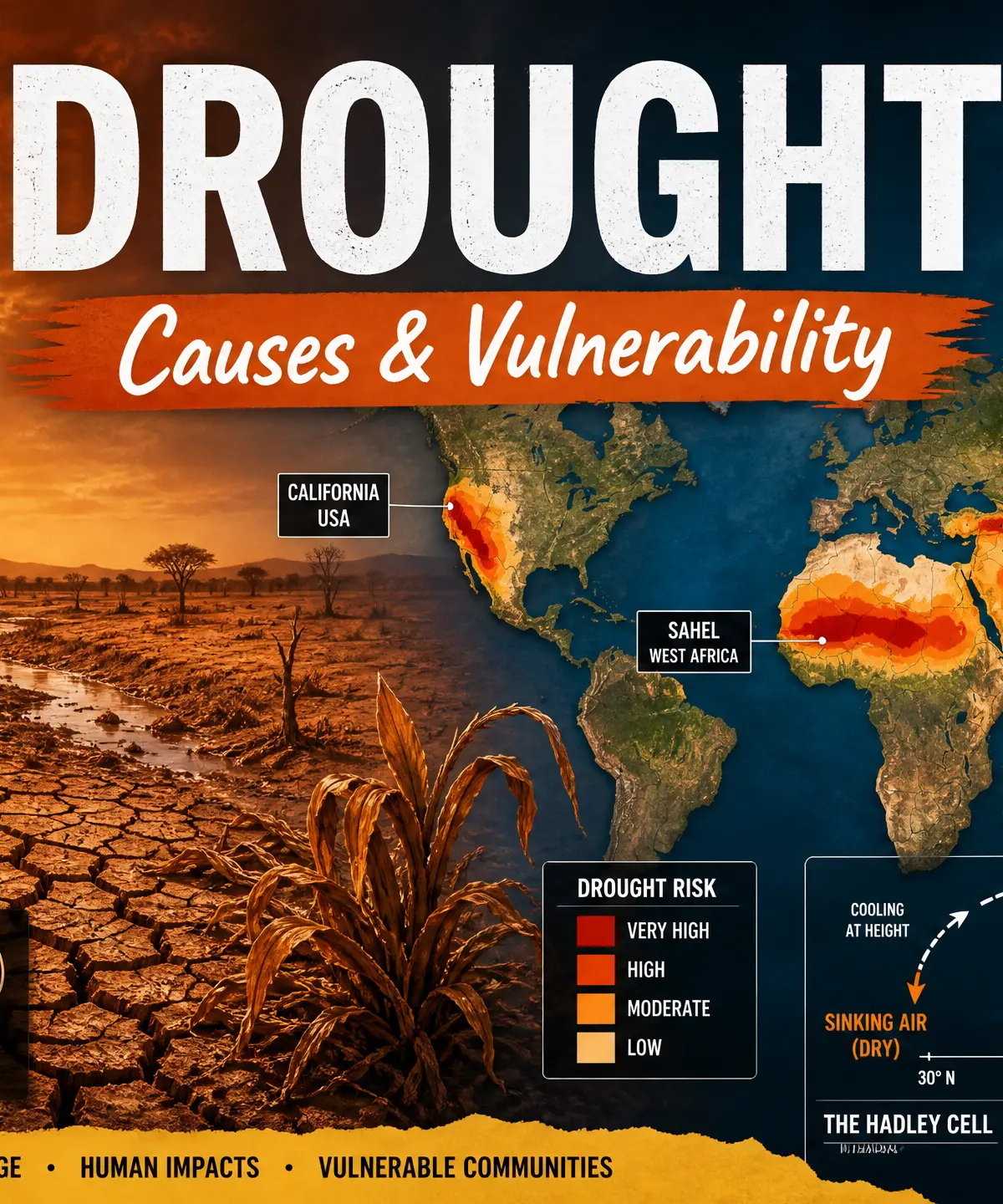
Meteorological Causes
Meteorological drought is the fundamental trigger. It occurs when an area receives significantly below-average rainfall over a sustained period.
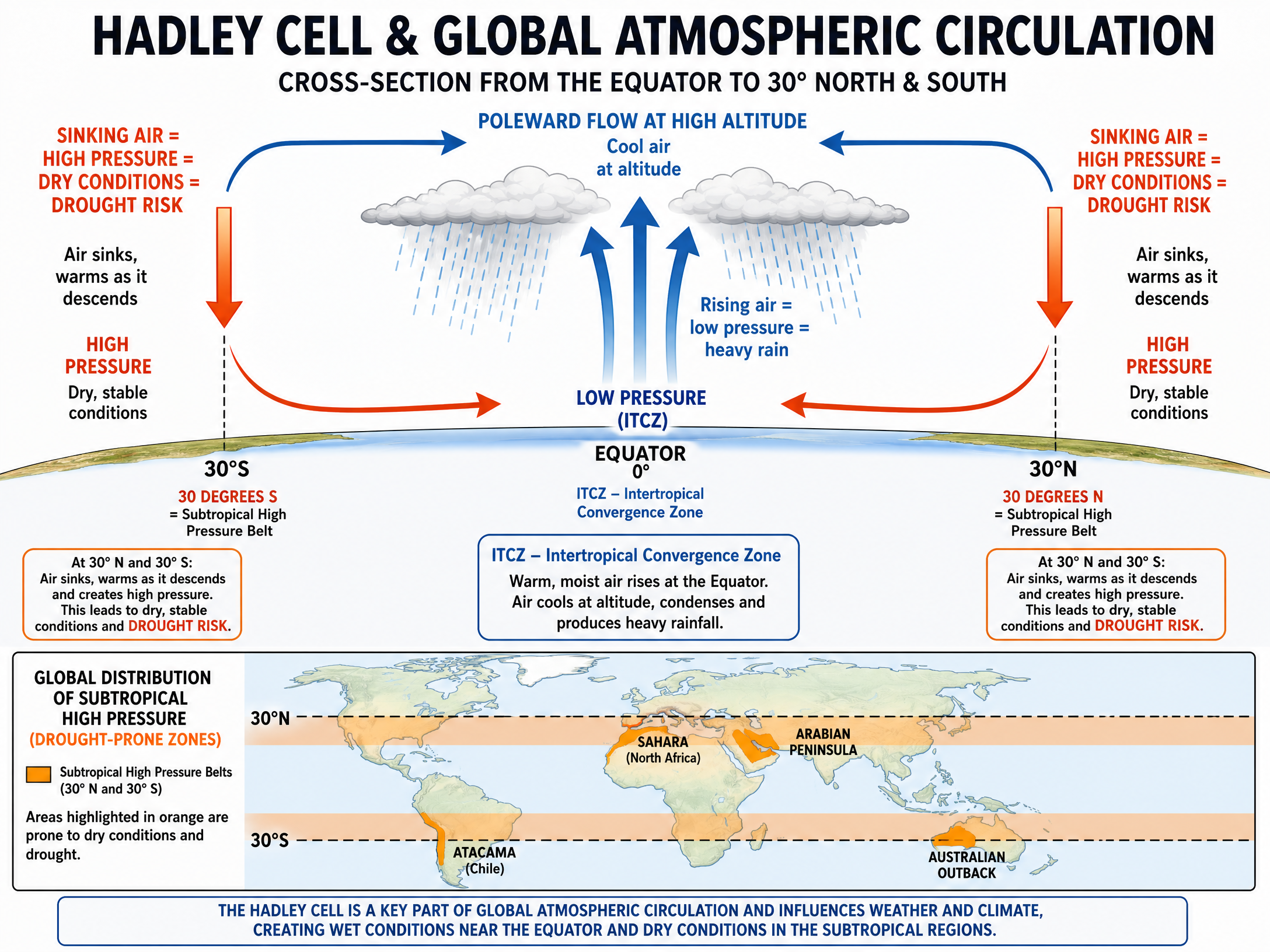
High Pressure Systems: Prolonged high pressure causes air to sink, warm, and dry out, suppressing cloud formation and preventing rainfall.
Global Atmospheric Circulation: The Hadley Cell creates permanent subtropical high-pressure belts at approximately 30° North and South of the Equator. Sinking air at these latitudes creates arid conditions, explaining the location of major deserts (e.g., Sahara, Atacama) and high drought vulnerability in these zones.
El Niño: This phenomenon disrupts normal Pacific Ocean temperatures, shifting rainfall patterns globally and often causing severe droughts in places like Australia and southern Africa.
Hydrological Causes
Hydrological drought occurs when a rainfall deficit begins to affect water stores such as rivers, lakes, reservoirs, and aquifers.
Time Lag: There is a significant time lag between meteorological and hydrological drought. Groundwater recharges slowly, so water stores may remain depleted long after rainfall returns to normal.
Human Causes
Human activities can significantly exacerbate drought conditions and increase vulnerability.
Deforestation: Trees release moisture through transpiration. Removing forests (e.g., in the Amazon) reduces atmospheric moisture, leading to less rainfall.
Over-abstraction: Extracting groundwater faster than it naturally recharges depletes aquifers (e.g., the Ogallala Aquifer in the USA).
Dam Building: Dams restrict downstream water flow, causing shortages for communities lower down the river basin.
Over-irrigation: Inefficient agricultural practices lose massive amounts of water to evaporation (e.g., the shrinking of the Aral Sea).
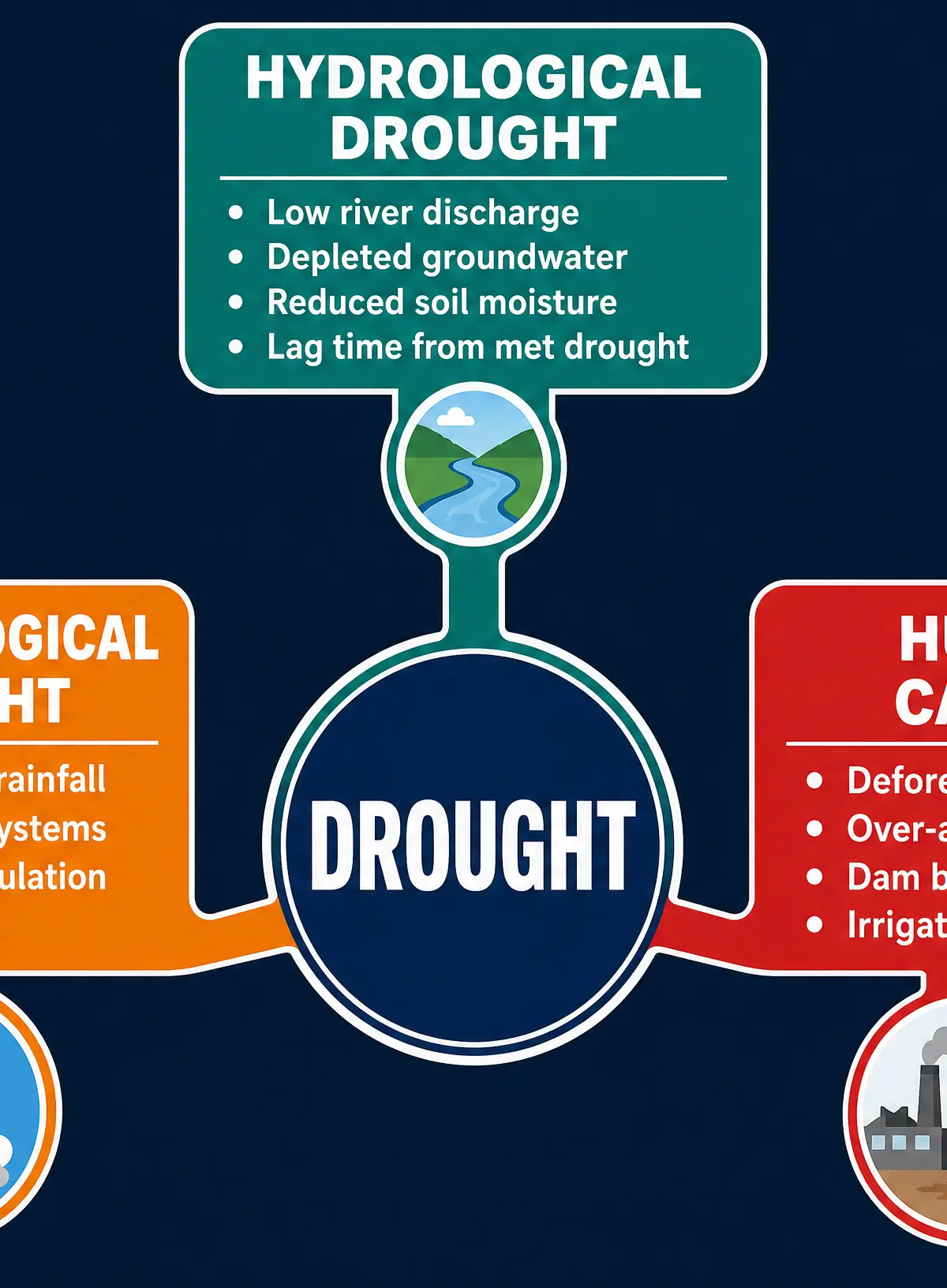
Drought Vulnerability
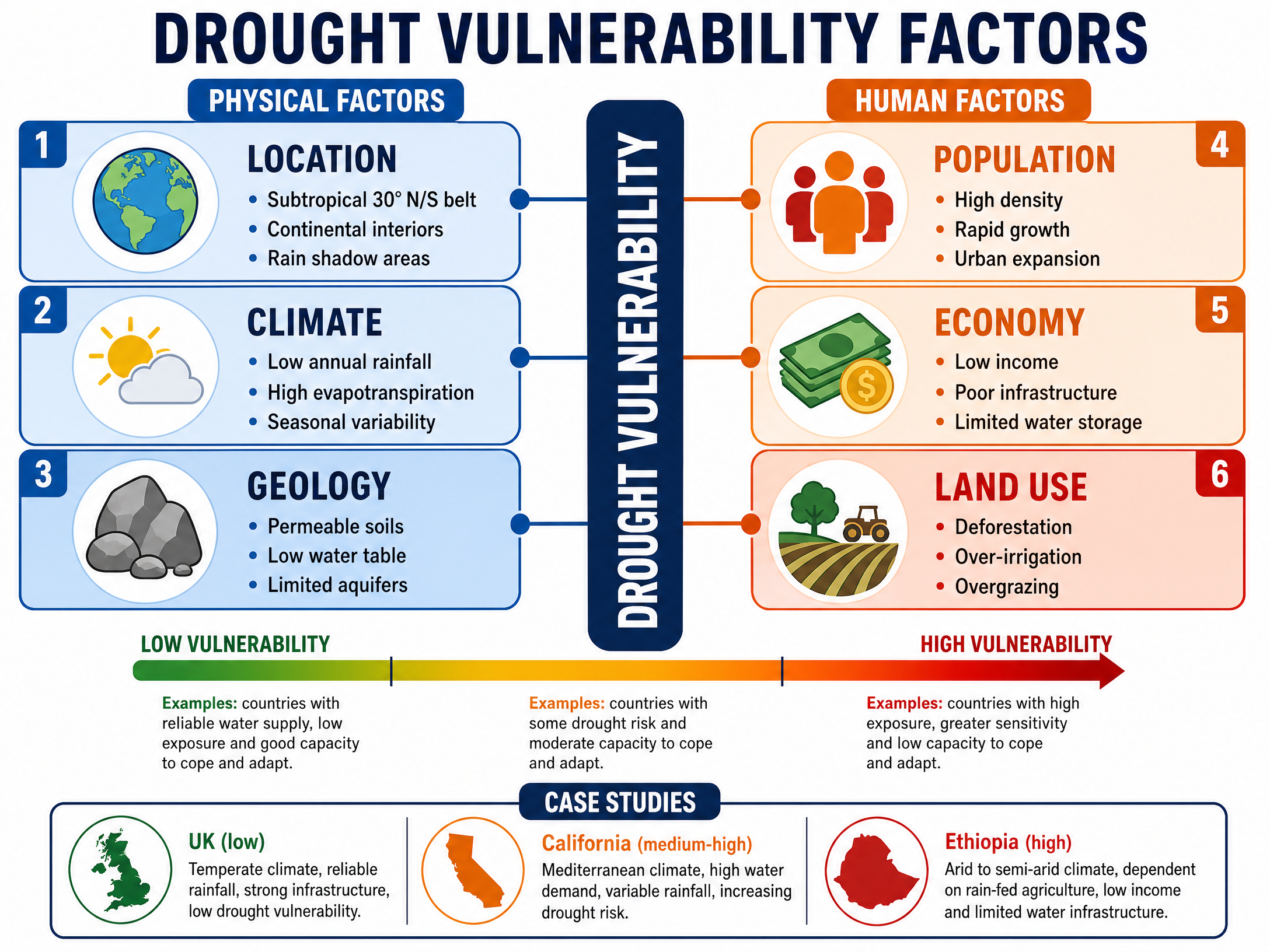
Vulnerability to drought varies globally and temporally. It is influenced by physical factors (location, climate, geology) and human factors (population density, economic wealth, infrastructure).
Revision Podcast
Listen to this 5-minute revision podcast covering all the key concepts, causes, and exam tips for this topic.

Visual Resources
3 diagrams and illustrations
Interactive Diagrams
1 interactive diagram to visualise key concepts
Conceptual Flow Outline
Flowchart showing the relationship between physical triggers, human activities, and types of drought.
Worked Examples
3 worked examples — open one to explore the question and available guidance.
Practice Questions
Test your understanding — click to reveal model answers
Describe the global distribution of areas with high drought vulnerability. (3 marks)
Hint: Look for patterns related to latitude and specific continents.
Explain how two human activities can increase the risk of drought. (4 marks)
Hint: Name the activity, then explain the mechanism (how it reduces water).
Assess the vulnerability of different locations to the impacts of drought. (9 marks)
Hint: Compare a developed country (e.g., UK or USA) with a developing country (e.g., Ethiopia).
Explain the role of the Hadley Cell in creating drought-prone regions. (4 marks)
Hint: Follow the air from the equator to 30 degrees N/S.
Outline the time lag between meteorological and hydrological drought. (2 marks)
Hint: Think about how long it takes for water to reach rivers and aquifers.