Pearson Edexcel · GCSE · Geography
The chosen UK city is being changed by movements of people, employment and services
This study guide explores how major UK cities like Manchester are transformed by the movements of people, employment, and services. Understanding these urban processes is critical for your GCSE Geography exam, as examiners frequently test your ability to link causes (like deindustrialisation) to consequences (like urban inequality).
- 4 min read
- 3 worked examples
- 5 practice questions
- 6 key terms
Study Notes
Overview
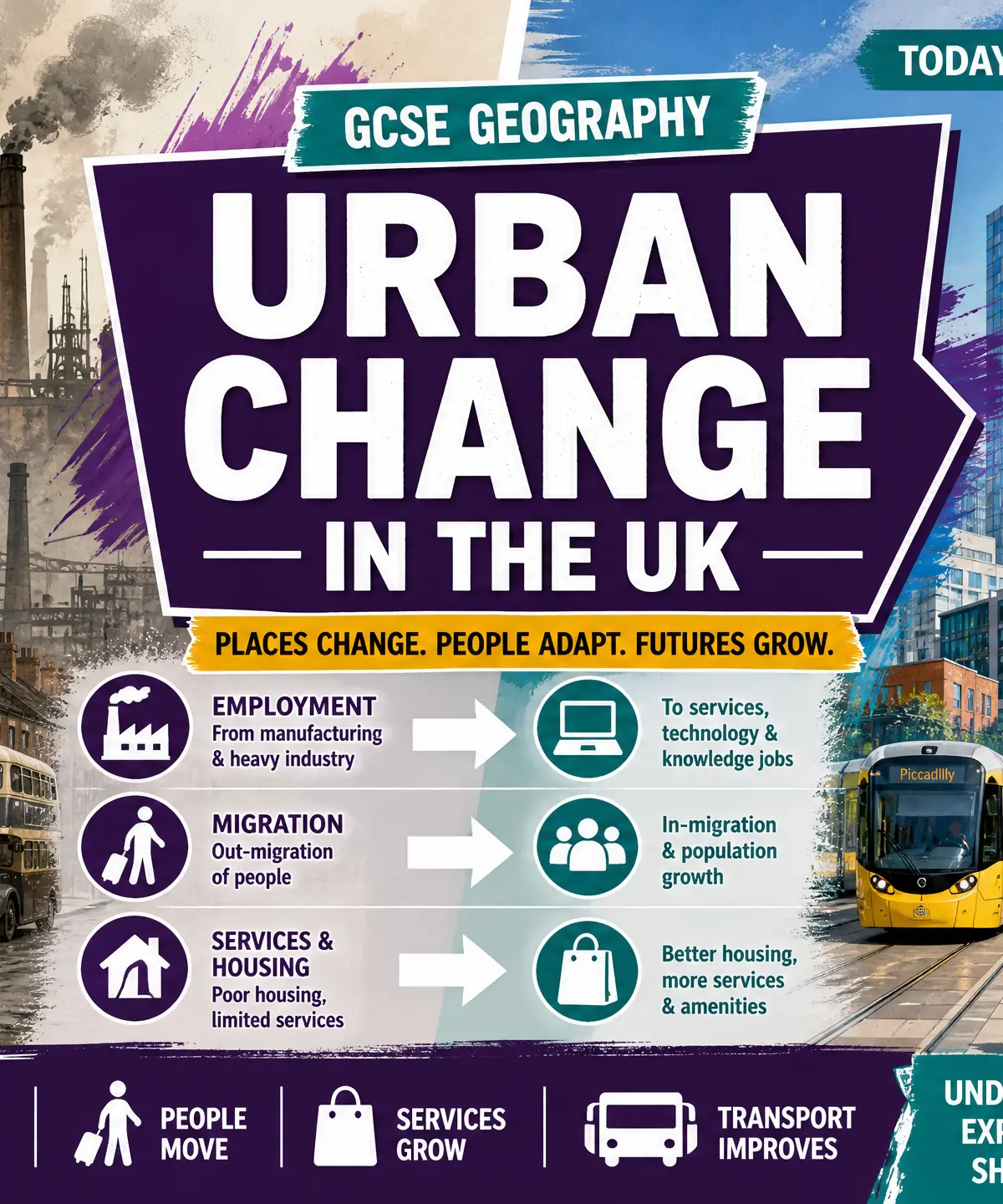
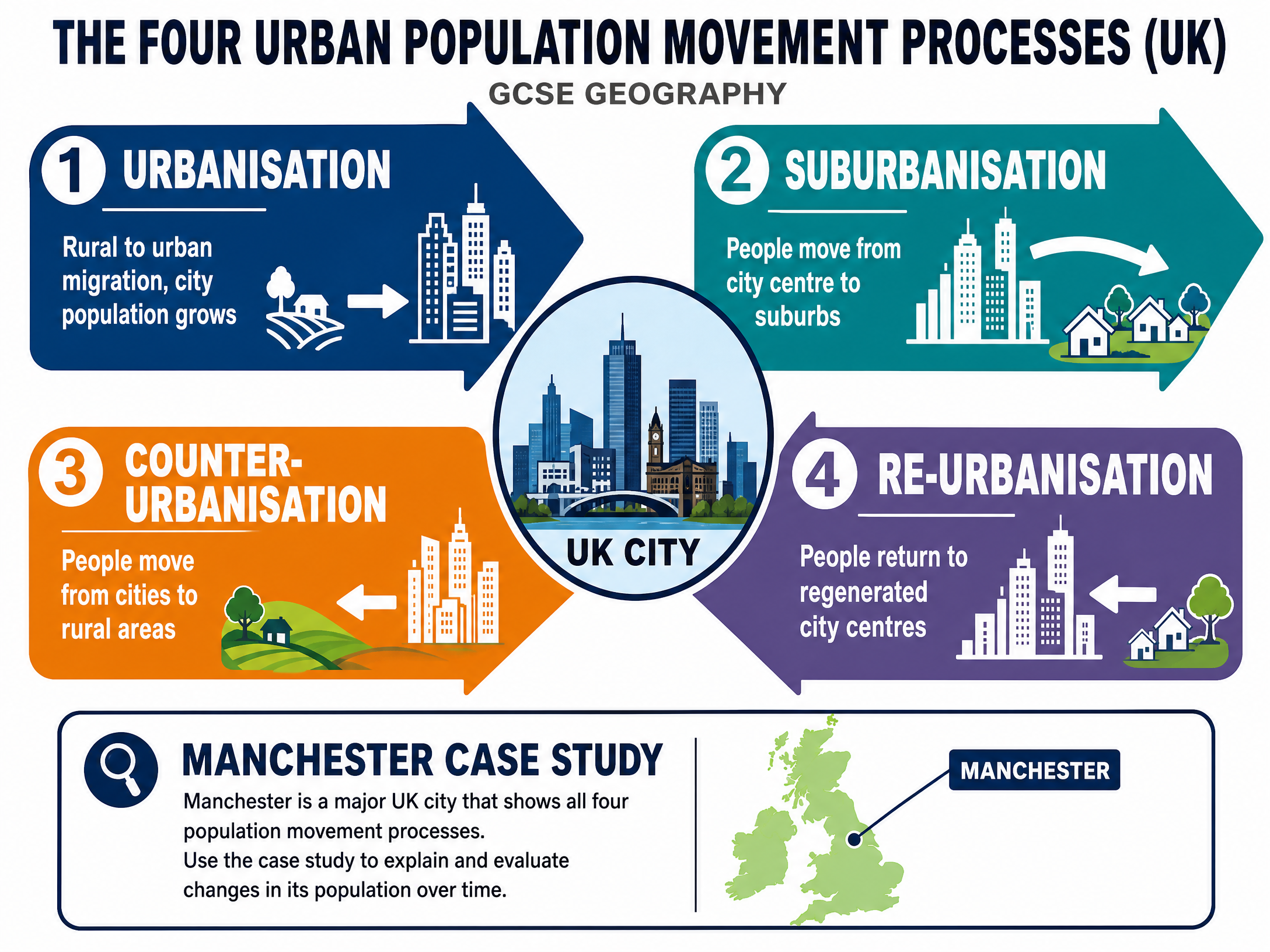
This topic examines the dynamic processes that shape major UK cities. You will explore how population movements (urbanisation, suburbanisation, counter-urbanisation, and re-urbanisation) change the demographic character of a city. You will also investigate the profound impacts of economic change, specifically the shift from a manufacturing-based economy to a service and knowledge-based economy. Using Manchester as our primary case study, we will see how deindustrialisation caused severe decline, and how subsequent regeneration has created both new opportunities and stark urban inequalities. Examiners expect you to use specific, named examples and data to support your points, and to evaluate the sustainability of strategies designed to improve urban quality of life.
Listen to the Podcast

Key Urban Processes
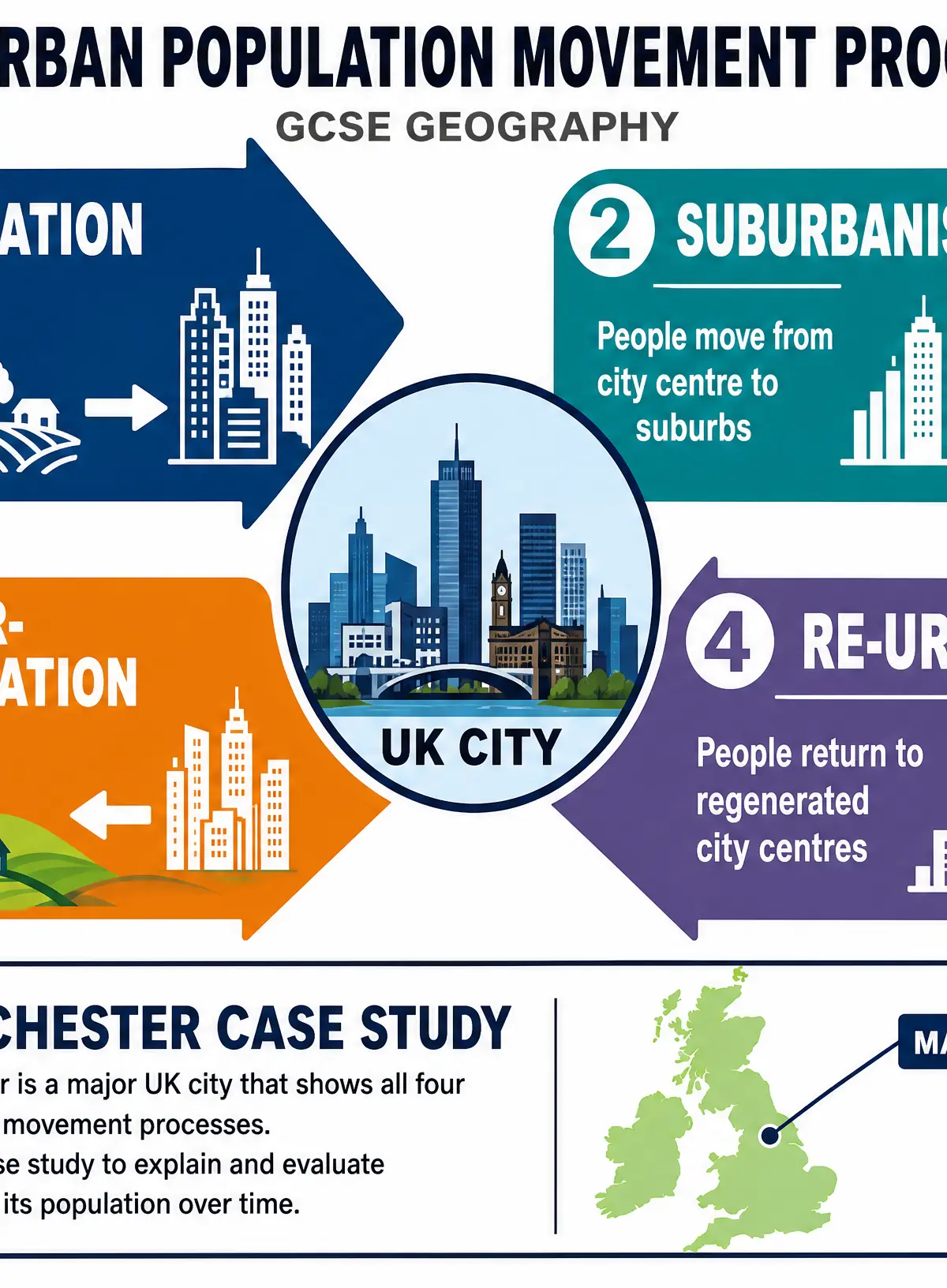
Population Movements
Urbanisation: The increasing proportion of people living in urban areas, historically driven by rural-to-urban migration during the Industrial Revolution.
Suburbanisation: The outward growth of a city as people and businesses move from the centre to the suburbs (e.g., Didsbury, Chorlton), facilitated by improved transport.
Counter-urbanisation: The movement of people away from urban areas into rural areas or smaller towns, seeking a better quality of life.
Re-urbanisation: The movement of people back into city centres, often driven by regeneration projects (e.g., Ancoats, Northern Quarter).
Deindustrialisation and Economic Change
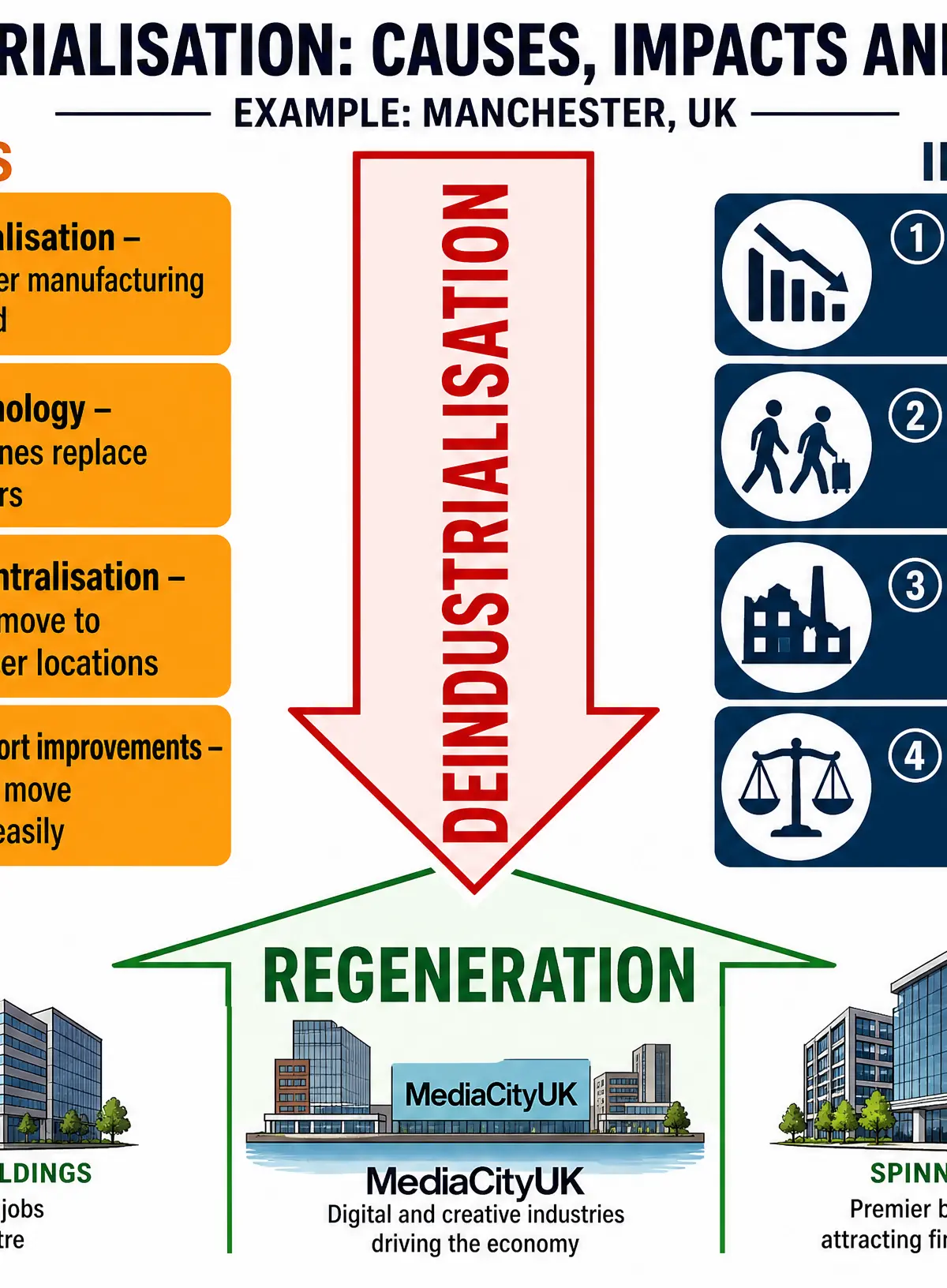
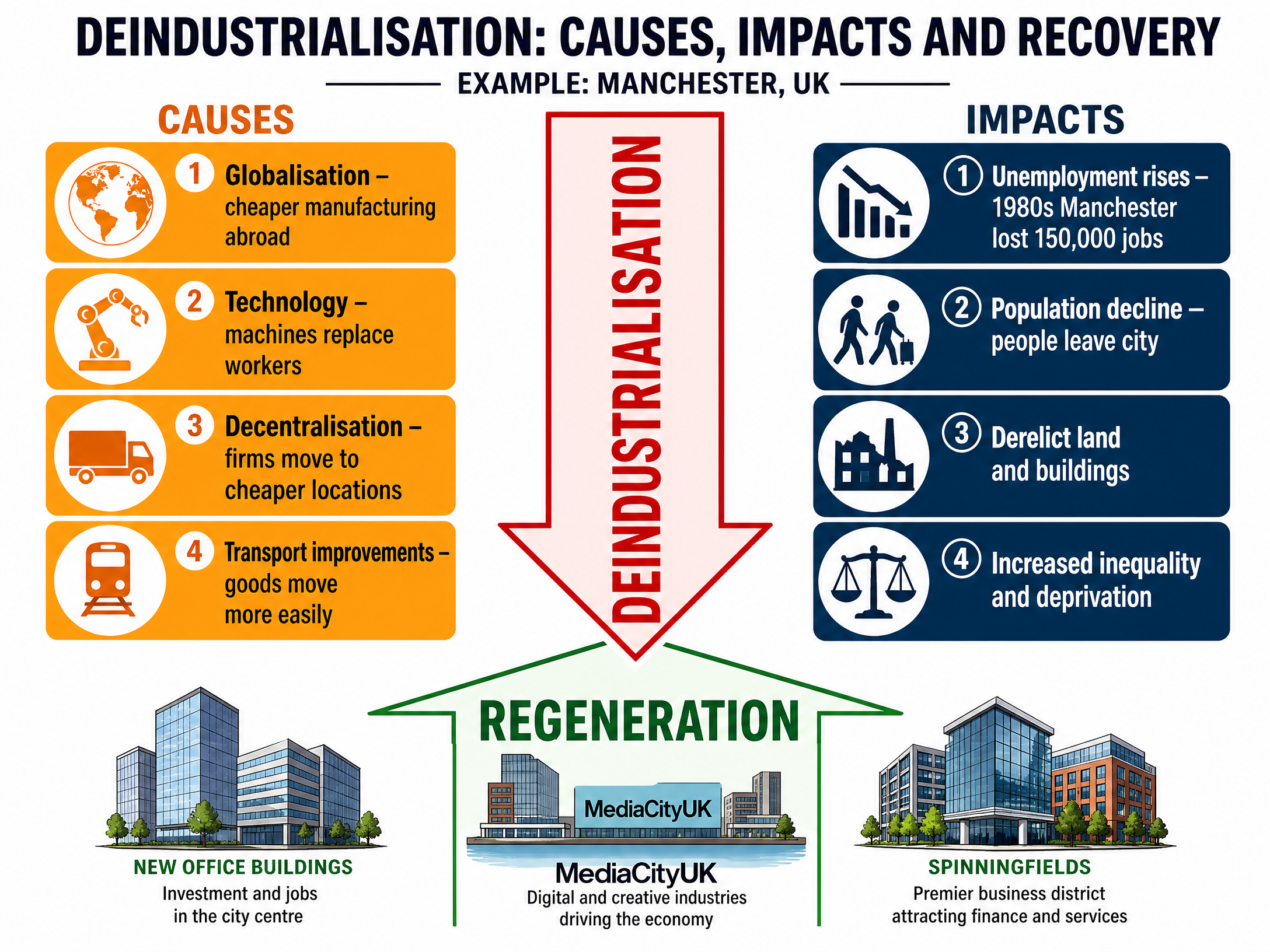
What happened: Manchester's traditional manufacturing industries (like textiles) collapsed in the 1970s and 1980s.
Why it matters: This caused massive unemployment (loss of 150,000 jobs) and urban decline. It was caused by globalisation, automation, decentralisation, and transport improvements.
Regeneration: The city transitioned to a service economy (MediaCityUK, Spinningfields), bringing new wealth but also increasing inequality.
Retail Change and Inequality
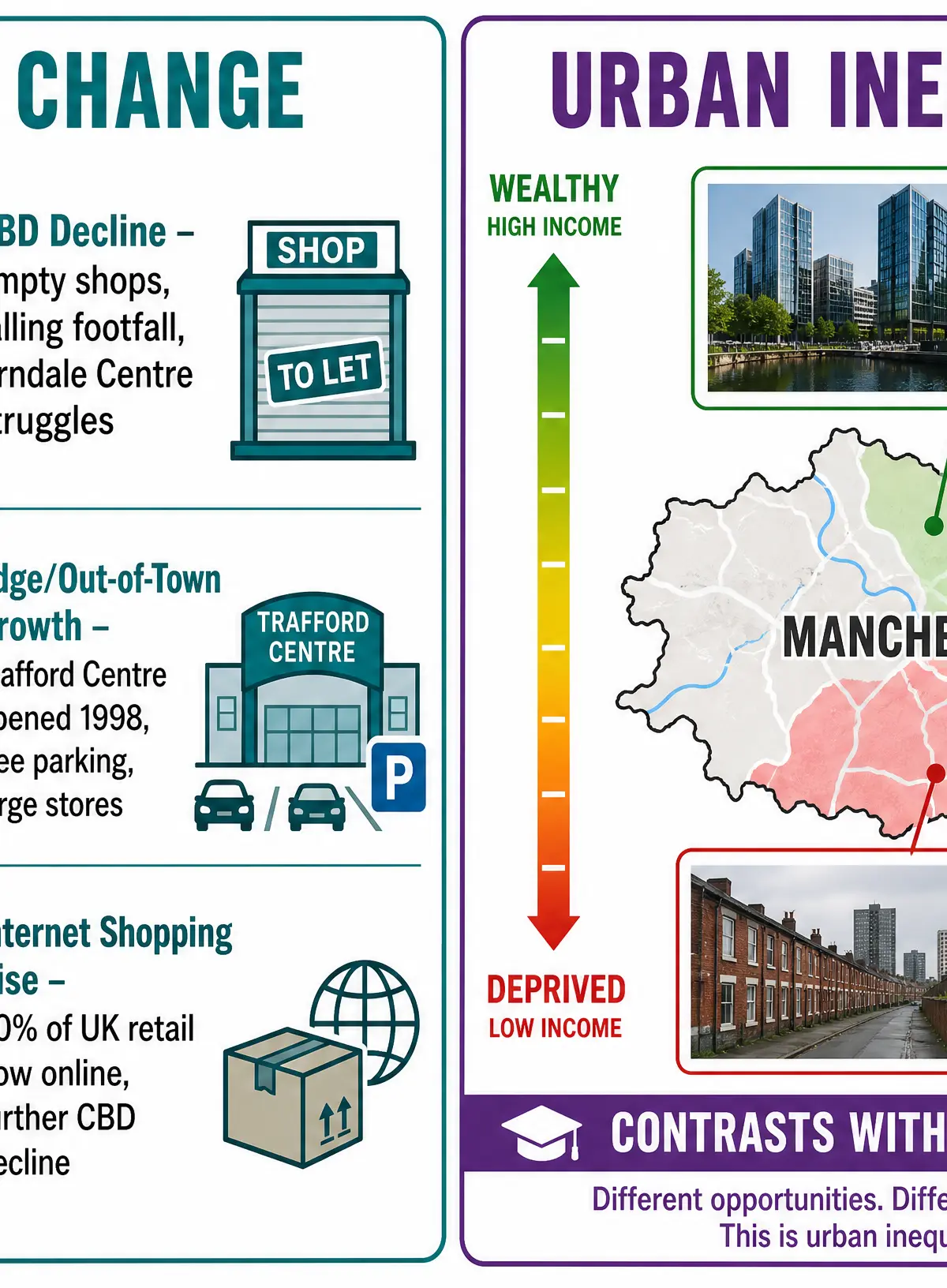
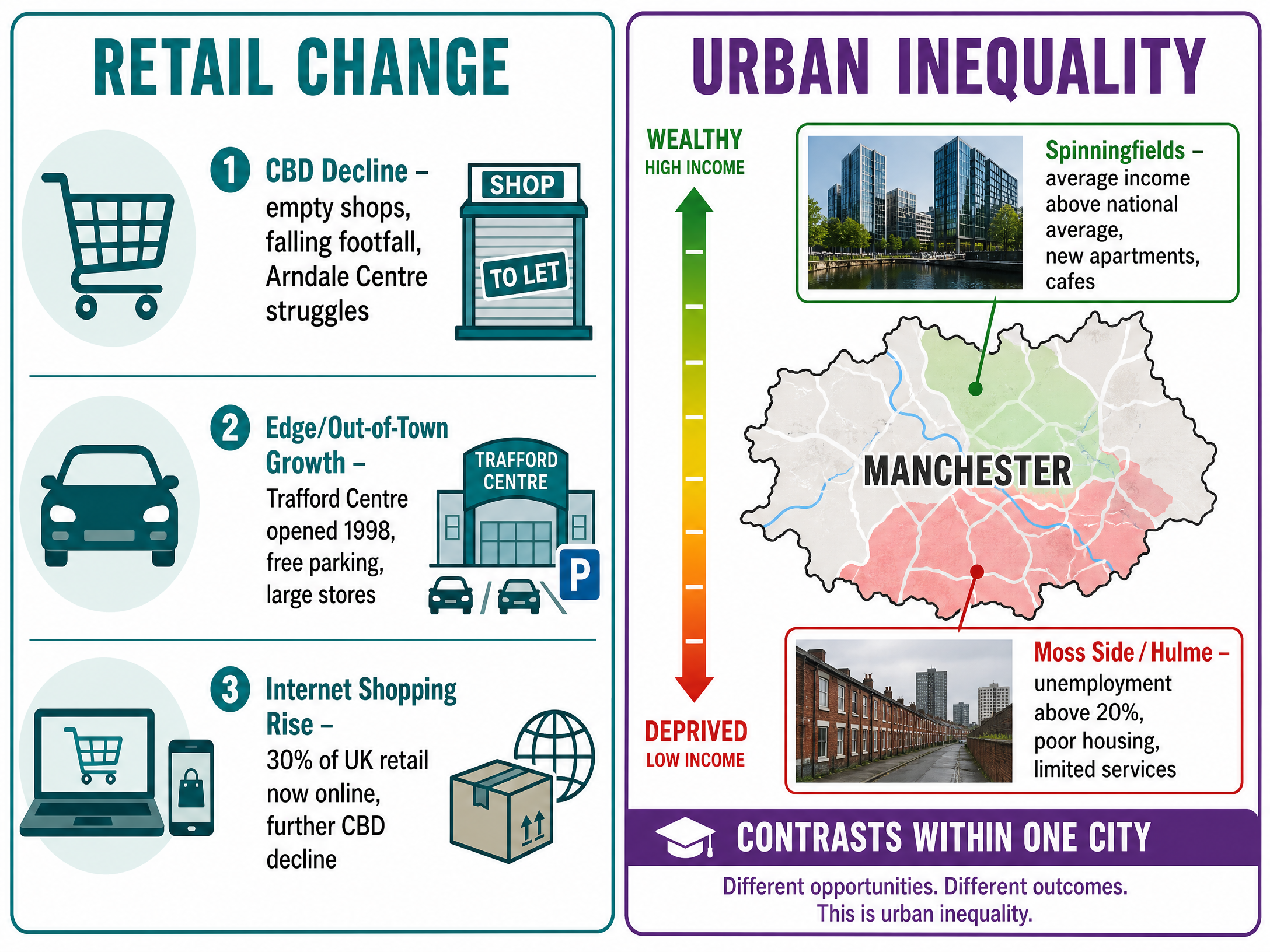
What happened: The traditional Central Business District (CBD) faced decline due to out-of-town shopping centres (Trafford Centre, opened 1998) and the rise of internet shopping.
Why it matters: This shifted services away from the centre, though recent regeneration has attempted to revive the CBD. Economic changes have left stark contrasts between wealthy areas (Spinningfields) and deprived areas (Moss Side, Collyhurst).
Second-Order Concepts
Causation
Deindustrialisation was caused by a combination of long-term global shifts (globalisation, cheaper foreign labour) and technological triggers (automation, containerisation).
Consequence
The immediate consequence of deindustrialisation was severe unemployment and dereliction. The long-term consequence was the necessary regeneration of the city into a service and digital hub, which subsequently caused rising urban inequality.
Change & Continuity
While the economic base changed completely (manufacturing to services), the city's role as a major regional hub continued. However, the demographic makeup changed significantly due to international and national migration.
Significance
Understanding these changes is crucial because they explain the current landscape of UK cities—why certain areas are wealthy, why others are deprived, and why sustainable planning is so important for the future.
Visual Resources
3 diagrams and illustrations
Interactive Diagrams
1 interactive diagram to visualise key concepts
Conceptual Flow Outline
Flowchart showing causes and consequences of Deindustrialisation
Worked Examples
3 worked examples — open one to explore the question and available guidance.
Practice Questions
Test your understanding — click to reveal model answers
Using a named UK city, explain how changes in retail have affected the city centre. (6 marks)
Hint: Think about the CBD, out-of-town shopping, and internet shopping. Use Manchester examples.
Assess the impacts of national and international migration on a UK city you have studied. (9 marks)
Hint: You need positive and negative impacts, covering both national (students/workers) and international migration.
State two causes of counter-urbanisation. (2 marks)
Hint: Why do people want to leave the city for the countryside?
Explain how urban change has led to inequality in a UK city. (6 marks)
Hint: Contrast a wealthy regenerated area with a deprived area left behind by deindustrialisation.
Evaluate the success of strategies to make urban living more sustainable. (9 marks)
Hint: Discuss transport, housing, and recycling. Are they working? Are there downsides?