Pearson Edexcel · GCSE · Geography
The context of the chosen developing country or emerging country city influences its functions and structure
Discover how the site, situation, and connectivity of cities in developing and emerging countries shape their dramatic growth and internal structure. Using Mumbai as a key case study, this guide provides the specific facts, terminology, and examiner insights you need to secure top marks.
- 6 min read
- 3 worked examples
- 5 practice questions
- 6 key terms
Study Notes
Overview
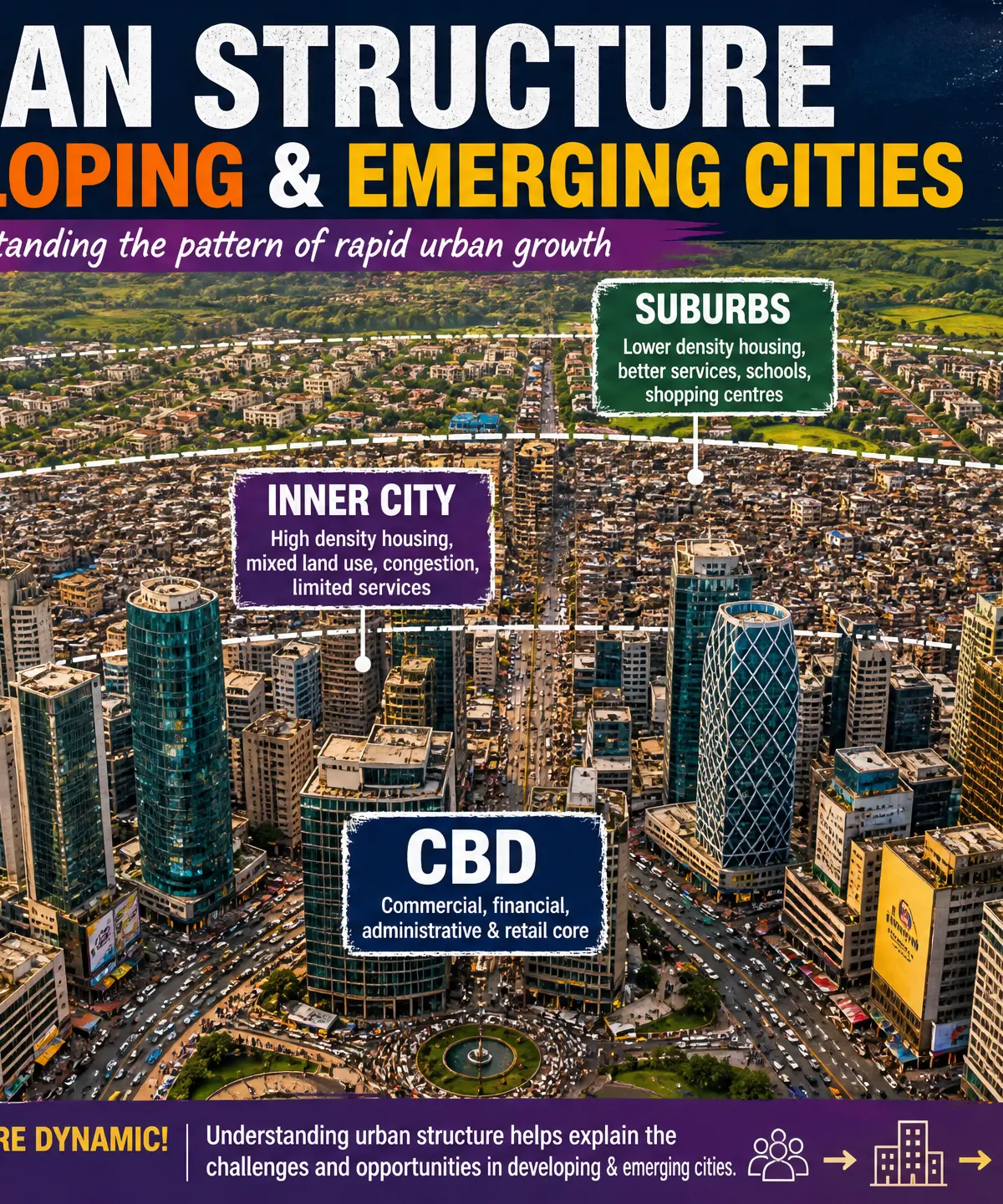
This study guide focuses on the fascinating urban geography of developing and emerging country cities, specifically examining how their physical context influences their internal structure and functions. Examiners expect candidates to move beyond generic descriptions of urban areas; you must be able to confidently apply concepts like site, situation, and connectivity to a named case study. In this guide, we use Mumbai, India, as our primary example. Understanding how historical port functions, rapid rural-urban migration, and modern global connectivity have combined to shape Mumbai's Central Business District (CBD), inner city, suburbs, and urban-rural fringe is crucial for achieving high marks in extended writing questions.

Geographical Context: Site and Situation
Site
Definition: The actual physical land on which a settlement is built.
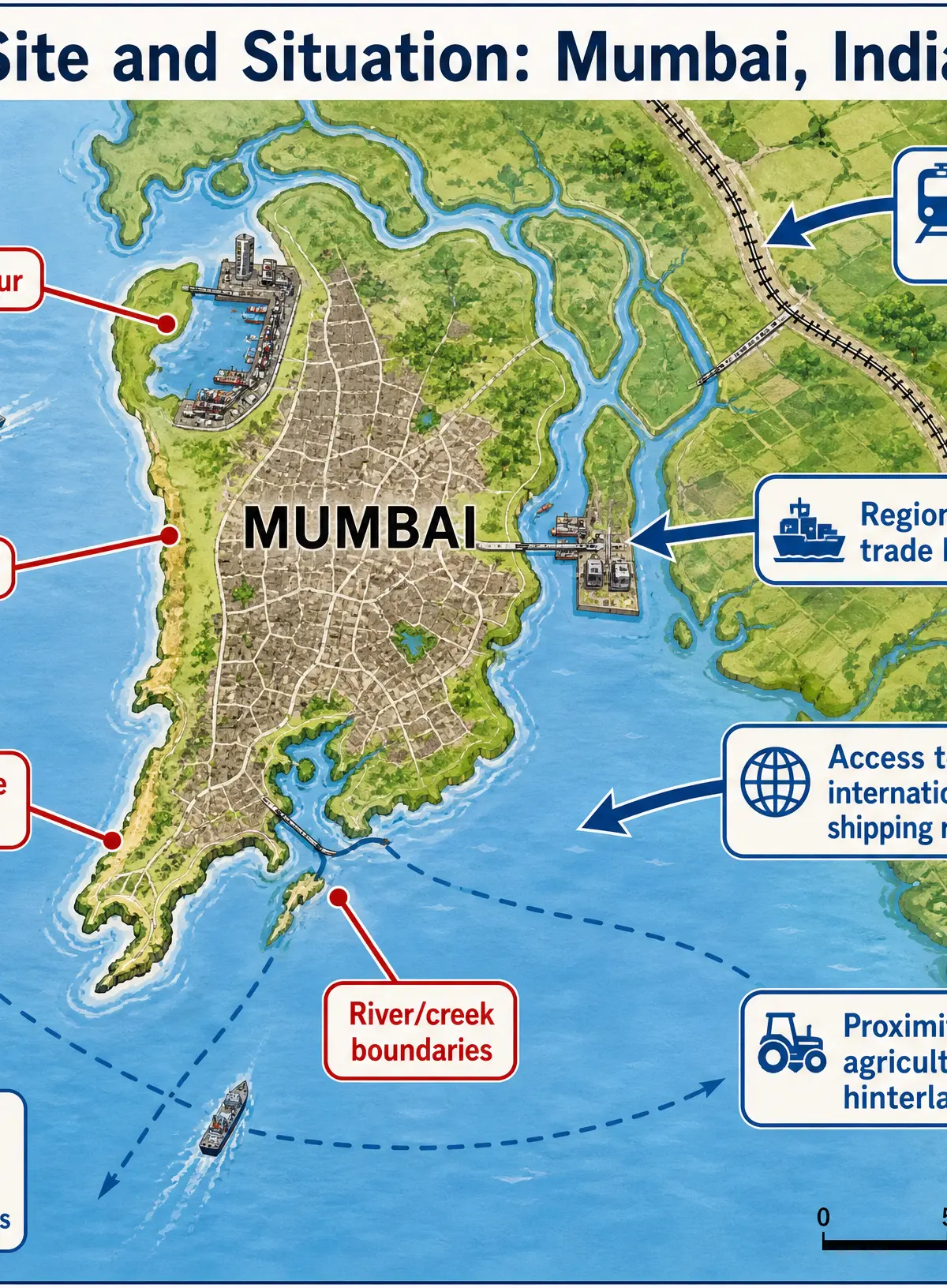
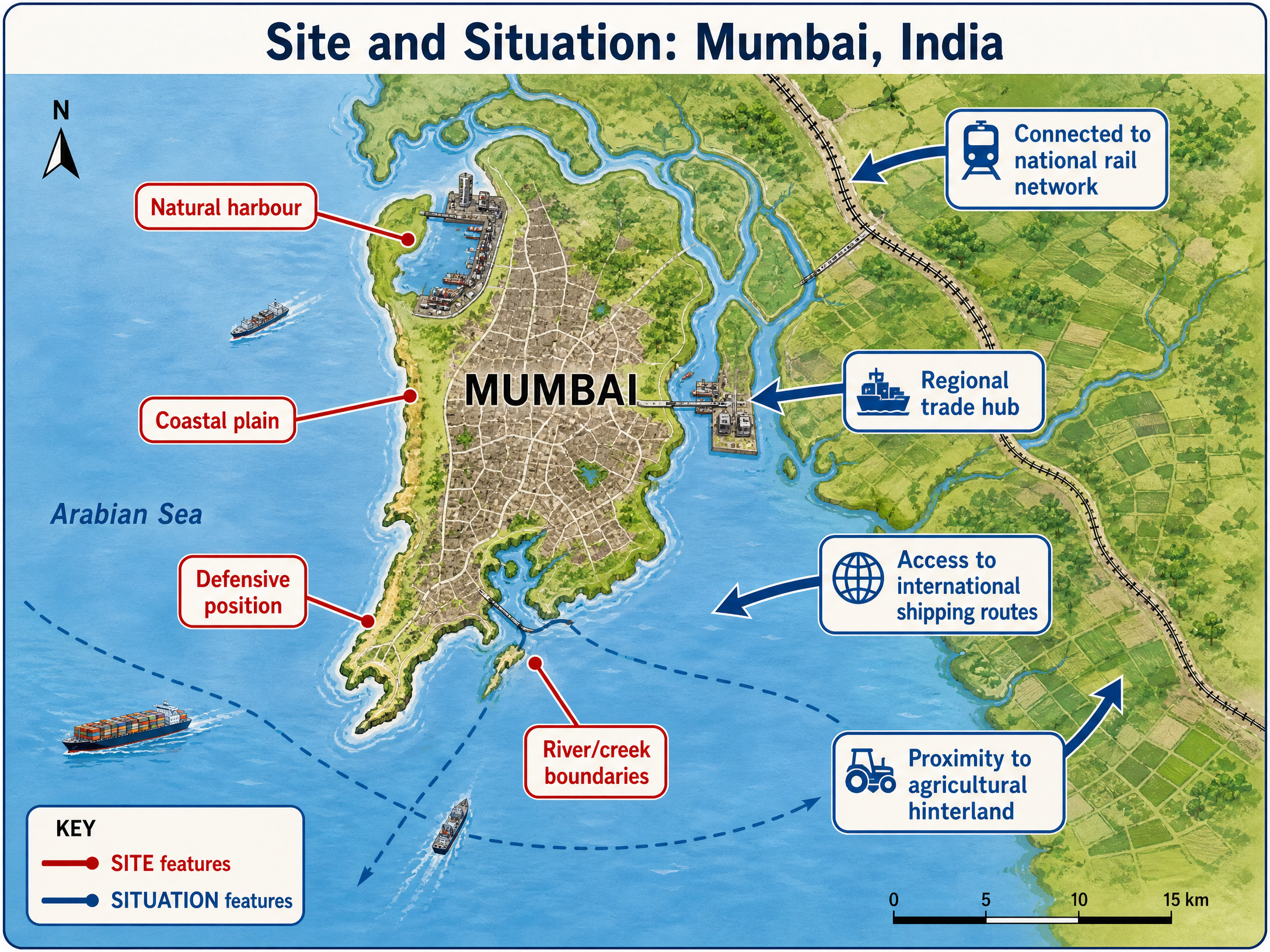
Mumbai's Site: Mumbai is located on a peninsula on the west coast of India, extending into the Arabian Sea. It was originally a series of seven islands.
Why it matters: The deep-water estuary provided a natural, sheltered harbour. This physical feature was the primary reason the British East India Company established a trading post here in the 17th century. The physical constraints of the peninsula also mean the city can only expand northwards, leading to extreme population density in the south.
Situation
Definition: The location of a place relative to its surroundings and other places.
Mumbai's Situation: Mumbai is strategically positioned on the west coast of India, facing the Arabian Sea. It sits on major international shipping routes connecting Europe (via the Suez Canal), the Middle East, and Asia.
Why it matters: This situation has made Mumbai India's premier port city. It serves as the 'Gateway to India', handling approximately 60% of India's sea-borne freight. This regional and global position drives its economic function as India's financial capital.
Connectivity and Urban Functions
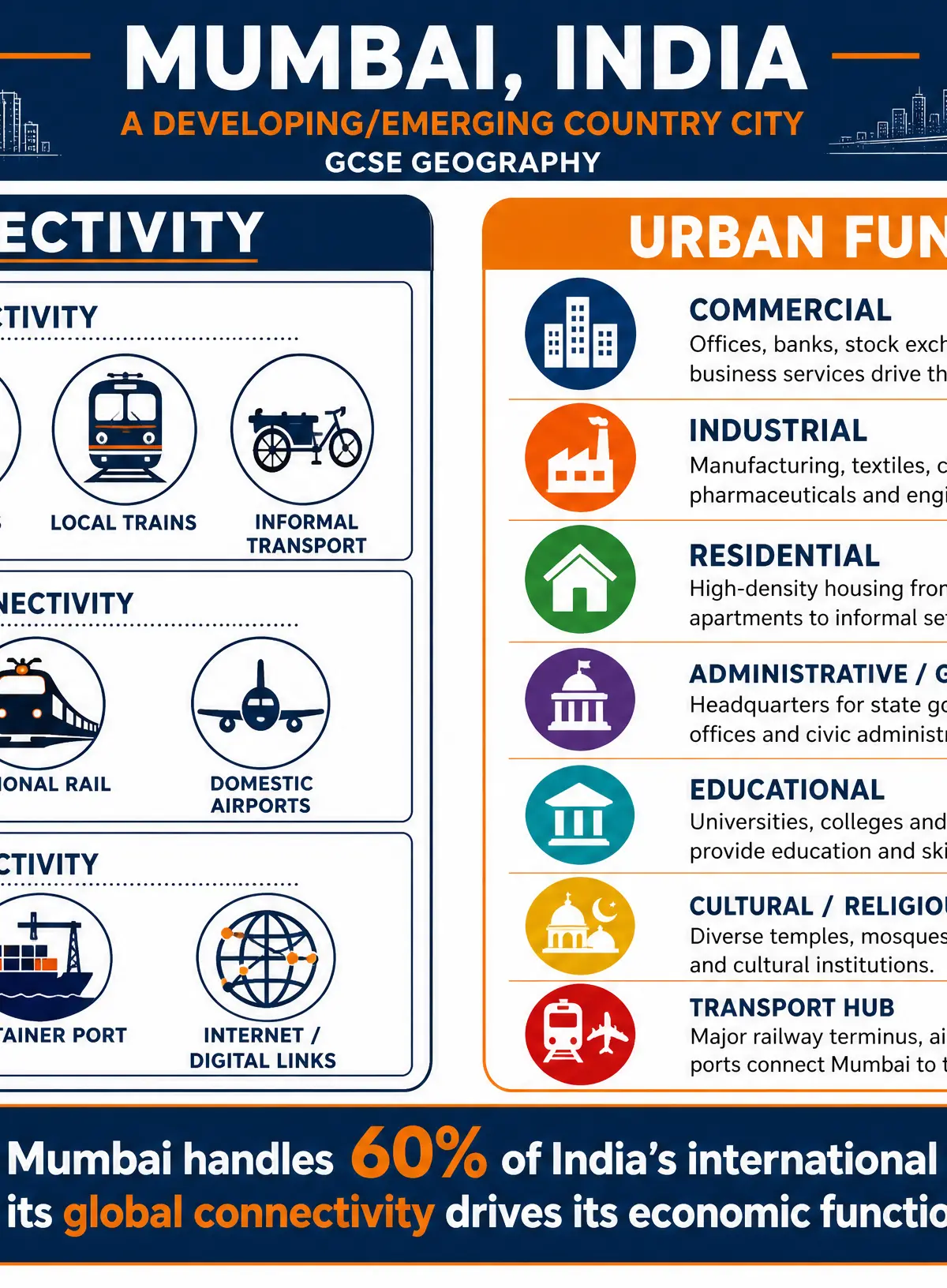
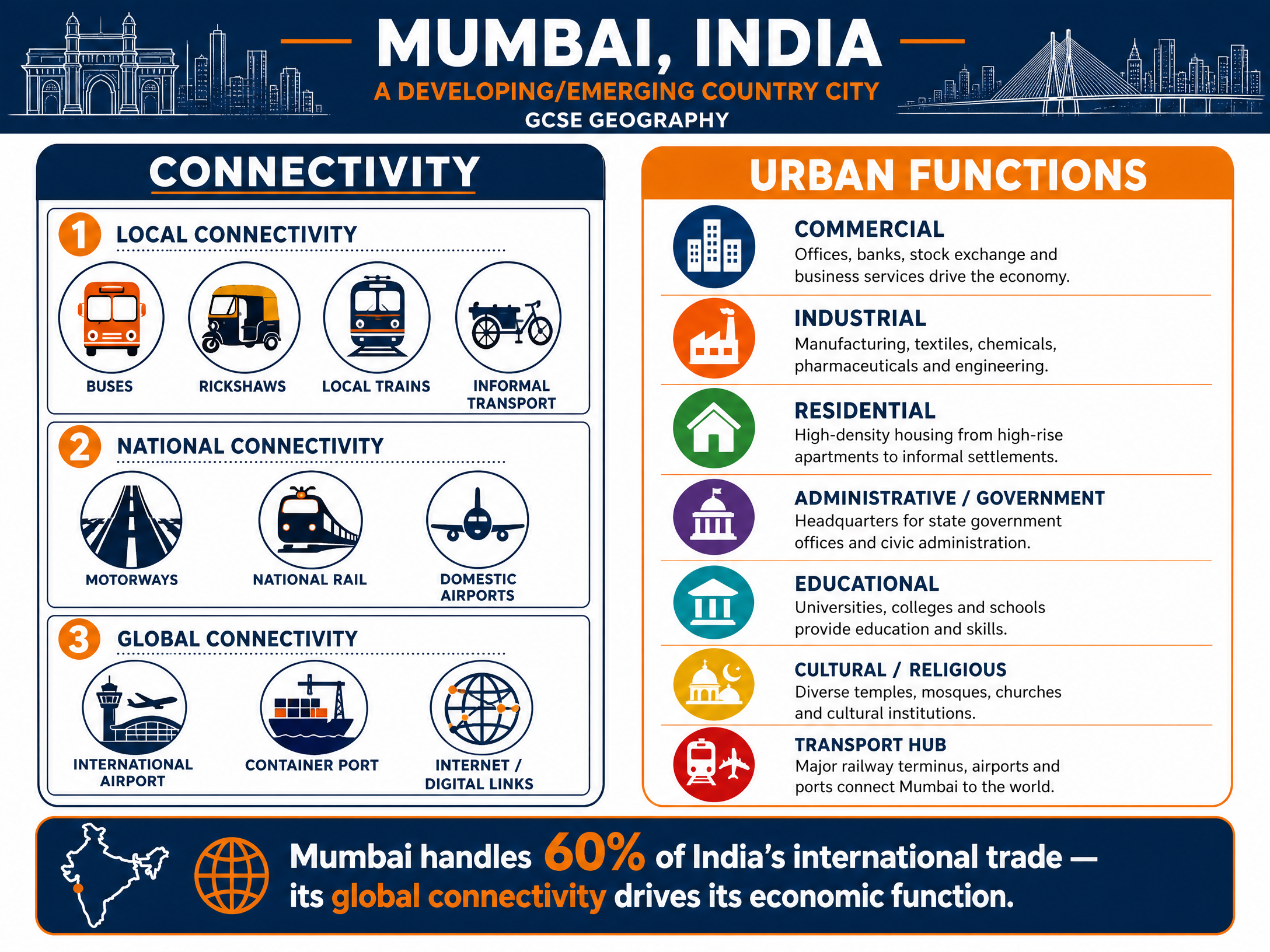
Connectivity operates at three scales, each influencing the city's functions:
1. Local Connectivity: How people and goods move within the city. Mumbai relies heavily on its suburban railway network, which carries over 7.5 million commuters daily. This local connectivity allows a vast workforce to travel from the suburbs to the CBD, supporting the city's commercial functions.
2. National Connectivity: How the city connects to the rest of the country. Mumbai is the hub of India's national railway and motorway networks, allowing raw materials to reach its industries and manufactured goods to be distributed across India.
3. Global Connectivity: How the city connects to the world. With two international airports (Chhatrapati Shivaji Maharaj International Airport) and major container ports (Jawaharlal Nehru Port), Mumbai is deeply integrated into the global economy, attracting transnational corporations (TNCs) and foreign direct investment (FDI).
Internal Structure of the City
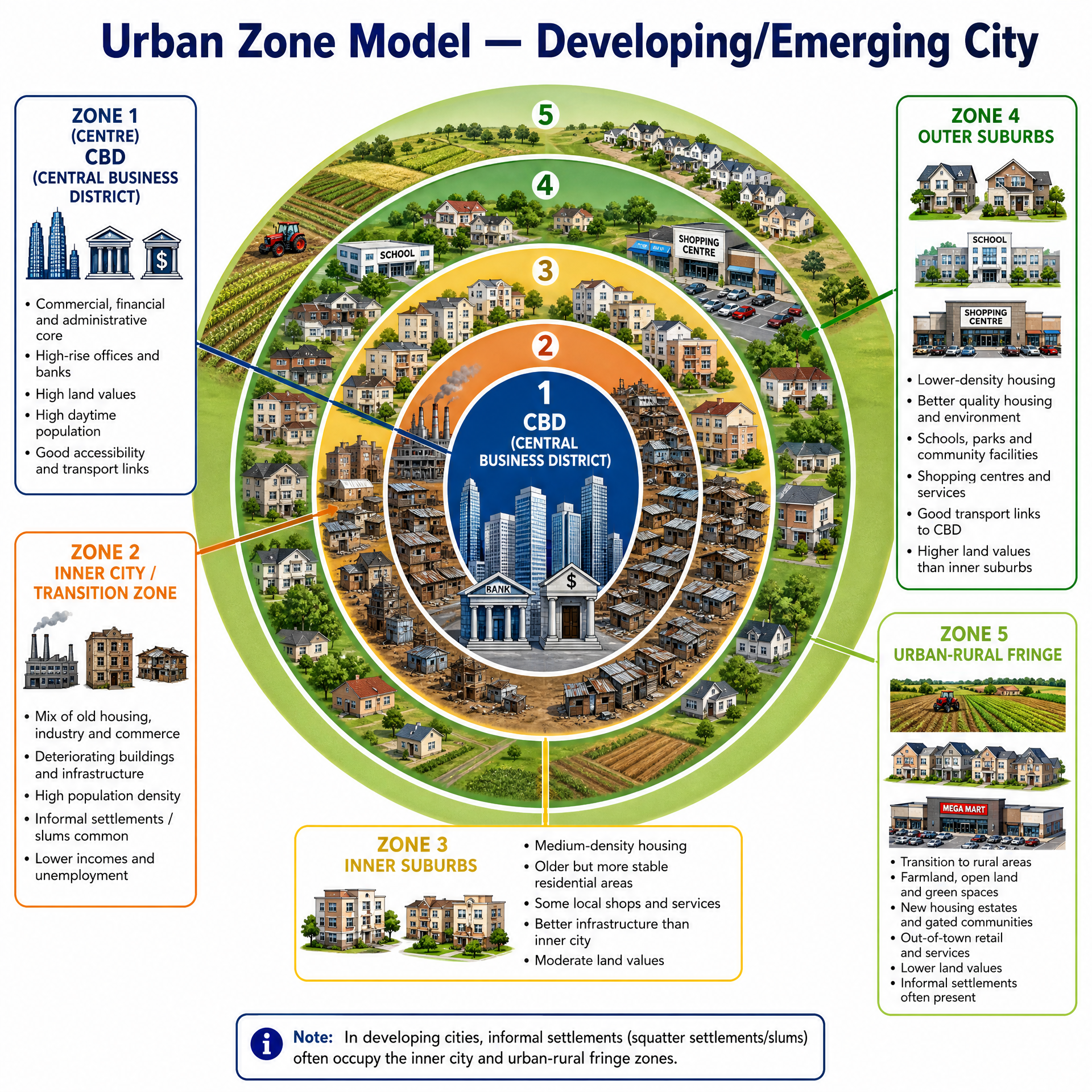
Cities in developing and emerging countries often follow a concentric zone model, but with distinct characteristics driven by rapid urbanisation.
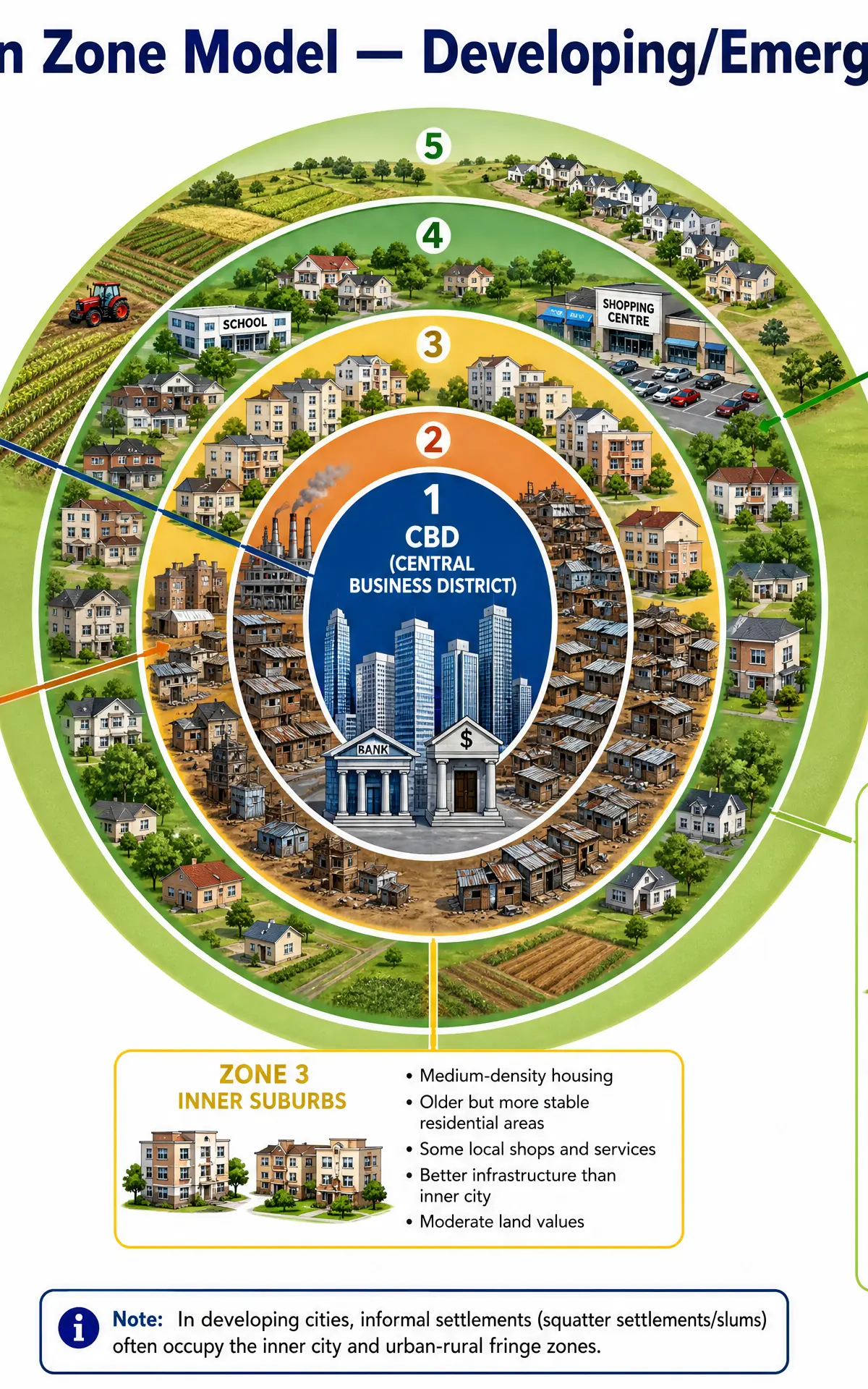
1. The Central Business District (CBD)
Location: Usually at the original site of the settlement (e.g., the historic port area).
Characteristics: High-rise commercial buildings, banks, government offices, and high-end retail. Land values are the highest in the city.
Mumbai Example: The Fort area and Nariman Point at the southern tip of the peninsula. It is the financial heart of India, housing the Bombay Stock Exchange.
2. The Inner City (Transition Zone)
Location: Surrounding the CBD.
Characteristics: A mix of older, often deteriorating housing, and older industrial areas. Crucially, in developing cities, this is where you frequently find large informal settlements (slums), established by rural migrants seeking proximity to jobs in the CBD or factories.
Mumbai Example: Dharavi is located in the inner city, between two main railway lines. It is home to an estimated 1 million people in just 2.1 square kilometres, highlighting the extreme population density driven by rapid rural-urban migration.
3. The Suburbs
Location: Expanding outward from the inner city.
Characteristics: More planned residential areas, ranging from middle-class apartment blocks to wealthier gated communities. Better infrastructure, schools, and hospitals than the inner city.
Mumbai Example: Areas like Bandra and Andheri. As the city has grown northwards along the transport corridors, these areas have developed significant commercial functions of their own to serve the suburban population.
4. The Urban-Rural Fringe
Location: The edge of the city where the built-up area meets the countryside.
Characteristics: A zone of rapid change. You will find new, large-scale housing developments, out-of-town retail, and new industrial estates. However, you will also find informal settlements appearing here, as the poorest migrants are pushed to the periphery where land is cheaper or less regulated.
Mumbai Example: Navi Mumbai (New Mumbai), a planned satellite city developed on the mainland to the east to relieve congestion on the main peninsula.
Visual Resources
3 diagrams and illustrations
Interactive Diagrams
1 interactive diagram to visualise key concepts
Conceptual Flow Outline
Flowchart showing the causes and spatial consequences of rapid urban growth.
Worked Examples
3 worked examples — open one to explore the question and available guidance.
Practice Questions
Test your understanding — click to reveal model answers
Explain two ways in which global connectivity influences the economic function of a named developing or emerging country city. (4 marks)
Hint: Name your city. State a type of global connection (e.g., ports, airports) and explain how it brings in money or business.
For a named developing or emerging country city, explain why informal settlements are often located in the inner city. (4 marks)
Hint: Think about why migrants move to the city in the first place, and what they need to be close to.
State one characteristic of the urban-rural fringe in a developing country city. (1 mark)
Hint: What kind of land use do you find at the very edge of the city?
Assess the importance of site in determining the internal structure of a named developing or emerging country city. (9 marks)
Hint: Evaluate site against other factors like situation, economic function, or migration.
Describe the location of the CBD in your chosen developing or emerging country city. (2 marks)
Hint: Where exactly is it? Use compass directions or specific geographical features.