Pearson Edexcel · GCSE · Geography
The global climate was different in the past and continues to change due to natural causes
Dive deep into Earth's dramatic history to uncover how natural forces—from wobbling orbits to massive volcanic eruptions—have driven climate change for millions of years. This guide gives you the precise knowledge, named examples, and examiner-approved techniques to secure top marks in your GCSE Geography exam.
- 5 min read
- 3 worked examples
- 5 practice questions
- 6 key terms
Study Notes
Overview
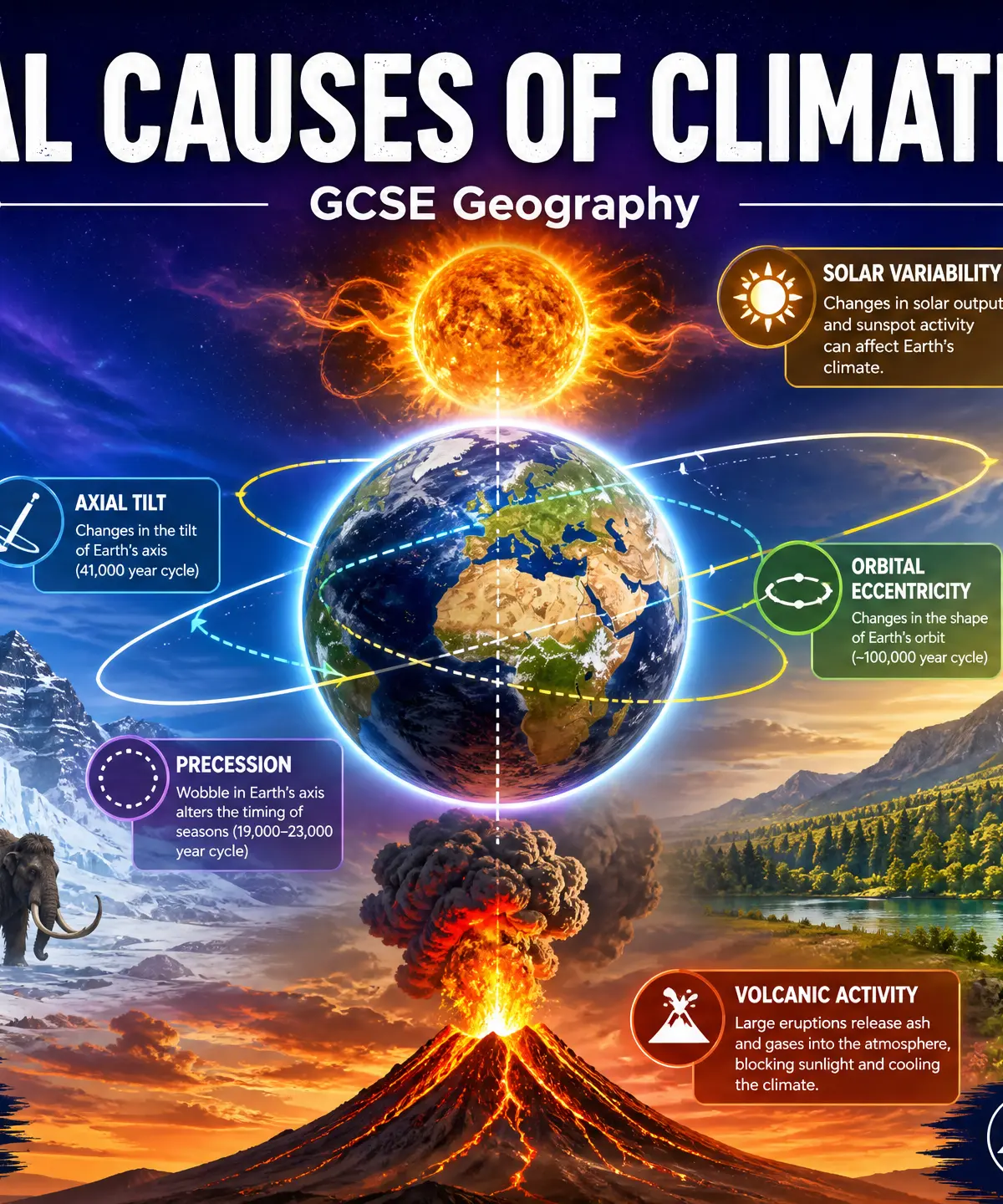
This topic explores how Earth's climate has changed naturally throughout the Quaternary period (the last 2.6 million years), long before humans began burning fossil fuels. During this time, the planet has experienced dramatic shifts between cold glacial periods (ice ages) and warmer interglacial periods. Understanding these natural cycles is crucial for GCSE Geography, as examiners frequently ask candidates to distinguish between natural climate change and the human-induced enhanced greenhouse effect. You will need to explain the three main natural causes—Milankovitch cycles, solar variation, and volcanic activity—and evaluate the evidence scientists use to reconstruct past climates, such as ice cores and tree rings. Precise knowledge and specific named examples are essential for achieving top marks in this topic.
Key Natural Causes
Milankovitch Cycles
Timescale: Tens to hundreds of thousands of years
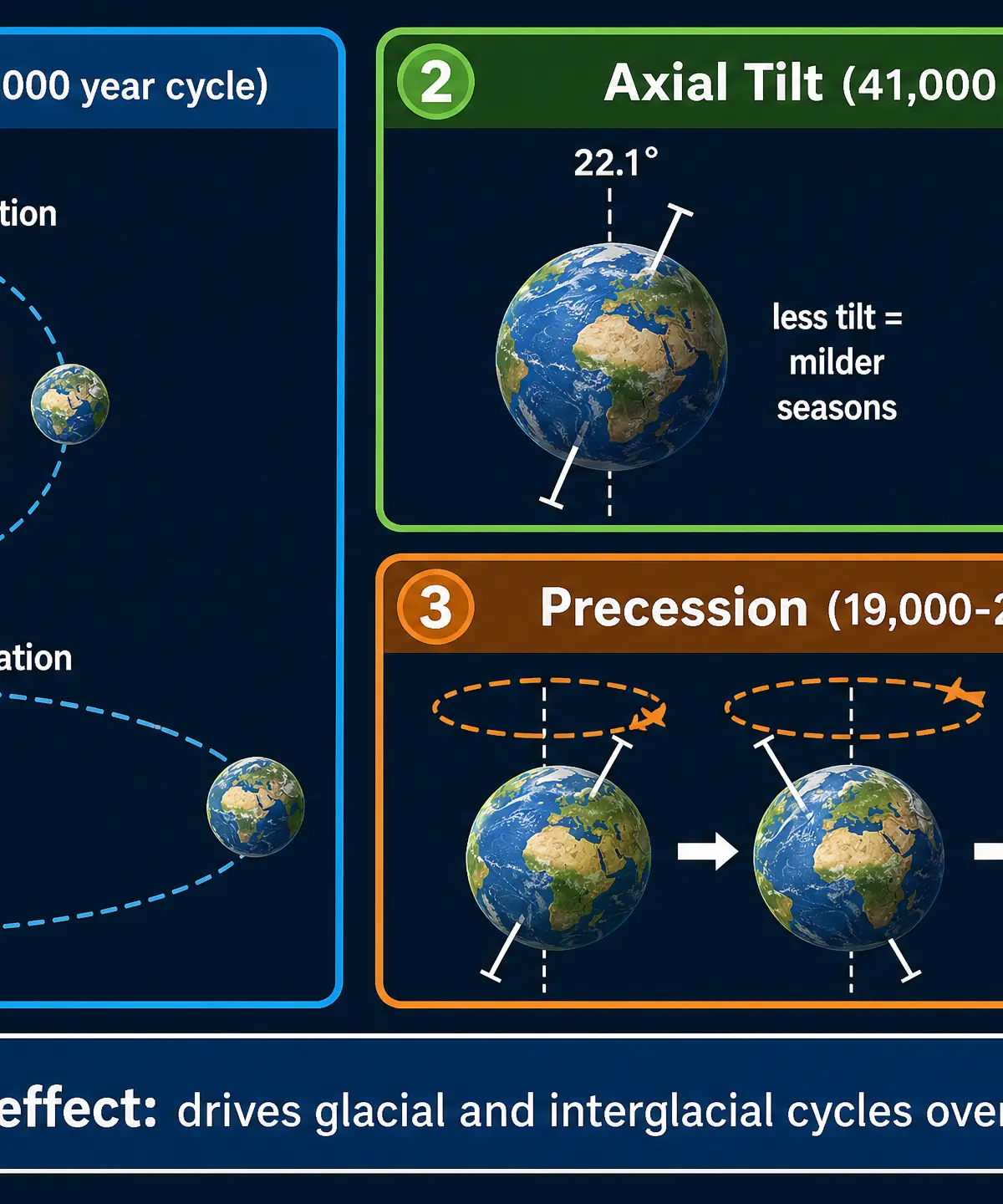
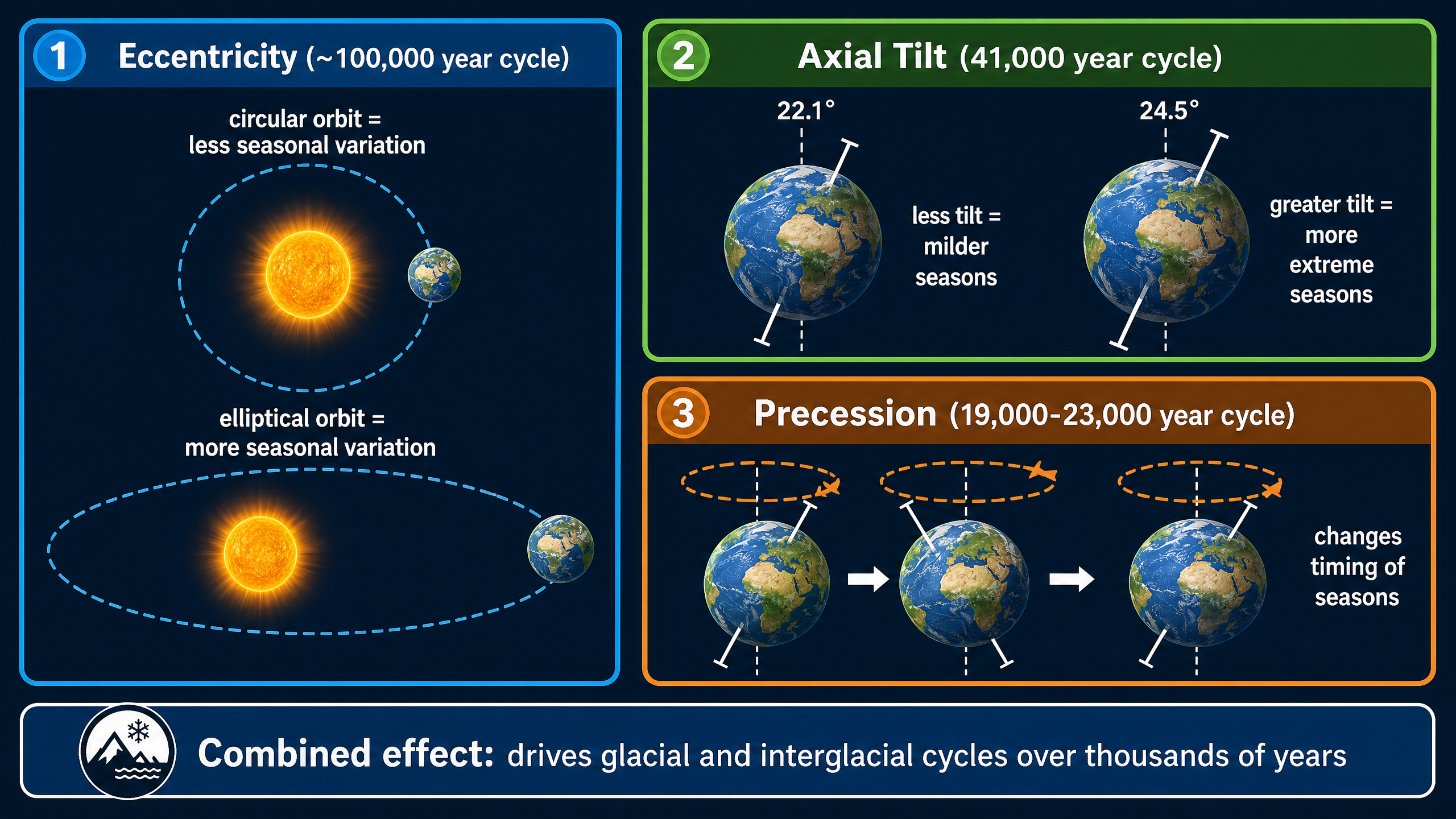
What happened: Earth's orbit and tilt change in three regular, predictable cycles: Eccentricity (orbit shape changes every ~100,000 years), Axial Tilt (angle changes every ~41,000 years), and Precession (axis wobbles every 19,000-23,000 years).
Why it matters: These cycles alter the amount and distribution of solar energy reaching Earth. When the cycles align to reduce summer sunlight in the Northern Hemisphere, ice sheets can grow, triggering a glacial period. Examiners expect you to name all three components.
Solar Variation
Timescale: 11-year cycles to centuries
What happened: The Sun's energy output is not constant. Sunspots (dark patches on the Sun's surface) indicate higher solar activity. Periods of very low sunspot activity reduce the solar energy reaching Earth.
Specific Knowledge: The Maunder Minimum (1645–1715) was a period of very low sunspot activity that coincided with the Little Ice Age in Europe, when the River Thames regularly froze over.
Volcanic Activity
Timescale: Short-term (1-3 years)
What happened: Massive volcanic eruptions blast ash and sulphur dioxide high into the stratosphere. This material reflects incoming solar radiation back into space, causing global cooling.
Specific Knowledge: The 1815 eruption of Mount Tambora caused the 'Year Without a Summer' in 1816. The 1991 eruption of Mount Pinatubo cooled the Earth by about 0.5°C for two years.
Evidence for Past Climate Change
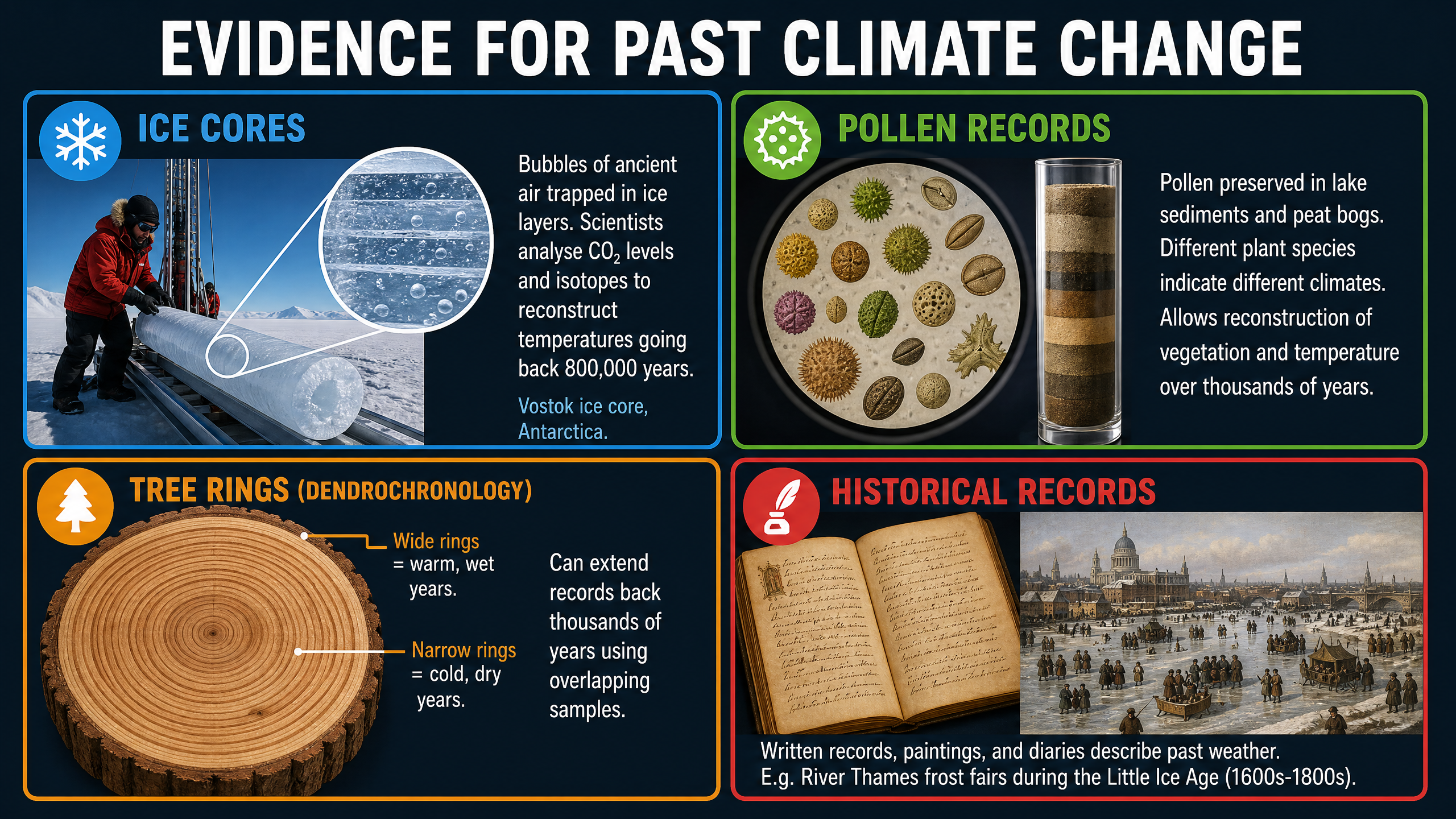
Ice Cores
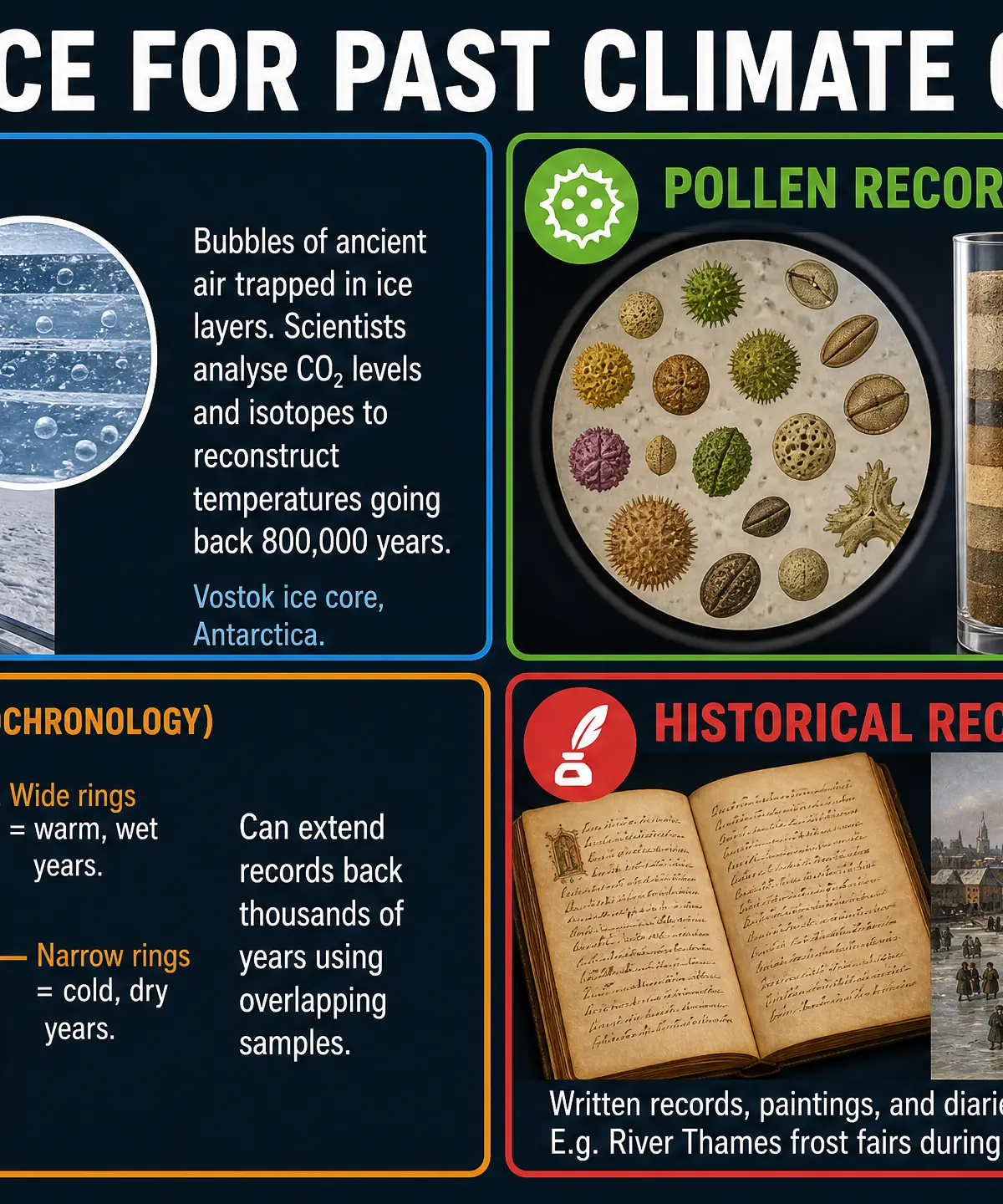
How it works: Scientists drill deep into ice sheets (e.g., in Antarctica) to extract cores. Each layer represents a year. Trapped air bubbles contain ancient atmospheric gases.
Significance: By analysing the ratio of oxygen isotopes and CO₂ concentrations in the bubbles, scientists can accurately reconstruct temperatures going back 800,000 years.
Tree Rings (Dendrochronology)
How it works: Trees grow one ring per year. Wide rings indicate warm, wet years with good growing conditions. Narrow rings indicate cold, dry years.
Significance: Provides highly accurate, localized climate records going back thousands of years.
Pollen Records
How it works: Pollen is preserved in peat bogs and lake sediments. Different plant species thrive in different climates.
Significance: By identifying the pollen at different sediment depths, scientists can reconstruct the vegetation and, consequently, the climate at that time.
Historical Records
How it works: Written accounts, diaries, harvest records, and paintings document past weather conditions.
Significance: Provides direct human observation of climate impacts, such as paintings of frost fairs on the frozen River Thames during the Little Ice Age.
Second-Order Concepts
Causation
Examiners expect you to differentiate between long-term causes (Milankovitch cycles) and short-term triggers (volcanic eruptions). You must also clearly separate natural causes from human-induced causes.
Significance
Understanding past natural climate change is vital because it provides the baseline against which modern, human-induced warming is measured. It proves that while climate changes naturally, the current rate of change is unprecedented.
Podcast Revision
Listen to this 10-minute podcast to consolidate your knowledge of the natural causes of climate change, complete with a quick-fire recall quiz:

Visual Resources
2 diagrams and illustrations
Interactive Diagrams
1 interactive diagram to visualise key concepts
Conceptual Flow Outline
Flowchart showing the mechanisms of natural climate change
Worked Examples
3 worked examples — open one to explore the question and available guidance.
Practice Questions
Test your understanding — click to reveal model answers
Outline one piece of evidence that shows the climate has changed in the past. (2 marks)
Hint: Name the evidence and give one detail about how it works.
Explain how volcanic activity can cause climate change. (4 marks)
Hint: Focus on what comes out of the volcano and how it interacts with sunlight.
Explain the role of Milankovitch cycles in causing long-term climate change. (6 marks)
Hint: Name all three cycles and explain how they affect solar radiation.
State what is meant by the Quaternary period. (1 mark)
Hint: Think about geological time.
Explain how solar variation can affect the Earth's climate. (3 marks)
Hint: Mention sunspots and give a historical example.