Pearson Edexcel · GCSE · Geography
The impacts of, and responses to drought vary depending on a country's level of development
Master the stark contrast in how drought affects the developed and developing world. This crucial Geography topic explores the inequality of hazard impacts, giving you the specific case studies and socio-economic data needed to secure top marks.
- 5 min read
- 3 worked examples
- 5 practice questions
- 6 key terms
Study Notes
Overview
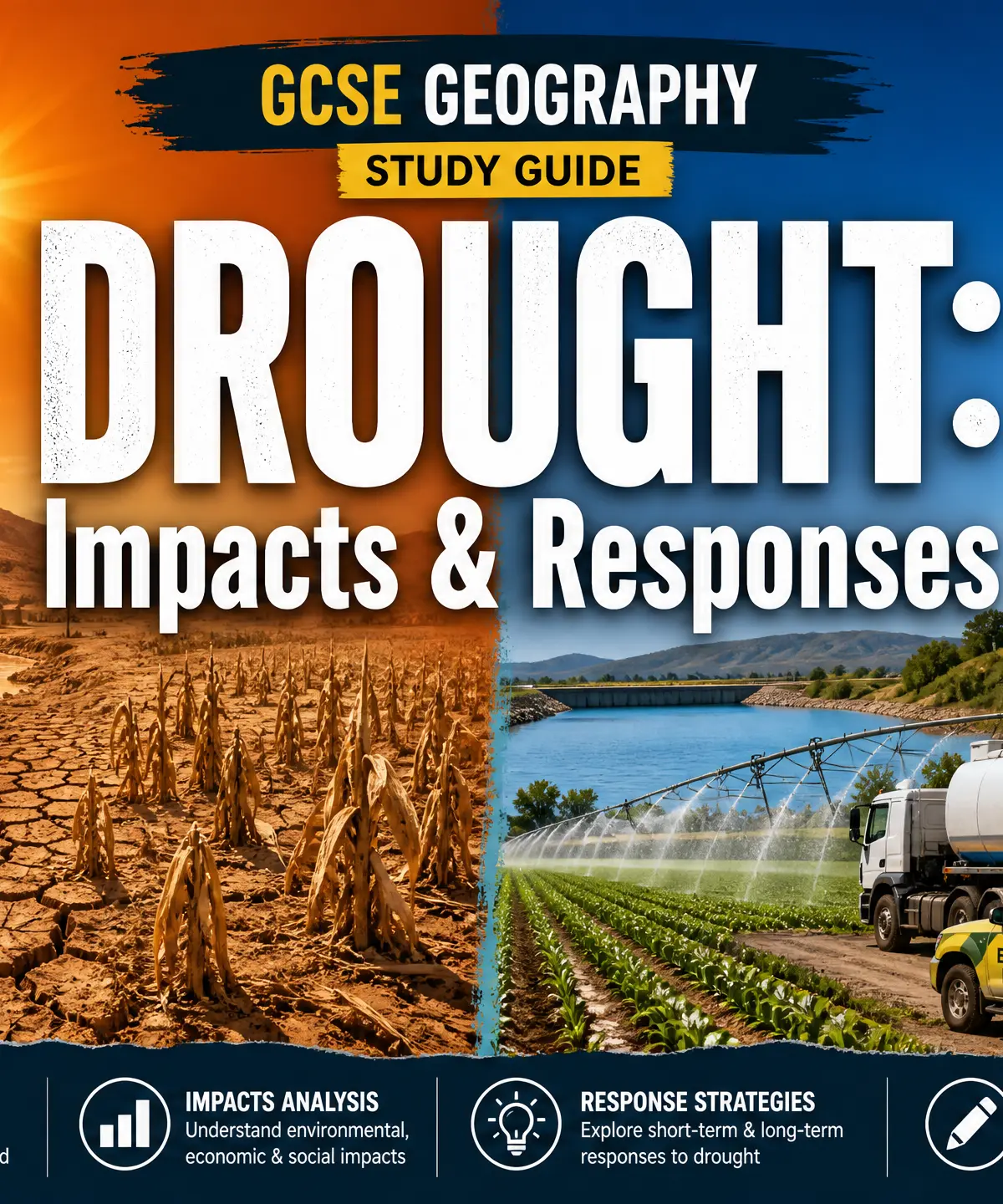
Drought is a slow-onset hazard that fundamentally exposes global inequality. While a meteorological drought (a prolonged period of below-average rainfall) is a physical event, its impacts and the responses it triggers are determined by human geography. Examiners expect you to understand that a country's level of development—specifically its wealth, infrastructure, and institutional capacity—dictates whether a drought is an economic inconvenience or an existential crisis.
This study guide contrasts the experiences of developed countries (high adaptive capacity) with emerging and developing countries (low adaptive capacity). You must be able to categorize responses into individual, organizational, and governmental actions, and evaluate the effectiveness of short-term relief versus long-term sustainable management.
Listen to the companion podcast below for a comprehensive overview of the topic:

The Hazard of Drought
Drought is hazardous because it acts as a threat multiplier. Unlike rapid-onset hazards such as earthquakes, droughts build slowly, making the precise onset difficult to identify.
Why is it hazardous?
- Water Security: Threatens domestic supply, sanitation, and industrial processes.
- Food Security: Causes widespread crop failure and livestock death (agricultural drought).
- Environmental Degradation: Leads to soil erosion, desertification, and loss of biodiversity.
- Secondary Hazards: Dramatically increases the risk and intensity of wildfires.
Variations in Impacts
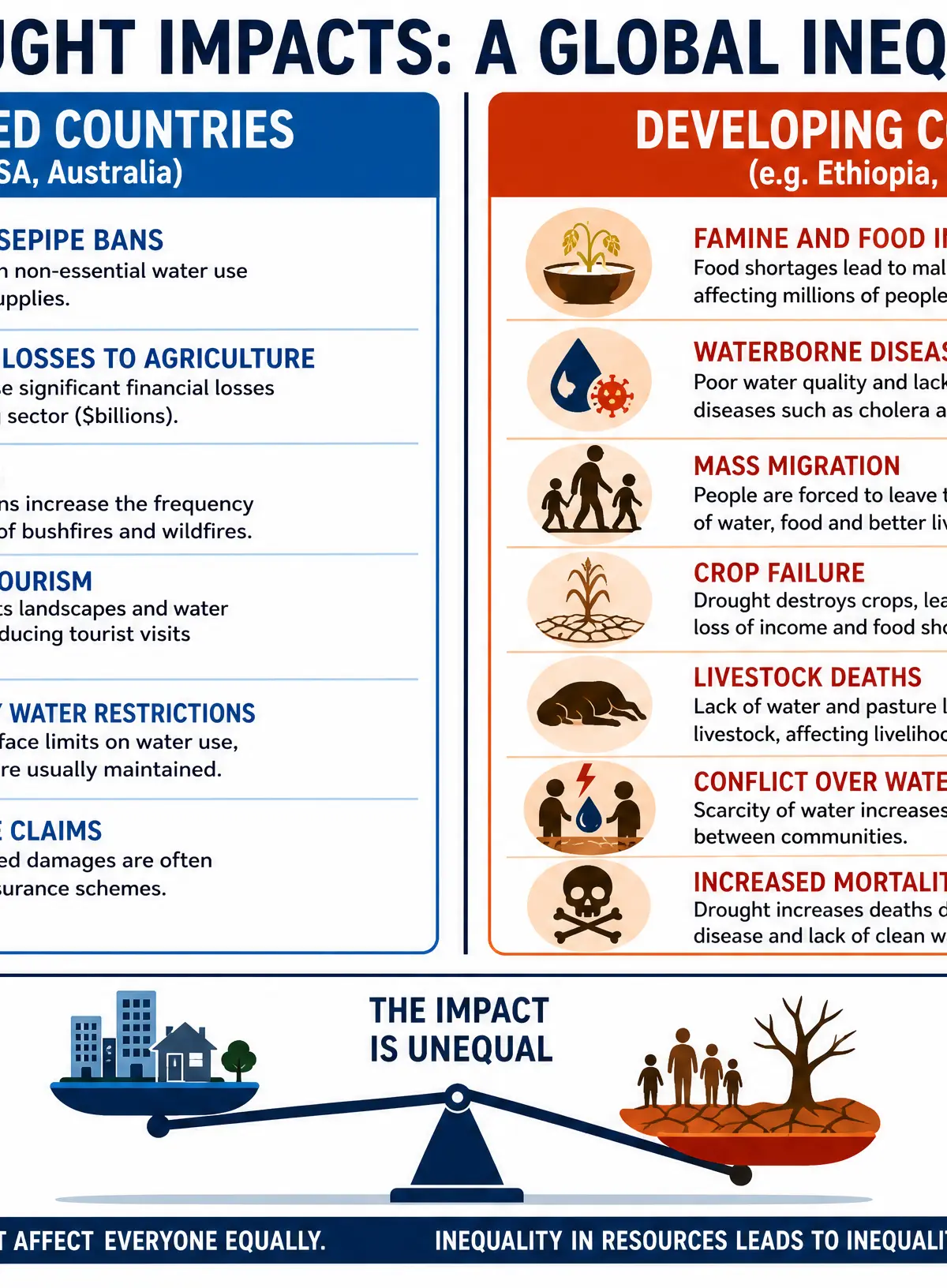
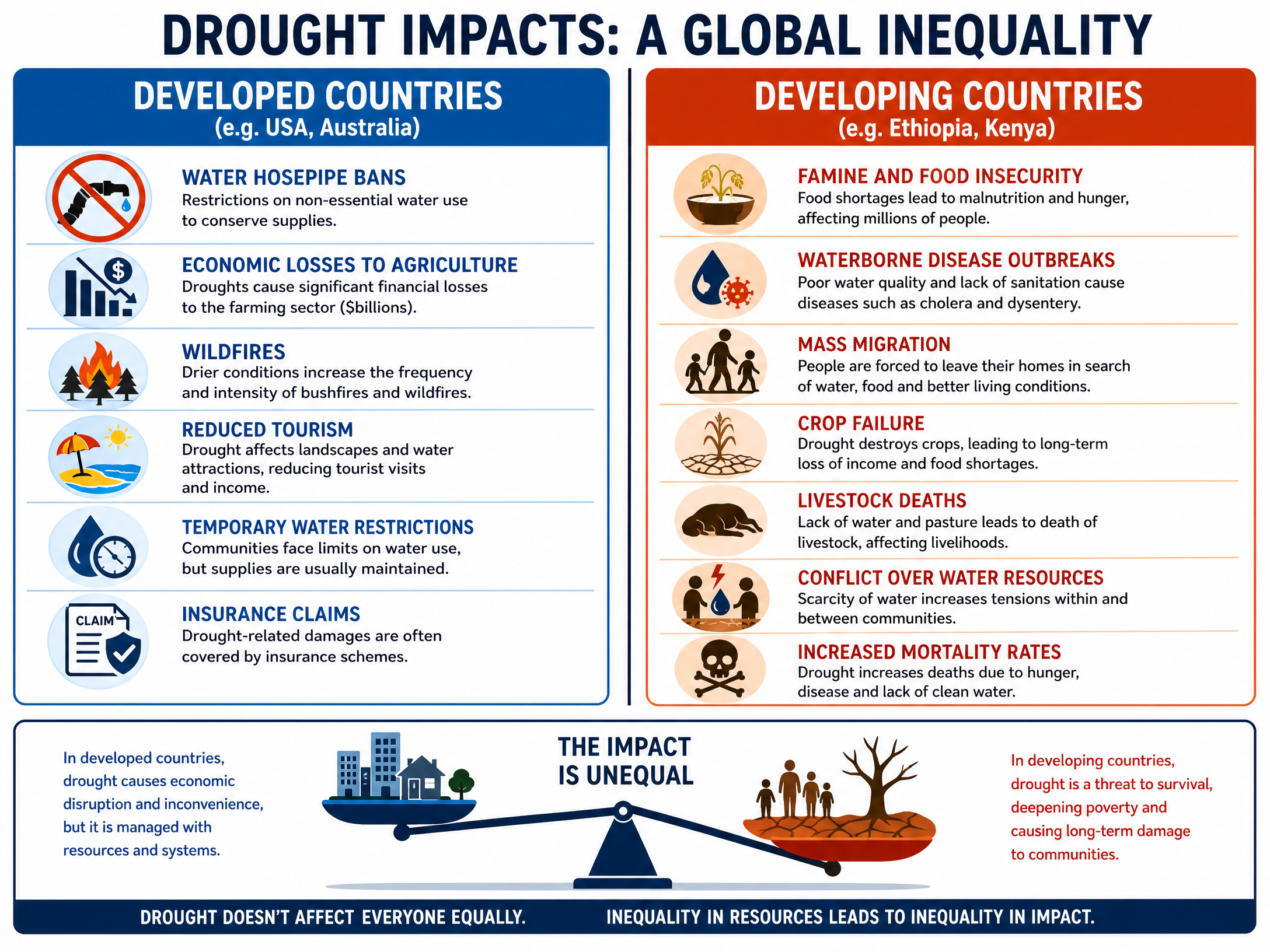
The impacts of drought vary drastically based on a country's Human Development Index (HDI) and Gross Domestic Product (GDP) per capita.
Developed Countries (e.g., USA, Australia)
Economic Focus: The primary impacts are financial rather than fatal.
- Agriculture: Significant financial losses. During the 2012-2017 California drought, agricultural losses reached $2.7 billion in 2015 alone.
- Environment: Increased frequency of severe wildfires (e.g., the Australian 'Black Summer' bushfires of 2019-2020).
- Society: Inconvenience through water restrictions (hosepipe bans), but basic survival is maintained due to robust infrastructure.
Developing Countries (e.g., Ethiopia, Kenya)
Existential Focus: The primary impacts threaten survival and long-term development.
- Agriculture: Total crop failure leading to famine. In the 2015-16 Ethiopian drought, up to 90% of crops failed in some regions.
- Health: Malnutrition and outbreaks of waterborne diseases (like cholera) as people are forced to use contaminated water sources.
- Society: Mass displacement as 'climate refugees' migrate in search of water and food, often leading to conflict over scarce resources.
Variations in Responses
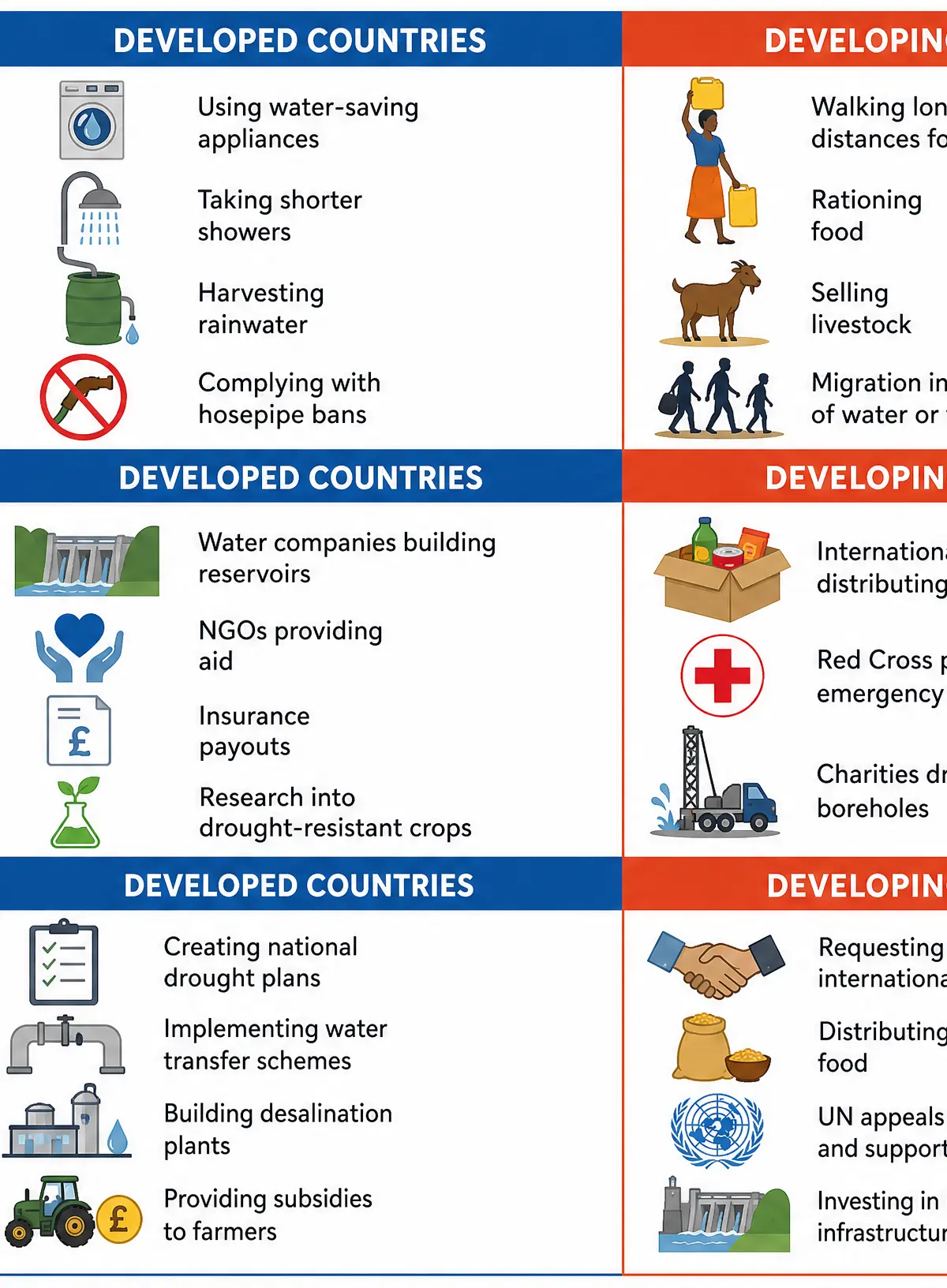
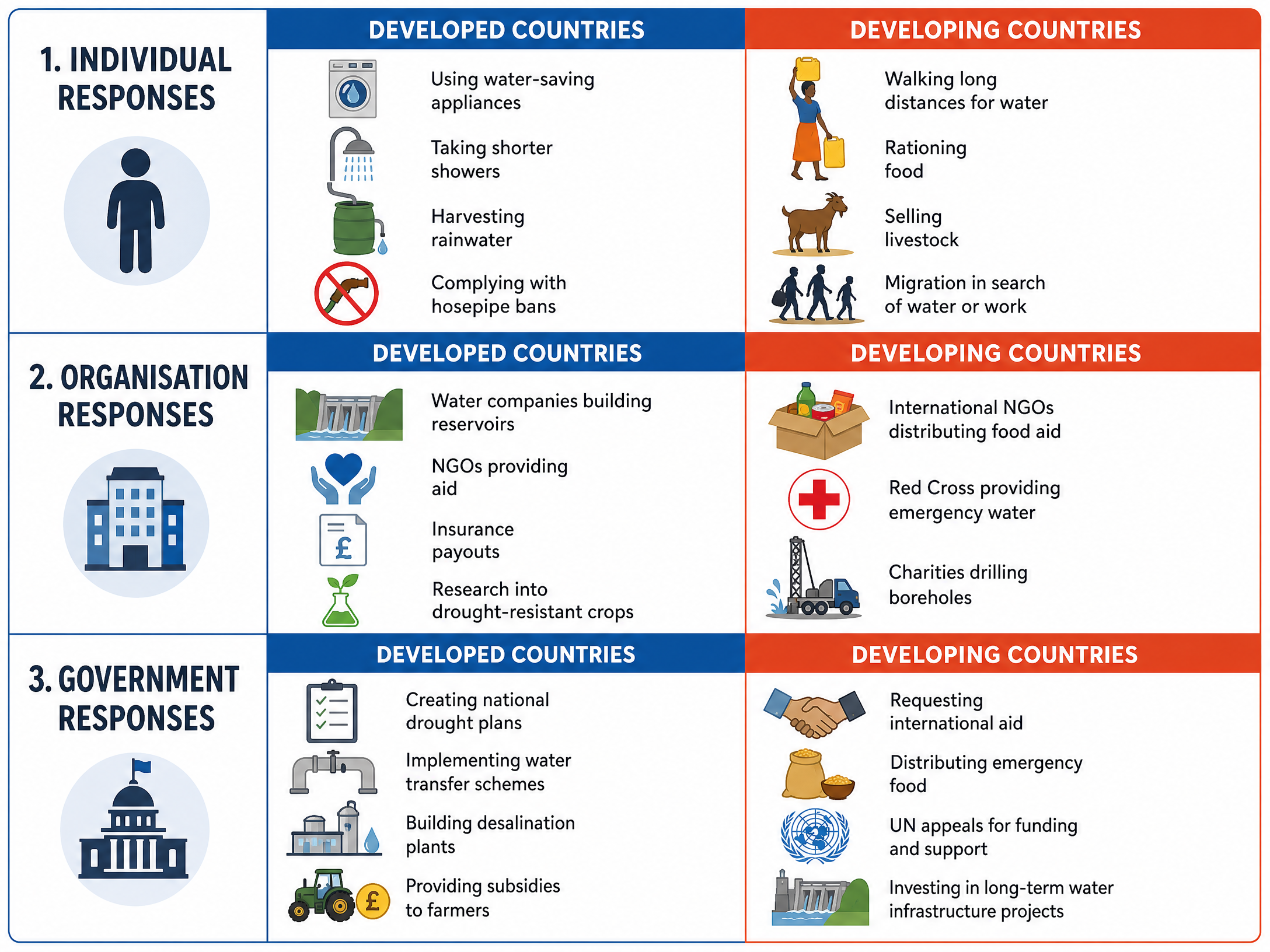
Examiners require you to categorize responses by scale: Individual, Organizational (NGOs/Companies), and Government.
Individual Responses
- Developed: Installing water-efficient appliances, adhering to usage restrictions, claiming insurance for crop losses.
- Developing: Walking long distances to alternative water sources, rationing food, selling livestock at depressed prices, or migrating.
Organizational Responses
- Developed: Water companies investing in leak reduction and new reservoirs; agricultural research institutes developing drought-resistant crop strains.
- Developing: International NGOs (e.g., Oxfam, Red Cross) providing emergency food aid, drilling boreholes, and distributing water purification tablets.
Government Responses
- Developed: Implementing national drought policies, funding large-scale infrastructure (e.g., desalination plants, water transfer schemes), and providing financial subsidies to affected farmers.
- Developing: Issuing international appeals for aid, relying on UN agencies (like the World Food Programme) for emergency distribution, and struggling to fund long-term infrastructure due to high national debt.
Case Studies
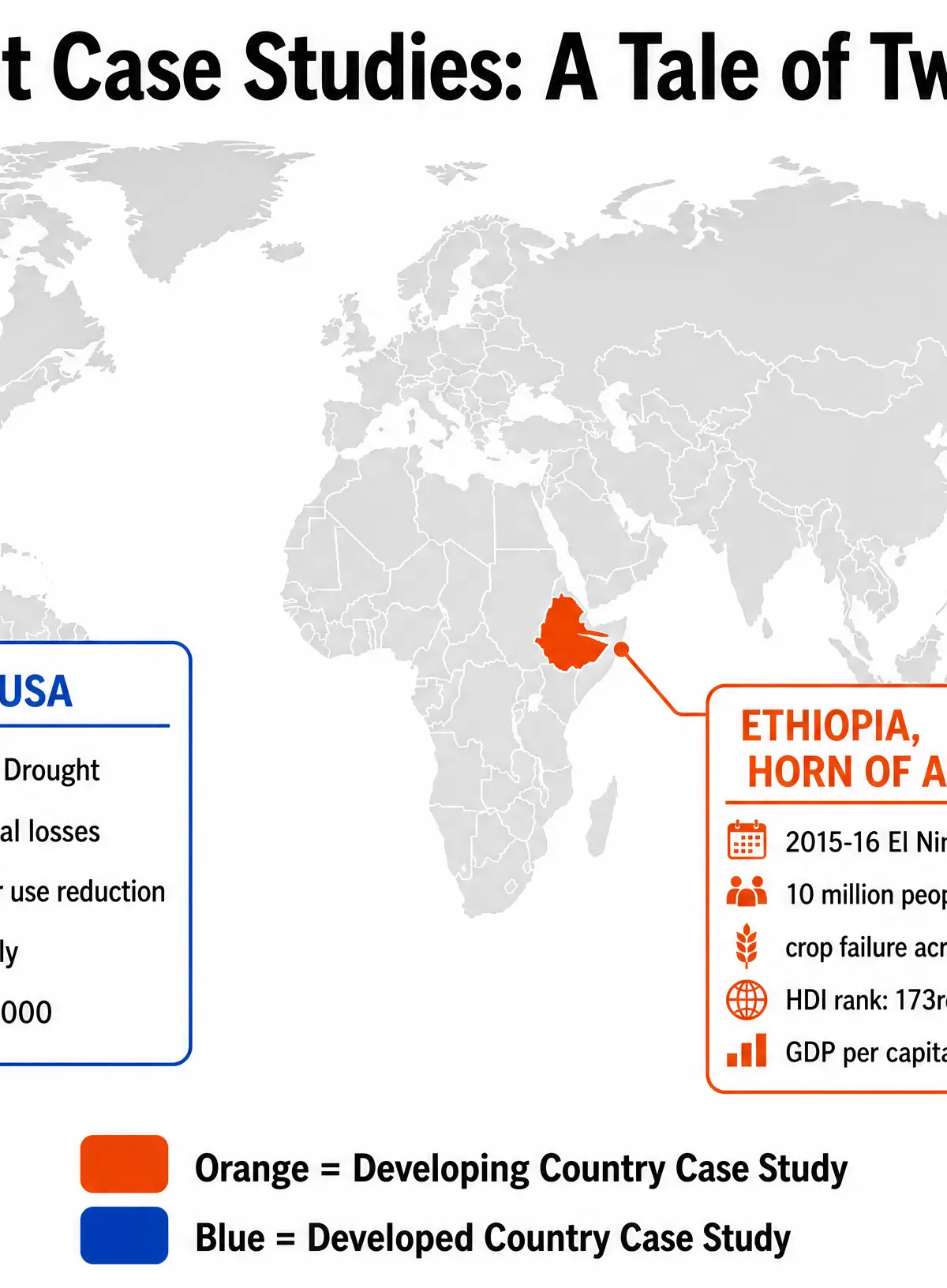
To achieve Level 3/4 marks, you must use specific located examples.
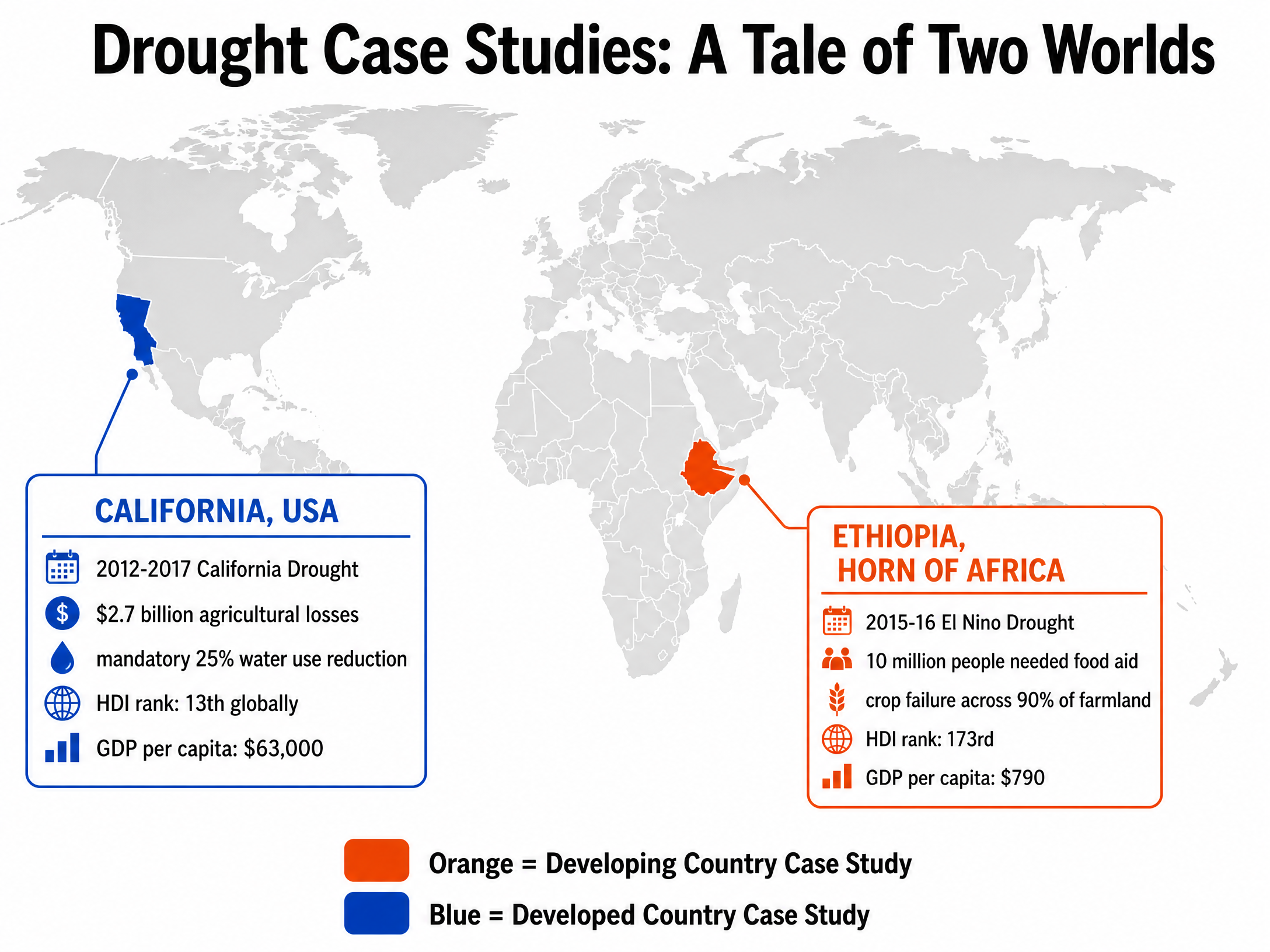
Developed Case Study: California, USA (2012-2017)
- Context: HDI rank 13th (USA), high GDP per capita.
- Impacts: $2.7bn agricultural loss (2015); severe wildfires; groundwater depletion.
- Responses: State-mandated 25% reduction in urban water use; investment in water recycling; farmers compensated through insurance.
Developing Case Study: Ethiopia (2015-2016)
- Context: HDI rank 173rd, low GDP per capita, heavy reliance on rain-fed agriculture.
- Impacts: 10 million people required emergency food aid; massive livestock deaths destroying pastoral livelihoods.
- Responses: Government appealed for $1.4 billion in international aid; NGOs distributed emergency rations; long-term vulnerability remains high.
Visual Resources
3 diagrams and illustrations
Interactive Diagrams
1 interactive diagram to visualise key concepts
Conceptual Flow Outline
The chain of consequences from meteorological drought to human impacts.
Worked Examples
3 worked examples — open one to explore the question and available guidance.
Practice Questions
Test your understanding — click to reveal model answers
Explain why droughts are considered a hazard. (4 marks)
Hint: Think about the threat to human life and economic activity.
To what extent is a country's level of development the most important factor in determining the impacts of a drought? (9 marks + 3 SPaG)
Hint: Argue that development is crucial (adaptive capacity), but acknowledge that the physical severity of the drought also matters.
Outline one organizational response to drought in a developed country. (2 marks)
Hint: Think about water companies or agricultural research.
Explain how individual responses to drought differ between developed and emerging/developing countries. (6 marks)
Hint: Contrast lifestyle adjustments with survival strategies.
Evaluate the effectiveness of international aid as a response to drought. (6 marks)
Hint: Look at short-term success versus long-term dependency.