Pearson Edexcel · GCSE · Geography
The patterns of the distribution and consumption of natural resources varies on a global and a national scale
This study guide explores the unequal global and national distribution and consumption of natural resources. Understanding these patterns is essential for tackling the geographical challenges of sustainability, environmental degradation, and global inequality.
- 6 min read
- 3 worked examples
- 5 practice questions
- 7 key terms
Study Notes
Overview
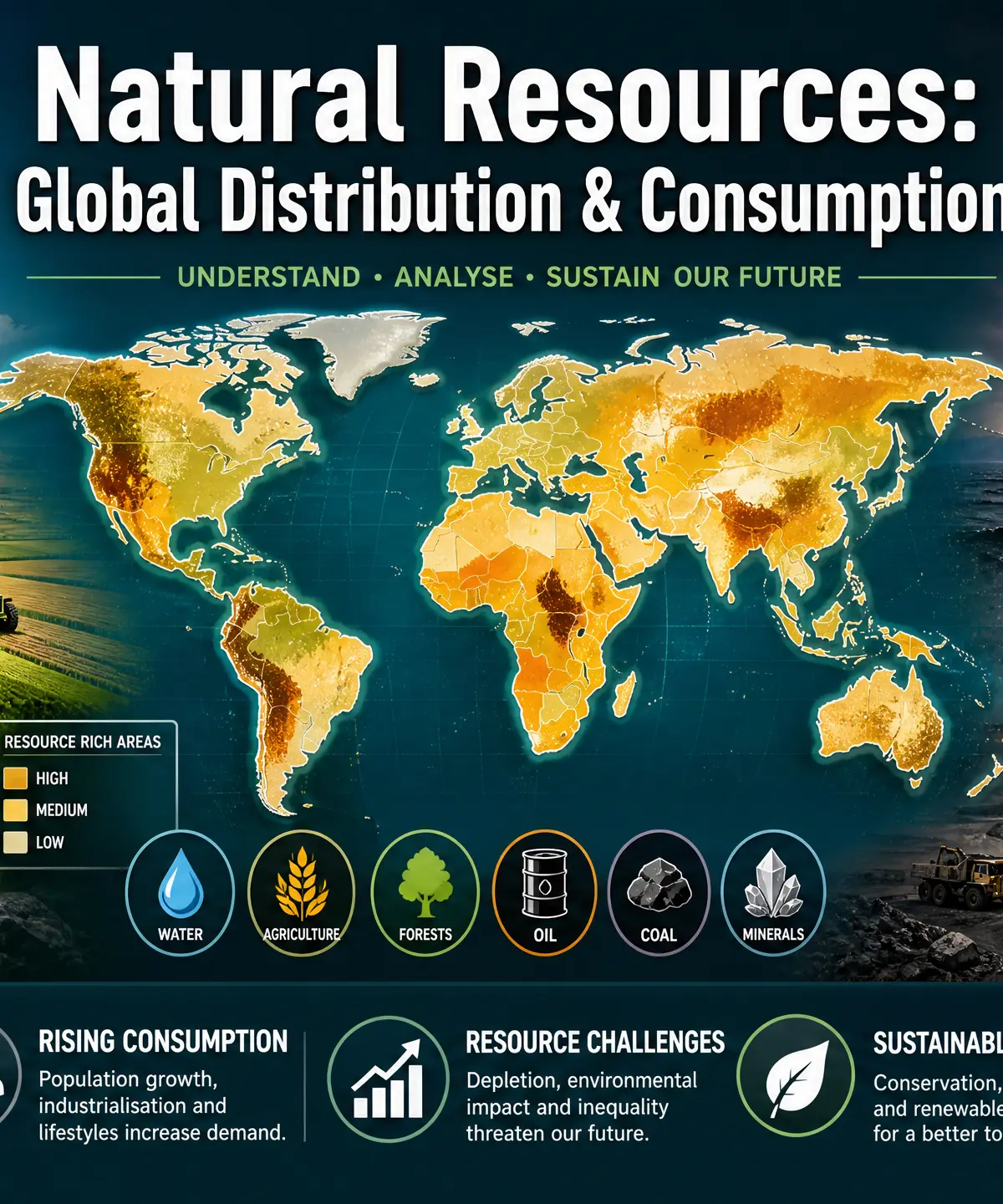
Natural resources are the foundation of human survival and economic development. This topic covers the classification of natural resources, their uneven global and national distribution, and the stark inequalities in how they are consumed. Examiners expect candidates to distinguish clearly between distribution (where resources are found) and consumption (who uses them). Furthermore, you must understand the environmental impacts of exploiting both renewable and non-renewable resources, supporting your answers with specific named examples and case studies.
Listen to the revision podcast for a comprehensive overview of this topic:

Classification of Natural Resources
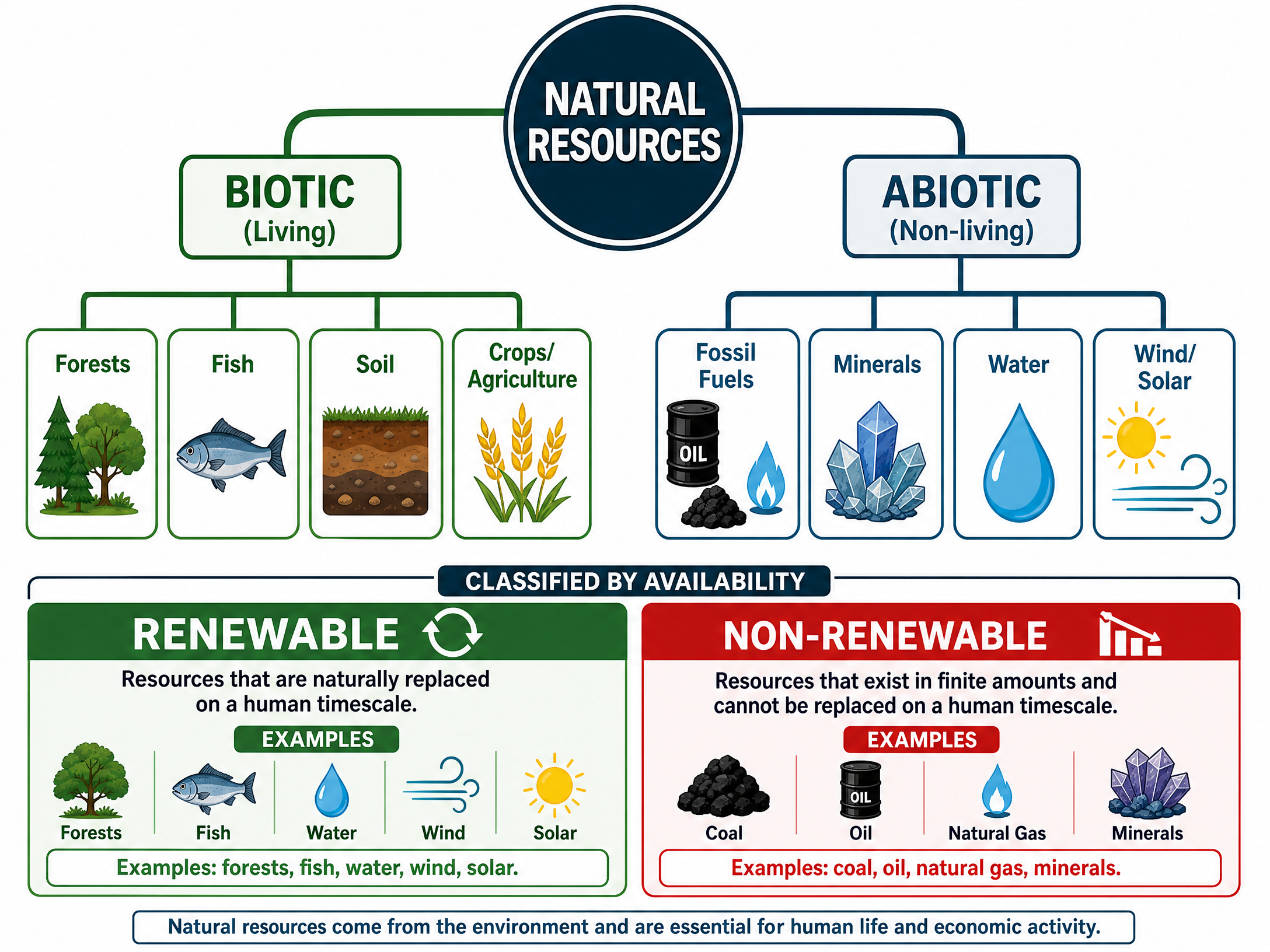
Resources can be classified in two primary ways: by their origin and by their availability.
By Origin (Biotic vs Abiotic)
Biotic Resources: These are derived from the biosphere (living things). Examples include forests, fish, soil, and agricultural crops. Fossil fuels like coal and oil are also technically biotic as they formed from decayed organic matter over millions of years.
Abiotic Resources: These come from non-living, physical environments. Examples include water, minerals (like gold, copper, iron ore), wind, and solar energy.
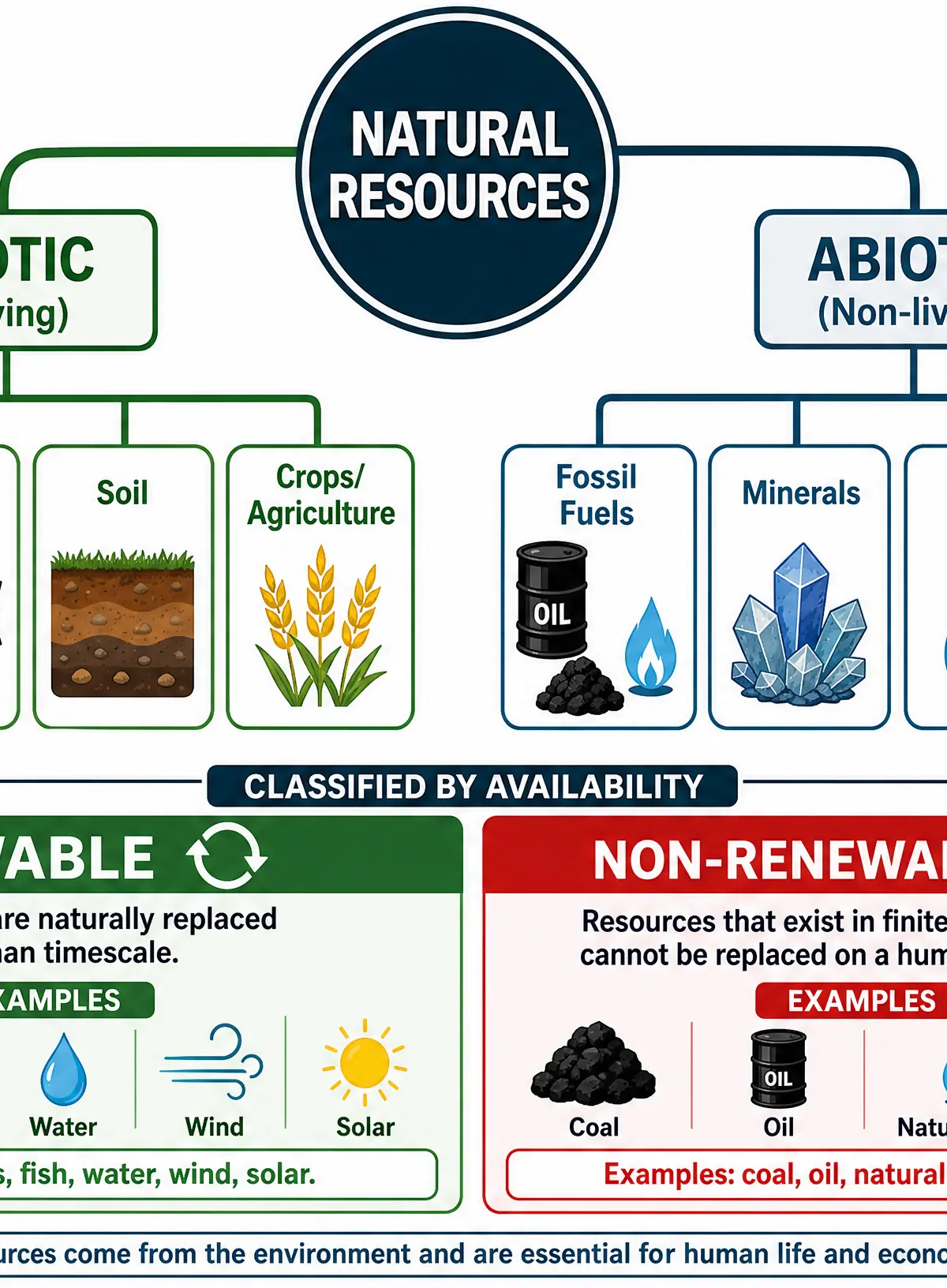
By Availability (Renewable vs Non-Renewable)
Renewable Resources: These can be naturally replenished on a human timescale. Examples include solar energy, wind energy, and flowing water. Importantly, some biotic resources like forests and fish are renewable only if managed sustainably. If exploited faster than they can regenerate, they effectively become non-renewable.
Non-Renewable Resources: These exist in finite amounts and cannot be replaced on a human timescale once used. Fossil fuels (coal, oil, natural gas) and minerals fall into this category.
Global and National Distribution
The distribution of natural resources is highly uneven, dictated by geology, climate, and latitude.
Fossil Fuels
- Global: Oil and natural gas are heavily concentrated in the Middle East (which holds roughly 48% of proven global oil reserves) and Russia (the largest natural gas reserves). Coal is more widely distributed, with massive deposits in the USA, Russia, China, and Australia.
- National (UK): The UK has significant historical coal reserves in South Wales, Yorkshire, and the Scottish Lowlands, though deep mining has ceased. Oil and gas reserves are concentrated offshore in the North Sea.
Water
- Global: Freshwater is abundant in countries with high rainfall and low evaporation, such as Brazil, Russia, Canada, and parts of China. Conversely, regions like the Middle East, North Africa, and Central Asia face severe water scarcity.
- National (UK): The UK experiences a 'water divide'. The north and west receive high rainfall but have lower population densities. The south and east receive much less rainfall but have the highest population densities, leading to significant water stress in areas like London.
Agricultural Land (Soil)
- Global: The most fertile soils (mollisols and chernozems) are found in temperate grasslands like the North American Great Plains, the South American Pampas, and the Eurasian Steppe.
- National (UK): The most productive arable land is in the East of England (e.g., East Anglia), where flat topography, warmer summers, and fertile soils support intensive cereal farming. The west and north are dominated by pastoral farming (sheep and cattle) due to steeper relief and higher rainfall.
Global Patterns of Consumption
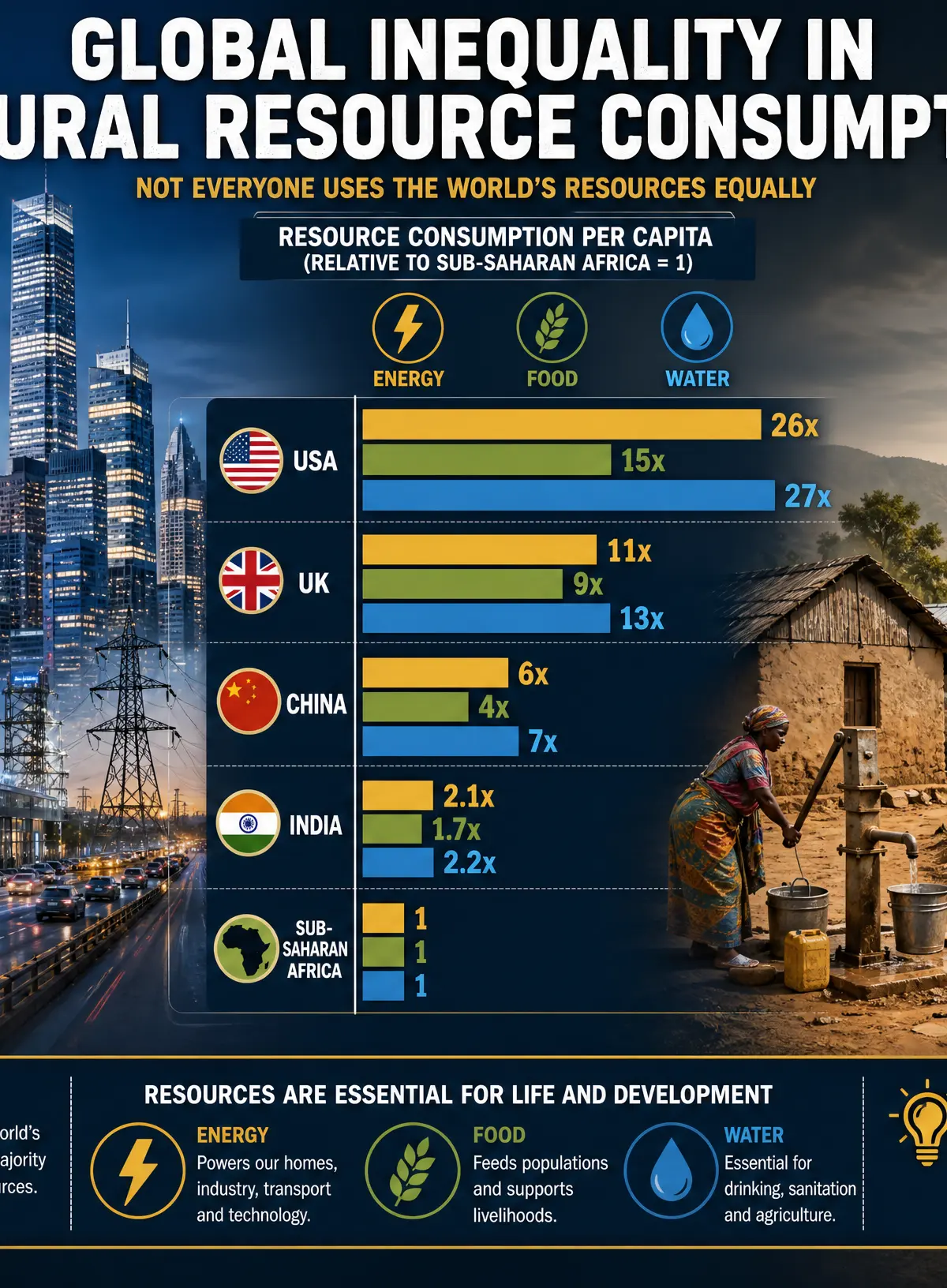
While distribution is about geology and climate, consumption is driven by wealth, industrialisation, and population.
The Inequality of Consumption
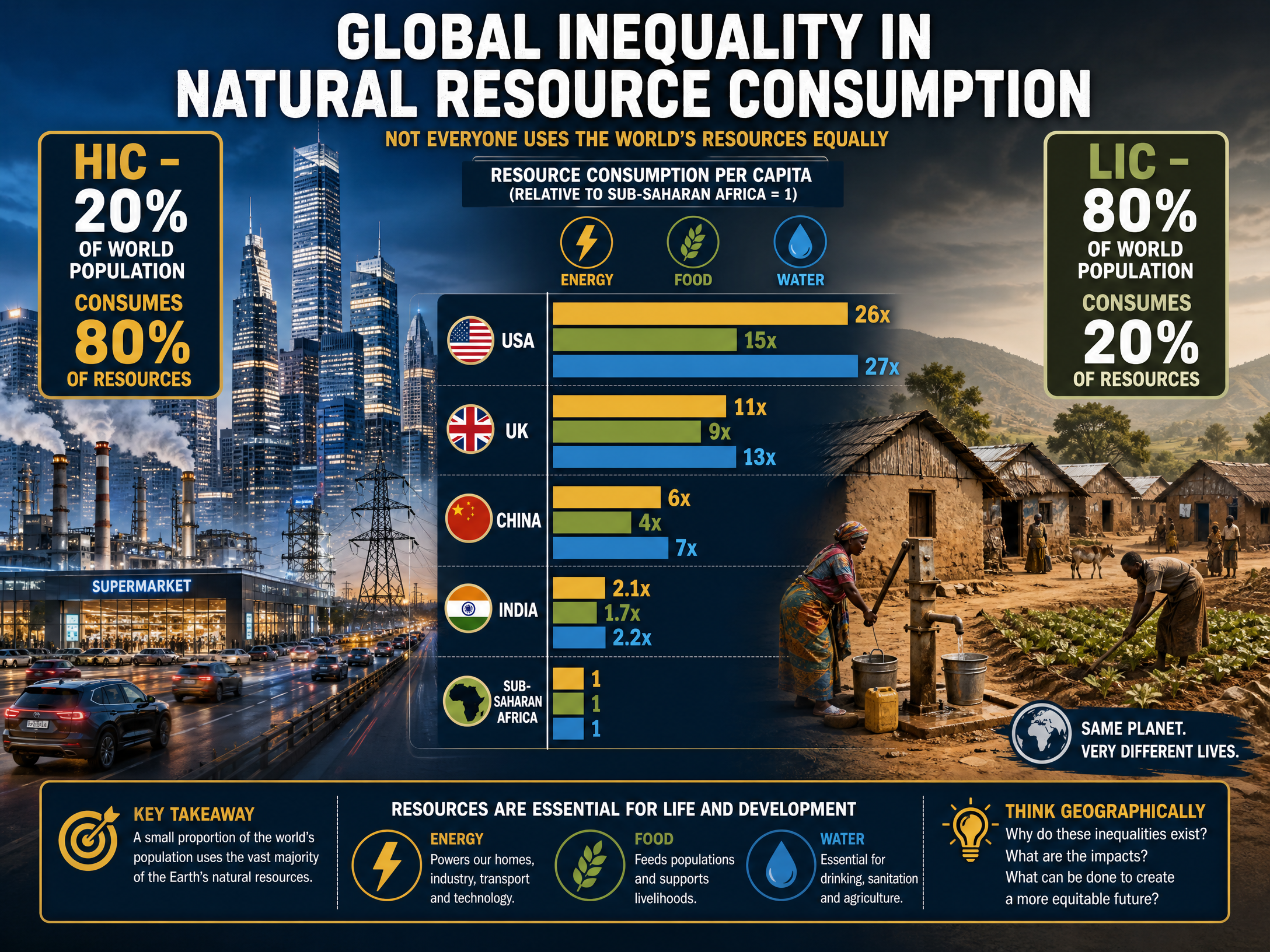
High Income Countries (HICs) account for approximately 20% of the global population but consume roughly 80% of the world's natural resources. For example, the USA consumes a disproportionate share of global energy and oil relative to its population size.
Low Income Countries (LICs), particularly in Sub-Saharan Africa, consume a tiny fraction of global resources, despite often being the source of many extracted minerals.
The Rise of NEEs
Newly Emerging Economies (NEEs), most notably China and India, have seen massive increases in resource consumption over the last three decades. China's rapid industrialisation has made it the world's largest consumer of coal, steel, and cement, fundamentally shifting global resource markets.
Environmental Impacts of Exploitation
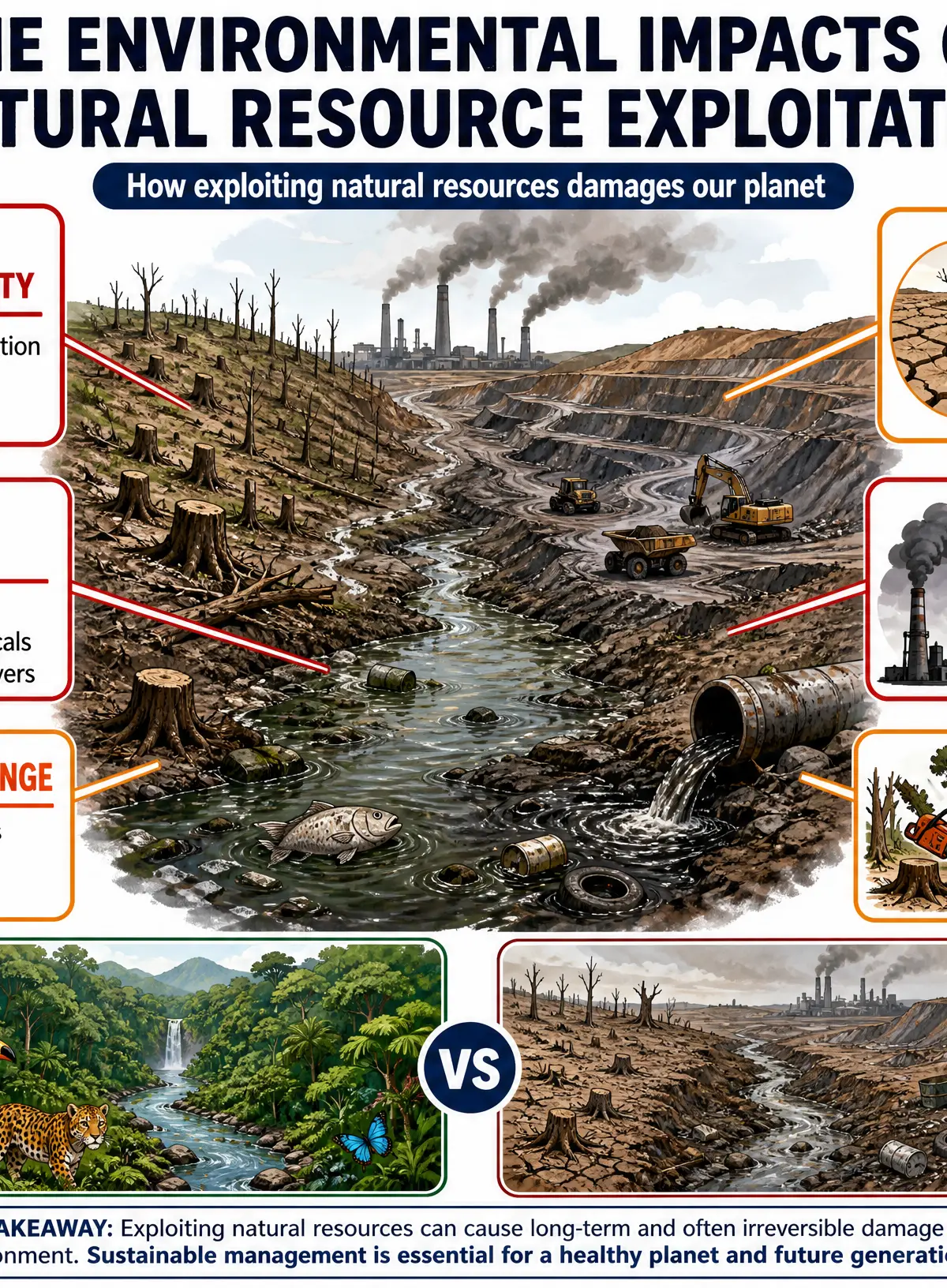
The extraction and use of natural resources cause profound environmental damage.
Deforestation
- Process: Clearing forests for timber, agriculture (cattle ranching, soya), or mining.
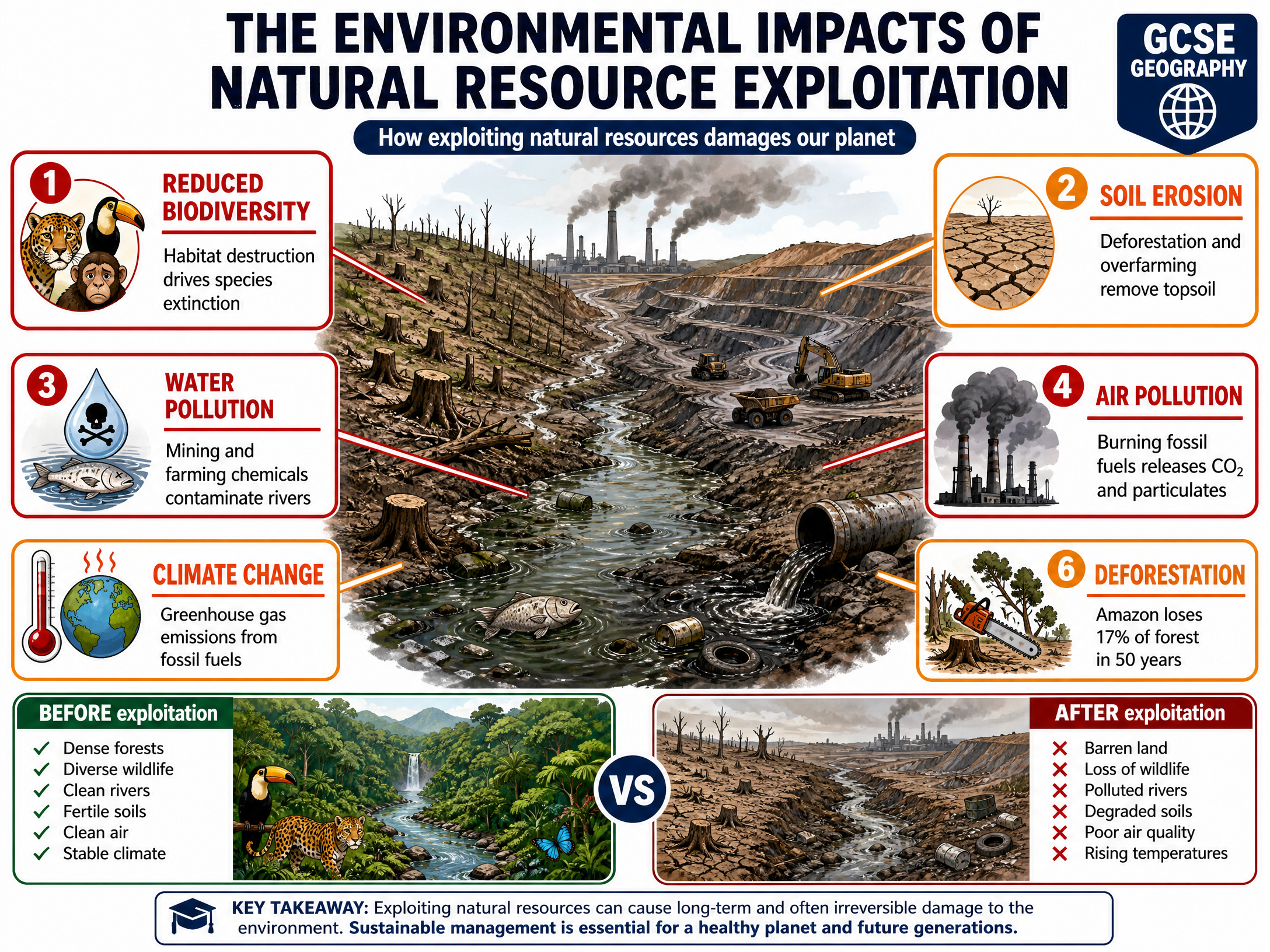
- Impacts: Reduced biodiversity (habitat loss), soil erosion (removal of root systems), and climate change (release of stored carbon and reduced carbon sequestration).
- Example: The Amazon Rainforest has lost approximately 17% of its cover in the last 50 years.
Fossil Fuel Extraction and Use
- Process: Opencast mining, offshore drilling, fracking, and combustion.
- Impacts: Landscape destruction, water pollution (acid mine drainage, oil spills), air pollution (particulates), and the enhanced greenhouse effect driving global climate change.
- Example: The 2010 Deepwater Horizon oil spill released millions of barrels of oil into the Gulf of Mexico, devastating marine ecosystems.
Intensive Farming
- Process: Monoculture, heavy use of chemical fertilisers and pesticides, overgrazing.
- Impacts: Soil degradation, loss of hedgerows (reducing biodiversity), and eutrophication of water bodies.
- Example: Eutrophication in the Norfolk Broads due to agricultural runoff from intensive arable farming.
Overfishing
- Process: Harvesting fish faster than populations can reproduce.
- Impacts: Collapse of fish stocks and disruption of marine food webs.
- Example: The collapse of the North Sea cod fishery in the early 2000s.
Visual Resources
3 diagrams and illustrations
Interactive Diagrams
1 interactive diagram to visualise key concepts
Conceptual Flow Outline
Flowchart showing the environmental impacts of different types of resource exploitation.
Worked Examples
3 worked examples — open one to explore the question and available guidance.
Practice Questions
Test your understanding — click to reveal model answers
Describe the global distribution of proven oil reserves. (3 marks)
Hint: Think about which region dominates, and name at least two specific countries.
Explain how the exploitation of a named renewable resource can have negative environmental impacts. (4 marks)
Hint: Choose forests or fish. Explain how over-exploiting them damages the ecosystem.
To what extent is the consumption of energy resources related to a country's level of economic development? (9 marks)
Hint: Discuss HICs, LICs, and NEEs. Use specific country examples.
Outline one reason why the UK experiences water stress in certain regions. (2 marks)
Hint: Think about the relationship between where the rain falls and where the people live.
Explain how intensive farming can lead to a reduction in water quality. (4 marks)
Hint: Use the term 'eutrophication' and explain the step-by-step process.