Pearson Edexcel · GCSE · Geography
The UK has its own variety of distinctive ecosystems that it relies on
This topic explores the diverse terrestrial and marine ecosystems found in the UK, from upland moorlands to deep-water coral reefs. It is crucial for understanding how humans rely on these environments for resources and ecosystem services, and the threats these habitats currently face.
- 6 min read
- 3 worked examples
- 5 practice questions
- 6 key terms
Study Notes
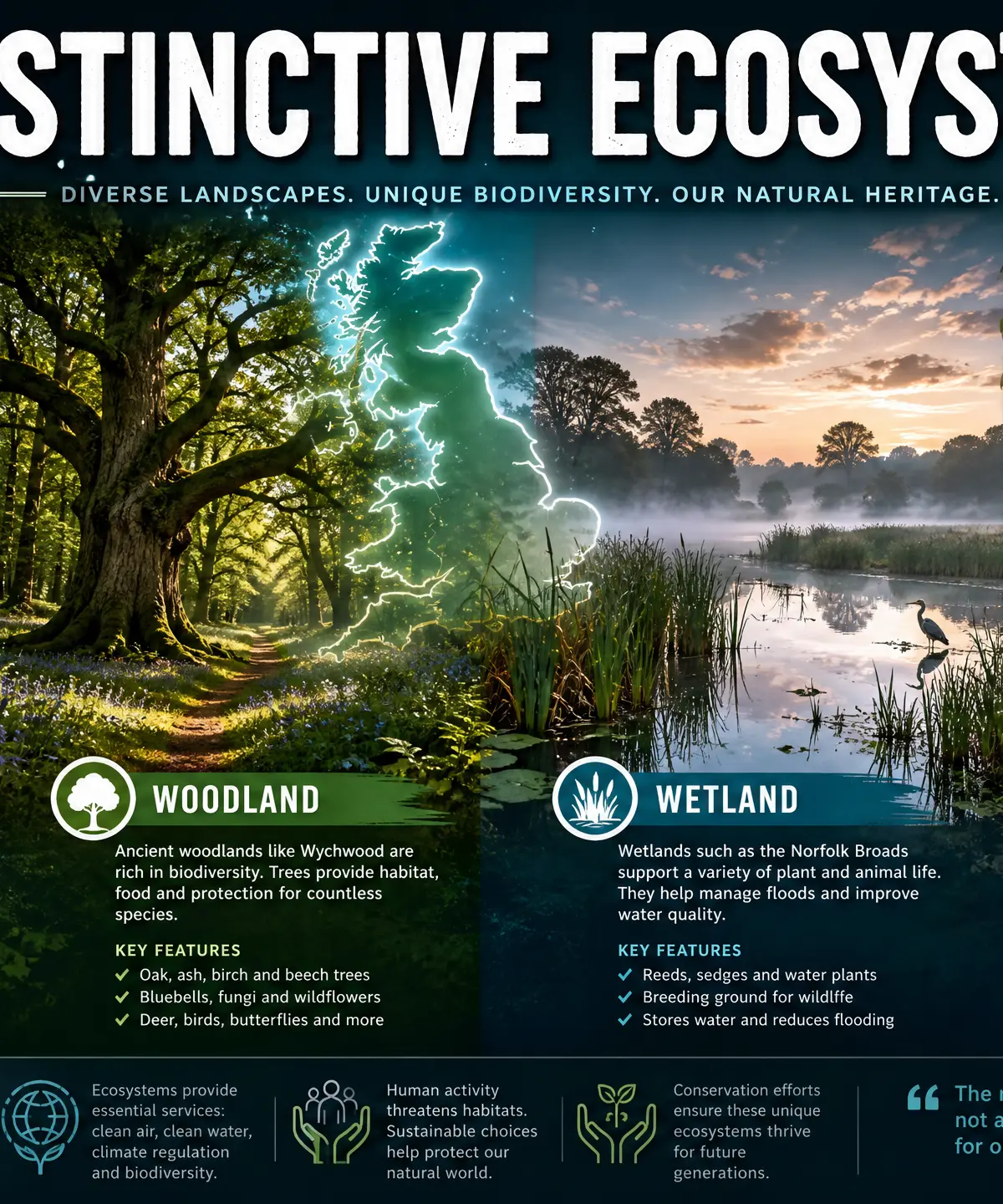
Overview
The UK may be a small island nation, but its varied climate, geology, and surrounding seas support a remarkably diverse range of ecosystems. This topic explores the distinct characteristics of the UK's terrestrial (land-based) and marine (sea-based) environments. Examiners expect candidates to be able to distinguish between the four main terrestrial ecosystems (moorlands, heathlands, woodlands, and wetlands), understand their distribution, and describe their key features including soil types and named species. Furthermore, candidates must understand the immense value of the UK's marine ecosystems, the resources they provide, and how human activities such as overfishing and pollution threaten these fragile environments. Specific, named examples are crucial for achieving top marks in this topic.

UK Terrestrial Ecosystems
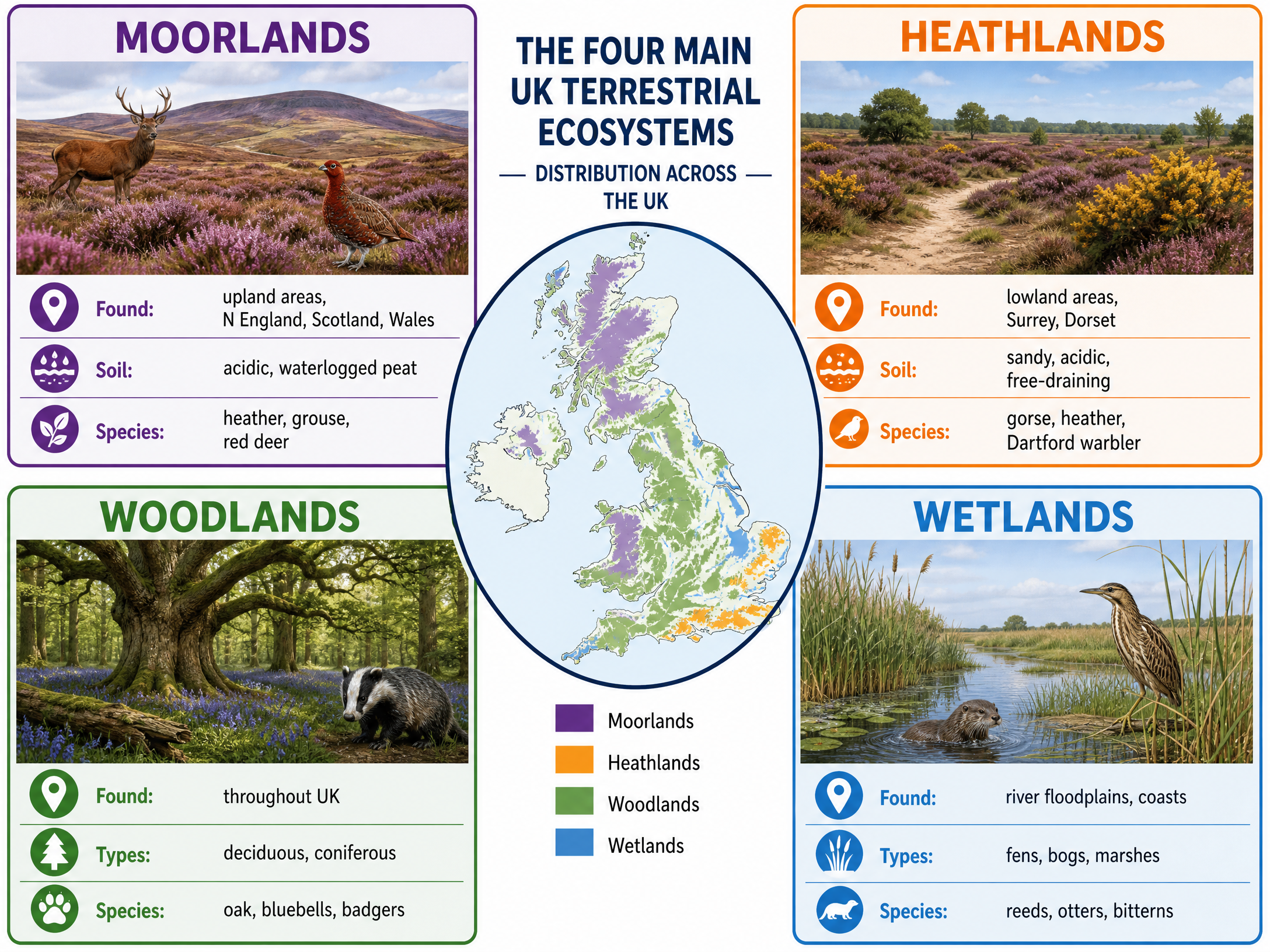
The UK is home to four main terrestrial ecosystems. You must be able to describe their characteristics, locations, and the differences between them.
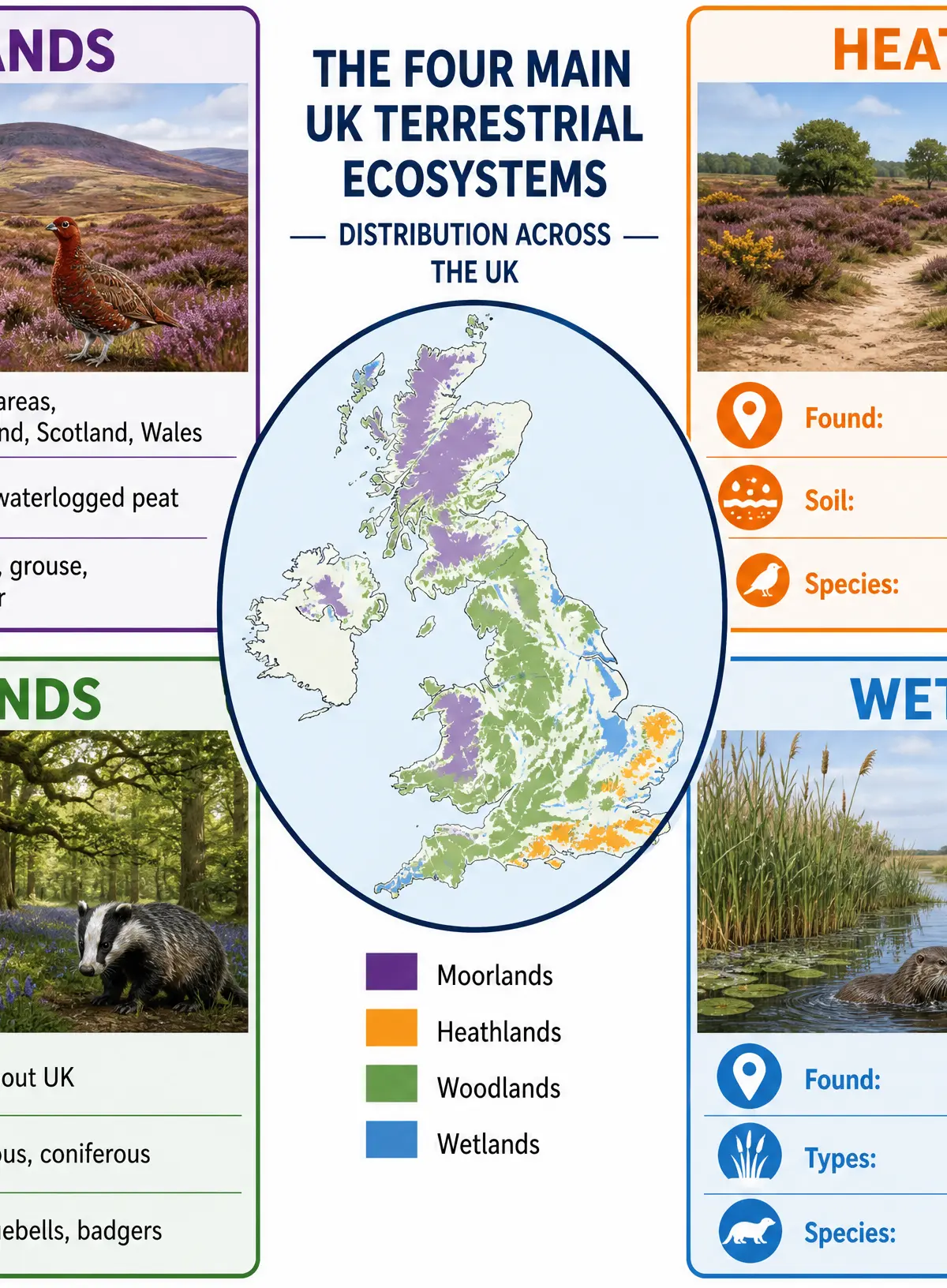
Moorlands
Location: Found in upland areas, typically in northern England, Scotland, and Wales. Named examples include the Peak District and the North York Moors.
Characteristics: Cool and wet climate. The soils are highly acidic and waterlogged, leading to the formation of peat. Because dead plant material does not fully decompose in these conditions, peat acts as a massive carbon store.
Flora and Fauna: Dominated by heather, which turns purple in late summer. Supports wildlife such as red grouse, mountain hares, and golden plovers.
Exam Significance: Moorlands cover approximately 10% of the UK land area. The UK holds over 75% of the world's heather moorland, making it globally significant.
Heathlands
Location: Found in lowland areas, primarily in southern and eastern England. Named examples include the New Forest, Surrey Heaths, and Dorset Heaths.
Characteristics: Unlike moorlands, heathlands have sandy, free-draining soils. These soils are acidic and nutrient-poor, meaning only specialist plants can thrive.
Flora and Fauna: Features heather, gorse (a spiky shrub with yellow flowers), and bracken. Key species include the Dartford warbler and the sand lizard.
Exam Significance: Heathlands are highly threatened. Over 80% of UK lowland heathland has been lost in the last 200 years due to agriculture and urban development. Do not confuse heathlands (lowland, dry) with moorlands (upland, wet).
Woodlands
Location: Scattered throughout the UK. Includes both ancient deciduous forests and modern coniferous plantations. Named examples include Wychwood Forest (Oxfordshire) and the New Forest (Hampshire).
Characteristics: Ancient woodlands are areas that have been continuously wooded since at least 1600. They have rich, deep soils and a complex layered structure (canopy, understorey, field layer, ground layer).
Flora and Fauna: Deciduous woodlands are dominated by oak, ash, beech, and birch. They support immense biodiversity, including bluebells, badgers, dormice, and numerous invertebrates.
Exam Significance: Ancient woodland covers only about 2.5% of the UK. Woodlands provide vital ecosystem services including timber, carbon sequestration, and flood mitigation.
Wetlands
Location: Found in low-lying areas, river floodplains, and coastal regions. Includes fens, bogs, marshes, and swamps. Named examples include the Norfolk Broads and the Somerset Levels.
Characteristics: Areas that are permanently or seasonally waterlogged. They have rich, waterlogged soils that store significant amounts of carbon.
Flora and Fauna: Reeds, sedges, and water lilies. Supports species such as otters, water voles, bitterns, and marsh harriers.
Exam Significance: Wetlands are crucial natural flood defences, absorbing excess water during heavy rainfall. They also act as natural water filters.
UK Marine Ecosystems
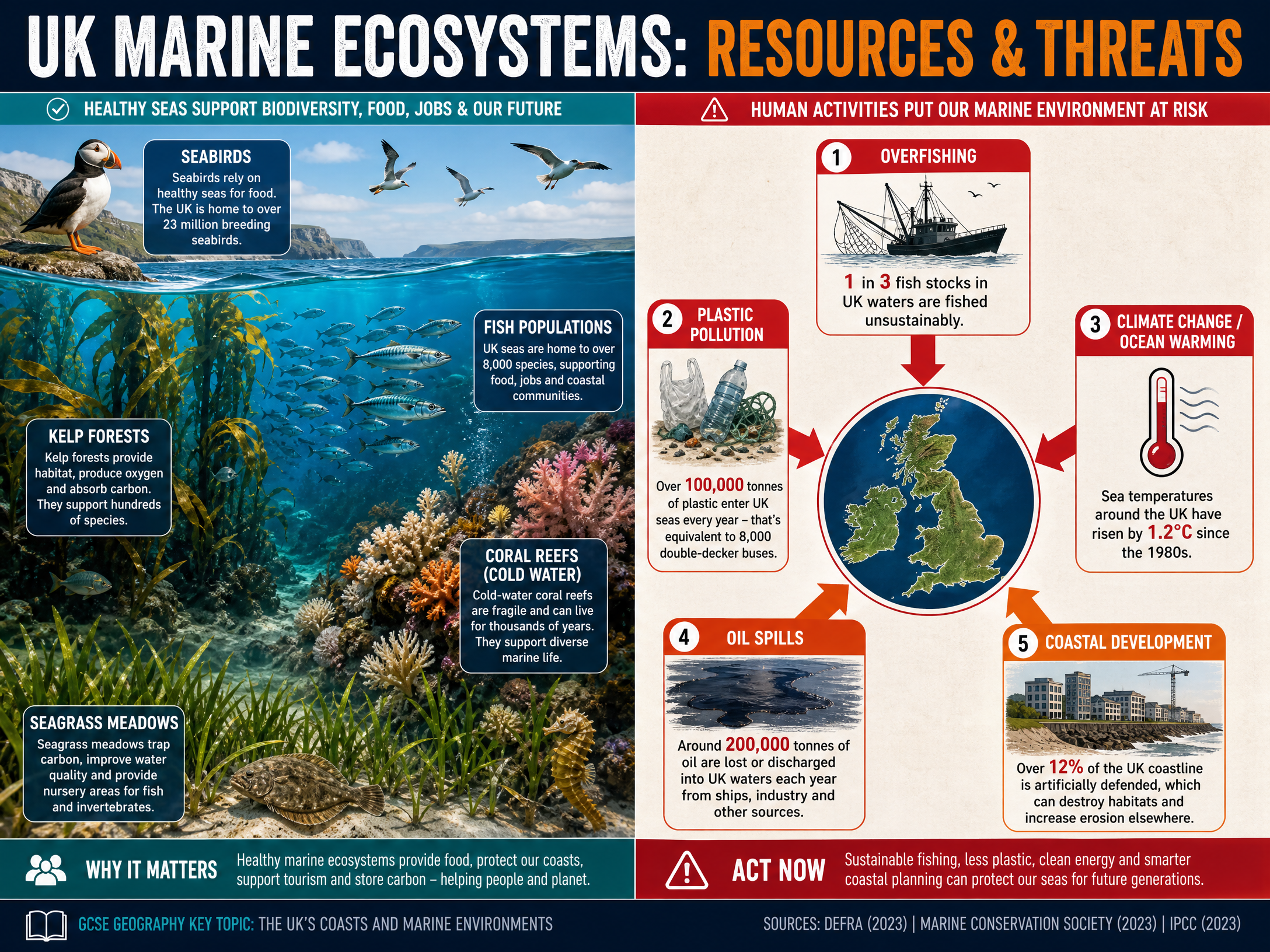
The UK is surrounded by highly productive marine environments, including the North Sea, Irish Sea, English Channel, and Atlantic Ocean. The UK's Exclusive Economic Zone (EEZ) covers roughly 773,000 square kilometres.
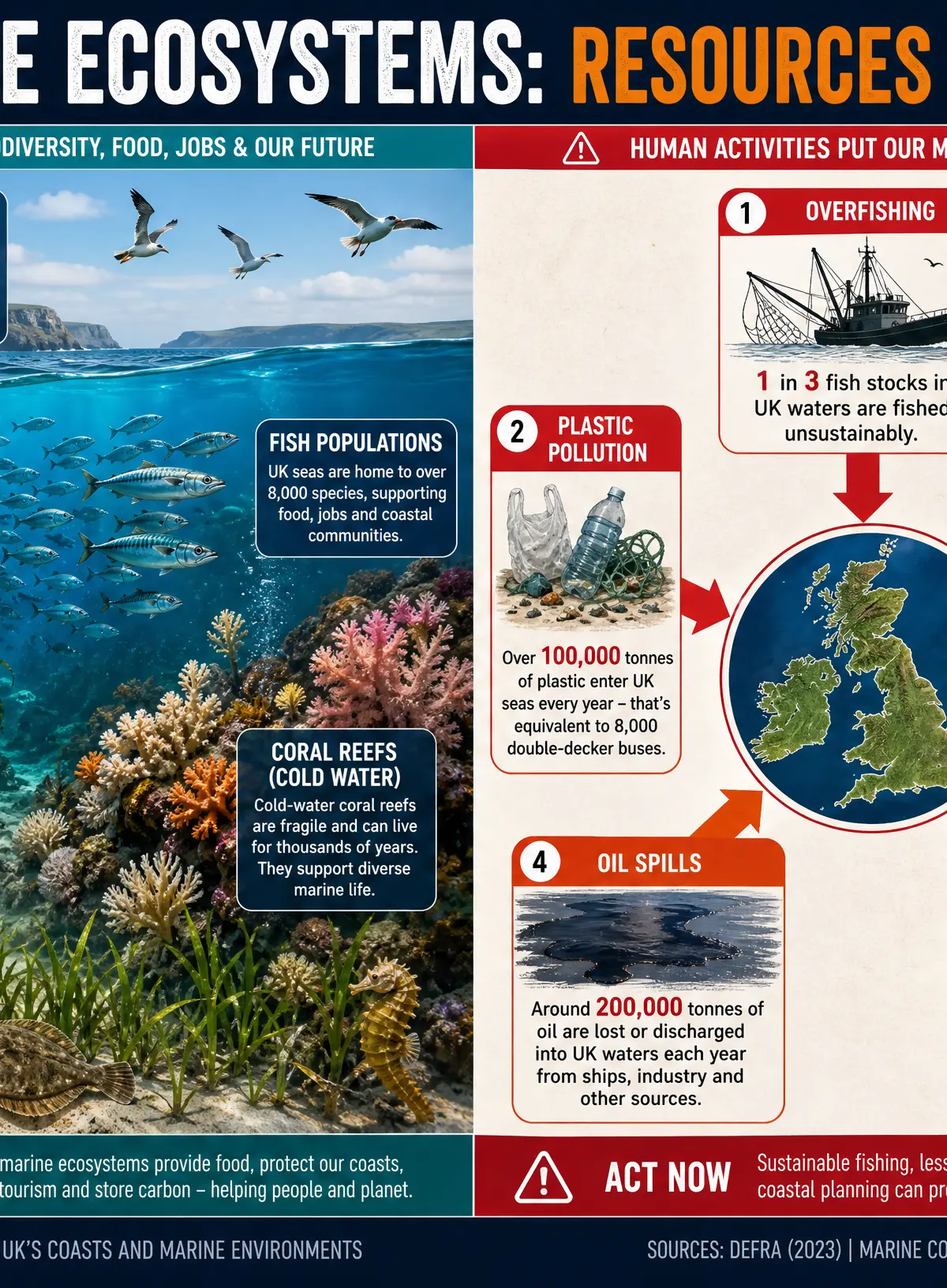
Key Marine Habitats
- Seagrass Meadows: Found in shallow coastal waters. They are incredibly productive, storing carbon up to 35 times faster than tropical rainforests, and act as vital nursery grounds for commercial fish. The UK has lost 92% of its seagrass in the last century.
- Kelp Forests: Underwater forests of large brown algae that provide habitat and absorb wave energy, protecting coastlines from erosion.
- Cold-Water Coral Reefs: Found in deep, dark, cold waters (200-1000m deep), such as the Darwin Mounds off Scotland. They grow very slowly and are highly vulnerable to damage from deep-sea trawling.
Resources and Human Reliance
- Fishing: The UK fishing industry is worth approximately £980 million annually. Key commercial species include cod, haddock, and mackerel.
- Tourism: Coastal tourism generates over £4 billion per year for the UK economy.
- Climate Regulation: Marine ecosystems absorb around 30% of anthropogenic CO2 emissions.
- Coastal Protection: Habitats like kelp and seagrass buffer wave energy, reducing coastal erosion and flooding.
Threats to Marine Ecosystems
Human activities are degrading these vital environments:
- Overfishing: Removing fish faster than they can reproduce. Around 1 in 3 UK fish stocks are fished unsustainably.
- Climate Change: Sea temperatures around the UK have risen by 1.2°C since the 1980s, altering species distribution.
- Plastic Pollution: Microplastics and macroplastics harm marine life through ingestion and entanglement.
- Coastal Development: Building infrastructure destroys shallow-water habitats like saltmarshes and seagrass beds.
- Oil Spills: Accidental releases from shipping or drilling coat marine life and toxic chemicals enter the food web.
Visual Resources
2 diagrams and illustrations
Interactive Diagrams
1 interactive diagram to visualise key concepts
Conceptual Flow Outline
Classification of UK Distinctive Ecosystems
Worked Examples
3 worked examples — open one to explore the question and available guidance.
Practice Questions
Test your understanding — click to reveal model answers
Explain how UK marine ecosystems provide valuable resources for humans. (6 marks)
Hint: Think about food, tourism, and protection. Use specific figures if you can.
State one difference between the soil in a moorland and the soil in a heathland. (1 mark)
Hint: Think about water and drainage.
Evaluate the importance of wetlands as a terrestrial ecosystem in the UK. (6 marks)
Hint: Discuss both biodiversity and ecosystem services (like flood management).
Outline two ways that human activity damages cold-water coral reefs. (4 marks)
Hint: One mark for identifying the activity, one mark for explaining the damage.
Explain why ancient woodlands are considered a precious ecosystem in the UK. (4 marks)
Hint: Think about how much is left and what lives there.