Pearson Edexcel · GCSE · Geography
The UK's landscape challenges
This study explores the physical and human challenges facing the UK's natural landscapes, focusing on the tension between conservation and development in National Parks, and the strategies used to manage river and coastal flood risks. Understanding these concepts is essential for evaluating geographical issues and making informed decisions about our environment.
- 5 min read
- 3 worked examples
- 5 practice questions
- 6 key terms
Study Notes
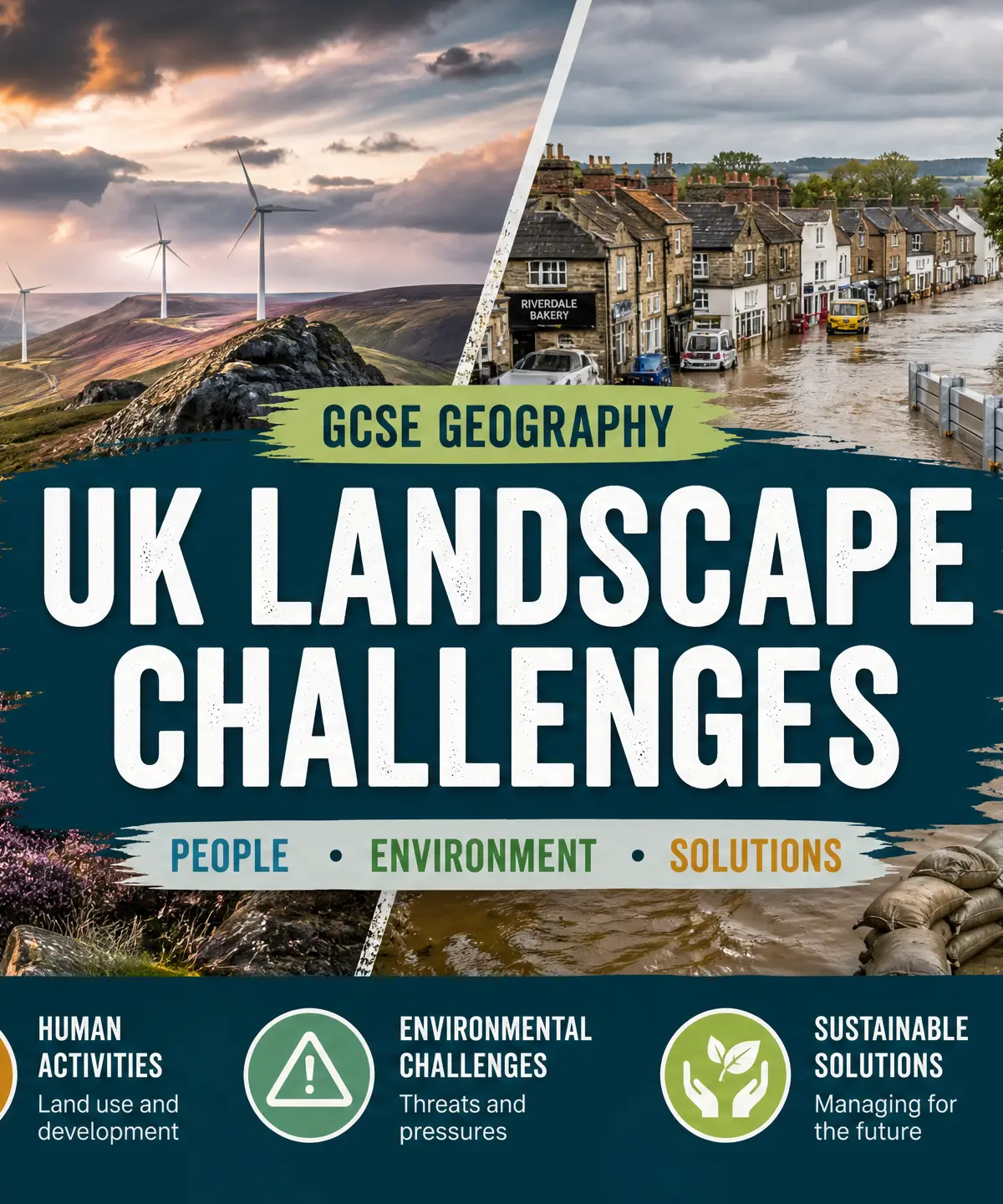
Overview
This topic covers the management of the UK's physical landscapes, specifically examining the challenges of balancing conservation with development in National Parks, and the strategies employed to manage river and coastal flood risks. Examiners expect candidates to demonstrate a clear understanding of the difference between hard and soft engineering, and to be able to evaluate the effectiveness of these approaches using specific, named case studies. You must also understand the conflicting views of different stakeholders regarding landscape management.
Key Concepts & Developments
National Parks: Conservation vs Development
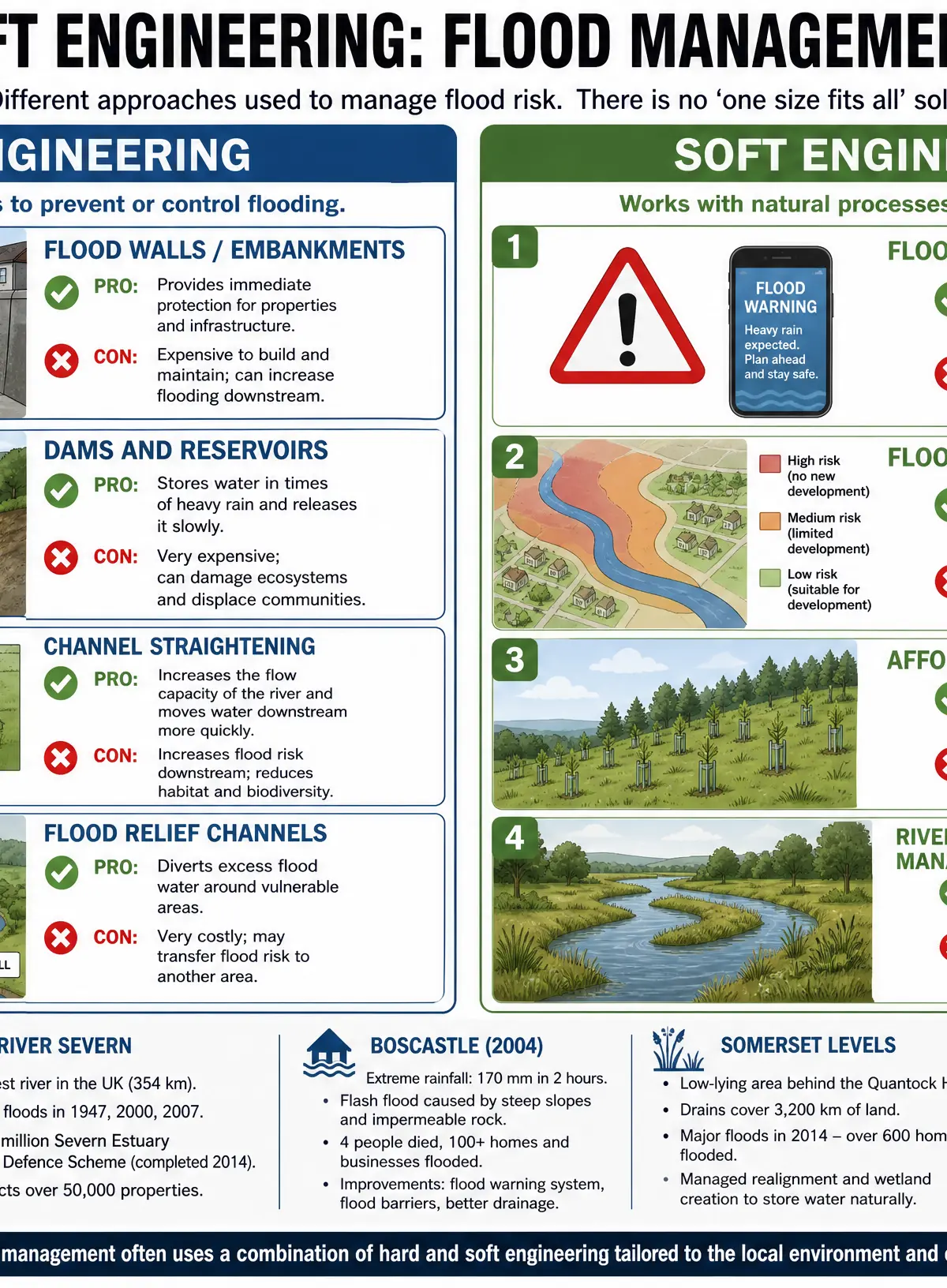
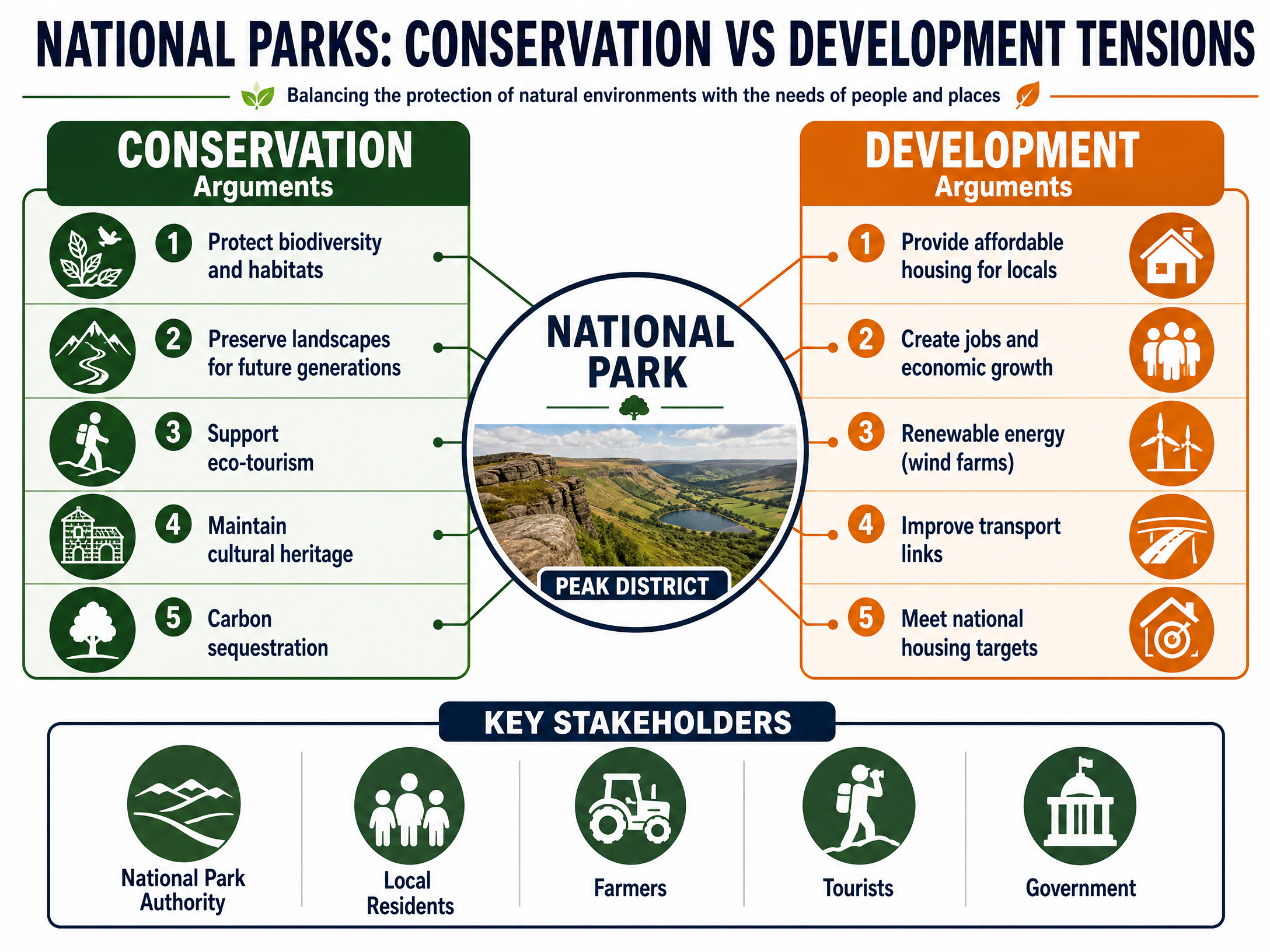
What it is: The UK has 15 National Parks, covering 10% of the land area. They are designated to conserve natural beauty and promote public enjoyment.
The Tension: National Parks are not wilderness; people live and work in them. This creates conflict between the need to protect the environment (conservation) and the need for housing, jobs, and infrastructure (development).
Specific Knowledge: The Peak District (designated in 1951) faces immense pressure due to its proximity to major cities (13 million people live within an hour's drive), leading to debates over wind farms, affordable housing, and tourism impact.
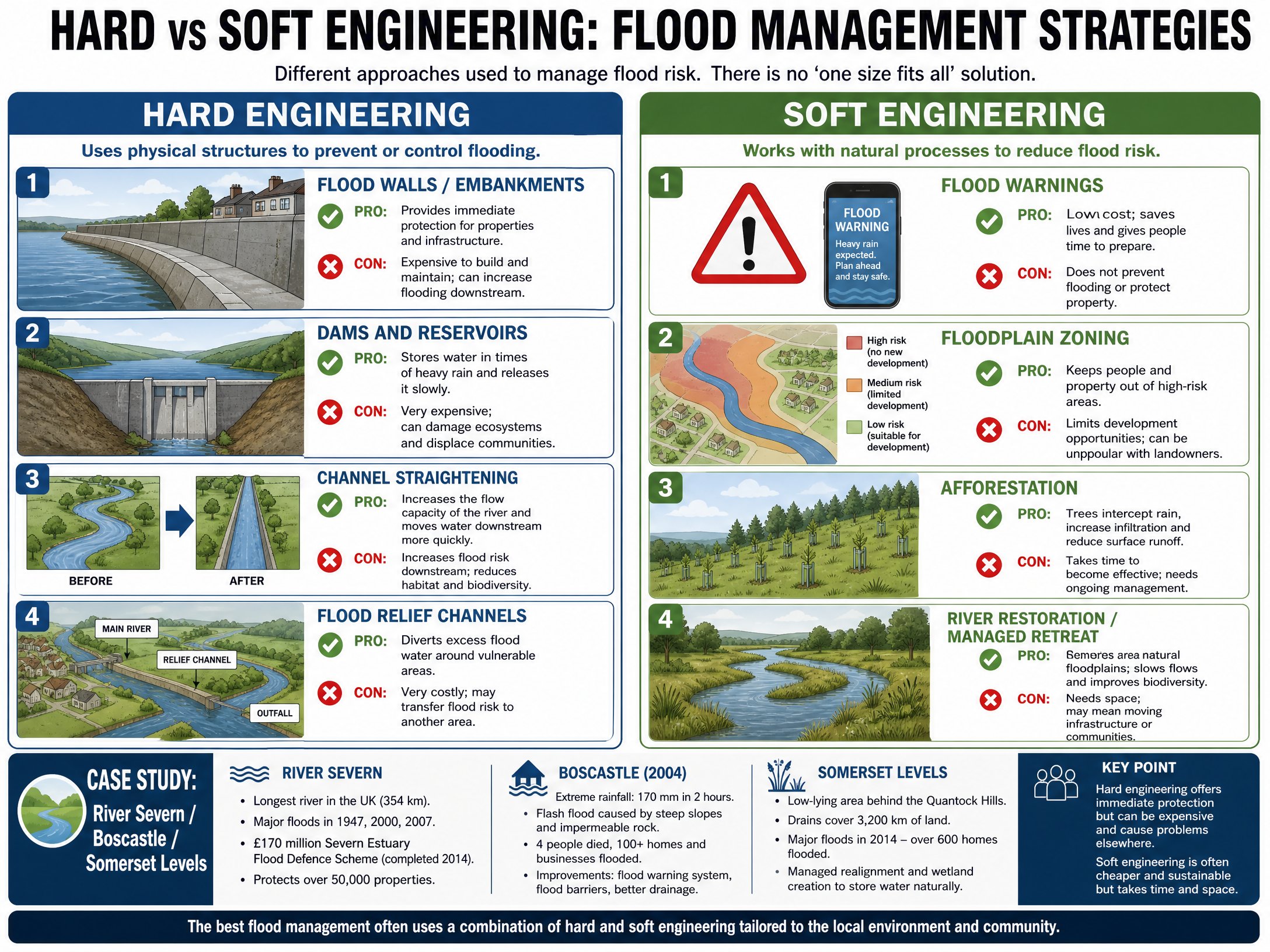
Hard Engineering for Flood Management
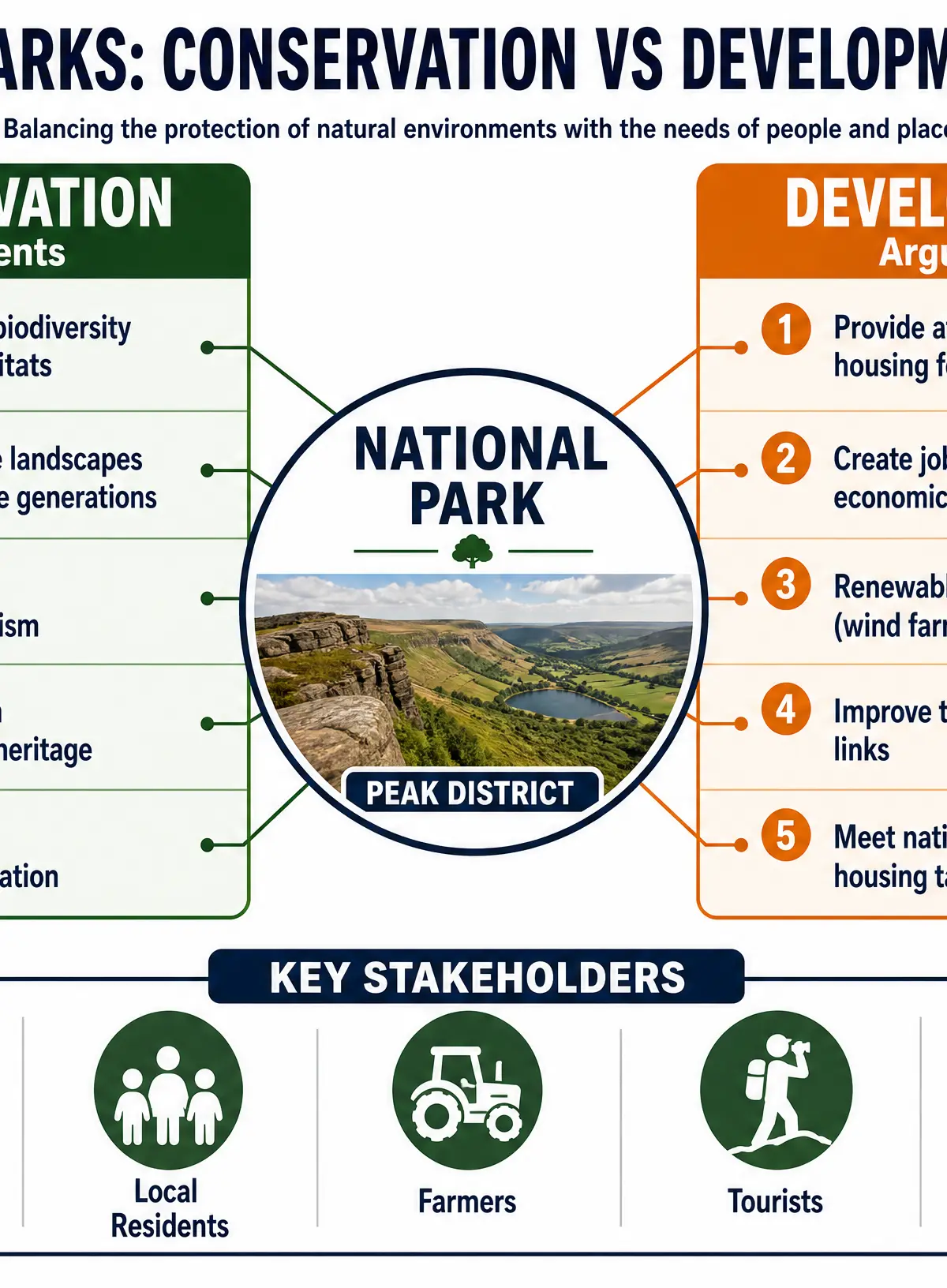
What it is: The use of artificial, physical structures to control floodwater.
Key Strategies: Flood walls, embankments, dams and reservoirs, channel straightening, and flood relief channels.
Evaluation: Provides immediate, highly visible protection (e.g., Thames Barrier), but is expensive, visually intrusive, disrupts natural habitats, and can increase flood risk downstream by speeding up water flow.
Soft Engineering for Flood Management
What it is: Working with natural river processes to manage flood risk in a more sustainable way.
Key Strategies: Flood warnings (Environment Agency), floodplain zoning, afforestation (planting trees to increase interception), and river restoration (managed retreat).
Evaluation: Generally cheaper, more sustainable, and improves biodiversity. However, it requires significant space, takes time to become effective, and may not offer the immediate protection demanded by local residents.
Key Stakeholders
National Park Authorities
Role: Planners and managers of the National Parks.
Key Actions: Decide on planning permissions, manage conservation projects, and promote sustainable tourism.
Impact: They often restrict development to protect the landscape, which can frustrate locals and businesses.
Local Residents & Farmers
Role: The people who live and work in the landscape.
Key Actions: Advocate for affordable housing, better transport links, and the ability to modernise farming practices.
Impact: Their needs highlight the 'development' side of the tension, emphasizing that landscapes must support livelihoods.
The Environment Agency
Role: Government body responsible for managing flood risk in England.
Key Actions: Issues flood warnings, builds and maintains flood defences, and advises on planning applications in flood risk areas.
Impact: Crucial for coordinating both hard and soft engineering strategies at a national and regional level.
Listen to the Podcast
Review this topic with our dedicated 10-minute audio guide covering all key concepts, case studies, and exam tips.

Second-Order Concepts
Causation
Flood risk is caused by a combination of physical factors (heavy rainfall, steep slopes, impermeable rock) and human factors (urbanisation, deforestation, channel straightening).
Consequence
The consequences of flooding include economic loss (damage to homes and businesses), social impacts (stress, loss of life, displacement), and environmental effects (pollution of water sources).
Change & Continuity
Flood management is changing from a traditional reliance on hard engineering towards more integrated, sustainable approaches that incorporate soft engineering and catchment-wide management.
Significance
Understanding these challenges is vital because climate change is increasing the frequency and severity of extreme weather events, making effective landscape and flood management more critical than ever.
Visual Resources
2 diagrams and illustrations
Interactive Diagrams
1 interactive diagram to visualise key concepts
Conceptual Flow Outline
The relationship between rainfall, runoff, and flood management strategies.
Worked Examples
3 worked examples — open one to explore the question and available guidance.
Practice Questions
Test your understanding — click to reveal model answers
Using a named example, evaluate the success of a river management scheme. (9 marks)
Hint: You must use a specific case study (e.g., Boscastle or River Severn). Discuss both successful aspects (protection of property) and less successful aspects (cost, environmental impact).
Explain two reasons why the use of hard engineering to manage river flooding is controversial. (4 marks)
Hint: Identify two distinct problems with hard engineering and explain why each is an issue.
Describe the location of the Peak District National Park. (2 marks)
Hint: Use compass directions and name nearby major cities or regions.
Explain how afforestation reduces the risk of river flooding. (4 marks)
Hint: Think about the journey of a raindrop. Use terms like 'interception' and 'surface runoff'.
State one advantage and one disadvantage of floodplain zoning. (2 marks)
Hint: Think about cost and land availability.