Pearson Edexcel · GCSE · Geography
There are various impacts of and responses to natural hazards caused by tropical cyclones depending on a country's level of development
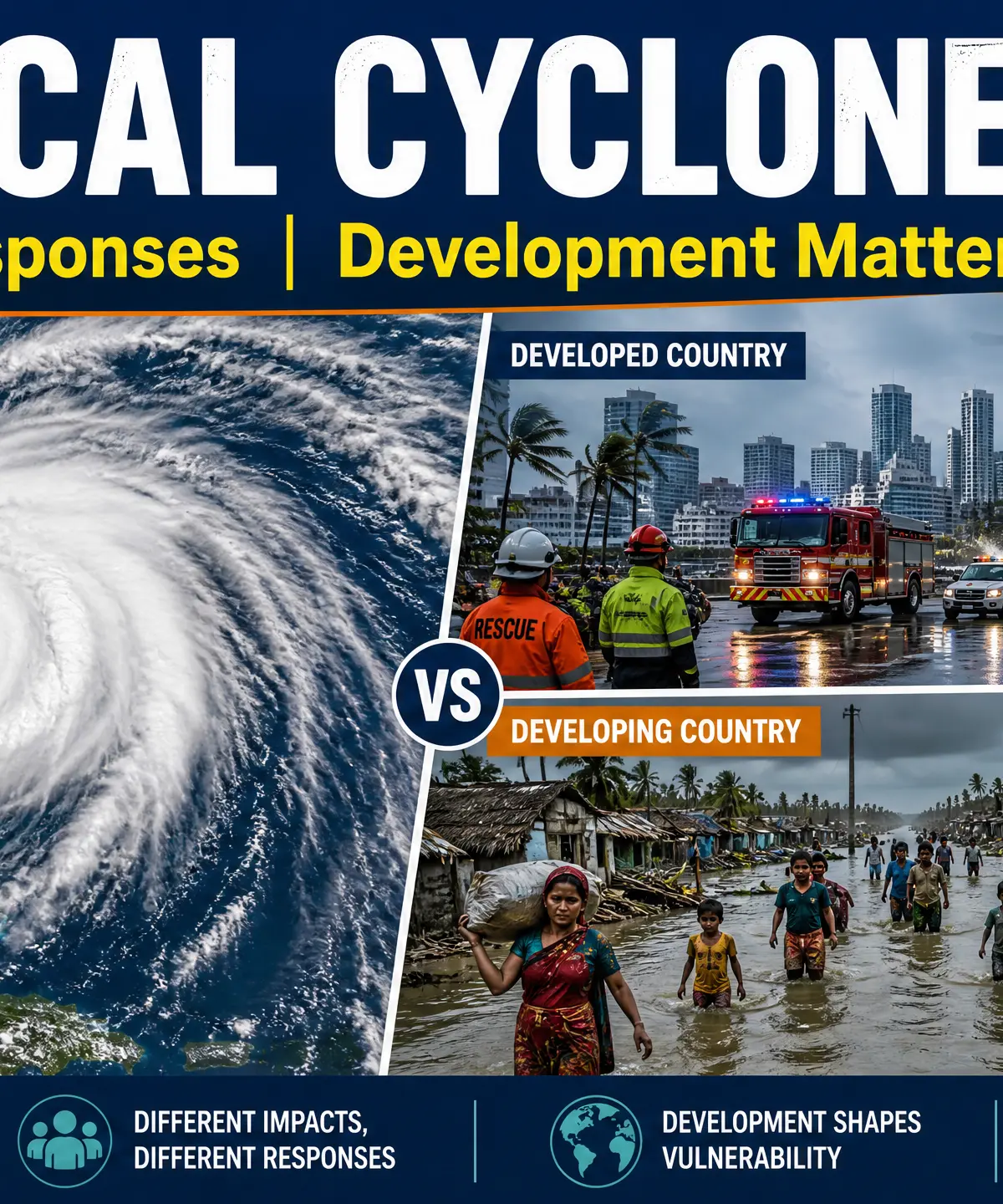
This study guide explores the devastating power of tropical cyclones and reveals a crucial geographical truth: the hazard is the same, but the disaster is shaped by development. By comparing a developed and developing country, you will learn how wealth, infrastructure, and preparation determine who survives and how quickly a nation recovers.
- 6 min read
- 3 worked examples
- 5 practice questions
- 6 key terms
Study Notes
Overview
Tropical cyclones are among the most powerful and destructive natural hazards on Earth. However, this topic is not just about extreme weather—it is a profound study of human vulnerability and capacity. Examiners expect you to understand the physical processes that create these massive storm systems, including the required sea surface temperatures, atmospheric pressure changes, and structural features like the eye and eyewall. More importantly, you must be able to evaluate how the impacts of, and responses to, these hazards vary dramatically depending on a country's level of economic development. By comparing detailed case studies of a developed country (USA, Hurricane Katrina, 2005) and a developing country (Myanmar, Cyclone Nargis, 2008), you will demonstrate how wealth, infrastructure, early warning systems, and governance directly influence death tolls and recovery times. This topic heavily assesses AO1 (Knowledge of places and processes) and AO2 (Understanding of concepts like vulnerability and development).

The Physical Hazard: Formation and Features
Formation Requirements
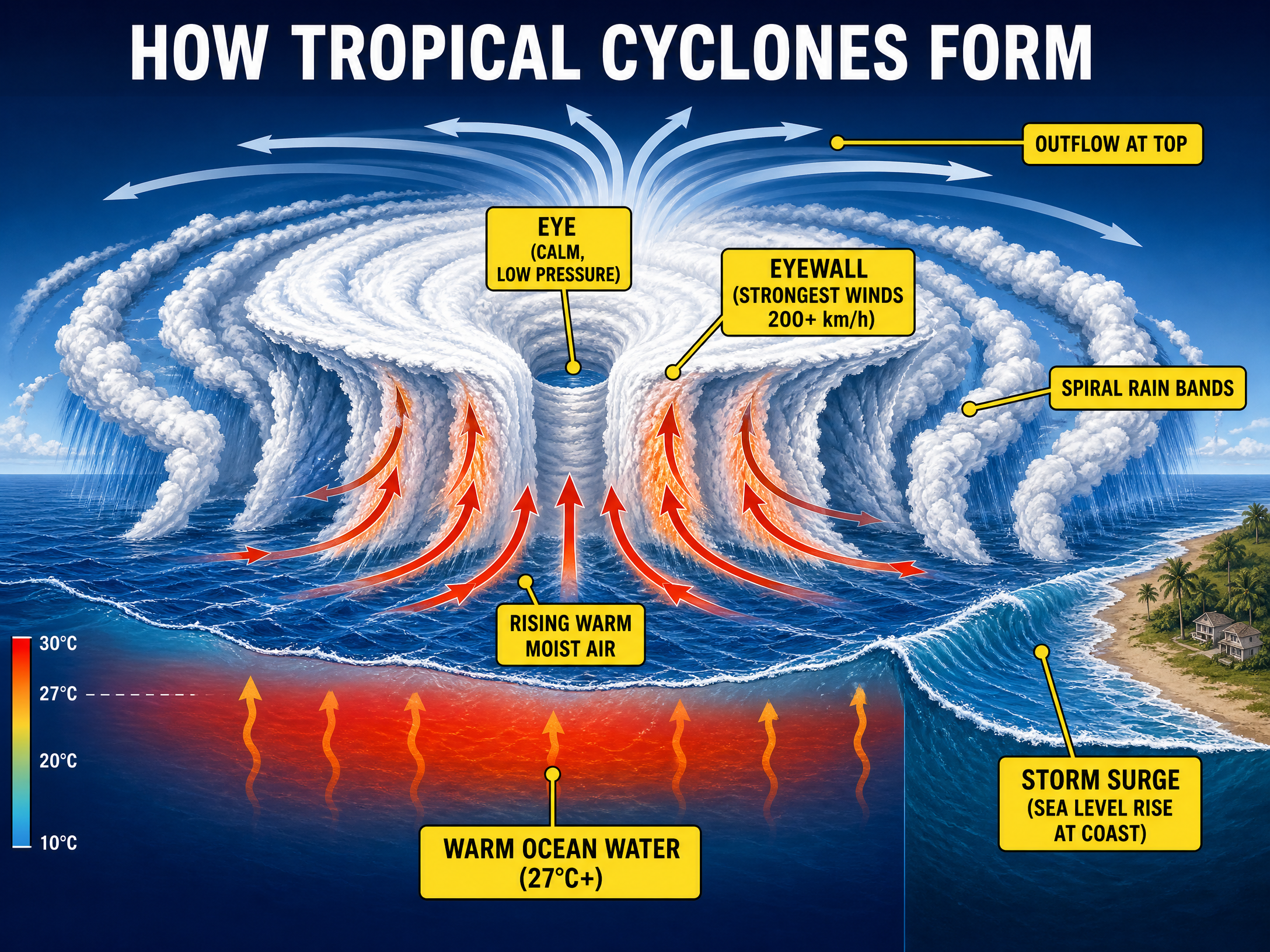
Tropical cyclones (also known as hurricanes or typhoons) require specific conditions to form:
- Warm ocean water: Sea surface temperatures must be at least 27°C to a depth of about 50 metres. This provides the latent heat energy that powers the storm.
- Location: They typically form between 5° and 30° north and south of the equator. They do not form on the equator because the Coriolis effect is too weak there to create the necessary spin.
- Atmospheric instability: Rapidly rising warm, moist air creates intense low pressure at the surface.
Key Structural Features
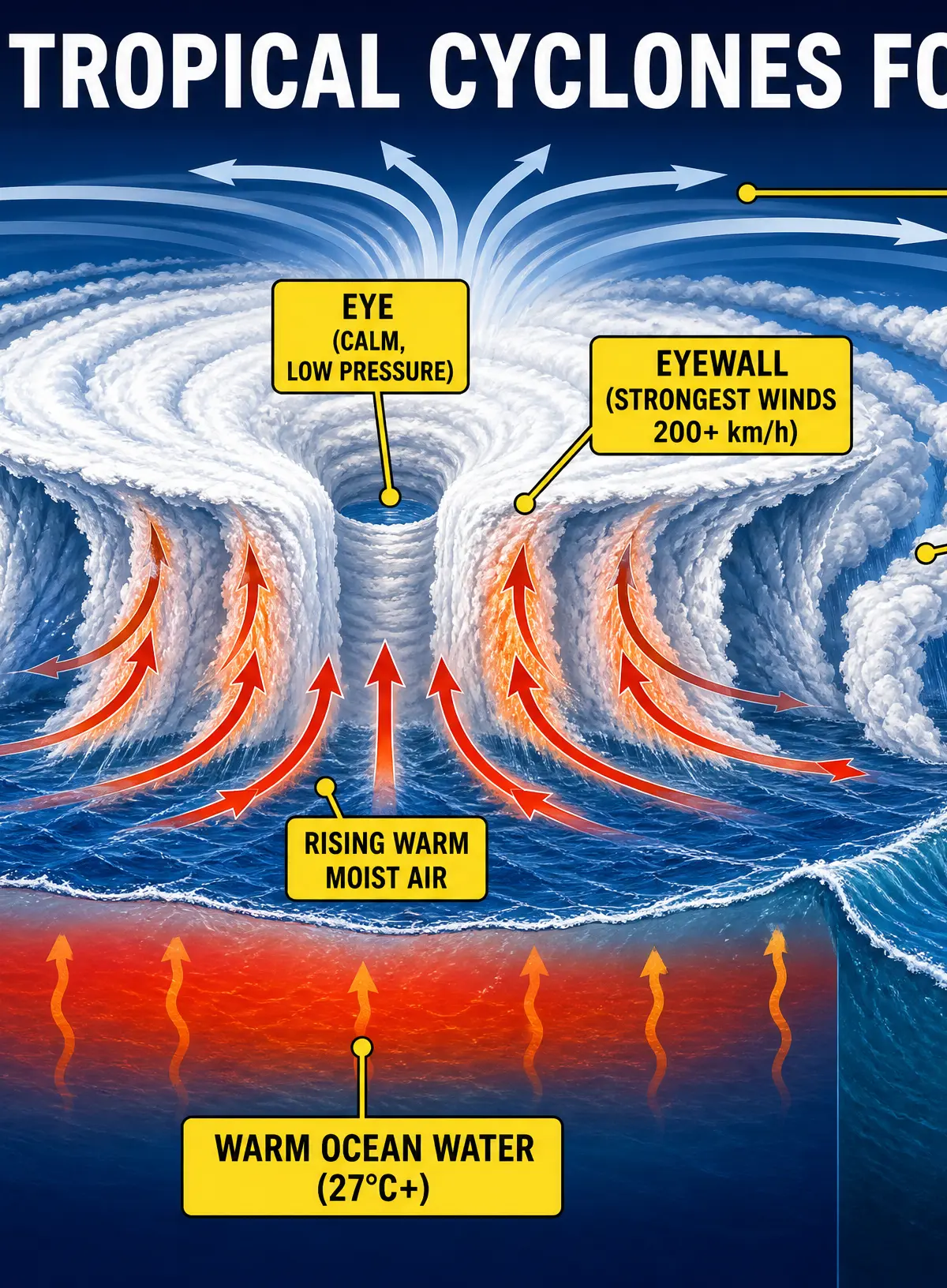
- The Eye: The centre of the storm. It is a small area (20-50km wide) of descending air, resulting in calm conditions, clear skies, and extremely low pressure.
- The Eyewall: A towering ring of cumulonimbus clouds surrounding the eye. This is where the most intense rainfall and strongest winds (often exceeding 200 km/h) are found.
- Spiral Rain Bands: Bands of heavy convective showers that spiral inward toward the storm's centre.
Primary Hazards
Tropical cyclones generate multiple distinct hazards that candidates must be able to identify:
- High Winds: Sustained winds can destroy infrastructure, uproot trees, and turn debris into lethal projectiles.
- Intense Rainfall: Can exceed 500mm in a few hours, leading to severe inland river flooding.
- Storm Surges: A rapid rise in sea level pushed onto the coast by the storm's winds and low pressure. This is often the deadliest hazard.
- Coastal Flooding: The combination of storm surge and high tides inundating low-lying coastal zones.
- Landslides: Triggered in hilly areas when intense rainfall saturates the soil.
Comparative Case Studies: Development Matters
Examiners require you to use named examples to illustrate how a country's level of development affects its vulnerability and capacity to respond.
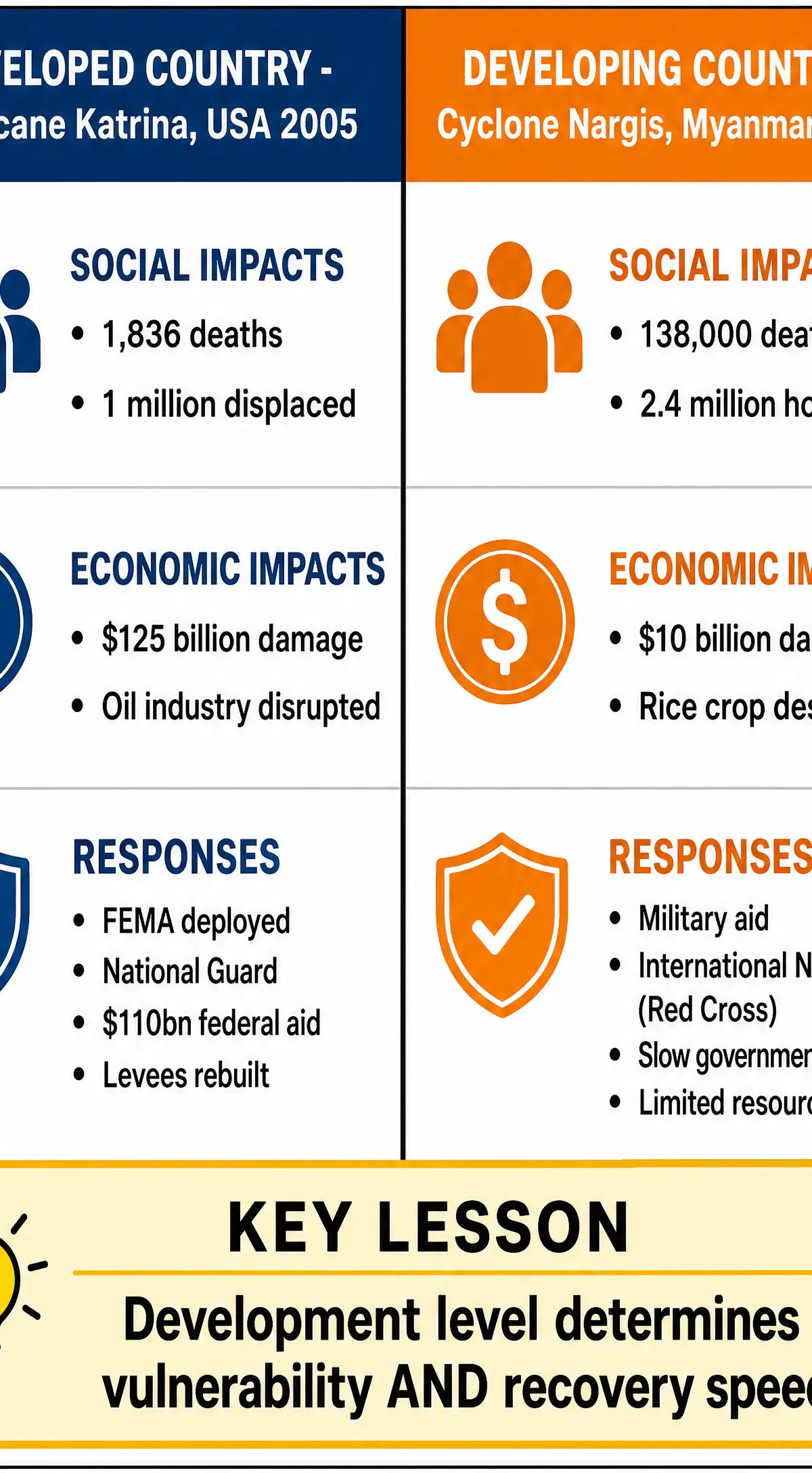
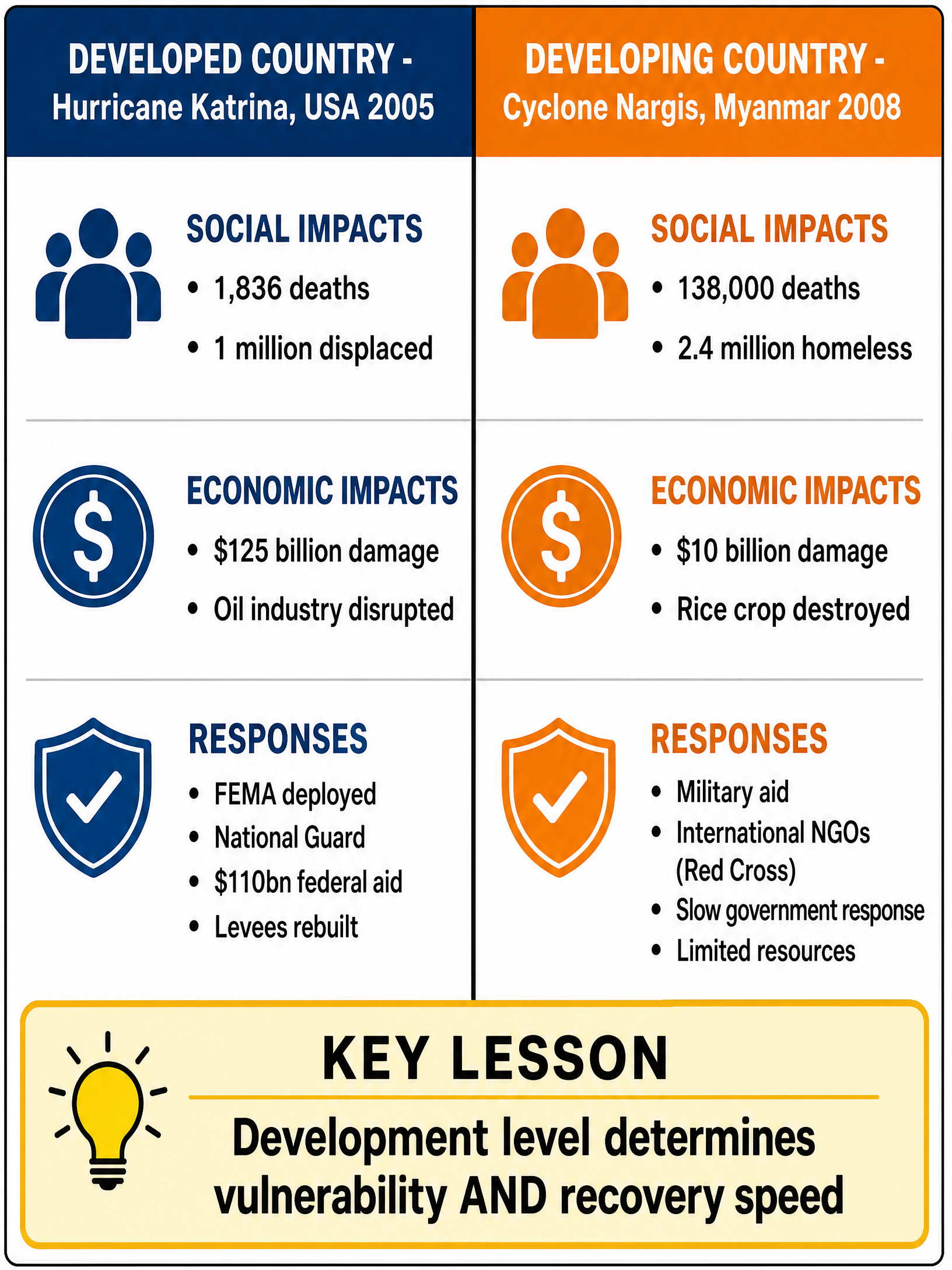
Developed Country Case Study: Hurricane Katrina (USA, 2005)
Context: A Category 4 hurricane that struck the Gulf Coast of the United States, particularly affecting the city of New Orleans.
Social Impacts:
- 1,836 deaths.
- Over 1 million people successfully evacuated before landfall.
- 1 million people displaced, many sheltering in the Superdome stadium in poor conditions.
Economic Impacts:
- Total damage estimated at $125 billion.
- Severe disruption to the Gulf Coast oil industry, causing global fuel prices to rise.
- 80% of New Orleans flooded due to the failure of the levee system.
Developing Country Case Study: Cyclone Nargis (Myanmar, 2008)
Context: A severe cyclone that struck the Irrawaddy Delta region of Myanmar (Burma), a low-lying, densely populated agricultural area.
Social Impacts:
- 138,000 people dead or missing (75 times higher than Katrina).
- 2.4 million people left severely affected and homeless.
- Complete destruction of coastal villages by a 4-metre storm surge.
Economic Impacts:
- Total damage estimated at $10 billion (a massive proportion of Myanmar's GDP).
- 65% of the country's rice paddies were destroyed, leading to long-term food shortages and loss of livelihoods.
The Three Levels of Response
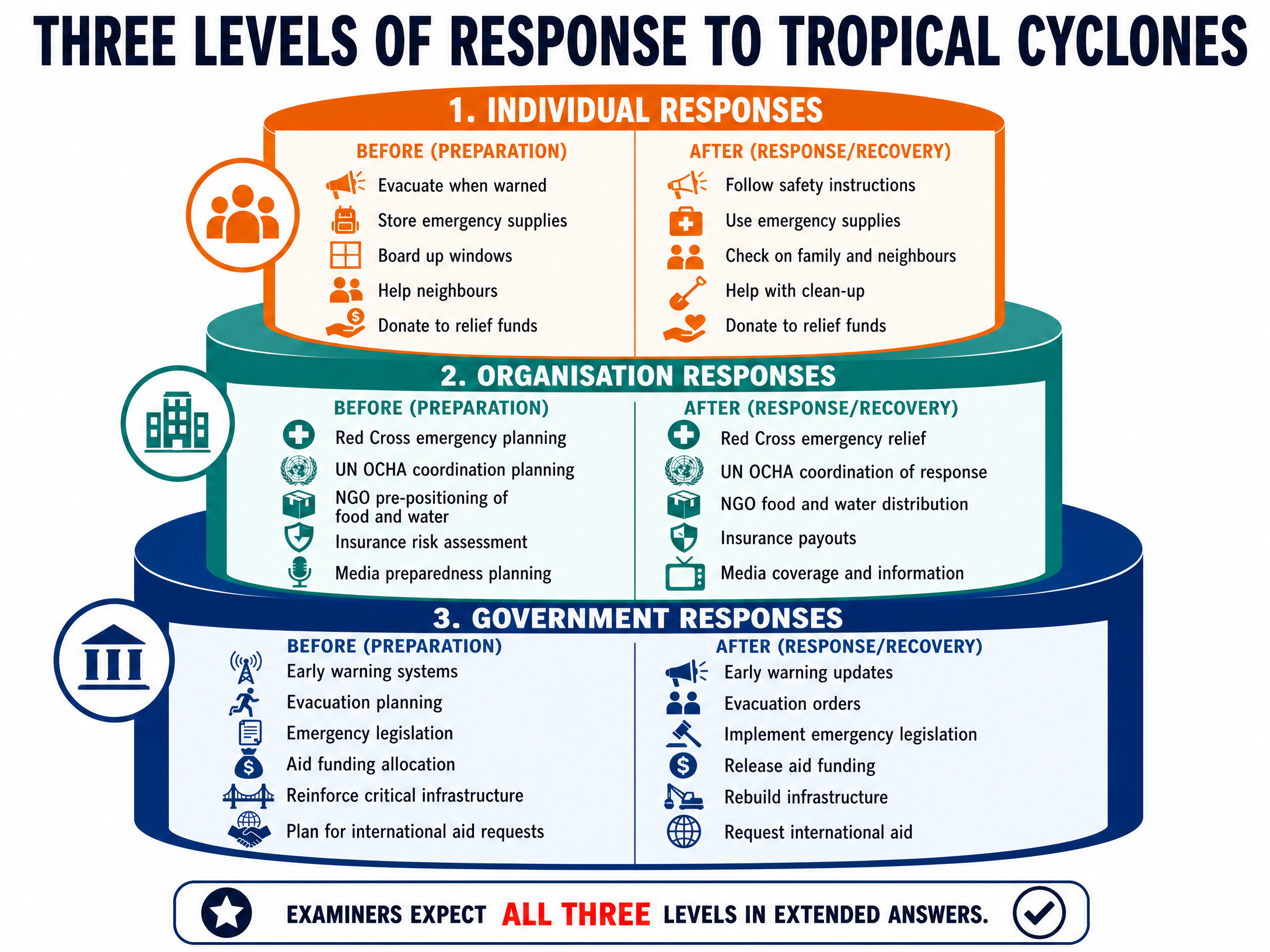
To achieve top marks in extended answers, candidates must structure their evaluation of responses across three distinct levels:
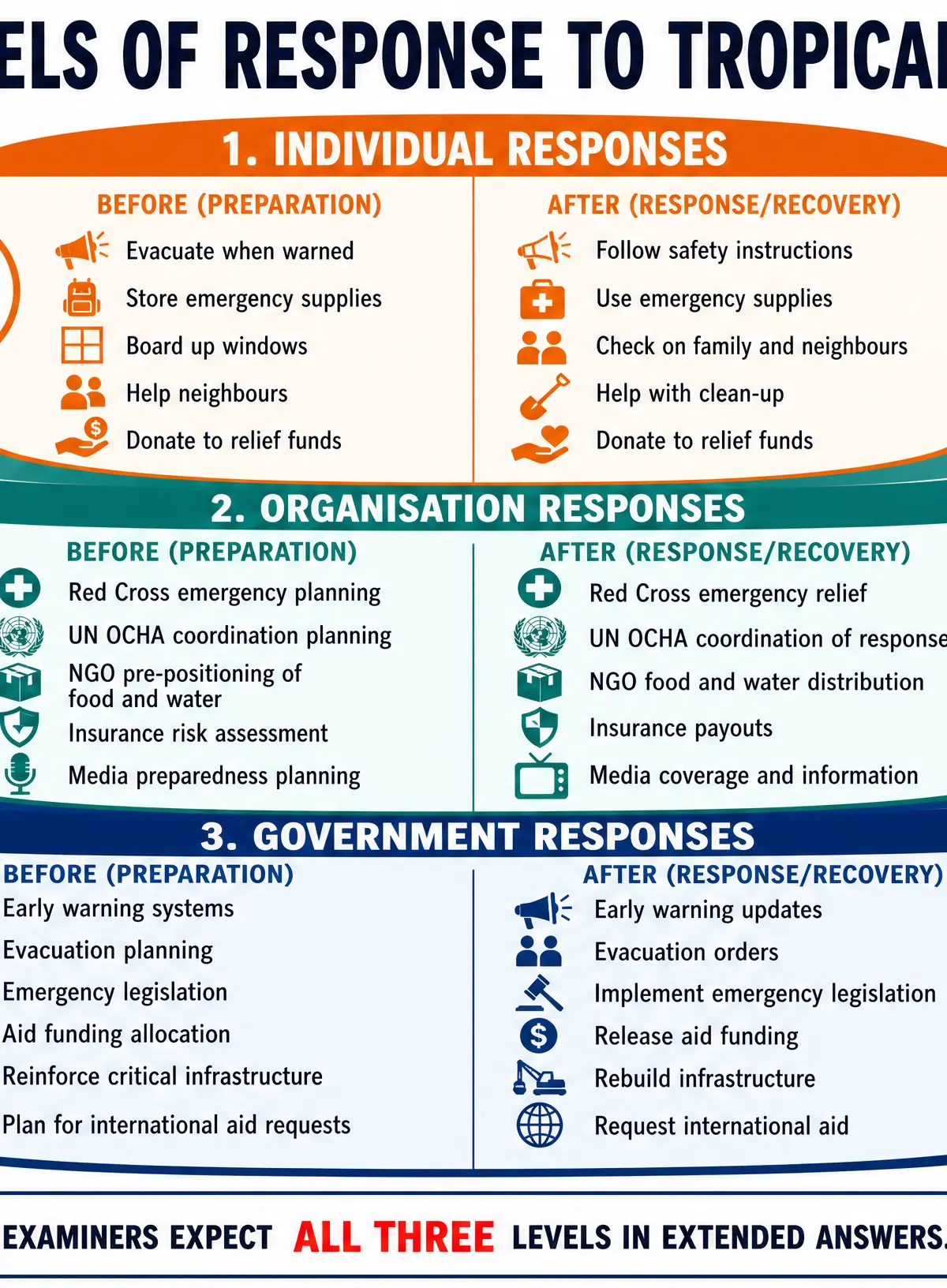
1. Individual Responses
- Preparation: Boarding up windows, stockpiling food/water, evacuating when ordered.
- Recovery: Rescuing neighbours, clearing debris, relying on savings or insurance (more common in developed nations).
2. Organisational Responses
- NGOs: Charities like the Red Cross providing emergency shelter, medical care, and clean water (crucial in Myanmar where government response failed).
- International Bodies: UN agencies coordinating global relief efforts.
- Private Sector: Insurance companies processing claims (mainly USA).
3. Government Responses
- Preparation: Investing in satellite tracking, issuing early warnings, building flood defences (levees in New Orleans).
- Recovery: Deploying military/National Guard for search and rescue, releasing emergency funding (FEMA in USA), requesting or initially refusing international aid (Myanmar military junta initially refused aid, worsening the death toll).
Visual Resources
3 diagrams and illustrations
Interactive Diagrams
1 interactive diagram to visualise key concepts
Conceptual Flow Outline
Step-by-step formation of a tropical cyclone
Worked Examples
3 worked examples — open one to explore the question and available guidance.
Practice Questions
Test your understanding — click to reveal model answers
State two hazards caused by a tropical cyclone. (2 marks)
Hint: Think about wind and water.
Explain why tropical cyclones lose their energy when they reach land. (2 marks)
Hint: What is the 'engine' of the storm, and what happens when it is removed?
Compare the economic impacts of a tropical cyclone on a developed country and a developing country. (4 marks)
Hint: Use your Katrina and Nargis case studies. Remember to compare absolute cost vs relative impact.
Explain how physical features of a tropical cyclone make it a dangerous natural hazard. (6 marks)
Hint: Link the structure (eyewall, pressure) to the specific hazards (wind, surge).
'The impacts of tropical cyclones are determined more by a country's level of development than by the strength of the storm.' To what extent do you agree with this statement? (9 marks + 3 SPaG)
Hint: This requires a balanced argument. Acknowledge that storm strength matters, but use Katrina vs Nargis to prove that development is the ultimate deciding factor.