Pearson Edexcel · GCSE · Geography
There is increasing demand for energy that is being met by renewable and non-renewable resources
Master the complexities of global energy demand and resource management. This comprehensive guide covers the critical shift from fossil fuels to renewables, the controversies of fracking, and how different countries are tackling the energy trilemma to secure a sustainable future.
- 8 min read
- 3 worked examples
- 5 practice questions
- 6 key terms
Study Notes
Overview
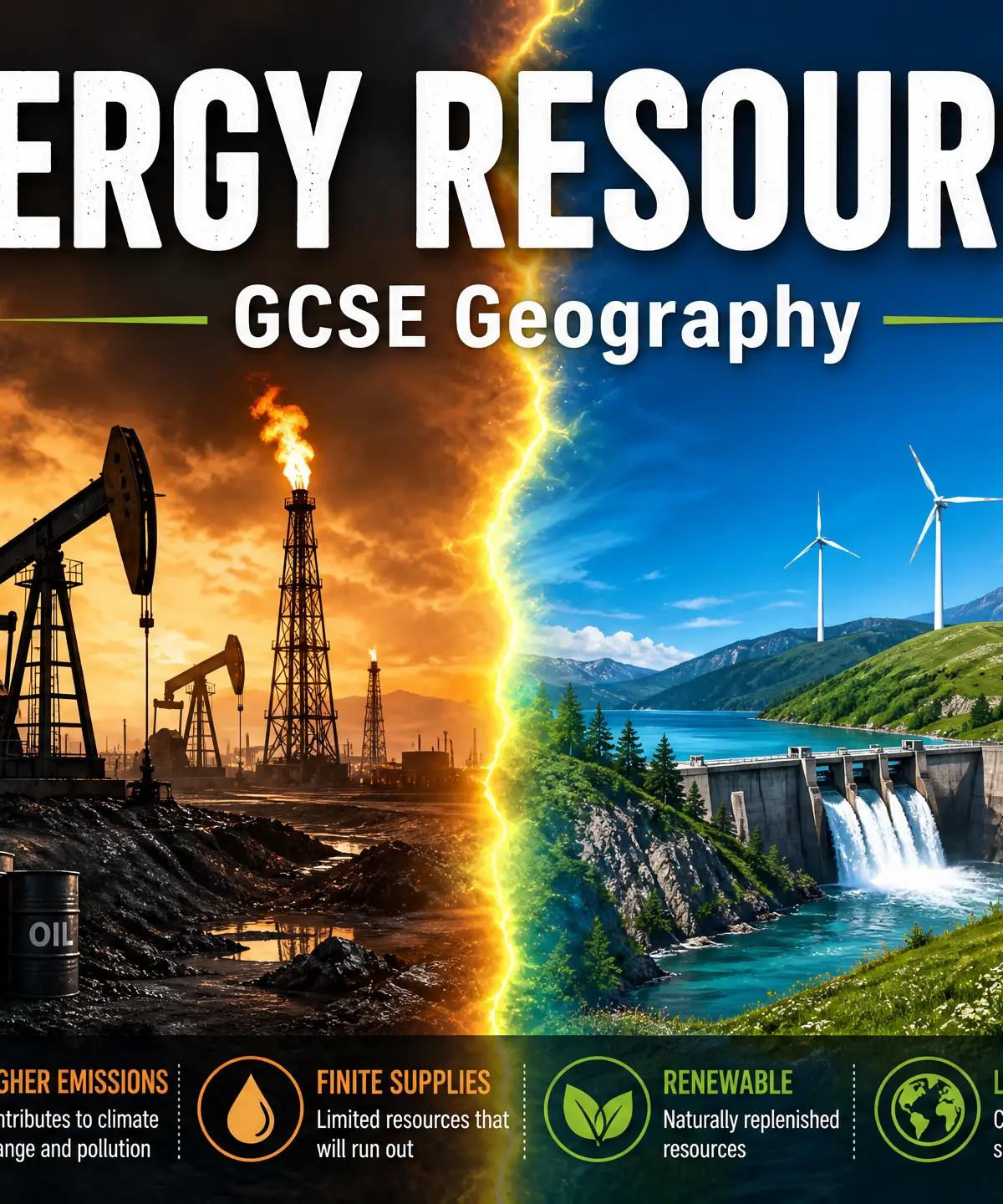
This topic explores one of the most pressing challenges of the 21st century: how to meet the rapidly increasing global demand for energy while managing environmental impacts. Over the last 100 years, global energy consumption has skyrocketed due to population growth, increasing wealth, and technological advancements. Examiners expect candidates to demonstrate a clear understanding of how energy resources are classified, the specific positive and negative impacts of different energy types, and the diverse attitudes of stakeholders involved in energy exploitation.
Crucially, you must be able to evaluate the role of technology, such as fracking, in resolving energy shortages, and provide detailed named examples of sustainable energy management in both a developed country and an emerging/developing country. This topic heavily tests your AO2 (understanding of concepts) and AO3 (skills and application) abilities, particularly when evaluating management strategies.
Listen to the companion podcast for a complete audio revision session:

Key Drivers of Energy Demand
Population Growth
Date(s): 1900 to present
What happened: The global population has grown from approximately 1.6 billion in 1900 to over 8 billion today.
Why it matters: More people inevitably require more energy for basic needs such as heating, lighting, cooking, and transport.
Specific Knowledge: The UN projects the global population will reach 9.7 billion by 2050, further intensifying energy demands.
Increasing Wealth
What happened: As countries develop economically, their citizens' disposable income increases.
Why it matters: Wealthier populations consume more energy through increased use of domestic appliances, air conditioning, personal vehicles, and higher consumption of manufactured goods.
Specific Knowledge: Emerging economies (e.g., BRICS nations like China and India) are seeing the fastest growth in energy demand as their middle classes expand rapidly.
Technological Advances
What happened: The proliferation of technology across all sectors of society and industry.
Why it matters: The digital economy, manufacturing processes, and modern transport systems are highly energy-intensive. Even the shift to electric vehicles (EVs) increases demand on national electricity grids.
Resource Classification
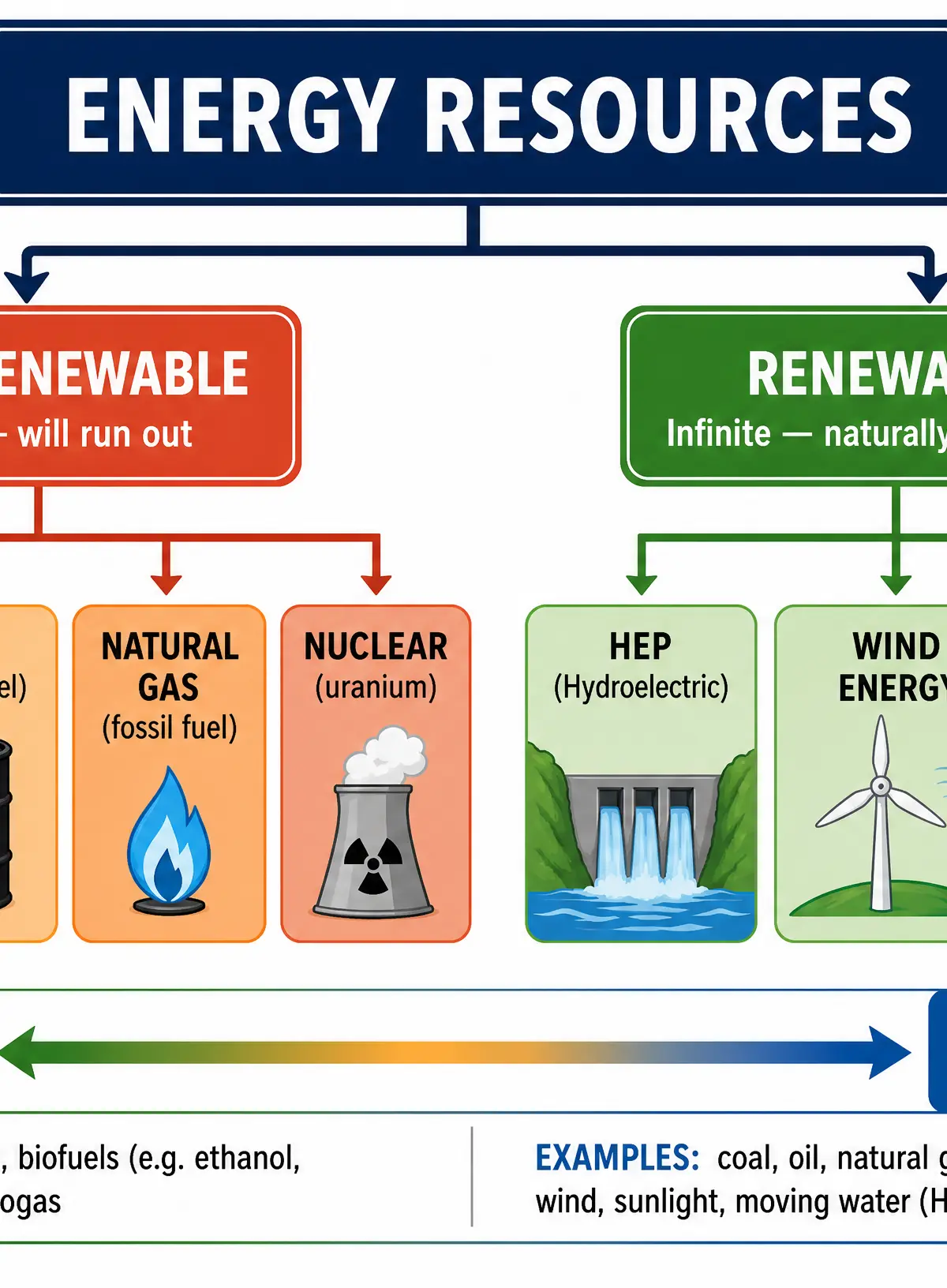
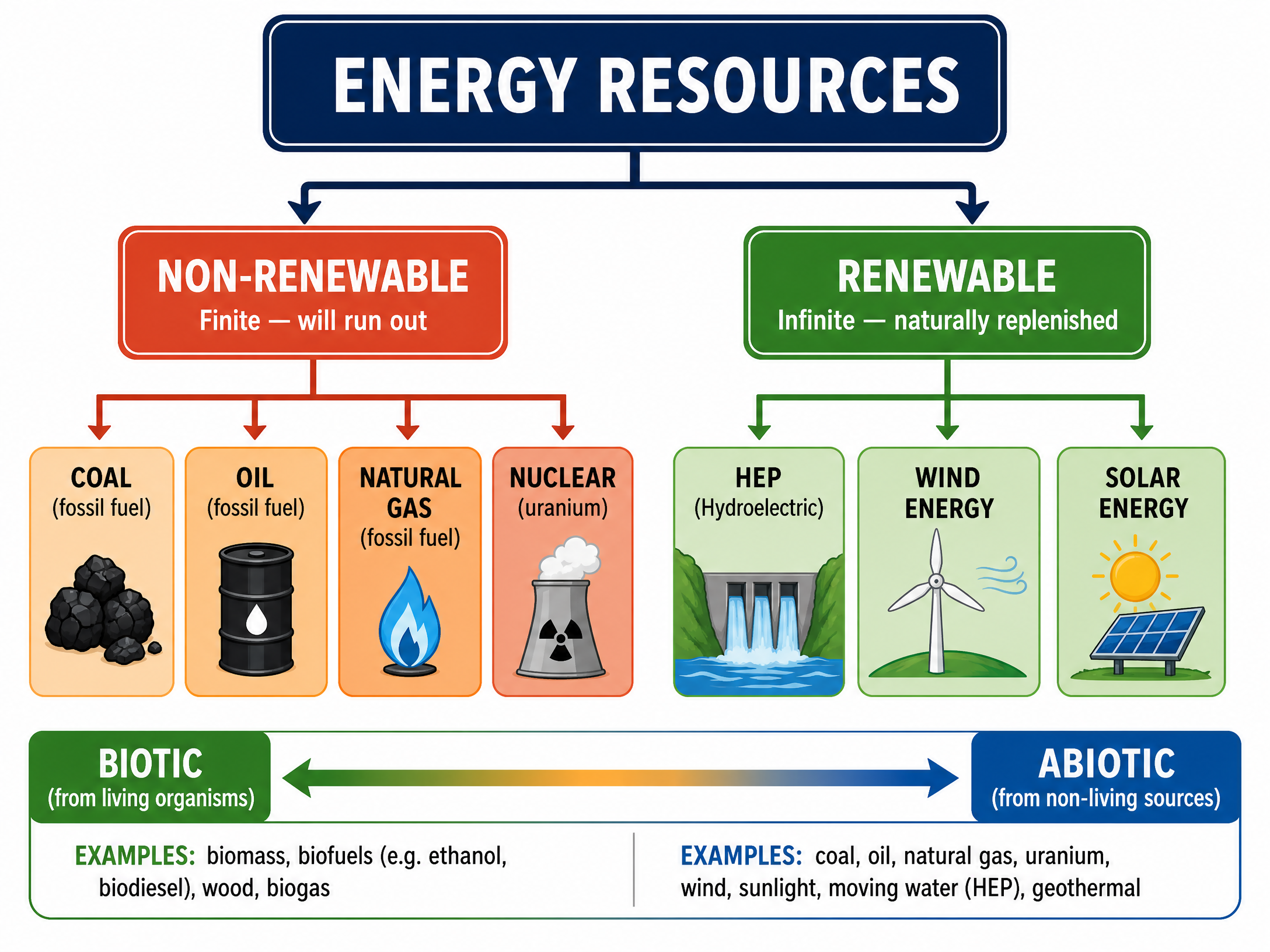
Energy resources are classified in two main ways:
- Renewable vs Non-Renewable: Non-renewable resources are finite and will eventually run out (e.g., fossil fuels, uranium). Renewable resources are naturally replenished and are effectively infinite (e.g., solar, wind, HEP).
- Biotic vs Abiotic: Biotic resources are derived from living or recently living organisms (e.g., biomass, wood, biofuels). Abiotic resources come from non-living physical sources (e.g., sunlight, wind, moving water, uranium).
Impacts of Energy Resources
Non-Renewable: Fossil Fuels (Coal, Oil, Natural Gas)
Positive Impacts: High energy density; established global infrastructure for extraction and transport; relatively cheap; provides significant employment in extraction industries.
Negative Impacts: Combustion releases CO2 (contributing to the enhanced greenhouse effect) and SO2 (causing acid rain); extraction can cause severe environmental degradation (e.g., open-cast mining); risk of catastrophic spills (e.g., Deepwater Horizon oil spill, 2010).
Non-Renewable: Nuclear (Uranium)
Positive Impacts: Generates massive amounts of baseload electricity; very low greenhouse gas emissions during operation; reduces reliance on imported fossil fuels.
Negative Impacts: High capital cost to build and decommission plants; risk of catastrophic accidents (e.g., Chernobyl 1986, Fukushima 2011); produces highly radioactive waste that remains dangerous for thousands of years.
Renewable: Wind and Solar
Positive Impacts: Zero emissions during operation; infinite supply; running costs are very low once installed; can be used off-grid in remote areas.
Negative Impacts: Intermittent generation (dependent on weather/time of day); low energy density requires large land areas; visual and noise pollution concerns for wind turbines (NIMBYism); manufacturing processes can be environmentally damaging.
Renewable: Hydroelectric Power (HEP)
Positive Impacts: Highly reliable and can respond quickly to demand spikes; produces large amounts of clean energy; reservoirs can provide water supply and recreation.
Negative Impacts: Construction requires flooding large areas of land, destroying habitats and displacing communities (e.g., Three Gorges Dam, China, displaced over 1.2 million people); high upfront capital costs; can disrupt downstream river ecosystems.
The Role of Technology: Fracking
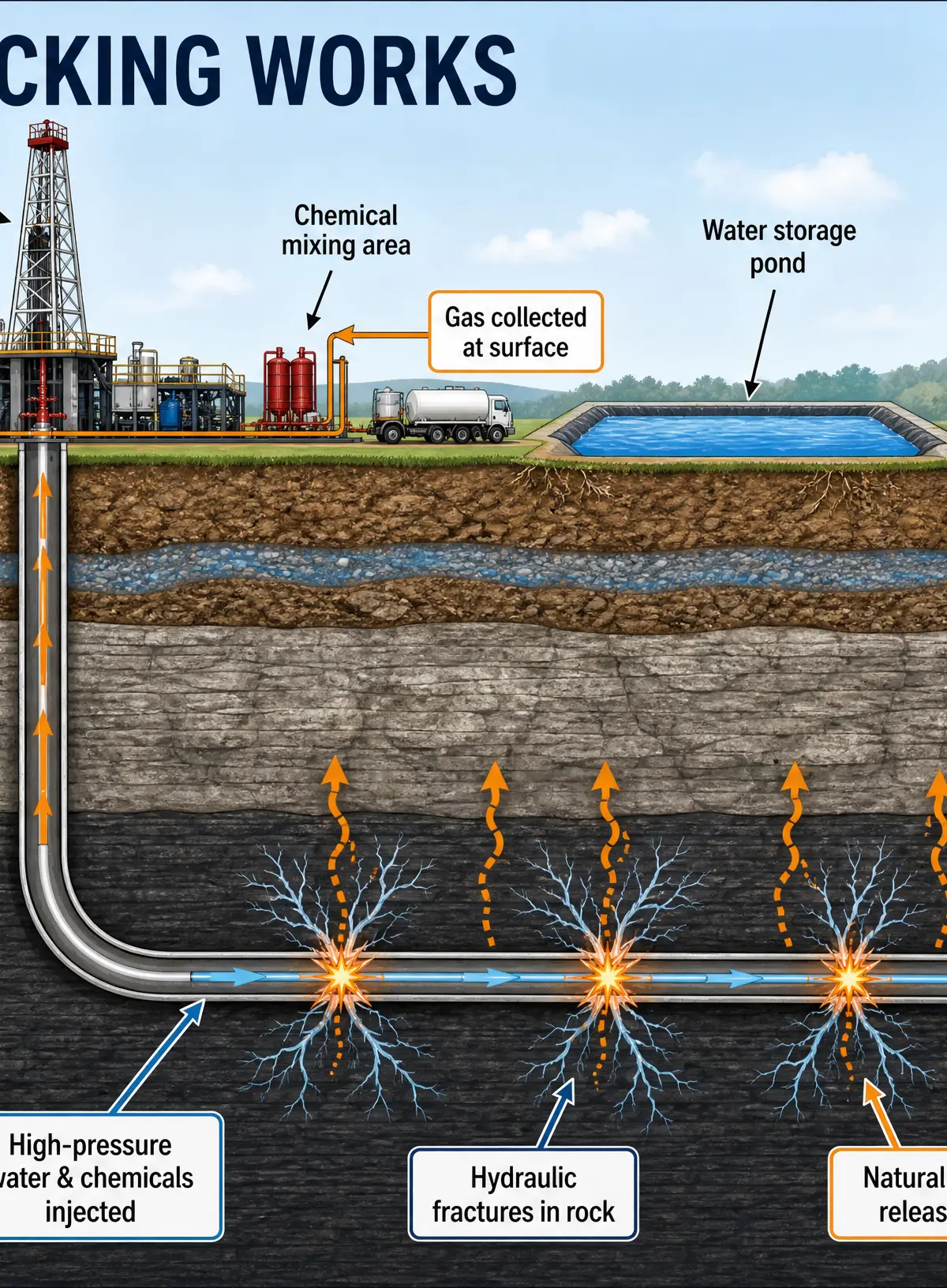
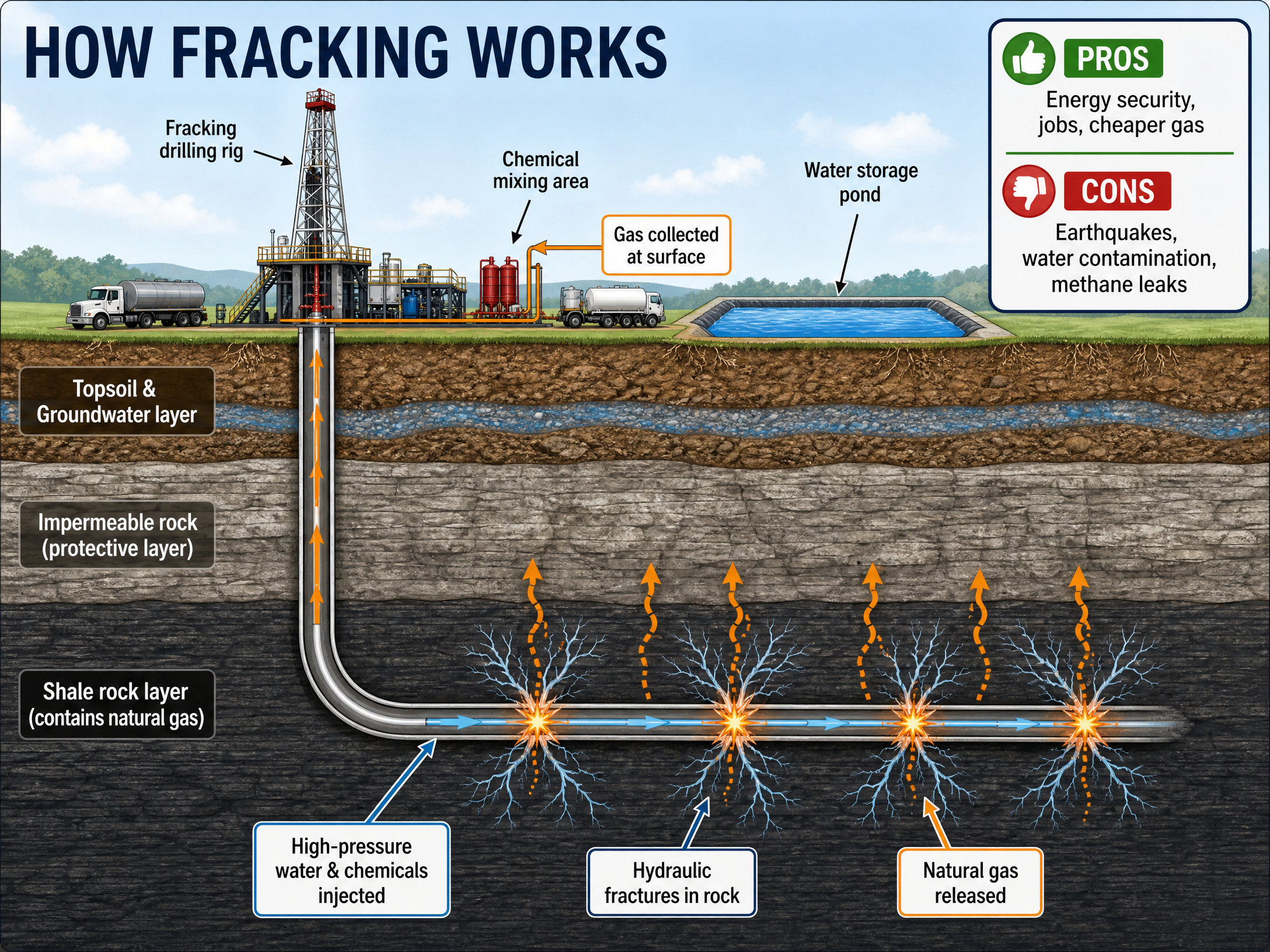
Hydraulic fracturing (fracking) involves injecting high-pressure fluid (water, sand, chemicals) into shale rock formations to release trapped natural gas.
Positive Impacts: Significantly boosts domestic energy security (e.g., USA became a net exporter of natural gas); creates jobs; natural gas burns cleaner than coal (approx. 50% less CO2).
Negative Impacts: Risk of groundwater contamination with fracking chemicals; can trigger minor seismic events (earthquakes, e.g., Preston New Road, UK, 2018); methane leaks during extraction contribute heavily to climate change; uses vast amounts of water.
Stakeholder Attitudes
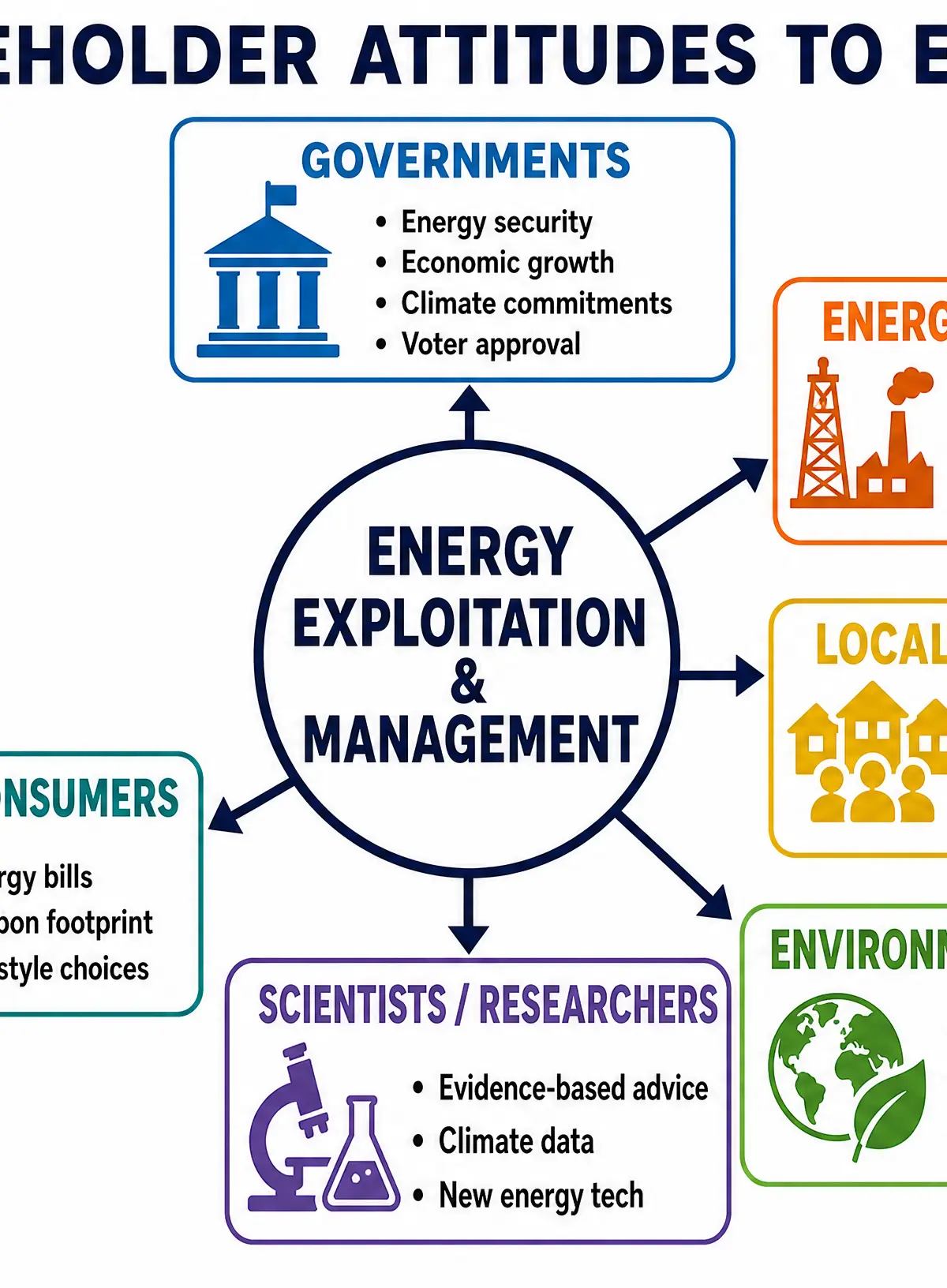
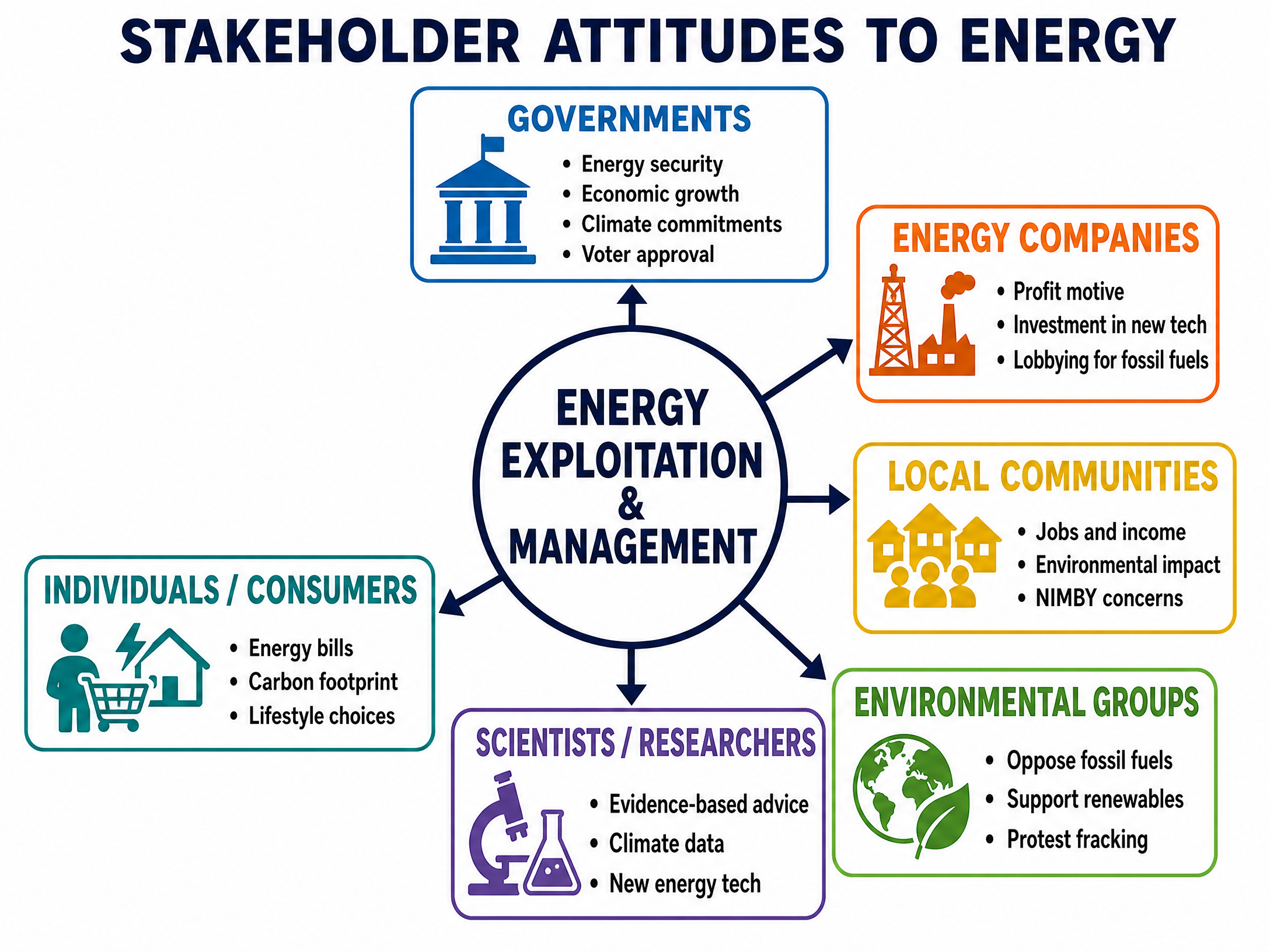
Managing energy involves balancing the conflicting interests of various stakeholders:
- Governments: Prioritise energy security, economic growth, and meeting international climate targets (e.g., Paris Agreement).
- Energy Companies (TNCs): Driven by profit margins and returns for shareholders; often lobby to protect existing fossil fuel investments while slowly transitioning to renewables.
- Local Communities: May welcome job creation but often oppose local energy projects (fracking sites, wind farms, nuclear plants) due to noise, visual impact, or environmental risks (NIMBY - Not In My Back Yard).
- Environmental Groups (NGOs): E.g., Greenpeace. Strongly oppose fossil fuel extraction and nuclear power; advocate for rapid transition to 100% renewable energy and increased energy efficiency.
- Consumers: Desire cheap, reliable energy to heat homes and power transport; increasingly concerned about their personal carbon footprints but sensitive to rising energy bills.
Sustainable Management Case Studies
Developed Country: Germany (Energiewende)
The Strategy: 'Energiewende' (Energy Transition) is Germany's national policy to transition to a low-carbon, nuclear-free energy supply.
Key Actions: Phasing out all nuclear power plants by 2022; heavy subsidies for solar and wind power; investing in grid infrastructure and energy efficiency.
Impact: Renewables now generate over 40% of Germany's electricity. However, the sudden nuclear phase-out temporarily increased reliance on highly polluting lignite (brown coal).
Emerging Country: India (National Solar Mission)
The Strategy: The Jawaharlal Nehru National Solar Mission aims to establish India as a global leader in solar energy.
Key Actions: Setting massive targets (100 GW of solar capacity by 2022, largely achieved); developing huge solar parks (e.g., Bhadla Solar Park, Rajasthan); subsidising off-grid solar panels for rural villages.
Impact: Significantly reduced reliance on imported coal; provided electricity to millions of rural citizens for the first time; created thousands of 'green jobs'.
Visual Resources
3 diagrams and illustrations
Interactive Diagrams
1 interactive diagram to visualise key concepts
Conceptual Flow Outline
Flowchart showing how increasing wealth drives energy demand
Worked Examples
3 worked examples — open one to explore the question and available guidance.
Practice Questions
Test your understanding — click to reveal model answers
Using a named example of a developed country, evaluate the success of its sustainable energy management strategy. (8 marks)
Hint: Use Germany's Energiewende. You must discuss both successes (increased renewables) and failures/limitations (reliance on coal during nuclear phase-out) to evaluate effectively.
Explain two negative environmental impacts of extracting fossil fuels. (4 marks)
Hint: Identify the impact (1 mark) and then explain how/why it happens (1 mark). Do this twice.
Describe the difference between renewable and non-renewable energy resources. (2 marks)
Hint: Define both terms clearly to show the contrast.
State one example of a biotic energy resource and one example of an abiotic energy resource. (2 marks)
Hint: Remember the hook: Bio = Biology = Living.
Explain why local communities and national governments might have conflicting attitudes towards a proposed new wind farm. (6 marks)
Hint: Explain the government's perspective (usually macro/national benefits) and then contrast it with the local community's perspective (usually micro/local negative impacts).