Pearson Edexcel · GCSE · Geography
Tropical cyclones are extreme weather events that develop under specific conditions and in certain locations
Master the dynamics of Tropical Cyclones for your GCSE Geography exam. This comprehensive guide covers their formation, global distribution, impacts, and responses, equipping you with the exact knowledge examiners look for when comparing developed and emerging countries.
- 6 min read
- 3 worked examples
- 5 practice questions
- 6 key terms
Study Notes
Overview
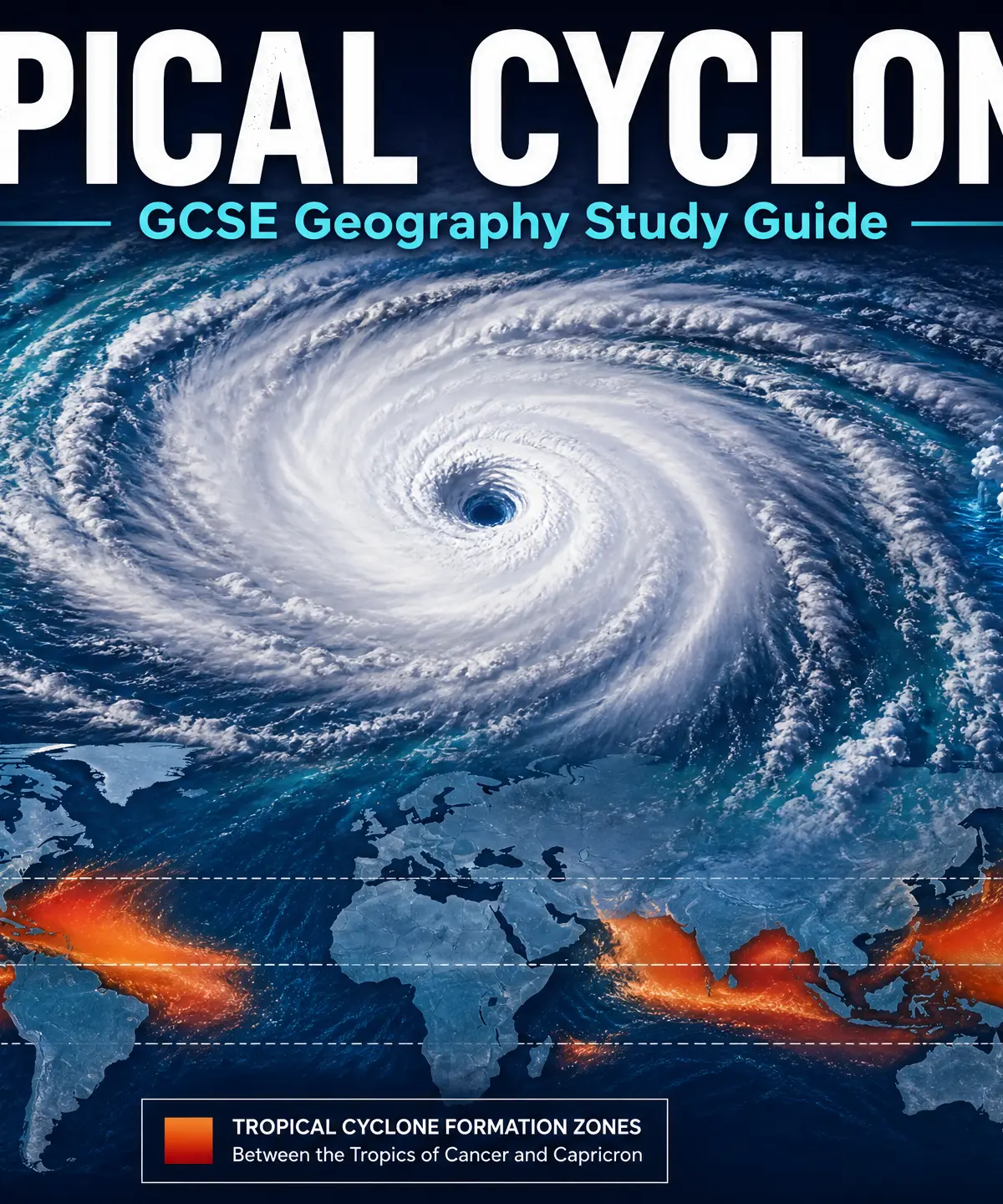
Tropical cyclones—also known as hurricanes and typhoons—are among the most powerful and destructive natural hazards on Earth. For GCSE Geography candidates, mastering this topic is essential, as examiners frequently use it to test your understanding of physical processes, global atmospheric circulation, and the human impact of natural disasters.
This study guide covers the precise conditions required for tropical cyclone formation, their global distribution patterns, and the sequence of their development. Crucially, you must be able to compare the social, economic, and environmental impacts of these storms across countries with different levels of development. By learning the detailed case studies of Hurricane Katrina (USA) and Typhoon Haiyan (Philippines), you will be fully prepared to tackle high-mark 'Assess' and 'Evaluate' questions.
Listen to the companion podcast below for a comprehensive overview of the topic, including expert exam tips and a quick-fire recall quiz.

Global Atmospheric Circulation
To understand tropical cyclones, you must first understand the global atmospheric circulation system. The Earth acts as a giant heat engine, with the sun heating the equator much more intensely than the poles. This creates a pattern of rising warm air at the equator and sinking cool air at the poles, driving the major circulation cells (Hadley, Ferrel, and Polar cells).
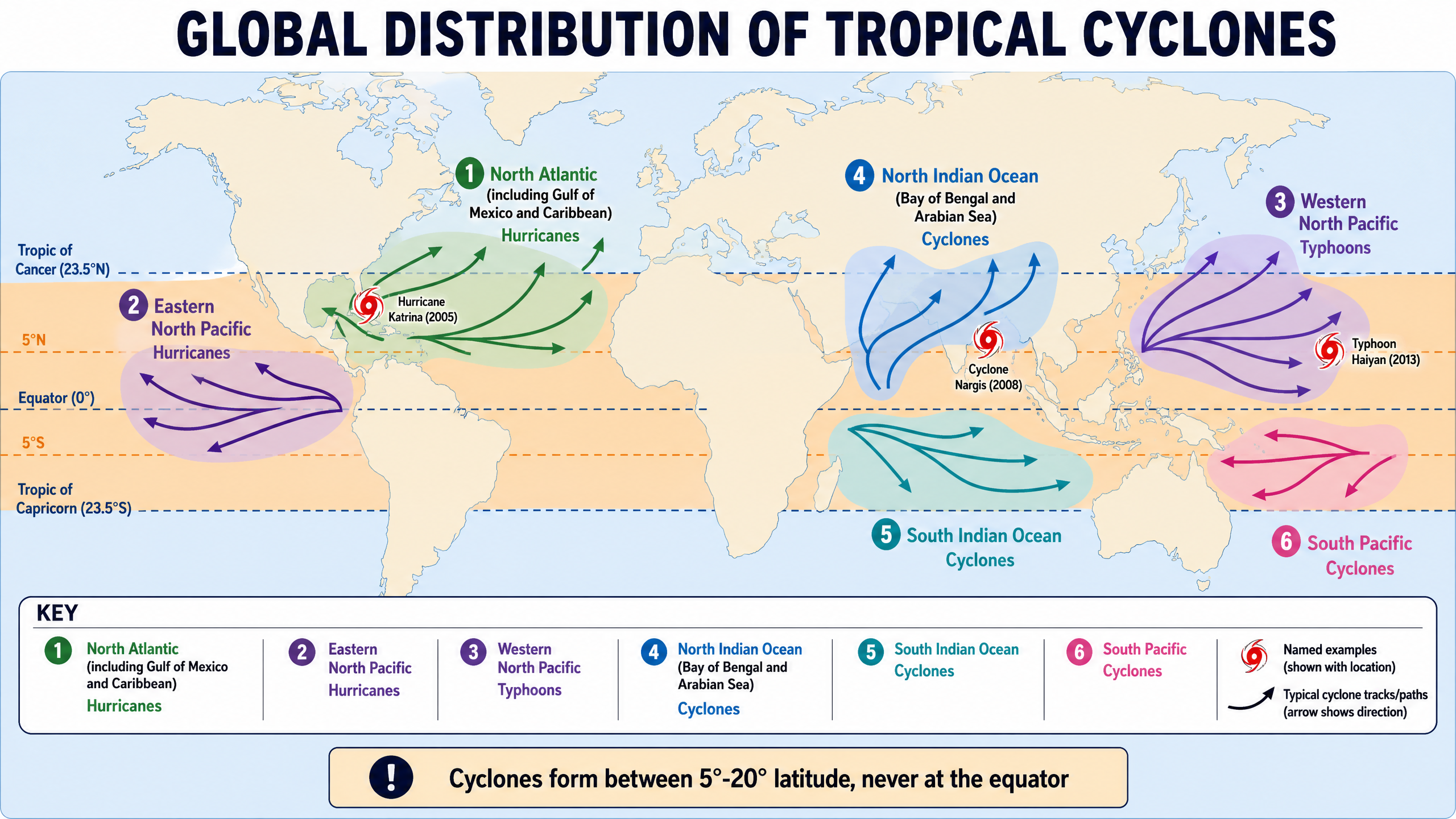
At the equator, warm, moist air rises, cools, and condenses, creating the Inter-Tropical Convergence Zone (ITCZ). This is a belt of low pressure, cloud, and heavy rainfall that shifts north and south with the seasons. Tropical cyclones form within the tropics, between roughly 5° and 20° latitude north and south of the equator, but never exactly at the equator. This is because the Coriolis effect—the spin caused by the Earth's rotation—is zero at the equator, and cyclones need this spin to form.
Tropical Cyclone Formation
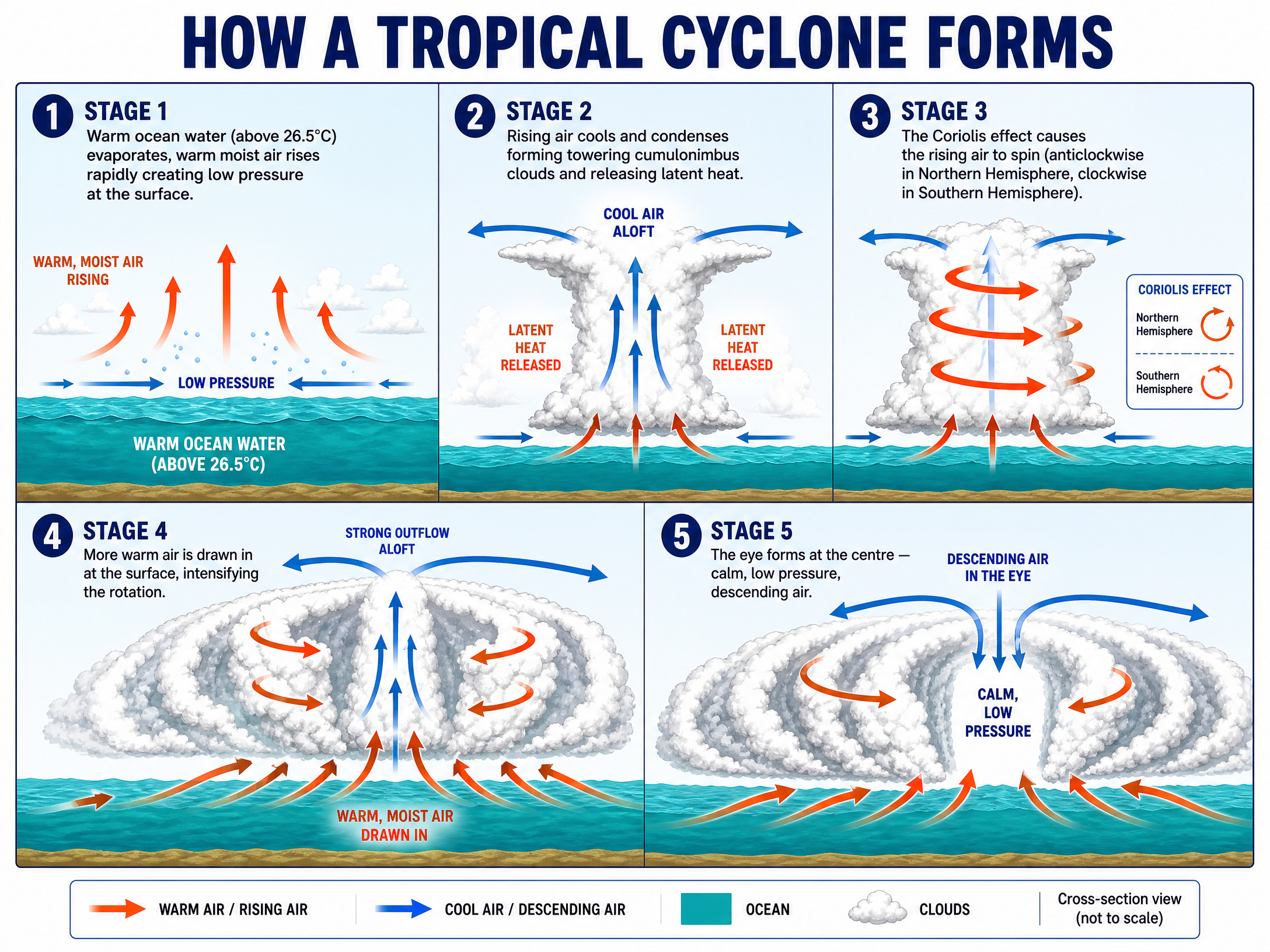
Tropical cyclones require specific ingredients to form. Remember the mnemonic WWILC: Warm water, Warm moist air, Instability, Low wind shear, and Coriolis effect.
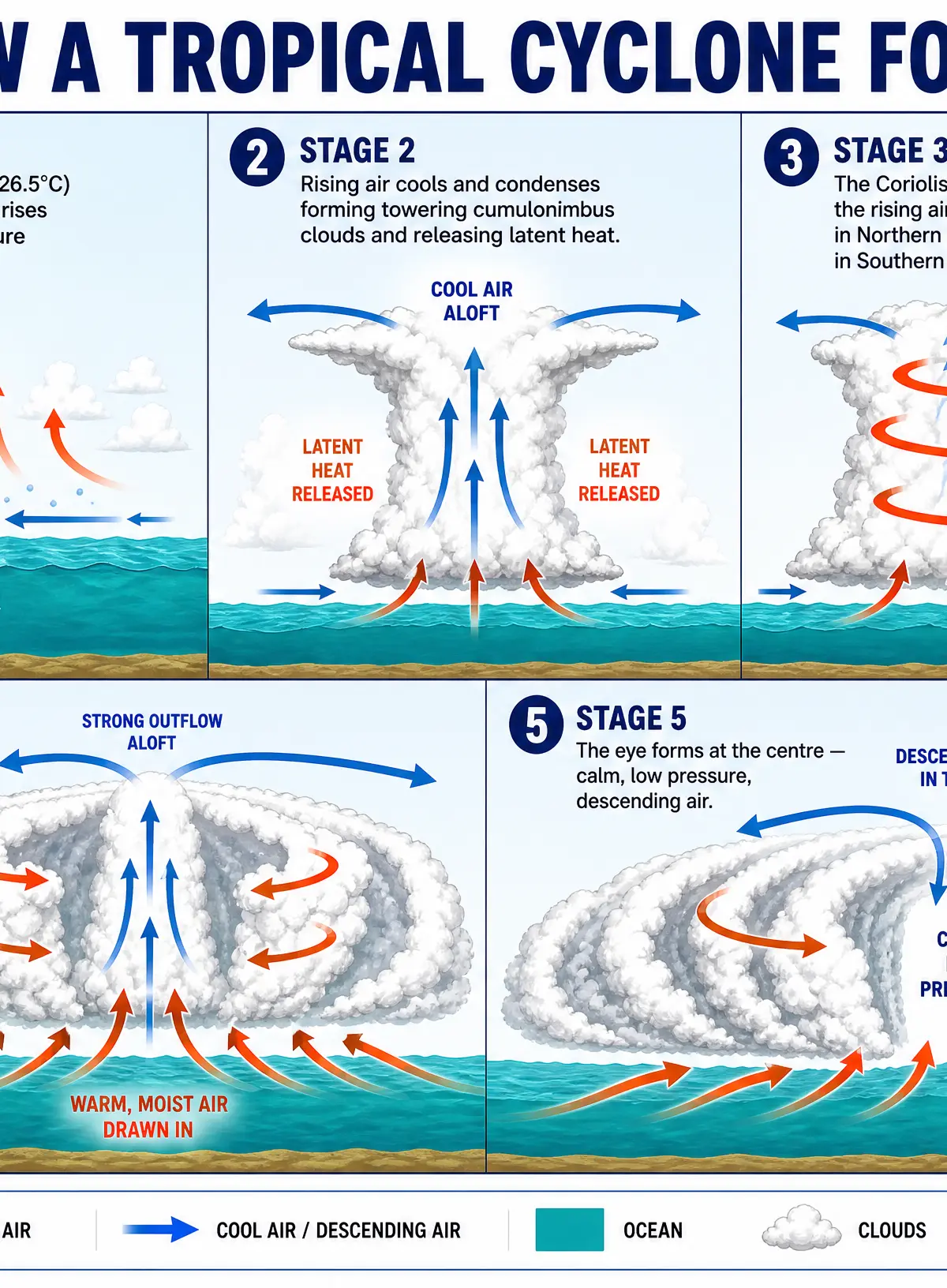
The Formation Sequence
Stage 1: Ocean HeatingSea surface temperatures must reach at least 26.5°C to a depth of around 50 metres. This warm water causes rapid evaporation, creating a column of rising warm, moist air and an area of low pressure at the ocean surface.
Stage 2: Condensation and Latent HeatAs the warm air rises, it cools and the water vapour condenses, forming towering cumulonimbus clouds. This condensation releases latent heat, which warms the surrounding air and drives it upward even more powerfully, creating a self-reinforcing feedback loop.
Stage 3: RotationThe Coriolis effect causes the rising air to begin rotating (anticlockwise in the Northern Hemisphere, clockwise in the Southern Hemisphere).
Stage 4: IntensificationMore warm, moist air is drawn in at the surface to replace the rising air, feeding the storm and intensifying the rotation. The winds spiral inward and upward.
Stage 5: The Eye and EyewallAs the storm intensifies, a calm central eye forms. This is an area of descending air, low pressure, and clear conditions. Surrounding the eye is the eyewall, the most violent part of the storm, with the strongest winds and heaviest rainfall.
Global Distribution
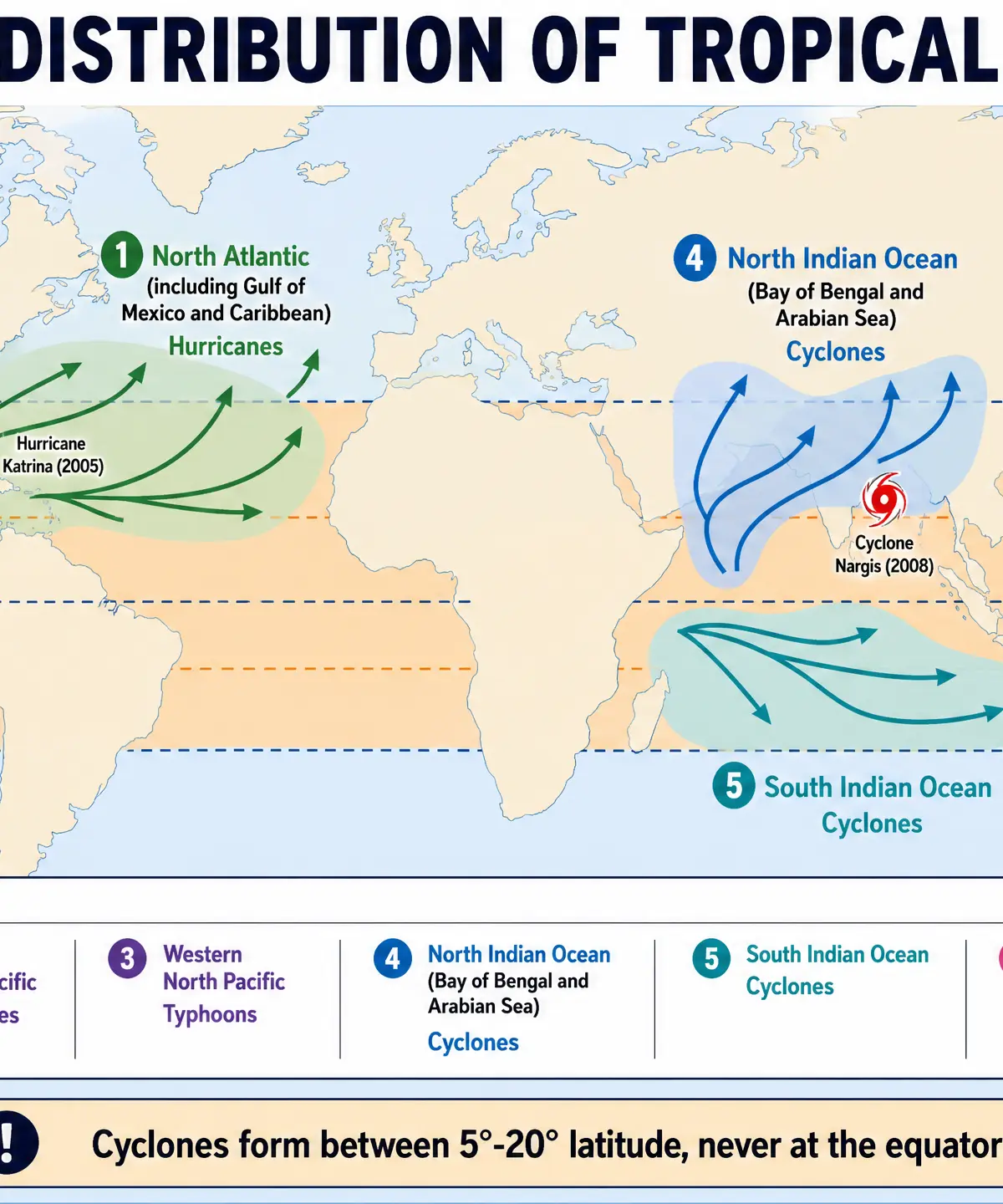
Tropical cyclones form in six main ocean basins:
- North Atlantic (Hurricanes)
- Eastern North Pacific (Hurricanes)
- Western North Pacific (Typhoons - the most active basin)
- North Indian Ocean (Cyclones)
- South Indian Ocean (Cyclones)
- South Pacific (Cyclones)
Climate change is influencing tropical cyclones. While the total frequency of storms may not be increasing, evidence suggests that the proportion of high-intensity storms (Categories 4 and 5) is rising due to warmer sea surface temperatures providing more energy.
Case Studies: Developed vs Emerging/Developing Countries
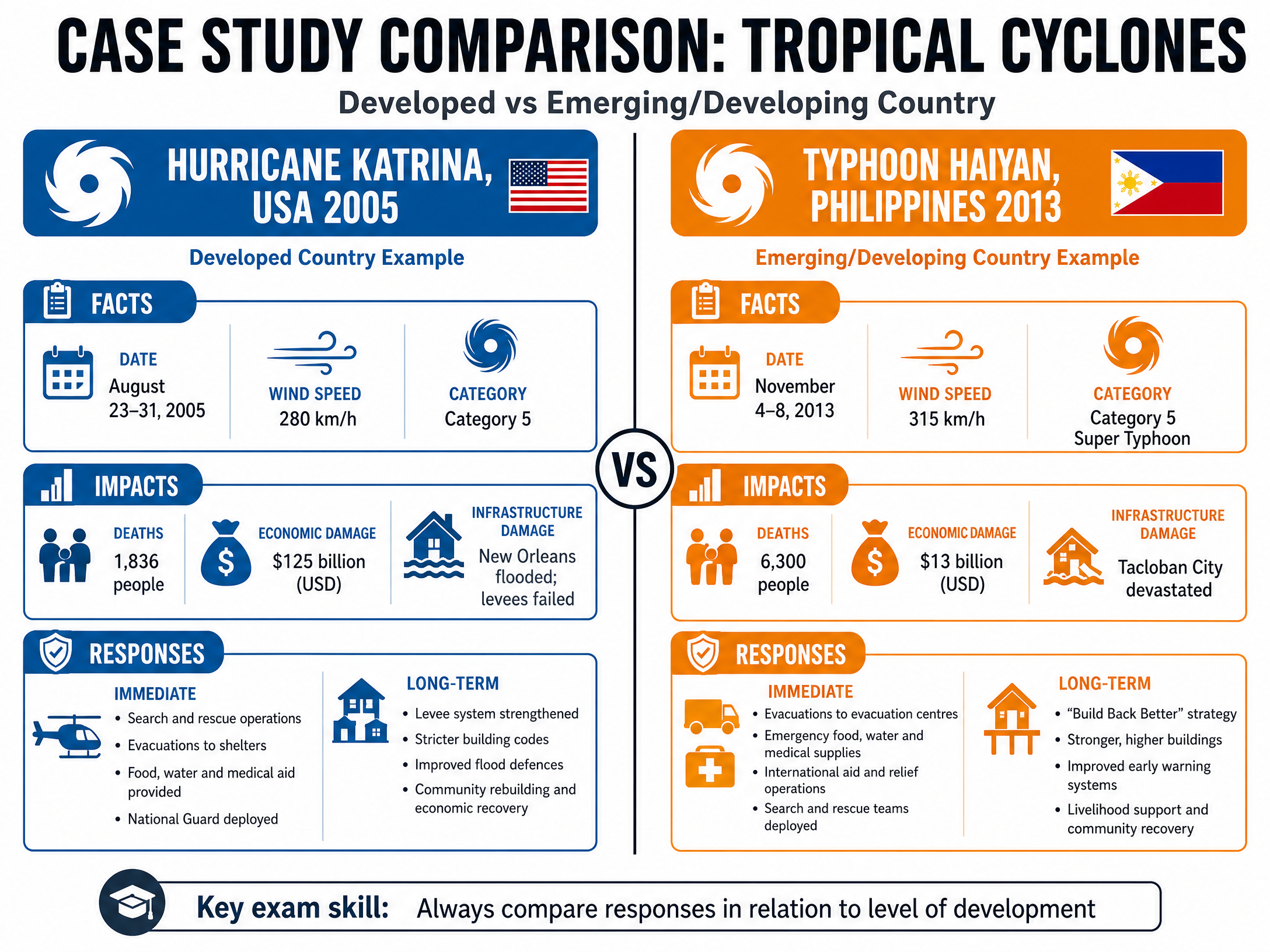
Examiners expect you to compare the impacts and responses to tropical cyclones between a developed country and an emerging/developing country. Your two key case studies are Hurricane Katrina (USA, 2005) and Typhoon Haiyan (Philippines, 2013).
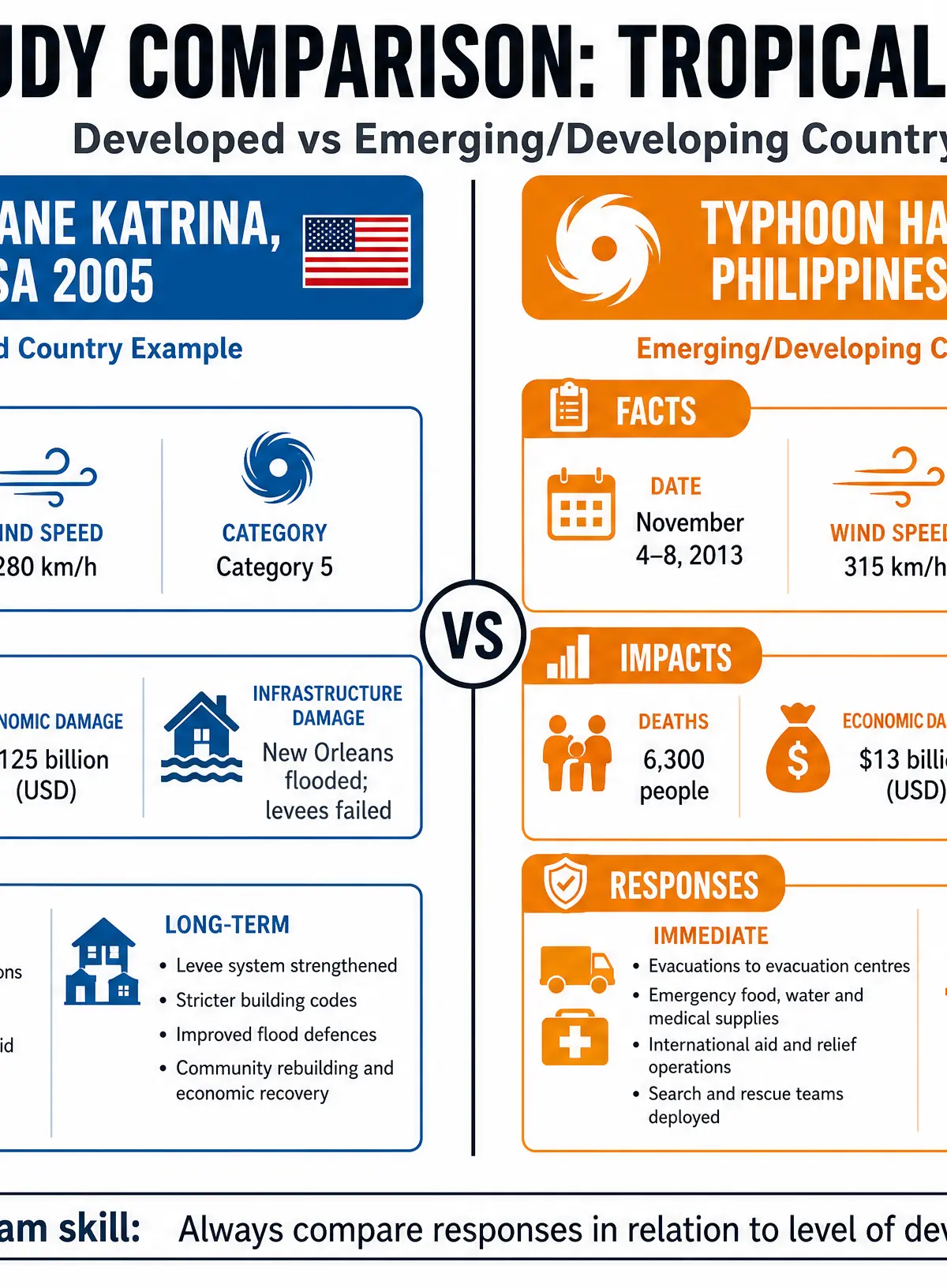
Developed Country: Hurricane Katrina (USA, 2005)
Facts: Category 5 hurricane, winds up to 280 km/h, struck the Gulf Coast on August 29, 2005.
Impacts: 1,836 deaths. The storm surge overwhelmed New Orleans' levee system, flooding 80% of the city. Economic damage was estimated at $125 billion USD. Over 1 million people were displaced.
Responses: Immediate responses included National Guard deployment and mass evacuations, though the response was heavily criticised for being slow. Long-term responses involved a $14.5 billion investment to rebuild and strengthen the levee system and improve flood defences.
Emerging/Developing Country: Typhoon Haiyan (Philippines, 2013)
Facts: Category 5 Super Typhoon, sustained winds of 315 km/h, struck on November 8, 2013.
Impacts: Over 6,300 deaths. Tacloban City was almost entirely destroyed by a 7-metre storm surge. Economic damage was $13 billion USD. 1.9 million people were left homeless.
Responses: Immediate responses relied heavily on international aid from over 60 countries. Long-term responses included the government's 'Build Back Better' strategy, aiming to construct stronger buildings and improve early warning systems, alongside livelihood support for affected farmers and fishers.
Key Exam Insight: When comparing these, note that while the USA suffered far greater absolute economic damage (due to high-value infrastructure), the Philippines suffered a much higher human cost (death toll) due to weaker infrastructure, lower capacity to prepare, and greater population vulnerability.
Visual Resources
3 diagrams and illustrations
Interactive Diagrams
1 interactive diagram to visualise key concepts
Conceptual Flow Outline
Flowchart showing the positive feedback loop of tropical cyclone formation.
Worked Examples
3 worked examples — open one to explore the question and available guidance.
Practice Questions
Test your understanding — click to reveal model answers
Explain how global atmospheric circulation leads to the formation of tropical cyclones. (4 marks)
Hint: Link the Hadley Cell to the ITCZ and explain the movement of air.
Using a named example, evaluate the immediate and long-term responses to a tropical cyclone in a developing/emerging country. (9 marks)
Hint: Use Typhoon Haiyan. Separate immediate (aid, rescue) from long-term (rebuilding, early warning), and make a judgement on their effectiveness.
State two hazards caused by tropical cyclones. (2 marks)
Hint: Think about wind, water, and the coast.
Explain why tropical cyclones lose their energy when they reach land. (2 marks)
Hint: What is the 'fuel' for a cyclone?
Compare the economic impacts of a tropical cyclone on a developed country and an emerging/developing country. (4 marks)
Hint: Use Katrina and Haiyan. Compare absolute cost vs relative cost.