Pearson Edexcel · GCSE · Geography
Tropical rainforest ecosystems provide a range of goods and services, some of which are under threat
Tropical rainforests are the most biodiverse ecosystems on Earth, providing essential goods like medicines and timber, alongside critical services like global climate regulation. This guide covers everything you need to know about the threats they face from climate change and deforestation, and how sustainable management strategies in the Amazon aim to protect them.
- 5 min read
- 3 worked examples
- 5 practice questions
- 6 key terms
Study Notes
Overview
Tropical rainforests are complex, highly productive ecosystems located near the equator, characterised by high temperatures and heavy rainfall year-round. For GCSE Geography, understanding these ecosystems is crucial because they are globally significant carbon sinks and biodiversity hotspots. Examiners expect candidates to clearly distinguish between the physical 'goods' we extract from the forest and the vital 'services' the ecosystem provides to the planet. Furthermore, you must be able to articulate how climate change specifically disrupts the structure and functioning of the rainforest, rather than just stating it 'gets hotter'. The core of this topic also requires analyzing the competing economic and social pressures driving deforestation, particularly in the Amazon, and evaluating how political and economic tools are used for sustainable management.
Goods and Services
Goods (Physical Products)
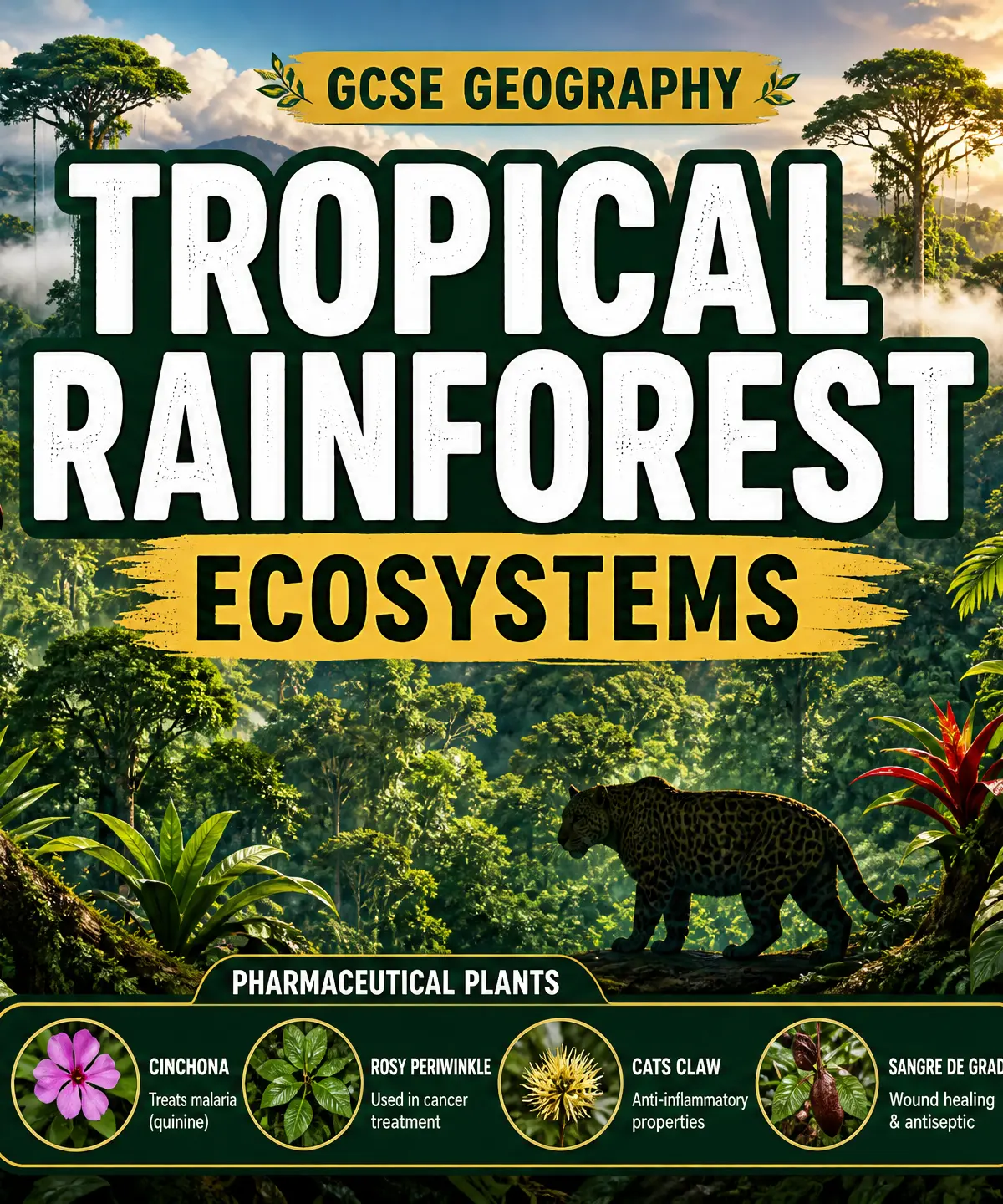
Food: Rainforests are the origin of many global food staples. Cacao (chocolate), bananas, coffee, and Brazil nuts all come from rainforest species.
Timber: Hardwoods like mahogany are highly sought after for furniture and construction, commanding high prices (e.g., $1,600 per cubic metre) on international markets.
Medicines: Approximately 25% of all modern medicines are derived from rainforest plants. For example, the rosy periwinkle is used to treat childhood leukaemia, and quinine from the cinchona tree treats malaria.
Services (Ecosystem Benefits)
Climate Regulation (Carbon Storage): The Amazon alone stores an estimated 150-200 billion tonnes of carbon, acting as a massive global carbon sink.
Water Regulation: The forest intercepts rainfall and releases moisture through transpiration, creating 'flying rivers' that maintain regional rainfall patterns across South America.
Biodiversity Support: Rainforests provide complex habitats that support over half of the world's plant and animal species.
Threats from Climate Change
Climate change poses a severe threat to the structure and functioning of tropical rainforests.
Temperature Increases: Rising temperatures push species beyond their thermal tolerance limits, leading to biodiversity loss.
Drought and Fire: Changing rainfall patterns increase the frequency of severe droughts (e.g., in the Amazon in 2005 and 2010). Drought-stressed trees die, releasing stored carbon and turning the forest from a sink to a source. Drier conditions also make the forest highly vulnerable to devastating wildfires.
Structural Collapse: As canopy trees die, more sunlight reaches the forest floor, drying it out and destroying the microclimate required by shade-adapted understory species.
Causes of Deforestation
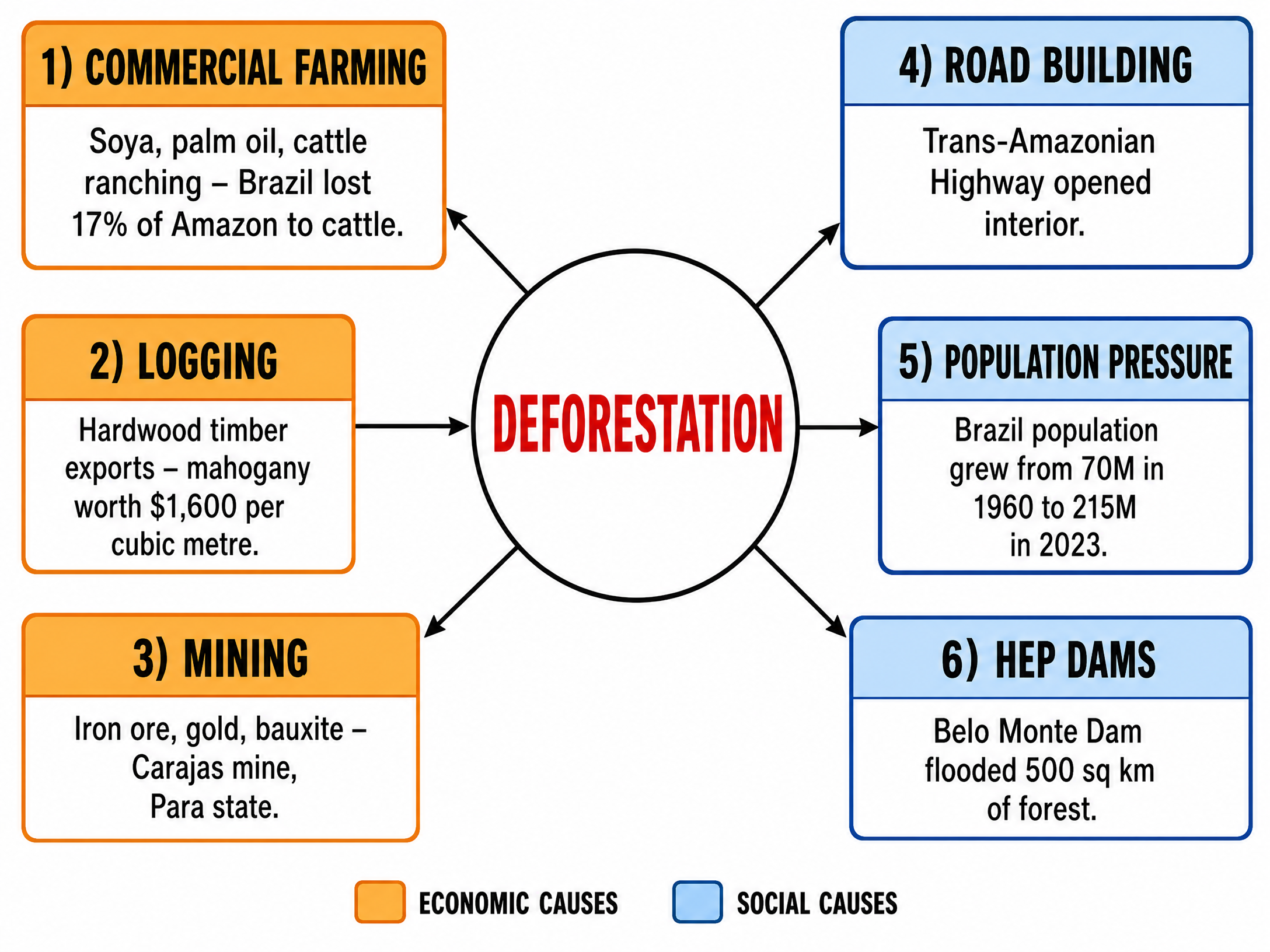
Economic Causes
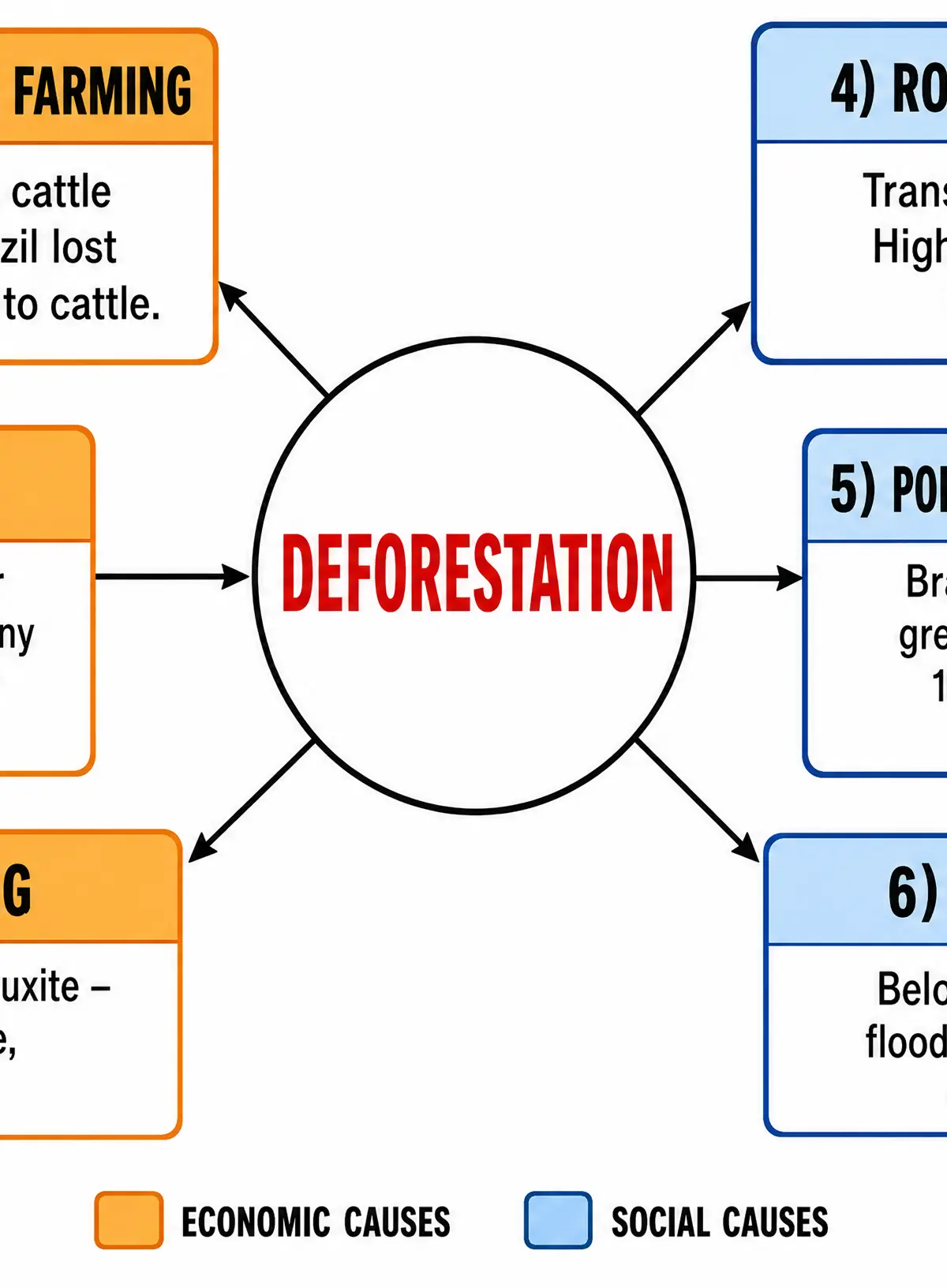
Commercial Farming: The largest driver in the Amazon. Cattle ranching accounts for ~80% of Brazilian deforestation. Soya farming is also expanding rapidly to feed global livestock.
Logging: Both legal and illegal extraction of valuable hardwoods degrades the forest structure.
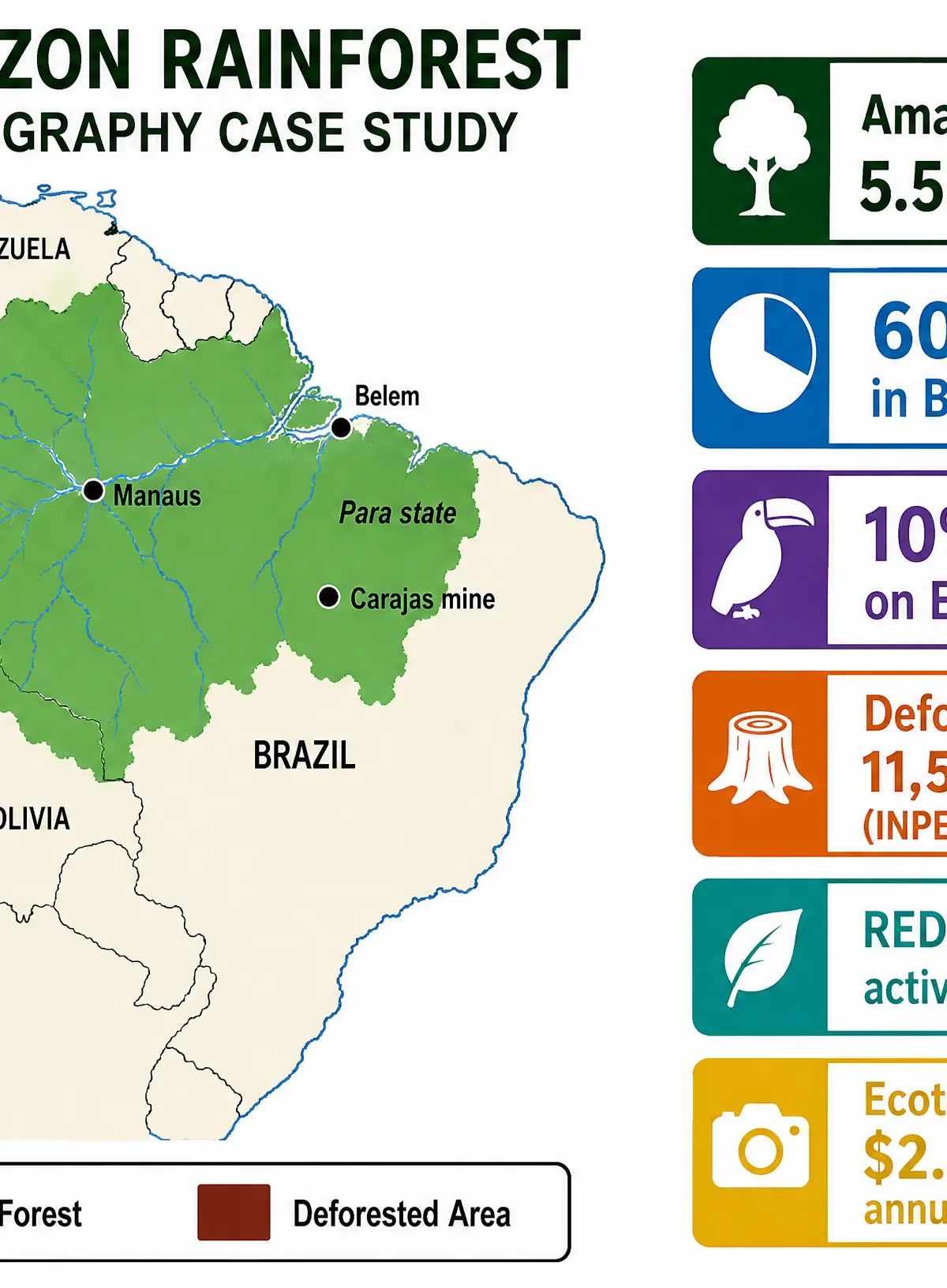
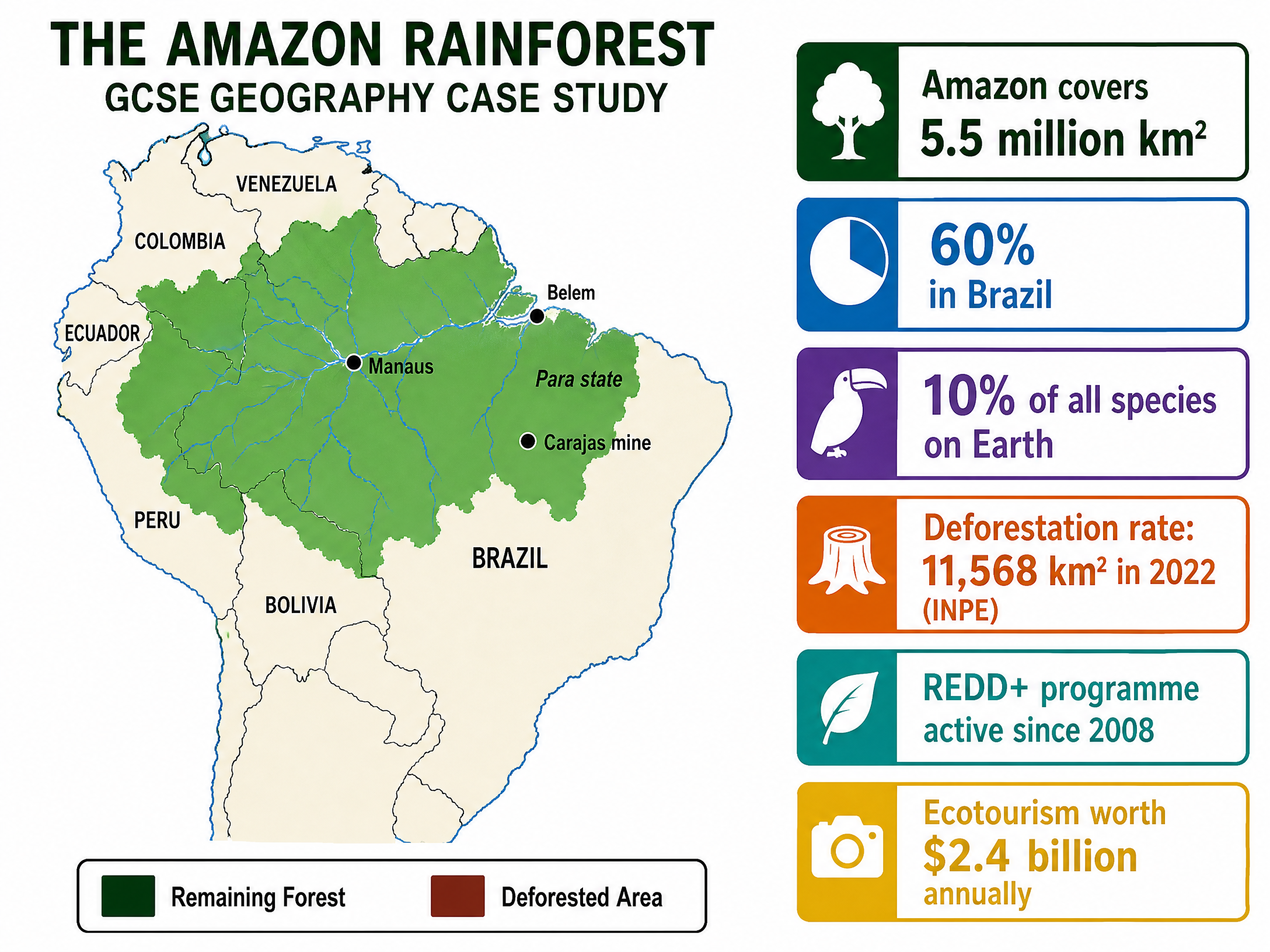
Mining: Extraction of iron ore (e.g., Carajas mine), gold, and bauxite requires clearing forest for the mines, roads, and processing facilities.
Social Causes
Population Pressure: Brazil's population growth (70M in 1960 to 215M in 2023) increases demand for land and resources.
Infrastructure: Projects like the Trans-Amazonian Highway open up previously inaccessible interior regions to settlement and exploitation.
Energy (HEP Dams): Large hydroelectric projects, such as the Belo Monte Dam, flood vast areas of forest and displace indigenous communities.
Sustainable Management: The Amazon Case Study
Sustainable management requires balancing economic development with conservation, using both political and economic tools.
REDD+ (Political/Economic): An international initiative that provides financial incentives to developing countries for reducing emissions from deforestation. It makes the forest economically valuable when left standing.
The Forest Code (Political): Brazilian law requiring Amazonian landowners to maintain 80% of their property as native forest. Success depends heavily on government enforcement.
Protected Areas and Indigenous Reserves (Political/Social): Empowering indigenous groups, such as the Kayapo people in Para state, to manage their traditional lands has proven highly effective at maintaining forest cover compared to unprotected areas.
Ecotourism (Economic): Initiatives like the Mamiraua Sustainable Development Reserve generate income for local communities through wildlife tourism, providing an economic alternative to logging or farming.

Listen to the podcast above for a comprehensive audio review of this topic, complete with a quick-fire recall quiz!
Visual Resources
3 diagrams and illustrations
Interactive Diagrams
1 interactive diagram to visualise key concepts
Conceptual Flow Outline
The Positive Feedback Loop of Deforestation and Climate Change
Worked Examples
3 worked examples — open one to explore the question and available guidance.
Practice Questions
Test your understanding — click to reveal model answers
Explain two economic causes of deforestation in a named tropical rainforest. (4 marks)
Hint: Name the Amazon, then choose two causes that make money (e.g., farming, logging) and explain how they lead to tree clearance.
Evaluate the effectiveness of local and international strategies in managing tropical rainforests sustainably. (9 marks)
Hint: Discuss a local strategy (like ecotourism or indigenous reserves) and an international strategy (like REDD+ or debt-for-nature swaps). Conclude which is more effective or how they must work together.
Describe the structure of a tropical rainforest. (3 marks)
Hint: Think about the different vertical layers from the ground to the sky.
Explain how the nutrient cycle in a tropical rainforest differs from a deciduous forest. (4 marks)
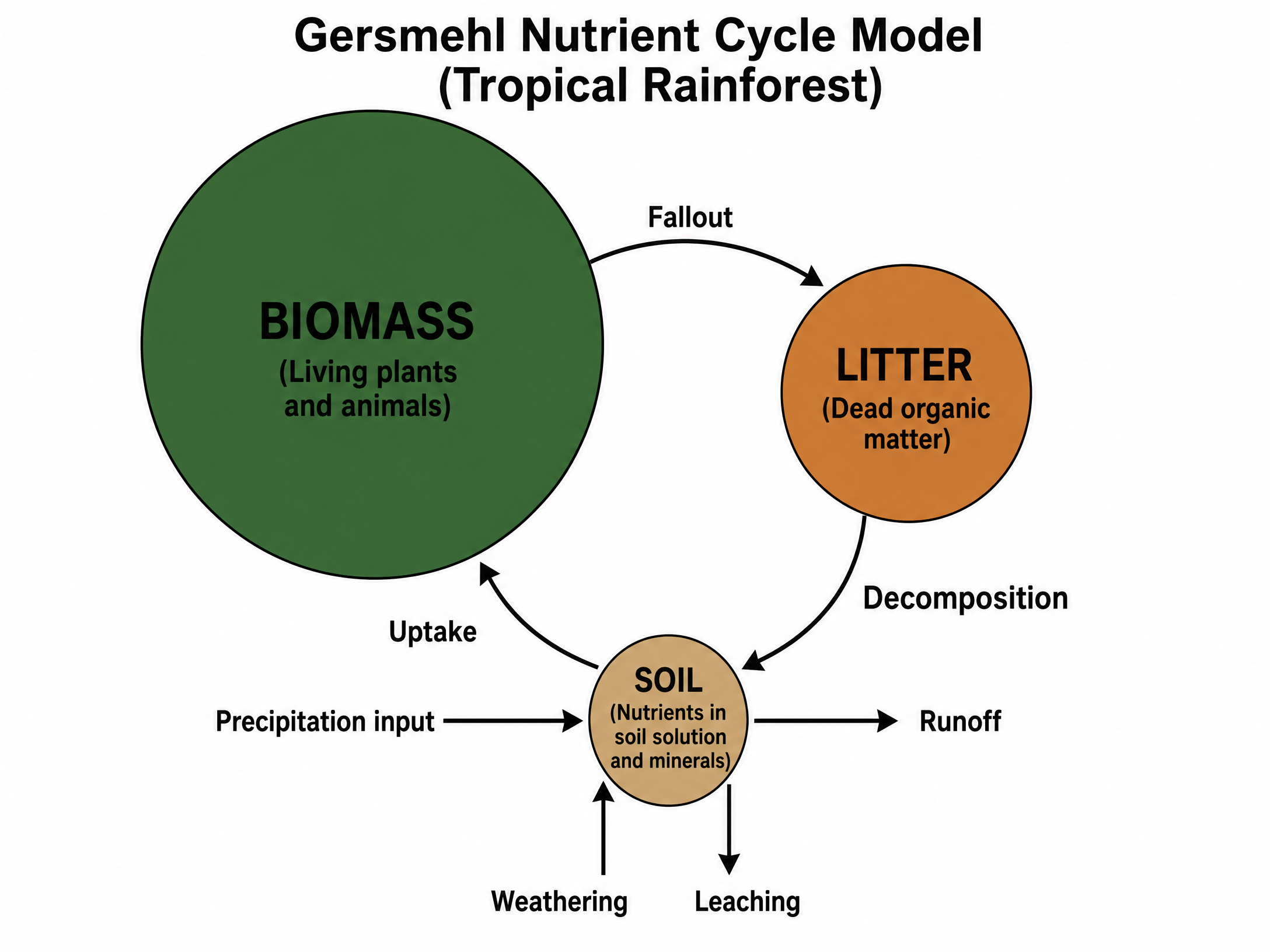
Hint: Use the Gersmehl model stores: Biomass, Litter, Soil. Where are most nutrients kept in the rainforest?
State one good and one service provided by tropical rainforests. (2 marks)
Hint: Good = physical item. Service = ecosystem function.