Pearson Edexcel · GCSE · Geography
Tropical rainforests show a range of distinguishing features
Tropical rainforests are the most biodiverse and productive ecosystems on Earth, yet they are incredibly fragile. Understanding their climate, structure, and nutrient cycling is essential for GCSE Geography, as examiners frequently test the concept of interdependence within this biome.
- 7 min read
- 3 worked examples
- 5 practice questions
- 6 key terms
Study Notes
Overview
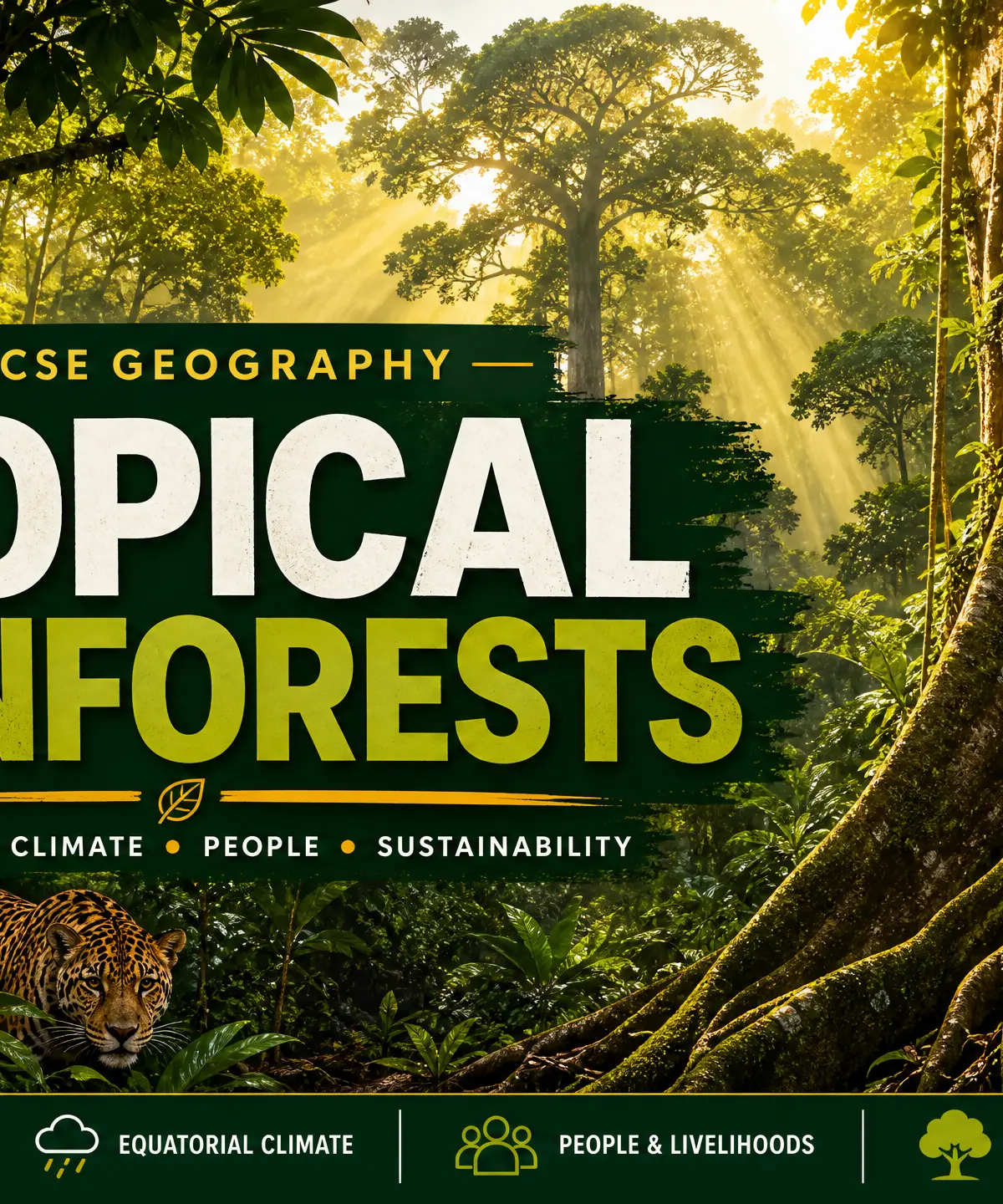
Tropical rainforests are complex, highly productive ecosystems located in a broad belt around the equator, primarily between 5° North and 5° South. They cover just 6% of the Earth's surface but are home to over 50% of the world's plant and animal species. For GCSE Geography, examiners expect candidates to demonstrate a deep understanding of interdependence — how the climate, soils, plants, animals, and human activities are all inextricably linked. You must be able to explain how the hot, wet equatorial climate drives rapid nutrient cycling and creates the conditions for immense biodiversity, while also understanding why this makes the ecosystem so vulnerable to human interference like deforestation.
The Equatorial Climate
Characteristics: The climate is consistently hot and wet throughout the year. There are no distinct seasons.
Specific Knowledge:
- Temperature: High and constant, averaging 26°C to 28°C. The annual temperature range is very small (often less than 2°C).
- Rainfall: Extremely high, typically over 2,000mm per year. It rains almost every afternoon (convectional rainfall).
- Insolation: The sun is directly overhead all year round, providing intense solar radiation.
Why it matters: This climate provides the perfect conditions for continuous plant growth, which in turn supports a massive food web. Examiners frequently ask candidates to link climate data to vegetation characteristics.
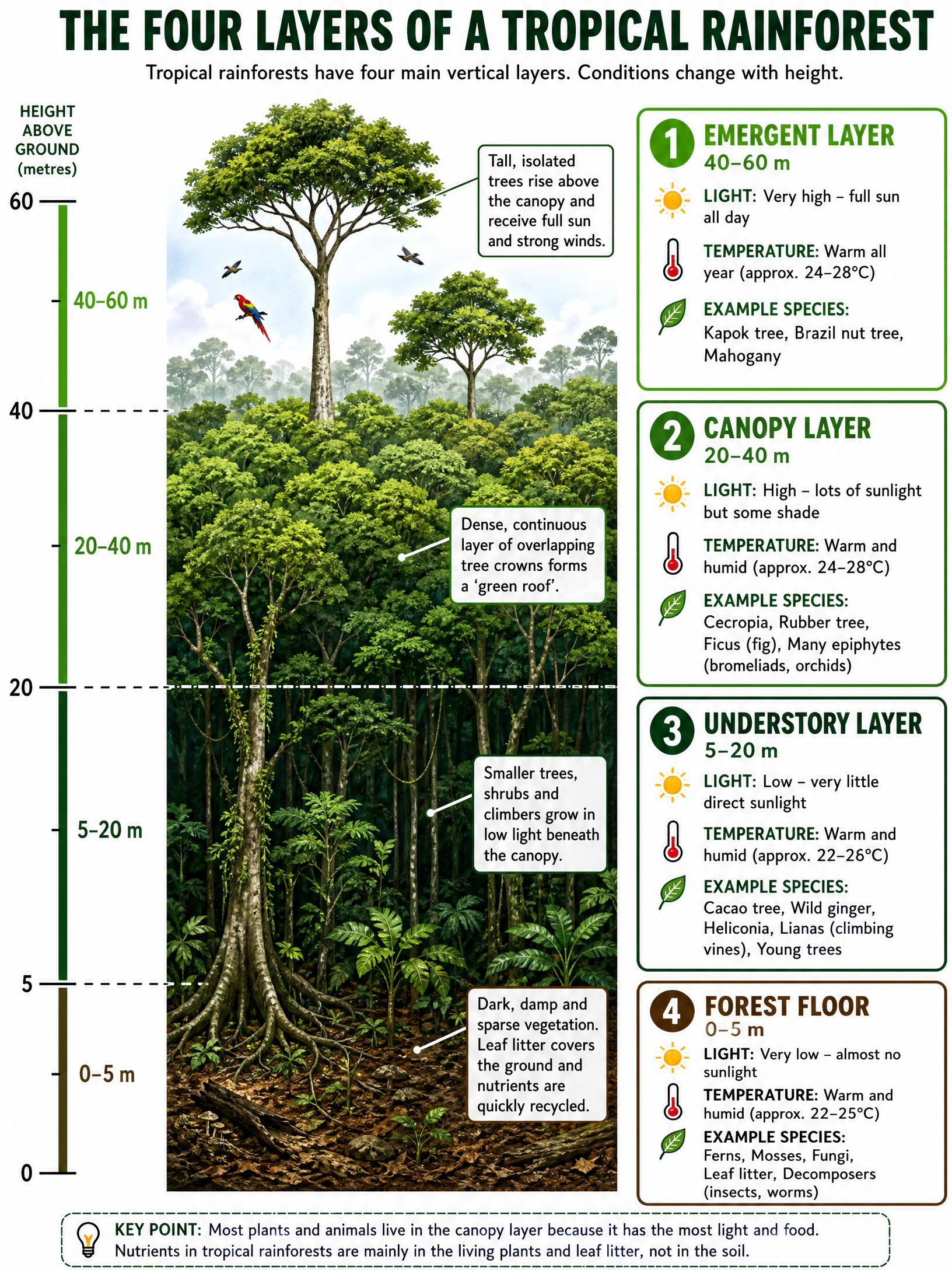
Rainforest Structure (Stratification)
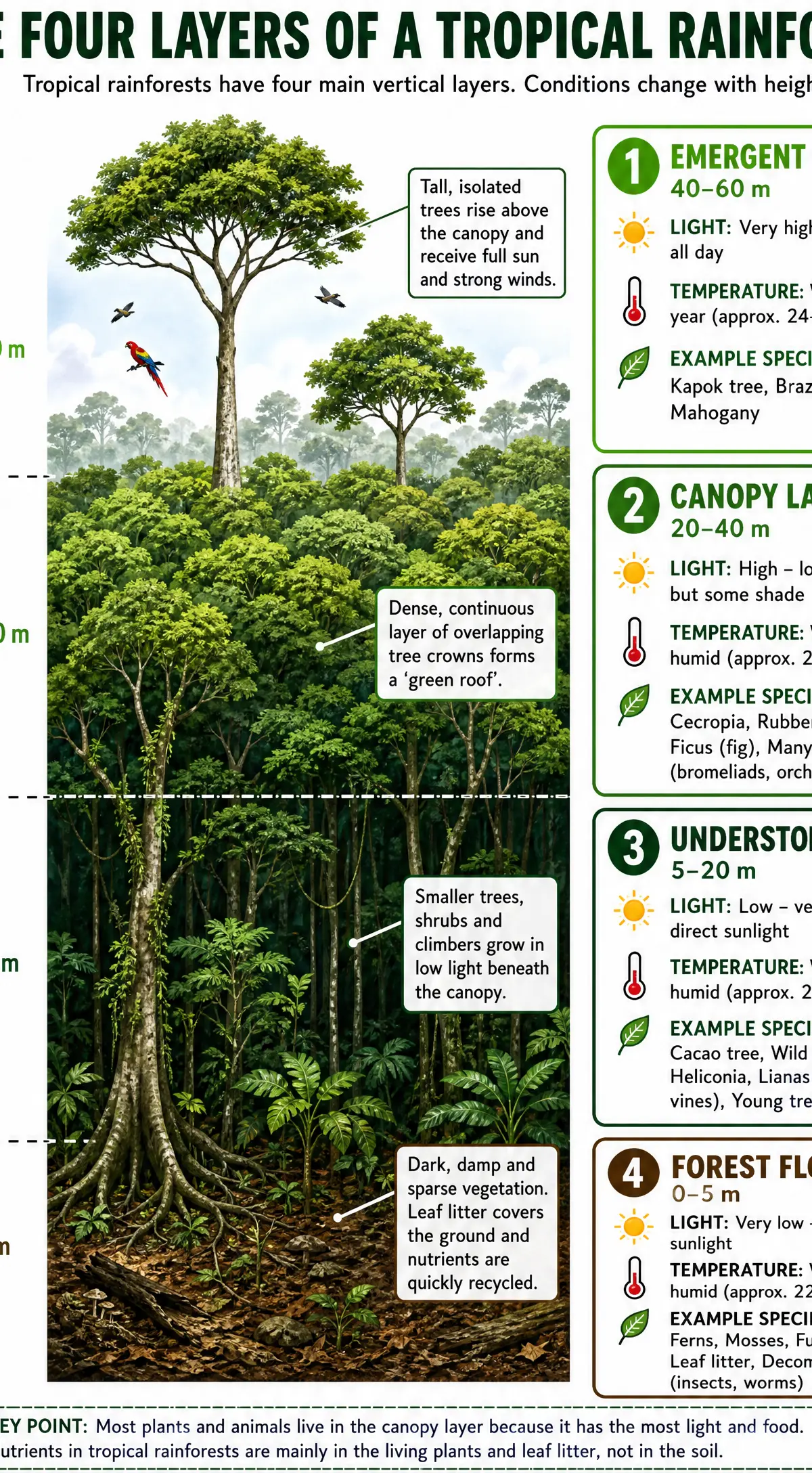
Tropical rainforests have a distinct vertical structure, known as stratification. Plants have adapted to the specific light and moisture conditions at each level.
1. Emergent Layer (40-60m)
Features: The tallest trees poke above the main canopy. They receive full, direct sunlight and must withstand strong winds.
Adaptations: Trees like the Kapok have small leaves to reduce transpiration and thick, waxy cuticles.
2. Canopy Layer (20-40m)
Features: A continuous, dense roof of overlapping leaves and branches. It intercepts about 80% of the sunlight and absorbs the heaviest rainfall.
Significance: This layer contains the highest biodiversity in the forest, providing food and shelter for countless species (e.g., toucans, monkeys).
3. Understory Layer (5-20m)
Features: A dark, humid environment receiving only 2-15% of sunlight.
Adaptations: Plants here (like ferns and young trees) have very large, broad leaves to capture the minimal light available.
4. Forest Floor (0-5m)
Features: Almost completely dark (less than 2% sunlight). It is covered in a layer of dead leaves and organic matter (leaf litter).
Significance: This is where rapid decomposition occurs, driving the nutrient cycle.
The Nutrient Cycle (Gersmehl Model)
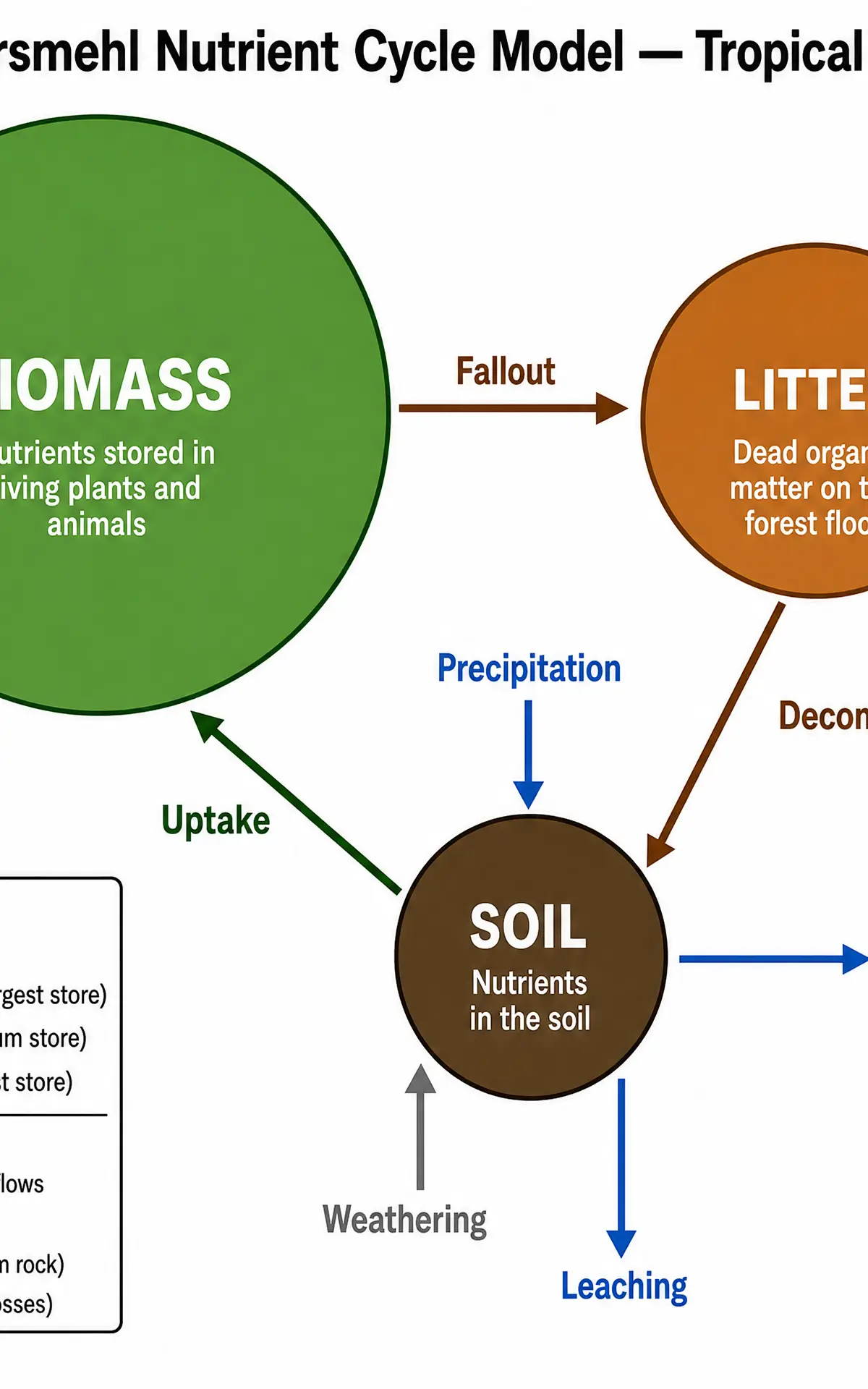
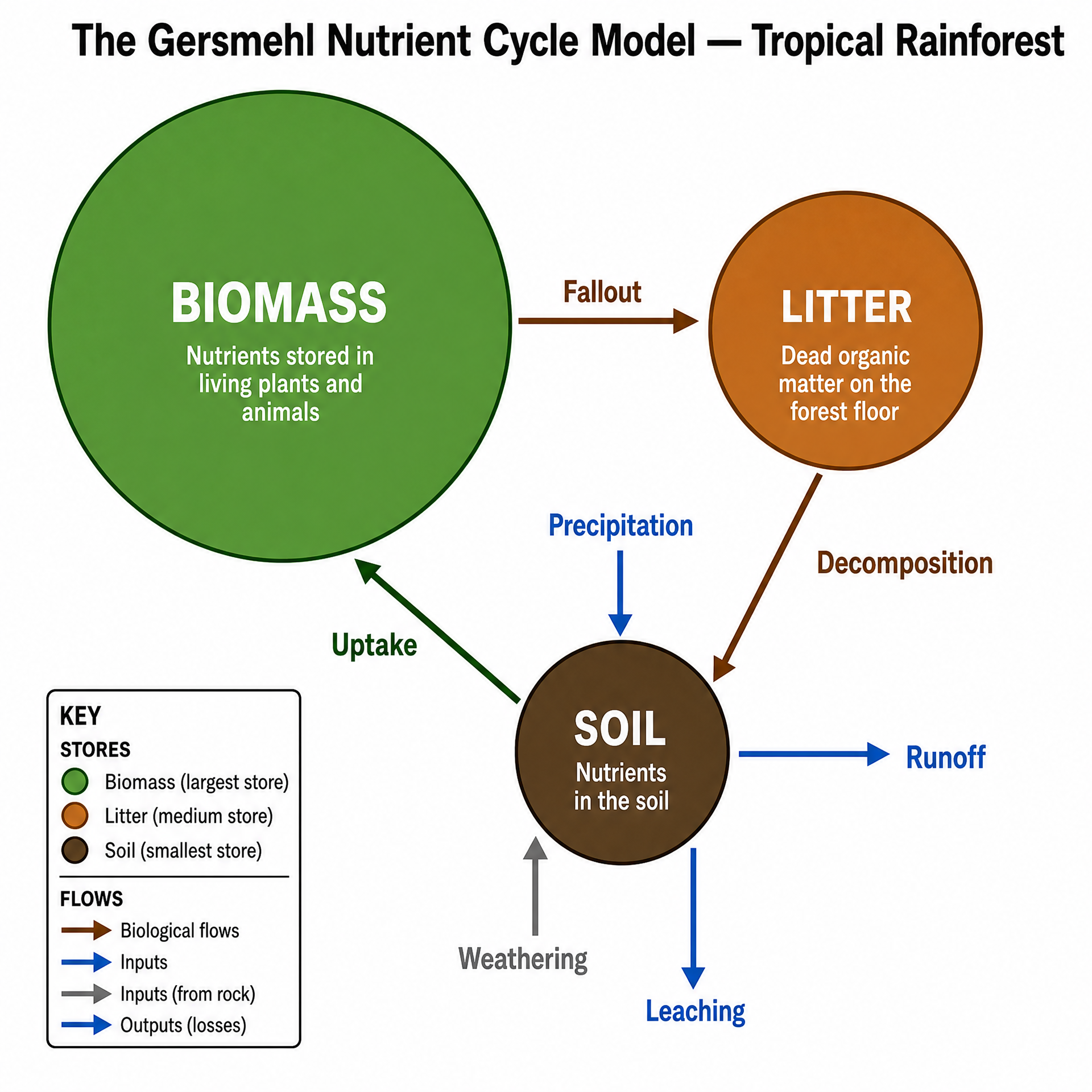
The Gersmehl model illustrates how nutrients move between three stores: Biomass (living things), Litter (dead organic matter), and Soil.
The Three Stores in a Rainforest:
- Biomass: The LARGEST store. The massive amount of vegetation holds most of the ecosystem's nutrients.
- Litter: A MEDIUM store. Leaves fall year-round, but the litter layer remains relatively thin because decomposition is so fast.
- Soil: The SMALLEST store. Rainforest soils (latosols) are surprisingly poor and acidic.
The Flows:
- Decomposition: Extremely rapid due to the hot, humid conditions. Fungi and bacteria break down litter quickly.
- Uptake: Shallow tree roots rapidly absorb nutrients from the soil as soon as they are released by decomposition.
- Leaching: Heavy daily rainfall washes nutrients downward through the soil, out of reach of plant roots. This is why the soil store is so small.
Exam Focus: Examiners love to test the contrast between the lush vegetation and the poor soils. The key is that nutrients are cycled rapidly, not stored in the soil.
Plant and Animal Adaptations
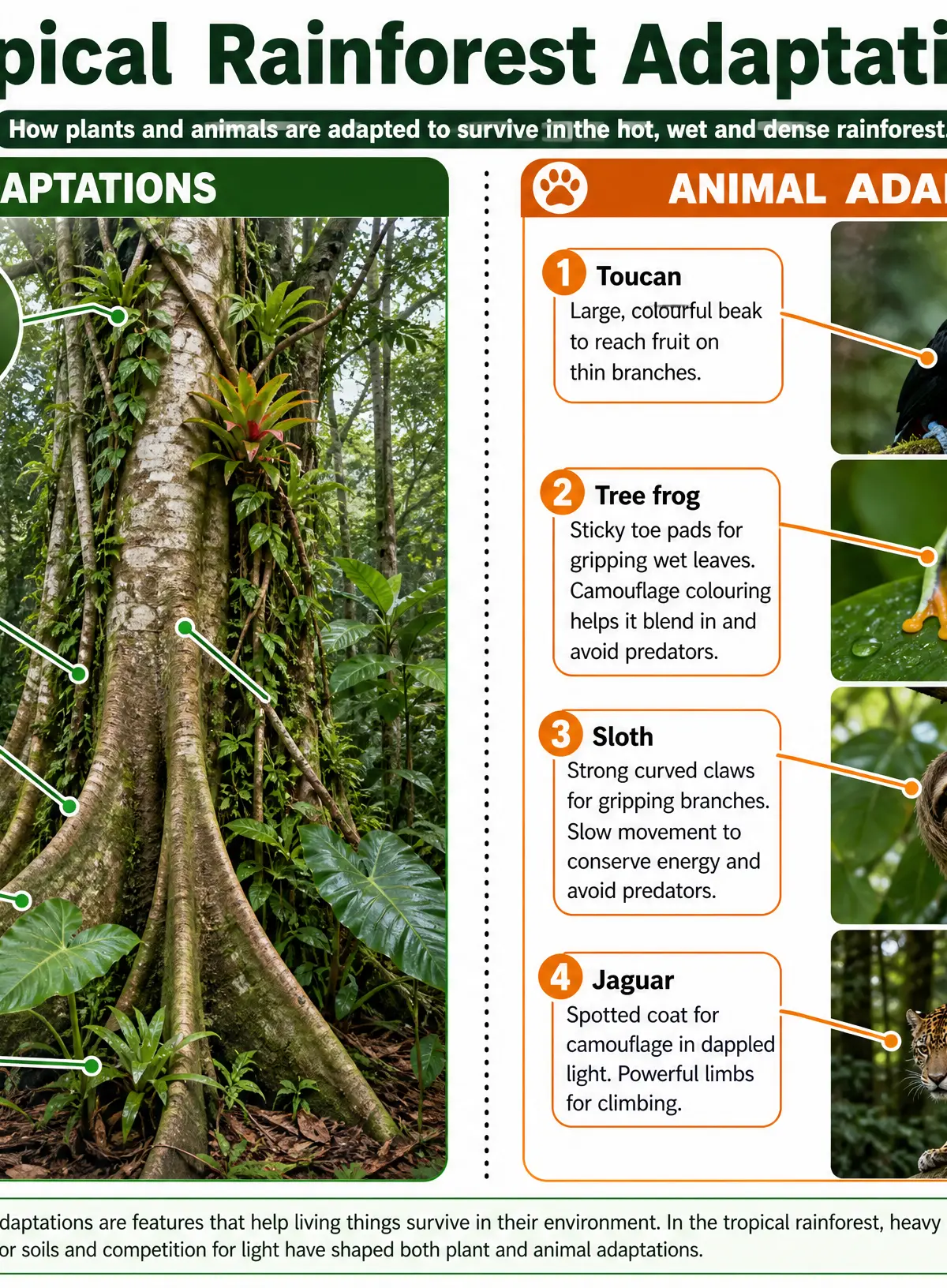
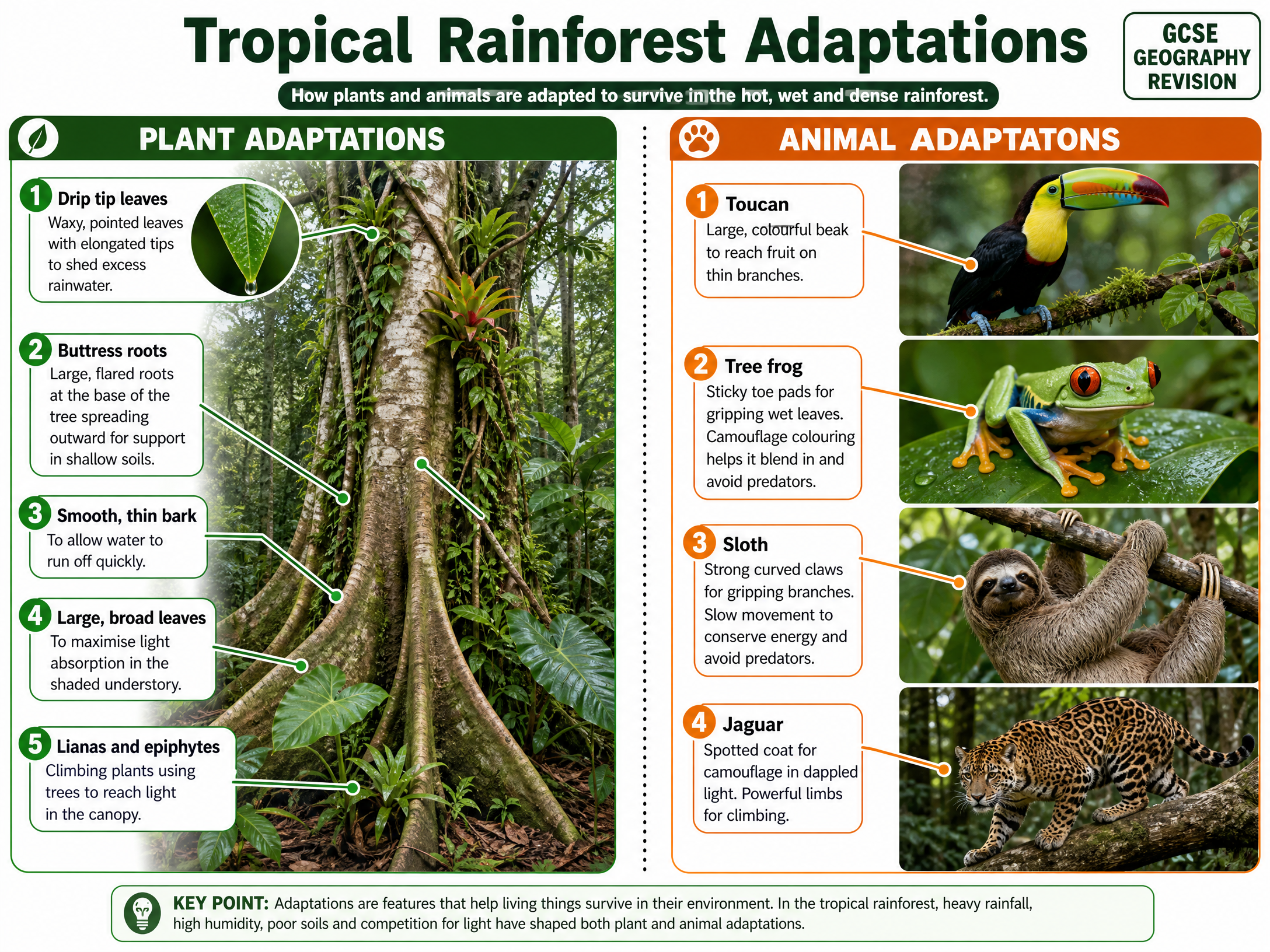
Flora and fauna have evolved specific characteristics to survive the environmental challenges of the rainforest.
Plant Adaptations
- Drip Tips: Leaves have waxy surfaces and pointed tips to allow heavy rain to run off quickly. This prevents the leaf from breaking under the weight of water and stops algae/fungi from growing and blocking sunlight.
- Buttress Roots: Massive, flared roots at the base of tall trees. Because the soil is shallow and nutrients are concentrated at the very top, roots spread wide rather than deep. The buttresses provide vital structural support for trees up to 50m tall.
- Lianas: Woody vines that root in the soil but climb up tree trunks to reach the sunlight in the canopy.
- Epiphytes: Plants (like orchids) that grow entirely on the branches of other trees, absorbing moisture and nutrients from the air and rain, bypassing the poor soil entirely.
Animal Adaptations
- Sloth: Moves incredibly slowly to conserve energy and avoid detection by predators. Algae grows in its fur, providing excellent camouflage against the green canopy.
- Toucan: Has a large, lightweight, colourful beak to reach fruit on thin branches that cannot support its body weight.
- Jaguar: Spotted coat provides camouflage in the dappled light of the forest floor. Powerful limbs allow it to climb trees and swim.
- Tree Frogs: Have sticky suction pads on their toes to grip wet, smooth leaves, and often feature bright warning colours (aposematism) to deter predators.
Interdependence
This is the crucial synoptic concept. A change in one part of the ecosystem affects all others. For example, if trees are removed (deforestation):
- The canopy is lost, so heavy rain hits the soil directly, causing severe soil erosion.
- The biomass store is removed, so the main source of nutrients (leaf fall) stops.
- Without tree roots to bind the soil and take up nutrients, the remaining nutrients are rapidly leached away.
- The soil becomes infertile, making it impossible for the forest to recover, and destroying the habitat for animals.
Audio Revision
Listen to our comprehensive 10-minute podcast covering all these topics, complete with examiner tips and a quick-fire quiz!

Visual Resources
3 diagrams and illustrations
Interactive Diagrams
1 interactive diagram to visualise key concepts
Conceptual Flow Outline
Flowchart showing the interdependence of climate, vegetation, and soils in the rainforest.
Worked Examples
3 worked examples — open one to explore the question and available guidance.
Practice Questions
Test your understanding — click to reveal model answers
Describe the climate of a tropical rainforest. (3 marks)
Hint: Mention temperature, rainfall, and seasonal variation.
Explain how one animal is adapted to survive in the tropical rainforest. (3 marks)
Hint: Name the animal, state the physical adaptation, and explain how it helps it survive.
Explain the interdependence of climate, soils, and vegetation in a tropical rainforest. (6 marks)
Hint: Use the Gersmehl model concepts. How does the climate affect the soil? How does the vegetation rely on the climate?
State two features of the emergent layer of a tropical rainforest. (2 marks)
Hint: Think about height and light.
Explain why deforestation in tropical rainforests has a severe impact on the nutrient cycle. (4 marks)
Hint: Think about which store is removed and what happens to the soil when exposed to rain.