Pearson Edexcel · GCSE · Geography
Urbanisation is a global process
Urbanisation is transforming our planet, with over half the global population now living in cities. This study guide breaks down the contrasting trends between developed, emerging, and developing countries, equipping you with the specific knowledge and case studies examiners reward.
- 6 min read
- 3 worked examples
- 5 practice questions
- 6 key terms
Study Notes
Overview
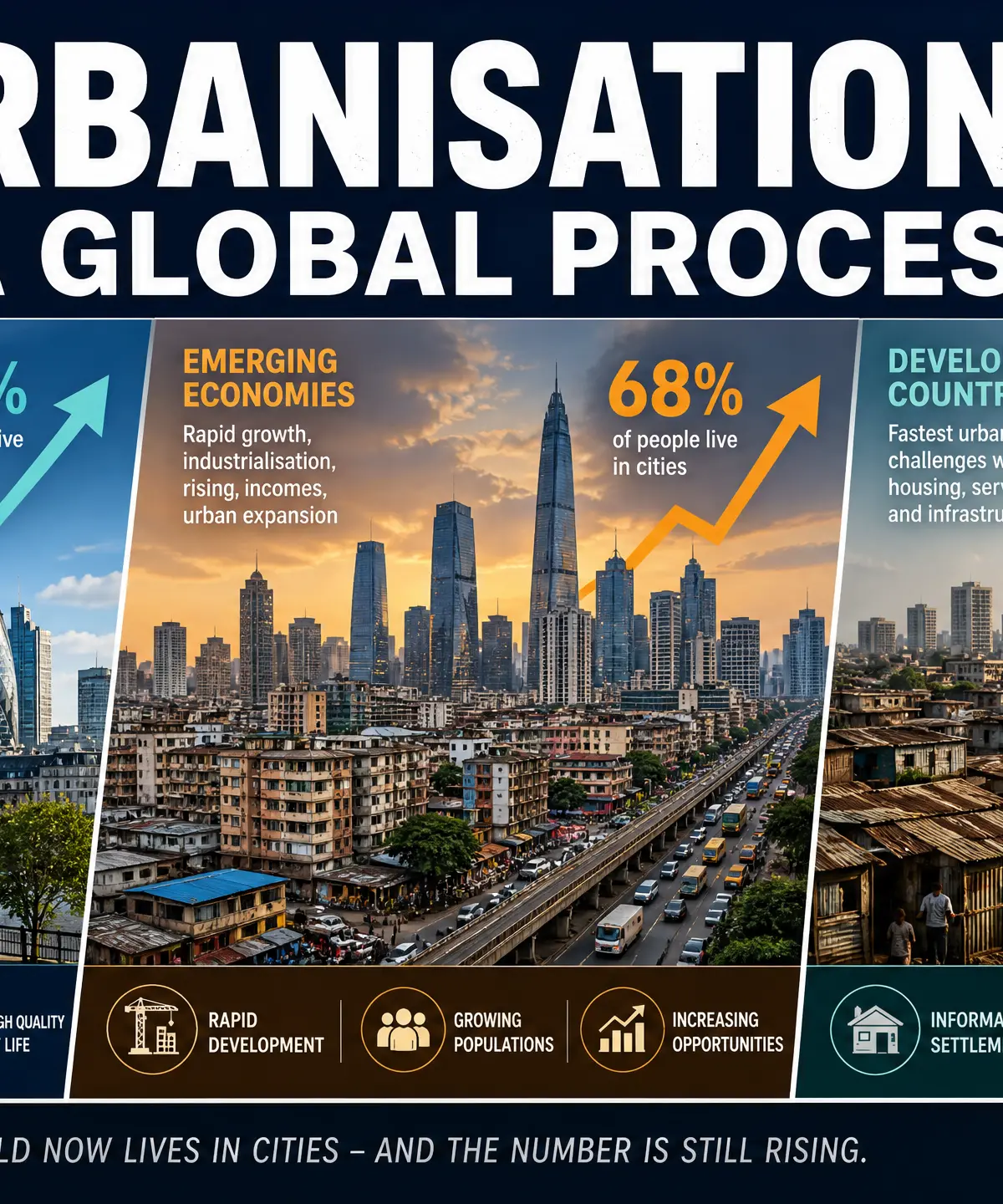
Urbanisation is the process by which an increasing proportion of a country's population comes to live in towns and cities. It is one of the most significant global processes of our time. In 1950, only 30% of the world's population was urban; today, it is over 55%, and by 2050, it is projected to reach 68%. For GCSE Geography candidates, mastering this topic means understanding that urbanisation does not happen at the same time or the same rate everywhere. Examiners expect you to clearly distinguish between the historical, slow urbanisation of developed countries and the rapid, ongoing urbanisation of emerging and developing countries today. You must be able to deploy specific case studies, accurately use terminology like 'push and pull factors', and interpret data showing these contrasting trends.
Audio Revision: The Urbanisation Podcast
Listen to this 10-minute revision podcast covering all the key concepts, case studies, and exam tips for this topic, including a quick-fire recall quiz.

Contrasting Trends in Urbanisation
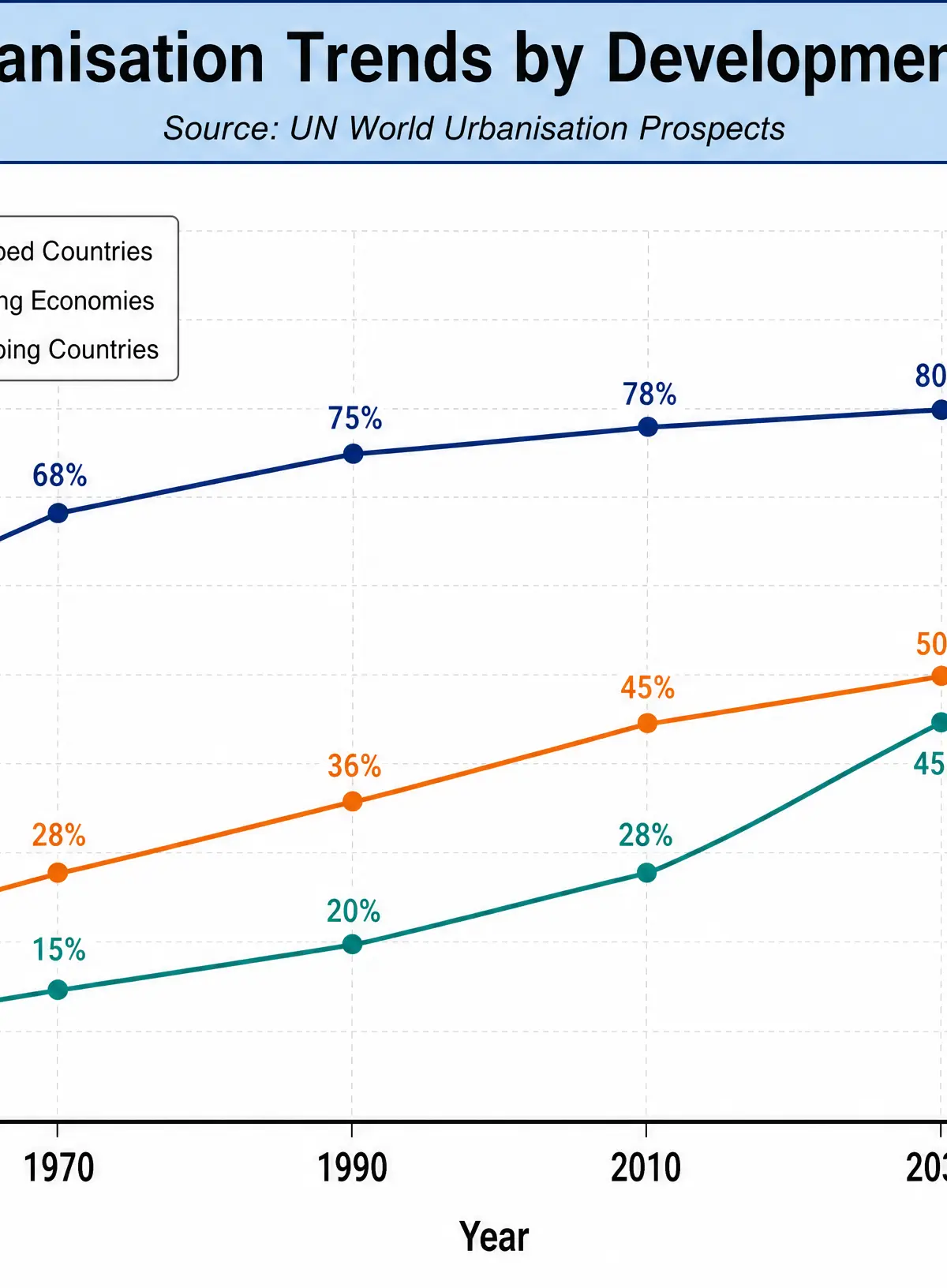
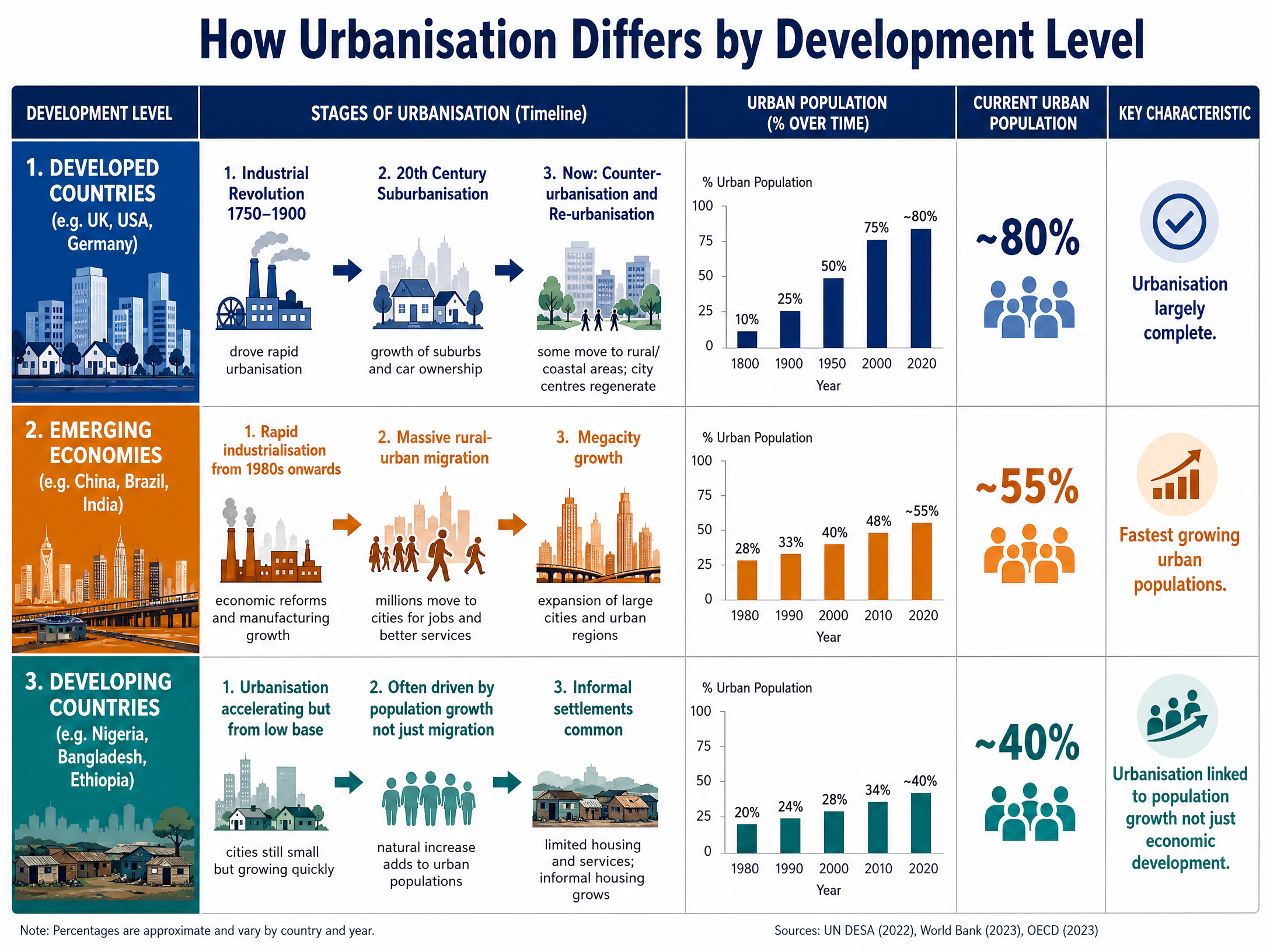
Developed Countries (e.g., UK, USA, Germany)
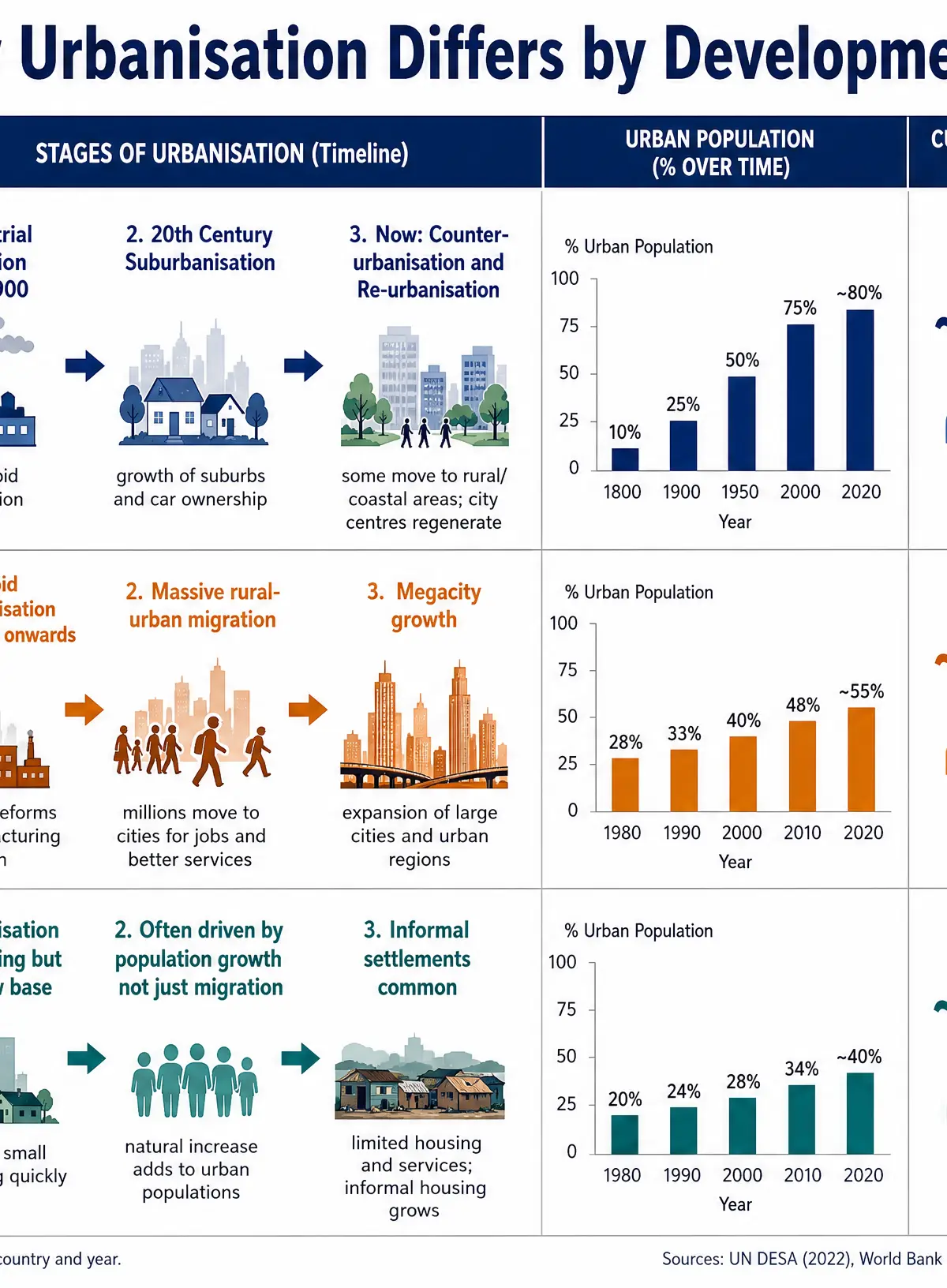
Timing: Early urbanisation, beginning in the 18th and 19th centuries.
Key Drivers: The Industrial Revolution. The mechanisation of agriculture pushed workers off the land, while the growth of factories in cities like Manchester and Birmingham pulled them in.
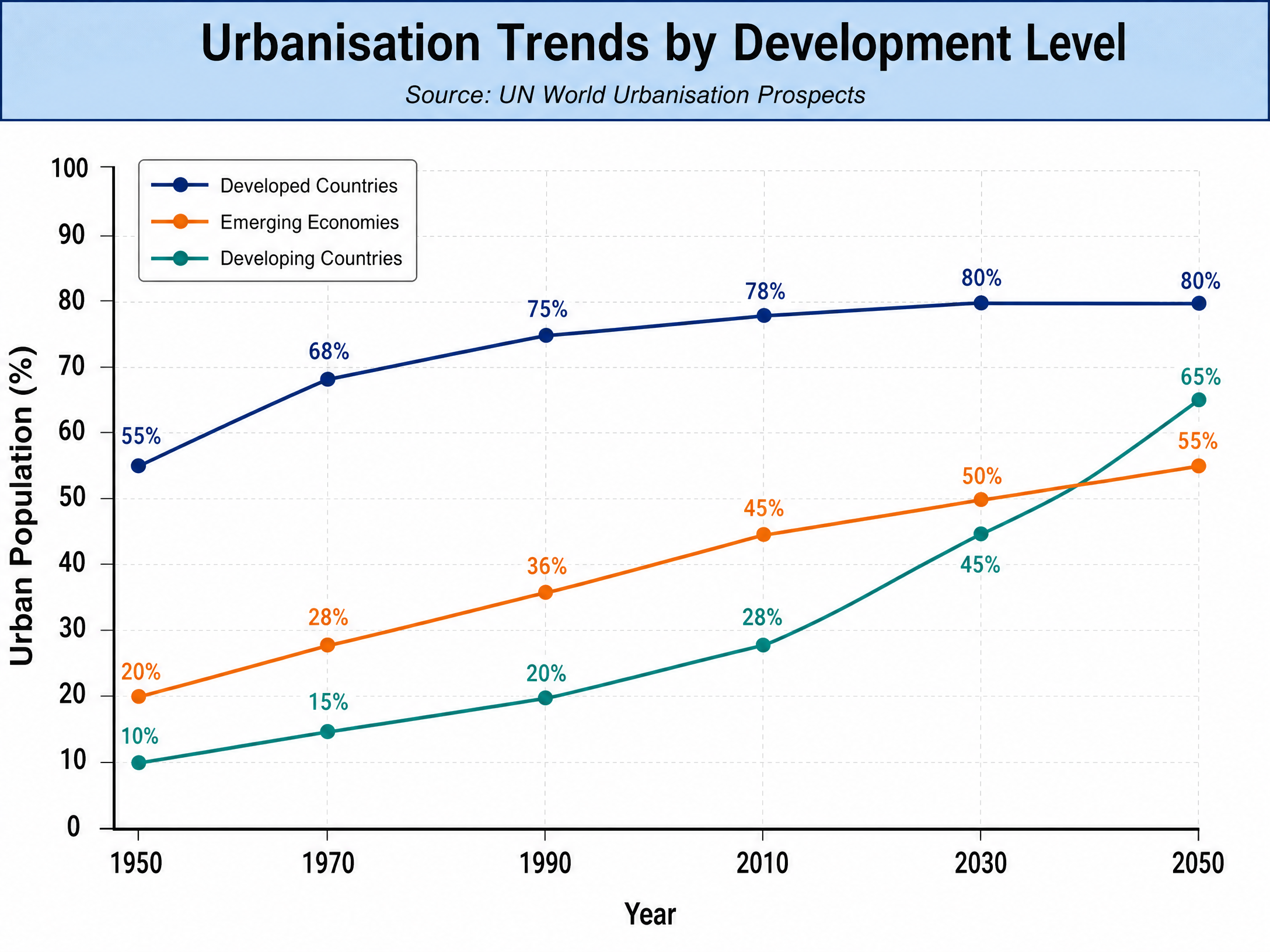
Current Status: Highly urbanised (typically 75-85%). The rate of urbanisation has now slowed down dramatically. In fact, many developed countries are experiencing counter-urbanisation (people moving out of cities to rural areas) and re-urbanisation (regeneration of city centres attracting people back).
Exam Relevance: Use these countries as your baseline for comparison. Examiners will reward candidates who recognise that urbanisation here is largely complete.
Emerging Economies (e.g., China, Brazil, India)
Timing: Rapid urbanisation began in the late 20th century and continues today.
Key Drivers: Massive industrialisation and economic reform. In China, the shift towards a manufacturing-based economy since the 1980s has driven hundreds of millions from rural areas to cities like Shenzhen and Shanghai.
Current Status: Rapidly urbanising, typically between 50% and 85% urban. Brazil is highly urbanised (87%), while India is lower (35%) but growing fast.
Exam Relevance: These countries provide your most dramatic case studies of rapid urban growth, megacity formation, and the associated challenges like informal settlements (e.g., favelas in São Paulo).
Developing Countries (e.g., Ethiopia, Bangladesh, Nigeria)
Timing: Urbanisation is accelerating now but starting from a low base.
Key Drivers: A combination of rural-urban migration (driven by extreme rural poverty and lack of opportunity) and high rates of natural increase (high birth rates and falling death rates) within the cities themselves.
Current Status: Lower levels of urbanisation (typically 20-40%), but experiencing the fastest rates of urban growth globally.
Exam Relevance: Examiners look for an understanding that urban growth here is often driven as much by natural increase as by migration, and that it often outpaces economic development, leading to severe housing and infrastructure shortages.
Reasons for Variations: Push and Pull Factors
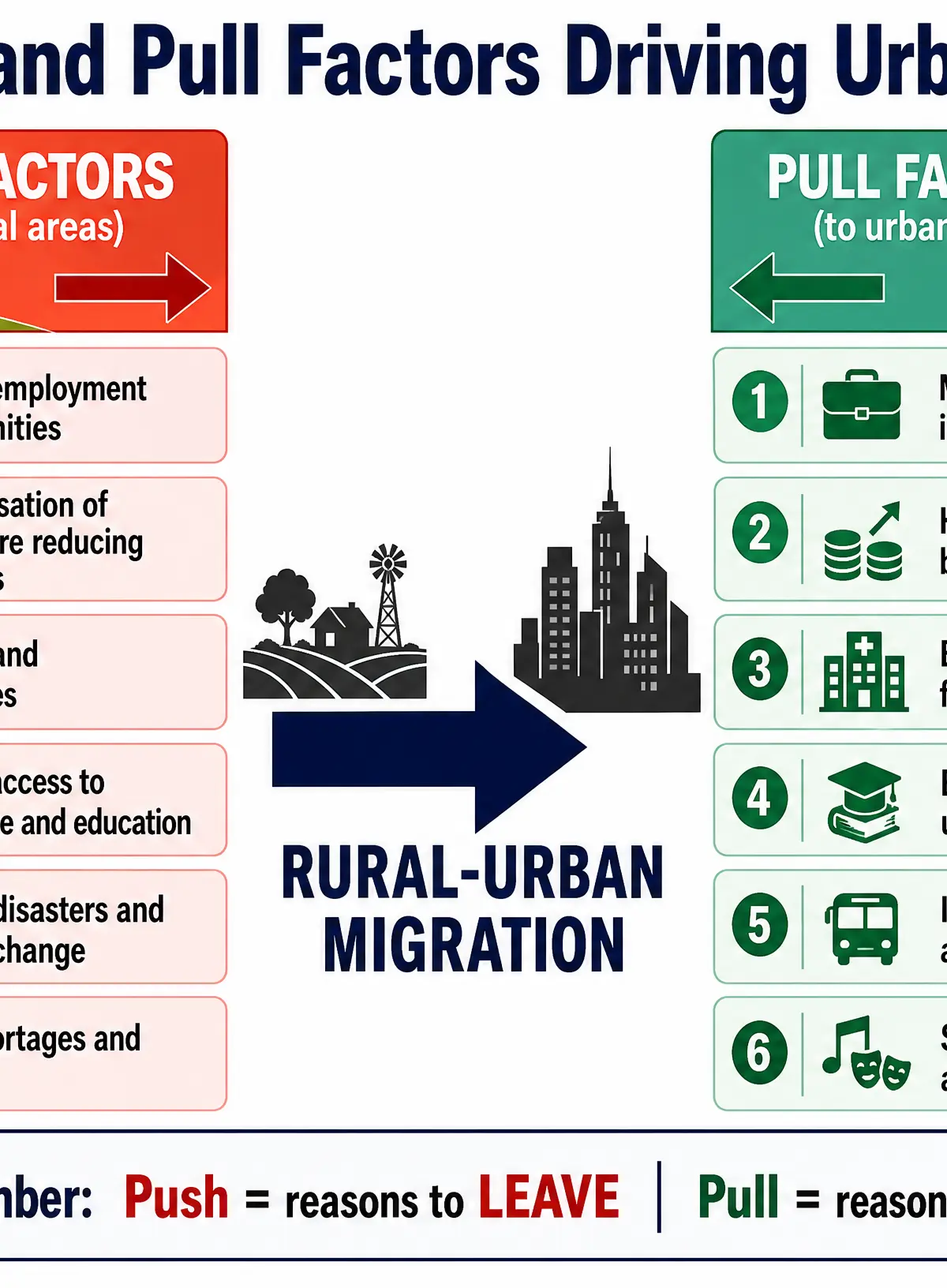
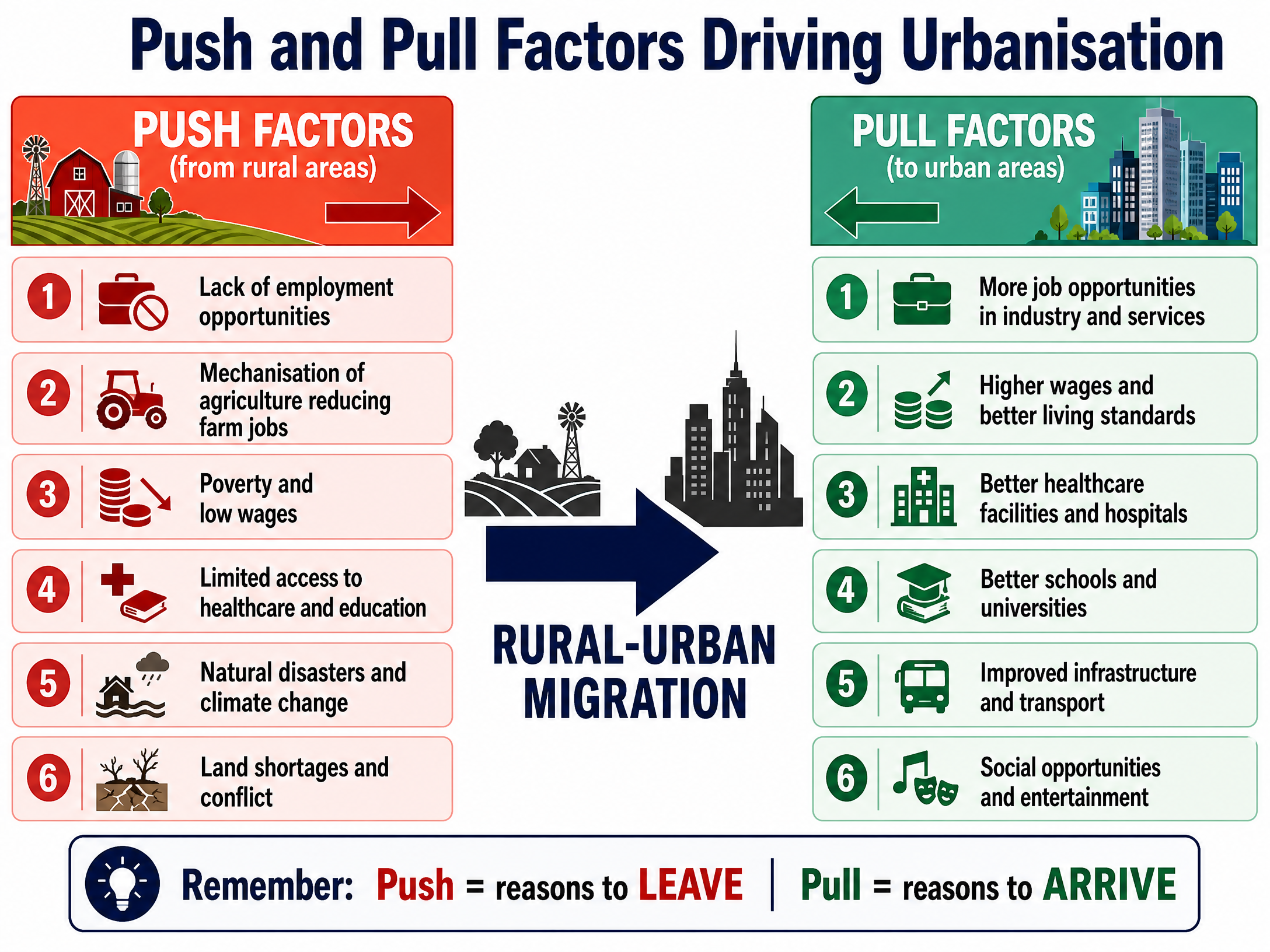
Rural-urban migration is driven by a combination of push factors (negative aspects of rural life) and pull factors (positive aspects of urban life).
Push Factors (Reasons to leave rural areas)
- Mechanisation of agriculture: Fewer jobs available in farming.
- Poverty and low wages: Subsistence farming provides little income.
- Lack of services: Poor access to healthcare, education, and clean water.
- Environmental challenges: Droughts, floods, or soil erosion (e.g., desertification in the Sahel region of Africa).
Pull Factors (Reasons to move to cities)
- Employment opportunities: Better-paid jobs in manufacturing and services.
- Better services: Access to hospitals, schools, and universities.
- Improved infrastructure: Reliable electricity, water, and transport networks.
- Perception of a better life: Often fueled by media and communication with relatives already in the city.
Effects of Urbanisation Globally
Positive Effects
- Economic growth: Cities generate the vast majority of global GDP.
- Improved living standards: Generally better access to education and healthcare compared to rural areas.
- Technological innovation: Concentration of people and capital drives development.
Negative Effects
- Informal settlements: Rapid growth outpaces housing supply, leading to slums, shanty towns, and favelas.
- Environmental degradation: Increased air and water pollution, waste generation, and loss of green space.
- Pressure on infrastructure: Traffic congestion, inadequate sanitation, and strained power grids.
Key Geographical Skills
For this topic, you must be comfortable interpreting line graphs showing urbanisation trends over time, calculating percentage changes, and comparing data between different country classifications.
Visual Resources
3 diagrams and illustrations
Interactive Diagrams
1 interactive diagram to visualise key concepts
Conceptual Flow Outline
Flowchart showing the causes and consequences of rapid urban growth in developing countries.
Worked Examples
3 worked examples — open one to explore the question and available guidance.
Practice Questions
Test your understanding — click to reveal model answers
State the meaning of the term 'urbanisation'. (1 mark)
Hint: Remember to use the word 'proportion' or 'percentage'.
Explain how natural increase contributes to urban growth in developing countries. (3 marks)
Hint: Define natural increase and explain why it happens specifically in cities.
Outline one push factor and one pull factor that lead to rural-urban migration. (2 marks)
Hint: Make sure you clearly identify which is which.
Explain why the rate of urbanisation in developed countries is now very slow. (4 marks)
Hint: Think about historical timing and current trends like counter-urbanisation.
Assess the challenges caused by rapid urbanisation in emerging economies. (9 marks)
Hint: Cover social, economic, and environmental challenges, use a named example, and evaluate which challenge is most significant.