OCR · GCSE · History
Course version: J410 · Version from Mar 2026
Form and Function c.1000–1750 (J410/12 and J410/13) - Life in Kenilworth…
Full specification wording
Castles: Form and Function c.1000–1750 (J410/12 and J410/13) - Life in Kenilworth Castle at different times in its history: The people who made the castle function e.g. blacksmiths, cooks etc.
This topic asks you to understand the workers whose labour kept Kenilworth Castle running.
Checked against the OCR J410 specification (opens in a new tab) on .
- Point 2 of 3
- 4 key terms
Study notes
From the checked teaching notes for this specification point.
The idea
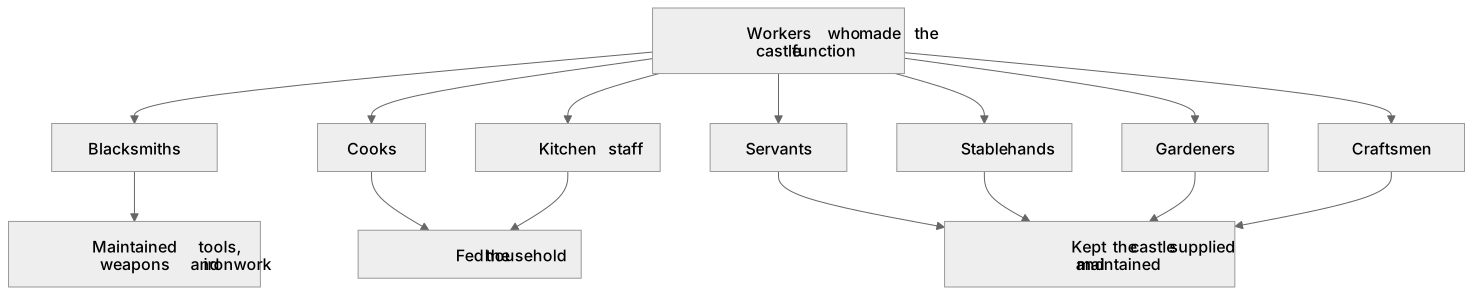
This topic asks you to understand the workers whose labour kept Kenilworth Castle running. Beyond the owners, many people made daily life possible: blacksmiths maintained tools, weapons and ironwork; cooks and kitchen staff fed the household; and others such as servants, stable hands, gardeners and craftsmen kept the castle supplied and maintained. For each role, think about what the person did, where they worked and how their work supported the owner's household. A strong answer names a specific role, describes the task that person performed, and explains how that task helped the castle function across the c.1000–1750 period.
What earns the marks
- Names a specific worker such as a blacksmith or cook and states the task they performed.
- Explains how that worker's task helped the castle and its household function.
- Links a worker's role to a place or activity in the castle, such as the kitchens or the forge.
- Recognises that many different workers, not just the owners, were needed to run the castle.
Common mistakes and how to put them right
Focuses only on the owners and forgets the workers.
Put it right: Name a specific role such as a cook or blacksmith.
Describes a worker's job without saying how it helped the castle function.
Put it right: Add the purpose of the task.
Assumes all workers did the same job.
Put it right: Distinguish between roles such as kitchen staff and smiths.
Exam tips
- Learn two or three named roles and the task each performed so you can pick the correct option.
- Link each worker to the part of the castle where they worked, such as the kitchens or forge.
- Eliminate options that describe the owner's lifestyle rather than the work that kept the castle running.
Try the lesson
The start of the Castles: Form and Function c.1000–1750 (J410/12 and J410/13) - Life in Kenilworth Castle at different times in its history: The people who made the castle function e.g. blacksmiths, cooks etc. lesson, made from checked teaching notes for this specification point.
Have a go first
Which of these people would have been responsible for making and repairing metal objects such as horseshoes and tools at Kenilworth Castle?
Listen
This topic asks you to understand the workers whose labour kept Kenilworth Castle running. Beyond the owners, many people made daily life possible: blacksmiths maintained tools, weapons and ironwork; cooks and kitchen staff fed the household; and others such as servants, stable hands, gardeners and craftsmen kept the castle supplied and maintained. For each role, think about what the person did, where they worked and how their work supported the owner's household. A strong answer names a specific role, describes the task that person performed, and explains how that task helped the castle function across the c.1000–1750 period. A strong answer earns marks for these points. Names a specific worker such as a blacksmith or cook and states the task they performed. Explains how that worker's task helped the castle and its household function. Links a worker's role to a place or activity in the castle, such as the kitchens or the forge. Recognises that many different workers, not just the owners, were needed to run the castle. Exam tip: Learn two or three named roles and the task each performed so you can pick the correct option.
See it
Key words
Say what each word means before you turn the card.
blacksmiths
Try answering aloud or in your head before turning the card.
cooks
Try answering aloud or in your head before turning the card.
servants
Try answering aloud or in your head before turning the card.
owner's household
Try answering aloud or in your head before turning the card.
See every definition
- blacksmiths
- Workers who maintained tools, weapons and ironwork so that the castle functioned.
- cooks
- Kitchen staff who fed the household so that the castle functioned.
- servants
- Workers who kept the castle supplied and maintained alongside stable hands, gardeners and craftsmen.
- owner's household
- The household that workers such as cooks and kitchen staff fed and that other workers supported.
Label the diagram
Some boxes have lost their names. Pick the right name for each number.
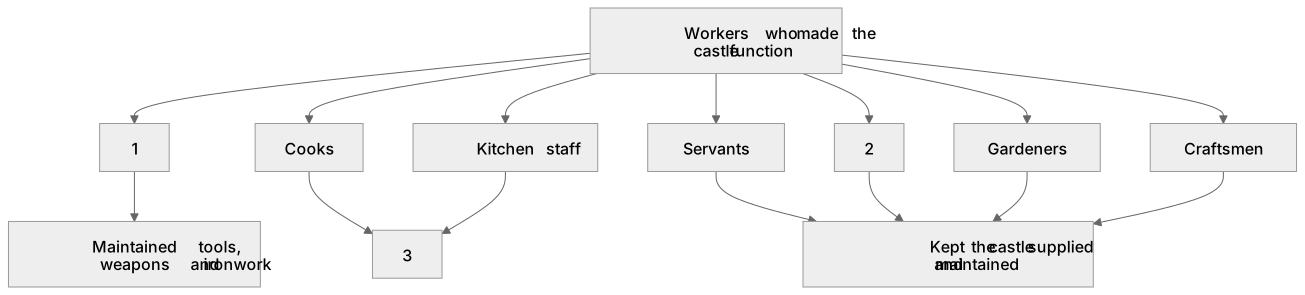
1Box 1
2Box 2
3Box 3
There is more to this lesson
The full lesson goes on to check your understanding and help you earn the marks. Create a free account to carry on, with your progress saved.
A week of Premium from your first lesson · Then the free plan continues · No card, no charge
Test your understanding of Castles: Form and Function c.1000–1750 (J410/12 and J410/13) - Life in Kenilworth Castle at different times in its history: The people who made the castle function e.g. blacksmiths, cooks etc.
Active recall beats re-reading. Take an instant quiz now to test what you’ve learned and lock it into long-term memory.
A week of Premium from your first lesson · Then the free plan continues · No card, no charge